Defining optimal drill-hole spacing: A novel integrated analysis from exploration to ore control
Abstract
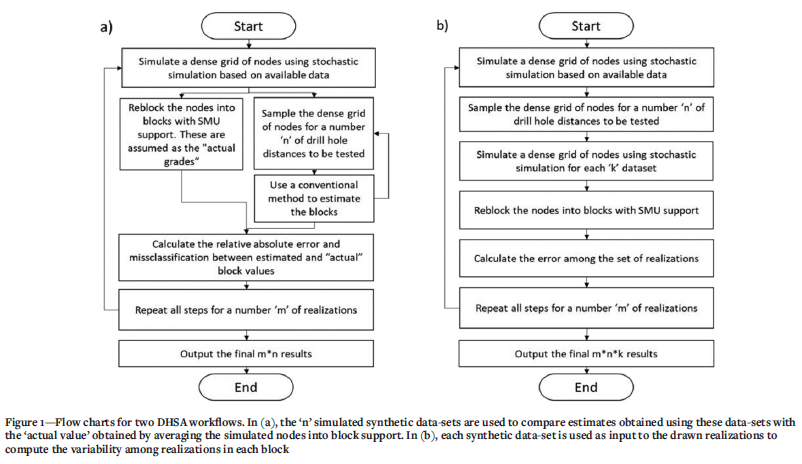
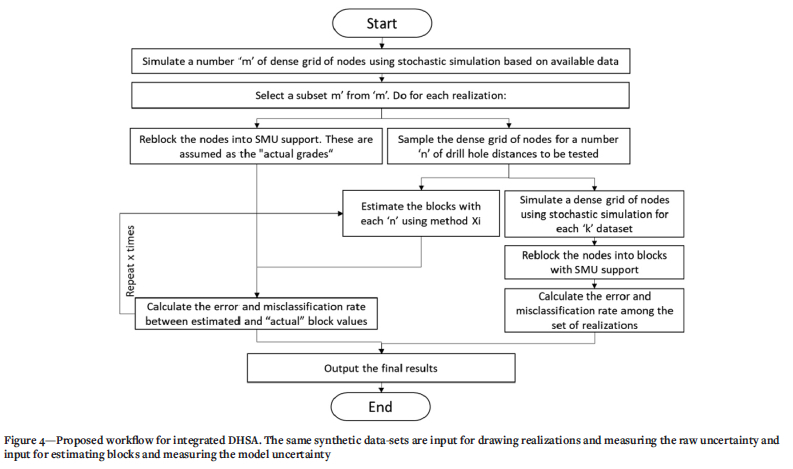
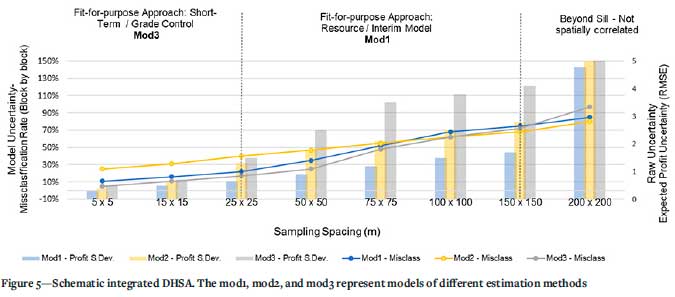
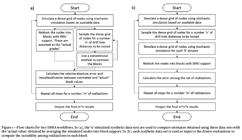
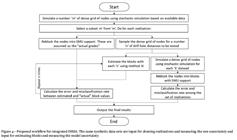
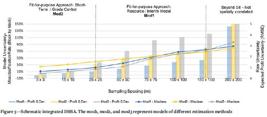
Drill-hole spacing analysis (DHSA) and optimization are becoming commonplace for uncertainty assessment and management in the mining industry. However, there is no standardized DHSA workflow, and the outputs of certain methodologies are not interchangeable. We group available simulation-based DHSA methods according to their accounted uncertainty into (i) raw uncertainty, assessed by drawing realizations from synthetic data-sets with the drilling spacings to be tested; and (ii) model uncertainty, in which these synthetic data-sets are used to assess the variation between the estimated model and the (unknown) actual value. DHSA workflows available in the literature ignore the differences between both types of uncertainty. Commonly, the DHSA algorithm is chosen without a detailed analysis of its uncertainty output, which may lead to misleading results and suboptimal decisions. While available solutions are based only on assessing raw or model uncertainty, the proposed approach simultaneously analyses both and their relationship for models at different stages of the mine. The integrated analysis results deliver more information to support decision-making than available methods. Principles, practical considerations, and discussions of the advantages of the proposed integrated analysis are presented. The approach is applied to a real gold deposit to illustrate its use.
drill-hole spacing analysis; conditional simulation; ordinary kriging; uniform conditioning; estimation error
 Thumbnail
 Thumbnail
 Thumbnail
 Thumbnail
 Thumbnail
 Thumbnail
 Thumbnail