A comprehensive evaluation of non-explosive rock fragmentation techniques with a focus on the potential of soundless chemical demolition agents in the surface mining of gemstone in Zambia
Abstract
Rock fragmentation methods in open pit gemstone mining have developed to give priority to safety, environmental sustainability, and crystal integrity. Though effective, traditional drill-and-blast techniques can generate vibrations, adverse emissions, and structural damage, all of which could be detrimental in fragile geological settings. Costs, application in hard rocks, and operational inefficiency remain issues, despite the fact that mechanical excavation and evolving thermal and hydraulic technologies have provided some solutions. In response, there has been a growing interest in non-explosive alternatives, particularly soundless chemical demolition agents. This paper provides a comprehensive evaluation of non-blasting rock fragmentation techniques with an emphasis on the efficiency, economic considerations, and operational constraints of soundless chemical demolition agents SCDAs in gemstone mining. Soundless chemical demolition agents technology has shown promising results in preserving gem purity and reducing environmental impact, despite ongoing challenges. These include increased reaction times that hinder output, decreased performance in saturated or high-stress environments, and temperature sensitivity. The contextual relevance of soundless chemical demolition agent application in lateritic regions, such as Zambia, is discussed based on published studies and reported operational experience. Developments in formulation chemistry, fracture modelling, and borehole design have also demonstrated promise in overcoming current limitations. This review identifies the main factors that affect soundless chemical demolition agent performance and brings together reported strategies that can improve their use in high-value mineral extraction through a comprehensive review of recent studies. Ultimately, this article supports a paradigm change towards excavation techniques based on state-of-the-art non-explosive technology that are safer, cleaner, and more accuracy focused.
Soundless chemical demolition agents; non-explosive rock breakage; gemstone mining; environmental benefits; safety; economic viability of soundless chemical demolition agents
Introduction
Rock excavation techniques have evolved considerably over time. They are generally categorised into three principal approaches: conventional drill-and-blast method, mechanical excavation, and emerging specialised techniques that are free from explosives (Rudakov et al., 2021; Habib et al., 2022). Recent research still demonstrates that blasting using explosives remains the primary method for fragmenting hard rock in open pit mining and quarries (Batouche et al., 2024; Manyepa, Mutambo, 2021). Explosives, or blasting agents, are chemicals or mixtures that, when initiated by heat or stress, undergo rapid chemical decomposition, releasing substantial amounts of heat and gas. The products from this reaction are generally high-pressure and high-temperature gases that generate shockwaves within the rock mass, facilitating fragmentation. Ideally, a stoichiometric and oxygen-balanced detonation yields mostly water vapour (H2O), carbon dioxide (CO2), and nitrogen (N2). However, in practice, deviations from ideal conditions often occur, resulting in the generation of undesirable by-products such as nitric oxide (NO), ammonia (NH3), methane (CH4), and elemental carbon. These noxious gases are harmful to health and the environment, especially at high concentrations, which impacts air quality around the pit mining sites (Biessikirski et al., 2025). In addition to environmental and health concerns, conventional blasting can introduce structural issues. The high-energy release can cause damage to the surrounding rock mass by inducing new fractures or back break, commonly referred to as blast damage (Brisebois, 2007). Moreover, suboptimal blast performance due to unfavourable joint orientations can result in oversized boulders and/or in finely sized fragments, which compromise muck pile quality and downstream processing.
In surface mining operations, the drill-and-blast cycle typically encompasses drilling, charging, blasting, evacuation near the blasting zones, and the following of re-entry periods. The necessity to vacate the site before blasting diminishes the effectiveness of this rock breaking approach, which then constrains the overall productivity (Habib et al., 2022). For example, in Mongolia, at the Erdenet open pit mine, equipment utilisation and overall productivity are reported to have been constrained due to a mandatory stand-down period following blasting, during which personnel and equipment must remain clear of the blast zone to ensure safety. Significant production time is lost between the detonation and the resumption of drilling and hauling activities (Kyelgyenbai et al., 2021). In Russian mines, Rudakov et al. (2021) note that drill-and-blast operations in surface mining can release significant nitrogen oxide (NOx) emissions. They argue that these gases negatively affect operational efficiency by extending re-entry times and limiting equipment productivity. The authors recommend reducing NOx emissions through optimised explosive compositions and blasting parameters.
However, drill-and-blast remains the predominant method for mine development and ore production in both underground and surface mining. A transition to other rock breaking techniques is gaining prominence. For example, in granite surface mining diamond wire sawing has gained popularity, particularly in mining dimension stone. The method is mainly used for block separation, selective extraction of gem-bearing veins, and trimming of the surrounding host rock. It relies on continuous cutting with diamond-coated beads mounted on a steel wire. This allows controlled excavation with very low vibration, elimination of blast-induced gases, and limited damage to the dimension stone (Ersoy, Atici, 2004). Nonetheless, the method presents its own set of challenges, including a significant drop in cutting efficiency in hard, quartz-rich rocks. Diamond wire cutting is known to work best in more uniform and less abrasive formations (Buyuksagis, Goktan, 2005; Buyuksagis, 2007). This reflects the inherent trade-off between high selectivity and lower production rates when diamond wire sawing is compared with conventional drilling and blasting methods.
Concurrently with advances in the drill-and-blast method and diamond wire cutting techniques, there has been growing interest in developing specialised explosion-free techniques. These emerging methods aim to mitigate the environmental, operational, and structural drawbacks of conventional techniques in surface mining; in turn offering the potential for continuous excavation, reduced ground disturbance, and improved safety. It is in this setting that explosive-free approaches are reviewed in this paper, with a focus on their underlying mechanisms, benefits, and limitations in the context of modern gemstone mining practices.
This paper is presented as a critical review rather than an experimental study. This paper contributes to the synthesis of various literature on non-explosive rock fragmentation with specific emphasis on soundless chemical demolition agents (SCDA) and their suitability for gemstone mining in lateritic geological settings. Even though several reviews exist on SCDA technology in construction and tunnelling, few have examined its relevance to gemstone mining, where crystal integrity, selective breakage, and environmental sensitivity are critical. Therefore, by investigating technical, operational, environmental, and economic considerations, this review provides a focused framework for assessing the role of SCDAs in gemstone open pit mining. All observations discussed in this paper are derived from previously published laboratory studies, field reports, and peer-reviewed literature; no new experimental or field data were generated.
Traditional gemstone rock fragmentation techniques
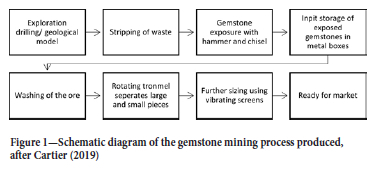
Before reviewing the development of non-explosive rock fragmentation techniques, it is important to cover the traditional techniques used in gemstone mining. Figure 1 provides an overview of the process of mining gemstones (Cartier, 2019).
The process involves the use of explosives to uncover the schist rock that contains emeralds with blasting done in a series of holes next to the veins. This exposure of the host rock is preceded by "chisellers" meticulously extracting the emerald mineral using a hammer and chisel. The process usually continues by placing the discovered emeralds in padlocked metal boxes or inside linen. Following this is the mineral processing phase, which entails the washing, screening, and sizing of the ore. A rotating trammel is then used to separate the larger and smaller pieces before being taken for further sorting on vibrating screens. Most of the small-scale miners cannot afford the processing machines needed in the implementation of the steps in Figure 1. Hence, they rent equipment to keep their costs low (Oliveira, Ali, 2011; Brandao et al., 2021). One of the most significant challenges in gemstone mining is rock fragmentation. This is because the host rock is highly competent and requires significant energy input for breakage. Adjusting conventional blasting techniques to this requirement therefore poses a risk to the integrity of the gemstones which in turn lead to mineral loss (Giuliani et al., 2019; Zwaan et al. 2005). Alternative non-explosive rock-breaking methods, such as chemical expansion agents and hydraulic splitting, are being explored to mitigate damage and improve recovery rates (De Silva et al., 2016).
Most emerald mines in the Kafubu region, Zambia, have experimented with controlled blasting and the diamond wire sawing method, discussed in the aforementioned, [A1.1][A1.2] in an attempt to reduce waste and enhance extraction efficiency (Mashikinyi, 2020). Being among the first to investigate the extraction of emeralds in the Kafubu region, Zwaan et al. (2005) observed the use of bulldozers, excavators, and dump trucks for waste removal. Moreover, surface mining techniques were widely utilised in the region to exploit emerald deposits. Underground mining was not regarded as a possibility due to the abundance of water during the rainfall period running from November through to March every year.[A2.1][A2.2]
In terms of the drilling and blasting of gemstones, Netecha et al. (2017) argued that the use of high-impact explosives on gemstones increased the chances of mineral losses. They believe that this phenomenon is due to the substantial energy released on the stones that create cracks and irregular shapes. The overall value and significance of the material are decreased when fractures and irregularities develop because they weaken the crystals and render them damaged. In contrast, very low-impact explosives loaded in specially designed blasthole patterns were used at Ural Emerald Mines in Russia. vv and Zhernakov (1995) specifically tested whether this would lead to reduced damage made to the emerald crystals. The two researchers also tested the use of expanding plastics and hydraulic wedge devices inserted into the drill holes in place of explosives. What they found is that the mine was able to extract record quantities of emeralds. For example, a famous extraction being the 11,000-ct crystal with an excellent green colour quality currently housed in a museum. While Netecha et al. (2017) seemed to recommend the use of low impact explosives to break rock, the investigation by Laskovenkov and Zhernakov (1995) appeared to yield better results for gemstone mining and crystal preservation.
Referring again to the drilling and blasting of gemstones, Alam et al. (2019) recommend the adoption of best charging practice. This is because the combined use of hand-held drilling tools and high-impact explosives causes undue damage to the emerald crystals. Alam et al. (2019) explain that good blasting outcomes hinge on the correct stemming length and associated aggregates, the right placement of the blasting caps in the drilled hole, and the correct hole diameter for explosives. When correctly implemented, the guidelines increase the likelihood of achieving efficient fragmentation while conserving the integrity of mineralised crystals. Another study by Eniowo et al. (2022) found that small-scale gemstone mining required geological and structural knowledge of an orebody's location, shape, size, and quality. They also noted that, without ore modelling data, high-energy explosives may be used unintentionally on gemstone crystals. This is largely the reason why emerald minerals have been observed to sustain inadvertent damage during blasting activities, thereby decreasing its overall worth. The absence of useful data most common in artisanal and small-scale gemstone mines therefore presents an opportunity for gentle rock breaking alternatives. These are reviewed in the section that follows.
A review of selected non-explosive rock fragmentation methods for gemstone mining
In sensitive mining environments like gemstone mining, the use of non-explosive rock fragmentation methods offers safer and more environmentally friendly alternatives as compared to high-energy explosives (De Silva et al., 2016). Hydraulic splitters, rock breakers, thermal lancing, and expansive grouts are some of the alternatives employed as opposed to traditional blasting methods. Particularly, hydraulic splitters and rock breakers fitted to hydraulic excavators are mostly used in operations near infrastructure as they offer precise fracturing with minimal vibration. However, Singhal (2014) reported that the major limitation of this technique is the slow cycle times that limit productivity, especially for large scale operations. Soundless chemical demolition agents (SCDA), on the other hand, offer controlled expansion, but their efficiency is limited by the porosity and temperature of the rock (Yapici, 2023). So, although non-explosive rock fragmentation techniques improve safety and lessen regulatory hazards, they are not widely used in large scale mines. This is because of their greater costs and slower rates of fragmentation when compared to explosive mining techniques (Wang et al., 2023). In gemstone mining, where preserving the integrity of mineral crystals is critical, non-explosive techniques like manual splitting and controlled wedge-and-feather methods are preferred to minimise damage. In countries like Zambia, which is dominated by lateritic and weathered formations, manual wedge-and-feather techniques as well as hydraulic and chemical alternatives are gaining popularity (Mashikinyi, 2020). However, for the purpose of this article, thermal fragmentation, plasma blasting technology, control form injection, radial axel splitter, superficial carbon dioxide, and SCDA's non-explosive rock fragmentation techniques are reviewed for gemstone mining. SCDAs are given further attention in subsequent sections with focus on their use in gemstone mining.
Supercritical carbon dioxide (SC-CO2) has been explored as a non-explosive rock breaking method, initially for hydrocarbon reservoir stimulation (Ishida et al., 2012) and later in tunnelling and mining projects. Operating above CO2's critical temperature and pressure, it behaves as a dense fluid with high diffusivity and dissolving capacity, allowing energy transfer and rock fracturing. Various researchers have demonstrated its potential; Kolle (2000) showed that SC-CO2 can cut through hard rocks at lower pressures, while Wang et al. (2019) found reductions in water use and improved fracture networks compared to hydraulic fracturing. Li et al. (2020) also reported reduced noise and dust in metro construction projects. Despite these advantages, SC-CO2 presents several challenges for gemstone mining. It requires precise pressure and temperature control, adding to operational complexity and cost (Li et al., 2020). Scaling up for continuous mining is also still difficult (Hu et al., 2024). More critically, the aggressive fracturing could damage delicate crystals. While effective in other contexts, its suitability for gemstones remains uncertain.
Controlled foam injection (CFI) is another method developed by injecting foam into a drilled hole, building pressure that fractures the rock in tension rather than compression, usually below 50 MPa (Pickering, Young, 2017). The foam forms an effective seal and allows a controlled release of energy, which improves safety and reduces dust (Pickering, Young, 2017). However, limitations exist. Penetration depth is restricted (Pickering, Young, 2017), and there are concerns over possible air bursts and fly rock (Liu et al., 2021). Bilgin et al. (2013) also noted that fracturing can be slow and unpredictable. For gemstone extraction, where precise and gentle breakage is essential, these factors could increase the risk of crystal damage (Singhal, 2014).
Thermal fragmentation was developed to reduce ore dilution in narrow vein deposits (Brisebois, 2007; Habib et al., 2022). The technique involves drilling a pilot hole and inserting a diesel- or plasma-powered burner, generating temperatures up to 800 °C. This causes ore to spall into small fragments while leaving surrounding rock mostly intact (Drake et al., 2020), which improves efficiency in high-grade, thin ore veins. The method, however, poses challenges for gemstone mining. The extreme heat increases ventilation requirements and energy costs (Drake et al., 2020: Vogt, 2016). Furthermore, the method requires specialised equipment and skilled operators and is designed for ore minerals rather than fragile crystals. The thermal stress could damage gemstones, making its application uncertain despite success in metalliferous mining.
Plasma blasting technology (PBT) uses electrical pulses through an electrolyte in a drilled hole to generate shockwaves exceeding 1 GPa, causing rock fragmentation comparable to conventional explosives (Kitzinger, Nantel, 1992; Lee et al., 2018). The process avoids traditional explosives and has been noted for environmental and safety advantages. Nonetheless, its use in gemstone mining may be limited. Significant electrical infrastructure is required, and the sequential activation of plasma shots reduces operational efficiency (Kitzinger, Nantel, 1992). The high shockwave pressures also present a risk of damaging delicate crystals, suggesting that careful consideration is needed before applying PBT to gemstone recovery.
Finally, the radial-axial splitter (RASP) is a mechanical rock fragmentation method that generates radial and axial forces in a pre-drilled borehole. Based on the penetrating cone fracture principle, the method propagates fractures outward from the hole, often forming a cone-shaped failure zone with depths up to 254 mm per split (Anderson, Swanson, 1987; De Graaf, Spiteri, 2018). Despite these promising results, RASP has operational limitations. It is not a continuous method, limiting throughput for high productivity, and requires significant thrust force for anchoring, which depends on operator skill (Paraszczak, Planeta, 2003). For gemstone mining, where efficiency and careful extraction are critical, these factors suggest that its applicability may be limited.
Overall, while each of these methods offers advantages in various mining contexts, their specific characteristics such as aggressive fracturing, high energy input, or limited control, highlight potential challenges for application in gemstone mining, where preservation of delicate crystals and selective extraction are paramount. Given the limitations of the methods presented, the following section explores SCDAs as a potentially suitable technique for gemstone mining, focusing on their ability to break rock gently and selectively, while preserving fragile gemstone crystals.
Soundless chemical demolition agents for gemstone mining
Soundless chemical demolition agents' (SCDA) commercial use only started about 10 to15 years ago, especially for controlled fracturing in rock and concrete demolition uses. SCDAs, sometimes known as expansive cements or non-explosive expansive materials (NEEM), were first created over three decades ago. Usually, the main active ingredient of these agents is quicklime (CaO), which comes in the form of cementitious powders. Mixed with water and kept under confinement, these cementitious powders undergo a hydration process that causes a notable volume increase and high expansive pressure that can induce tensile cracks in the surrounding material (Harada et al., 1989). SCDAs can therefore be defined as "cementitious powdery materials with quicklime (CaO) as the main component that expands upon contact with water, producing high expanding pressure under confined conditions" (De Silva et al., 2016).
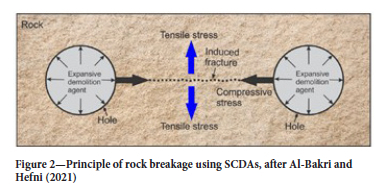
SCDAs operate by injecting the hydrated mixture into a borehole pre-drilled inside the rock or concrete substrates. The resulting chemical process, which is mostly the creation of calcium hydroxide from the reaction between calcium oxide and water, generates significant crystallisation pressure. This force is directed radially against the borehole walls that then creates tangential tensile stress (see Figure 2).
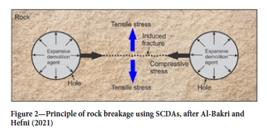
Usually starting along the weakest channel in the borehole circle, a fracture propagates outward under pressure of magnitude exceeding the tensile strength of the host material (De Silva et al., 2016; Harada et al., 1989). Products like Bristar and Dexpan are now commercially available and widely employed, particularly in urban infrastructure rehabilitation projects where the use of conventional explosives is banned or limited (Habib, 2022). Indeed, concordant studies have underlined the increasing relevance of non-blasting techniques in the framework of safe and environmentally benign rock fragmentation. For example, De Silva et al. (2016) and Netecha et al. (2017) found methods like hydraulic fracturing, hydro-wedging, electro-disintegration, diamond wire cutting, and the application of non-destructive demolition mixtures (NDM) as acceptable substitutes for traditional explosives. SCDAs stand out among these for their low environmental impact since their use does not generate vibrations, pollutants, or fly rock, which are especially important in urban and fragile biological contexts. This is because the usual uniaxial compressive strength (UCS) of concrete is exceeded by expansive pressures over 44 MPa levels and heat up to 150 °C produced by this reaction. Note that the UCS of concrete ranges from 10 MPa to 20 MPa (Arshadnejad et al., 2011; Al-Bakri, Hefni, 2021).
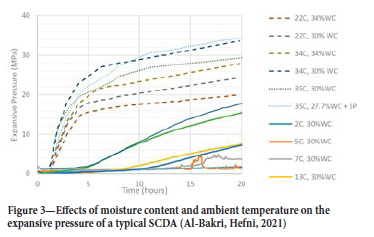
Parameters such as water content in the rock mass, borehole diameter, borehole spacing, and ambient temperature affect the performance of the expansive pressure generated. Indeed, as can be seen in Figure 3, a 4% increase in water content leads to a 17.6% decrease in the expansive pressure, while a reduction of 12 °C in the ambient temperature results in a 23.5% decrease in the expansive pressure. For optimal performance, Arshadnejad et al. (2011) as well as Al-Bakri and Hefni (2021) suggested ideal operating parameters of roughly 34 °C ambient temperature and a moisture content of the rock mass of about 30% (Figure 3).
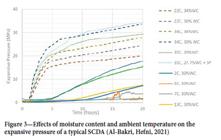
Other notable research by Hinze and Brown (1994) showed that the expanding pressure generated under a limited application of SCDA is inversely proportional to water content. This means that a lower water-to-cement ratio results in great packing density and less spacing. Consequently, more concentrated hydration reactions are encouraged, which then explain the high expanding pressure generated. Researchers such as Natanzi et al. (2019), Laefer et al. (2010), and others also revealed that expansive pressure usually rises proportionally with temperature. However, a blowout can occur beyond a particular temperature limit, forcing the pressure to escape too soon before complete fracturing can take place (Natanzi et al., 2019; Hinze, Brown, 1994).
Although SCDAs offer a safe, silent, and emission-free substitute to blasting, some restrictions remain. Chief among these is the slow rate of fracturing, usually needing more than 10 h for the procedure to fully propagate the rock. This, together with quite low efficiency, especially in large-scale operations, are the primary reasons why the broad use of SCDAs in high-productivity mining settings is limited (Zhou et al., 2018b; Maubane, Ngwenyama, 2025). Their use, however, is still quite beneficial in delicate or limited work areas where traditional techniques have legal, environmental, or safety concerns, like gemstone mining. Therefore, this methods of extraction will be explored further in the gemstone mining context.
Classification and characteristics of soundless chemical demolition agents
The classification of soundless chemical demolition agents (SCDA) is generally guided by the nature of their expansive constituents. According to the Standard Specification for Expansive Hydraulic Cement (ASTM C845, 2018), there are three primary types of expansive cements: Type K, Type M, and Type S. These three types of cement differ in their specific alumínate components but share a common mechanism of action responsible for the production of expansive ettringite crystals during hydration and, subsequently, their swelling behaviour. In addition to these three common types, there is a special type called Class G that acquires its swelling properties mainly from the creation of portlandite, Ca(OH)2, when it hydrates.
Looking at Type K expansive cement, this is made from a mix of three components: anhydrous calcium-alumino-sulphate, calcium sulphate, and uncombined calcium oxide. In this case, Equation 1 shows the hydration reaction, which governs the expansive mechanism (ASTM C845, 2018; Habib et al., 2022):

Improvements to the wide-ranging capabilities of Type K cements have been noted by adding silica fume and plasticisers. Calcium aluminate (CaOAlO) and calcium sulphate combine to form this type of cement. Its reaction proceeds in Equation 2 (ASTM C845, 2018; Habib et al., 2022):

The second type of expansive cement or Type M demonstrates significant ettringite formation, which in turn leads to producing effective expansive pressure (ASTM C845, 2018). Type M expansive cement is a blend of calcium aluminate (CaOAlO) and calcium sulphate combined to form this type of cement. Its reaction is given in Equation 3:

The last type of Type S expansive cement comprises tricalcium aluminate (3CaOAl2O3 or C3A) and calcium sulphate. The hydration pathway for Type S cement can be expressed as Equation 4 (ASTM C845, 2018):

The reaction in Equation 4 also yields ettringite, an expansive product offering similar capabilities for pressure generation to Types K and M. The special type of cement, known as Class G cement, is unique in the sense that most of its expansion comes from the hydration of lime, which makes up 80% to 90% of the mix. Other constituents include SiO2, Al2O, and Fe2O3, responsible for regulating the rate and extent of expansion. The fundamental hydration reaction in the Class G cement is given by Equation 5 (De Silva et al., 2016):

However, the main differences between the reviewed expansive classes are the amount of aluminate compounds contained and the optimal temperature they function at, which affects the selection of the expansive agent to use. Type K operates optimally at -5 °C and 10 °C, type M at 10 °C to 20 °C, while type S at 20m°C to 35m°C, and type G at 35m°C and higher (Maubane, Ngwenyama, 2025). For gemstone mining, especially in Zambia, Type S and G are ideal for the climate and recommended for use.
Applications of soundless chemical demolition agents in surface mining
Increasingly, SCDAs are being acknowledged worldwide in the mining industry for their part in regulated rock fragmentation. Though their use in gemstone mining is underexplored, several research in mining and quarrying settings offer insightful information that might be used in gemstone operations. Recent studies by Zhang et al. (2020) considered how well SCDA fractured granite. The reported findings indicate that drilling spacings of 15 cm - 20 cm could generate expansive pressures between 30 MPa and 80 MPa. These magnitudes of pressure were deemed sufficient to cause fractures within 12 to 48 h after SCDA loading. Applying this in more capable lithologies like quartzite and basalt, however, has been less efficient. Research by Chen et al. (2019) provided evidence that SCDAs do not perform well in hard rocks like quartzite and basalt, particularly when the temperature rises to more than 30 °C, which can lead to unequal curing outcomes.
In terms of empirical description, Arshadnejad et al. (2011) proposed a model to forecast the optimal distance between boreholes considering the strength, elasticity, and toughness of the rock. The inclusion of these factors was to address limitations of previous models reported by Jin et al. (1988), Wang et al. (1988), and Jana et al. (1991). In doing so, the predictive model led to the enhanced use of SCDAs. The proposed empirical model is provided in Equation 6 (Arshadnejad et al., 2011):

Where S is the borehole spacing (mm); P is the expansive pressure (MPa); a_t is the uniaxial tensile strength (MPa); t is the charging time (h); E is Youngs modulus (GPa); d is the borehole diameter (mm); and K_IC is the Mode I fracture toughness (MPa-m0.5). Mode I fracture toughness is used when assessing the resistance of rock masses to tensile failure and fracture toughness; it is the perpendicular propagation of cracks to the crack plane (Chang et al., 2002).
Later, Arshadnejad (2019) confirmed the validity of Equation 6 by means of field tests in an Iranian granite quarry. Various borehole diameters (i.e., 32 mm, 38 mm, and 44 mm) were employed. The experimentally measured fractures were then found to closely match predictions produced with Equation 6, thereby showing its robustness for practical application. Note that earlier empirical models, such as those suggested by Jin et al. (1988) and Wang et al. (1988), employed simplified relationships for calculating borehole spacing. They are provided in Equations 7 and 8:

Here, ac indicates the uniaxial compressive strength of the rock mass while β is an empirical coefficient set at β = 1 for rock (Wang et al., 1988). Although simpler to calculate, Equations 7 and 8 ignore the modulus of elasticity and the fracture toughness of the rock and therefore lack accuracy in varied geological environments like gemstone mining.
Shang et al. (2018) also investigated the effects of hole spacing on the expansive pressure generated in pre-drilled holes of different sizes. The aim of the study was to develop a mathematical model of the relationship between the stresses produced between two neighbouring holes while subjected to the incremental expansive pressure of the SCDA. Shang et al. (2018) conducted a parametric study using a developed analytical model on a soft rock Midgely Grit sandstone (MGS) and a hard rock Horton Formation siltstone (HFS). Various hole spacings of 50 mm intervals between 20 mm and 2000 mm were tested. Stresses produced were then monitored at seven different loading times t = 1, 2, 3, 4, 10, 15, 20, and 25 hrs. The experimental findings showed that with both rocks an increase in hole spacing between drill holes, the time required to fragment the rock increased significantly. For example, at a hole diameter of 100 mm for soft rock with tensile strength of 2.0 MPa, rock fracture time increased by 24 h when the hole spacing was increased from 0.29 m to 1.21 m. Interestingly, hole diameter was shown to greatly affect the level of hole pressure that could be generated within. Chen et al. (2023) reported that borehole spacing had more impact on stress fluctuation than diameter. However, this study excluded changes in ambient temperature, an aspect deserving attention in future research.
Other studies have expanded SCDA applications. Tang et al. (2021) used computer simulations to study SCDA performance and borehole angles. The researchers subsequently found that a drill elevation angle affected SCDA breakage performance more than an azimuth angle. Wang et al. (2022) examined granite fracture propagation under different initial stress levels. Their experimental results highlighted the need of pre-existing stress fields within the rock mass. This is because these fields affect fracture behaviour following SCDA treatment.
However, a closer look at these studies reveals a crucial gap in the known data. While the effects of spacing and diameter are clearly demonstrated, the experiments were conducted in controlled laboratory environments. Additionally, relatively small-diameter boreholes were used. Shang et al. (2018) tested diameters up to only 100 mm, while Chen (2023) only went as far as 86 mm. These sizes fall short of the actual borehole diameters used in gemstone mining operations, which often exceed 100 mm. This research though, offers promising evidence that SCDAs can be effective in larger diameter holes. It highlights the need for further studies to validate their performance under field-scale conditions. The most important question is: Will similar results be seen in hole diameters greater than 100 mm and in uncontrolled field environments?
Comparison of environmental effects of SCDA and traditional explosives
The inherent safety of SCDAs is one of their most important advantages compared to explosives. Several researchers have conducted comparative analyses of toxic emissions due to the use of SCDAs versus that of traditional explosives. Ferreira et al. (2015), for example, evaluated the life-cycle energy and environmental impacts of producing emulsion explosives, which are based on ammonium nitrate. They highlighted the significant environmental footprint associated with the production and use of such explosives. Indeed, some of the emissions from explosives include CO2 and NOx, emissions, both of which are key greenhouse gases responsible for climate change. De Silva and Ranjith (2016) concluded that, unlike ammonium nitrate-based explosives (e.g., ANFO), which release CO2, NOx, and other toxic gases into the air, SCDAs undergo a non-explosive chemical reaction that does not produce harmful emissions. Both authors emphasised the need for the adoption of SCDAs, as they offered a safer, cleaner, and more sustainable alternative to conventional explosives.
For many years, researchers have also been investigating the effects of explosives on the environment. Concordant findings, e.g., Habib (2022), Bajpayee et al. (2004), Persson et al. (2018), and Vogt (2016), clearly highlight the environmental and operational disadvantages of using traditional explosives. Bajpayee et al. (2004), for example, investigated blasting-related injuries in surface mining throughout the United States of America. What they found is that fly rock was the most prevalent hazard, responsible for over 60% of all documented injuries. The unpredictable nature of explosive blasts and inadequate safety zones were the primary causes of these risks. In contrast, SCDAs do not generate high-velocity debris, which renders them a much safer option, particularly in urban or sensitive environments. It should be noted that conventional explosives can easily surpass 120 dB, necessitating hearing protection, while SCDAs remain below 85 dB, allowing their use without extra noise safety gear. SCDAs outperform typical explosives in gemstone mining circumstances in terms of the environment and safety, according to the studies in this section. They demonstrate that SCDAs reduce hazardous fumes and vibrations and reduce fly rock and inadvertent detonations. SCDAs are safe and easy to handle for miners.
Economic benefits of SCDA over traditional explosives
The financial viability of SCDAs is a critical consideration for their adoption. Maneenoi et al. (2022) argue that even though SCDAs reduce noise, vibration, fumes, dust, and toxic emissions into the environment, they are usually considered less cost-effective when compared to explosives. Furthermore, the authors believe that the slower reaction rates seen have the potential to lead to increased production and labour costs. Habib et al. (2022) and Laefer et al[HS1.1]. (2010) agree with this argument by adding that the prolonged reaction time of more than 10 hrs in some instances, has led to elevated labour costs and extended project timelines. They further explain that these costs far outweigh the environmental and safety benefits of the SCDAs.
A dominant cost component in SCDA-based rock breakage systems that cannot be overlooked is the increased cost of drilling. De Silva and Ranjith (2016) and Musunuri and Mitri (2009) highlighted that effective rock breakage requires closely spaced boreholes. This leads to significantly higher drilling intensity, when compared to conventional explosive blasting where wider hole spacing and burden are possible. Jimeno et al. (1995) explained that expansive motors required hole spacings of 5 to 10 times the hole diameter compared to explosives which allow for hole spacings that are 20 to 40 times the hole diameter, demonstrating that SCDAs require higher drilling effort compared to blasting with explosives. To achieve good fragmentation with SCDAs there needs to be a cost trade-off between drilling and fragmentation quality.
Other authors like De Silva and Ranjith (2016) justify the use of SCDAs by suggesting that the cost savings that SCDAs generate from the decreased insurance premiums, minimal regulatory compliance costs, and the need for specialised labour mitigated, contribute to the overall financial benefit of SCDAs. Furthermore, the removal of costs connected to blast-induced damages and environmental remediation supports the economic justification for SCDAs (Hinze, Nelson, 1996). Hinze and Brown (1994) also add that the continuous nature of SCDA application, without the need for extensive safety evacuations, partially compensates for the extended reaction periods. In any case, operational efficiency is enhanced because SCDAs are seen not to require post-blast mucking and scaling and leads to a reduction in the damage to surrounding structures (De Silva, Ranjith, 2016).
While literature does not seem to offer specific figures on cost reductions that can be incurred from implementing SCDA rock-breaking methods, the potential for saving mining costs exists through reduced explosive usage and reduced disturbances from blast evacuations and re-entry periods (Sakhno, Sakhno, 2024. This makes SCDA a potential and viable option to explore for gemstone rock breaking. Arguably in the case of gemstone mining, where the reduction of cracks induced in the crystal is far more valuable as opposed to cost-saving, the use of SCDAs becomes an appealing option for breaking the host rock.
Challenges and limitations of soundless chemical demolition agents
Inasmuch as SCDAs have gained popularity and have shown potential for great use in mining operations, there are still several challenges and limitations associated with their use. Limitations presented here are also a concern to gemstone mining operations. Natanzi et al. (2016) investigated the efficiency of SCDAs under varying temperatures. They were able to show that sudden changes in temperature had a great effect on the expansive pressure generated in the boreholes. They further noted that elevated temperatures had the potential to cause blowouts in the charged holes before the rock started to break. De Silva et al. (2016) added that the calcium oxide contained in SCDAs is accelerated quickly with high temperatures, while lower temperatures slow the chemical reaction. This limitation compromises the predictability and efficiency of the crack propagation, especially in regions with variable weather.
Looking at the washout of SCDAs in saturated conditions, rock breaking with SCDAs occurs when calcium oxide is hydrated. However, too much water content in the mixture tremendously reduces the efficiency of the expansion process (Arshadnejad et al., 2011; Al-Bakri, Hefni, 2021). De Silva et al. (2016; 2021) suggested that viscosity-enhancing admixtures (VEA), such as welan gum, could mitigate this issue by improving resistance to washout. However, more research on the admixtures needs to be conducted to ascertain their effectiveness and usage in controlling washout. This challenge places a limitation on the use of SCDAs in deep, wet underground mines and waterlogged drill holes compared to the use of traditional explosives.
Finally, the inherent challenge observed with larger drill holes is the reduced efficiency of the SCDA. Most studies, including Shang et al. (2018), Chen (2023), Arshadnejad et al. (2011), and Arshadnejad et al. (2019), to name but a few, focused on testing SCDAs in smaller diameter holes less than 100 mm. It therefore seems, to the best of our knowledge, that little research has been conducted on the use of SCDAs in large-diameter holes greater than 100 mm and its optimal drilling and blasting design. Notably, research papers available in the body of knowledge tend to agree that higher diameter holes improve the initial crack propagation time significantly when compared to diameter holes smaller than 70 mm. This then requires that follow-up research is conducted on the requirements for optimal drilling and blasting design patterns when larger diameter holes are used.
Prospects for future work
In the present review, it is evident that the use of SCDAs in rock breaking is emerging as a practical and safer alternative to traditional explosives. The potential of SCDAs to minimise toxic fumes, fly rock, dust, and especially seismic vibration, therefore makes it a viable option for gemstone mining. Gemstone mining is concerned with controlled explosive pressure release, precision cutting, and the reduction of collateral damage to the surrounding rock and structures. All these features can be offered with SCDAs, which makes them a good candidate for use in the fragmentation of gemstone rock. However, there is a need for more comprehensive studies of SCDAs that are focused more on field trials and laboratory-based simulations mimicking realistic mining conditions. Zhang et al. (2025), for instance, performed biaxial confinement tests on granite panels and showed that SCDA-induced fractures could propagate effectively under increased in situ stress conditions when combined with optimised drilling patterns. They subsequently found that SCDAs may be more viable in deep and high-pressure environments than was previously believed. Future research should also concentrate on the suitability of SCDAs in large-diameter boreholes utilised by both small-scale and large-scale mines. It is equally crucial for future research to focus on improving the reliability and consistency of SCDA in terms of rock breakage performance.
Lastly, Maneenoi et al. (2022) emphasised that the rate and magnitude of expansion pressure are significantly affected by environmental factors like ambient temperature, humidity, and rock saturation. As a result, currently reported experiments have been including chemical admixtures such as retarders or accelerators to tailor SCDAs to different field conditions. This may facilitate their use in more unpredictable or extreme environments. Future research and technology should equally focus on addressing the slow reaction time of SCDAs, especially for operations that are sensitive to time.
Conclusion
The development of rock fragmentation methods reflects a more general industrial shift towards safer, more sustainable, and precision-driven approaches, particularly in the field of gemstone mining. Though speed and established operational infrastructure keep conventional drill-and-blast techniques dominant, their associated environmental and occupational hazards (e.g., unintentional damage to precious crystal structures) have increasingly called into question their widespread use. Mechanical excavation has provided a partial solution in suitable lithologies, but large capital costs and low adaptability in geologically complex regions often restrict its application. Non-explosive rock fragmentation techniques, particularly soundless chemical demolition agents (SCDA), offer a good replacement in this respect. Though, SCDAs still suffer significant practical constraints despite their potential. Their temperature sensitivity, washout vulnerability, shorter reaction times, and variable performance in hard rock or high-stress geological settings question their scalability. A lack of field-based empirical data, especially in bigger borehole applications, has also hampered the development of prediction models and undermined more general industry confidence in their use. Economically speaking, while SCDAs may not yet rival conventional explosives in throughput efficiency, their indirect cost benefits are more important than output. As field trials increase and formulations improve, the cost-performance ratio is expected to shift further in favour of SCDAs.
In the end, non-explosive fragmentation techniques, particularly SCDA-based systems, may position themselves and start offering a hopeful and increasingly important instrument in the quest for responsible mining. Their application, especially in gemstone open pit operations, may also suggest a paradigm shift away from high energy excavation towards a more intelligent, environmentally responsive, and minerally conservative approach to resource recovery. Transforming the potential of SCDAs into industry-standard practice will eventually depend on continuous multidisciplinary research supported by empirical validation and pragmatic application.
It should be noted that this paper does not present new experimental or field data, instead, it consolidates and critically evaluates existing studies to highlight current capabilities, limitations, and research gaps associated with SCDA use in gemstone mining.
References
-
Al-Bakri, A., Hefni, M. 2021. A review of some nonexplosive alternative methods to conventional rock blasting. Open Geosciences, vol. 13, no. 1, pp. 431-442. https://doi.org/10.1515/geo-2020-0245
» https://doi.org/10.1515/geo-2020-0245 -
Alam, M., Ali, S., Khan, G., Alam, M., Bano, Y., Khan, A. 2019. An overall view on gemstone mining in Gilgit-Baltistan: Problems and mitigations. Journal of Mountain Area Research, vol. 4, no. 1, pp. 3-39. https://doi.org/10.53874/jmar.v4i0.57
» https://doi.org/10.53874/jmar.v4i0.57 - Anderson, S.J., Swanson, D.E. 1987. Capability evaluation of the radial-axial splitter. (Vol. 9071). US Department of the Interior, Bureau of Mines.
-
Arshadnejad, S. 2019. Design of hole pattern in static rock fracture process due to expansion pressure. International Journal of Rock Mechanics and Mining Sciences, vol. 123, no. 1, pp.104100. https://doi.org/10.1016/j.ijrmms.2019.104100
» https://doi.org/10.1016/j.ijrmms.2019.104100 -
ASTM International. 2018. ASTM C845/C845M-18: Standard specification for expansive hydraulic cement. West Conshohocken, PA: ASTM International. https://doi.org/10.1520/C0845C0845M-18 [Accessed: 12 August 2025].
» https://doi.org/10.1520/C0845C0845M-18 -
Arshadnejad, S., Goshtasbi, K., Aghazadeh, J. 2011. A model to determine hole spacing in the rock fracture process by non-explosive expansion material. International Journal of Minerals, Metallurgy, and Materials, vol. 18, no. 5, pp. 509-514. https://doi.org/10.1007/s12613-011-0470-5
» https://doi.org/10.1007/s12613-011-0470-5 -
Bajpayee, T.S., Rehak, T.R., Mowrey, G.L., Ingram, D.K. 2004. Blasting injuries in surface mining with emphasis on flyrock and blast area security. Journal of Safety Research, vol. 35, no. 1, pp.47-57. https://doi.org/10.1016/j.jsr.2003.07.003
» https://doi.org/10.1016/j.jsr.2003.07.003 -
Batouche, T., Tabet, A., Zerzour, O., Hadji, R., Benyoucef, A.A., Moueri, A., Dinar, H. 2024. Optimizing rock fragmentation in open pit mining: Blasting plan refinement using WipFrag and Kuz-Ram method. Geomatics, Land management and Landscape. vol. 1, no. 4, pp. 77-89. https://doi.org/10.15576/GLL/193744
» https://doi.org/10.15576/GLL/193744 -
Biessikirski, A., Dworzak, M., Pytlik, M., Nachlik, S. 2025. Impact of the Type of Energetic Material on the Fume Emission in Open-Pit Mining. Sustainability, vol. 17, no. 5, pp. 2071-1050. https://doi.org/10.3390/su17052075
» https://doi.org/10.3390/su17052075 - Bilgin, N., Copur, H., Balci, C. 2013. Mechanical excavation in mining and civil industries. 1st ed. CRC press. Florida.
-
Brandao, L., De Alencar Naas, I., Neto, P.L.D.O.C. 2021. Sustainable development of gem production: An application of the Analytical Hierarchy Process. International Journal of the Analytic Hierarchy Process, vol. 13, no. 3, pp 1-8. https://doi.org/10.13033/ijahp.v13i3.880
» https://doi.org/10.13033/ijahp.v13i3.880 - Brisebois, D., Rocmec International Inc. 2007. Thermal rock fragmentation application in narrow vein extraction. U.S. Patent 7,195,320.
-
Buyuksagis, I.S. 2007. Effect of cutting mode on the sawability of granites using segmented circular diamond sawblade. Journal of Materials Processing Technology, vol. 183 no. 2-3, pp. 399-406. https://doi.org/10.1016/j.jmatprotec.2006.10.034
» https://doi.org/10.1016/j.jmatprotec.2006.10.034 -
Buyuksagis, I.S., Goktan, R.M. 2005. Investigation of marble machining performance using an instrumented block-cutter. Journal of Materials Processing Technology, vol. 169, no.2, pp. 258-262. https://doi.org/10.1016/j.jmatprotec.2005.03.014
» https://doi.org/10.1016/j.jmatprotec.2005.03.014 -
Cartier, L.E. 2019. Gemstones and sustainable development: Perspectives and trends in mining, processing and trade of precious stones. The extractive industries and society, vol. 6 no. 4, pp.1013-1016. https://doi.org/10.1016/j.exis.2019.09.005
» https://doi.org/10.1016/j.exis.2019.09.005 -
Chang, S.H., Lee, C.I., Jeon, S. 2002. Measurement of rock fracture toughness under modes I and II and mixed-mode conditions by using disc-type specimens. Engineering Geology, vol. 66, no. 1-2, pp. 79-97. https://doi.org/10.1016/S0013-7952(02)00033-9
» https://doi.org/10.1016/S0013-7952(02)00033-9 - Chen, T. 2023. Explosive-Free Breakage of Biaxially Loaded Rock Using Soundless Chemical Demolition Agents. PhD thesis, McGill University, Montreal, Canada.
-
Chen, T., Vennes, I., Mitri, H.S. 2023. Biaxially confined rock breakage with SCDA: large-scale tests and numerical modelling. Rock Mechanics and Rock Engineering, vol. 56, no. 8, pp.5525-5541. https://doi.org/10.1007/s00603-023-03332-0
» https://doi.org/10.1007/s00603-023-03332-0 -
De Graaf, W.W., Spiteri, W. 2018. A preliminary qualitative evaluation of a hydraulic splitting cylinder for breaking rock in deep-level mining. Journal of the Southern African Institute of Mining and Metallurgy, vol. 118, no. 8, pp.891-897. https://doi.org/10.17159/2411-9717/2018/v118n8a13
» https://doi.org/10.17159/2411-9717/2018/v118n8a13 -
De Silva, R.V., Ranjith, P.G. 2016. An alternative to conventional rock fragmentation methods using SCDA: A review. Energies, vol. 9, no. 11, pp.958-989. https://doi.org/10.3390/en9110958
» https://doi.org/10.3390/en9110958 -
De Silva, V.R.S., Ranjith, P.G., Perera, M.S., Wu, B., Rathnaweera, T.D. 2019. The influence of admixtures on the hydration process of soundless cracking demolition agents (SCDA) for fragmentation of saturated deep geological reservoir rock formations. Rock Mechanics and Rock Engineering, vol. 52, no. 2, pp.435-454. https://doi.org/10.1007/s00603-018-1596-9
» https://doi.org/10.1007/s00603-018-1596-9 -
Drake, B., Koroznikova, L., Tuck, M., Durkin, S. 2020. Application of thermal fragmentation in Australian hard rock underground narrow-vein mining. Mining, Metallurgy & Exploration, vol. 37, no. 1, pp.219-229. https://doi.org/10.1007/s42461-019-00154-z
» https://doi.org/10.1007/s42461-019-00154-z -
Eniowo, O.D., Kilambo, S.R., Meyer, L.D. 2022. Risk factors limiting access to formal financing: Perceptions from artisanal and small-scale mining (ASM) operators in Nigeria. The Extractive Industries and Society, vol. 12, no. 1, p.101181-101193. https://doi.org/10.1016/j.exis.2022.101181
» https://doi.org/10.1016/j.exis.2022.101181 -
Ersoy, A., Atici, U. 2004. Performance characteristics of circular diamond saws in cutting different types of rocks. Diamond and Related Materials, vol. 13, no. 1, pp. 22-37. https://doi.org/10.1016/j.diamond.2003.08.016
» https://doi.org/10.1016/j.diamond.2003.08.016 -
Ferreira, C., Freire, F., Ribeiro, J. 2015. Life-cycle assessment of a civil explosive. Journal of Cleaner Production, vol. 89, no. 1, pp.159-164. https://doi.org/10.1016/j.jclepro.2014.11.027
» https://doi.org/10.1016/j.jclepro.2014.11.027 -
Giuliani, G., Groat, L.A., Marshall, D., Fallick, A.E., Branquet, Y. 2019. Emerald deposits: A review and enhanced classification. Minerals, vol. 9, no. 2, p.105-168. https://doi.org/10.3390/min9020105
» https://doi.org/10.3390/min9020105 - Habib, K.M. 2022. Development of explosive-free method for the breakage of hard rock using soundless chemical demolition agents. PhD Thesis, McGill University, Montreal, Canada.
-
Habib, K.M., Shnorhokian, S., Mitri, H. 2022. Evaluating the application of rock breakage without explosives in underground construction-a critical review of chemical demolition agents. Minerals, vol. 12, no. 2, p.220-237. https://doi.org/10.3390/min12020220
» https://doi.org/10.3390/min12020220 -
Harada, T., Idemitsu, T., Watanabe, A., Takayama, S.I. 1989. The design method for the demolition of concrete with expansive demolition agents. In Fracture of Concrete and Rock: SEM-RILEM International Conference June 17-19, 1987, Houston, Texas, pp. 47-57. https://doi.org/10.1007/978-1-4612-3578-1_5
» https://doi.org/10.1007/978-1-4612-3578-1_5 -
Hinze, J., Brown, J. 1994. Properties of soundless chemical demolition agents. Journal of construction engineering and management, vol. 120, no. 4, pp.816-827. https://doi.org/10.1061/(ASCE)0733-9364(1994)120:4(816)
» https://doi.org/10.1061/(ASCE)0733-9364(1994)120:4(816) -
Hinze, J., Nelson, A. 1996. Enhancing performance of soundless chemical demolition agents. Journal of construction engineering and management, vol. 122, no. 2, pp.193-195. https://doi.org/10.1061/(ASCE)0733-9364(1996)122:2(193)
» https://doi.org/10.1061/(ASCE)0733-9364(1996)122:2(193) -
Hu, S.B., Zhang, L., Cai, Y.K., Pang, S.G., Yan, Z.Y., Zhang, Q. 2024. Study on the influence factors of rock breaking by supercritical CO2 thermal fracturing. Petroleum Science, vol. 21, no. 6, pp.4328-4343. https://doi.org/10.1016/j.petsci.2024.07.028
» https://doi.org/10.1016/j.petsci.2024.07.028 -
Ishida, T., Aoyagi, K., Niwa, T., Chen, Y., Murata, S., Chen, Q., Nakayama, Y. 2012. Acoustic emission monitoring of hydraulic fracturing laboratory experiment with supercritical and liquid CO2. Geophysical Research Letters, vol. 39, no.16, pp. 1-6. https://doi.org/10.1029/2012GL052788
» https://doi.org/10.1029/2012GL052788 - Jana, S. 1991. Non-explosive expanding agent-an aid for reducing environmental pollution in mines. Indian Mining and Engineering Journal, vol. 1, no. 1, pp.31-35.
- Jimeno, C.L., Jimeno, E.L., Carcedo, F.J.A., De Ramiro, Y.V. 1995. Drilling änd blasting of rocks. USA CRS Press, 41, pp. 35947.
- Jin, Z.Z., Liao, H., Zhu, W. 1988. Splitting mechanism of rock and concrete under expansive pressure. Proceedings of Demolition and Reuse of Concrete and Masonry. 1st ed. CRC press. Hong Kong, pp.141-148.
- Kitzinger, F. and Nantel, J., Noranda Inc, 1992. Plasma blasting method. U.S. Patent 5,106,164.
-
Kolle, J.J. 2000. November. Coiled-tubing drilling with supercritical carbon dioxide. Proceedings of SPE/CIM international conference on horizontal well technology, SPE/CIM international conference on horizontal well technology, Alberta, pp. 1-9. https://doi.org/10.2118/65534-MS
» https://doi.org/10.2118/65534-MS -
Kyelgyenbai, K., Pysmennyi, S., Chukharev, S., Purev, B., Jambaa, I. 2021. Modelling for degreasing the mining equipment downtime by optimizing blasting period at Erdenet surface mine. In E3S Web of Conferences EDP Sciences, vol. 280, no. 1, pp. 08001. https://doi.org/10.1051/e3sconf/202128008001
» https://doi.org/10.1051/e3sconf/202128008001 -
Laefer, D.F., Ambrozevitch-Cooper, N., Huynh, M.P., Midgette, J., Ceribasi, S., Wortman, J. 2010. Expansive fracture agent behaviour for concrete cracking. Magazine of Concrete Research, vol. 62, no.6, pp.443-452. https://doi.org/10.1680/macr.2010.62.6.443
» https://doi.org/10.1680/macr.2010.62.6.443 - Laskovenkov, A.F., Zhernakov, V.I. 1995. An update on the Ural emerald mines. Gems and Gemology, vol. 31, no. 2, pp. 106-113.
- Lee, B., Shin, Y., Jang, B., Hur, K. 2018. July. Waterless fracturing for shale gas/oil production using plasma blasting. Proceedings of the 45th EPS Conference on Plasma Physics, Prague, pp. 2-6.
-
Li, Q.Y., Chen, G., Luo, D.Y., Ma, H.P., Liu, Y. 2020. An experimental study of a novel liquid carbon dioxide rock-breaking technology. International Journal of Rock Mechanics and Mining Sciences, vol. 128, no. 1, pp.104244. https://doi.org/10.1016/j.ijrmms.2020.104244
» https://doi.org/10.1016/j.ijrmms.2020.104244 -
Liu, S., Cui, Y., Cui, S., Li, Z., Zhou, F., Wang, H. 2021. Experimental investigation on rock fracturing performance under high-pressure foam impact. Engineering Fracture Mechanics, vol. 252, no. 1, pp.107838-107851. https://doi.org/10.1016/j.engfracmech.2021.107838
» https://doi.org/10.1016/j.engfracmech.2021.107838 -
Maneenoi, N., Bissen, R., Chawchai, S. 2022. Influence of admixtures on the performance of soundless chemical demolition agents and implications for their utilization. Journal of Sustainable Mining, vol. 21, no. 2, pp. 93-111. http://dx.doi.org/10.46873/2300-3960.1350
» http://dx.doi.org/10.46873/2300-3960.1350 -
Manyepa, J., Mutambo, V. 2021. Approaches for designing extraction methods for randomly occurring pocket formation of gemstones: A case of Musakashi emerald area, Solwezi, Zambia. Journal of Mining and Environment (JME), vol. 12, pp. 605-618. https://doi.org/10.22044/jme.2021.10661.2024
» https://doi.org/10.22044/jme.2021.10661.2024 - Mashikinyi, M. 2020. Investigating the technical, financial and regulatory challenges in the Zambian gemstone mining sector: a case study of gemcanton investment holdings limited. PhD Thesis, The University of Zambia, Lusaka.
-
Maubane, I., Ngwenyama, P.L. 2025. The use of soundless chemical demolition agents in large scale in situ rock breaking applications in the mining industry. Journal of the Southern African Institute of Mining and Metallurgy, vol. 125, no. 7, pp. 371-384. https://doi.org/10.17159/2411-9717/3204/2025
» https://doi.org/10.17159/2411-9717/3204/2025 -
Musunuri, A., Mitri, H. 2009. Laboratory investigation into rock fracturing with expansive cement. International Journal of Mining and Mineral Engineering, vol. 1, no. 4, pp.327-345. https://doi.org/10.1504/IJMME.2009.029318
» https://doi.org/10.1504/IJMME.2009.029318 -
Natanzi, A.S., Laefer, D.F., Connolly, L. 2016. Cold and moderate ambient temperatures effects on expansive pressure development in soundless chemical demolition agents. Construction and Building Materials, vol.110, no. 1, pp.117-127. https://doi.org/10.1016/j.conbuildmat.2016.02.016
» https://doi.org/10.1016/j.conbuildmat.2016.02.016 -
Natanzi, A.S., Laefer, D.F., Kakali, G., Iman Zolanvari, S.M. 2019. Temperature-induced chemical changes in soundless chemical demolition agents. Journal of Materials in Civil Engineering, vol. 31, no. 7 pp.04019098. https://doi.org/10.1061/(ASCE)MT.1943-5533.0002653
» https://doi.org/10.1061/(ASCE)MT.1943-5533.0002653 -
Netecha, M.V., Shevchenko, S.V., Strilets, O.P. 2017. Jaspilites and other gemstones of post-jaspilite genesis: Mining, treatment, and enhancement. Scientific Bulletin of National Hirnichoho University, vol. 1, no. 17, pp. 28-33. https://nbuv.gov.ua/UJRN/Nvngu_2017_2_6
» https://nbuv.gov.ua/UJRN/Nvngu_2017_2_6 - Paraszczak, J., Planeta, S. 2003. Feasibility of Narrow Vein Mining Using a Mechanical Rock Splitter. Mine Planning Equipment. Vol. 1, no. 1, pp.415-422.
-
Persson, P.A., Holmberg, R., Lee, J., 2018. Rock blasting and explosives engineering. 1st ed. CRC press, Boca Raton. https://doi.org/10.1201/9780203740514
» https://doi.org/10.1201/9780203740514 -
Pickering, R.G.B., Young, C. 2017. Controlled foam injection: A new and innovative non-explosive rockbreaking technology. Journal of the Southern African Institute of Mining and Metallurgy, vol. 117, no. 3, pp.237-243. https://doi.org/10.17159/2411-9717/2017/v117n3a5
» https://doi.org/10.17159/2411-9717/2017/v117n3a5 -
Rudakov, M., Babkin, R., Medova, E. 2021. Improvement of working conditions of mining workers by reducing nitrogen oxide emissions during blasting operations. Applied Sciences, vol. 11, no. 21, pp.9969-9982. https://doi.org/10.3390/app11219969
» https://doi.org/10.3390/app11219969 -
Sakhno, I., Sakhno, S. 2024. Directional fracturing of rock by soundless chemical demolition agents. Heliyon, vol. 10, no. 4, pp. 1-20. https://doi.org/10.1016/j.heliyon.2024.e26068
» https://doi.org/10.1016/j.heliyon.2024.e26068 -
Shang, J., Zhao, Z., Aliyu, M.M. 2018. Stresses induced by a demolition agent in non-explosive rock fracturing. International Journal of Rock Mechanics and Mining Sciences, vol. 107, no. 1, pp. 172-80. https://doi.org/10.1016/j.ijrmms.2018.04.049
» https://doi.org/10.1016/j.ijrmms.2018.04.049 -
Singhal, R.K. 2014. Mechanical excavation in mining and civil industries. International Journal of Mining, Reclamation and Environment, vol. 28, no. 3, pp.214-214. https://doi.org/10.1080/17480930.2014.912821
» https://doi.org/10.1080/17480930.2014.912821 -
Tang, W., Zhai, C., Xu, J., Sun, Y., Cong, Y., Zheng, Y. 2021. The influence of borehole arrangement of soundless cracking demolition agents (SCDAs) on weakening the hard rock. International Journal of Mining Science and Technology, vol. 31, no. 2, pp.197-207. https://doi.org/10.1016/j.ijmst.2021.01.005
» https://doi.org/10.1016/j.ijmst.2021.01.005 -
Vogt, D. 2016. A review of rock cutting for underground mining: past, present, and future. Journal of the Southern African Institute of Mining and Metallurgy, vol. 116, no. 11, pp.1011-1026. https://doi.org/10.17159/2411-9717/2016/v116n11a3
» https://doi.org/10.17159/2411-9717/2016/v116n11a3 -
Wang, L., Duan, K., Zhang, Q., Li, X., Jiang, R. 2022. Study of the dynamic fracturing process and stress shadowing effect in granite sample with two holes based on SCDA fracturing method. Rock Mechanics and Rock Engineering, vol. 55, no. 3, pp.1537-1553. https://doi.org/10.1007/s00603-021-02728-0
» https://doi.org/10.1007/s00603-021-02728-0 -
Wang, L., Duan, K., Zhang, Q., Li, X., Jiang, R., Zheng, Y. 2023. Stress interference and interaction between two fractures during their propagation: insights from SCDA test and XFEM simulation. International Journal of Rock Mechanics and Mining Sciences, vol. 169, no. 1, pp.105431-105445. https://doi.org/10.1016/j.ijrmms.2023.105431
» https://doi.org/10.1016/j.ijrmms.2023.105431 -
Wang, M., Huang, K., Xie, W., Dai, X. 2019. Current research into the use of supercritical CO2 technology in shale gas exploitation. International Journal of Mining Science and Technology, vol. 29, no. 5, pp.739-744. https://doi.org/10.1016/j.ijmst.2018.05.017
» https://doi.org/10.1016/j.ijmst.2018.05.017 - Wang, Y.S., You, B.K., Zhang, G.Q. 1988. Application of soundless cracking agent in China. Proceedings of Demolition and Reuse of Concrete and Masonry. Japan: [publisher unknown], pp.149.
-
Zhang, F., Yang, L., Hu, Y., Ma, J., Liu, N., Yang, R. 2025. Experimental and Numerical Study on Mechanical Response Mechanism of Granite Under Coupled Confining Pressure and Blasting Load. Rock Mechanics and Rock Engineering, vol. 58, no. 2, pp.1617-1637. https://doi.org/10.1007/s00603-024-04295-6
» https://doi.org/10.1007/s00603-024-04295-6 -
Zhou, H., Xie, X., Feng, Y. 2018b. March. Rock breaking methods to replace blasting. In IOP Conference Series: Materials Science and Engineering, vol. 322, No. 2, pp. 022014-022021 https://iopscience.iop.org/article/10.1088/1757-899X/322/2/022014
» https://iopscience.iop.org/article/10.1088/1757-899X/322/2/022014 - Zwaan, J.H., Seifert, A.V, Vrána, S., Laurs, B.M., Anckar, B., Simmons, W.B.S., Falster, A.U., Lustenhouwer, W.J., Muhlmeister, S., Koivula, J.I., Garcia-Guillerminet, H. 2005. Kafubu Area, Zambia. Gems and Gemology, vol. 41, no. 2, pp. 116-148.
Revised: 01 Dec. 2025
Accepted: 15 Jan. 2026
Published: May. 2026