Investigation of physical and mechanical properties of polymer based composite material using volcanic tuff dust in Cappadocia, Turkey
Abstract
Cappadocia is not only a region of Turkey with historical and touristic importance. During the cutting and processing of volcanic tuff, quarries in this region release large amounts of tuff into the environment that is viewed as waste. The release of this waste constitutes an economic loss and contributes to environmental pollution. However, through experimentation with deformation, weight per unit of volume, water absorption, uniaxial compression strength, modulus of elasticity, and point load strength index, volcanic tuff and marble dust composite materials can be produced for use in the building sector. In this study it was observed that, as the percentage of volcanic tuff dust in the mixture increased, the water absorption rate of the material increased, and uniaxial compression strength and point load strength decreased. The produced composite samples used in this study were kept for a predetermined number of times per day, and no deformation in the surface characteristics of the materials was observed. In a statistical parameter analysis, averages, variances, standard deviations, coefficients of variation, and skewness coefficients were calculated. Covariance changes between experimental parameters were also determined. In this study, two types of volcanic tuff dust, that is, yellow and red, were produced during the production of tuff-marble dust composite material. When the percentage of either type of volcanic tuff dust was increased, an increase in water absorption was observed. It was also observed that when the percentage of volcanic tuff dust was increased, uniaxial compressive strength and point load strength decreased. Furthermore, the physical and mechanical properties of the materials obtained by mixing different colored tuff powders and marble powders in different proportions were evaluated using statistical parameter analysis.
composite material; marble dust; volcanic tuff dust; statistical parameter analysis
Introduction
Composite material is defined as the product formed by the combination of two or more materials and that has properties that differ from the original components (Şahin, 2000). Composite materials are not invented; rather, they are produced by the combining of materials in nature that have different properties. The purpose of combining materials is to produce mechanical (strength, toughness, etc.) and/ or physical (electrical conductivity, thermal conductivity, etc.) properties that cannot be obtained from a single material (Gibson, 1994; Balasubramanian, 2013).
Concrete is one of the most commonly used composite materials in modern construction. The material, comprised of cement and sand, is supported by a matrix of steel bars. Cob is another composite material, first used 2000 years ago in Ancient Egypt, and it is produced by combining mud and straw. Cob is a durable building material and may be the oldest building material used by humanity (Matthews et al., 1999).
Composite materials can be classified by the materials that they are made of, their properties, and the compounds they contain. Generally, composite materials can be classified into the following groups (Shwwartz, 1997; Strong, 2008):
> Polymer matrix composite materials
> Ceramic matrix composite materials
> Metal matrix composite materials.
Marble powder is often used as a filling material in polymer matrix composites, and it has been observed that, as the percentage of a filler increases, the mechanical properties of the composite material improves (Gürü et al., 2005). For example, one study found that waste marble powder can be used in the production of paving stones (Filiz et al., 2010). It has also been concluded that adding a certain amount of waste marble powder to the mixture in brick production has a positive effect on the phase in which pores and crystals form, and the use of waste marble powder in industrial production has been seen to benefit the environment and the national economy (Bilgin et al., 2012; Sütçü et al., 2015). In addition, studies have found that adding a specific amount of waste marble dust improves the physical and mechanical properties of concrete (Aliabdo et al., 2014; Arel 2016). Other studies have noted that it is beneficial to use natural stone and marble waste as additives in ceramic tile production (Garcia et al., 2003; Erol and Pekdemir, 2018).
Underground cities carved into soft tuff rocks have hosted many civilisations throughout history. The most important of these are the underground cities in the Cappadocia region. Due to its binding nature, tuff is often used in the construction of lightweight concrete and wall elements and as an additive material in cement. The use of tuff in the consolidation of soil and construction projects requiring large fill volumes, such as highways and airports, has also been investigated (Ene and Okagbue, 2009; Saltan and Findik, 2008; Hossain, 2007; Kaya and Durukan, 2004). In some prior studies on tuff, a strong relationship was found between the elasticity modulus and porosity (Price 1983; Price and Bauer 1985; Price et al. 1994).
This study examined the reusability of yellow and red volcanic tuff waste produced in the Cappadocia region. The physical and mechanical properties of the materials obtained by mixing different colored tuff powders and marble powders in different proportions were evaluated using statistical parameter analysis.
Volcanic tuffs
Volcanic tuff is the name given to the melted magma particles thrown into the atmosphere as a result of volcanic eruptions. The Anatolian region is rich in volcanic tuff because of the large number of volcanic activity (Fisher et al., 2006). For this reason, the use of tuff in cement production is especially economical in the Middle Anatolian region.
While the chemical properties of tuffs are similar, they differ slightly depending on the region of origin (Liebig and Althaus, 1998). For example, Çakırca et al. (2016) found that the dense quartz (SiO2) content of tuff from the Cappadocia region delayed the weathering of tuff, and the high clay content (Al2O3) accelerated the alteration thereof. They also noted that the tuff with a high quartz content was lighter in color, while an increase in the magnetite (Fe2O3) content darkened the color of the rock.
Volcanic tuff can sometimes be observed as ground layers. This is the result of the deposition of materials in lakes and the sea or on the ground or hillsides after a volcanic eruption. Particles are sometimes found in tuff that are separated from volcano vents. Because of its porous structure, composite material containing tuff produces light, natural building stones (Arıcı, 1997).
Volcanic tuff can be found in many regions of Turkey and especially in the Central Anatolian region. Volcanic tuffs containing different kinds of minerals can be found in Ankara, Eskişehir, Kayseri, Konya, Niğde and Nevşehir. (Duran, 2009).
Production method of the tuffs in the Cappadocia region
Cappadocia, Turkey, is an important region that produces volcanic tuff in the country. Natural stones that are produced in the quarries of the Cappadocia region, which produces volcanic tuffs, are used by the building sector for multistory buildings, mosques, separate houses, interior façade linings, exterior façade linings, and decorative additions to fire places and barbeques. There are waste particles in different sizes that come off during production at the quarries and in factories after cutting.
Deformations in quarries like faults, cracks, and fissures are causes of not handling blocks appropriately during block production and, as a result, there are large and small particles that come off as waste. In addition, the absence of deciding on an appropriate production method for the geological structure of the volcanic tuff quarries and crystal structures, is causing tuff waste production in quarries.
In the Cappadocia region, mining firms use similar methods for the production of volcanic tuff natural stones. Before production commences, excavation, land stripping, and cleaning works are done. After cleaning works are completed, the land is deemed ready for production. Production is made possible by double cut machines.
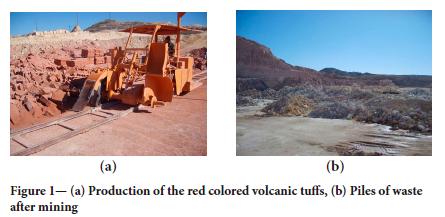
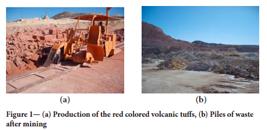
Production of the red colored volcanic tuffs in Cappadocia is shown in Figure 1a and piles of waste after mining is shown in Figure 1b.
Samples of applications for tuffs in Cappadocia
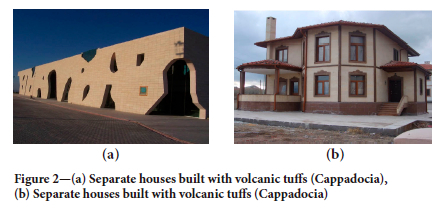
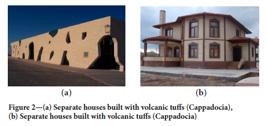
Volcanic tuffs are commonly used in buildings, load bearing walls, door and window frames, interior and exterior facade siding, stairs, pavements, base fillings, garden walls, and handrails, examples of which are illustrated in Figure 2a and Figure 2b.
Production method of composite material
The volcanic tuffs used in the experiments were taken from the quarries of the Saray Taş firm in Nevşehir. Two different colors of tuff, yellow and red, were extracted from these quarries.
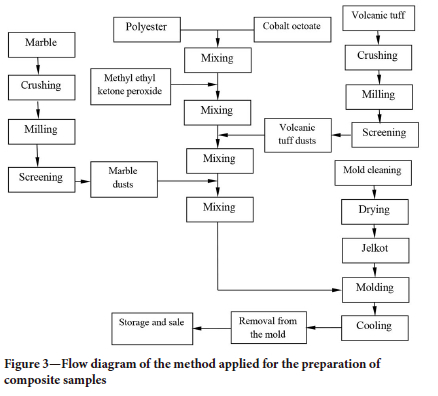
The flow chart shown in Figure 3 illustrates the method followed for the production of composite samples using the Cappadocia region volcanic tuffs. (Siniksaran, 2012).
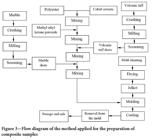
Yellow and red colored volcanic tuff waste that was used in the experiments were grinded in laboratories. Grinded volcanic tuff dust was classified by means of sieve analysis. Volcanic tuff dust that was used in the experiments has a particle size of -200 μm.
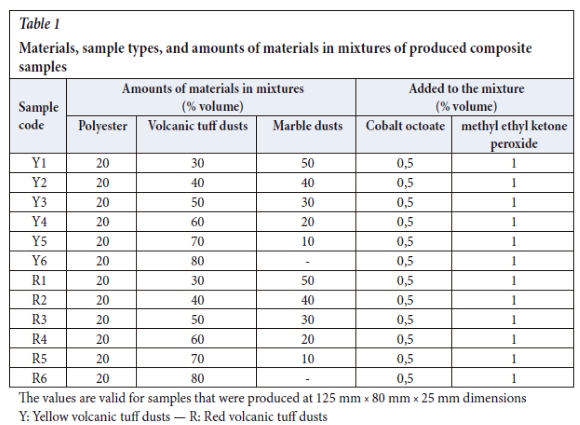
Materials, sample types, and amounts of materials in mixtures of produced composite samples are shown in Table 1.
Polyester was added to the agitation vessels in accordance with their formulations. After that, cobalt octoate with 0,5 percentage by volume was added to the mixture. The mixing procedure was continued until the cobalt octoate was homogeneously distributed in the mixture. Then methyl ethyl ketone peroxide with 1 percentage by volume was added to the mixture. Once again, the mixing procedure was continued until it was homogeneously distributed in the mixture. Thereafter volcanic tuff dusts were added to the mixture in accordance with their formulations and the mixing procedure was continued. The mixing procedure was continued until volcanic tuff dusts were homogeneously distributed in the mixture. To conclude, marble powder was added to the mixture in accordance with its formulations and the mixing procedure was continued. Ultimately, the mixing procedure was continued until the mixture became homogeneously.
After the moulding was finished, the samples were left in the molds for 24 hours to harden. These samples, which were kept in the molds for 24 hours, were then removed from the moulds.
After the samples were removed, they were left to rest for 28 days, both to complete the reaction and to test the changes in their surface. The samples, of which the resting period had been completed, were made ready for experimental procedures.
Properties of produced materials
Methods that are used for the determination of the physical properties (deformations, unit volume weight, amount of water absorption) and mechanical properties (uniaxial compressive stress, modulus of elasticity, point load stress index) of composite samples are indicated in the following.
Physical properties
Samples that were removed from molds with 125 × 80 × 20 mm sizes were left in clean and smooth surfaces at 18°C-22°C room temperature for 28 days. At the end of this procedure, there was no change or deformation observed in the surface and shapes of these samples.
When the samples completed the resting duration, they were weighed by a 0,01 grammes precision scaled weighing machine. The volumes of each of the samples were calculated by size. The sizes of the experiment samples were determined by measuring the sizes in two perpendicular directions and their arithmetic average was taken. Volumes of experiment samples was calculated in accordance with those sizes found.
In order to determine the water absorption ratio, experiment samples that were rested for 28 days (14 days in room temperature conditions and another 14 days in an external environment), were weighed by a 0,01 grammes precision scaled weighing machine. Following this, the samples were again rested in appropriately sized vessels, submerged in water at a depth of 25 mm for 24 hours, at a temperature of+20±2°C. Experiment samples that were submerged in water for 24 hours at the beginning of the experiment were weighed with 0,01 sensitivity after all surface water (droplets) was removed by means of wet rags, and the sample mass in water was determined.
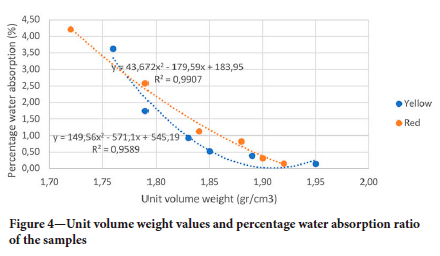
Unit volume weight values and percentage water absorption ratio of the samples are calculated and shown in Figure 4.
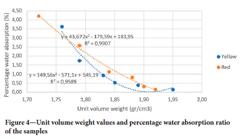
In accordance with the results of the unit weight experiment results, composite samples that are produced by the yellow volcanic tuffs have the highest unit weight value and 30 percent by volume of volcanic tuff dust is found in the Y-1 coded sample, which contains 50% marble powder. The highest unit weight value in composite samples that is pro duced by the red volcanic tuff dusts is the R-1 coded sample and that sample contains volcanic tuff dust with 30 percent by volume and contains 50% marble powder.
When the volcanic tuff dust ratio is increased in composite samples, the unit volume weight value decreases.
In accordance with the results of the water absorption by weight experiment, the Y-6 coded sample has the highest water absorption by weight value in composite samples, which is produced by the yellow volcanic tuff dust, containing 80% volcanic tuff dust. The R-6 coded sample has the highest water absorption by weight value in composite samples, which is produced by the red volcanic tuff dust, containing 80% volcanic tuff dust.
In accordance with the results of the water absorption by weight experiments, water absorption values are increased for both samples of yellow volcanic tuff dust and red volcanic tuff dust when volcanic tuff dust ratios are increased.
Mechanical properties
The uniaxial compressive strength of the samples is determined by the uniaxial press of the experiment samples that have been prepared as a cylindrical rectangular prism, which has two times the length of its diameter.
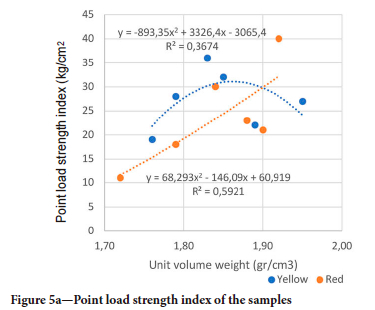
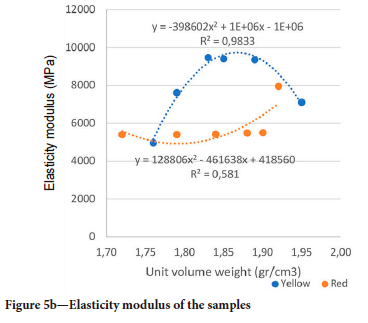
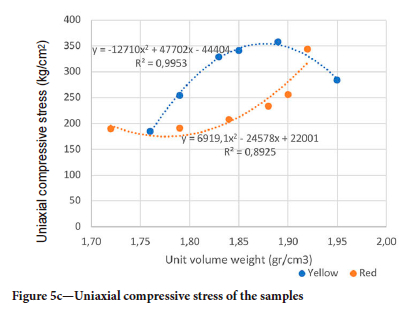
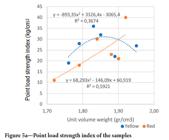
Results of uniaxial compressive stress, elasticity modulus, and point load strength of the samples are shown in Figure 5a, Figure 5b, and Figure 5c.
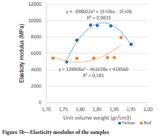
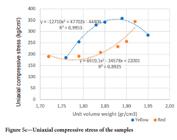
In accordance with the uniaxial compressive strength test results, the highest compressive strength value in composite samples that is produced by the yellow-coloured volcanic tuff dust was found to be the Y-2 coded sample, which contains 40% volcanic tuff dust and 40% marble powder. The highest compressive strength value in composite samples produced by the red colored volcanic tuff dusts was found to be the R-1 coded sample, which comprised 30% volcanic tuff dust and 50% marble powder.
In accordance with the uniaxial compressive strength test results, the lowest compressive strength value in composite samples that was produced by the yellow-colored volcanic tuff dust was determined to be the Y-6 coded sample, which contained volcanic tuff dust with 80% of volume. The lowest compressive strength value in composite samples that was produced by the red colored volcanic tuff dust was determined as being the R-6 coded sample, which contains volcanic tuff dust of 80% of volume.
The point load test is based upon the breaking of the rock that is located between two conical bits. The sample is located between those two conical bits and the load that is applied hydraulically raises the conical bit at the end. The top is fixed to the frame. This frame is designed for placement of the cylindrical or irregular samples. The applied load can be established from the press indicator on the device.
The point load strength of the samples is determined by loading the samples that have been prepared in a rectangular prism shape with a length of two times its diameter, between two conical bits.
In accordance with the results of the point load strength index experiments, the highest point load strength was determined to be the Y-4 coded sample, which is produced by yellow volcanic tuff dust, which contains 60% volcanic tuff dust by volume and 20% marble powder. The highest point load strength was determined to be the R-1 coded sample, which is produced by red volcanic tuff dust, which contains 30% volcanic tuff dust by volume and 50% marble powder.
In accordance with the point load strength index experiments, the lowest point load strength was found to be the Y-6 sample, which is produced by yellow volcanic tuff dust and contains 80% volcanic tuff dust by volume. The lowest point load strength for the composite samples was found to be the sample coded as R-6, which was produced by red coloured volcanic tuff and contains 80% volcanic tuff dust by volume.
Statistical parameter analysis
In accordance with the results of the uniaxial compressive strength experiments, the average uniaxial compressive strength value for the samples produced by yellow-coloured volcanic tuff is 291,83 kg/cm2. On the other hand, the average uniaxial compressive strength value for the samples produced by red coloured volcanic tuff is 237,17 kg/cm2.
In accordance with the results of the point load strength index experiments, the samples produced by the yellow tuff dust have an average point load strength index value of 27,33 kg/cm2, while the samples that were produced by using red volcanic tuff dust have an average point load strength index value of 23,83 kg/cm2.
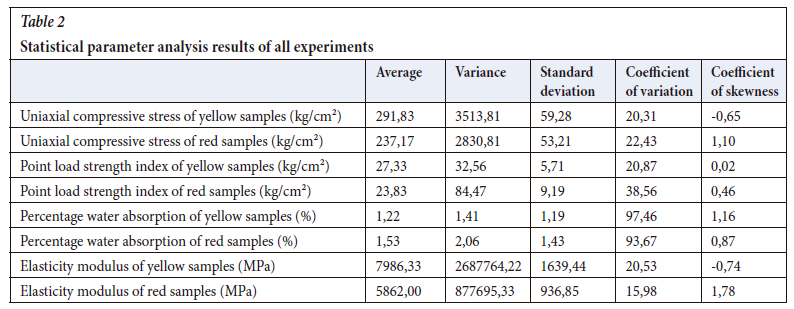
For statistical parameter analysis, the averages, variances, standard deviations, coefficients of variation, and skewness coefficients were calculated and are presented in Table 2.
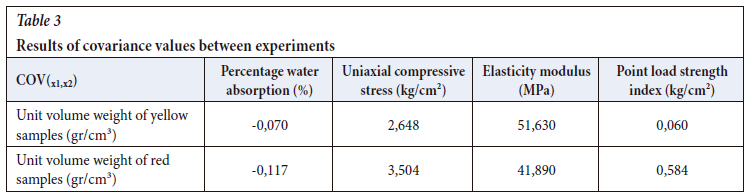
Covariance reveals the increase-decrease relationship between the two data. The covariance values obtained as a result of the experiments are given in Table 3.
Here, only the water absorption test results were found to be negative. In other words, while one data increases, the other decreases. The other results being positive shows that the data are directly proportional to each other.
Conclusions
The use of a combination of volcanic tuff dust and marble powder in composite materials results in an increased volcanic tuff dust ratio and a decrease in strength and hardness. On the other hand, it has been determined that polyester resin, which is used to attach volcanic tuff dust and marble powder, must be applied in definite volumes. Using inadequate amounts of polyester causes problems in attaching the polyester reinforcement materials. Furthermore, using more than just sufficient amounts of polyester causes a weakness in the polyester due to the use of reinforcement material, which is reflected in the material.
However, samples that were rested in room temperature conditions first and afterwards in an exterior environment for 28 days in total exhibited no deformation. Composite materials that are produced in those ratios can be used in buildings for interior and exterior facades.
Previous studies on volcanic tuff rock have pointed out that natural volcanic stone has a water absorption ratio of approximately 23%. For composite materials that are produced by volcanic tuff dust, the water absorption ratio reduces to 0,14%. Thus, composite materials coded as Y-1, Y-2, Y-3, R-1, and R-2 can be used in wet floors, kitchen benches, washbasins, basements of buildings, and the inside of swimming pools.
In previous studies on natural volcanic tuff rocks, it was shown that their uniaxial compressive strength value is approximately 150 kg/cm2. For composite samples that are produced by volcanic tuff dust, the Y-2 sample's uniaxial compressive strength value is 358 kg/cm2. Composite materials that are produced with the volcanic tuff dust ratios determined in this study will be used in areas of natural volcanic tuff rock.
During the production of the composite materials, no press machine or vibrating bench is used. Thus, small air spaces are not closed or trapped in these samples. In order to close or eliminate these small air spaces, a vibrating bench or press machine that squeezes the material in mould can be utilised.
During composite material production there are two different colours of volcanic tuff dust taken from the quarries in the Cappadocia region and composite samples are used with those dusts. There are various coloured volcanic tuff dusts in that area. Different colours of volcanic dust can be used for the production of composite material, and composite materials with different colours and properties can be produced. Different colours of volcanic tuff dust increase the variety of the products.
Compliance with ethical standards
Conflict of interest: On behalf of all authors, the corresponding author states that there is no conflict of interest.
References
- Aliabdo, A.A., Abd Elmoaty, M., Auda, E.M. 2014. Re-use of waste marble dust in the production of cement and concrete. Constructions and Building Materials, vol. 50, pp. 28-41.
- Arel H.Ş. 2016. Recyclability of waste marble in concrete production. Journal of Cleaner Production, vol. 131, pp. 179-188.
- Arıcı E. 1997. Investigation of the effect of the volcanic tuff in Van region and of its usabelty as lightweight concrete aggregate. The Graduate School of Naturel and Applied Sciences, Firat University, Turkey, p 77.
- Balasubramanian, M. 2013. Composite Materials and Processing, CRC Press.
- Bilgin, N., Yeprem, H.A., Arslan, S., Bilgin, A., Günay, E., Marşoğlu, M. 2012. Use of waste marble powder in brick industry. Construction and Building Materials, vol. 29, pp. 449-457.
- Çakırca, D., Turan, N. 2016. Correlations Between Chemical Properties of Liquid Crystal Tuff Nevşehir, Tunceli University. Journal of Science and Youth, vol. 4, Issue 1, pp.1-7.
- Duran, F. 2009. Formation of the Erciyes volcanism, stratigraphy around Koçcağız village (Kayseri) and usage of tuffs as building - facing stone. The Graduate School of Naturel and Applied Sciences, Cukurova University, Turkey, p 148.
- Ene, E., Okagbue, C. 2009. Some basic geotechnical properties of expansive soil modified using pyroclastic dust. Engineering Geology, ISSN: 00137952, vol. 107, pp. 61-65.
- Erol, G., Pekdemir, D. 2018. Investigation of thermal and mechanical behaviors of construction materials obtained from some natural stone waste. Journal of MTA, vol. 157, pp. 193-199.
- Filiz, M., Özel, C., Soykan, O., Ekiz, Y. 2010. Usage of Waste Marble Dust at Paving Stones. Electronic Journal of Construction Technologies, vol. 6, no. 2, pp. 57-72.
- Fisher, R.V., Heiken, G., Mazzoni, M. 2006. Where do tuffs fit into the framework of volcanoes? in Heiken, G., ed.Tuffs. Geological Society of America Special Paper, vol. 408, pp. 5-9.
- Garcia, J., Mallol, C., Bou, E., Silva, G., Fernandez, J., Molina, A., Romera, J. 2003. Recycling Marble working wastes in manufacturing ceramic products. CFI Ceramic Forum International, vol. 80, pp. 84-90.
- Gibson, R.F. 1994. Principles of composite material mechanics, Mc Graw Hill, Inc, Department Of Mechanical Engneering. Wayne State University, Detroit, Michigan, pp.135-139.
- Gürü, M., Akyüz, Y., Akın, E. 2005. The effects of filling ratio on the mechanical properties of marble powder/polyester composites. Journal of Polytechnic, vol. 8, no. 3, pp. 271-274.
- Hossain, K.M.A., Lachemi, M., Easa, S. 2007. Stabilized soils for construction applications incorporating natural resources of Papua new Guinea. Resources conservation & Recycling 51, pp. 711-731.
- Kaya, A., Durukan, S. 2004. Utilization of bentonite-embedded zeolite as clay liner. Applied Clay Science, vol. 25, pp. 83-91.
- Liebig, E., Althaus, E. 1998. Pozzolanic activity of volcanic tuff and suevite, effects of calcination. Cement and Concrete Research, vol. 28, pp. 567-575.
- Matthews, F.L., Rawlings, R.D. 1999. Composite Materials: Engineering and Science, CRC Woodhead Publishing.
- Saltan, M., Findik, F.C. 2008. Stabilization of subbase layer materials with waste pumice in flexible pavement. Building and Environment, vol. 43, pp. 415-421.
- Shwwartz, M. 1997. Composite Materials, Prentice Hall PTR, New Jersey, pp1-15, pp. 170-171.
- Siniksaran, M. 2012. Production of polymer based composite material using volcanic tuff dust, MsC Thesis, The Graduate School of Naturel and Applied Sciences, Selcuk University, Konya, p88.
- Sütçü, M., Alptekin, H., Erdoğmuş, E., Er, Y., Gencel, O. 2015. Characteristics of fired clay bricks with waste marble powder addition as building materials. Constructions and Building Materials, vol. 82, pp. 1-8.
- Şahin, Y. 2000. Introduction to composite materials, Gazi Publisher, Ankara, p327.
- Price, R.H. 1983. Analysis of the Rock Mechanics Properties of Volcanic Tuff Units from Yucca Mountain, Nevada Test Site, Sandia Report SAND82-1315, Albuquerque, New Mexico: Sandia National Laboratories.
- Price, R.H., Bauer, S.J. 1985. Analysis of the Elastic and Strength Properties of Yucca Mountain Tuff, Nevada, Research & Engineering Applications in Rock Masse. Proceedings of the 26th U.S. Symposium on Rock Mechanics, Rapid City, South Dakota, June 26-28, 1985. pp. 89-96.
- Price, R.H., Boyd, P.J., Noel, J.S., Martin, R.J. 1994. Relationship between Staticand Dynamic Rock Properties in Welded and Nonwelded Tuff, Rock Mechanics, ISBN 90-5410-380-8, Nelson & Laubach (eds), Balkme, Rotterdam, pp 505-512.
- Strong, A.B. 2008 Fundamentals of Composites Manufacturing: Materials, Methods and Applications, SME.

Revised: 7 Jul. 2024
Accepted: 22 Nov. 2024
Published: February 2025