Removal of heavy metals using cassava peel waste biomass in a multi-stage countercurrent batch operation
Abstract
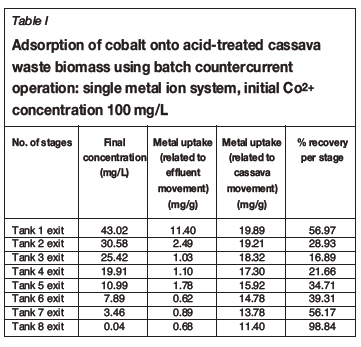
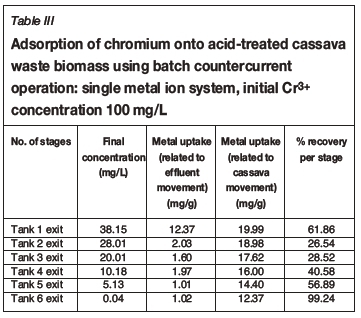
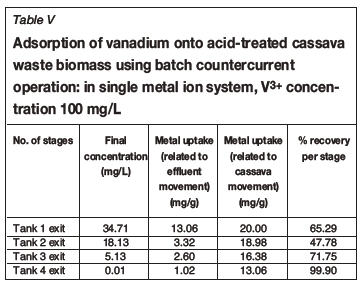
This paper presents a study of the removal of cobalt (Co2+), chromium (Cr3+), and vanadium (V3+) from synthetic effluent solution using cassava waste biomass. Test work was carried out in a multi-stage countercurrent batch system. Single and ternary metal ion systems were studied. A feed inlet concentration of 100 mg/L for each metal ion system was contacted with 0.5 g of cassava waste biomass. The target concentration in the final outlet stream was set against the South African Department of Water and Forestry (DWAF) standards. The results showed that the adsorption capacity was slightly lower for ternary metal ion systems than for single metal ion systems. This was attributed to the greater competition among the metal ions for the occupancy of the binding surfaces on the cassava waste in the ternary systems. Eight adsorption stages were required to meet the targeted limit of 0.5 mg/L for Co2+set by the DWAF. The Cr3+system needed six stages to obtain the targeted limit of 0.1 mg/L, while the V3+ system required four stages to attain the target limit of 0.2 mg/L. In general, cassava waste biomass adsorbed the metal ions in the following order: V3+> Cr3+> Co2+.
heavy metals; wastewater; biosorption; cassava waste; biomass; multistage; countercurrent; batch
 Thumbnail
 Thumbnail
 Thumbnail