Collaborative accountability: Empowering roles in tailings storage facilities governance and risk management
Abstract
Effective governance of tailings storage facilities hinges on adherence to international standards like the Global Industry Standard on Tailings Management, which promotes safety, sustainability, and ethical accountability in mining. However, governance is not just about assigning titles; it demands a deep, active engagement with the responsibilities those roles entail. This paper explores the philosophical risks of role misalignment in tailings storage facilities governance. When individuals treat roles as symbolic rather than functional, they risk undermining the intent of the entire framework. Titles alone do not ensure accountability; it is the embodiment of responsibility that matters. Misalignment leads to poor communication, blurred decision-making, and a lack of long-term risk awareness. Central to this discussion are the roles of the Engineer of Record, Responsible Tailings Facility Engineer, and Accountable Executive, as defined in Principle 9 of the Global Industry Standard on Tailings Management. The paper examines how these roles interconnect and how the Accountable Executive must empower the Engineer of Record, not just formally, but in a way that enables meaningful oversight. The concept of 'empowerment' is unpacked to emphasise its practical and ethical dimensions. Additionally, the paper explores the 'as low as reasonably practicable' risk principle and its relevance to tailings storage facilities governance. The low as reasonably practicable principle is not just a technical guideline; it reflects a commitment to minimising risk through informed, ethical decision-making. The roles of the Engineer of Record, Responsible Tailings Facility Engineer, and Accountable Executive must align with this principle to ensure that risk management is both effective and morally sound. Ultimately, this paper critiques current governance practices and calls for a shift toward genuine engagement. It argues that holding a role means more than having a title; it requires understanding, commitment, and ethical accountability. By rethinking how roles are defined and enacted, the mining industry can better manage systemic risks and foster a culture of responsible stewardship.
Tailings Storage Facilities (TSFs); GISTM governance; Collaborative accountability Engineer of Record (EOR); Risk management; ALARP principle and Role misalignment
Introduction
Tailings storage facilities (TSF) are critical components of mining operations, designed to contain the residual by-products of mineral extraction, often a mixture of finely ground rock, water, and potentially hazardous substances such as heavy metals or process chemicals. If not managed responsibly, TSFs pose significant risks to human health, ecosystems, and infrastructure. Catastrophic failures can result in widespread environmental damage, loss of life, and long-term socio-economic disruption. Recognising these risks, the Global Industry Standard on Tailings Management (GISTM) advocates for a comprehensive, lifecycle-based approach to TSF management, integrating sound engineering practices with robust governance structures. At the heart of this governance framework is a triad of roles: the Accountable Executive (AE), the Responsible Tailings Facility Engineer (RTFE), and the Engineer of Record (EOR). These roles form a collaborative triangle, each with distinct but interrelated responsibilities, authorities, and competencies. The structure is designed to function through collaborative accountability, where effective TSF management depends not only on individual expertise, but on the alignment and interaction of these roles.
This paper explores the philosophical and practical risks that arise when this alignment breaks down. Role misalignment (where individuals hold titles without fully enacting the responsibilities they imply) can lead to gaps in oversight, blurred decision-making, and ethical ambiguity. It can leave individuals exposed to liability and, more critically, result in failures of execution when the appropriate party is either not adequately empowered or does not take ownership of essential tasks. The paper critiques the mining industry's current ability to embody the tenets of the GISTM as intended. It argues that titles alone do not ensure accountability; rather, it is the meaningful enactment of responsibility that safeguards TSF integrity. It further considers the 'as low as reasonably practicable' (ALARP) risk principle as a moral and practical benchmark for risk management, arguing that role alignment (particularly in how each governance actor interprets and applies ALARP) is fundamental to ensuring that TSF management is not only technically effective, but ethically sound. When the EOR, RTFE, and AE operate in concert, with clearly defined responsibilities and mutual empowerment, the governance structure functions as intended, i.e., to reduce risk and uphold the GISTM's goal of zero harm.
Governance framework for TSFs
Overview of TSF governance in terms of GISTM
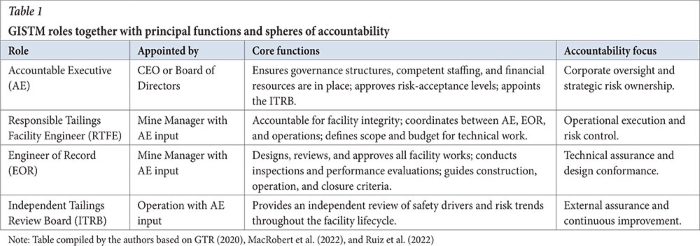
The Global Industry Standard on Tailings Management (GISTM), released in 2020 by the Global Tailings Review (GTR), defines a governance model designed to achieve 'zero harm to people and the environment' through clearly articulated accountability, responsibility, and competency frameworks (GTR, 2020). It replaces legacy ambiguity in tailings oversight, such as that observed under SANS 10286, with a globally consistent structure centred on four key appointments, those being the Accountable Executive (AE), Responsible Tailings Facility Engineer (RTFE), Engineer of Record (EOR), and the Independent Tailings Review Board (ITRB).
This framework aligns corporate governance with engineering practice by ensuring that competent professionals make technical decisions and that ultimate accountability resides at the highest corporate level. As outlined by MacRobert et al. (2022), the AE ensures that management structures and resources exist, the RTFE manages facility-level risk, the EOR guarantees technical integrity, and the ITRB provides independent assurance without decision-making authority. Together, these roles form the backbone of GISTM-aligned governance systems.
Roles in TSF governance
The GISTM is built on the recognition that safe tailings management is not solely a technical exercise but a governance discipline requiring the alignment of authority, accountability, and competence throughout an organisation. Before the publication of the GISTM, governance arrangements for tailings facilities were often fragmented and inconsistent, creating uncertainty over who ultimately bore responsibility for safety. The GISTM was developed to remove this ambiguity by defining a transparent management hierarchy that ensures critical decisions are made by qualified professionals while keeping accountability anchored at the highest corporate level (GTR, 2020).
In the South African context, shaped historically by SANS 10286, Code of Practice, Mine Residue (2013), the use of terms such as manager, operator, and professional engineer was frequently inconsistent, leading to blurred lines of responsibility.
MacRobert et al. (2022) highlighted that this structural ambiguity allowed operational and design responsibilities to overlap without clear accountability, which could compromise facility safety.
The GISTM resolves this by prescribing four explicit appointments, each with clearly defined authority and responsibility:
➤ The AE, who embodies corporate accountability and ensures governance structures, competencies, and resourcing are in place.
➤ The RTFE, who manages day-to-day operational integrity and risk control at the facility level.
➤ The EOR, who assures technical adequacy, design conformance, and lifecycle safety.
➤ The ITRB, which provides objective, periodic review and external assurance of safety drivers.
These appointments form the foundation of the GISTM accountability framework, addressing one of the key lessons identified from major tailings failures worldwide-namely, that a lack of clear ownership and communication was a recurrent causal factor (GTR, 2020; MacRobert et al., 2022). By defining who is responsible for what, and how authority flows between roles, the GISTM promotes a culture in which risk ownership is transparent, decisions are traceable, and safety is prioritised above production (Ruiz et al., 2022).
The four key roles are summarised in Table 1, along with their principal functions and spheres of accountability.
Together, these appointments create an integrated triangle of accountability that links strategic authority, operational responsibility, and technical assurance. Each role is distinct, yet interdependent; the effectiveness of this framework relies not only on the appointment of competent individuals but on their empowerment to act within clearly defined boundaries of authority, an issue explored further in the next section.
Role, responsibilities, and interdependencies: The governance triangle
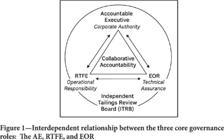
The GISTM recognises that the safe management of a TSF depends not only on sound engineering but also on a clear and balanced governance structure. At the centre of this structure is a three-way relationship between the AE, the RTFE, and the EOR. MacRobert et al. (2022) describe the AE-RTFE-EOR relationship as a mutually reinforcing structure, rather than a hierarchy. These roles form what has become known as the 'triangle of accountability' or governance triangle (MacRobert et al., 2022).
Each vertex of the triangle represents a different dimension of governance:
➤ Corporate authority (AE);
➤ Operational responsibility (RTFE);
➤ Technical assurance (EOR).
For the triangle to function effectively, these three dimensions must operate in dynamic equilibrium, supported by communication, trust, and mutual empowerment. The triangle works only when each side supports the others; if one weakens, the whole system becomes unstable. The GISTM's design assumes that no single role alone can ensure safety; only the interaction between them can maintain it.
This schematic, shown in Figure 1, illustrates the interdependent relationship between the three core governance roles defined by the GISTM: The AE, RTFE, and EOR. Each vertex of the triangle represents a distinct but complementary sphere of accountability.
At the top of the triangle sits the AE, usually a senior company leader with the authority to commit resources and make policy decisions. The AE is ultimately responsible for embedding tailings safety into the company's wider risk and governance framework. This means ensuring that the right people are appointed, that they are competent and empowered, and that sufficient funds and systems are in place to manage risk effectively. GISTM Principle 2 explicitly states that ultimate accountability for TSF safety rests with the company's highest governing body (GTR, 2020). In practical terms, the AE's responsibilities include:
➤ Approving risk acceptance criteria and tolerances.
➤ Ensuring a competent RTFE and EOR are appointed and empowered.
➤ Maintaining direct oversight through periodic reviews and board-level reporting.
The AE must therefore translate corporate governance into technical action by enabling and resourcing the RTFE and EOR. When the AE fails to empower these roles, risk migrates downward into operational and technical layers without adequate authority to mitigate it (MacRobert et al., 2022). The AE's ability to resource and empower the RTFE and EOR is what gives the governance system strength and credibility.
The RTFE sits at the operational base of the triangle. This is the person directly responsible for the day-to-day integrity of the facility, making sure that deposition, water management, instrumentation, and maintenance all align with design intent and company policy. The RTFE acts as the main link between the AE and the EOR, translating corporate expectations into practical action on site. According to the GISTM, the RTFE is accountable for the integrity of one or more named facilities, acting as the custodian of site-level implementation of the tailings management system (GTR, 2020). This means that the RTFE must have enough authority and time to focus solely on tailings safety. The RTFE's functions include:
➤ Overseeing day-to-day operations of the TSF, including deposition, water balance, and instrumentation.
➤ Coordinating risk communication between operations, the EOR, and corporate management.
➤ Ensuring that design recommendations are implemented as intended.
➤ Maintaining awareness of the facility's performance and compliance status.
MacRobert et al. (2022) observed that, in South African practice, the RTFE role is often conflated with other managerial duties (e.g., metallurgical or plant management), which dilutes its focus and creates potential governance gaps. This can create divided priorities and blurred accountability. The RTFE should therefore be a dedicated, technically competent individual with authority to act, sufficient resources, and direct access to both the AE and the EOR.
The EOR is the technical cornerstone of the triangle. This role carries a professional responsibility, with the primary mandate to ensure that the facility is designed, constructed, operated, and closed in accordance with the design intent and applicable standards. They carry professional and ethical accountability for the technical adequacy of the facility and for verifying that its performance remains within acceptable limits (MacRobert et al., 2022). The EOR collaborates closely with the RTFE to interpret performance data, identify deviations, and recommend remedial actions.
In line with GISTM Principle 9, the EOR's professional judgment must take precedence over commercial or production pressures (GTR, 2020). However, this is only achievable when the AE formally empowers the EOR to make safety-critical recommendations without interference. Ruiz et al. (2022) demonstrated that when the AE grants the EOR direct access to decision-making channels, rather than reporting through multiple management layers, tailings governance systems mature faster, achieve more consistent safety outcomes, and adopt best practices more effectively.
Although not part of the internal triangle, the Independent Tailings Review Board (ITRB) provides an essential external perspective. Its role is to review both the technical condition of the facility and the effectiveness of the governance relationships themselves. As shown by Ruiz et al. (2022), active and regular engagement with an ITRB strengthens internal accountability and promotes a culture of continuous improvement rather than reactive compliance.
The Governance Triangle is not a chain of command but a system of shared accountability and constant feedback. Information must circulate freely among all three parties. The AE relies on the RTFE and EOR for an honest assessment of risk, the RTFE relies on the EOR for technical direction, and the EOR relies on the AE for the mandate and resources to act. If communication fails or one role is under-resourced, responsibility becomes fragmented, and decisions can be delayed or diluted. This breakdown in collaboration has been identified as a recurring weakness in past TSF failures (MacRobert et al., 2022).
A balanced triangle is characterised by:
➤ clear reporting lines and defined escalation procedures;
➤ regular three-way meetings and transparent documentation;
➤ mutual respect for each role's boundaries and expertise;
➤ a shared understanding that risk accountability is collective, not isolated.
When the triangle is functioning well, decisions are transparent, recommendations are implemented quickly, and each party understands its limits and obligations. When it is not, the structure becomes top-heavy, dominated by production or cost pressures, and the engineers who carry technical risk are left without the authority to prevent unsafe practices.
Philosophical exploration of responsibility
What does it mean to hold a role in TSF governance?
As highlighted in this paper, the GISTM introduces a structured framework of role-based accountability aimed at enhancing the safety, integrity, and transparency of tailings facilities. But what does it truly mean to hold a role in TSF governance? Appointment to a defined role, such as AE, EOR or RTFE, is intended to represent a formal entrustment of ethical, technical, and operational responsibility. Philosophically, however, the concept of 'holding a role' extends beyond procedural designation. It implies participation in a social contract of stewardship, where professional identity is shaped by the duty to safeguard human life, environmental integrity, and public trust.
Yet, the embodiment of these roles in current industry practice reveals a persistent tension between the conceptual ideals embedded in governance standards and the pragmatic realities of role execution. Research in engineering ethics and governance shows that while roles are formally assigned, their enactment is often shaped by organisational constraints, cultural norms, resource scarcity, and ambiguous accountability structures (MacRobert et al., 2022). Johnson (2017) argues that accountability must be understood as a relational practice, shaped through interactions and shared norms, not merely an isolated moral obligation. In the context of tailings governance, this means that the ethical weight of a role is not automatically realised through appointment - it must be actively cultivated through institutional support, professional competence, and a culture of ethical responsibility.
Moreover, the Southern African mining context presents unique challenges, including a limited pool of qualified professionals and competing pressures between regulatory compliance and operational efficiency. This often leads to symbolic compliance, where roles are filled to meet external expectations but lack the depth of engagement required for meaningful accountability (MacRobert et al., 2022). As such, interrogating the philosophical nature of holding a role in TSF governance reveals a critical gap between the aspirational framework of the GISTM and the lived realities of its implementation.
Symbolic versus functional roles
Symbolic roles refer to positions that are formally assigned within an organisation or governance framework but may lack substantive authority, engagement, or impact. These roles often serve to signal compliance, legitimacy or alignment with external expectations (such as regulatory standards or public scrutiny), without necessarily influencing decision-making or operational outcomes.
In contrast, functional roles are actively performed and embedded within the organisational processes. They involve real decision-making power, technical competence, and ethical responsibility. Functional role holders engage with the complexities of their duties and are supported by institutional structures that enable accountability and oversight.
Westphal and Park (2020) highlight a pervasive pattern in organisations where formal governance structures are often decoupled from actual practices, creating a disconnection between appearance and reality. This misalignment fosters symbolic management, where compliance and oversight mechanisms exist more for display than for substantive effect, ultimately undermining the integrity of governance systems. In the context of tailings management and the GISTM, this decoupling may occur when roles such as the EOR or RTFE are appointed to satisfy the external standards for compliance purposes but lack the necessary institutional support or clarity required for meaningful execution of their duties.
This distinction between symbolic and functional roles sets the stage for a deeper philosophical inquiry into the nature of responsibility in governance frameworks, particularly in high-risk contexts like TSF management, where the consequences of role failure can be profound.
Responsibility and accountability in TSF governance
Responsibility, accountability, and authority are foundational, yet distinct concepts in governance, each contributing to the clarity and effectiveness of role-based systems. The ICMM Tailings Management Good Practice Guide (2025) offers precise definitions:
➤ Responsibility is the obligation to perform a task in accordance with defined expectations, with consequences if those expectations are not met.
➤ Accountability is the answerability for one's own performance and that of others whose work one directs, and it cannot be delegated.
➤ Authority is the power to make decisions and assign or delegate responsibilities appropriately.
These distinctions are not merely semantic but are key to establishing clarity in governance structures and ensuring ethical and effective decision-making.
Responsibility refers to the duty or obligation to perform assigned tasks in accordance with defined expectations. It is typically linked to a role or position and flows upward in organisational hierarchies. In TSF governance, responsibility is both technical and moral. For example, an RTFE is tasked with ensuring that operational practices conform to design specifications and safety protocols. This responsibility includes anticipating risks and making informed decisions that protect human and environmental well-being.
Accountability is the requirement to answer for one's actions and decisions, including those delegated to others. Unlike responsibility, accountability cannot be delegated - it remains with the individual or entity that holds it. The ICMM Good Practice Guide emphasises that individuals with accountability must be clearly identified and supported by governance structures that enable oversight and ethical scrutiny (ICMM, 2025). In practice, the AE in a mining company is answerable for the safety of tailings facilities, even if operational tasks are delegated to engineers or contractors. The role requires not only technical understanding but also ethical leadership and the ability to respond to failures or emergencies.
Authority is the legitimate power to make decisions, assign responsibilities, and allocate resources. It flows downward in organisational hierarchies and is essential for enabling individuals to act on their responsibilities. Without appropriate authority, responsibility and accountability become symbolic rather than functional.
For example, if an RTFE is responsible for implementing safety protocols but lacks the authority to halt operations or request additional resources, their role is undermined. The ICMM Good Practice Guide stresses that individuals with responsibility and accountability must also have commensurate authority to act effectively (ICMM, 2025). This alignment is crucial for ethical governance as it ensures those who are expected to act are empowered to do so.
Strengthening the Governance Triangle through collaborative accountability
Effective tailings governance relies not only on the clarity of individual roles but on the alignment and interaction of three foundational elements: Responsibility, accountability, and authority. When these elements are misaligned, such as when individuals are held accountable without authority, or given responsibility without support, governance systems become vulnerable to failure. This is particularly dangerous in TSF management, where unclear roles can lead to delayed decisions, overlooked risks, and catastrophic outcomes.
The Governance Triangle - comprising the AE, RTFE, and EOR, as described already in this paper, provides a structured and balanced framework for distributing the core governance attributes of responsibility, accountability, and authority across distinct yet interdependent roles. By assigning each role a specific domain - corporate oversight (AE), operational execution (RTFE), and technical assurance (EOR) - the triangle ensures that no single individual bears disproportionate governance burden. This separation of functions allows each role to operate with clarity and autonomy within its sphere, while still contributing to a unified safety and risk management strategy. More importantly, the distribution of governance functions enables collaborative accountability, where each role supports and reinforces the others through shared responsibilities and open communication.
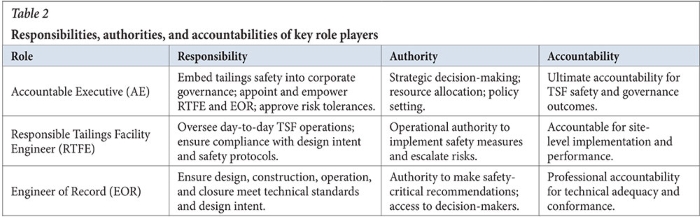
Table 2 outlines the specific responsibilities, authorities, and accountabilities of each role, illustrating how their distinct functions contribute to a cohesive governance system.
Each role must be empowered to act within its domain. For example, the AE must have the authority to allocate resources and approve risk thresholds, while the RTFE must be able to halt operations if safety is compromised. The EOR must be able to issue independent technical recommendations without interference from production pressures (GISTM, 2020; Ruiz et al., 2022).
Rather that functioning hierarchically, these roles operate in complementary alignment, as mentioned before. By enabling and deliberately engaging with each other through continuous communication, an environment of mutual respect and a shared commitment to safety will be fostered. As shown in Table 3, each role has a unique focus but overlaps in decision-making and risk management, which is essential for integrated and effective governance.
The triangle's resilience lies in its ability to enact and embody individual responsibilities in concert. When one role is under-resourced or lacks authority, the triangle becomes unstable. For instance, if the EOR is not empowered to escalate safety concerns directly to the AE, technical risks may go unaddressed. Similarly, if the RTFEs are burdened with unrelated managerial duties, their focus on tailings safety may be diluted (MacRobert et al., 2022).
Practical implications of role misalignment
Defining role misalignment
The governance framework established by the GISTM depends on a deliberate balance of authority, responsibility, and technical competence among the AE, RTFE, and EOR. When roles are clearly defined and aligned, decision-making is transparent, communication remains open, and safety is prioritised through early identification and timely mitigation of risk. When alignment deteriorates, collaborative accountability fractures, resulting not only in inconsistent decisions and weak communication, but also in delayed interventions, which can materially increase the likelihood of failure.
Role misalignment arises when the distribution of responsibility, authority, decision-making, timing or accountability among these roles becomes unclear, overlapping, or inconsistent with the intent of governance frameworks such as the GISTM. It often stems from ambiguous reporting lines, inadequate empowerment, misplaced delegation, or escalation pathways that introduce delay at critical moments. In this context, misalignment is not only about who is responsible and what they are responsible for, but also when decisions are made and how quickly action can be taken. Fundamentally, misalignment occurs when the what (responsibilities), who (role holders), how (authority to act), and when (timeliness of intervention) are not coherently aligned. This breakdown undermines the principle of collaborative accountability and typically manifests as communication barriers, deferred decisions, and risk controls being implemented too late to prevent escalation.
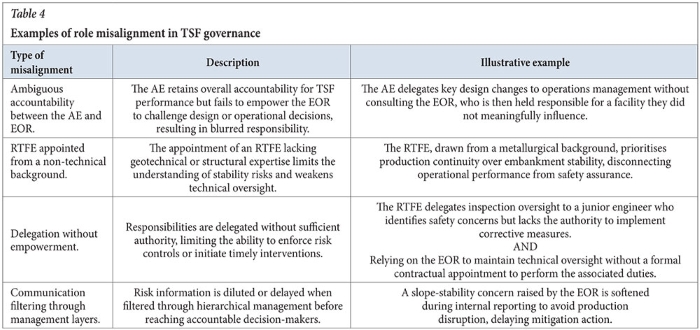
The manifestations of role misalignment vary with organisational structure, technical capacity, and communication practices. Table 4 summarises recurring industry examples illustrating how unclear authority, unsuitable appointments, or filtered communication compromise the governance intent of the GISTM and erode accountability and risk visibility.
These examples demonstrate that misalignment rarely appears as a single failure but as a systemic weakness across the governance structure. When interfaces between the AE, EOR, and RTFE are not clearly delineated or respected, accountability diffuses and risk ownership blurs. Consequently, organisational safeguards, such as oversight committees or design reviews, may fail to detect early signs of technical or behavioural drift. Respected engineers within the South African industry have consistently raised concerns about the potential risks posed by breakdowns in governance - warning that failures often stem not from isolated errors, but from persistent structural and behavioural misalignments (MacRobert et al., 2022).
Simultaneously, individuals occupying these roles face disproportionate personal liability for outcomes they cannot fully influence. This duality, where institutional risk increases while individual accountability intensifies, highlights the need for clear authority pathways and empowered technical roles. The following subsection explores these vulnerabilities in greater depth, exploring how each role carries distinct organisational and individual risks within the governance hierarchy.
Risks and challenges in role misalignment
Role misalignment generates complex risks that extend beyond operational inefficiency to threaten governance integrity. When authority and accountability lose clarity, both organisations and individuals are exposed to uneven and amplified risks within the AE-RTFE-EOR structure.
The Accountable Executive (AE) holds ultimate corporate responsibility for ensuring that governance systems are effective, adequately resourced, and supported by sound oversight mechanisms. This role anchors the organisation's legal and reputational standing. When safety measures are poorly enforced or professional advice is ignored, consequences may include regulatory penalties, shareholder litigation, and a loss of stakeholder confidence. On a personal level, the AE faces ethical and, in some jurisdictions, legal exposure stemming from uninformed or technically unsound decision-making. The AE therefore operates within a delicate balance where accountability may exceed technical competence, creating governance gaps that can compromise the quality of decisions made at the highest level.
The Responsible Tailings Facility Engineer (RTFE) functions at the interface between operational delivery and technical assurance. Organisationally, lapses in compliance or inadequate control within the RTFE's remit can jeopardise both facility integrity and production continuity. The risk to the organisation increases when the RTFE lacks the authority and/or the ``expertise to enforce geotechnical controls (for example), particularly in environments driven by production targets. Individually, the RTFE faces the challenge of balancing operational efficiency with safety obligations. This duality can foster divided loyalties, where production pressures overshadow risk management responsibilities. Delegating oversight without verification, or disregarding the EOR's technical guidance, can constitute professional negligence and expose the RTFE to disciplinary or legal consequences.
The Engineer of Record (EOR) carries the highest level of technical and ethical responsibility within the governance structure. At an organisational level, design errors, misinterpretation of monitoring data, or inadequate performance evaluation can lead to significant financial loss, environmental harm, and reputational damage. The risk is compounded when a single EOR is assigned to multiple facilities, reducing continuity of institutional knowledge and increasing systemic vulnerability. Individually, the EOR bears substantial personal liability. Professional registration obliges the EOR to act independently, uphold ethical standards, and prioritise public safety. Yet, when management interference, incomplete and/or flawed and erroneous data sets, or commercial pressures compromise professional judgement, this independence can erode, turning technical challenges into ethical dilemmas and legal exposure.
Collectively, these vulnerabilities show that misalignment undermines not just operations but the ethical foundations of governance. A particularly critical outcome occurs when the EOR is not empowered by the AE to exercise independent technical judgment, an issue explored in the following.
Implications of EOR disempowerment in relation to GISTM Principle 9
When the AE does not adequately empower the EOR, the consequences extend beyond technical oversight and undermine the intent of GISTM Principle 9. This principle requires that qualified professionals inform all decisions and that the safety of people and the environment take precedence over production and cost considerations. EOR disempowerment (through scope restrictions, delayed approvals, erroneous or misleading data, or withheld resources) transfers organisational risk to the individual engineer.
Production pressures that defer maintenance or exceed design limits also erode the risk principle, as low as reasonably practicable (ALARP), weakening the foundation of risk-based decision-making. Professionally, failure to escalate or withdraw endorsement may constitute negligence and ethically, it represents a breach of duty of care. Furthermore, legally, it exposes the EOR to shared liability with the owner's management.
Disempowerment replaces collaborative accountability with top-down control driven by production priorities. As noted by MacRobert et al. (2022), these imbalances are increasingly evident in organisations where formal role appointments have progressed more rapidly than the systems and authority structures that are required to support genuine professional empowerment.
Preventing these outcomes requires formal safeguards. The EOR must have: Authority to suspend unsafe operations, direct access to the AE and board, transparent escalation procedures, and protection for technical dissent. These measures preserve professional independence and uphold the GISTM's intent.
Ultimately, the EOR's duty is to protect life, the environment, and the public interest. Silence in the face of risk is an ethical failure. Genuine empowerment under Principle 9 ensures that safety decisions remain within the domain of qualified professionals and that risk is judged consistently across the governance framework.
ALARP principle and its influence on decision-making
The ALARP risk principle requires that all reasonable measures be taken to reduce risk until further mitigation becomes grossly disproportionate to the benefit gained. Its application varies with how each role interprets 'reasonable' and 'practicable.'
For the AE, ALARP is often viewed through a corporate lens that balances safety against financial and production objectives. This can narrow the definition of 'reasonably practicable' when short-term economic priorities dominate. The RTFE, operating at an operational level, tends to apply ALARP reactively (focusing on compliance and continuity rather than proactive risk reduction), especially under production pressure. By contrast, the EOR interprets ALARP as an ethical and professional duty to minimise risk to life and the environment, independent of commercial influence. This aligns with GISTM Principle 9 but relies on genuine empowerment to be upheld in practice.
These differing interpretations create uneven applications of ALARP across the governance framework. While all parties may claim adherence, their thresholds for acceptable risk vary, often reflecting organisational hierarchy rather than objective assessment. Achieving consistency requires shared risk criteria, transparent justification, and alignment of accountability so that ALARP remains a tool of safety assurance, not of convenience.
Appropriate appointment of the RTFE and its influence on governance integrity
Consistent application of ALARP also depends on the technical suitability of the RTFE, who is the operational custodian of risk. Under GISTM, the RTFE must uphold facility integrity through technically informed oversight (ICMM, 2020; ICOLD, 2022). However, many operations appoint metallurgists or production managers based on seniority rather than technical alignment (MacRobert et al., 2022). While these individuals bring process expertise, they may lack the geotechnical competence needed to assess embankment behaviour or recognise early instability, for example, often prioritising production over safety (Blight, 2010; Morgenstern, 2018).
Conversely, appointing a geotechnical or tailings engineer as RTFE aligns with the GISTM's emphasis on informed, risk-based decisions (Robertson, 2021). Such individuals can better interpret performance data, challenge operational pressures, and collaborate effectively with the EOR (Azam, Li, 2010). Competence-based appointments enhance governance credibility, support consistent ALARP application, and reinforce collaborative accountability (ICOLD, 2022; Morgenstern et al., 2015).
Effective TSF governance relies not only on defined responsibilities but on empowerment, competence, and integration. When authority and accountability diverge-through disempowered EORs, operationally constrained RTFEs, or inconsistent ALARP interpretation-the intent of the GISTM is diluted. The next section examines these broader systemic factors, analysing how current organisational culture and leadership behaviours serve to reinforce misalignment and limit the practical realisation of GISTM principles.
Critique of current TSF governance structure
The GISTM provides a robust framework for governance and accountability in TSF management. It has clarified roles, improved transparency, and raised the visibility of tailings risks at the executive level. However, consistent implementation remains uneven, limited by hierarchical structures, resource disparities, and differing interpretations of accountability within the AE-RTFE-EOR framework.
While the GISTM has fostered a shared language of responsibility and embedded tailings risk within corporate decision-making, governance often remains procedural rather than transformative, strong in documentation but weak in behavioural change. This gap between policy and practice undermines the intent of the standard and sustains fragmented accountability.
Advancing governance maturity requires a shift from compliance to role embodiment. The AE, RTFE, and EOR must act as interdependent peers within a system of shared accountability, supported by both structural mechanisms and a culture of ethical engagement. Achieving this alignment demands more than formal compliance; it calls for continuous learning, professional courage, and empowerment across all levels of decision-making.
Although many organisations have achieved compliance milestones, few have internalised the GISTM's principles into everyday governance, that is, procedural comfort risks replacing active stewardship. Sustained improvement depends on reinforcing professional accountability, clarifying interfaces, and maintaining ethical vigilance against production-driven decisions.
Implementing the GISTM also requires significant investment. Recruiting and retaining qualified AEs, RTFEs, and EORs, supported by capable teams, imposes costs that challenge smaller or lower-margin operations. Yet, underinvestment in governance capacity presents far greater long-term risk. Competent, empowered professionals remain the most effective safeguard against technical failure and reputational loss.
Despite its emphasis on defined roles, the current governance structure provides few mechanisms for genuine collaboration. The AE-RTFE-EOR relationship often functions through reporting lines rather than active dialogue, weakening both technical input and shared ownership of risk. Strengthening this 'governance triangle' requires structured communication pathways, joint risk reviews, and transparent escalation processes that allow unfiltered technical concerns to reach the executive level. Building mutual respect and accountability can transform the framework from a compliance hierarchy into a learning-oriented system capable of managing evolving risks.
Conclusion
The GISTM has redefined expectations for accountability in tailings management, but frameworks alone cannot ensure integrity. Their success depends on competence, empowerment, and ethical commitment. Persistent misalignment - through disempowered EORs, constrained RTFEs, and hierarchical decision-making - continues to erode the principle of collaborative accountability.
Progress demands movement beyond compliance towards role embodiment; the active, values-driven exercise of professional responsibility. The AE, RTFE, and EOR must function as empowered peers, guided by technical integrity rather than procedural conformity.
Organisations should invest in competence, foster open communication, and preserve the primacy of safety and ethics in governance. Regulators and professional bodies must likewise enable, rather than restrict, independent technical oversight.
Future dialogue must extend beyond engineering practice to the ethical and cultural dimensions of governance. Understanding how professional identity and organisational behaviour shape accountability is vital to closing the gap between compliance and stewardship. Only through such reflection can the industry progress from procedural assurance to genuine trust.
References
- Azam, S., Li, Q. 2010.'Tailings dam failures: a review of the last one hundred years', Geotechnical News, vol. 28, no. 4, pp. 50-53.
- Blight, G.E. 2010. Geotechnical Engineering for Mine Waste Storage Facilities. Boca Raton: CRC Press.
- GISTM. 2020. Global Industry Standard on Tailings Management. International Council on Mining and Metals (ICMM), United Nations Environment Programme (UNEP), and Principles for Responsible Investment (PRI).
- Global Tailings Review. 2020. Global Tailings Review Report: Towards Zero Harm. London: United Nations Environment Programme (UNEP), International Council on Mining and Metals (ICMM), and Principles for Responsible Investment (PRI).
- International Council on Mining and Metals. 2020. Role Profile Guidance for Accountable Executive, Engineer of Record, and Responsible Tailings Facility Engineer under the GISTM. London: ICMM.
- International Council on Mining and Metals. 2025. Tailings Management: Good Practice Guide. 2nd ed. London: ICMM.
- ICOLD. 2022. Bulletin 181: Tailings Dam Safety - Lessons Learned and Emerging Trends. Paris: International Commission on Large Dams.
- Johnson, D.G. 2017. Rethinking the Social Responsibilities of Engineers as a Form of Accountability. In: Michelfelder, D., Newberry, B., Zhu, Q. (eds) Philosophy and Engineering. Philosophy of Engineering and Technology, vol 26. Springer, Cham.
- MacRobert, C.J., Wates, J., Coetzee, A., Howell, G. 2022. 'GISTM: Who are the responsible individuals?', Journal of the Southern African Institute of Mining and Metallurgy, vol. 122, no. 6, pp. 299ff.
- Morgenstern, N.R. 2018. 'The role of the Engineer of Record in tailings dam safety', CIM Journal, vol. 9, no. 1, pp. 32-38.
- MacRobert, D., Owen, J., Mahlangu, L. 2022. 'Professional roles and governance interfaces in implementing the Global Industry Standard on Tailings Management (GISTM)', Journal of the Southern African Institute of Mining and Metallurgy, vol. 122, no. 9, pp. 471-482.
- Morgenstern, N.R., Vick, S.G., Robertson, P.K. 2015. Report on Mount Polley Tailings Storage Facility Breach. Vancouver: Independent Expert Engineering Investigation and Review Panel.
- Robertson, P.K. 2021. 'Tailings management and governance: applying the GISTM', Mining Engineering, vol. 73, no. 6, pp. 28-34.
- Ruiz, E., Halderman, H., Ridlen, P. 2022. 'Transforming tailings management systems toward alignment with the GISTM: a case history', Proceedings of the Tailings and Mine Waste Conference 2022, Vancouver, Canada, pp. 1-9.
- Westphal, J.D., Park, S.H. 2020. Introduction to the symbolic management perspective. In: Symbolic Management: Governance, Strategy, and Institutions. Oxford: Oxford University Press.
- SABS (2013) SANS 10286: Code of Practice for Mine Residue Deposits. Pretoria: South African Bureau of Standards.

Published: April 2026