Characterisation of the reworked residual norite in the Rustenburg region of South Africa
Abstract
Many tailings storage facilities in the Rustenburg region of South Africa's North-West Province are founded on reworked residual norite derived from the weathering of the Bushveld Igneous Complex. The weathering of these rocks results in the formation of residual soils, typically characterised by high-reactivity clays near the surface, grading into coarser materials with depth. The upper horizon, commonly referred to as reworked residual norite or black turf, typically comprises of clay contents of up to 80% with high plasticity. Cyclic swelling and shrinkage result in remoulding and the development of non-continuous slickensides characteristic of residual soils. With the implementation of the Global Industry Standard on Tailings Management, increased emphasis is placed on robust material characterisation, as this layer frequently controls tailings storage facility stability under both drained and undrained conditions. Laboratory testing is challenging due to very low permeability, high overconsolidation, and a nonlinear shear strength envelope characterisation, with yield stresses of approximately 800 kPa. Oedometer results show decreasing coefficients of volume compressibility and consolidation with increasing stress, likely due to closure of microfissures. Undrained triaxial shear testing on undisturbed and compacted specimens indicates contractive behaviour, with peak strength mobilised at shear strains of approximately 7% -10%, followed by mild strain softening. The results support a nonlinear failure envelope for effective stresses below the yield stress, transitioning to linear behaviour at higher stresses.
Reworked residual norite (Black turf); Expansive clays; Tailings storage facilities; GISTM; Shear strength; Permeability; Coefficient of consolidation; Coefficient of volume compressibility
Introduction
Tailings storage facilities (TSF) in the Rustenburg area are characterised by a foundation where the presence of reworked residual norite creates a preferential failure plane, given the low shearing resistance. With the introduction of the Global Industry Standard on Tailings Management (ICMM, 2020), a higher degree of confidence in the knowledge base has been requested from stakeholders throughout the entire tailings management system, including the geotechnical characterisation of the soils (foundation and tailings) as well as the behaviour in drained and undrained conditions. Historically, the South African industry only required drained stability, whilst nowadays, emphasis has also been placed on undrained behaviour, both at peak and residual (if applicable) requiring a higher degree of knowledge of the materials, in terms of shearing behaviour.
This paper presents findings from several geotechnical investigations in the Rustenburg area, focusing on the geotechnical characterisation of the reworked residual norite, including index properties and shear strength behaviour from consolidated undrained triaxial testing and direct simple shear testing, and its implications for TSF stability.
A total of 26 samples of reworked residual norite have been considered in this work, logged by a professional registered engineering geologist and classified as reworked residual norite.
Background
Regional geology of the Rustenburg Layered Suite
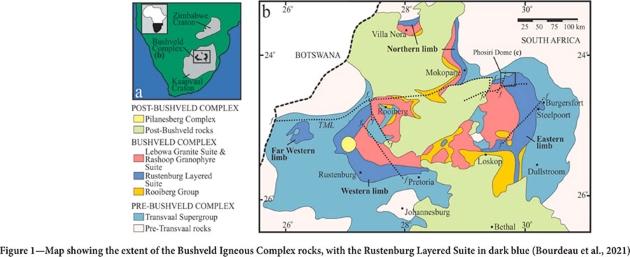
The Bushveld Igneous Complex comprises the Rustenburg Layered Suite at its base, followed by the Rashoop Granophyre and Lebowa Granite Suite. This mafic to ultramafic pseudo-stratified intrusion includes basal, critical, main, and marginal zones, distinguished by lithologies such as norite, gabbronorite, gabbro, anorthosite, pyroxenite, and chromitite (Brink, 1979). The critical zone, rich in norites, is particularly significant (Bourdeau et al., 2021). Figure 1 highlights the Rustenburg Layered Suite in dark blue.
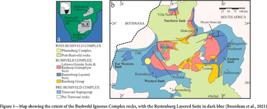
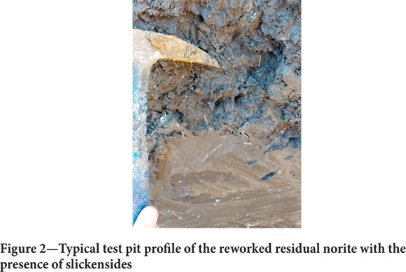
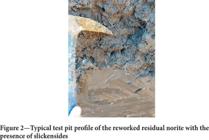
The western limb, forming an arc from Thabazimbi through Rustenburg to Pretoria, is characterised by norite deposits containing calcic plagioclase, orthorhombic pyroxene, and olivine. These norites weather into expansive montmorillonite clays, with recent geotechnical findings indicating finer textures and higher plasticity indices (PI) compared to the eastern limb-often exceeding 60% clay content-enhancing their expansiveness (van der Merwe, 1967). Pyroxene weathering produces smectite clays that expand with water infiltration and shrink upon drying, causing cracks and uneven surfaces (Netterberg, 2019). Fresh norite is quarried for dimension stone and aggregates, but its residual soils pose significant construction challenges due to pronounced shrink-swell behaviour. These soils display a shattered and slickensided soil structure, which indicates soil movements (heaving/ swelling/desiccation) under changing moisture conditions (Brink, 1979), as illustrated in Figure 2. The upper reworked residual soil texture comprises mainly silt-clay and transitions into silty, gravelly sand derived from the in situ weathered parent rock between 1 m and 2 m below surface (Brink, 1979).
Chemical weathering dominates under a Weinert N-value > 5, with climate and topography, assessed via land facet mapping, shaping these properties.
The eastern limb, extending from Mokopane to Stoffberg, shares stratigraphic similarities but differs notably. Its critical zone thins and disappears from Burgersfort to Stoffberg, likely reducing norite abundance and resulting in coarser materials with lower PI values (Cooper et al., 1998). The rugged topography and wetter climate may accelerate weathering, potentially increasing montmorillonite content, yet the finer, higher-PI western limb soils appear more expansive. These differences highlight the need for site-specific geotechnical assessments to mitigate construction risks across both limbs.
Scope
Due to the inherent variability of soil and even more for residual soils such as the reworked residual norite, with challenges in gathering accurate soil indicators and shear strength behaviours, the paper aims to provide the results of years of investigation informed by a robust sample size with 26 samples, 71 shear tests (68 isotropically consolidated undrained triaxial tests and 3 direct simples shear tests, 2 permeability tests, 3 consolidations tests and 3 Bromhead ring shear tests).
Indicator test results
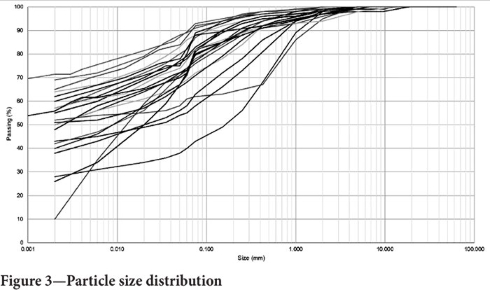
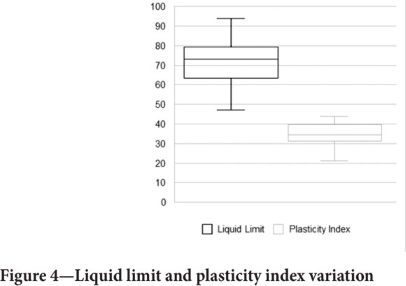
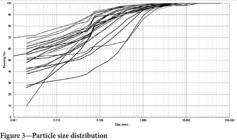
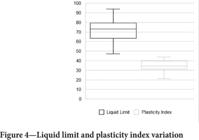
The reworked residual norite is a non-homogeneous material, as the mulching effect, given by its very high shrinkage and swelling potential, results in the presence of transported material being present in the upper parts. Generally, it is classified as a clay with high plasticity (CH) according to the Unified Soil Classification System (USCS) classification with a plasticity index above 20 and, in some instances, a clay fraction of more than 50%, as illustrated in Figure 3 and Figure 4. The permeability measured in a triaxial apparatus of two specimens compacted at 90% standard Proctor was measured as 1 x 10⁻⁸ m/s. The average specific gravity of a number of specimens was found to be 2.64.
Strength behaviour
Critical state soil mechanics framework for clays
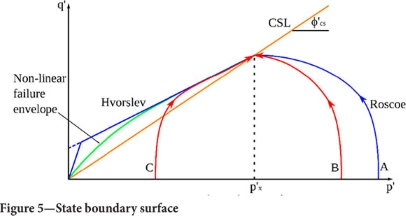
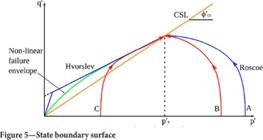
Critical state soil mechanics provides a useful framework within which to interpret the behaviour of clay, although it makes some simplifications, which may not be appropriate for all clays. Figure 5 shows the critical state framework for clay in mean effective stress (p') vs. deviatoric stress (q') space. It suggests that normally consolidated clay (A) or lightly overconsolidated clay (B) will reach the Roscoe surface and then contract before failing at the critical state line (CSL). The critical state line passes through the origin, which implies that normally consolidated or lightly overconsolidated soil has no strength at zero normal effective stress. In contrast, heavily overconsolidated clay (C) will yield at the Hvorslev surface and dilate before reaching the critical state line. The Hvorslev surface is often assumed to be a straight line and the extension of the Hvorslev surface (dashed line) has a positive intercept with the deviatoric stress axis (q'), as shown in Figure 5. The framework suggests that the failure envelope for clay sheared with an initial mean effective stress (p'i) greater than p'x,will be linear and pass through the origin (i.e., have no cohesion intercept). In contrast, soils with an initial mean effective stress (p'i) less that p'x, will have a failure envelope above the critical state line (CSL).
Many engineers prefer to use the Mohr Coulomb failure envelope as failure criterion for soil (Equation 1). The equation assumes that the failure envelope is a straight line defined by two soil parameters: c' and Ø'.

where:
τf′: shear stress on the failure plane at failure
σn′: normal effective stress on the failure plane at failure
Equation 1 can be used for both normally consolidated soils, where the failure envelope passes through the origin by taking c' = 0 and heavily overconsolidated soils by taking c' > 0. However, from Figure 5 it is clear that the friction angle Ø' is not the same for these two cases.
It is well known that the failure envelope for rocks is nonlinear, e.g., Hoek and Brown (1980) and numerous other authors have shown that the failure envelope for soils is also nonlinear. Various nonlinear function types have been suggested to define the curvature of the failure envelope for soils. These include bilinear envelopes (Baker, 2004), hyperbolic functions (Maksimovic, 1989) and power functions (Perry, 1994; Heymann, 2016). It is important to note that a value of the parameter c' greater than zero, does not necessarily imply shear strength at zero normal effective stress. It may simply be a consequence of the assumption that the Mohr-Coulomb envelope is a straight line fitted to some portion of a nonlinear failure envelope.
From the aforementioned discussion it is clear that, when conducting triaxial testing with the aim of quantifying the shear strength of soils, the applied effective stresses should be considered carefully. Preferably, the tests should be conducted in the same stress range to which the soil will be subjected in the field. For instance, if a tailings dam is founded on a heavily overconsolidated clay, but during triaxial testing high effective normal stresses are applied causing the clay to be normally consolidated, the failure envelope will pass through the origin. But if the same overconsolidated soil is tested at lower normal effective stresses, the failure envelope will be nonlinear. However, many commercially available slope stability programs use the straight-line Mohr-Coulomb failure envelope (Equation 1) as failure criterion. But, if the failure envelope is nonlinear, as shown in Figure 5, assigning the appropriate c' and Ø' can be challenging, and the parameters c' and Ø' should not be evaluated in isolation. For heavily overconsolidated clay, it would be inappropriate to use Ø'cs together with c' = 0, which would lead to an underestimation of the strength of the soil.
Interpretation of triaxial test results
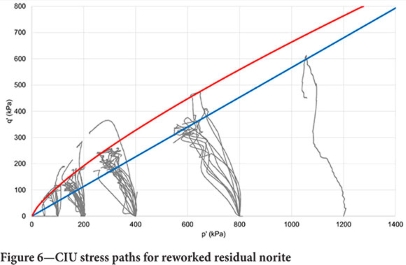
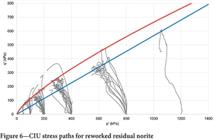
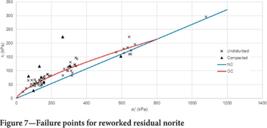
Figure 6 shows the stress paths for 68 isotropically consolidated undrained triaxial tests on reworked residual norite from the western limb according to ASTM 4767, conducted for a number of projects by four commercial soils laboratories. Tests were conducted on both undisturbed and compacted specimens. Also shown is the failure envelope in red with form where A = 3.25 and b = 0.77. The failure envelope gives a reasonable state boundary to the triaxial stress paths and also shows that the failure envelope is nonlinear. Due to a shear banding behaviour at higher strains, the stress paths have been trimmed as it is not a representative shearing behaviour of the whole sample, therefore, residual behaviour cannot be estimated. Thus, direct simple shear testing has been considered for residual behaviour.
Mesri and Abdel-Ghaffar (1993) proposed a nonlinear failure envelope described by Equation 2.

where:
σm′: pre-consolidation pressure
m: material parameter
Figure 5 shows that for the critical state framework, the boundary between the linear and nonlinear portions of the failure envelope is the mean effective stress at the apex of the state boundary surface (p'x), however Mesri and Abdel-Ghaffar (1993) proposed to use the pre-consolidation pressure as the boundary. In the context of residual clays such as reworked residual norite, it may not be appropriate to use the term "pre-consolidation pressure", as pre-consolidation pressure is typically taken as the maximum effective stress to which a soil has been subjected in the past. A more appropriate term is "yield stress". Murison et al. (2025) conducted one-dimensional load tests on samples of reworked residual norite from a site on the eastern limb near Steelpoort and estimated the vertical effective yield stress to be 800 kPa. The attraction of Mesri and Abdel-Ghaffar's (1993) formulation of the failure envelope is that it is nonlinear for overconsolidated clay and linear for normally consolidated clay. This conforms closely to the nonlinear envelope shown in Figure 5 for mean effective stresses less than p'x and the linear critical state line for mean effective stresses greater than p'x.
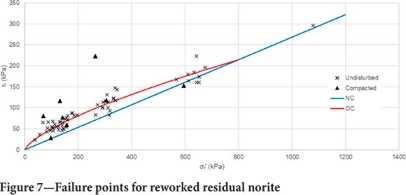
Figure 7 shows the shear stress on the failure plane at failure (τ'f) and the normal effective stress on the failure plane at failure (σ'n) for the same data, as presented in Figure 6. Also shown in the figure is the failure envelope using Equation 2 with Ø' = 15°, σ'm = 800 kPa, and m = 0.7. The parameters were chosen not to give an upper bound envelope, but to represent a good fit to the triaxial results. Figure 7 shows that at low mean effective stress (less than 100 kPa) an appropriate Mohr-Coulomb failure envelope may pass through the origin (c' = 0), but with Ø' significantly higher than 15°. In contrast in the stress range 200 kPa - 400kPa, a friction angle Ø' close to 15° may be appropriate, but will require a cohesion intercept c' > 0 to accurately express the strength of the soil. As stated previously, the parameters c' and Ø' cannot be evaluated in isolation. To illustrate this, a failure envelope with friction angle Ø' = 15° with c' = 0, is shown in Figure 6 as the blue line. It shown that if this failure envelope is used for reworked residual norite at a mean effective stress (p') less than 800 kPa, the strength of the soil will be significantly underestimated.
Interpretation of direct simple shear results
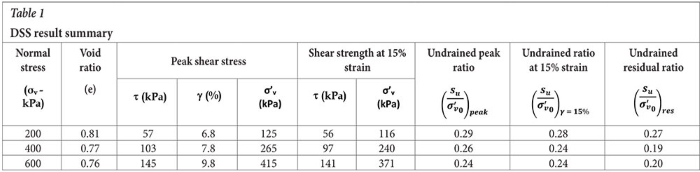
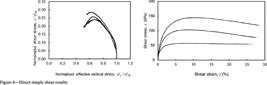
Direct simple shear (DSS) tests were performed on undisturbed specimens in accordance with ASTM D6528 to simulate undrained horizontal shearing at constant volume. Consolidation stresses of 200 kPa, 400 kPa, and 600 kPa were applied to bracket anticipated foundation stresses.
Peak shear stress and shear stress at 15% shear strain were adopted as failure criteria, with residual values recorded at large displacements. Results are summarised in Table 1.
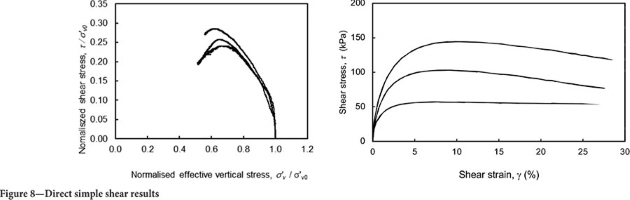
Normalised undrained shear strength ratios range from 0.24 to 0.29 at peak and 0.19 to 0.28 at 15% strain, showing mild reduction with increasing consolidation stress-consistent with strain-softening in overconsolidated clays. Stress-strain response (Figure 8) indicates contractive behaviour with peak strength mobilised at 7% - 10% shear strain, followed by gradual softening toward a stable residual plateau. The absence of pronounced brittleness suggests ductile post-peak response under monotonic loading.
Interpretation of ring shear results for residual strength
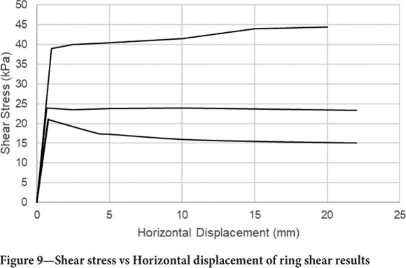
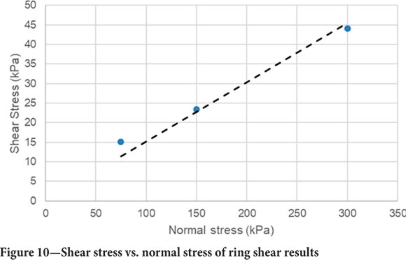
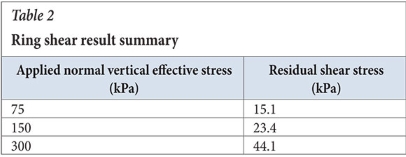
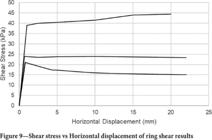
Residual shear strength parameters were determined using the Bromhead ring shear apparatus on remoulded and pre-sheared specimens, consolidated at normal effective stresses of 75 kPa, 150 kPa, and 300 kPa. Testing followed ASTM D6467, with specimens sheared to high strains to ensure full mobilisation of the residual condition. Table 2 provides a summary of the ring shear results.
Figure 9 shows shear stress versus displacement, illustrating a progressive transition from peak to stable residual values after about 20 mm of displacement. The failure envelope (Figure 10) is near linear and passes through the origin, with a residual friction angle of 8.5° with zero effective cohesion.
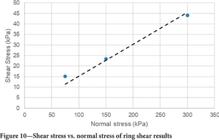
These parameters represent the large-displacement condition and are applicable only where pre-existing aligned slickensided surfaces or progressive failure mechanisms are present. The exceptionally low friction angle is consistent with alignment of platy clay minerals along polished shear planes.
Caution is required in applying these values; they constitute a lower-bound strength and should be used only in conjunction with strain compatibility assessments and consideration of displacement magnitude.
Stiffness behaviour
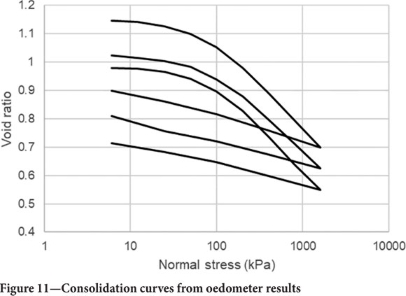
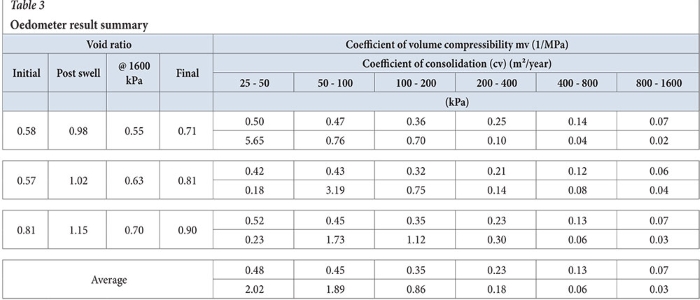
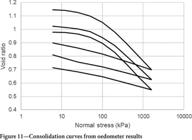
Oedometer tests were conducted on undisturbed tube samples of reworked residual norite in accordance with ASTM D2435. Initial void ratios ranged from 0.57 to 0.81, consistent with field densities. Upon inundation under a seating stress of 6 kPa immediate and substantial swell strains were observed reflecting the highly expansive montmorillonite and smectitic clay mineralogy. Table 3 provides a summary of the oedometer results.
Specimens were loaded incrementally to a maximum vertical effective stress of 1600 kPa, followed by unloading to 25 kPa. Figure 11 presents the void ratio versus log effective vertical stress relationship for three representative specimens.
Conclusions
Coefficients of volume compressibility (mv) decrease from 0.48 MPa-1 (at 25 kPa - 50 kPa) to 0.07 MPa-1 (at 800 kPa - 1600 kPa), while coefficients of consolidation (cv), evaluated via the Casagrande log-time method, range from 0.03 m2/year to 5.65 m2/year, with a general reduction at higher stress levels, possibly due to closure of microfissures.
Many tailings storage facilities (TSF) are located in the Rustenburg region of South Africa founded on an upper layer of reworked residual norite. The reworked residual norite is characterised by a high percentage of clay (up to 80%) with a PI above 20. Due to the high swell and shrinkage potential, remulching is common, which results in the presence of slickensides. These planes are not aligned and non-continuous, which is characteristic of residual soils, rather than transported soils. Ring shear results yield a residual friction angle of 8.5°. The oedometer test results presented, indicate the coefficient of volume compressibility (mv) and the coefficient of consolidation (cv) both reducing at increasing stress levels. The reduction in coefficient of consolidation (cv) is possibly due to closure of microfissures. The permeability of the reworked residual norite, measured in the triaxial apparatus, is of the order of 10-8 m/s.
GISTM places a high demand on material characterisation in terms of shear behaviour for stability purposes. This has resulted in extensive shear strength characterisation of this material for stability analysis. The critical state framework suggests that overconsolidated clays have a nonlinear failure envelope, which poses challenges when applying a linear failure envelope such as the Mohr-Coulomb failure criteria. Due to the broad range of effective stress that a TSF is subject to, the failure envelope suggested by Mesri and Abdel-Ghaffar (1993), which provides nonlinear strength behaviour for overconsolidated clay and linear for normally consolidated clays, was applied to undrained triaxial shear data. The reworked residual norite has a yield stress of the order of 800 kPa, therefore suggesting a nonlinear behaviour for effective stresses less than 800 kPa and linear behaviour for higher stresses. Furthermore, the reworked residual norite exhibits contractive behaviour with a peak strength mobilised at 7% to 10% shear strain with a mild strain softening. A significant number of undrained triaxial shear results are presented for both undisturbed and compacted specimens. The tests were performed by a number of different laboratories allowing general conclusions to be made regarding the shear behaviour over a large range of effective stresses. However, because of the variability of residual soils, especially the reworked residual norite, site-specific investigations are recommended in line with the Site Investigation Code of Practice (SAICE, 2010) for critical structures such as TSFs, as the repercussions of instability for the industry, environment, and society are severe.
Acknowledgements
The authors would like to acknowledge G. Wiid and R. Cooper for their contributions to the database presented in this paper.
References
- Baker, R. 2004. Nonlinear Mohr Envelopes Based on Triaxial Data. Journal of Geotechnical and Geoenvironmental Engineering, vol. 130, no. 5, pp. 498-506.
- Brink, A.B.A. 1979. Engineering Geology of Southern Africa, Volume 1., Chapter 10 Bushveld Complex, Rooiberg Group and Rustenburg Layered Suite, pp. 277-301.
- Bourdeau, J., Hayes, B., Zhang, S., Logue, A., Bybee, G. 2021. Origin and significance of noritic blocks in layered anorthosites in the Bushveld Igneous Complex, South Africa. Contributions to Mineralogy and Petrology.
- Heymann, G. 2016. Typical strength properties of South African soils. Proceedings of the First Southern African Geotechnical Conference, Sun City, South Africa, 5 - 6 May 2016, pp. 289-294. Jacobsz (Ed.), Taylor and Francis, ISBN 978-1-138-02971-2.
- Hoek, E., Brown, E.T. 1980. Underground Excavations in Rock. CRC Press, London, pp. 536.
-
ICMM, UNEP, PRI. 2020. Global Industry Standard on Tailings Management. International Council on Mining and Metals, London. Available at: https://www.icmm.com/gistm [Accessed 21 April 2026].
» https://www.icmm.com/gistm - Maksimovic, M. 1989. "Nonlinear Failure Envelope for Soils." Journal of Geotechnical Engineering, ASCE, vol. 115 , no. 4, April. pp. 581-586.
- Mesri, G., Abdel-Ghaffar, M.E.M. 1993. Cohesion intercept in effective stress-stability analysis. Journal of Geotechnical Engineering, vol. 119, no. 8, pp. 1229-1249.
- Murison, R.A., Gaspar, T.A.V., Jacobsz, S.W., Heymann, G., Osman, A.S. (in print). Practical guidelines on the determination of one-dimensional swell properties of highly expansive clays. Canadian Geotechnical Journal.
- Netterberg, F. 2019. Identification of Potentially Expansive Clay Soils from Soil Structure. 17th African Regional Conference on Soil Mechanics and Geotechnical Engineering. Cape Town: International Society for Soil Mechanics and Geotechnical Engineering.
- Perry, J. 1994. A technique for defining non linear shear strength envelopes and their incorporation in a slope stability method of analysis. Quarterly Journal of Engineering Geology. vol. 27, no 3, pp. 231-241.
- South African Institution of Civil Engineering Geotechnical Division. 2010. Site Investigation Code of Practice, 1st edn., South African Institution of Civil Engineering, Johannesburg.
- Van der Merwe, D. 1967. The Composition and Physical Properties of the Clay Soils in the Mafic Rocks of the Bushveld Igneous Complex. The Fourth Regional Conference for Africa on Soil Mechanics and Foundational Engineering, pp. 141-146. Cape Town.
Published: April 2026