Impact of air granulation on the ferrochrome value chain in metallurgical smelter complexes
Abstract
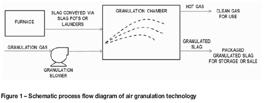
South African ferrochrome producers typically operate single tap-hole furnaces with alloy and slag separation occurring post-taphole by means of a skimmer block. Both streams are then cast directly onto a prepared surface, or in some cases a layer-casting process is employed using hot metal ladles. These processes all require significant cooling time followed by extensive in situ crushing operations, leading to a high burden and cost in terms of time and on-site material handling. Moreover, the slag is then further crushed and screened in a chrome recovery plant to liberate any entrained alloy, and subsequently discarded as waste. Air granulation has achieved commercial success in other sectors and typical South African ferrochrome operations can also benefit. Air granulation promises lower production costs by elimination of casting, cooling, break-up, and crushing activities; improved alloy liberation by elimination of middlings; and improved safety due to faster cooling without water sprays. There is also a market for subsequent use of air-granulated ferrochrome slag as a valuable product, due to its potential improved physical properties over slow cooled variants. Air granulation is being tested to evaluate its effect on the ferrochrome value chain within a typical South African metallurgical complex. Here we report the results of this first-of-its-kind work, and explore strategies for successful integration.
slag handling; air granulation; dry granulation; energy recovery; granulation; ferroalloys; ferrochrome
 Thumbnail
 Thumbnail
 Thumbnail
 Thumbnail
 Thumbnail
 Thumbnail
 Thumbnail