Influence of layered joints on zonal disintegration in deep rock masses under coupled high in-situ axial stress and blasting load
Abstract
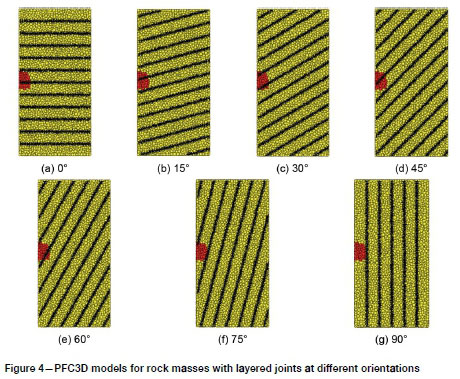
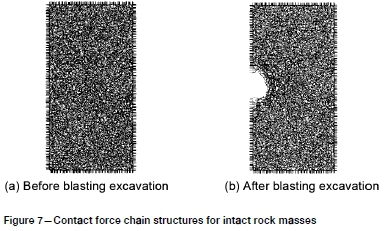
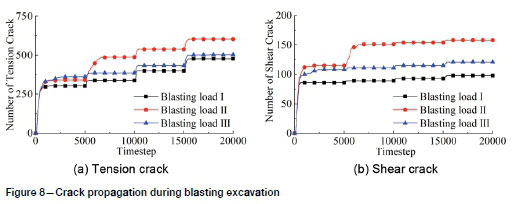
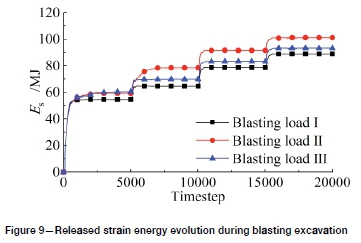
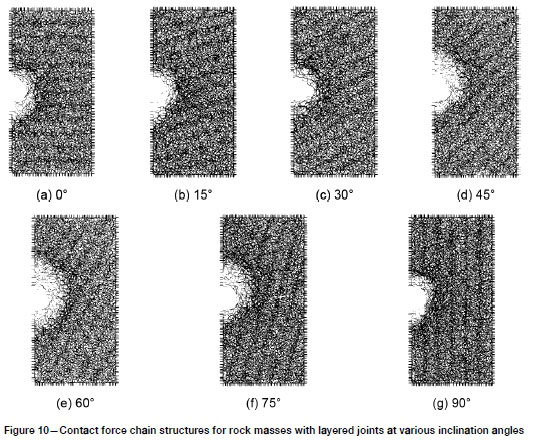
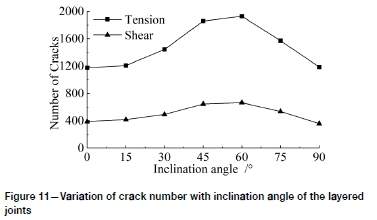
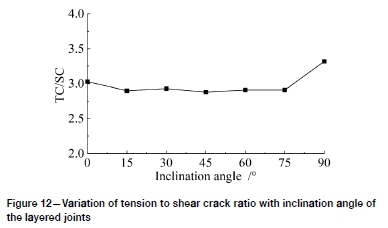
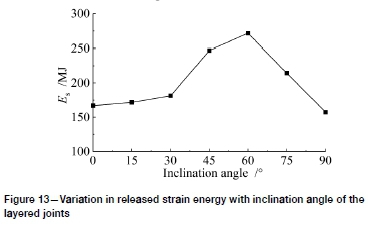
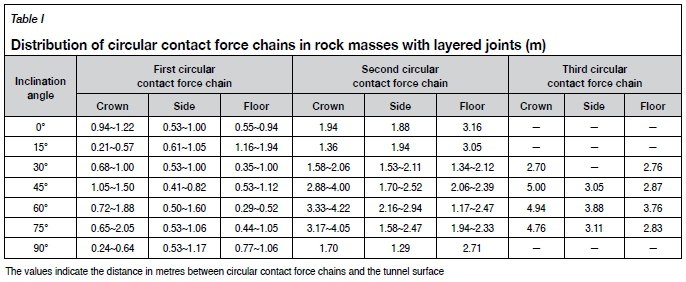
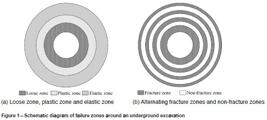
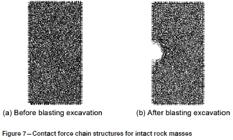
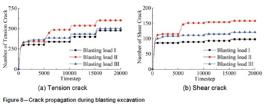
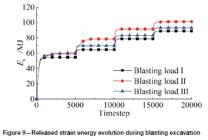
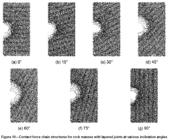
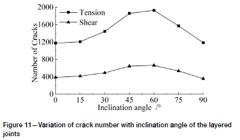
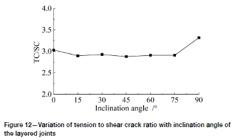
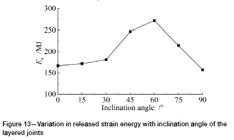
Zonal disintegration is a characteristic failure mode of deep rock masses under coupled high in-situ axial stress and blasting load. PFC3D numerical simulations were carried out to investigate the influence of inclination angle of widely spaced, layered joints on zonal disintegration. The results indicate that after the four-step blasting procedure, nearly circular contact force chains, which are approximately concentric with the surface of the tunnel, are formed in both intact rock masses and rock masses with layered joints. The number of tension cracks is much greater than that of shear cracks; hence, tension failure predominates as the failure mode for zonal disintegration. Corresponding to the four-step blasting, a time-dependent characteristic is apparent for crack propagation and released strain energy evolution during the advance of the tunnel. Zonal disintegration can be intensified by extending the duration of the blasting load, and alleviated by extending the blasting rise time. The inclination angle of layered joints has a significant effect on zonal disintegration. With an increase of inclination angle, both the number of cracks and released strain energy first increase and then decrease, which is consistent with the distribution of contact force chains. When the inclination angle of layered joints is 60°, the joints present a strong influence on intensifying the zonal disintegration.
zonal disintegration; layered joints; inclination angle; particle flow code; contact force chain
 Thumbnail
 Thumbnail
 Thumbnail
 Thumbnail
 Thumbnail
 Thumbnail
 Thumbnail
 Thumbnail
 Thumbnail
 Thumbnail
 Thumbnail
 Thumbnail
 Thumbnail