A case for the adoption of decentralised reinforcement learning for the control of traffic flow on South African highways
Abstract
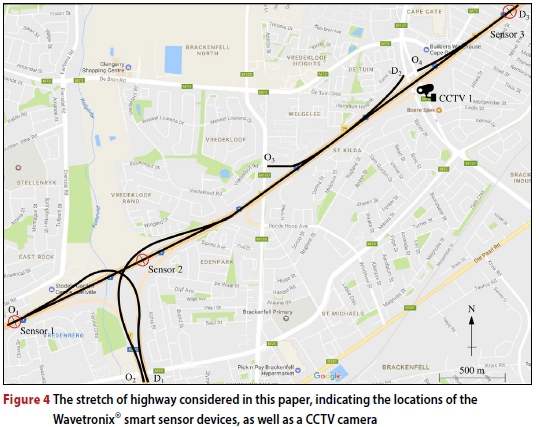
As an alternative to capacity expansion, various dynamic highway traffic control measures have been introduced. Ramp metering and variable speed limits are often considered to be effective dynamic highway control measures. Typically, these control measures have been employed in conjunction with either optimal control methods or online feedback control. One shortcoming of feedback control is that it provides no guarantee of optimality with respect to the chosen metering rate or speed limit. Optimal control approaches, on the other hand, are limited in respect of their applicability to large traffic networks due to their significant computational expense. Reinforcement learning is an alternative solution approach, in which an agent learns a near-optimal control strategy in an online manner, with a smaller computational overhead than those of optimal control approaches. In this paper an empirical case is made for the adoption of a decentralised reinforcement learning approach towards solving the control problems posed by both ramp metering and variable speed limits simultaneously, and in an online manner. The effectiveness of this approach is evaluated in the context of a microscopic traffic simulation model of a section of the N1 national highway outbound from Cape Town in South Africa's Western Cape Province.
ramp metering; variable speed limits; reinforcement learning; highway traffic control; traffic simulation
 Thumbnail
 Thumbnail
 Thumbnail
 Thumbnail
 Thumbnail
 Thumbnail
 Thumbnail
 Thumbnail
 Thumbnail
 Thumbnail
 Thumbnail