Experimental and analytical investigation into the stiffness of composite steel-reinforced timber beams with flexible shear connectors
Abstract
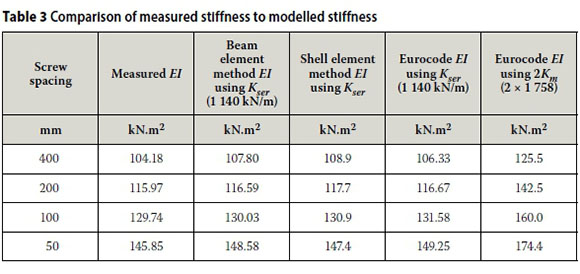
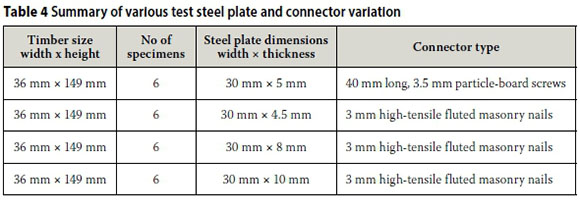
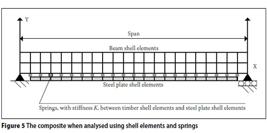
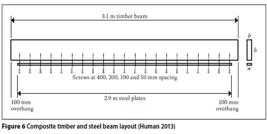
Most of the current research on the design of timber composite beams involves either complex mathematical models which are not checked with experimental testing, or is purely based on experimental work with no attempt to model the behaviour. In a literature review the authors failed to find a practical way of designing composite timber beams, other than in the Eurocode 5. The equations in Eurocode 5 are unfortunately limited in their application. This paper looks at stiffening timber beams, with a known stiffness distribution, by screwing or nailing a steel strip to the underside of the beam. The modelled behaviour is compared with experimental test results and recommendations for the analysis and design of such members are given. The experimental work involved determining the stiffness of twenty-four South African pine beams reinforced with metal strips. The spacing of the connectors was varied to ascertain the increase in stiffness of the composite with a reduction in the connector spacing. The analytical methods used were the Eurocode 5 method, as well as two finite element modelling methods, which may be used to determine the composite stiffness. The results of the three methods used show a remarkably good fit with the lower-bound experimental results.
composite; timber; steel; beams; flexible connectors
 Thumbnail
 Thumbnail
 Thumbnail
 Thumbnail
 Thumbnail
 Thumbnail