
 Publishing particulars of the paper under discussion
DISCUSSION
Publishing particulars of the paper under discussion
C L Blersch; J A du Plessis
Vol 59 (1) 2017, Pages 11-21, Paper 1200: Planning for desalination in the context of the Western Cape water supply system
(http://dx.doi.org/10.17159/2309-8775/2017/v59n1a2)
COMMENTThe authors must be congratulated on demonstrating the introduction of a sea-water desalination plant as an integral part of a water supply system - in this case the Western Cape water supply system. While this new resource would provide a constant and reliable source of water, its operating costs typically are high in comparison with the cost of other traditional resource developments. As the authors showed (e.g. in Figure 7 of their paper), due to the stochastic nature of the hydrology on which the traditional resources depend, the augmentation requirement from a desalination plant with its high operating cost will be of a stochastic nature as well. This follows as the annual operating decisions, based on system risk analyses, can be expected to favour resources with lower operating costs in times when the system is relatively flush and the risk of curtailments in the short term is expected to be within acceptable limits. The authors therefore demonstrated that, by simulating the annual operating decisions according to the methodology proposed by Van Niekerk and Du Plessis (quoted reference 2013a), the operating costs would also vary stochastically over time. These variable costs then carry over into the determination of the unit reference values (URVs), showing the latter themselves to be uncertain in nature.
It is with the authors' calculation of the URVs that this writer has a difficulty. While seemingly the improved URV determination methodology by Van Niekerk and Du Plessis (referenced incorrectly as 2013a - it should have been quoted as 2013b) is accepted by the authors (2017:14), the equation for determining the URV in their Equation 1 (2017:15) is not the same as Equation 2 by Van Niekerk and Du Plessis (quoted ref 2013b:552), which is:
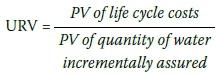
In the authors' Equation 1 the denominator is given as "NPV of the water supplied from the desalination plant (Wn)", which is quite different to the "PV of quantity of water incrementally assured" in the above equation.
Van Niekerk (2013) demonstrated that the URV concept should be grounded in the cost-effectiveness analysis (CEA) theory. Van Niekerk and Du Plessis summarised it as follows (quoted 2013b:554): "Examination of the URV measure in view of its underlying CEA economic theory revealed that a good measure of effectiveness would be the incremental water availability assured by the expansion of a system and bounded by the projected demand curve until full capacity is reached. The PV of the annual quantities of water thus assured is used as denominator in the URV equation."
Analogous to what was advocated by Van Niekerk and Du Plessis for inter-basin transfer systems, a conceptual separation is required between the water supplied by the desalination plant, affecting operating costs, and the water incrementally assured, used as a proxy measure for effectiveness.
The authors did not make such a separation. It is suggested that the URV calculations be redone with the denominator amended in accordance with the methodology of Van Niekerk and Du Plessis (quoted 2013b). The expectation is that the URV results will be quite different, be revelatory regarding the optimality of desalination plants in terms of sizing and operations, and give rise to some different conclusions from those arrived at in the paper.
The difference in URV calculations can be illustrated by taking the example of the 150 M£/d desalination plant with the 70% storage level trigger (scenario D (70%)). The incremental 1:50 year yield of this plant is about 120 M£/d (44.106 m3/a) (estimated from Figure 5), providing about two to three years of augmented supply before a follow-up intervention is required (deduced from Table 3), and the median (50 percentile) supply over the 20 years (from Figure 6) is estimated as 72 M£/d on average. The denominator in this case should be the incrementally assured supply over the economic life of the intervention (assumed here to be 20 years to fit in roughly with the planning horizon). While the discounted volume of water, used as denominator to determine the URV of R15.49/m3 in Figure 4, was not stated in the paper, logically it had to relate to the 72 M£/d figure, whereas it should have been associated with the 120 M£/d, being the approximate incremental assurance provided by the desalination plant, in keeping with the approach by Van Niekerk and Du Plessis. The correct median URV for the 150 M£/d plant, operated at a 70% trigger level, would be closer to an estimated R9.30/m3 than the quoted R15.49/m3.
A further note for correction: The title at the top, within the border, of Figure 5, referring to historic firm yield, has presumably been incorrectly copied from Figure 4. It should refer to the 1 in 50 year yield, as in the title given below the border for Figure 5.
Dr Peter van Niekerk Pr Eng FSAICE
References
- Blersch, C L & Du Plessis, J A 2017. Planning for desalination in the context of the Western Cape water supply system. Journal of the South African Institution of Civil Engineering, 59(1): 11-21.
-
Van Niekerk, P H 2013. Hydrologic-economic appraisal of inter-basin water transfer projects. PhD thesis, Stellenbosch University. URL: http://hdl.handle.net/10019.1/7988 .
» http://hdl.handle.net/10019.1/7988
