Advancing the profession of academic advising for impactful practice
Abstract
The Academic Advising Professional Development (AAPD) short learning programme is the only intervention that currently contributes to the professionalisation of academic advising in South Africa. To effectively and efficiently support student growth, development, and success, academic advisors need to develop a set of professional skills, knowledge, and behaviours. Only in combining continuous formal and informal professional training, development, and learning opportunities can students and institutions attain success. The AAPD is a contextualised formal training; it has borrowed from international literature and practice to assist academic advisors in acquiring the prerequisite knowledge and skills to develop intentional and responsive academic advising programmes, while refining their own advising values and philosophies. This article builds on and contributes to both international and national work in the field of academic advising as a practice and a profession. Additionally, it draws from Habley's (1995) and McClellan's (2007) conceptualisations of academic advising, which identify five core components that contribute to the professionalisation of advising. The application of these conceptual frameworks to map the content of the AAPD against key findings, has shown that while the AAPD provides a comprehensive introduction to the components of academic advising contextualised for the South African higher education landscape, early career participants still have a disjuncture in their understanding of the components. Therefore, the results of the study demonstrate that the AAPD framework does not only create opportunities to strengthen the existing components, but also reinforces additional components such as career advising, to advance the academic advising profession and practice within the South African context.
Academic advising; South Africa; professional development; practice; training
Abstract
Indlela Esezingeni Yokululeka Kwimfundo Ephakeme, i-AAPD, okuwuhlelo lokufunda oluyisikhashana esincane yilona kuphela uhlelokuxalulusa isinginga olukhona, olunegalelo ekusetshenzisweni kochwepheshe beziluleko zezemfundo ephakeme eNingizimu Afrika. Ukweseka ngempumelelo nangenjolozela egcwele ukukhula kwabafundi, ukuthuthuka, kanye nempumelelo, abeluleki bezemfundo badinga ukuthuthukisa isethi yamakhono ochwepheshe, ulwazi, kanye nokuziphatha. Kungaba ngendlela yenhlanganisela yokuqeqeshwa okuqhubekayo okusemthethweni nokungakahleleki, ukuthuthukiswa, namathuba okufunda lapho abafundi nezikhungo zithola impumelelo. I-AAPD iwukuqeqeshwa okusemthethweni okunezimo ezithathelwa ezincwadini zamazwe ngamazwe kanye nezindlela zokusebenza ukuze abeluleki bezemfundo bafunde futhi bathole ulwazi namakhono okuthuthukisa izinhlelo zokweluleka zezemfundo ezihlose futhi nokusiza bona abeluleki ukuthi bacwengisise izindingonqangi zabo zokweluleka nobuyoninco bolwazi. Leli phepha lakhela phezu futhi lihlela neqhaza elingabanjwa kumsebenzi wamazwe ngamazwe kanye kazwelonke emkhakheni wokweluleka kwezemfundo njengomkhuba nomsebenzi. Liphinde ligxile ekucatshangelweni kokwelulekwa kwezemfundo okuvela ku-Habley kanye noMcClellan, okuhlonza izingxenye ezinhlanu ezibalulekile ezifaka isandla ekwenzeni ukweluleka kube nobungcweti. Ngokusebenzisa lezi zinhlaka zomqondo ukuze kudwetshwe okuqukethwe yi-AAPD kuqhathanise nemiphumela esemqoka, kukhombisa ukuthi nakuba i-AAPD inikeza isingeniso esibanzi ezingxenyeni zokwelulekwa kwezemfundo eziqondiswe esimweni semfundo ephakeme yaseNingizimu Afrika, abahlanganyeli bemisebenzi yokuqala basenokuphazamiseka ekuqondeni kwabo lezi zingxenye. Lokhu kukhombisa ukuthi uhlaka olusetshenziswa ku-AAPD luyathembisa ukuqhubekisela phambili umkhuba nomsebenzi, nethuba lokuqinisa izingxenye ezikhona ngaphezu kwezinye, njengokweluleka ngemisebenzi, esebenza endaweni yaseNingizimu Afrika.
Ukweluleka kwezemfundo; iNingizimu Afrika; ukuthuthukiswa ngokwezinga eliphakeme; ukuzijwayeza; ukuqeqeshwa
Introduction
The growth of academic advising as a profession in South African higher education is leading to many academic administrative staff joining the profession from other student support and development entities (Tiroyabone & Strydom, 2021). The creation of a common professional identity that can help academic advisors take control of their careers and design a path to personal and professional fulfilment has been identified as a necessary step for personal and professional growth in the field (Justyna, 2016). Ongoing advancements linked to the development of a knowledge base for academic advising, inform both its practice and scholarly identity independent of other fields and professions (Schulenberg & Lindhorst, 2008, p. 44); these efforts have largely been exclusive to the international community. South African higher education practitioners have adopted and adapted academic advising best practices for over a decade; however, these were very limited within the domain of advancing their professionalisation. While the work of advisors differs from institution to institution, a definite path for professional advancement is proving to be essential for the South African landscape.
Globally, the National Academic Advising Association (NACADA), an association serving the international academic advising community, drives the professionalisation of the practice as its coordinating body. Informed by the Core Competencies of Academic Advising (NACADA, 2017), and in response to establishing and strengthening the identity of academic advising professionally in South Africa, significant strides have been made in formalising the profession through the development and implementation of the Academic Advising Professional Development (AAPD) short learning programme offered by the UFS. The AAPD contextualises the core competencies of NACADA for the South African landscape in an effort to upskill practitioners as professionals.
In view of the above background, this article aims to reflectively consider whether, and if so, how the AAPD contributes to the profession as a community of practice and to the actual student support practice of academic advising in South Africa.
Academic advising as practice and profession
Academic advising is a student-success practice that provides students with an opportunity to connect and explore their personal academic journey alongside their future life aspirations (Drake, 2011). The global evolution of academic advising traces its existence back to 1877, when the primary focus of advising was to offer students counselling on academic curricula and academic decision-making (Cook, 2009; Rudolph, 1962). The evolution of the university systems and course offerings introduced diversification, which required universities to employ staff whose primary responsibility was to provide academic guidance to students, thereby giving birth to academic advising.
In what Troxel et al. (2021) describe as growth in the discipline and profession, they assert that because the advancements have resulted in the existence of a professional community with identifiable competencies, academic advising is indeed a profession. As the practice of academic advising has been growing in parallel with the demand for structured, evidence-based support, the need for structured professional training, development, and identity is also emerging. Whereas advisors see their work as highly relational and developmental, other student support practitioners and university administrators often believe the work of advisors to be prescriptive and limited (Menke et al., 2020). The effects of these perceptions are broadly explored in recent advising literature as a significant issue for the professionalisation of advising (Aiken-Wisniewski et al., 2015; Cate & Miller, 2015; Larson et al., 2018; McGill, 2017, 2019; White, 2020).
There is a growing need for academic advisors to support student success within the higher education sector nationally and internationally; however, academic advising currently lacks a consistent occupational career pathway (McGill, 2019). The inconsistency in role definitions and the lack of a universal advising structure complicate structural factors to implement progressive career pathways for primary role advisors (Aiken-Wisniewski et al., 2015; Larson et al., 2018; McGill, 2019). In response to these challenges, the AAPD was developed to professionalise academic advising in South Africa, also borrowing from the theory of communities of practice (Roberts, 2006) to define and shape advisor training and professional development.
Academic advisor professional development in South Africa
Within the South African context, little is known about professional advisors as academic advising has existed for less than fifteen years. Although academic advising was not part of the higher education policy development in 1997 when the Higher Education Act no. 101 (Republic of South Africa, 1997, p. 2) was drafted, research and practice in several higher education streams, focusing on student success since then, has warranted its existence and integration into our learning and teaching practices. The desire to establish a structured approach to student development has led to the identification of academic advising as a critical pillar within student support provision that offers integrated support in an effort to improve student success (DHET, 2018). While Strydom and Loots (2020) describe academic advising as a high-impact practice as informed by student engagement frameworks in the South African context, little research has been able to prove this practice. De Klerk (2021), however, has found complementing evidence that describes how academic advising is a proven high-impact practice; there is supporting evidence describing how it may aid a decrease in student dropout and inversely increase student retention and success.
Despite the fact that there has been minimal conceptual description and policy guidance as to what student (academic) advising means, the practice has been rapidly developing in South African public higher education institutions in response to the ever-growing need for student support. The most prominent effort to develop contextualised professional academic advisors has been through the development of the AAPD in 2018. Placing great emphasis on the need for qualified staff to carry out the role of academic advisors, Levin et al. (2010) articulate the need for qualified, competent, and caring staff to take on this role. Extending and borrowing from the NACADA core competency model (2017), the AAPD is the first of its kind produced for South African higher education in an effort to formally define the practice of academic advising as a profession.
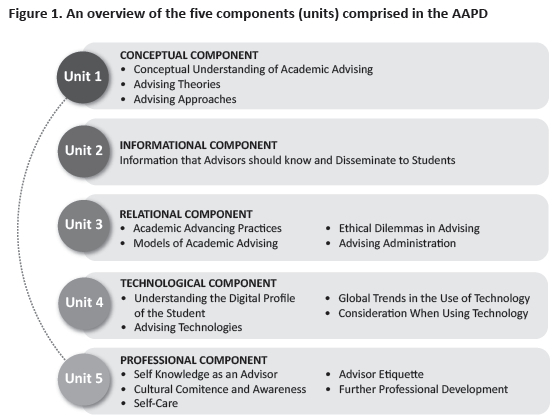
Figure 1 describes the overview of the five components adapted from the Habley (1995) and McClellan (2007) frameworks inform the AAPD. Adapted from the Core Competencies Model of Academic Advising (NACADA, 2017), the AAPD distinguishes the information, knowledge concepts, skills, and technology associated with academic advising. The AAPD units are arranged in accordance with the Informational, Conceptual, Relational, Technological, and Personal (ICRTP) framework, which introduces academic advisors professionally to the practice through the training and assessment of these components, which contribute to the advancement of the practice and student success. It further extends and is mapped against the typology of Communities of Practice (CoP), which is a traditional CoP. The CoP affords both experienced student support practitioners and new academic advisors the opportunity to learn and create moments that move them towards full participation in the practice of academic advising (Arthur, 2016).
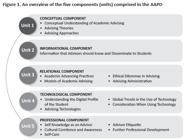
Expanding on the units of the framework, the informational component forms the substance of academic advising; it refers to what formal and informal information academic advisors should know. NACADA (2017) adds that advisors within the informational component should understand the characteristics, needs, and experiences of the majority and the emerging student population.
The conceptual component includes the ideas and theories that advisors need to understand in order to provide responsive support (King, 2000; Menke et al., 2020). Keeling (2014), in describing the conceptual component in the practice of academic advising, emphasizes the notion that advisors who consider themselves as thought leaders and leading professionals when applying this component, work collaboratively in ensuring that students are supported to persist through to graduation.
The relational component refers to how advisors engage with advisees to build a sense of belonging. It includes the knowledge, skills, attitudes, beliefs, values, and abilities associated with good advising. As many would underestimate the power of a relationship, academic advisors advocate its significance in relation to student success. Menke et al. (2020) found in a study that advisors value interpersonal skills, multicultural competence, and an understanding of students and student success mostly as part of their advising roles. This exemplifies how advisors understand and relate to students. In an early description of the relational component in academic advising, Habley (1987) described it as what academic advisors do.
As a fairly new component to the academic advising competencies framework, the technological component refers to the embracing and leveraging of technology in the facilitation of academic advising. With technological advancements in the higher education sector, the effective use of technology is becoming a necessity. According to McClellan (2007), it has become essential for advising professionals to understand the significant role of technology in academic advising as a practice to deliver student support information in an advising session. Although the COVID-19 pandemic might have accelerated the use of technology in academic advising, the technological component requires further strategic development and advancement. Addressing this component will help alleviate the pressures on other components of advising, such as the informational and conceptual aspects.
In the personal (professional) component, academic advisors need to be self-aware as well as have sound self-knowledge in order to be efficient and effective academic advisors for students. Borrowing from what Higginson (2000) terms 'advisor self-knowledge', this component is underscored by how the advisor understands their role, knowledge, skills, and competencies to fulfil the requirements of the practice. McGill (2019) suggests and confirms that three key characteristics to professionalise academic advising have emerged from the literature and become critical over the years: (1) scholarship, (2) professional community, and (3) professional development programmes.
The components of the ICRTP framework have been the critical lever driving the advancements of the academic advising practice and profession globally. Research has shown that, using the integration of these components and their application, advisors are able to achieve what academic advising is intended to achieve - student retention as a by-product and academic success (NACADA, 2017). To better understand how the AAPD has contributed to the development of academic advising in the South African context, this study reflects on each advising component and how AAPD-trained advisors have used this to inform their practice.
Methodology
A non-probability sample was selected for this study, specifically a purposive sample, as AAPD participants were invited to complete a qualitative survey during the period from 2018 to 2021. These participants reflected on the demands of their professional practice with the core aim of exploring to what extent the AAPD had been supportive of their practice. A total of 153 participants were invited to participate in the study. Questback software was used to design and distribute the survey link. Because the AAPD is offered across the South African higher education sector to 26 universities, the participants were also representative of different institutions. The ICRTP framework as adapted from Habley (1995) and McClellan (2007) was used as the theoretical framework for the study. Thematic analyses by Braun and Clarke (2006) was adopted to allow for easy identification under each component of the significant factors contributing to a deepened reflection and understanding of the state of the practice and profession linked to academic advising.
Results and discussion
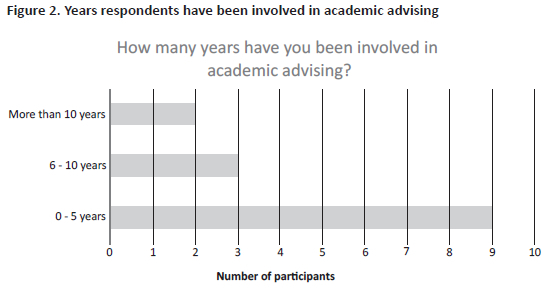
The results are from 19 participants, of whom 14 opted to proceed and complete the survey. Although the response rate was quite low (9%), the purpose of the qualitative survey was not to generalise findings, but to gain an overall understanding of how the AAPD is fulfilling its purpose to advance the professional development of its participants. Therefore, the interpretation of the data will take this into account. The 26 South African universities are represented by the following six higher education institutions: the University of the Free State (UFS), the University of KwaZulu-Natal (UKZN), Nelson Mandela University (NMU), the University of the Witwatersrand (Wits), the University of Pretoria (UP) and Durban University of Technology (DUT); the sample indicates how young the profession and practice is in South Africa. Many of the participants in this survey are considered early-career advisors, with the majority having five years or less exposure and involvement in academic advising. Figure 2 shows the distribution in the number of years that the participants have been involved in academic advising. Linked to this, the participants had limited exposure to other professional associations and groupings, with only five participants holding professional membership of either NACADA or the South African Academic Advising Association (ELETSA).
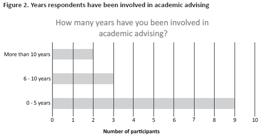
It is interesting to note that while academic advising dates back to slightly more than a decade in South Africa, five (36%) of the respondents had been involved in academic advising for more than six years (6-10 years and more than 10 years). The majority, nine (64%) of the respondents, were still in the early years of academic advising, with their experience in the profession being five years or less.
Participants were asked to describe their roles as academic advisors. While the roles described by participants differ, most reflect the informational and relational aspects of academic advising with varying emphasis on each aspect. For example, one participant noted that their role as an advisor is mainly about providing individual consultations and workshops to support students in developing their skills and helping them cope: "Individual consultations and workshops on general academic support; goal setting & motivation; adjustment to university life; time management skills; basic study methods skills; test/exam preparation; stress management and; career exploration."
Others described their informational roles as intertwined with establishing a trusting and supportive relationship with students. For example:
I often engage with students regarding their academic progress, personal challenges, hopes and aspirations.
I assist students to navigate the [university] terrain as far as the registration of correct modules/curriculum is concerned . . . I assist students in monitoring their academic progress as per the applicable rules . . . AA allows me to assess student needs and to refer them to much-needed services available to them at the [university] . . .
My academic advising role in my institution is to provide a supportive role to faculties (specifically the teaching and learning department) and students. Ensuring that I equip my students with academic success strategies that they require to become successful in their academic journey and make it to graduation.
My role consists of offering time management skills to students, looking at their academic journey and making sure that they are on the right path in terms of academia, how they are able to handle the pressures of their academic journey and how they are copying as students and as human beings outside of work.
Only one participant mentioned the conceptual aspect of academic advising as being part of their role, and combined it with the informational aspect of advising:
My role as an academic advisor is to give academic support through academic guidance strategies. It is important to note that, academic support is embedded within a human being's holistic being. Thus, in addition to being an academic advisor, it is also my role to detect whether the academic issues are indeed the problem or challenges. If not, it is my duty as well to know where to further refer the student to get additional support either psychologically or socially.
Only one participant mentioned the technology aspect of advising as being part of their role as an advisor, albeit as just a tool or a platform to engage with students:
I assist students with individual academic advising sessions online/face to face on various topics such as institutional rules, time management, stress management, lifestyle, study strategies, and career decisions. I also teach and academic advising is not my only role.
One participant indicated that "[a]cademic advising is still a project in our institution, I do not have a role yet."
Nine of the fourteen respondents indicated that their institutions had a formal definition of academic advising at an institutional/faculty and or departmental level. Two indicated that they had a definition in one or more departments and three indicated that they did not have a definition of academic advising either at institutional, faculty, and/or departmental level.
A summative assessment of the overall state of academic advising, according to the responses, is that academic advising is still an evolving profession in South Africa with varying degrees of advancement among institutions. The responses confirm that institutions are largely committed to the practice as there are formal definitions; however, support for the profession lacks steady growth as role clarifications are not yet as concrete. Findings further draw us closer to what the literature describes as characteristics of a community of practice (CoP). The reflections of participants in this study confirm that the AAPD provides a shared domain of interests that supports agile methods and strategies. There is a commitment in the AAPD to learning and sharing while developing participants' reflective experiences. The practice of academic advising encompasses sustained interactions stemming from the AAPD and beyond into other scholarly environments (Wenger, 2006). To gain a more in-depth and detailed understanding of how the AAPD has contributed to participants' professional identities and development as well as the manner in which they practise academic advising, the discussion of participants' responses is arranged in accordance with the ICRTP framework that forms the conceptual basis for the AAPD. The participants responded to the following sample question: Which theories inform your academic advising practice and describe how they inform your work as an advisor? An analysis of specific themes is included under the components of the ICRTP framework to provide the relevant data.
Informational
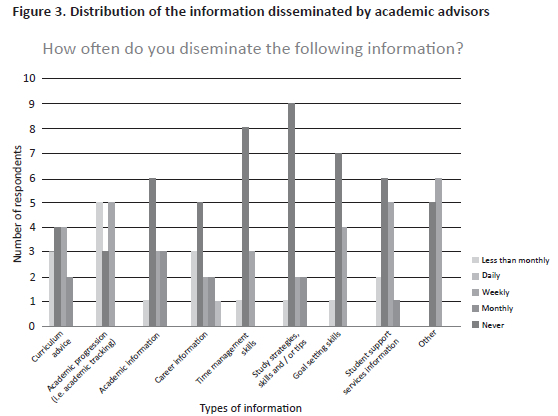
While the roles are varied among the respondents, unpacking the types of information disseminated, the responses, as illustrated in Figure 3, show that respondents disseminate student support services information, goal setting, study strategies, time management, career information, academic information, academic progression, and curriculum information on a daily basis. Similarly, the same types of information are also disseminated on a weekly basis. It is worth noting that practical information such as goal setting (seven), study strategies (nine), and time management (eight) are the top three types of information disseminated daily by respondents, thus signalling what students' needs are. Interestingly, an almost similar trend is observed between academic information and career information. Information is disseminated daily, weekly, and monthly, showing a link between these two types of information.
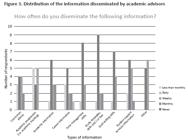
Further analysis of the respondents' data also indicates that 'other' information is disseminated as part of their function as academic advisors. Elaborated, this 'other' includes module related information, writing place (writing centre) activities, and any other key messages related to their curriculum or teaching and learning activities; appeals processes, NSFAS propensity requests, and referral for service rendering by other student support stakeholders. In their descriptions of what the 'other' information entails, respondents indicate:
Key important dates in the academic calendar that students should be aware of.
Psychosocial issues that affect [sic] students' academic success.
Dealing with academic stress, living a balanced lifestyle for long-term success, dealing with career indecision, university policies, e.g. pregnant students.
General rules and specific faculty rules they may not be aware of (related to progression and assessments), application and registration information.
These data confirm the importance of the informational component in academic advising practice and how broad it can be. It underscores that advisors need to stay informed from an internal (institutional), external (sectoral), and student-needs perspective in order to be responsive to students' needs.
The informational components provide the core of academic advising as a practice. It is made up of the knowledge that academic advisors ought to acquire to be able to guide students throughout their university journeys. In their responses, participants describe the informational component of the academic advising practice and profession. The overall responses indicate that there is still a fragmented availability of information disseminated in the advising practice. As in the case of students not knowing and understanding what information to request and seek from academic advising. The respondents have a similar understanding.
Most responses suggest that advisors focus on internal environmental information and meeting student needs when providing information. The following responses are supportive of this:
Providing a student with adequate information enables them to make good decisions.
Being able to convey relevant information that supports students' success and decision-making.
Know (and/or know where to find) and be able to impart knowledge, explain processes, policies, etc.
Institutional knowledge advisors must know to guide students.
Resourceful-giving students something tangible to go and implement.
Being able to provide students with information related to the institutional ecology and support networks.
There are, however, some vague responses suggesting that a more in-depth understanding of the informational component is required such as, "Collecting and disseminating information; being up to date with information."; and "Very important to keep up to date with correct information, so that the information we give to students, is accurate and up to date."
Overall, the qualitative responses demonstrate two broad themes: (i) those with an understanding and (ii) those with a limited understanding of the informational component. This is significant because the informational component is important for the organisation and facilitation of academic advising as a practice and a profession.
Conceptual
Reflecting through a conceptual lens on the description of academic advising in practice, respondents used varying descriptors that illustrated and suggested only a partial understanding of the conceptual component in relation to practice. Showing a clear and aligned understanding, three respondents described the conceptual component, which is the conceptual framework and basis, as follows:
Conceptual and contextual framework informing practice.
Concepts advisors must understand to effectively advise students.
Being able to explain in basic terms what rules/regulations, etc. mean in relation to a student's studies.
Other descriptions used by respondents to explain the conceptual component suggest that for these participants, there is still a basic understanding of the conceptual component:
Understanding what academic advising entails.
Understand how academic advising fits in [sic] my institution as well as in [sic] the higher education environment.
Although the responses and prominent themes reflect that most of the respondents are still in the early stages of understanding and unpacking the context and concepts of academic advising, the AAPD has provided a learning opportunity which extends into crafting meaning-making. According to the literature, a thorough understanding of the conceptual component means that advisors understand, value, and have the skills to act upon the concepts affecting students' needs and success through an advising lens.
Relational
In an analysis of participants' responses regarding their understanding and interpretation of the relational component and how it is understood in their profession and practice, two themes have emerged: (i) interpersonal skills and (ii) practicality. Ten of the fourteen responses support participants' understanding of the relational component as being linked to interpersonal skills (Menke et al., 2020). The following are example of such responses:
Understanding the interrelatedness of people, processes, success, failure etc.
[. . . ] requires a connection between more than 1 person.
Building strong supportive relationships with students.
Very important to establish good relations with students. To get them to trust you and open up to you.
[. . . ] being able to interact with students on a [sic] individual or group platform to help them see they are not alone in their academic journey.
Relating to students, stakeholders, and other support structures.
The above supports Heikkila and McGill's (2015) proposal that the relational component in a developmental approach is underscored by the advisor-advisee relationship. Demonstrating an opportunity for future focus on enhancing the understanding of the relational component both in practice and profession, it is worthwhile to explore and strengthen the skills of rapport building, communication, problem-solving, and effective questioning.
Technology
Two participants reflected on learning technology and how, in their practice, this category enables them to disseminate and make information available, and fosters relationships with students. As one of these comments illustrates: "Accessibility, the information that you need or that you came for into the office is also accessible at your fingertips as a student, just strengthen your relationship with your LMS-BB (Blackboard) Collaborate."
While some responses were generic and overarching and not very explicit, others reflected specifically on engagement technology. The responses address the issue and suggest that engagement technology enables the practice and allows professionals to cast a wider net in offering support and resources to students, as the following three comments show: "Being able to reach out to more students via emails/social media platforms, etc."; "The use of equipment used, having access to reaching students."; and "Being able to reach out to a wider audience of students. Sharing resources."
In the generic responses, it is clear that participants appreciate the overall role of technology in their practice and profession. One of the participants' reflections mentions and conveys an appreciation of how the COVID-19 pandemic has enabled better use of technology in their advising practice: "Plays a very important part in advising today. Especially during the Covid epidemic [sic]."
Personal (professional)
Highlighting the significance of the personal component in promoting advisor efficiency and effectiveness, McGill (2019) summarises that the personal component in advancing the advising profession and practice should, on the part of the advisor, include self-reflection of one's practice, beliefs, and further growth and development. Two of the participants' responses capture this and describe the personal component as follows: "How this relates to my personal and professional development and competencies-and how this will influence how [. . .] engage in my workspace with staff and students."; and "Assisting students with guidance in terms of being healthy on a personal level in order to be successful in their studies. Everything is interconnected."
Most participants identified parts of the personal component that resonated with them in describing what it means in their profession and practice: "Constantly reflect on my advising philosophy. Take care of myself. It will not be possible to pour to students from an empty cup."; "Development and care."; and "Competence and cultural awareness."
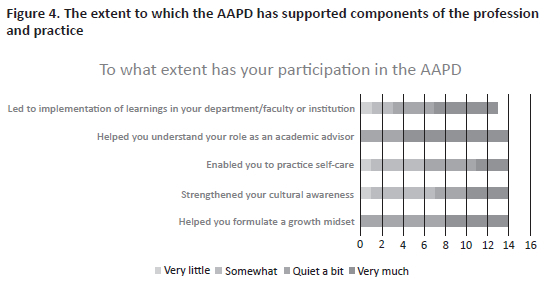
In summary, the participants' reflections from the thematic analysis draw a clear and comprehensive measure of the extent to which the AAPD has enabled them to advance their practice and establish a professional identity through a traditional Community of Practice (CoP). Figure 4 illustrates that, to a greater extent, the AAPD afforded the respondents a formalised developmental opportunity. For most respondents, the AAPD clarified and helped them understand the role of being an academic advisor and the formulation of a growth mindset, speaking to the willingness to learn and grow as a professional. To a lesser extent, the AAPD did not afford respondents space to practice self-care or strengthen their cultural awareness; this suggests that these components are difficult to measure and will require deeper investigation. Since all institutions represented in this study have an institutional definition of academic advising, this is promising for the advancement of the profession and practice, as the definition is an essential building block for implementation. The AAPD has further enabled an overall mindshift and learning opportunities on how to integrate the self into the advisor role. The data suggest that the AAPD needs strengthen and improve the areas of self-care, cultural awareness, and opportunities for implementation.
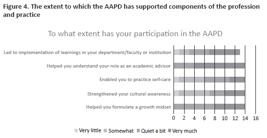
An analysis of the participants' responses suggests that the AAPD does provide the foundational knowledge base of professional development and prepares advisors for practice. While the majority of the participants are early-career academic advisors, many benefited as the SLP created more in-depth exposure and engagement with the theories and concepts underpinning academic advising. The following participant's reflection describes how the AAPD influenced and informed their practice as an early-career academic advisor:
I participated in the AAPD the same year that I started with academic advising. It provided me with a lot of insight in terms of theory and practice. I enjoyed to learn that it can be a structured process backed up by theory. Additionally, looking at academic advising in terms of cycles that speak to the student needs at certain points of the year was very insightful and helped me to frame my thoughts on ways to assist students.
Other participants indicated that for them, participation in AAPD, to a great extent, helped them understand academic advising in a more practical way, thus enabling more informed and structured practice.
I have benefited from the programme. Going through formal academic advising training, understanding that there are processes and practices that exist in the field of academic advising has been beneficial in instilling confidence in myself and improving my advising processes. A major benefit is knowing through the AAPD programme that the processes I employed as an academic advisor were good processes.
I was able to implement and coordinate academic advising in my institution.
Participation in the programme gave me the starting and thinking tools, to develop my own coaching style that assists me in becoming a successful academic coach.
I am now able to reach and impact more students. As I was once a student, and worked with students I know the importance of sharing my journey with students. Hosting weekly webinar sessions with students and being apart [sic] of their realities has helped me come up with initiatives that allow us the staff [to] know the realities of our students.
It provided a foundation of knowledge to help better understand the role of academic advising, which has helped me feel more grounded as a [sic] advisor. This foundation also helped me structure strategies/ideas to help improve how effective advisors can be within our faculty.
Three participants alluded that, more than contributing to their professional development, the AAPD created extended awareness and reflective space for them. One participant indicated that in addition to the AAPD being reflective, it further aided them to be more intentional in their practice. This translated into positive implementation institutionally.
It increased my awareness in terms of the existence of AA as a profession as well as the efforts made to coin and categorize it as such. Being in a venue full of AAs from various institutions made me realise that AA is not a UFS-only practice. I observed that there are differences in how AA service rendering is done across the various institutions and how AA practices in some institutions are advanced. I appreciated the thorough and relevant material provided and presented to us during the training workshop, it indicated that the practice is informed by the latest research. This allowed me to reflect on my service rendering, relevance, and impact thereof.
The programme gave me in-depth awareness of advising [as] a professional practice and the areas of development one needs to engage with in order to be responsive to their students and to create a programme that has impact.
Since completing the AAPD, I am constantly reflecting on the competencies I possess to do my "job" well. In relation to all the 5 components of advising, I am ensuring that I reflect on whether my conceptual understanding of Advising [sic] a year ago for instance is still the same as currently. If it has changed then how has it changed and what does it mean now. The AAPD has helped me become more intentional about being curious about developments in the advising space as well as being a part of communities that foster that growth and curiosity, [I especially became] engaged in the programme in my first six months of being an advisor.
Many of the participants' responses confirm the valuable contributions of the AAPD to their professional development and practice. Consequently, the use of the ICRTP framework to advance the professionalisation and practice of academic advising in responding to student needs, has proven to have a positive impact. From an informational perspective, it is evident that advisors disseminate an array of information and the AAPD creates greater understanding and contextualisation. In the case of the conceptual component, it introduces participants to theories and approaches to academic advising; however, there is an identified gap in that none of the theories used in the practice are directly applicable to academic advising, but are rather borrowed from other professions and bodies of literature, such as psychology.
Another gap, which is explicitly flagged, is that there are no local theories, models, and approaches related to student support and success introduced or discussed in the AAPD. A participant articulated this by suggesting, "include a clear model which has been combined and adapted from local psychology and education to speak to academic advising specifically."
Implications and recommendations
Findings from the survey responses indicate that the ICRTP framework offers valuable insights into the perceptions and practices of academic advisors in South Africa. While some respondents have extensive experience, most are still in the early stages of their careers. Institutions represented by participants in this study are also in the early- to mid-developmental phase of the profession, with data leaning toward a description of the practice, which is a combination of developmental and intrusive approaches. Roles described by participants primarily focus on providing informational and relational support to students, highlighting the multifaceted nature of academic advising. However, there are varying levels of understanding and implementation of the informational, conceptual, relational, technological, and personal components of academic advising as proposed by Habley (1995) and McClellan (2007).
Regarding the informational component, participants demonstrated a fragmented understanding, with some acknowledging the importance of providing relevant information to students. In contrast, others need a more in-depth grasp of this aspect. The conceptual component, emphasizing understanding of the theoretical underpinnings of advising, is still in the early stages of development among respondents. However, the AAPD programme facilitates learning and meaning-making opportunities in this area. The relational component, crucial for building rapport and supporting students effectively, is widely recognised by participants, with interpersonal skills being highlighted as essential for successful advising.
Technology integration in advising emerges as an area for further development, with participants acknowledging its significance, especially in light of the COVID-19 pandemic. The personal (professional) component, often overlooked but essential for effective academic advising, is highlighted by participants as integral to their professional growth and competence.
Conclusion
As proposed by participants, there remains a need for further extensions to advance both the profession and practice in academic advising, especially in the context of South African higher education. While there is a move towards the identity formation of academic advisors professionally, there needs to be more critical and theoretical underpinnings that inform the organisation of professionals in practice. The identification of the AAPD as a lever affording the development of a traditional CoP is not sufficient; a better identity definition needs to be investigated and proposed as an extension of the baseline established through the AAPD.
Overall, the study demonstrates and underscores the positive evolution and advancement of academic advising in South Africa, with the AAPD programme serving as a valuable platform for professional development and enhancing advisor competencies. For those not directly involved in the day-to-day operations of academic advising and senior leadership, the AAPD helps formulate a better understanding of the practice but offers very little about how to lead advisors. Unlike those in early career transitions into practice and others transferring from other entities in higher education, the AAPD provides fundamental and comprehensive exposure to understand, acquire the skills, and have a blueprint for the operationalisation of practice.
There is a need for further studies and professional development opportunities in the form of webinars, conferences, and training to continue building on the AAPD. This will enable further advancement efforts to strengthen the understanding and implementation of academic advising across all five components, as proposed by McClellan (2007), and to ensure adequate support for student success.
From the findings, it is furthermore more evident that the AAPD can be considered the initial base for a community of practice. However, there is still a gap for the AAPD to earn a distinct classification as a CoP that aligns to a broader professional development framework, which refines the identification of academic advising as a profession and the AAPD as a formalised professional development programme.
Ethics statement
The authors subscribed to the highest levels of ethics during this research study. The Research Ethics Committee of the University of the Free State (UFS) granted approval for the study to be conducted (ethical clearance number: UFS-HSD2022/0907/22).
Potential conflict of interests
The authors declare that no competing interests from this study.
Funding acknowledgement
The research received no designated funding from any funding agency for this study.
References
- Aiken-Wisniewski, S. A., Johnson, A., Larson, J., & Barkemeyer, J. (2015). A preliminary report of advisor perceptions of advising and of a profession. NACADA Journal, 35(2), 60-70. https://files.eric.ed.gov/fulltext/EJ1090145.pdf
- Arthur, L. (2016). Communities of practice in higher education: Professional learning in an academic career. International Journal for Academic Development, 21(3), 1-12. https://eric.ed.gov/?id=EJ1106515
- Braun, V., & Clarke, V. (2006). Using thematic analysis in psychology. Qualitative Research in Psychology, 3(2), 77-101. https://doi.org/10.1191/1478088706qp063oa
- Cate, P., & Miller, M. A. (2015). Academic advising within the academy. In P. Folsom, F. Yoder, & J. E. Joslin (Eds.), The new advisor guidebook: Mastering the art of academic advising (2nd ed., pp. 39-53). Jossey-Bass. https://www.wiley.com/The+New+Advisor+Guidebook%3A+Mastering+the+Art+of+Academic+Advising%2C+2nd+Edition-p-9781118823606
- De Klerk, D. (2021). Making known the real: An exploration of academic advising practices in a South African higher education context. Journal of Student Affairs in Africa, 9(2), 101-121. https://files.eric.ed.gov/fulltext/EJ1336416.pdf
- Department of Higher Education and Training (DHET). (2018). Ministerial statement on university funding: 2018/19 and 2019/20. Government Printer. Retrieved from https://www.dhet.gov.za/UCD%20Policies/Ministerial%20Statement%20on%20the%20Implementation%20of%20the%20University%20Capacity%20Development%20Programme.pdf
- Drake, J. K. (2011). The role of academic advising in student retention and persistence. About Campus, 16(3), 8-12. https://doi.org/10.1002/abc.20062
- Habley, W. R. (1987). Academic advising conference: Outline and notes (pp. 33-34). ACT National Center for the Advancement of Educational Practices. Retrieved from https://www.nacada.ksu.edu/Portals/0/Clearinghouse/advisingissues/documents/AcademicAdvisingConferenceOutlineandNotes.pdf
- Habley, W. R. (1995). Advisor training in the context of a teaching enhancement center. In R. E. Glennen, & F. N. Vowell (Eds.), Academic advising as a comprehensive campus process (Monograph No. 2, pp. 53-60). National Academic Advising Association.
- Heikkila, M. R., & McGill, C. M. (2015). A study of the relational component in an academic advisor professional development program [Conference paper]. South Florida education research conference. Retrieved from https://www.academia.edu/65376285/A_Study_of_the_Relational_Component_in_an_Academic_Advisor_Professional_Development_Program
- Higginson, L. C. (2000). A frame work for training program content revisited. In V. N. Gordon, Habley, W. R., & Associates (Eds.), Academic advising: A comprehensive handbook (pp. 298-306). Jossey-Bass. Retrieved from https://www.nacada.ksu.edu/Portals/0/Clearinghouse/documents/2000-Higginson-Informational-Components.pdf
- Justyna, E. (2016). Creativity in higher education curriculum: A qualitative case study of pedagogical processes and practices [Unpublished doctoral dissertation]. Texas Tech University. https://ttu-ir.tdl.org/server/api/core/bitstreams/760367b9-634c-4743-b387-1d9b71f3a458/content
- King, M. C. (2000). Designing effective training for academic advisors. In Academic advising: A comprehensive handbook (2nd ed., Chapter 20). Jossey-Bass. https://www.wiley.com/en-be/Academic+Advising%3A+A+Comprehensive+Handbook%2C+2nd+Edition-p-9780470371701
- Larson, J., Johnson, A., Aiken-Wisniewski, S. A., & Barkemeyer, J. (2018). What is academic advising? An application of analytic induction. NACADA Journal, 38(2), 81-93. https://files.eric.ed.gov/fulltext/EJ1202423.pdf
- McClellan, J. L. (2007). Content components for advisor training: Revisited. NACADA Clearinghouse of Academic Advising Resources. https://nacada.ksu.edu/Resources/Clearinghouse/View-Articles/Advisor-Training-Components.aspx
- McGill, C. M. (2017). The professionalization of academic advising (Publication No. 6278). FIU Libraries Digital Scholarship Commons. https://digitalcommons.fiu.edu/record/6278
- NACADA: The Global Community for Academic Advising. (2017). NACADA academic advising core competencies model. https://www.nacada.ksu.edu/Resources/Pillars/CoreCompetencies.aspx
- Rudolph, F. (1962). The American college and university: A history. Random House. Retrieved from https://ia801901.us.archive.org/4/items/in.ernet.dli.2015.150700/2015.150700.The-American-College-And-University-A-History.pdf
- Schulenberg, J. K., & Lindhorst, M. J. (2008). Advising is advising: Toward defining the practice and scholarship of academic advising. NACADA Journal, 28(1), 43-53. https://doi.org/10.12930/0271-9517-28.1.43
- Tiroyabone, G. W., & Strydom, F. J. (2021). The development of academic advising to enable student success in South Africa. Journal of Student Affairs in Africa, 9(2), 1-15. Retrieved from https://files.eric.ed.gov/fulltext/EJ1336213.pdf
- Troxel, W. G., Bridgen, S., Hutt, C., & Sullivan-Vance, K. A. (2021). Transformations in academic advising as a profession. New Directions for Higher Education, 2021(195-196), 23-33. https://eric.ed.gov/?id=EJ1334571
- Wenger, E. (2006). Communities of practice: A brief introduction. Retrieved from https://scholarsbank.uoregon.edu/server/api/core/bitstreams/d1fddebc-8756-4647-9aef-80046f02df59/content
- White, E. R. (2020). The professionalization of academic advising: A structured literature review - A professional advisor's response. NACADA Journal, 40(1), 5-9. https://doi.org/10.12930/NACADA-20-01
Accepted 13 October 2025
Published 18 August 2026