Hauntological engagements: Visual redress at Stellenbosch University
Abstract
This article asks the central question of how to practically engage in the ongoing production of space at Stellenbosch University (SU) as to reimagine and redefine spaces. Spaces, which affect people indirectly and subconsciously, can act as microaggressions on one hand and places of safety connected to identity on the other. The Visual Redress (VR) project at SU focuses on removing or replacing contentious visual elements on campus and facilitating engagements to alter experiences of places and spaces. The VR project is not only interested in physically transforming the space, but also in facilitating critical dialogue and physical interventions to engage in spatial memory and emotional remembrance. In this article Hauntology is used as a methodology to remember and reflect on visual elements on the Stellenbosch campus of SU and how the memory of the past and the dead in the form of visual elements still haunts the present. These hauntological engagements include crucial interactions with students, lecturers, and the various publics of the university. In this article the researchers will provide an overview of VR at SU and show and discuss the processes of three specific VR projects that were implemented at SU to illustrate the importance of hauntological engagements with the aim of reconstructing spaces.
Hauntology; space; visual redress; Stellenbosch University; South Africa
Abstract
Eli nqaku liphakamisa owona mbuzo ungundoqo wendlela yokuzibandakanya kuqulunqo lweqonga oluqhubayo kwiYunivesithi yaseStellenbosch (iSU) njengokucinga ngokutsha kunye nokuchaza ngokutsha iqonga. Amaqonga, achaphazela abantu ngokungathanga ngqo yaye bengaqondanga bona, anokusebenza njengohlaselo olungaqondakaliyo kwelinye icala kunye neendawo zokhuseleko ezihambalena nobuni kwelinye icala. Iphulo loKulungiswa kweMbonakalo (VR) eSU ligxile ekususeni okanye ekutshintsheni iimbonakalo ezinokuxabanisa ekhampasini kunye nokuququzelela iindibano zokutshintsha amava eendawo kunye nawamaqonga. Eli phulo leVR alijolisanga kuphela ekuguquleni iqonga ngqo, kodwa likwajolise ekuququzeleleni iingxoxo ezibalulekileyo kunye nokungenelela ngokuthe ngqo okubandakanya iinkumbulo ngendawo kunye neenkumbulo ngokweemvakalelo. Kweli nqaku iHauntology isetyenziswa njengendlela yokukhumbula kunye nokucamngca ngezinto ezibonakalayo kwikhampasi yaseStellenbosch yaseSU kunye nendlela inkumbulo yexesha elidlulileyo kunye nabalishiyayo eli limagade ahlabayo ngendlela yezinto ezibonakalayo ezisakhathazayo kule mihla. Olu nxibelelwano lwe-hauntological lubandakanya uthethathethwano olubalulekileyo nabafundi, abahlohli, kunye noluntu lweyunivesithi ngokubanzi. Kweli nqaku abaphandi baya kubonelela ngesishwankathelo seVR eSU kwaye baya kubonisa ze baxoxe ngeenkqubo zamaphulo amathathu eVR athe aphunyezwa yiSU ukubonakalisa ukubaluleka kothethathethwano lwe-hauntological ngenjongo yokwakha ngokutsha iziko..
iHauntology; iziko; ukulungiswa kwembonakalo (VR); iYunivesithi yaseStellenbosch; uMzantsi Afrika
Overview of redressing space at Stellenbosch University
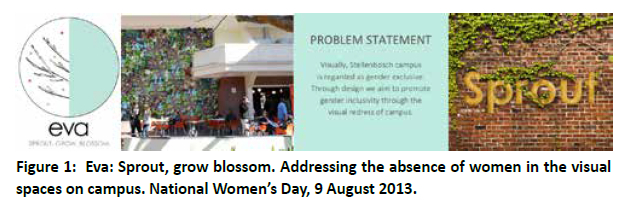
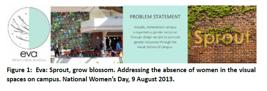
The VR project started in 2013 in the Visual Arts Department with the aspiration of moving projects outside the studio space and into the main square of the university to engage other students on campus in transformation and social justice related projects. The concept 'visual redress' spontaneously developed from a student group project on National Women's Day (a South African holiday celebrated yearly on 9 August that commemorates the historically significant Women's March of 1956) that addressed the absence of statues/artworks of women on campus (Figure 1). The words 'visual redress' were used for the first time in the course of this project and it then became a concept that was used in various projects that aimed to make the campus a better and more welcoming space for all students.
In South African higher education institutions, the student protests from October 2015 to late 2016, now commonly known as the Fees Must Fall protests, called for the decolonisation of higher education spaces and equal access to these spaces. Student activism is described by Sonwabo Stuurman (2018, p. 1) as a "form of action or practice that seeks to make changes to how the university systems function, or which challenges a particular paradigm, be it politically, socially, economically or otherwise". He also argues that student activism is informed by the prevalent conditions of economic and political crisis, which directly affect student's financial situation. This, therefore, also affects the status of students and their personal identities, and that could lead to the infusion of financial and identity issues in student protests (Stuurman, 2018). Engaging and understanding historical pain, forgiveness and healing can help in addressing identity issues related to social injustice.
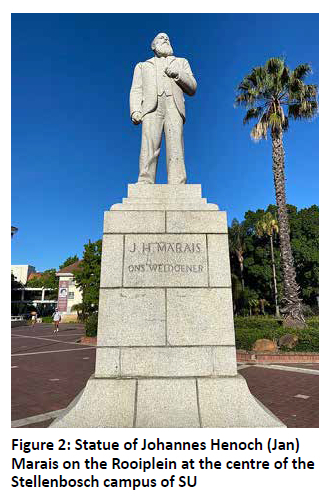
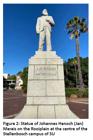
During the abovementioned student protests, this article's first author worked with one of her master's students, to identify sensitive spaces such as statues, names of buildings, and plaques that were offensive or hurtful, one such issue was the Jan Marais statue. At the centre of the Stellenbosch campus of SU, on what is called the Rooiplein (Red Square), is the statue of Johannes Henoch (Jan) Marais. In 1915, Jan Marais made a distinctive financial contribution towards the establishment of SU with the money that he had accumulated in the mining industry. During the 2015 and 2016 protests, the students called for an inquisition into historical statues and symbols at the university, and in particular called for the removal of the Jan Marais statue (Figure 2). Protesting students in 2016 attempted to set the statue on fire. This event specifically led to the implementation of actual measures by the SU management to create a welcoming space for all on campus. It was decided to retain the statue and create opportunities to engage students and staff in conversations about the history of the university and Jan Marais. The importance of having these engagements is highlighted by a student: "I don't know the history of Mr Jan Marais but... I feel like I can assume with the history of South Africa ...just leaving it there is not really addressing stuff in my opinion" (BM1). The statue must be questioned and engaged with, not allowed to just stand unproblematised on campus.
A staff member (WM1) made the following comment that supported the retention of the statue and the possibilities for interventions with it:
If we forget the past, there is a strong possibility that we are repeating it, maybe just in a different form. I would like to see the things that are there from the past explained, rather than removed Explain it and make it an educational thing, instead of remove it, out of site out of mind -we tend to forget.
Keeping the statue allows for it to be contextualised and for history to be interacted with. As a contrast to the Jan Marais statue, a sculpture of a circle of women, The Circle, has been erected on a stretch of grass next to the statue and will be discussed in the following section.
In 2017, a VR Plan was written up based on students' projects and suggestions during the protests, and this was presented to the SU Rectorate, the management body of the SU. This plan was written into a financial project request to the university based on which substantial funding was made available to implement projects linked to the plan. Aslam Fataar (2021, p. 8) in the book, Evoking Transformation: Visual Redress at Stellenbosch University, writes: "Visual redress refers to processes involving changes in the university's visual environment and culture that promote restitution, inclusivity and institutional cohesion". VR at SU is interlinked with the SU Transformation Plan (2017), as it is included as one of the crucial aspects to redress: Programmes, People and Places; where VR falls under 'places' to redress. But it is clear that the theme of transformation and decolonising place could invite varying intensities of interest - from a sense of belonging, activism, curiosity, to distance or fear. A dedicated VR committee was also established in 2018 to facilitate an institution-wide discussion on and implementation of public artworks. This committee complements the SU committee for the naming and renaming of buildings, venues, and other facilities/ premises and as such there is direct interaction between these two institutional committees. It should therefore also be mentioned that these two committees are guided by the same policy (SU, 2021, p. 2).
Spatial interventions
This section discusses three projects on campus that evolved from the VR project and the need to redress and redefine spaces on campus to overcome its hauntological aspects. These interventions, all installed on and around the Rooiplein in 2019, are the welcome benches, Stellenbosch area maps, and The Circle sculpture
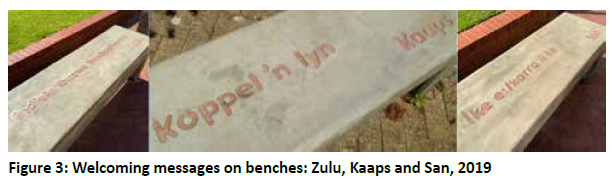
The first intervention discussed is the welcome benches (Figure 3). Welcoming messages in 16 different languages and dialects were inscribed on benches around campus. South Africa currently has 12 official languages, namely Afrikaans, English, isiNdebele, Sepedi, Sesotho, Seswati, Xitsonga, Sestwana, Tshivenda, isiXhosa, isiZulu, and the recently added South African Sign Language. Braille and dialects of Afrikaans, Kaaps and Moeslim Kaaps, were also added to the benches. isiNdebele, Sepedi, Sesotho, Seswati, Xitsonga, Setswana, Tshivenda, isiXhosa, isiZulu are indigenous African languages. Afrikaans, a language that developed during the 19th century in South Africa, is mainly based on Dutch but also has Malay, Indonesian, and Khoekhoe (Khoi) and San influences. The language of the San and Khoi people, Khoekhoegowab, was also added to the benches. The San and Khoi people are the indigenous people of Southern Africa and are regarded as the first nations of South Africa. It was they whom the Dutch colonisers met when they landed in the Cape. Khoekhoegowab is still a spoken language and its speakers are currently struggling to have it recognised as an official language of South Africa.
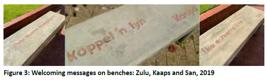
The idea for these benches came from Monique Biscombe, a student of SU at the time. In 2019, lecturer Sima Mashazi from the General Linguistics department at SU volunteered to contact first-language-speaking students to ask them to contribute welcoming messages. However, because of the hierarchies of languages created in the colonial and apartheid past as well as the impact of current social realities and dynamics, this was not a straightforward task. Even after the installation of the benches, differences emerged in the meaning of the messages, for instance the saying 'koppel 'n lyn' (connect a line) in Kaaps has different meanings depending on which area you are from. One meaning is to 'put people in contact with each other' and the other refers to using drugs. Students who understood the message as referring to drugs felt that SU was trying to devalue their culture because they connected their culture with drug use. They felt so strongly about the matter that they considered transferring to another university. This event catalysed many discussions between students and lecturers who speak Kaaps themselves and also opened up the conversation in general about diversity and inclusivity regarding languages on campus.
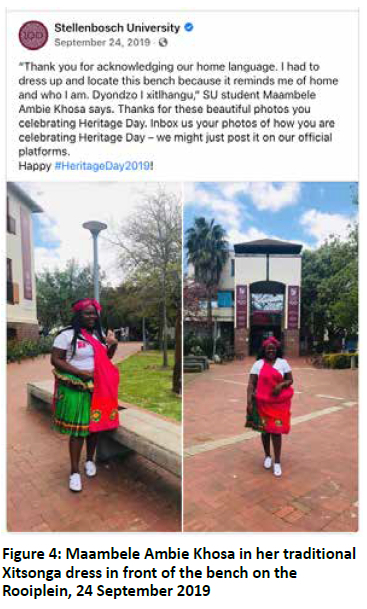
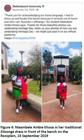
In 2019, student Maambele Ambie Khosa indicated that she appreciated the diversity and inclusivity regarding language use on the benches when she came across one that included her own language. The bench held a proverb in Xitsonga: 'Dyondzo i xitlhangu xa vutomi', which means 'Education is the key to a good life' (SU, 2019b). She posted a picture on social media (Figure 4) with the caption: "Thank you for acknowledging our home language. I had to dress up and locate this bench because it reminds me of home and who I am" (SU, 2019a). During data collection in 2022, a student said about the benches: "I think it's a good initiative because it makes everyone feel welcome" (BM7). Another comment also notes the issue of language diversity and inclusivity: "I think they are good because we always sit by these [benches] with the braille, and I feel like it brings more of an awareness that we are living in a very like multicultural, you know, world and country" (CF3). These responses acknowledge that including all of these languages increases cognizance of the multicultural - and multilingual - nature of campus.
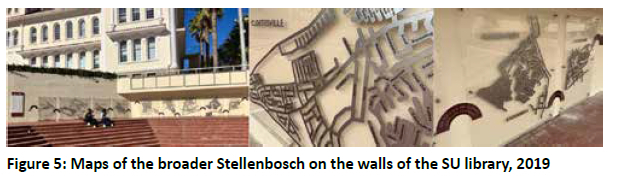
The debates regarding inclusivity and languages led to discussions on segregated living areas in Stellenbosch that are still a reality for most citizens of the town. Student Joshua Mclean developed the idea of adding maps of Stellenbosch areas to the outside walls of the library on the Rooiplein (Figure 5). What seemed to be a relatively clear and manageable project again turned into a long discussion and interaction. People from some areas/neighbourhoods in the broader Stellenbosch region saw themselves as living in independent towns/communities/villages, while others saw themselves as being part of the town of Stellenbosch. This resulted in engaging discussions by the members of the VR committee, which represents people from different areas in Stellenbosch.
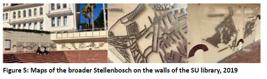
Because of apartheid laws linked to forced removals (Group Areas Act of 1950), some people of colour had been forcibly removed from their homes in central Stellenbosch from an area known as Die Vlakte (The Plains) to the outskirts of the town in established neighbourhoods that catered, under law, for specifically pre-designated groups of people. Through engagement it became clear that people who had been forcibly removed felt that they were part of Stellenbosch, whereas other communities that had been formed as mission stations, for example, felt that they were independent towns. These discussions also opened up issues of land ownership that resulted from pre-colonial, colonial, and apartheid-linked occupations. The VR committee proposed to add bridges between the maps to show that it was a continuous process of building relationships between people of different areas in and around Stellenbosch. As Ratele and Duncan (2007) argue, the relationship between the coloniser and colonised needs to be deeply reflected on. Through these interactions, new insights emerged on the different perspectives of the sensitive issues, and it was only through these processes that we could learn from each other and finally move on to the implementation of the maps.
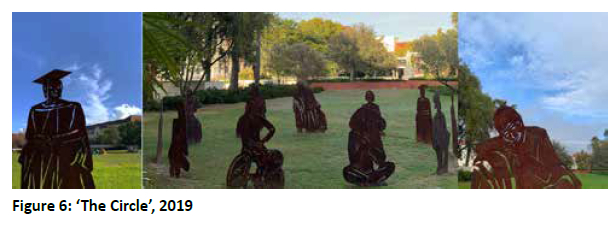
The last intervention to discuss in this article is The Circle sculpture (Figure 6) that was placed on an area of grass across from the prominent and towering Jan Marais statue on the SU Rooiplein. The idea for the artwork originated during the 2015/2016 student protests when Stephane Conradie, who was part of the Open Stellenbosch student movement, initiated discussions on the matter. The Open Stellenbosch movement specifically opposed culture and language based exclusionary practices and policies at SU and linked directly with the larger Rhodes Must Fall and the later Fees Must Fall protest (Van Rooi, 2021, p. 51). Conradie's rationale for the artwork was that during the protests there was "a lot of animosity and confusion and the idea came if everyone could sit down in a circle and humble themselves and talk, then maybe we would move forward" (Anthony, 2019). Conradie suggested that, because women are underrepresented on campus, the artwork should comprise 11 South African women. This contrasts the Jan Marais statue, which follows a traditional art historical format of a heroic male figure on a pedestal.
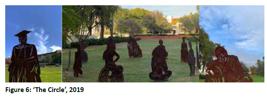
However, there was difficulty in deciding whom to include. A survey was launched on campus that included about 300 female students of different racial and cultural groups to vote for women that they considered role models. The survey was structured in such a way that the same number of students from different racial groups on campus voted. In the end, the women selected, based on most voted received, were: Krotoa/ Eva, the Khoi ancestress of many families in South Africa; Prof Thuli Madonsela, former Public Protector and current Law Trust Chair of Social Justice in the Faculty of Law at SU; anti-apartheid activists Winnie Madikizela-Mandela, Fatima Meer and Lilian Masediba Ngoyi; actress Quanita Adams; author and poet Antjie Krog; Wimbledon wheelchair tennis player Kgothatso Montjane; artist and activist Zanele Muholi; and music artist Dope Saint Jude.
As is the nature of our engagement with art and symbols in public spaces, informal conversations occur from time to time. Given its significance, one such conversation is noted in this article. After installation of The Circle, an interesting observation was made by a male staff member during a visual redress walkabout who felt that the women in a circle symbolised subservience to the man (Jan Marais) standing on a pedestal. A student reacted to that comment during the walkabout and said that in some cultures in South Africa women would sit on the floor while men would sit on chairs in traditional cultural meetings and that could be the reason for the interpretation. Conradie, however, felt that it was a mindful decision to move away from single people on pedestals and towards and a new way of engagement with each other: on equal ground. SU has to work very hard to become a more inclusive and welcoming space for all because of its problematic history, but that also means that channels for dialogue are always open and in that way these important conversations stay alive.
One respondent noted: "I really think the women sculpture is a good thing. Women are not always given credit for what they do. I think [gender] equality is important. Many times, we only represent male figures and forget about women" (CM3). Historically, and in the Western world especially, statues have focused on male figures and their contributions. This response acknowledges that women also deserve to be praised for their contributions to society. CF3 indicated that The Circle is helping to do this: "... we're always on the grass by [it] and then we read all of them like, all the women and what they have accomplished and it's really interesting to know about these women and be made aware of it". However, there are also those who do not believe that there is benefit to initiatives such as these: "Why spen[d] money on these things, the pain sit inside people, fix this first. You will spend millions on this [VR] ... Instead of changing names they should apologise to us" (CM7). He feels the university has not done and is not doing enough to alleviate the pain and foster healing for those who were previously disenfranchised.
Others suggested that the public art on campus is a visual cue that the university is making strides towards transformation. WF7 said, "I think it's really cool to have sculptures on campus, especially in public places. It does make you aware that the university is making an active effort to change the institutional associations." CF4 agreed :
I think it serves a purpose, it's showing that change is happening and people are being acknowledged and that we are trying to become more connected as a people. I think it's also making students more comfortable, especially people of colour.
These comments imply that the VR Project promotes the ideas of the South African 'White paper on arts, culture, and heritage' (DAC, 2017) and the VR policy (SU, 2021). They show that the university is making an effort to transform and to make campus more equal and diverse; more welcoming.
Reimagining and redefining space
As Mbali Phala (2016) suggests, space is never neutral. This is especially true of SU's campuses, campuses of a historically white university. BM1 spoke to this issue, "I just feel like, there's not a lot of people who look like me [in class] ... So that kinda makes me nervous, I guess, so that would probably be the main cause of my discomfort." Another respondent commented:
I think, everyone sort of warned me before I came like, "oh don't go to Stellenbosch - it's the racist university; it's the white university"... I don't think the university itself is like hostile and racist to me at least, but my experience of the students and staff being the majority white was really disappointing, cause it's not really a true reflection of the whole South Africa. (WF7)
This relates to Zembylas et al.'s (2019, p. 25) question on how "to expose the materiality and affectivity of a colonial university, the ruins, traces, fragments, gaps, absences and displaced actors and agencies that register affectively". Haunting is not only about the tangible. It is also about the intangible, about how it is embodied. Space affects people -it makes them feel nervous, uncomfortable, disappointed, etc.
This feeling of space is not only confined to SU, but also to the town in which it sits. As BM3 stated:
There is an invisible line [in town], and you don't get to see it, but as a person of colour you know that as I cross here... it feels like Europe basically. Those are the type of things that I would like to see being addressed and transformed. Yes, as a university we can change and make benches, but how are we influencing the community? Because it's one thing for students here to be accepting and loving but, as you leave out the door, the town sings a different tune. And you still feel so isolated. Still, like, 'you are our guest, you don't belong'.
These comments highlight the deep and entrenched perceptions about Stellenbosch - as a town and university. They demonstrate the long and hard engagements towards transformation that need to continue to assure everyone that all spaces at SU belong to everyone and no one is a guest. They also indicate that these engagements need to happen not only on campus, but also in collaboration with the town, with the public spaces that the university borders, so that these can also become more welcoming spaces. Embodied engagements enable us to associate sensitive spaces with something more pleasant, where people can feel safe. This is something the VR project hopes to facilitate with these and other initiatives.
How do we 'heal' spatial trauma? In physical interactions, body language and facial expressions are more prominent, and that can assist in creating a more respectful space for communication and understanding. Healing from historical pain begins with engaging and understanding. This means that the body needs to be present - and a mind/body learning and healing experience is necessary. The construction of new spaces and a deeper engagement with issues to create more inclusive and diverse visual landscapes also have the potential to be extended and implemented within communities around campus.
There is potential to foster healing and forgiveness through the combination of VR with collaborative engagements. Opportunities for learning and healing were opened through the deeper engagements sparked by these projects. Therefore, an important aspect of VR on campus is not only the changing of the visual landscape, but also the processes that are followed to enable new understandings. An important aspect of VR activity is inclusive dialogue and consensus-generating processes at the various sites on campus. These processes emphasise the deliberative participation and collegiality necessary for ensuring that VR contributes to a cohesive and inclusive campus culture (SU, 2021, p. 3).
Concluding remarks
There are deep silences around material histories, such as statues and spaces, but they are also heavy with the presence of ghosts. VR brings these ghosts to life, offering a voice to the various emotions affected by material histories. It is about being able to "provide openings for new political claims that do not naturalize the past or the present, but see it as getting ready to speak at length about ghosts, inheritance, and generations, generations of ghosts" (Zembylas et al., 2019, p. 45). South Africa, Stellenbosch, and SU are certainly burdened with "generations, generations of ghosts" (Zembylas et al., 2019, p. 45).
Hauntological engagements remind us that colonialism is not over and done with and its oppressive nature still has intergenerational impacts. Rather than a static memorialization, engaging in a hauntological encounter encourages us to remember and to participate in conversations with each other. It urges us to think about our roles in decoloniality (and implicatedness in coloniality). As Bozalek et al. (2021, p. 3) refer to
Barad (2017, pp. 47-48):
The past is not fixed, not given, but that isn't to say that the trace of all memories can simply be erased. Memory is not a mere property of individual subjects, but a material condition of the world. Memory-the pattern of sedimented enfoldings of iterative intra-activity-is written into the fabric of the world. The world 'holds' the memory of all traces; or rather, the world is its memory (enfolded materialization).
The haunting informs our understanding of what was and shapes what will be. It could also serve as a call for more mourning; to hollow out memories and remind us of our shared vulnerabilities. And, as is the nature of the spaces of higher learning, the lessons learned through these engagements could also be applied to other university campuses throughout South Africa and abroad.
Ethics statement
Ethical clearance for the project was obtained from the Research Ethics Committee: Social, Behavioural and Education Research of Stellenbosch University (Project ID 9525).
Potential conflict of interest
We confirm that there is no conflict of interest.
Funding acknowledgement
We received no funding to support the completion of this study.
References
- Abrahamsson, K. V. (1999). Landscapes lost and gained: On changes in semiotic resources. Human Ecology Review, 6(2), 51-61.
- Anthony, E. (2019, September 2). Circle of art set to unite. Eikestadnuus, Netwerk24. https://www.netwerk24.com/ZA/Eikestadnuus/Nuus/circle-of-art-set-to-unite-20190828-2
- Auchter, J., Meireles, B. H., & Lage, V. C. (2019). On the spectrality of the Inter-state-EAL/international: A forum on Jacques Derrida's specters of Marx after 25 years, part III. Contexto Internacional, 41(3), 663-687. https://doi.org/10.1590/s0102-8529.2019410300009
- Barad, K. (2007). Meeting the universe halfway: Quantum physics and the entanglement of matter and meaning. Duke University Press.
- Bentley, K., & Habib, A. (2008). Racial redress & citizenship in South Africa. HSRC Press.
-
Bozalek, V., Zembylas, M., Motala, S., & Hölscher, D. (Eds.). (2021). Higher education hauntologies: Living with ghosts for a justice-to-come. Routledge.
» https://doi.org/10.15700/saje.v38n4a1704 - Costandius, E., & de Villiers, G. (Eds.). (2023). Visual redress in Africa from indigenous and new materialist perspectives. Routledge. https://doi.org/10.4324/9781003334156
- Department of Arts and Culture (DAC). (2017). Third draft: Revised white paper on arts, culture and heritage. http://www.dac.gov.za/white-papers
- Derrida, J. (1994). Specters of Marx: The state of the debt, the work of mourning and the new international. Routledge.
- Fataar, A. (2021). 'Discourse Speaks Us': Visual Redress at Stellenbosch University, 2000-2021. In A. Fataar & E. Costandius (Eds.), Evoking transformation: Visual redress at Stellenbosch University (pp. 17-46). African Sun Media. https://doi.org/10.2307/j.ctv1qgnkd8
- Fisher, M. (2014). Ghosts of my life: Writings on depression hauntology and lost futures. Zero Books.
- Gordon, A. F. (2008). Ghostly matters: Haunting and the sociological imagination. University of Minnesota Press.
- Lefebvre, H. (1991). Production of space (D. Nicholson-Smith, tr.). Basil Blackwell. (Original work published 1974)
- Massumi, B. (1995). The autonomy of affect. Cultural Critique, 31, 83-109. https://doi.org/10.2307/1354446
- Mbembe, A. (2016). Decolonizing the university: New directions. Arts and Humanities in Higher Education, 15(1), 29-45. https://doi.org/10.1177/1474022215618513
- Mbembe, A. (2021). Out of the dark night: Essays on decolonization. Columbia University Press.
-
Ndlovu-Gatsheni, S. J. (2020). The cognitive empire, politics of knowledge and African intellectual productions: Reflections on struggles for epistemic freedom and resurgence of decolonisation in the twenty-first century. Third World Quarterly. 1-20. DOI: 10.1080/01436597.2020.1775487.
» https://doi.org/10.1080/01436597.2020.1775487 - Phala, M. (2016, May 12). Ntokozo Qwabe on disrupting whiteness. IOL News. https://www.iol.co.za/news/opinion/ntokozo-qwabe-on-disrupting-whiteness-2020699
- Ratele, K., & Duncan, N. (2007). Social psychology: Identities and relationships. UCT Press.
- Stellenbosch University (SU). (2021). Visual Redress policy. http://www.sun.ac.za/english/transformation/Documents/Visual_Redress_Policy_2021.pdf
- Stellenbosch University (SU) [@stellenboschuniversity]. (2019a, September 24). SU student Maambele Ambie Khosa sent us these. Thanks for this beautiful photos you celebrating Heritage Day. Twitter. https://twitter.com/stellenboschuni/status/1176390936806535168
- Stellenbosch University (SU). (2019b, September 11). The Xitsonga proverb 'Dyondzo i xitlhangu xa vutomi, meaning 'Education is the key to a good life' is fitting. Facebook. https://www.facebook.com/stellenboschuniversity/posts/the-xitsonga-proverb-dyondzo-i-xitlhangu-xa-vutomi-meaning-education-is-the-key-/10157640013927421/
- Van Rooi, L. B. (2021). Transforming the Stellenbosch University landscape(s): The journey of visual redress at Stellenbosch University. In A. Fataar & E. Costandius (Eds), Evoking transformation: Visual redress at Stellenbosch University (pp. 47-68). African Sun Media.
Accepted 17 April 2024
Published 22 July 2024