Empowering student agency in academic advising through design thinking: Voices of academic advisors
Abstract
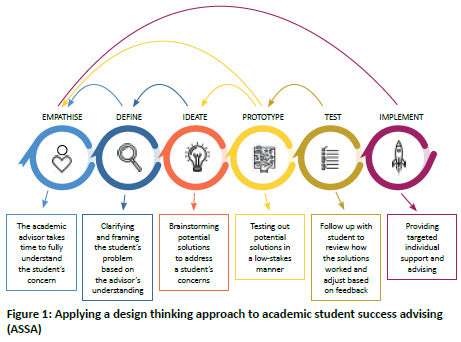
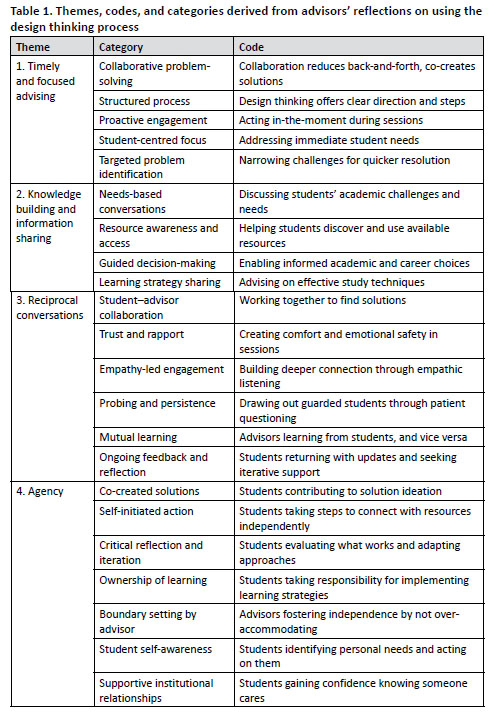
Design thinking is a human-centred approach that offers practical methods and tools that can be used by academic advisors to enhance innovation, develop meaningful problem-solving strategies, and drive change in student academic advising sessions. Academic advising can be regarded as a critical component of student success; however, many students and advisors struggle to engage deeply in the advising process in a shared and reciprocal manner. This study addresses this issue by adopting a design thinking approach to support students during the academic advising process. The study explored how the adapted design thinking process at a particular institution enhanced student-advisor agency, collaboration, and student-centred engagement. The study employed a qualitative research methodology, drawing on Schön's (1991) reflective model. Qualitative data were collected from the three advisors' reflective reports and one focus group interview. Thematic analyses were used to identify key patterns and themes. The design thinking approach gave rise to four key themes: (1) timely and focused advising, (2) knowledge building and information sharing, (3) reciprocal conversations, and (4) agency. The findings reveal that the application of design thinking in academic advising enabled advisors to shift their advising sessions from a prescriptive to a developmental approach, thereby fostering a deeper and more collaborative engagement with students.
Academic advising; design thinking approach; student agency
 Thumbnail