Empowering student agency in academic advising through design thinking: Voices of academic advisors
Abstract
Design thinking is a human-centred approach that offers practical methods and tools that can be used by academic advisors to enhance innovation, develop meaningful problem-solving strategies, and drive change in student academic advising sessions. Academic advising can be regarded as a critical component of student success; however, many students and advisors struggle to engage deeply in the advising process in a shared and reciprocal manner. This study addresses this issue by adopting a design thinking approach to support students during the academic advising process. The study explored how the adapted design thinking process at a particular institution enhanced student-advisor agency, collaboration, and student-centred engagement. The study employed a qualitative research methodology, drawing on Schön's (1991) reflective model. Qualitative data were collected from the three advisors' reflective reports and one focus group interview. Thematic analyses were used to identify key patterns and themes. The design thinking approach gave rise to four key themes: (1) timely and focused advising, (2) knowledge building and information sharing, (3) reciprocal conversations, and (4) agency. The findings reveal that the application of design thinking in academic advising enabled advisors to shift their advising sessions from a prescriptive to a developmental approach, thereby fostering a deeper and more collaborative engagement with students.
Academic advising; design thinking approach; student agency
Abstract
ISISHWANKATHELO Ukucinga ngoyilo yindlela egxile ebantwini, enika iindlela nezixhobo ezisebenzayo ezinokusetyenziswa ngabacebisi bezemfundo ukuphucula ukuveliswa kwezimvo ezintsha, ukuphuhlisa izicwangciso zokusombulula iingxaki ngendlela enentsingiselo, nokukhuthaza utshintsho kwiintlanganiso zokucetyiswa kwabafundi. Ukucebisa ngezemfundo kungathathwa njengelinye icandelo elibalulekileyo ekuphumeleleni kwabafundi. Nangona kunjalo, abafundi abaninzi kunye nabacebisi baye baphazamiseka ekubandakanyekeni ngokunzulu kule nkqubo ngendlela eyabelana ngayo nenobudlelwane obuphinda-phindayo. Olu phando lubhekisa kulo mba ngokusebenzisa indlela yokucinga ngoyilo ukuxhasa abafundi ngexesha lenkqubo yocebiso ngezemfundo. Uphando luye lwaphonononga indlela inkqubo yokucinga ngoyilo ehlenga-hlengisiweyo esetyenziswe kwisikhululo esithile eyakhuthaza ngayo ukuzimela kwabafundi kunye nabacebisi, intsebenziswano, kunye nokubandakanyeka okugxile kumfundi. Olu phando lusebenzisa indlela yophando yohlobo, luqwalasela umzekelo kaSchön (1991) yokuzicingela ngokuzibuyekeza. Iinkcukacha zohlobo ziqokelelwe kwiingxelo zokuzicingela zabacebisi abathathu nakudliwano-ndlebe enye yeqela elijoliswe kulo. Ukuhlalutya ngokwemixholo kusetyenzisiwe ukufumanisa iindlela nemixholo ephambili. Indlela yokucinga ngoyilo iveze imixholo emine ephambili: (1) ukucebisa ngexesha elifanelekileyo nelijolise kwinjongo ethile; (2) ukwakha ulwazi nokwabelana ngolwazi; (3) iingxoxo ezibuyiselanayo; kunye (4) nokuzimela. Iziphumo zophando zityhila ukuba ukusetyenziswa kwendlela yokucinga ngoyilo kucebiso ngezemfundo kuye kwabavumela abacebisi ukuba batshintshe kwiindlela zokucebisa eziyalelayo baye kwindlela ephuhlisayo, ngaloo ndlela bekhuthaza ukubandakanyeka okunzulu nokusebenzisanayo nabafundi.
Ukucebisa ngezemfundo; indlela yokucinga ngoyilo; ukuzimela kwabafundi
Introduction
Kuhn (2008, p. 3) defines academic advising (AA) as "situations in which an institutional representative gives insight or direction to a student about an academic, social, or personal matter. The nature of this direction might be to inform, suggest, counsel, discipline, coach, mentor, or even teach". NACADA: The Global Community for Academic Advising defines academic advising as
A series of intentional interactions with a curriculum, a pedagogy, and a set of student learning outcomes. Academic Advising synthesises and contextualises students' education experiences within the frameworks of their aspirations, abilities, and lives to extend learning beyond campus boundaries and timeframes. (NACADA, 2006)
In recent years, particularly in the South African higher education context, AA has moved from the periphery to find its place at the centre of student success initiatives. Academic advising plays a pivotal role in ensuring students' overall development during their academic journey, promoting their success, and enhancing their retention (Obaje & Jeawon, 2021). According to Masengeni (2019), AA is not simply about supporting students in passing at the end of each year; rather, the emphasis is on creating an environment that enables students to reach their full academic, social, and emotional potential. Many researchers have included the above concepts when defining academic student success advising. ELETSA ('advising' in Sesotho) is a non-profit organisation operating in the South African region, which holds allied membership status at NACADA, and describes AA as a continual, purposeful approach to teaching and learning that gives students the tools they need to investigate, align, and achieve their academic, professional, and personal objectives (ELETSA, n.d.).
However, many of the definitions mentioned by researchers above do not explicitly include the relational aspect of AA. This study focuses on reciprocity and relational engagement during advising sessions between students and advisors. We utilise a contextually informed definition of academic advising developed by stakeholders from across the University of Western Cape (UWC) during a series of consensus workshops on conceptualising AA at UWC (Pather et al., 2022). In workshop 2, the following definition was collaboratively conceptualised to represent our institutional context:
Academic Advising is about student success and providing integrated support that guides and assists students both academically and psycho-socially throughout their academic journey. Through collaborative, interactive, and agentic conversations, advisors work holistically with students to enhance their university experience and foster their personal and academic development. (Pather et al., 2022)
In the intentional use of collaborative, interactive, and agentic conversations, this definition emphasises the importance of relational reciprocity and agency in the advising process at UWC. The reference to student agency in this definition refers to a student's capacity to make choices, set goals, and take action to achieve their academic objectives (NACADA, 2006). Other studies that consider the relational include Swecker (2013), who describes AA as a process involving a student and academic advisor establishing a relationship to coordinate decision-making, problem-solving, and resource identification in a student's personal and academic endeavours. Tiroyabone and Strydom's (2021) study also acknowledges this. It defines AA to include the relationship between the academic advisor and student, indicating that it is a continuous and purposeful practice that explores the shared responsibilities of both parties in this relationship. They further note that shared responsibilities foster the development of student agency, growth, and success.
Internationally, AA is widely recognised as a cornerstone of student success in higher education, playing a critical role in guiding students through their academic and personal challenges (Drake, 2011). Young-Jones et al. (2013) stress that an essential feature of AA is for advisors to adopt a developmental approach and prioritise relationship-building in addressing the unique needs of each student. By understanding and responding to students' diverse experiences, institutions can optimise advising practices to promote equity and success across student populations. However, traditional advising models often fail to foster a deep, reciprocal relationship between students and advisors, resulting in surface-level engagement and limited student ownership over their academic journeys (Kuh et al., 2005). Advising sessions, which explore a shared responsibility, provide students with tools to develop agency. According to Bandura (2020), student agency is not fixed and can change throughout a student's educational journey as they engage with, and take control of, their learning. In their study, which maps the conceptualisation of student agency, Torres Castro and Pineda-Báez (2023, p. 1183) refer to agency as the capacity of individuals to engage in intentional, self-defined, meaningful, and autonomous actions in circumstances constrained by power relations and structural and contextual factors. Advising sessions are ideally placed to play a key role in enhancing student agency, as a successful advising relationship empowers students to take ownership of their learning. Advising is a shared responsibility between the advisor and student, where the advisor plays an important role in creating a space that welcomes and fosters student agency.
However, failing to develop agency in their academic careers can hinder first-year students' transition into the university's academic and social environment. One approach to enhancing student agency is through the use of the design thinking process, particularly in the advising space. In Kaui et al. (2021), which examined the relationship between design thinking and student agency, the researchers noted that design thinking enhances self-efficacy, promotes perseverance in the face of challenges, and supports individual expression within a collaborative context. The study further suggests that by engaging with the design thinking's creative processes, students can develop their own creative knowledge and abilities, while also strengthening their critical thinking and problem-solving skills. In this regard, design thinking fosters a learning environment in which students are encouraged to view mistakes as valuable opportunities for growth and learning. Several studies have employed the design thinking process to achieve various outcomes in AA. In Alvarado's (2025) study, design thinking was used to reimagine student services by engaging students as co-creators. In this study, empathy-driven methods were employed to identify genuine student needs, resulting in innovative redesigns of services. The approach emphasised student-centred innovation and iterative prototyping to improve engagement and satisfaction (Alavarado, 2025). In another study by Almaghaslah and Alsayari (2022), conducted at the College of Pharmacy in Saudi Arabia, a design thinking framework was employed to enhance AA services within the college, to improve students' experiences with AA. Several prototypes were suggested during the design thinking process that have proven effective in enhancing students' experiences in university life and overcoming challenges, including work-life imbalance, a lack of social life on campus, limited awareness of academic rules, and a lack of trust in academic staff. In this study, we employ the design thinking process in the advising sessions with students and explore its use as an alternative approach to traditional student-advisor advising. Our focus was to examine the potential of using the design thinking process in advising sessions to enhance student-advisor agency, collaboration, and engagement.
UWC context, conceptualisation of academic student success advising (ASSA) and a shift to the design thinking framework
In 2022, a deliberate shift in the term 'academic advising' to 'academic student success advising' (known as ASSA) at UWC was implemented. The intentional use of the new concept of ASSA was to underscore its holistic approach to student support, extending beyond purely academic and curricular concerns, but also encompassing the psychosocial well-being and transition of students into the university environment. The ASSA initiative was intentionally designed to address two key goals in the institution's strategic plan: Goal 1: Student experience: to enrich the student experience through, amongst others, the building of "a supportive environment for all students that addresses barriers to success" and the provision of "optimal support services" and Goal 2: Learning and teaching: to strengthen learning and teaching and to "develop an environment conducive to excellence in learning and teaching in support of student success and retention" (UWC, 2021, p. 22, 28). The ASSA initiative is offered at the institutional level and is located in the office of the Deputy Vice Chancellor, Academic, indicating the institutional priority of student retention and success. At the inception of the ASSA at our institution, the priority was to focus on students enrolled in identified high-priority modules (HPMs), which are commonly referred to as at-risk modules in many institutions. Institutional data revealed that students who failed in the identified HPMs ran the risk of extending their degree completion time by an additional year. In this regard, the advisors reached out to students in the HPMs via email, inviting them to the ASSA sessions. In the design of our ASSA initiative, the collaborative partnership between the student and the advisor is central to this model, emphasising agentic and interactive conversations. Advisors were assigned specific high-priority modules, and all enrolled students were introduced to the services of the ASSA unit. Before the advising sessions, students completed a pre-appointment survey to help advisors prepare for the session and to identify their current challenges.
Initial observations revealed that while many students received necessary assistance, a considerable number tended to rely heavily on advisors to provide solutions, such as contacting lecturers, tutors and support services on their behalf. This reliance indicated a lack of student agency and a potential disconnection from the advising process. The advisors noted that some students appeared disempowered or detached from suggested strategies, leading to feelings of overwhelm, frustration, or isolation. These students struggled to internalise the proposed solutions as personally relevant tools for academic success, hindering their motivation and limiting the depth of engagement with their challenges. To counter this challenge, the ASSA unit sought alternative strategies to promote active and collaborative participation among students and advisors, enabling them to co-create solutions. Design thinking was identified as a potentially suitable framework for both strategic and operational levels of ASSA. The five stages were identified as being easily transferable into actionable steps within the advising context, thereby shifting the dynamic towards a more reciprocal relationship where students could feel more in control of their academic journeys.
Design thinking framework
The intentional use of the design thinking process in the advisor-student advising sessions, which is regarded as a human-centred approach, offers practical methods and tools to enhance innovation, meaningful problem-solving strategies, and change in a student's advising session. Rooted in empathy, iterative problem-solving, and co-creation, design thinking empowers advisors and students to redefine challenges and develop actionable solutions collaboratively (Brown & Wyatt, 2010; Liedtka, 2015). The design thinking process comprises five key steps: (i) empathise, (ii) define, (iii) ideate, (iv) prototype, and (v) test. This process is regarded as non-linear and iterative, providing an opportunity for advisors to gain a deeper understanding of their students and challenge their assumptions. In this study, we explored how the adapted design thinking process used by the advisors at the UWC enhanced student-advisor agency, collaboration, and student-centred engagement.
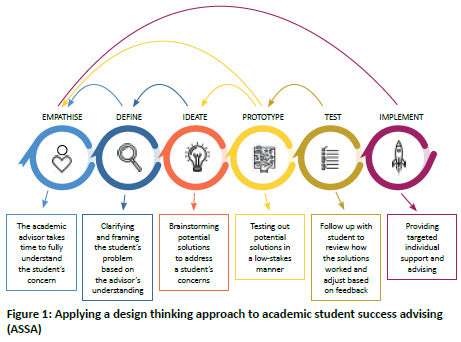
Design thinking, with its innovative approach, focuses on solving problems and offers a process that helps with gaining a deeper, more holistic understanding of students' complexity. The Stanford design thinking (SDT) model, as seen in Figure 1 below, was used in this study to support and guide the advisor-student advising process at our institution. Stanford design thinking has become a powerful tool used in various departments within higher education institutions to solve complex problems with innovative solutions. According to O'Donoghue (2022), the SDT process involves understanding people's needs, empathising with their experience, reframing the challenge to generate out-of-the-box solutions, prototyping, and continuously refining ideas, and testing these prototypes with real users to create successful products. In this regard, the SDT process encourages teams to prioritise the user while fostering creativity in exploring potential solutions. In the area of AA, the SDT model, as suggested by Watson (2015), provides advisors with a guiding approach and tools to overcome creative blocks, enabling the student and advisor to generate innovative insights and promote more ideas. In Mann's (2020) study, she examines the role of design thinking in AA, applying it at both strategic and operational levels. Her analysis reveals that using the human-centred design thinking process can be a powerful tool in bridging the gap that many students perceive between the institutional offering and the student experience.
Figure 1 illustrates the phases employed by the advisors at UWC as they interacted with their students during AA sessions. Per Mann (2020), the first phase of empathising with the student is a crucial starting point in the advising relationship. In this phase, the advisors in the study observe students and their behaviours, interact with them, listen intently, and immerse themselves in understanding students' experiences and perspectives. These insights allow the advisors to approach the rest of the design thinking process with a stronger understanding of the context and problem, allowing them to step into the student's shoes. In the second phase, which is the define phase, advisors used insights gathered from empathising to focus on the problem. As stated in the diagram, this stage involved clarifying and framing the students' problems to go beyond superficial engagement, as students described their complexities, problems, and contexts of their challenges. In the ideating phase, the advisors articulate a problem based on the details and understandings they gained from the student. They focus on brainstorming possible solutions with the students. In this third phase, the focus is on exploring diverse solutions and innovative ideas. Students work collaboratively with their advisor to foster creative thinking through a brainstorming activity, addressing the problem at hand. In the prototype phase, the ideas are made tangible (but still in the development stages), the advisor and student work together to explore possible short-term and long-term actions. In the fifth stage of testing, the ideas discussed are put into action by the student. Implementation of short- and long-term solutions is tried out. Reflection and changes are also considered in this next phase.
As mentioned earlier in the article, the process is not linear, and the iterative design thinking process allows advisors and students to loop through the process or re-enter phases as needed to understand or explore problems and solutions together, even bringing in other support professionals to support students. This SDT process creates an environment where the advisor and the student experience a sense of comfort in sharing their thoughts, and the student actively takes ownership of their decisions, thus fostering a greater understanding of agency and accountability on the part of the student. Through the collaborative engagement between the advisor and student, effective solutions could be integrated into the student's routine. Additionally, joint reflection on the process can facilitate the recognition of growth and key lessons learned, leading to further reinforcement of the student's sense of empowerment. This process, when intentionally applied, can create a sense of connectedness or bond between the student and advisor.
Methodology
The study employed a qualitative research methodology, and Schön's (1991) reflective model was applied to examine the reflections-in-action and reflections-on-action of the three institutional AAs during and after the advising sessions.
Schön's (1991) conceptualisation of reflective practice distinguishes between reflection-in-action, where professionals critically analyse and adjust their actions in real time, and reflection-on-action, which involves a retrospective analysis of decisions and their outcomes to inform future practice. This dual lens provided a framework for the three advisors to capture both the immediate, real-time adjustments they made during the advising sessions and the retrospective sensemaking that informed their future practice. This iterative process was valuable in the advising process, as it enabled advisors to refine their pedagogical strategies and improve student engagement based on their lived experiences.
Participants
Three institutional advisors participated in this study. They were trained in SDT and implemented this process in their AA sessions in the second semester of 2024. They followed a structured ASSA program incorporating SDT processes into their sessions. All three participants were also co-researchers in the study, and their participation was voluntary.
Data collection instruments
Multiple data collection methods, including weekly written reflections, bi-weekly dialogue sessions, and an end-of-semester focus group interview, were employed to facilitate a rich and triangulated understanding of the advisors' experiences with using design thinking processes in their advising sessions. The weekly written reflections were completed individually by the three advisors at the end of every week to capture their reflections on action. This process enabled the advisors to document the impact of their sessions retrospectively. These written reflections were unstructured but guided by the phases in the design thinking process, documenting insights, challenges, adaptations, and observed student responses. Data were collected from the advisors' reflective reports during and after a session and a focus group discussion. The reflective report writing served as both a data collection and an analytical tool, allowing the advisors to critically engage with their experiences, perspectives, and positionalities as they worked collaboratively with students in the advising sessions, adopting the design thinking process.
The second set of data was collected from the bi-weekly collaborative dialogue sessions in which the program coordinator and the three advisors were involved. These meetings served as a form of collaborative reflection, allowing advisors to share their experiences, seek peer input, and co-develop strategies to enhance their advising sessions. The notes from these meetings, which the program coordinator documented, were used to track evolving perceptions, recurring challenges, and the adaptive use of design thinking. These sessions provided advisors with opportunities for both reflection-in-action and reflection-on-action, as they could immediately test insights gained from their peers in subsequent advising sessions.
The third data collection method was a focus group interview conducted by the program coordinator at the end of the 2024 academic year. A semi-structured interview was conducted with the three advisors to explore their overall experiences with applying design thinking to the advising sessions, the extent to which it supported relational engagement with students, and its influence on their own sense of agency and that of the students. The focus group discussion was recorded, transcribed, and systematically analysed by the advisors and the program coordinator to identify recurring themes and patterns, aiming to answer the following research question: How did the implementation of a design thinking approach in the AA sessions enhance the ASSA experience? The focus group session enabled a deeper exploration of patterns and themes that emerged from the written reflections and bi-weekly dialogues.
Their engagement in the reflective process allowed for a deeper analysis and learning. By using this reflective lens, the academic advisors were able to critically examine their application of the design thinking approach in the advising sessions and evaluate how their engagement with students evolved during interactions. The reflective lens also allowed for post-session reflections, which informed future practice. This iterative process of reflection enabled the academic advisors to refine their strategies, fostering a more student-centred and responsive advising framework.
Data analysis
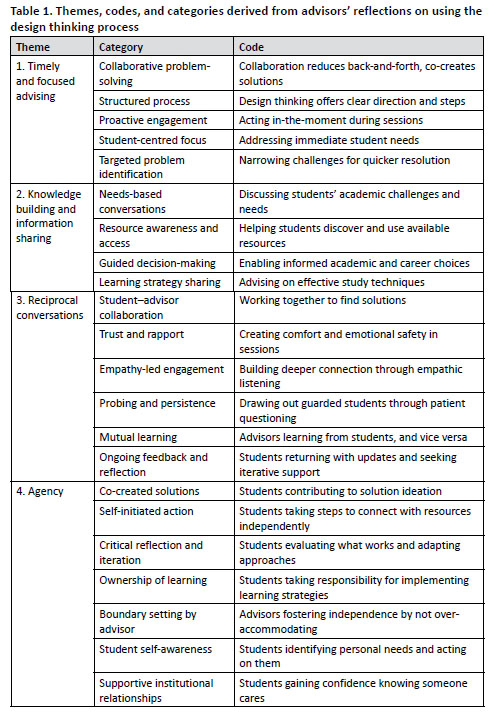
A three-cycle coding process was used to analyse the transcripts, reflective reports, and notes from the bi-weekly dialogue sessions (Saldaña, 2015). In the first round, we worked in pairs to summarise excerpts and add descriptive codes. In the second cycle, we worked together as a team to collapse codes into common descriptions, and during the final third cycle, we grouped codes into categories and identified themes. For this article, we focused on themes related to the academic advisors' experiences with using design thinking in advising sessions and the advisors' perceptions of students' engagement in these sessions. Table 1 outlines the coding, categorisation, and emergence of themes derived from the data analysis of the advisors' reflections on using the design thinking process in the advising sessions.
Limitations to the study
A key limitation of this study is its restriction to time and context. This study was conducted over one semester at a single institution, which limits the generalisability of the findings. The findings of this study are specific to a particular organisation, structure, context, and group of students and, in this regard, may not be fully transferable to other institutions. In addition, the small number of participants in the study, comprising only three institutional advisors, implies that the study represents a limited range of experiences and narratives of insights into how design thinking processes were applied to academic student success advising.
Findings and reflections
Four key themes identified are discussed below, providing direct quotes to support the emerging themes from the data analysis:
Did the design thinking process allow for precise and time-efficient advising?
Using the design thinking approach allowed the advisors to provide timely and focused student advising. The empathetic phase created a safe space for students to open up to advisors. Both advisors and students felt relaxed, creating a supportive environment that reduced feelings of awkwardness and allowed the student to share their challenges. The advisor actively listened and gathered detailed information, providing more targeted and responsive support to the student.
As one advisor noted, "the design thinking process involves collaboration with the student, making it easier and more effective to address a student's problem, thereby reducing the back and forth with probing." Another advisor highlighted that the design thinking process provided a structure and a clearer direction for them to advise the student:
Having that process in place, also gave us a clearer direction of what we need to be doing. I think sometimes we get into the space and then there's so many things that comes up and you don't always know, but then by having that design thinking process, you're able to know this is the steps that I need to follow to help the student.
The advisors were able to filter down and reach students' challenges at a quicker pace and offer time-efficient advising, as noted: "Being very specific in following the design thinking approach helped a lot in narrowing the students challenge and zoning into the challenge quicker to make it easier for the student to get the assistance as quick as possible." The advisors acknowledged that the design thinking approach allowed a proactive approach and for them to focus on the immediate needs of the student which resulted in reducing the number of repeat consultations.
Was there professional development and knowledge building?
The clarity and structured guidance provided by the student and the advisor during the defining and ideating stage of design thinking assisted the advisors in sharing critical information and resources with students. In seeking information to assist students, the advisors were able to strengthen their own knowledge and understanding of university policies and program requirements. As one of the advisors noted:
... looking for resources and information to support the student in reaching their academic goals in the short term as well as in the long term, personally helped me develop a deeper understanding of university structures, policies, and resources, enabling me to navigate and support the student more effectively.
In guiding students through academic challenges, the advisors refined their ability to diagnose learning difficulties and provide appropriate support. This enhanced their critical thinking and problem-solving skills, as noted by one of the advisors:
I became good at identifying patterns in student struggles and crafting effective interventions for them, for example, a student struggling with programme choice in the Education faculty, I actually researched some special needs schools as well to give her advice, and then she can make an informed decision, I was glad that I could assist her and learn in the process.
This process allowed the advisors to reflect on their advising approaches and enhance their own knowledge and skills in advising.
Did the reciprocal conversation allow more collaboration and information sharing?
Using the design thinking framework enabled a reciprocal nature of communication between the student and advisor, where both parties engaged deeply in conversation, building trust and understanding throughout the advising process. The advisors tailored their communication to diverse student needs, strengthening their ability to explain complex academic concepts in accessible ways. One advisor noted how building trust made the reciprocal conversation easier to support the student:
... the student felt more comfortable to speak to me because it almost felt like they had this trust in me, as if I knew what they were doing and feeling because I was able to say 'okay what is your concern?, what is your challenge?, what is your immediate need?, how can I help you?'...
In addition, the advisor noted: "... just by empathising with the student they really felt comfortable to engage further with you as the advisor and then sharing things that would not have come out easily if I opted to just start off the engagement in a very formal non-empathetic manner." Engaging with students from different backgrounds fostered cultural competence and empathy, which allowed for effective communication and information sharing, as noted in the following quote: "many students requested resources from us as the advisor, they would always return to an advising session to give me feedback, they would sit here and say what helped them, what challenged them and how they changed things to work for them ... they would also feel comfortable to say... 'I've tried to implement what we've discussed, but it's now not working in a different module. So how can we have a different way around it?'" The return of students to engage in conversations with the advisors can also be attributed to intentional engagement through active listening to students' experiences, challenges, and goals, along with the encouraged mutual exchange, where students' voices shape the advising process rather than engaging in the traditional one-way advisory model, allowed for reciprocal conversations and the sharing of information.
Was student agency enhanced in the advising process?
The intentional use of the design thinking process by the advisors provided an opportunity for students to develop agency in the advising process. This approach shifted advising from a directive model, where advisors provide solutions and challenges, to a collaborative, student-centred process that empowered students to take ownership of their academic journeys. Here is an example of a student exercising agency after their advising session: "... after we had the conversation about special schools, the student demonstrated her agency when she contacted the school principal, and now she's going to the school to do her observation sessionsAnother example of students demonstrating agency is in the following quote: "... the collaboration within the solutions during ideation made it easier for the student to say, 'Okay, I got this, I know what I'm meant to do, and will implement it'... And then they will pop an email saying, 'It's working', ... it's always great to get feedback." These reciprocal conversations encouraged shared ownership in the advising process, thereby validating students' agency in shaping their learning paths. This sense of ownership empowers students to take responsibility for their own learning, making informed decisions about their academic journey and seeking support when needed.
Discussion
Sellon et al. (2023) emphasise that incorporating design thinking into AA has the potential to provide advisors and students with a framework for addressing and overcoming challenges through open communication, reflection, and planning. As reflected in the advisors' comments above and supported by Mann's (2020) study, the engagement between students and their advisors encourages students to actively participate in academic experiences while simultaneously expanding and developing those experiences (Mann, 2020). In this study, it was evident that the student-advisor relationship evolved into a partnership built on trust and reciprocal conversations, with the student and advisor listening and learning from each other. The reciprocal relationship between advisor and student involves information sharing and knowledge building. Ige et al. (2023) describe this partnership as going beyond simply acknowledging students' voices, but also recognising the value of students' contributions to the conversations and the role of both student and advisor in resolving issues of concern. This study reveals that the use of the design thinking process in AA fosters a collaborative and iterative approach where advisors and students engage as co-creators in shaping meaningful learning experiences. This aligns with Cook-Sather et al.'s (2014) emphasis on partnership as a reciprocal process, ensuring that both advisors and students contribute equally, though in different ways, and bring their unique perspectives, experiences, and expertise to problem-solving and decision-making in the advising process.
Conclusion
The study reveals that integrating design thinking principles into ASSA at our institution offers a transformative approach that places students at the heart of the advising process. Co-creating solutions alongside students, rather than for students, shifted our approach from being top-down to fostering a collaborative and reciprocal partnership. This process cultivated shared agency, enhanced knowledge building, facilitated information sharing, and strengthened professional competencies for both the advisor and the student. By the advisors intentionally engaging in design thinking and co-creating with students during advising sessions, both parties participated in a mutually beneficial learning process that fostered critical thinking skills, problem-solving abilities, listening skills, reciprocal conversations, and a sense of agency. This dynamic interaction not only empowered students to navigate their academic journeys with confidence but also enabled academic advisors to refine their advising practices through continuous learning and reflective engagement.
The advisors found the use of design thinking to be highly beneficial in the ASSA process at UWC, as it streamlined student engagement and enhanced problem-solving efficiency. The advisors acknowledged that by facilitating a structured yet flexible iteration through the five stages of empathising, defining, ideating, prototyping, and testing, this approach enabled students to articulate their needs, identify challenges, and access appropriate support more rapidly. The early identification of challenges in the advising session enabled timely interventions, thereby fostering student success and enhancing overall academic outcomes.
In conclusion, while this article adds to the growing body of literature on AA innovation and design thinking by offering empirical evidence of its effectiveness in a higher education context, the limitations outlined create opportunities for further in-depth research that can generate practical insights for academic advisors and institutions aiming to adopt similar methodologies to empower students and enhance academic outcomes.
Ethics statement
This reflective study was conducted within the institutional ethical guidelines. All participating staff provided informed and voluntary reflections, and anonymity was safeguarded throughout. As the authors also occupy roles within the program, steps were taken to minimise dual-role bias and maintain professional boundaries. No identifiable information is reported, and participation had no impact on staff members' professional standing.
Potential conflict of interests
The authors have no conflict of interests to declare.
References
Funding acknowledgement
We acknowledge and formally thank the Department of Higher Education and Training (DHET) for its financial support through the University Capacity Development Grant (UCDG), which made it possible to implement the Academic Student Success Advising (ASSA) program. This enabled the the advisors to support many undergraduate students in addressing their academic concerns and building agency.
Literature review
- Almaghaslah, D., & Alsayari, A. (2022). Using design thinking method in academic advising: A case study in a college of pharmacy in Saudi Arabia. Healthcare (Basel), 10(1), 83. https://doi.org/10.3390/healthcare10010083
- Alvarado, L. F. (2025). Design thinking as an active teaching methodology in higher education: A systematic review. Frontiers in Education, 10, 1462938. https://doi.org/10.3389/feduc.2025.1462938
- Bandura, A. (2020). Social cognitive theory: An agentic perspective. Psychology: The Journal of the Hellenic Psychological Society, 12(3), 313-333. https://doi.org/10.12681/psy_hps.23964
- Brown, T., & Wyatt, J. (2010). Design thinking for social innovation. Stanford Social Innovation Review, 8(1), 31-35. https://doi.org/10.48558/58Z7-3J85
- Cook-Sather, A., Bovill, C., & Felten, P. (2014). Engaging students as partners in teaching and learning: A guide for faculty. Jossey-Bass.
- ELETSA (n.d.). About ELETSA. https://eletsa.org.za/about/
- Ige, B. O., Doyle, G., & Pienaar, L. (2023). Partnering with students to connect students. South African Journal of Higher Education, 37(4), 163-180. https://doi.org/10.20853/37-4-5074
- Kaui, T. M., Victor, G., Kyota, C., & Waiki, Q. (2021). Developing student agency to support student application and implementation of design thinking: Phase one. Techne serien-Forskning i slöjdpedagogik och slöjdvetenskap, 28(2), 119-127. https://journals.oslomet.no/index.php/techneA/article/view/4324
- Kuh, G. D., Kinzie, J., Schuh, J. H., Whitt, E. J., & Associates. (2005). Student success in college: Creating conditions that matter. Jossey-Bass.
- Kuhn, T. L. (2008). Historical foundations of academic advising. In V. N. Gordon, W. R. Habley & T. J. Grites (Eds.), Academic advising: A comprehensive handbook (2nd ed., pp. 3-16). Jossey-Bass/ Wiley.
- Mann, C. (2020). Advising by design: Co-creating advising services with students for their success. Frontiers in Education, 5(99), 1-9. https://doi.org/10.3389/feduc.2020.00099
- Masengeni, M. (2019). Building trust between academic advisers and students in the academic advising centre at a private higher education institution. Educor Multidisciplinary Journal, 3(1), 159-172. https://hdl.handle.net/10520/EJC-1b349d5e26
- NACADA: The Global Community for Academic Advising. (2006). Concept of academic advising. https://www.nacada.ksu.edu/Resources/Pillars/Concept.aspx
- O'Donoghue, J. (2022, December 15). The Stanford design thinking process. Make: Iterate. https://makeiterate.com/the-stanford-design-thinking-process/
- Pather, S., Davids. M., Goldberg, B., Hlanjwa, T., Jaftha, M., & Johannes, C. (2022, October, 6). Defining academic advising within UWC context [Workshop 2]. University of the Western Cape.
- Saldaña, J. M. (2015). The coding manual for qualitative researchers (3rd ed.). Sage Publications.
- Schön, D. (1991). The reflective practitioner: How professionals think and act. Avebury.
- Swecker, H., Fifolt, M., & Searby, L. (2013). Academic advising and first-generation college students: A quantitative study on student retention. NACADA Journal, 33(1), 46-53. https://doi.org/10.12930/NACADA-13-192
- Tiroyabone, G., W., & Strydom, F. (2021). The development of academic advising to enable student success in South Africa. Journal of Student Affairs in Africa, 9(2), 1-15. Retrieved from https://files.eric.ed.gov/fulltext/EJ1336213.pdf
- Torres Castro, U. E., & Pineda-Báez, C. (2023). How has the conceptualisation of student agency in higher education evolved? Mapping the literature from 2000-2022. Journal of Further and Higher Education, 47(9), 1182-1195. https://doi.org/10.1080/0309877X.2023.2231358
- University of the Western Cape. (2021). Institutional operating plan (IOP) 2021-2025 [Discussion document]. Retrieved from https://international.uwc.ac.za/wp-content/uploads/2021/12/February_2021_v.2_UWC_IOP_2021_-_2025_Discussion_Document.pdf
- Young-Jones, A. D., Burt, T. D., Dixon, S., & Hawthorne, M. J. (2013). Academic advising: Does it really impact student success? Quality Assurance in Education, 21(1), 7-19. https://doi.org/10.1108/09684881311293034
Accepted 27 August 2025
Published 5 December 2025