Social-emotional competence and personality traits as key drivers for student teacher well-being in a VUCA world
Abstract
Initial teacher education programs around the globe are aimed at equipping beginner teachers with competencies that will enable them to be successful practitioners in a volatile, uncertain, complex, and ambiguous (VUCA) world. In this South African study, aimed at conceptualising the competencies needed by early-career English teachers who specialise in the Senior (Snr) and Further Education and Training (FET) phase (Grades 8-12), data were generated through a mixed-method approach involving qualitative in-depth interviews with heads of departments (HODs), document analysis and quantitative online surveys administered to early-career English language teachers who had completed their studies at a university, focusing on their training and development during initial teacher training. The overall findings of the study suggest that while traditional competencies such as content knowledge (CK), pedagogical knowledge (PK), and pedagogical content knowledge (PCK) remain foundational, there is a pressing need to focus more on the development and support of affective domains such as social-emotional competencies and personality traits. These findings highlight the need for institutional practices that promote holistic student teacher development through accessing support services and acquiring the needed competencies to support their well-being during their studies and to ensure relevant competence when they start teaching.
Social-emotional competence; personality traits; teacher training; student well-being; VUCA world
Abstract
KAKARETSO Mananeo aqalang a thuto ya matitjhere lefatsheng ka bophara a reretswe ho hlomella matitjhere a qalang ka litsebo tse tla ba nolofalletsa ho ba ditsebi tse atlehileng lefatsheng le sa tsitsang, le sa tshepahaleng, le rarahaneng le le sa hlakang (VUCA). Phuputsong ena ya Afrika Borwa, e reretsweng ho hlahisa bokgoni bo hlokwang ke matitjhere a Senyesemane a dilemong tse qalang tsa mosebetsi oo ba ipabolang ka oona Mokgahlelong o phahameng (Snr) le wa Thuto le Kwetliso e Tswelang Pele (FET) (Mephato 8-12), deitha e ile ya hlahiswa ka mekgwa e fapaneng e kenyeletsang dipuisano tse tebileng tsa boleng le dihlooho tsa mafapha (HODs), manollo ya ditokomane le tlhahlobo ka dipatlisisopalo tsa khompuitha tse ileng tsa fuwa matitjhere a qalang a thuto ya Senyesemane a qetileng dithuto tsa oona yunivesithing, di tsepamisitse maikutlo ho kwetliso le ntshetsopele ya bona nakong ya thupelo e qalang ya matitjhere. Diphumano tse akaretsang tsa phuputso di fana ka maikutlo a hore le hoja ditsebo tsa ditlwaelo tse kang tsebo ya dikahare (CK), tsebo ya ho ruta (PK), le tsebo ya dikahare tsa thuto (PCK) e ntse e le tsa motheo, ho na le tlhokahalo e potlakileng ya ho tsepamisa maikutlo ho ntshetsopele le tshehetso ya dibaka tse amehang tse kang bokgoni ka ditsebo tsa maikutlo le kahisano le ditshobotsi tsa botho. Diphumano tsena di totobatsa tlhokahalo ya ditheo/ditsi tsa thuto ho kgothalletsa ntshetsopele ya matitjhere a baithuti ka kakaretso ka ho fumana ditshebeletso tsa tshehetso le ho fumana bokgoni bo hlokahalang ho tshehetsa boiketlo ba bona nakong ya dithuto tsa bona le ho netefatsa bokgoni bo nepahetseng ha ba qala ho ruta.
Ditsebo tsa maikutlo le kahisano; ditshobotsi tsa botho; kwetliso ya matitjhere; boiketlo ba Baithuti; lefatshe la VUCA
Introduction
Research shows that student success in tertiary education is significantly influenced by social-emotional competence and personality traits such as adaptability, social engagement, and motivation (Santos et al., 2023). The development of these soft skills enhances both student performance and well-being, not only during their studies but also when they enter the job market (Sauli et al., 2022) and the multifaceted realities of the modern educational landscape, often described as a VUCA (volatile, uncertain, complex and ambiguous)5 world (Salakhova et al., 2021). This is particularly relevant in teacher education, where students prepare for unprecedented complexity that transcends traditional pedagogical knowledge and mere mastery of content (Riedler & Eryaman, 2016). In addition, Dinçer et al. (2013, p. 1) postulate that English language teachers "should have socio-affective skills, pedagogical knowledge, subject matter knowledge and personal qualities for better language teaching and learning." These skills should be acquired through academic programs, but higher education institutions have additional structures that run parallel to formal academic classes in the form of student support services that could further foster social-emotional growth and resilience. However, despite their importance, there is still not enough emphasis placed on the acquisition of these skills in teacher training programs (Aspelin, 2019; Hadar et al., 2020).
International studies highlight these gaps. A study by Hadar et al. (2020) indicated that student teachers struggle with volatile and uncertain circumstances, lacking sufficient preparation in social-emotional competencies. In addition, Molyneux (2021) emphasises the need to prepare teachers for emotional labour, suggesting that identity development and social-emotional competence should be addressed during teacher preparation. Even before the Covid pandemic (which magnified the challenges of a VUCA world), Carstensen et al. (2019) demonstrated the effectiveness of a social-emotional competence training program for student teachers, showing improvements in emotional self-awareness and cognitive reappraisal. Matischek-Jauk and Reicher (2021) further argue that implementing social and emotional learning in teacher education programs fosters professional growth, equips early-career teachers with essential competencies, and supports emotional well-being. South African researcher, Marsay (2022) confirms the need for tertiary institutions to integrate social-emotional competencies and support skills training within teacher education in South Africa and states that interpersonal relationships, self-awareness and self-management are regarded essential for workplace readiness and teachers' professional resilience. These studies reinforce the argument that teacher education programs must contain both curricular content and practical exposure.
In this article, we want to suggest that tertiary institutions should focus more explicitly on the development of social-emotional competencies alongside the cultivation of certain personality traits in their academic training programs by better integrating and aligning curricular components with parallel structures such as student support services. By doing so, student teachers will not only be equipped to effectively access and utilise institutional support services during their own studies, but also to acquire competencies essential to ultimately thriving as effective practitioners in a VUCA world (Li et al., 2022). As a departure point this article will focus on the importance of the acquisition and development of social-emotional competence and personality traits by prospective English teachers.
Social-emotional competency
Social-emotional competency comprises different characteristics (Sauli et al., 2022), such as socio-affective skills, socio-emotional competency, or soft skills, generally used to define the ability of individuals to direct, regulate and understand thoughts, emotions, behaviours of others and to interact and adapt to changing interpersonal conditions (Schoon, 2021). Literature indicates that socio-affective skills in the education field include enthusiasm, positive attitudes towards learners and responding to their needs in nurturing healthy relationships whilst creating a stress-free learning environment (Dinçer et al., 2013). Hadar et al. (2020) add more specific social-emotional competencies such as showing social and self-awareness, having good communication skills, empathy and making responsible decisions. Research indicates that social-emotional competence has a direct effect on the success and performance of prospective teachers (Domitrovich et al., 2017; Mella et al., 2021) and is therefore of utmost importance that students approach their problems and emotions as a natural part of the learning process.
Personality traits
Certain personality traits are necessary for a teacher to be an effective practitioner. These include being passionate, cooperative, authoritative, creative and patient (Marchbanks, 2000, as cited in Sulistiyo, 2016, p. 401). Several researchers agree that an effective English teacher demonstrates personality traits such as being caring, polite, entertaining, helpful, tolerant, authoritative, humanistic, intelligent, helpful, enthusiastic, and culturally literate (Badamas, 2021; Murphy et al., 2004; Özkan & Kesen Mutlu, 2017). Dinçer et al. (2013) affirm that a teacher needs a sense of humor, must be sensible, optimistic, open-minded and flexible. Furthermore, Aydin et al., (2017) found that personality traits such as extraversion, agreeableness and conscientiousness have a positive effect on student teachers' perceived teaching skills (Aydin et al., 2017). In a study by Spitzer (2009, p. 90) with English Second Language (ESL) teachers, the participants felt that the:
possession of personal characteristics is of paramount importance for successful ESL teaching. Disposition impacts teaching; any successful teacher will attest to that. Although difficult to quantify, teacher education programmes must do a great deal more to encourage the development of those characteristics that teachers intuitively know are necessary for good teaching.
Personality traits influence not only teaching success, but also student well-being. The interplay between personality traits and student well-being has garnered increasing attention particularly in VUCA circumstances (Saputra et al., 2023). Orrú et al. (2025) further reiterate the importance of tertiary institutions incorporating personality-based training to aid in student well-being (traditionally associated with parallel student support structures at universities) and academic performance (traditionally associated with formal academic programs at universities). It, therefore, is important that different departments and structures at universities collaborate and work closely together in the development of personality traits and social-emotional competencies for students. Academic programs for prospective teachers use policy documents as a departure point for program design and outcomes but in exploring SA educational frameworks, notable gaps were revealed in terms of the emphasis of these documents on social-emotional competence and personality traits.
Identified competency gaps in SA teacher education policy
There are four policy frameworks that have sought to guide the practices of SA teachers over the past two decades (Kimathi & Rusznyak, 2018). These are:
1. The roles of the educator and their associated competences, which forms part of the NSE (RSA, 2000).
2. The SACE Code of Professional Ethics (SACE, 2002).
3. The (Integrated) Quality Management System (QMS) (ELRC, 2003).
4. The Minimum Requirements for Teacher Education Qualifications (MRTEQ) (DHET, 2015).
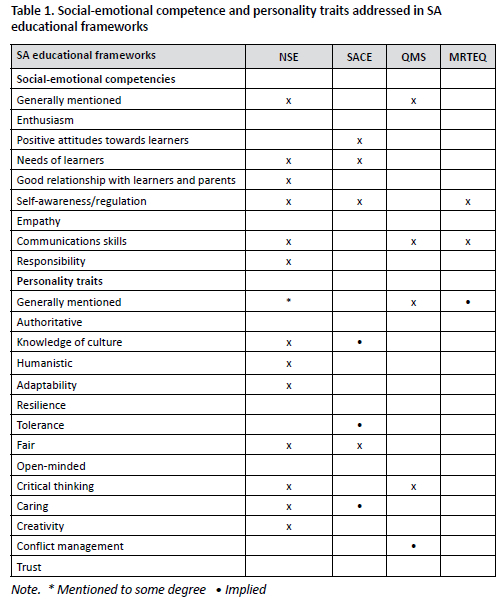
As part of the literature review, the focus on social-emotional competence and personality were analysed and depicted in Table 1 below.
Table 1 indicates that social-emotional competencies and personality traits are acknowledged but not an explicit focus of the policy documents, particularly not within the MRTEQ framework, which is the official teacher-training framework in SA. According to Kimathi and Rusznyak (2018, p. 2), none of these frameworks effectively recognise "the relations between knowledge, skills, judgement and the ethical orientations that underpin professional teaching". Marongwe and Chisango (2022) agree that SA teacher programs should address classroom volatility, behavioural pressures, societal matters, diverse teaching context, as well as coping with constant change. The limited attention given to such aspects in policy underscores the need for relevant research that examines how early-career teachers perceive, develop, and apply social-emotional competencies and personality traits in the realities of South African VUCA classrooms and how they can be better supported in their training and education.
Complex dynamic systems theory (CDST) as a theoretical framework for research in and for a VUCA world
Complex dynamic systems theory is underpinned by the belief that the reality of the human and social world is one in which, "first, everything counts, and everything is connected, and second, everything changes" (Hiver et al., 2022, p. 916). Koopmans (2020) and Cameron and Larsen-Freeman (2007) emphasise that systems (such as education systems) often find themselves in states of turmoil or instability, changing quickly and unpredictably (a VUCA situation). Student well-being, viewed through the lens of CDST, is seen as an emergent, fluid phenomenon shaped by non-linear interactions of personal as well as professional contextual factors across all areas of students' studies (Vidal, 2023).
Student well-being in a VUCA world
Teaching is recognised as a highly stressful profession due to the emotional labour required in diverse and demanding classroom environments (Schonert-Reichl, 2019). Social-emotional skills are increasingly acknowledged as essential and are concrete factors in the overall success of teachers (Jones et al., 2013; Jennings & Greenberg, 2009). On the other hand, poor social-emotional competence negatively impacts student teacher achievement and behaviour (Schonert-Reichl, 2019). Research indicates that personality traits such as resilience, adaptability, openness, caring, responsibility, self-discipline, and conflict management, are crucial for navigating the complexities of higher education and maintaining higher academic achievement (Fru-Ngongban, 2023; Jardim et al., 2021). In SA, these VUCA conditions are often intensified by overcrowded classrooms, under-resourced schools, persistent socio-economic inequality, and curriculum changes (Du Plessis, 2019; Marongwe & Chisango 2022) that amplify the emotional and pedagogical demands placed on student teachers and early-career teachers. Even though social-emotional competencies and personality trait development are necessary for early-career teachers and student teachers' well-being, studies reveal that teacher education programs may not adequately prepare student teachers for the challenges of teaching (Hadar et al., 2020; Chesak et al., 2019).
This gap places pressure on institutions to revisit both their curricular frameworks and support systems. Student support services play a pivotal role and are particularly well-positioned to cultivate personality traits that contribute to overall student well-being and success, addressing not only academic performance but also personal and professional development (Barnard & Henn, 2023). This article thus explores the social-emotional competence and personality traits needed to foster teacher effectiveness by answering the following three questions:
1. To what extent do early-career teachers feel prepared for the profession in terms of social-emotional competencies and sought after personality traits?
2. Which specific personality traits and social-emotional competencies do experienced teachers (HODs) view as crucial for early-career teachers to thrive in a VUCA environment?
3. How does the teacher education and support services curriculum rendered by the institution currently align with the attainment of crucial competencies?
To date, limited research has been done on the perceived preparedness related to social-emotional competencies and the much-needed personality traits, or how existing curricula and support services align with the demands of the SA classroom (Marsay, 2022). The following methodology was employed to address these questions.
Methodology
This study aimed at conceptualising the competencies needed by early-career English teachers who specialise in the Senior (Snr) and Further Education and Training (FET) phase. The data used for this article form part of a larger study that employed a sequential exploratory mixed-method design, grounded in the CDST and framed through a pragmatic lens.
The research commenced with a qualitative phase, wherein voluntary, purposeful sampling targeted English heads of department (HODs) with more than two years' experience from the Sedibeng West District in Gauteng, South Africa. Fourteen semi-structured interviews were conducted, representing all school quintiles - a classification based on community literacy and unemployment rates, with quintile 1 indicating the poorest and quintile 5 the most affluent schools. Data saturation was reached by the ninth interview. The subsequent quantitative phase used non-probability, purposeful volunteer sampling to recruit volunteer alumni early-career English teachers who studied at a South African university across three campuses. These early-career teachers had less than three years' experience teaching Grades 8-12 in diverse school contexts across all nine provinces in SA. Ninety-eight participants completed a questionnaire comprising 83 items on a four-point Likert scale, with 91 responses deemed valid. Qualitative data were analysed inductively, employing AI-assisted coding via ATLAS.ti (v 25.01.3). Quantitative data were subjected to descriptive statistical analysis, including the calculation of frequencies, means, and standard deviations. Additionally relevant policy and curricula documents were analysed to contextualise and triangulate data. Validity and reliability were strengthened through third-party recruitment, pre-testing of instruments, pilot testing, supervisor checks, and consultation with a statistician. The reliability of the quantitative instrument was further supported by Cronbach's alpha and Spearman's rank correlation analyses.
Ethics
This study was approved by the North-West University Education Management and Economic Sciences, Law, Theology, Engineering and Natural Sciences Research Ethics Committee (NWU-EMELTEN-REC) and adhered to the principles of Ethics in Health Research. To minimise the risk, we ensured anonymity and confidentiality after permission and informed consent were obtained from all participants. Anonymity was ensured and limited biographical information was required from the interviewees. Confidentiality was maintained by referring to HOD's by number; participants who completed the questionnaire online remained anonymous via an untraceable link to the questionnaire. All raw data were stored safely.
Findings
The importance of social-emotional competence
Studies show that social-emotional competence is extremely important during teacher training, as it has a high correlation with teacher burnout and academic performance (Jennings et al., 2017; MacCann et al., 2020). HODs 4 and 5 reiterate that emotional intelligence is essential to teach in a VUCA world where teachers increasingly:
deal with more emotional and psychological problems of learners than before. Since schools promote inclusive education, learners with learning barriers and emotional/ psychological problems are placed in one class. This is a huge challenge especially for new teachers. (HOD 4)
This comment underscores the importance of the inclusion of teacher preparation that includes social-emotional competence as learners learn more effectively in a classroom with positive teacher-learner relationships. Conversely, when teachers struggle to manage the social-emotional demands of teaching, it negatively affects both their own well-being and their learners' academic performance (Schonert-Reichl, 2017). HOD 5 adds that "it is obviously important that teachers should be stable and mature in order to be excellent teachers".
Here, emotional maturity is framed as a non-negotiable attribute for quality teaching, yet the developmental pathway to such maturity during training remains under-addressed (Shafiuddin, 2022). Research confirms that good social-emotional competence is related to lower burnout symptoms and thus lower attrition among teachers (Mérida-López & Extremera, 2017). HOD 13 echoes this in stating:
there are very few teachers that have not gone through that particular set of challenges [social-emotional challenges] and those that have stayed have, I suppose, worked a little at it. But there are teachers that have actually left because of those challenges. It's too hard and too much.
This remark supports the reality that prospective teachers struggle to manage stress during their studies, and that, left unaddressed, these challenges persist and remain unresolved when they enter the profession. This was alluded to by Peterson and Baule (2023) who state that inadequate emotion and stress management during training can lead to persistent wellbeing challenges when student teachers begin professional practice. HODs further identified specific social-emotional competencies that were underdeveloped in early-career educators. These included, struggling to be inclusive, adapting to an ever-changing environment, challenges in relationship and trust building, managing insecurity and engaging in sensitive topics. These align with the competencies outlined by Lozano-Peña et al. (2021) and De Azevedo et al. (2021) and were corroborated by the quantitative data.
An overall average mean of 3.36 and standard deviation of 0.49 suggested that participants felt only 'moderately' prepared after their training with respect to social-emotional competence, graduating without feeling confident in the core affective skills needed to sustain themselves or their learners in volatile school environments. This reflects a disconnect between theoretical training and situational practice. The particularly low mean for 'coping with workload' (mean = 2.82, SD = 0.980) suggests that time and stress management were inadequately addressed in training programs. Participants also indicated a limited ability 'to cope with aspects in my environment that often change' (mean = 2.86, SD = 0.82) and deal with any 'emotional stresses at school' (mean = 2.82, SD = 0.84), indicating persistent gaps in social-emotional competency development.
While in their research some scholars, such as Carstensen and Klusmann (2021) and Hamer et al. (2024), indicated that the development of adaptation is possible during teacher training, and this could help teachers remain resilient and optimistic, the findings in this study suggest that such development is not automatic and needs explicit attention. The document analysis of the eight Module Outcome Documents for the curriculum of English for Education reveals that the development of resilience and dealing with insecurities and stress management are not explicitly addressed in any of the English for Education modules. In contrast soft skills such as communication, collaboration, critical thinking and creativity are explicitly included and appear to contribute, as these were reported as competencies gained 'to a large extent'. We believe that intentional alignment of academic curriculum and parallel support structures could promote sustainable student teacher and early-career teacher well-being. In addition to social-emotional competence, personality traits (discussed in the next section) further contribute to teacher effectiveness, adaptability and resilience.
The importance of personality traits
Students' perceptions and attitudes are directly influenced by their personality traits and these, in turn, influence student well-being and the mastering of certain learning outcomes (Fandos-Herrera et al., 2023). Teachers' personality traits include the unique combination of behaviours, attitudes and the general characteristics that affect learners' learning experiences (Dinçer et al., 2013; Goodwin & Kosnik, 2013). During the qualitative phase of the study, in interview, the HODs highlighted the following personality traits as being of utmost importance for successful teaching: flexibility, openness, caring, responsibility, self-discipline, conflict management, and resilience: "... flexibility is one of the biggest struggles for some teachers" (HOD 6). Further, "... to be open that there are different interpretations to the poetry" and that teachers "have to be open to the different ideas and technologies... that our learners are thinking of" (HOD 4).
HOD 3 shared that literature teaching is a perfect opportunity to build relationships and that it is the responsibility of the teacher to have "open" inclusive conversations: "you cannot close yourself off". HOD 4 added that "you have to make the kids comfortable, if you make them comfortable, then immediately they won't be so resistant to learning or you trying to teach them."
HOD 13 shared the observation that "new teachers don't take responsibility for the outcomes that the children achieve in class or for the kids and for their marks" and later concluded that "they don't seem to worry about that too much". Moreover, according to HOD 5, "Teachers find it difficult to deal with conflict in the workplace, with reference to colleagues and parents". HOD 3 later shared that novice teachers lacked "inner strength"; elaborating, "...resilience despite your circumstances, you cannot be a snowflake, you cannot melt."
These quotations reflect the interpersonal demands of teaching and simultaneously suggest that early-career teachers are underprepared not due to individual gaps in personality traits but rather due to training that failed to prioritise the development of certain personality traits, like flexibility, interpersonal maturity and resilience. Le Cornu (2013, p. 13) agrees that resilience in early-career teachers can be built "through developing and nurturing relationships that were mutual, empowering and encouraging, and by being the recipient of relationships that had these attributes". Most HODs added that commitment was the ultimate personality trait that could lead to a successful practitioner. As HOD 8 sums it up:
Being a successful teacher is being all in. It is not only about the subject content. It is a 24-hour deal. Some of the skills come naturally for some students. However, if you are committed to becoming a great teacher you can better your skills. For me it all boils down to COMMITMENT!
Regrettably, the quantitative data indicated that early-career teachers only 'moderately' felt 'commitment to the school without looking for another school/place to work at' (mean = 3.03, SD = 0.912). Other moderate mean scores with higher standard deviation scores indicate an uneven internalisation of certain personality traits such as 'confronting conflict constructively' (mean = 3.20, SD = 0.749) 'coping during challenging circumstances at school' (mean = 3.24, SD = 0.812) and being 'flexible in all aspects of my work to accommodate changes' (mean = 3.26, SD = 0.77). The variability and lower mean scores reflect a gap in the curriculum, where such traits are often assumed to be inherent or develop implicitly. Unfortunately, emotional and practice-generated issues tend to not be explored and even avoided during teacher training (Lindqvist, 2019). This was confirmed when the Module Outcome Documents for English were analysed. There, no explicit attention was given to the development of personality traits. One would trust, however, that all factors that pertain to personality traits would be developed during the training in content knowledge, pedagogical knowledge and pedagogical content knowledge, however the findings confirm that it was not.
We agree with Çetin and Halisdemir (2019) and Tidhar (2023) to some extent that the generation born between 1997 and 2012 (Generation Z) often avoid introspection, they tend to be reserved, are challenged by interpersonal interactions and prefer to only be committed to their own success rather than that of the organisation. But we feel that while generational traits may influence emotional engagement, it is reductive to frame this purely as a personality issue. The findings highlight the importance of personality traits, and their development and we feel strongly that teacher training programs should cater for training to counter these behavioural tendencies. Kell (2019) and Bavlý and Alcý (2020) emphasise the experiential evidence of the relationship between personality traits and teaching competencies. Integrating traits such as flexibility and openness into teacher training enhances student teachers' ability to adapt to the ever-changing VUCA world. Possessing personality traits such as care, self-discipline, resilience and commitment, contribute to the conscientiousness required for effective teaching.
Recommendations
The findings in this study underscore the need for increased focus on social-emotional competence and personality trait development in teacher education curricula. This aligns with international research supporting the need to better equip early-career teachers with essential emotional and interpersonal skills to succeed in the workplace (Domitrovich et al., 2017; Dung & Zsolnai, 2021; Hadar et al., 2020; Schonert-Reichl, 2017). These competencies are also linked to student well-being, job satisfaction and broader systemic issues (Dicke et al., 2020; Kurt & Duyar, 2023) which have not been adequately addressed in the institution's teacher training material. This was evident as HODs and early-career teachers indicated a lack in the ability to manage conflict, change, stress or workload. Other factors, such as insufficient commitment, difficulty coping with challenging circumstances, and limited flexibility, further indicate underlying development needs. Chesak et al. (2019, p. 32), agrees that a training program that caters for "stress, anxiety, resilience, gratitude, happiness, life satisfaction and quality of life" enhances the overall well-being of an individual, it aids in positive interactions and enhances overall resilience.
Counselling centres, psychosocial support and the university climate could assist with the well-being of students whilst studying as these play a vital role in fostering the professional identity development of student teachers (Wu et al., 2023). The institution that formed part of this study offers student counselling and development services that focus on the optimal well-being of the student. However, there is a misalignment when referring students for additional support. This requires collaboration and better communication between academics and support departments to explicitly work on a holistic approach to training teachers. HODs further indicated that early-career teachers did not show strong commitment and refrained from taking responsibility for learner outcomes, skills that should be acquired during teacher training. In the year following this study (2025) the institution's Centre for Teaching and Learning started workshops targeting academic soft skills development. The workshops included aspects such as conflict management, collaboration, time management skills and dealing with academic anxiety and stress.
Additional research is being conducted to deepen the understanding of student well-being and enhance the overall academic experience at the institution. Findings from this study could further guide the development of more targeted support initiatives in collaboration with student support services. Clear guidelines should be established for conceptualising, assessing, and fostering social-emotional competencies and personality traits through structured interventions (Lozano-Peña et al., 2021; Hadar et al., 2020; Chesak et al., 2019).
Conclusion
There is an increasing gap between what is taught in teacher preparation programs and what is needed in the complex, emotionally charged realities of students that will work in global VUCA contexts. Clinging to traditional ideas of teacher preparation is no longer sustainable. This article aimed to contextualise the competencies that student teachers need to acquire during their training with a focus on social-emotional competence and personality traits that promote effectiveness in practice and to improve student well-being whilst studying. Guided by three questions, this article explored early-career teachers' perceived preparedness in terms of social-emotional competencies and sought after personality traits; the competencies prioritised by experienced teachers (HODs); and the extent to which the institutional curriculum and support services currently align with the attainment of crucial competencies.
The moderate levels of perceived readiness in social-emotional competence and essential personality traits indicate that student teachers seem only partially prepared to manage the emotional, interpersonal, and professional demands placed upon them. This points to a clear mismatch between the realities that they face, the competencies needed and the preparation that they receive. By prioritising the training of teachers with a focus on their holistic development, teacher education institutions may be more successful in ensuring that early-career teachers are better prepared to thrive in dynamic and uncertain environments. These findings are contextually relevant, and they cannot be generalised across all teacher education institutions in South Africa. However, educational institutions should aim to produce graduates that thrive amidst volatility, uncertainty, complexity, and ambiguity. To achieve this, teacher education programs should focus more on the development of social-emotional competencies and the cultivation of key personality traits, through better alignment and integration of the academic curriculum and student support services.
Ethics statement
The study reported in this article was approved by the NWU-EMELTEN-REC and adhered to the principles of Ethics on Health Research. The anonymity of participants was ensured through the requirement of limited biographical information.
Potential conflict of interest
The authors of this article have no competing interest to declare.
Funding acknowledgement
The research and data presented in this article formed part of a doctoral thesis submitted in fulfilment of the requirements for a Doctor of Philosophy degree. The authors received no funding to support this research.
References
- Aspelin, J. (2019). Enhancing pre-service teachers' socio-emotional competence. International Journal of Emotional Education, 11(1), 153-168. Retrieved from https://files.eric.ed.gov/fulltext/EJ1213620.pdf
- Aydin, H., Ozfidan, B., & Carothers, D. (2017). Meeting the challenges of curriculum and instruction in school settings in the United States. Journal of Social Studies Education Research, 8(3), 76-92. https://jsser.org/index.php/jsser/article/view/223
- Badamas, O. L. (2021). Basic school teachers' personality type as determinant of classroom management in Lagos State, Nigeria. Journal of Education and Learning (EduLearn), 15(3), 329-334. https://doi.org/10.11591/edulearn.v15i3.18993
- Barnard, R. W., & Henn, R. H. (2023). Overcoming learning obstacles: Strategies for supporting students with diverse needs. Open Access Library Journal, 10(8), 1-14. https://doi.org/10.4236/oalib.1110509
- Bavlý, B., & Alcý, B. (2020). Examining the effects of pre-service teachers' personality traits on their teaching competencies. International Online Journal of Educational Sciences, 5(3), 575-586. https://iojes.net/?mod=makale_tr_ozet&makale_id=41095
- Cameron, L., & Larsen-Freeman, D. (2007). Complex systems and applied linguistics. International Journal of Applied Linguistics, 17(2), 226-240. https://doi.org/10.1111/j.1473-4192.2007.00148.x
- Canzittu, D. (2020). A framework to think of school and career guidance in a VUCA world. British Journal of Guidance & Counselling, 50(2), 248-259. https://doi.org/10.1080/03069885.2020.1825619
- Carstensen, B., & Klusmann, U. (2021). Assertiveness and adaptation: Prospective teachers' social competence development and its significance for occupational well-being. British Journal of Educational Psychology, 91(1), 500-526. https://doi.org/10.1111/bjep.12377
- Carstensen, B., Köller, M., & Klusmann, U. (2019). Förderung sozial-emotionaler Kompetenz von angehenden Lehrkräften. Konzeption und Evaluation eines Trainingsprogramms. Zeitschrift für Entwicklungspsychologie und Pädagogische Psychologie, 51(1), 1-15. https://doi.org/10.1026/0049-8637/a000205
- Çetin, M., & Halisdemir, M. (2019). School administrators and generation Z students' perspectives for a better educational setting. Journal of Education and Training Studies, 7(2), 84-97. Retrieved from https://files.eric.ed.gov/fulltext/EJ1202111.pdf
- Chesak, S. S., Khalsa, T. K., Bhagra, A., Jenkins, S. M., Bauer, B. A., & Sood, A. (2019). Stress management and resiliency training for public school teachers and staff: A novel intervention to enhance resilience and positively impact student interactions. Complementary Therapies in Clinical Practice, 37, 32-38. https://doi.org/10.1016/j.ctcp.2019.08.001
- De Azevedo, C. M., Balsanell, A. P., & Tanaka, L. H. (2021). Teachers' social and emotional competencies in nursing technical education. Revista Brasileira de Enfermagem, 74(6), e20210109. https://doi.org/10.1590/0034-7167-2021-0109
- Department of Higher Education and Training (DHET). (2015). Revised policy for teacher education qualifications. DHET.
- Dinçer A., Göksu, A., Takkaç Tulgar, A., & Yazici, M. (2013). Common characteristics of an effective English language teacher. The International Journal of Educational Researchers, 4(3) 1-8. Retrieved from https://files.eric.ed.gov/fulltext/ED574883.pdf
- Domitrovich, C. E., Durlak, J. A., Staley, K. C., & Weissberg, R. P. (2017). Social-emotional competence: An essential factor for promoting positive adjustment and reducing risk in school children. Child development, 88(2), 408-416. https://doi.org/10.1111/cdev.12739
- Du Plessis, P., & Mestry, R. (2019). Teachers for rural schools-a challenge for South Africa. South African Journal of Education, 39(1), s1-s9. https://doi.org/10.15700/saje.v39ns1a1774
- Dung, D. T., & Zsolnai, A. (2021). Teachers' social and emotional competence: A new approach of teacher education in Vietnam. Hungarian Educational Research Journal, 12(2), 133-144. https://doi.org/10.1556/063.2021.00050
- Education Labour Relations Council (ELRC). (2003). The integrated quality management system. Collective agreement Number 8 of 2003. ELRC. https://elrc.org.za/docs/no-8-of-2003-training-manual-on-integrated-quality-management-system/
- Fandos-Herrera, C., Jiménez-Martínez, J., Orús, C., Pérez-Rueda, A., & Pina, J. M. (2023). The influence of personality on learning outcomes and attitudes: The case of discussants in the classroom. The International Journal of Management Education, 21(1), 100754. https://doi.org/10.1016/j.ijme.2022.100754
- Goodwin, A. L., & Kosnik, C. (2013). Quality teacher educators = quality teachers? Conceptualizing essential domains of knowledge for those who teach teachers. Teacher Development, 17(3), 334-346.
- Hadar, L. L., Ergas, O., Alpert, B., & Ariav, T. (2020). Rethinking teacher education in a VUCA world: Student teachers' social-emotional competencies during the Covid-19 crisis. European Journal of Teacher Education, 43(4), 573-586. https://doi.org/10.1080/02619768.2020.1807513
- Hamer, L., Ross, W., & Holland, A. (2024). The whole thing needs a shake-up: A mixed method study examining teachers' perspectives on social and emotional skills in schools. Teaching and Teacher Education, 148, 104708. https://doi.org/10.1016/j.tate.2024.104708
- Hiver, P., Al-Hoorie, A., & Larsen-Freeman, D. (2022). Toward a transdisciplinary integration of research purposes and methods for complex dynamic systems theory: Beyond the quantitative-qualitative divide. International Review of Applied Linguistics in Language Teaching, 60(1), 7-22. https://doi.org/10.1515/iral-2021-0022
- Jardim, J., Pereira, A., & Bartolo, A. (2021). Development and psychometric properties of a scale to measure resilience among Portuguese university students: Resilience Scale-10. Education Sciences, 11(2), 61. https://www.mdpi.com/2227-7102/11/2/61
- Jennings, P. A., Brown, J. L., Frank, J. L., Doyle, S., Oh, Y., Davis, R., Rasheed, D., DeWeese, A., DeMauro, A. A., Cham, H., & Greenberg, M. T. (2017). Impacts of the CARE for teachers program on teachers' social and emotional competence and classroom interactions. Journal of Educational Psychology, 109(7), 1010-1028. https://psycnet.apa.org/doi/10.1037/edu0000187
- Jennings, P. A., & Greenberg, M. T. (2009). The prosocial classroom: Teacher social and emotional competence in relation to student and classroom outcomes. Review of Educational Research, 79(1), 491-525. https://doi.org/10.3102/0034654308325693
- Jones, S. M., Bouffard, S. M., & Weissbourd, R. (2013). Educators' social and emotional skills vital to learning. Phi Delta Kappan, 94(8), 62-65. https://doi.org/10.1177/003172171309400815
- Kell, H. J. (2019). Do teachers' personality traits predict their performance? A comprehensive review of the empirical literature from 1990 to 2018. ETS Research Report Series, 2019(1), 1-27. https://doi.org/10.1002/ets2.12241
- Kimathi, F., & Rusznyak, L. (2018). Advancing professional teaching in South Africa: Lessons learnt from policy frameworks that have regulated teachers' work. Education as Change, 22(3), 25. https://doi.org/10.25159/1947-9417/4042
- Koopmans, M. (2020). Education is a complex dynamical system: Challenges for research. The Journal of Experimental Education, 88(3), 358-374. https://doi.org/10.1080/00220973.2019.1566199
- Kurt, T., & Duyar, I. (2023). The influence of perceived organizational support on teachers' job satisfaction: The mediating roles of climate for initiative and climate for psychological safety. Participatory Educational Research, 10(2), 156-173. https://doi.org/10.17275/per.23.34.10.2
- LeBlanc, P. J. (2018). Higher education in a VUCA world. Change: The Magazine of Higher Learning, 50(3-4), 23-26. https://doi.org/10.1080/00091383.2018.1507370
- Le Cornu, R. (2013). Building early career teacher resilience: The role of relationships. Australian Journal of Teacher Education, 38(4), 1-16. http://dx.doi.org/10.14221/ajte.2013v38n4.4
- Li, M., Heydarnejad, T., Azizi, Z., & Rezaei Gashti, Z. (2022). Modeling the role of emotion regulation and critical thinking in immunity in higher education. Frontiers in Psychology, 13, 1005071. https://doi.org/10.3389/fpsyg.2022.1005071
- Lindqvist, H. (2019). Strategies to cope with emotionally challenging situations in teacher education. Journal of Education for Teaching, 45(5), 540-552. https://doi.org/10.1080/02607476.2019.1674565
- Lozano-Peña, G., Sáez-Delgado, F., López-Angulo, Y., Mella-Norambuena, J. (2021). Teachers' social-emotional competence: History, concept, models, instruments, and recommendations for educational quality. Sustainability, 13(21), 12142. https://doi.org/10.3390/su132112142
- MacCann, C., Jiang, Y., Brown, L. E. R., Double, K. S., Bucich, M., & Minbashian, A. (2020). Emotional intelligence predicts academic performance: A meta-analysis. Psychological Bulletin, 146(2), 150-186. https://psycnet.apa.org/doi/10.1037/bul0000219
- Marongwe, N., & Chisango, G. (2022). Reconfiguring teacher education in South African universities to address learner behavioural conducts in schools: Changed reality. In M. Carmo (Ed.), Education and new developments (pp. 40-44). inSience Press. Retrieved from https://end-educationconference.org/wp-content/uploads/2022/06/Education-and-New-Developments_2022_Vol_I.pdf
- Matischek-Jauk, M., & Reicher, H. (2021). Social and emotional learning as part of professional development in initial teacher education. In M. Talvio & K. Lonka (Eds.), International approaches to promoting social and emotional learning in schools: A framework for developing teaching strategy (pp. 90-108). Routledge. https://doi.org/10.4324/9781003093053
- Mella, N., Pansu, P., Batruch, A., Bressan, M., Bressoux, P., Brown, G., Butera, F., Cherbonnier, A., Darnon, C., Demolliens, M., De Place, A.-L., Huguet, P., Jamet, E., Martinez, R., Mazenod, V., Michinov, E., Poletti, C., Régner, I., ... Desrichard, O. (2021). Socio-emotional competencies and school performance in adolescence: What role for school adjustment? Frontiers in Psychology, 12, 640661. https://doi.org/10.3389/fpsyg.2021.640661
- Mérida-López, S., & Extremera, N. (2017). Emotional intelligence and teacher burnout: A systematic review. International Journal of Educational Research, 85, 121-130. https://doi.org/10.1016/j.ijer.2017.07.006
- Molyneux, T. M. (2021). Preparing teachers for emotional labour: The missing piece in teacher education. Journal of Teaching and Learning, 15(1), 39-56. Retrieved from https://files.eric.ed.gov/fulltext/EJ1303474.pdf
- Özkan, Y., & Kesen Mutlu, A. (2017). Pre-service English language teachers views of the effective teacher and teaching. Mediterranean Journal of Humanities, 7, 213-231. https://doi.org/10.13114/MJH.2017.332
- Peterson, P. K., & Baule, S. M. (2023). Preventing burnout among early career teachers. AASA Journal of Scholarship & Practice, 20(3), 18-27. Retrieved from https://www.aasa.org/docs/default-source/publications/journal-of-scholarship-and-practice/2023-fall-issue/preventing-burnout-among-early-career-teachers.pdf
- Republic of South Africa (RSA). (2000). 1996 National education policy act, Norms and standards SA. RSA.
- Riedler, M., & Eryaman, M. Y. (2016). Complexity, diversity and ambiguity in teaching and teacher education: Practical wisdom, pedagogical fitness and tact of teaching. International Journal of Progressive Education, 12(3), 172-188. Retrieved from https://ijpe.inased.org/files/2/manuscript/manuscript_220/ijpe-220-manuscript-151405.pdf
- Salakhova, V. B., Masalimova, A. R., Belyakova, N. V., Morozova, N. S., Osipova, N. V., & Prokopyev, A. I. (2021). Competitive teacher for higher education: Risk-based models of its development. Eurasia Journal of Mathematics, Science and Technology Education, 17(10), em2021. https://doi.org/10.29333/ejmste/11187
- Santos, A. C., Simões, C., Melo, M. H. S., Santos, M. F., Freitas, I., Branquinho, C., Cefai, C., & Arriaga, P. (2023). A systematic review of the association between social and emotional competencies and student engagement in youth. Educational Research Review, 39, 100535. https://doi.org/10.1016/j.edurev.2023.100535
- Saputra, M. O., Putra, A. P., Iman, M. I. N., Saputri, A. D., Saptarini, C., & Farhanah, S. (2023). Personality trait, intolerance of uncertainty, and psychological well-being in Palembang city students in facing VUCA. Proceeding conference on psychology and behavioral sciences (pp. 225-235). CV Doki Course and Training.
- Sauli, F., Wenger, M., & Fiori, M. (2022). Emotional competences in vocational education and training: State of the art and guidelines for interventions. Empirical Research in Vocational Education and Training, 14(1), 4. https://doi.org/10.1186/s40461-022-00132-8
- Schonert-Reichl, K. A. (2017). Social and emotional learning and teachers. The future of children, 27(1), 137-155. https://doi.org/10.1353/foc.2017.0007
- Shafiuddin, D. (2022). How emotional maturity plays an important role in the effectiveness of teacher. Scholars Journal of Arts, Humanities and Social Sciences, 10, 318-319. https://doi.org/10.36347/sjahss.2022.v10i07.001
- South African Council of Educators (SACE). (2002). Code of professional ethics. SACE.
- Spitzer, L. (2009). Personality or pedagogy: Which personal characteristics are necessary for ESL teachers to possess and what role do they play compared to formal pedagogical training in ESL teaching. Studies in Learning, Evaluation, Innovation & Development, 6(3), 80-92.
- Sulistiyo, U. (2016). English language teaching and EFL teacher competence in Indonesia. Proceedings of the fourth ISELT FBS (pp. 396-406). Universitas Negeri Padang.
- Tidhar, L. (2023). Management and leadership for generation Z in an era of changing employee commitment. Journal of Public Administration, Finance and Law, (27), 462-470. https://doi.org/10.47743/JOPAFL-2023-27-36
- Vidal, J. (2023). Systems thinking in education: Its application in a D-VUCA world. https://doi.org/10.13140/RG.2.2.11873.79208
- Wu, S., Zhu, X., Tian, G., & Kang, X. (2023). Exploring the relationships between pre-service preparation and student teachers' social-emotional competence in teacher education: Evidence from China.Sustainability, 15(3), 2172. https://www.mdpi.com/2071-1050/15/3/2172
Accepted 2 September 2025
Published 5 December 2025