Conceptualising student resilience in higher education: A scoping review
Abstract
The construct of resilience has received growing attention in the higher education literature over the past three decades. However, conceptualisations of resilience are widely varied. Since resilience has often been viewed as a fixed trait an individual either possesses or lacks, the influence of context on resilience is frequently underestimated. The purpose of this review is to gain a better understanding of how resilience is conceptualised in the broader context of higher education literature. A scoping review of the conceptualisation of resilience within higher education is provided based on the methodological framework for scoping reviews developed by Arksey and O'Malley. The scoping study method is guided by the need to identify all pertinent literature, irrespective of study design. The initial search via the EBSCO, ERIC and PsychINFO databases yielded 189 records. Altogether, 41 contributions were included in the scoping analysis. Each resource was evaluated thematically to identify key categorisations of resilience. Three overarching themes were identified, including (1) resilience as an internal construct, (2) resilience as an external or environmental construct, and (3) resilience as a malleable, growth construct. These categorisations can equip universities to design more comprehensive student support programs that do not focus on a singular interpretation of resilience. For educators, practitioners and policymakers this review highlights the need for a multifaceted approach to fostering resilience in higher education. Future research on how resilience is conceptualised specifically within an African context is recommended.
Resilience; higher education; student; mental health; student experience
Abstract
ISISHWANKATHELO Uluvo lokomelela lufumene ingqwalasela ekhulayo kwiincwadi zophando zemfundo ephakamileyo kule minyaka ingamashumi amathathu idlulileyo. Nangona kunjalo, iindlela zokuyiqonda nokuyichaza le ngcamango zahlukene kakhulu. Ukusukela oko ukomelela kudla ngokuthathwa njengopawu olungaguqukiyo umntu anokuba nalo okanye angabi nalo, imeko-bume ekomeleleni ihlala ingahoywanga ngokwaneleyo. Injongo yolu phononongo ibikukufumana ukuqonda okungcono malunga nendlela ukomelela okuqondwa ngayo ngaphakathi komxholo obanzi wemfundo ephakamileyo. Uphononongo olubanzi lwemigaqo yokuchazwa kokomelela kwimfundo ephakamileyo lunikezelwe, kusetyenziswa indlela yo-Arksey no-O’Malley njengesiseko solu phononongo. Le ndlela ijolise ekufumaneni yonke imithombo efanelekileyo, nokuba iyahluka kuyilo lophando. Uphando lokuqala ngeziseko zeenkcukacha ze-EBSCO, ERIC, kunye ne-PsychINFO lufumene iirekhodi ezili-189. Ekugqibeleni, inani elingama-41 leminikelo lafakwa kwingxoxo ephambili. Umthombo ngamnye wahlalutywa ngokwemixholo ukuze kuchongwe iintlobo eziphambili zokomelela. Kwachongwa imixholo emithathu ephambili: (1) ukomelela njengopawu lwangaphakathi, (2) ukomelela njengopawu lwangaphandle okanye ehlobene nendawo-bume, (3) nokomelela njengopawu elinokuguquka okanye eliphuhlayo. Ezi ntlobo zinganceda amaziko emfundo ephakamileyo ukuba ayile iinkqubo ezibanzi zokuxhasa abafundi ezingajolisi kuphela kwindlela enye yokuyiqonda inkalo yokomelela. Kubafundisi, iingcali, kunye nabenzi benkqubo olu phononongo lubonisa isidingo sendlela ebanzi, enamacala amaninzi, ekukhuliseni ukomelela kwimfundo ephakamileyo. Uphando oluzayo luyacetyiswa ukuze kuhlolwe ngakumbi indlela ukomelela okuqondwa ngayo ngokukodwa kumxholo waseAfrika.
Ukomelela; imfundo ephakamileyo; umfundi; impilo yengqondo; amava omfundi
Introduction
Understanding how resilience is fostered in higher education students has been a topic of interest amongst researchers for over thirty years (Brewer et al., 2019). Higher education students have been identified as a 'high-risk' group predisposed to mental health issues, mostly due to a combination of academic, social, economic, and personal stressors (Larcombe et al., 2024). Higher education students are particularly more vulnerable than the general population due to their lack of life experience, limited psychological tolerance, instability, underdeveloped cognitive capacities, immature defence mechanisms, and frequent inability to handle unexpected life events (Li & Peng, 2022). The transition to university is often a period of significant upheaval, necessitating rapid adjustment and substantial personal resources. When transitioning to university, students may face the challenge of relocating to a new environment away from trusted friends and family. Students are therefore challenged to work on forming new social connections, overseeing household responsibilities, and managing their time and finances, all of which can be daunting new experiences (Brett et al., 2023). According to Jillani et al. (2023), students find the transition from school to university a demanding experience that can either adversely affect their lives or offer substantial personal satisfaction. Fortunately, studies have shown that students with higher resilience during this transitional phase are better equipped to meet emerging challenges and maintain positive subjective well-being (Liu et al., 2022).
This period of transition can be viewed through the lens of Ungar's social-ecological resilience framework, which views resilience not as an individual or internal trait, but as a product of students' ability to make use of the resources around them to cope with challenges (Ungar, 2012). This theory shifts the focus more to the student's social and physical environment as the primary source of resources to facilitate personal growth (Ungar, 2008). The shift in how resilience is understood is similar to how Bronfenbrenner (1979) shifted the focus from the individual to the multiple systems within which the individual interacts (Ungar, 2012). According to Bronfenbrenner (1979), resilience should be seen as a dynamic process within in individuals' context, specifically their family (microsystem) and broader community and cultural value systems (macrosystem), rather than internal individual capacities (Antony, 2022).
It is important to note that an increasing amount of research has reported that apparently universal definitions of resilience are relative to culture and context (Masten, 2014). Within African contexts, culture (macrosystem) plays a key role in fostering resilience, largely due to the principles of collectivism and ubuntu. African cultural norms emphasise communal living, mutual reliance, and shared responsibility, rather than focusing on individual traits (Balogun & Woldegiorgis, 2024). Mbiti's (1970, p. 141) renowned statement, "Whatever happens to the individual happens to the whole group, and whatever happens to the whole group happens to the individual" serves as a powerful illustration of this worldview. From this perspective, resilience is embedded within cultural practices and collective support systems. According to Theron et al. (2012), extended family networks, community bonds, religious customs and spirituality offer protection to individuals facing traumatic life events. As an example, during the Covid-19 pandemic, African students leveraged community traditions of reciprocal aid, emphasising that collective duty plays a key role in upholding resilience (Cockcroft et al., 2024).
Until now, the perspective on the mental health of university students has been a deficit one, emphasising the individual's discomfort, anxiety, and depression without considering the socio-cultural environment or the resilience that many students build in the face of stress and/or hardship (Brewer et al., 2022). The resilience portfolio model challenges this notion, shifting the focus from the weaknesses and vulnerabilities of students to the use of strengths and internal capacities that enable students to navigate challenges better (Fang et al., 2024). This theory claims that the functioning of a student after experiencing stressful conditions is determined by the individual's coping strategies (Grych et al., 2015). Those with more or higher levels of protective factors may deal with stress or adversity more effectively and in turn demonstrate better functioning over time than those with fewer or lower levels of protective factors. The model proposes that internal protective factors for healthy functioning in response to stress consist of individuals' inner strengths or assets, such as optimism, self-efficacy, emotional intelligence and reflective ability (Turner & Holdsworth, 2023).
The increased interest in resilience has prompted responses from universities. In health professional education, for instance, a recent evaluation of the literature indicated a move toward the proactive promotion of resilience strategies. The evaluation also brought attention to the lack of consensus surrounding the definition of resilience and the limited number of studies addressing the enhancement of student resilience (Brewer et al., 2019). In general, resilience is regarded as a crucial factor that distinguishes between success and failure in overcoming life's challenges. However, as noted by Idris et al. (2019), there is no universally accepted definition of resilience. Brewer et al. (2019) reported that a review conducted in the context of teacher education revealed resilience to be a developing topic that lacked methodological rigour and conceptual clarity. Duchek et al. (2023) point out that to date, there has been limited research on resilience within the higher education context. Although the education literature offers insights into promoting resilience among children and adolescents through school programs, and the management literature addresses resilience promotion in organisational settings, there is scant research on how universities can cultivate students' resilience and effectively prepare them for their future careers.
The purpose of the current review was to enhance the understanding of student resilience in the context of higher education, going beyond a focus on health and teacher education. Conceptualisations of resilience differ greatly; many see resilience as a fixed quality that a person either possesses or does not, and the influence of context on resilience is frequently overlooked (Datzer et al., 2022). Although variations in definitions or conceptualisations of resilience could be anticipated due to the diverse fields and professions covered in the reviewed research, this presents challenges for educators and researchers.
Against this background, a scoping review of the conceptualisation of resilience in higher education is provided. The following research question was posed:
How is student resilience conceptualised within higher education literature?
The research question prompts scrutiny of the conceptual clarity of resilience in higher education. This focus on conceptualisation and description seeks to enhance understanding of the diverse perspectives within higher education that contribute to the concept of student resilience.
Method
A scoping review serves the following basic purposes: it orients the reader on the current status of the research literature on a particular issue; it helps clarify concepts and relevant conceptual aspects; it comments on the evidence that is now available; and it identifies knowledge and research gaps (Brewer et al., 2019). The methodological framework for scoping reviews developed by Arksey and O'Malley (2005) served as the basis for this review. Instead of being driven by a narrowly focused research question suited for searching specific study designs, as seen in a systematic review, the scoping study method is guided by the need to identify all pertinent literature, irrespective of study design. The current scoping review was guided by the framework developed by Arksey and O'Malley (2005), and the PRISMA Extension for Scoping Reviews (PRISMA-ScR) checklist (Tricco et al., 2018) was used to guide methodological quality and transparency (Tricco et al., 2018).
Search strategy and data sources
Given the scoping review's constrained scope, depth, and limited timeframe, only the EBSCOhost, ERIC and PsychINFO databases were utilised. Boolean connectors (AND, OR) were used to combine search terms such as 'higher education', 'university', 'college', 'student' and 'resilien*'. To narrow the focus to the most recent published literature, the search will be limited to the last five years (2019-2024).
Inclusion and exclusion criteria
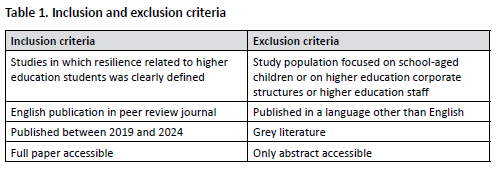
Clearly defined inclusion and exclusion criteria were used when conducting the literature search. Inclusion criteria included English publications published between 2019 and 2024. The study population was required to include higher education students. Exclusion criteria for the literature selection included research published in a language other than English, studies focused on school-aged children or on higher education corporate structures or higher education staff, and studies for which the full paper was not accessible (abstract only), as well as grey literature. The detailed inclusion and exclusion criteria are provided in Table 1.
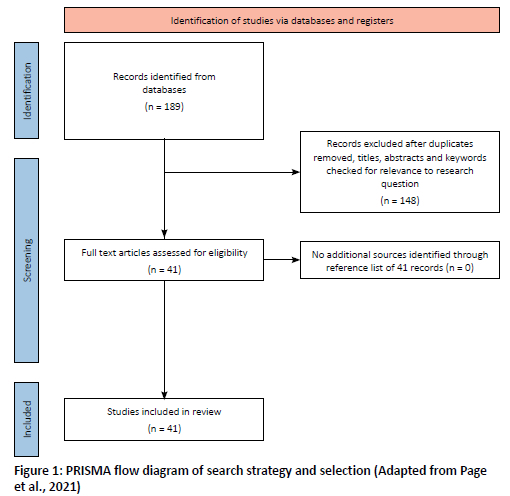
Figure 1 displays the flowchart depicting the search strategy and the process of study selection. The initial search via the EBSCO, ERIC and PsychINFO databases yielded 189 records. A review of the titles, abstracts and keywords indicated a large number of studies which did not include a clear discussion and definition of the concept 'resilience'. A number of studies were also identified in which the focus was on the university as a corporation or on resilience in school-aged children. A total of 148 records were excluded based on one of the inclusion criteria not being met or at least one of the exclusion criteria being present. No further studies were identified through the reference list of 41 records. As a result, a final total of 41 contributions were included in the scoping review.
Table 2 contains information regarding the 41 included contributions. The aim of the subsequent sections is to outline the pertinent themes that surfaced regarding how resilience was conceptualised in the 41 studies incorporated in this scoping review. First, the significant characteristics of each article are examined to establish context. Thereafter, the three identified themes are discussed in more detail.
Discussion
Resilience holds a significant place in contemporary higher education discussions as it pertains to how students navigate unpredictable environments with unknown parameters, where the prospect of failure is present (Munro et al., 2019). The term 'resilience' is derived from the Latin word resilire, signifying the ability to bounce back or rebound. In the realm of research, the concept of resilience finds its roots in material sciences, symbolising a material's capacity to revert to its initial state following the impact of external forces (Duchek et al., 2023). Although the results of the analysis show that over the past five years there has been a rise in interest in resilience in the literature on higher education, there are several problems that have affected how this concept is understood. One such problem is the absence of a generally agreed-upon definition of resilience (Brewer et al., 2019).
While definitions of resilience vary considerably, the foundation of the concept primarily stems from the research conducted by Connor and Davidson (2003). This includes the definition that resilience encompasses the personal attributes that facilitate an individual's ability to flourish amidst adversity. Resilience has the capacity to transform life during times of adversity. While it may be present in various aspects of life, it tends to develop more robustly during unanticipated challenges (Pertegal-Felices et al., 2022). In agreement with this understanding, Saðar (2022) states that resilience is characterised as the process of grappling with stressful experiences and successfully adapting to these negative life events. Although previous studies have offered varying definitions of resilience, there is a consistent consensus that resilience is an adaptive process that enables individuals to manage stress and return to a normal state (Al Omari et al., 2023). Several studies have demonstrated the importance of resilience in adapting to new, critical, and unexpected circumstances or situations, facilitating a return to normality (Serpa-Barrientos et al., 2023). It encompasses the process of being flexible to adapting to numerous challenging life experiences. Being flexible does not imply the absence of difficulties or negative situations; rather, it refers to the ability to successfully recover and return to the prior state in the face of risky conditions, despite significant threats to adaptation and development (Traþ et al., 2019). Emerson et al. (2023) define resilience as an individual-level attribute that fosters adaptation, mitigates the adverse impacts of stress, and facilitates coping with challenging situations. Bharti et al. (2023) state that resilience can be conceptualised according to two different schools of thought: one perspective views resilience as a relatively stable personality trait, while the other considers it a capacity that can evolve over time, depending on the circumstances. Brewer et al. (2019, p. 1109) note that resilience has been defined in some ways as "thriving" rather than just "surviving". According to Price (2023), in the context of higher education, resilience is a particular skill to be utilised to deal with obstacles and unfavourable situations. Price claims that resilience can be conceptualised as a distinct capability that individuals can tap into when navigating setbacks and negative events in the higher education environment and can be viewed as a precursor to well-being (Price, 2023).
Expressing a wider view, Ang et al. (2022) contend that resilience can be developed through both intrinsic and extrinsic factors. Intrinsic factors that enhance resilience in students include the desire to succeed, and personal motivation. Extrinsic factors involve support from friends, family, and teachers, and religious influences. Jillani et al. (2023) regard resilience as the student's ability to utilise both internal and external resources to manage various situational and ongoing challenges. It is a process that evolves over time, influenced by age-related maturation and increased interaction with the environment. As resilience develops, it concurrently enhances the student's psychological and physical health. Consistent with this perspective, Kaya et al. (2023) contend that resilience refers to an individual's capacity to overcome adversity, achieve positive outcomes despite the presence of risk factors, and adapt behaviourally, based on internal and external circumstances. The loss of a loved one, physical or mental abuse, abandonment, failure, and poverty are all examples of challenging situations. However, students can generate the necessary biological, psychological, or social factors to withstand and eventually recover from these adversities (Valverde-Janer et al., 2023).
Three broad conceptualisations of resilience are discussed below, namely resilience as an internal construct, resilience as an external/environmental construct, resilience as a malleable, growth construct, which will be unpacked into sub-themes.
Resilience as an internal construct
Resilience as a stable trait
Findings from the review indicate that most authors view resilience as an internal construct or trait. Up to the present, most higher education research has concentrated on traits at the individual level (Duchek et al. 2023). According to research, resilience was initially viewed as a set of fixed traits of an individual, which was investigated through the use of psychometric questionnaires, such as the Hammadi Dispositional Resilience Scale (Litwic-Kaminska et al., 2023). Datzer et al. (2022, p. 2562) reported that respondents in their study held implicit beliefs regarding "resilience as a stable personal characteristic".
Resilience as a skill or capacity
Brewer et al. (2022) characterise resilience as either a skill (such as using coping mechanisms, self-motivation, or managing conflicting interests) or as an inherent and unchanging personality trait within the individual. Respondents in the study by Datzer et al. (2022) regarded individual-inherent resources as less flexible due to the belief that students can only develop positively if they are able to adapt to adversity in their own personal capacity. Supporting this notion, Duchek et al. (2023) comment that previous studies focused on the individual abilities and traits of students to foster resilience. The literature has similarly indicated that individuals' personal characteristics, such as intrinsic determination and desire, serve as foundational elements of resilience (Ang et al., 2022).
Internal resources, self-sufficiency and intrinsic motivation
Resilience is often linked to an individual's inner resources and their capacity to be self-sufficient. According to Cruz et al. (2022), individuals who exhibit high levels of resilience are characterised by perseverance, self-sufficiency, and goal-setting. They persist in striving to achieve their objectives despite the difficulties or challenges involved. Datzer et al. (2022) also note that respondents in a study viewed these personal resources as vital to their adjustment in the face of adversity, suggesting that individuals should rely on their internal capacities to cope with difficulties. The role of intrinsic motivation and self-determination in fostering resilience is closely related, as personal determination, aspiration and tenacity enable students to reach their goals despite challenges (Ang et al., 2022). Moriña and Martins (2024) emphasise the connection between resilience and self-determination, noting how self-determination and inner drive are key elements in the formation of resilience. Ellis and Johnston (2024) contend that resilience is an individual's ability to control their outcomes on their own by independent of external factors
Resilience as a protective factor for mental health
Resilience has also been linked to benefits for mental health. According to Kennett et al. (2021), while there is ongoing dispute regarding its precise definition, resilience is widely acknowledged as a comprehensive construct that encompasses internal resources and behaviours that empower individuals to manage difficult life circumstances and consequently overcome difficulties. Resilience has been fundamentally associated with flexibility, positive adaptation, the maintenance of psychological well-being despite difficulties, and the reacquisition of psychological health (Tanacioðlu Aydin & Pekþen Süslü, 2023). According to Brewer (2019), resilience can be defined as an adaptive response that is constructive in the face of major adversity or as a means of assisting a person in maintaining their psychological well-being through the management of obstacles, failures, and other stressors. Emerson et al. (2023) describes resilience as a coping strategy that might lessen psychological suffering and academic burnout.
Resilience as external/environmental construct
Shifting the focus from individual to environmental resilience
Past research on resilience predominantly focused on how students could cultivate their resilience on their own. Ellis and Johnston (2024) found a tendency in research to overly highlight an individual's resilience while neglecting the role of environmental factors in the development of resilience. Duchek et al. (2023) argue that greater emphasis should be given to exploring how environmental factors, such as support networks, might contribute significantly to the development of student resilience. Brewer et al. (2019) found that by engaging in facilitated discussions about resilience and presenting a resilience model grounded in current research, the participants of a study transitioned from viewing resilience as an inherent attribute or skill possessed by individuals in their pre-program perspectives to adopting a more contemporary understanding of resilience as an ecological process after the program. In a study conducted by Datzer et al. (2022), it was found that framing resilience as an inherent trait, whether malleable or fixed, may lead to the stigmatisation of failure as a character flaw, especially if it is considered independent of the context. Kaya et al. (2023) explicitly state that resilience is not a personality trait.
Community resources
Social cohesion and community support are considered significant external resources that contribute to the development of resilience (Datzer et al., 2022). While the historical focus of resilience theory has been on the strategies and adaptations employed by individuals surpassing expectations, it is crucial to also contemplate the modifications that can be made to environmental factors to facilitate the flourishing of individuals (Ellis & Johnston, 2024). According to Ang et al. (2022), resilient students can be distinguished by their capacity to effectively utilise resources and seek assistance to overcome challenges, thereby excelling in their academic pursuits. Datzer et al. (2022) note that the exosystem approach to resilience has surprisingly received little attention. Within the exosystem, elements such as community and social services interact with individuals, providing support and enhancing their resilience in the face of adversity. Intrinsic values, including strength, determination, and a future-oriented mindset, combined with the development of a sense of belonging and social support, are qualities commonly found in resilient students.
Relationship building
In the study by Ang et al. (2022), participants primarily developed resilience through social connections. Relationships with parents, friends, and significant others, such as teachers, fostered students' resilience. One crucial approach to enhancing resilience is fostering healthy family and community environments, which enable individuals to develop and utilise natural defence mechanisms effectively. A supportive family and community environment provides emotional support and economic stability and contributes to the overall health and well-being of students (Zainoodin et al., 2021).
A socio-political perspective
There is growing debate regarding the conceptualisation of resilience as an individual character trait, as this perspective is problematic because it depoliticises resilience, detaching it from its broader socio-political context, including issues of race, racism, inequality, and social change (Zembylas, 2020). Zembylas (2020) argues that a contextualised approach views resilience as the result of cultural, social, economic, political, and psychological factors, in addition to its biological correlates. This perspective emphasises that resilience is influenced by structurally embedded social inequalities, including dimensions such as gender, socio-economic status, and ethnicity. Resilience is therefore not limited to individual factors but rather emphasises the structural embeddedness of individuals within their contexts. Specifically, an ecological approach to resilience highlights the concept of 'ecologies of resilience,' which asserts that resilience is a social and political process rather than an attribute that individuals possess or develop in isolation.
Resilience as a malleable, growth construct
Understanding resilience as a dynamic process
Per Datzer et al. (2022), respondents' beliefs align with what can be termed the process perspective of resilience. From this standpoint, resilience is defined as a dynamic process that entails positive adaptation in the face of significant adversity. Emerson et al. (2023) acknowledge the capacity of resilience to lessen the effects of factors contributing to attrition. Furthermore, there is substantial evidence supporting the idea that resilience is a flexible trait that can be nurtured in the classroom. From this perspective, individual resilience is not necessarily an inherent trait one is born with but can be developed and cultivated throughout a student's life. Resilience is inherently multifaceted and multidimensional. In a study by Al Omari et al. (2023), it was conceptualised as a dynamic, context-dependent adaptation mechanism that can be enhanced and acquired through learning.
Resilience as a developable trait
Datzer et al. (2022) claim that the flexibility of inherent personal factors ultimately shapes the perception of students' capacity for positive adaptation. Others agree that individuals' resilience can evolve over time and that their ability to cope with challenges is influenced by circumstances and additional support that acts as a buffer against disadvantages (Ellis & Johnston, 2024). According to Demir and Aliyev (2019), resilience can be characterised as a set of developable traits that enable individuals to persevere, overcome difficulties, and achieve better outcomes than anticipated despite experiencing negative and stressful life events. The Connor-Davidson Resilience Scale (CD-RISC) introduced a new perspective on resilience, recognising that resilience levels are not constant and may vary depending on different experiences, health states, and overall functioning (Litwic-Kaminska et al., 2023). According to Saðar (2022), resilience is indeed a feature that can be developed over time. A review of the literature indicates that resilience can be developed or enhanced through various interventions, including group counselling, cognitive-behavioural approaches, positive psychology, and realistic approaches. These studies have demonstrated that interventions grounded in different psychological counselling methodologies positively impact individuals' resilience.
Resilience and personal growth
Research by Emerson et al. (2023) depicts resilience as the constructive transformation of individuals in the face of adversity, ultimately leading to personal growth or learning. This awareness has the potential to strengthen their resilience and dispel the misconception held by some students that resilience is an unchanging trait. Instead, it emphasises that resilience is a quality that can be developed, ultimately contributing to improved mental health in students (Kotera et al., 2021). According to Litwic-Kaminska et al. (2023), resilience is understood not merely as an individual trait but as a process. When viewed as a process, resilience pertains to the effective management of difficult phenomena and events throughout a person's life. Some researchers emphasise that resilience involves a dynamic process of positive adaptation in response to emerging adversities. Brewer et al. (2019) align with this view, defining resilience as a process rather than a skill or trait. A limited number of authors explored the link between resilience and growth. In recent years, many researchers have recognised resilience as a developmental process rather than an innate personal trait (e.g. hardiness) and believe it can be strengthened through effective strategies (Liu et al., 2022). According to Saifullah and Khan (2022), resilience is not innate; rather, it is a skill that individuals learn to regulate as they navigate various situations and emotions.
Implications for future research
The insights from this review present several key implications for higher education research, policy and practice. For educators, practitioners and policymakers, this review indicates that more comprehensive strategies are required to promote resilience in higher education students. Foremost, the categorisation of resilience into the three themes can equip universities to design student support programs that do not focus on a singular interpretation of resilience. Practitioners should use the identified resilience categories to establish a shared understanding amongst students and staff, which could in turn guide the development and implementation of resilience-building interventions and initiatives. Further research should be conducted to refine the categorisations of resilience, particularly how resilience is context-dependent, especially from an African perspective. It is important to note the scarcity of research on the development of resilience within the context of African higher education students, where culture, collectivism, and ubuntu play a key role in fostering resilience. Further research on this topic within the African context is crucial to ensure that resilience programs and initiatives are culturally relevant, considering the unique social and communal factors relevant to fostering resilience in students within African contexts.
Limitations
The study had some limitations. The use of filters, such as date (2019-2024) and academic journals with full text availability, for database searches meant that neither pertinent studies published before 2019 nor studies in languages other than English from non-peer reviewed publications, such as the grey literature, would have been accessible. Since the author alone created the inclusion and exclusion criteria, it is possible that other pertinent articles were overlooked, and the reasoning was limited. One criticism of the scoping review approach is that it usually does not involve a process of evaluating the quality of the literature, which raises the risk that conclusions would be drawn based more on the availability of studies than on their inherent value.
Conclusion
In recent years there has been a significant increase in literature focusing on the application of resilience in the field of higher education. Despite variances in definition, consensus has been reached on the general core components of resilience, such as the ability to withstand change or disturbance, adversity, difficulty, trauma, and stressors, despite definitional diversity. It is apparent that the most notable contributions emphasise three primary themes: (i) resilience as an individual characteristic, (ii) resilience as a social or environmental concept, and (iii) resilience as a flexible rather than static entity, being perceived as a developmental trait that can evolve over time. The categorisations of resilience can also function as a sensemaking tool which aims to create a common understanding of resilience, which could inform decision-making with regard to resilience training programs. Future studies are needed to refine these resilience classifications. Further research conceptualising resilience as an external and growth construct is recommended, as there is a lack of research viewing the concept of resilience through these lenses. Further studies on conceptualisation of resilience within African higher education is recommended to reach a more culturally relevant understanding of resilience in the African context.
Ethics statement
This review used publicly available literature and therefore did not require ethics approval.
Potential conflict of interests
The author declares no conflict of interests.
References
Funding acknowledgement
The author received no external funding.
Literature selection
- Abdolrezapour, P., Ganjeh, S. J., & Ghanbari, N. (2023). Self-efficacy and resilience as predictors of students' academic motivation in online education. PLoS ONE, 18(5), e0285984. https://doi.org/10.1371/journal.pone.0285984
- Al Omari, O., al Yahyaei, A., Wynaden, D., Damra, J., Aljezawi, M., Al Qaderi, M., Al Ruqaishi, H., Abu Shahrour, L., & ALBashtawy, M. (2023). Correlates of resilience among university students in Oman: A cross-sectional study. BMC Psychology, 11, 2. https://doi.org/10.1186/s40359-022-01035-9
- Ang, W. H. D., Shorey, S., Lopez, V., Chew, H. S. J., & Lau, Y. (2022). Generation Z undergraduate students' resilience during the COVID-19 pandemic: A qualitative study. Current Psychology, 41(11), 8132-8146. https://doi.org/10.1007/s12144-021-01830-4
- Antony, E. M.-A. (2022). Framing childhood resilience through Bronfenbrenner's ecological systems theory: A discussion paper. Cambridge Educational Research e-Jounal, 9, 244-257. https://doi.org/10.17863/CAM.90564
- Arksey, H., & O'Malley, L. (2005). Scoping studies: Towards a methodological framework. International Journal of Social Research Methodology, 8(1), 19-32. https://doi.org/10.1080/1364557032000119616
- Balogun, B. J., & Woldegiorgis, E. T. (2024). Individualising collectivity: Rethinking the individualism-communitarianism debate in the context of students' resilience during the Covid-19 era. Educational Philosophy and Theory, 56(12), 1241-1252. https://doi.org/10.1080/00131857.2024.2376640
- Bharti, T., Mishra, N., & Ojha, S. C. (2023). Mindfulness and subjective well-being of Indian university students: Role of resilience during COVID-19 pandemic. Behavioral Sciences, 13(5), 353. https://doi.org/10.3390/bs13050353
- Brett, C. E., Mathieson, M. L., & Rowley, A. M. (2023). Determinants of wellbeing in university students: The role of residential status, stress, loneliness, resilience, and sense of coherence. Current Psychology, 42(23), 19699-19708. https://doi.org/10.1007/s12144-022-03125-8
- Brewer, M., van Kessel, G., Sanderson, B., & Carter, A. (2022). Enhancing student resilience by targeting staff resilience, attitudes and practices. Higher Education Research and Development, 41(4), 1013-1027. https://doi.org/10.1080/07294360.2021.1877622
- Brewer, M. L., van Kessel, G., Sanderson, B., Naumann, F., Lane, M., Reubenson, A., & Carter, A. (2019). Resilience in higher education students: A scoping review. Higher Education Research and Development, 38(6), 1105-1120. https://doi.org/10.1080/07294360.2019.1626810
- Bronfenbrenner, U. (1979). The ecology of human development: Experiments by nature and design. Harvard University Press.
- Cockcroft, K., Greyling, M., Fouché, A., Ungar, M., & Theron, L. (2024). South African emerging adults' capacity for resilience in the face of COVID-19 stressors. Journal of Health Psychology, 29(6), 522-533. https://doi.org/10.1177/13591053231208620
- Connor, K. M., & Davidson, J. R. T. (2003). Development of a new resilience scale: The Connor-Davidson Resilience Scale (CD-RISC). Depression and Anxiety, 18, 76-82. http://dx.doi.org/10.1002/da.10113
- Cruz, P. D. A., Covarrubias, L. P. C., & Pérez, P. A. (2022). The effect of resilience on entrepreneurial intention in higher education students in a post-Covid Stage 19. Journal of Higher Education Theory and Practice, 22(18). https://doi.org/10.33423/jhetp.v22i18.5695
- Datzer, D., Razinskas, S. & Hoegl, M. (2022). Implicit resilience theories: A qualitative study of context-shapers at higher education institutions. Studies in Higher Education, 47(12), 2553-2574. https://doi.org/10.1080/03075079.2022.2091538
- Demir, Ö. O., & Aliyev, R. (2019). Resilience among Syrian university students in Turkey. Turkish Journal of Education, 8(1), 35-51. https://doi.org/10.19128/turje.454138
- Duchek, S., Geithner, S., & Roth, T. (2023). Mastering team crises: A play-oriented approach to foster resilience capabilities in student teams. Teaching in Higher Education, 28(8), 1937-1956. https://doi.org/10.1080/13562517.2021.1943652
- Ellis, K., & Johnston, C. (2024). Resilience, higher education and widening participation: Generating change for care experienced students. Higher Education, 87(1), 1-16. https://doi.org/10.1007/s10734-022-00985-8
- Emerson, D. J., Hair, J. F. Jr., & Smith, K. J. (2023). Psychological distress, burnout, and business student turnover: The role of resilience as a coping mechanism. Research in Higher Education, 64(2), 228-259. https://doi.org/10.1007/s11162-022-09704-9
- Fang, S., Barker, E., Arasaratnam, G., Lane, V., Rabinovich, D., Panaccio, A., O'Connor, R. M., Nguyen, C. T., & Doucerain, M. M. (2024). Resilience, stress, and mental health among university students: A test of the resilience portfolio model. Stress & Health, 41(2), e3508. https://doi.org/10.1002/smi.3508
- Fernández-Castillo, A., & Fernández-Prados, M. J. (2022). Burnout, resilience and self-esteem in school teaching university students. Behavioral Sciences, 32(11), 422. https://doi.org/10.3390/bs12110422
- Grych, J., Hamby, S., & Banyard, V. (2015). The resilience portfolio model: Understanding healthy adaptation in victims of violence. Psychology of Violence, 5(4), 343-354. https://psycnet.apa.org/doi/10.1037/a0039671
- Idris, I., Khairani, A. Z., & Shamsuddin, H. (2019). The influence of resilience on psychological well-being of Malaysian university undergraduates. International Journal of Higher Education, 8(4), 153-163. https://doi.org/10.5430/ijhe.v8n4p153
- Jillani, U., Bhutto, Z. H., & Ahmad, K. B. (2023). Role of emotional intelligence, resilience, and year of enrollment for adjustment among university students. Pakistan Journal of Psychological Research, 38(2), 267-280. https://doi.org/10.33824/PJPR.2023.38.2.16
- Kashif, M. F., Nasir, M., & Shaheen, F. (2024). Effect of emotional intelligence on resilience among university students at undergraduate level. Pakistan Social Sciences Review, 8(1), 370-382. https://doi.org/10.35484/pssr.2024(8-I)33
- Kaya, I., Turk, F., & Hamamci, Z. (2023). Investigating the relationship between university students' resilience, cognitive emotion regulation strategies and metacognitions. Global Journal of Guidance and Counseling in Schools: Current Perspectives, 13(1), 36-45. https://doi.org/10.18844/gjgc.v13i1.7954
- Kennett, D. J., Quinn-Nilas, C., & Carty, T. (2021). The indirect effects of academic stress on student outcomes through resourcefulness and perceived control of stress. Studies in Higher Education, 46(11), 2460-2472. https://doi.org/10.1080/03075079.2020.1723532
- Kotera, Y., Ting, S.-H., & Neary, S. (2021). Mental health of Malaysian university students: UK comparison, and relationship between negative mental health attitudes, self-compassion, and resilience. Higher Education, 81(2), 403-419. https://doi.org/10.1007/s10734-020-00547-w
- Larcombe, W., Ryan, T., & Baik, C. (2024). Are international students relatively resilient? Comparing international and domestic students' levels of self-compassion, mental health and wellbeing. Higher Education Research & Development, 43(2), 362-376. https://doi.org/10.1080/07294360.2023.2234315
- Li, Y., & Peng, J. (2022). Evaluation of expressive arts therapy on the resilience of university students in COVID-19: A network analysis approach. International Journal of Environmental Research and Public Health, 19(13), 7658. https://doi.org/10.3390/ijerph19137658
- Liu, X., Wang, Q., & Zhou, Z. (2022). The association between mindfulness and resilience among university students: A meta-analysis. Sustainability, 14(16), 10405. https://doi.org/10.3390/su141610405
- Litwic-Kaminska, K., Btachnio, A., Kapsa, I., Brzezinski, t., Kopowski, J., Stojkovic, M., Hinic, D., Krsmanovic, I., Ragni, B., Sulla, F., & Limone, P. (2023). Resilience, positivity and social support as perceived stress predictors among university students. International Journal of Environmental Research and Public Health, 20(19), 6892. https://doi.org/10.3390/ijerph20196892
- Maniram, R. (2022). Exploring the resilience and epistemic access of first-year female students in higher education. HTS Teologiese Studies / Theological Studies, 78(2), a7803. https://doi.org/10.4102/hts.v78i2.7803
- Masten, A. S. (2014). Global perspectives on resilience in children and youth. Child Development, 85(1), 6-20. https://doi.org/10.1111/cdev.12205
- Mbiti, J. S. (1970). Concepts of God in Africa. Praeger.
- Moriña, A., & Martins, M. H. (2024). Success and self-determination: A systematic review of the narratives of students and graduates with disabilities. Higher Education Research & Development, 43(5), 1107-1123. https://doi.org/10.1080/07294360.2023.2293191
- Page, M. J., McKenzie, J. E., Bossuyt, P. M., Boutron, I., Hoffmann, T. C., Mulrow, C. D., Shamseer, L., Tetzlaff, J. M., Akl, E. A., Brennan, S. E., Chou, R., Glanville, J., Grimshaw, J. M., Hróbjartsson, A., Lalu, M. M., Li, T., Loder, E. W., Mayo-Wilson, E., McDonald, S., McGuinness, L. A., & Moher, D. (2021). The PRISMA 2020 statement: An updated guideline for reporting systematic reviews. Declaración PRISMA 2020: Una guía actualizada para la publicación de revisiones sistemáticas. Revista Española de Cardiología (English ed.), 74(9),790-799. https://doi.org/10.1016/j.rec.2021.07.010
- Pertegal-Felices, M. L., Valdivieso-Salazar, D. A., Espín-León, A., & Jimeno-Morenilla, A. (2022). Resilience and academic dropout in Ecuadorian university students during COVID-19. Sustainability, 34(13), 8066. https://doi.org/10.3390/su14138066
- Price, R. A. (2023). A review of resilience in higher education: Toward the emerging concept of designer resilience. Studies in Higher Education, 48(1), 83-99. https://doi.org/10.1080/03075079.2022.2112027
- Saðar, M. E. (2022). The effect of solution-focused group counseling on the resilience of university students. E-International Journal of Educational Research, 33(1), 103-117. https://doi.org/10.19160/e-ijer.1034931
- Saifullah, S., & Khan, O. Z. (2022). Relationship between grit and academic resilience among university students. CARC Research in Social Sciences, 3(1), 11-14. https://doi.org/10.58329/criss.v1i1.4
- Serpa-Barrientos, A., Calvet, M. L. M., Acosta, A. G. D., Fernández, A. C. P., Rivas Díaz, L. H., Albites, F. M. A., & Saintila, J. (2023). The relationship between positive and negative stress and posttraumatic growth in university students: The mediating role of resilience. BMC Psychology, 33(1), 348. https://doi.org/10.1186/s40359-023-01400-2
- Tanacioðlu Aydin, B., & Pekþen Süslü, D. (2023). The mediating role of difficulties in emotion regulation in the relationship between childhood trauma and resilience among university students. Turkish Psychological Counseling and Guidance Journal, 33(70), 315-329. https://doi.org/10.17066/tpdrd.1265528.4
- Theron, L. C. (2012). Resilience research with South African youth: Caveats and ethical complexities. South African Journal of Psychology, 42(3), 333-345. https://doi.org/10.1177/008124631204200305
- Traþ, Z., Öztemel, K., & Kaðnýcý, E. (2019). A review on university students' resilience and levels of social exclusion and forgiveness. International Education Studies, 32(10), 50-59. https://doi.org/10.5539/ies.v12n10p50
- Tricco, A. C., Lillie, E., Zarin, W., O'Brien, K. K., Colquhoun, H., Levac, D., Moher, D., Peters, M. D., Horsley, T., Weeks, L., Hempel, S., Akl, E. A., Chang, C., McGowan, J., Stewart, L., Hartling, L., Aldcroft, A., Wilson, M. G., Garritty, C., Lewin, S., Godfrey, C. M., Macdonald, M. T., Langlois, E. V., Soares-Weiser, K., Moriarty, J., Clifford, T., Tunçalp, Ö., & Straus, S. (2018). PRISMA extension for scoping reviews (PRISMA-ScR): Checklist and explanation. Annals of Internal Medicine, 369(7), 467-473. https://doi.org/10.7326/M18-0850
- Turner, M., & Holdsworth, S. (2023). Developing resilience: Examining the protective factors of early career construction professionals. Construction Management and Economics, 43(10), 805-819. https://doi.org/10.1080/01446193.2023.2208238
- Ungar, M. (2008). Resilience across cultures. The British Journal of Social Work, 38(2), 218-235. http://dx.doi.org/10.1093/bjsw/bcl343
- Ungar, M. (2012). Researching and theorizing resilience across cultures and contexts. Preventive Medicine, 55(5), 387-389. https://doi.org/10.1016/j.ypmed.2012.07.021
- Valverde-Janer, M., Ortega-Caballero, M., Ortega-Caballero, I., Ortega-Caballero, A., & Segura-Robles, A. (2023). Study of factors associated with the development of emotional intelligence and resilience in university students. Education Sciences, 13(3), 255. https://doi.org/10.3390/educsci13030255
- van Agteren, J., Woodyatt, L., lasiello, M., Rayner, J., & Kyrios, M. (2019). Make it measurable: Assessing psychological distress, wellbeing and resilience at scale in higher education. Student Success, 10(3), 1-13. https://doi.org/10.5204/ssj.v10i3.1411
- Vilca-Pareja, V., Luque Ruiz de Somocurcio, A., Delgado-Morales, R., & Medina Zeballos, L. (2022). Emotional intelligence, resilience, and self-esteem as predictors of satisfaction with life in university students. International Journal of Environmental Research and Public Health, 19(24), 16548. https://doi.org/10.3390/ijerph192416548
- Xing, C., Mu, G. M., & Henderson, D. (2023). Mobilising resilience to symbolic violence with Chinese international research students in Australia: A Bourdieusian perspective. Higher Education Research & Development, 43(6), 1448-1463. https://doi.org/10.1080/07294360.2023.2292649
- Zainoodin, N. N., Hutasuhut, I. J., Abu Bakar, M. A., & Wardhani, N. (2021). Gratitude and its relationship to resilience and academic performance among university students. Journal of Cognitive Sciences and Human Development, 7(2), 145-158. https://doi.org/10.33736/jcshd.3808.2021
- Zembylas, M. (2021). Against the psychologization of resilience: Towards an onto-political theorization of the concept and its implications for higher education. Studies in Higher Education, 46(9), 1966-1977. https://doi.org/10.1080/03075079.2019.1711048
10 September 2025
Published 5 December 2025