Student motivation for volunteering in a peer mentorship programme at a university of technology in South Africa
Abstract
The increasing demand and competition for funding for student academic development and psychosocial support programmes in South African higher education is a reality. The peer mentorship programme at a university of technology in South Africa changed from being incentivised to voluntary in 2021 to expand its reach. Volunteer mentors were able to develop skills, expand social networks, boost employability, and increase life satisfaction in serving others. However, changes in the programme structure contributed to low morale and a higher dropout rate among mentors. This article reports a qualitative study that explored volunteer mentors' motivations to propose programme enhancements. Data were collected from eight purposefully selected peer mentors who participated in focus groups. The findings indicated esteem enhancement as the strongest motivator for the participants, followed by value expression or altruism and a desire to increase their knowledge and skills. The participants' motivation for volunteering contrasts with the findings of global and local research studies on student volunteering. Implications for peer mentorship programme design, marketing, recruitment, selection, engagement, and remuneration strategies are discussed. Avenues for further research are proposed.
Dropout; first-year student; functional approach in psychology; incentives; motivation; need satisfaction; peer mentor; volunteering
Abstract
Nyakego le phadisano tse di oketsegago tsa thuso ya ditshelete tsa tlhabollo ya thuto ya baithuti le mananeo a thekgo ya monagano le tsa leago ka thutong ya godimo ya Afrika Borwa ke nnete. Lenaneo la tlhahlo ya baithutimmogo Yunibesithing ya Theknolotsi ka Afrika Borwa le fetogile go tswa go go putswa go ya go boithaopo ka 2021 go katolosa phihlelelo ya lona. Baeletsi ba baithaopi ba ile ba kgona go hlabolla bokgoni, go katolosa mararankodi a tsa leago, go godisa go thwala le go oketsa kgotsofalo ya bophelo ka go hlankela ba bangwe. Lege go le bjalo, diphetogo thulaganyong ya lenaneo di bile le seabe go maikwelo a tlase le tekanyo e phagamego ya go tlogela ga baeletši. Sengwalwa se se bega nyakišišo ya boleng yeo e ilego ya hlahloba ditutuetšo tša baeletši ba baithaopi tša go šišinya dikaonafatšo tša lenaneo. Datha e kgobokeditšwe go tšwa go baeletši ba baithutimmogo ba seswai bao ba kgethilwego go ka tšea karolo dihlopheng tše di nepišitšwego. Dikutollo di laeditše go godiša tlhompho bjalo ka tlhohleletšo ye maatla go batšeakarolo, gomme ya latelwa ke go bontšha boleng goba go se be le boithati le kganyogo ya go oketša tsebo le bokgoni bja bona. Tlhohleletšo ya batšeakarolo ya boithaopi e fapana le dikhwetšo tša dinyakišišo tša lefase ka bophara le tša selegae ka ga boithaopi bja baithuti. Ditlamorago tša tlhamo ya lenaneo la tlhahlo ya baithutimmogo, papatšo, go thwala, kgetho, go tsenela, le maano a moputso di ahlaahlwa. Ditsela tša nyakišišo ye nngwe di šišintšwe.
Go tlogela; moithuti wa ngwaga wa mathomo; mokgwa wa mošomo ka thutong ya monagano; meputso; tlhohleletšo; go kgotsofatša hlokego; mohlahli wa moithutimmogo; go ithaopa
Introduction
Peer mentorship programmes, which offer social, intellectual, guiding, and mental health support, are important initiatives that assist first-year students with the transition, adjustment and enculturation into university life (Lunsford et al., 2017; McConney & Fourie-Malherbe, 2022; Waite, 2021). The concept of peer mentorship refers to a relationship in which more experienced students provide information, guidance and support to less experienced students, increasing their chances of success (McConney & Fourie-Malherbe, 2022). Amongst others, peer mentorship relationships promote a sense of belonging, support identity formation, and aid in developing social-emotional skills while also driving learning outcomes and accountability and enhancing general well-being (McConney & Fourie-Malherbe, 2022; Waite, 2021). Whereas mentorship offers valuable benefits to mentees, those who assume mentorship roles also benefit from greater self-development, career awareness, self-efficacy, and organisational and communication skills (Hayman et al., 2022; McConney & Fourie-Malherbe, 2022; Swart et al., 2019). Hence, both mentors and mentees benefit from the mentoring relationship.
This article focuses on a specific University of Technology in South Africa (UoTSA), where it became evident that its remuneration structure for a peer mentorship programme (referred to hereafter as 'the Programme') limited its reach. The Programme transitioned from a paid structure where mentors were remunerated for services offered (pre-2020) to incentivised (2020) and then to a volunteer programme (2021 to 2023). The Programme custodians argued that mentors would benefit from volunteering by developing their skills and social networks, improving their employability profiles, and experiencing life satisfaction while serving others. In turn, more first-year students could potentially benefit from a better educational experience, while the institution benefitted from increased student retention and success. Therefore, the Programme was marketed as a volunteer initiative toward the end of 2020. Efforts were made during the recruitment and selection processes to emphasise the volunteer nature of the mentor role. The shift in the Programme structure from paid to incentivised in 2020 widened its reach. However, upon closer inspection, it became apparent that the structural adjustment from a paid to a volunteer initiative contributed to lower morale among mentors and higher mentor dropout rates from the Programme. The COVID-19 pandemic, which had a significant impact on academic activities worldwide, also affected the Programme.
The impact of COVID-19 on the Programme
In December 2019, the first COVID-19 cases were identified in Wuhan, China, and soon resulted in a global pandemic, infecting and affecting people across nations (Pokhrel & Chhetri, 2021). The measures taken to mitigate the spread of infection resulted in mandatory social isolation practices among mentors and mentees participating in the Programme. Consequently, the Programme moved from face-to-face interaction to utilising online and social media platforms, such as WhatsApp and Zoom. Emergency remote teaching was a priority, necessitating the reallocation of university funds to facilitate the speedy transition to online learning and teaching. Due to slow institutional processes, mentors were forced to use their cell phone data to support their mentees during the early stages of the COVID-19 lockdown.
Mentors' dissatisfaction started manifesting through complaints and dropping out of the Programme due to various issues, such as insufficient cell phone data, no stipends, and perceived injustice. The COVID-19 lockdown also frustrated the mentors' need to connect physically with their mentees and peers (Phillips et al., 2022). Consequently, their senses of community, belonging and acceptance were negatively affected. Although they were recruited as volunteers, some mentors were dissatisfied with the limited compensation for their services. Their dissatisfaction stemmed from a perceived injustice in tutoring being a paid peer-to-peer service, whereas their work was rendered voluntary only, and a belief that the Programme needed to be better understood. As the COVID-19 social isolation began to ease, some mentors became dissatisfied with the lack of identifying attire, which signified a loss of personal and group identity.
The COVID-19 restrictions also prohibited mentors from accompanying their mentees to their respective industries as part of their career development. Similarly, changing the year-end certificate ceremony to a virtual event impacted the mentors' need for social interaction and validation. The combined changes contributed to mentors' dissatisfaction, low morale and dropout. Hence, restabilising the disrupted Programme was essential to retaining mentors and meeting the specified goals and targets. Measures were taken to manage these changes and create a more positive volunteer experience. The measures included improved communication with mentors, consistent communication regarding the Programme's funding limitations and the benefits of peer mentoring and increased reach.
The present study
Before the Programme's remuneration structure changed, mentors would drop out for better economic opportunities (e.g. working as a tutor at the UoTSA or taking up formal employment elsewhere). The sense of unfairness that emerged among some mentors about working as volunteers whilst tutors were paid highlighted their political awareness.
Those mentors regarded volunteering as free labour and a practice perpetuating structural inequality among varying peer supporters at the UoTSA.
Mentors' unhappiness called for reflection on the view of student volunteering as inherently noble and good, albeit preparing them for work and civil engagement, while enhancing their personal development and well-being (Joseph & Carolissen, 2019). Hawksley and Georgeou (2019) argue that volunteering supports sections of the economy that are socially vital but too costly to operate at market rates. They suggest that volunteer peer mentors fill gaps and contribute to reducing expenses in higher education (HE) services by providing low-cost or free labour. The authors argue that this practice could encourage normalisation of apolitical volunteering, which doesn't address the root causes of societal inequality. Consequently, these scholars' argument raises questions about volunteer peer mentors in the HE sector.
Nevertheless, individuals' motivations to volunteer are complex and multifaceted. Scholars (see Grönlund et al., 2011; Joseph & Carolissen, 2019; Patel et al., 2007) warned against presuming individuals' motives to volunteer without considering their unique contexts since various factors influence volunteer behaviour, such as a country's socio-political-economic context, religious and related values, and collectivistic versus individualistic cultural backgrounds.
Against this background, the researcher did a literature exploration on the academic search engine Google Scholar using keywords (e.g. 'Clary's functional approach', 'HE', 'student volunteerism', 'Africa') that yielded approximately 3 430 results. The search was then refined by systematically searching various databases (e.g. Ebscohost, Taylor and Francis, JStor). The researcher found only a few South African studies on student volunteerism that utilised Clary et al.'s (1992) framework (Joseph & Carolissen, 2019; Patel et al., 2007; Van den Berg et al., 2015). The researcher found no study on peer mentor volunteerism in South African HE. Hayman et al. (2022) argued that although peer mentorship programmes in HE have been researched, the peer mentor perspective has been neglected. Similarly, McConney and Fourie-Malherbe (2022) call for more research centring the peer mentor perspective in South African HE.
The present study aimed to enhance the Programme custodians' understanding of student motives for volunteering in the Programme at UoTSA and promote sustained participation in mentoring activities. The study was guided by the following question:
What motivates students to volunteer as peer mentors in the UoTSA Programme?
The study's theoretical framework, literature review and methodological approach are presented next, followed by a presentation and discussion of the findings. The article concludes by recommending strategies and interventions for practice, highlighting limitations and suggesting avenues for further research.
Theoretical framework and literature review
This section discusses theoretical aspects relevant to the qualitative study reported on. Findings are also presented from the literature review on volunteer motivations within Clary et al.'s (1992) framework; concluding with a summary of the empirical findings.
Theoretical framework
The functional approach in psychology provided a lens for uncovering student motivations behind their decisions to volunteer in the Programme (Clary et al., 1992). Proponents of the functional approach argue that reasons for volunteering are complex, dynamic, and context-specific (Clary et al., 1992). The functional approach revolves around five assumptions, namely:
1. Individuals engage in volunteer work to meet important personal and social goals;
2. Individuals participating in the same volunteer activity in a specific context may have vastly different motivations for volunteering;
3. People could attempt to address or satisfy two or more personal needs through volunteering,
4. Motivations are malleable, and tend to change over time; and
5. Successful volunteer recruitment, satisfaction, and retention correlate positively with the capacity of the volunteer experience to fulfil volunteers' important motives or needs.
Volunteering fulfils several psychological needs, including expressing humanitarian and altruistic values, gaining knowledge and skills, and promoting personal growth and self-development (Clary et al., 1992). It provides career-related experience, strengthens social relationships, and offers a means to manage individual issues and mitigate negative emotions, thereby enhancing overall well-being (Chacón et al., 2017; Clary et al., 1992).
Understanding the motivational needs of peer mentors at UoTSA from Clary et al.'s (1992) perspective can offer valuable insights into effectively addressing these needs. By doing so, the Programme can create a more supportive learning environment for first-year students, ultimately contributing to the overall success of HE in South Africa.
South Africa has a rich history of volunteering that promotes citizenship and civic responsibility (Patel et al., 2007). Volunteering is regarded as serving others without receiving significant financial recompense (Joseph & Carolissen, 2019). The altruistic value of wanting to help others is recognised as a critical motivator for volunteering (Chacón et al., 2017; Gage & Thapa, 2011; Grönlund et al., 2011). Altruism is motivated by humanistic values and involves self-initiated and self-sacrificing helping behaviour without concern for external reward (e.g. remuneration, praise) (Phillips & Phillips, 2011).
Maslow (Green, 2000) proposes five categories of motivational needs that are satisfied sequentially. In ascending order, the categories are (1) physiological, (2) safety and security, (3) love and belonging, (4) esteem and (5) self-realisation. The categories are divided into lower-order or deficiency needs (physiological, safety, love and belonging) and higher-order or growth needs (esteem, intellectual, creative, artistic) (Noltemeyer et al., 2021). Maslow's (Green, 2000) earliest work suggests that a lower-order need must be fulfilled entirely before a higher-order need can be satisfied. He later acknowledges that need satisfaction is not absolute (Rojas et al., 2023). Individuals can progress to satisfying higher-order needs once lower-order needs are partially fulfilled.
Mawere et al. (2016) maintain that human motivation in Africa comprises four aspects, namely (1) seeking out connections, (2) the community's strengthening, (3) recognition of authority, and (4) speaking up and avoiding embarrassment. Disinterest develops when these motivations are not satisfied. Common to motivation and volunteering in Africa is the philosophy of ubuntu. Within ubuntu, all interactions are orientated towards the common ground or helping to create a better life for all (Mawere et al., 2016; Patel et al., 2007).
A cross-cultural study of student volunteer activities throughout North America, Europe, the Middle East, and the South Pacific region indicated that altruism was the most important motivator for student volunteers, followed by a need to increase their knowledge and skills to enhance their employability (Grönlund et al., 2011). Van den Berg et al. (2015) conducted a study to compare the motives and constraints of South African and Australian sports students who engaged in voluntary activities. The findings revealed that participants from both countries agreed on the importance of learning and developing skills and helping others (Van den Berg et al., 2015). Patel et al. (2007) conducted a study in Africa and found that volunteering adolescents were motivated to develop knowledge, improve their skills, and gain work experience and possibilities. According to Chacón et al. (2017), self-enhancement and professional advancement are the least essential motives for volunteering worldwide. However, volunteers under 40 place a higher value on job advancement and learning new skills (Chacón et al., 2017).
On the other hand, Hawksley and Georgiou (2019) argue that under neoliberalism, where individual behaviour is seen as a mere cost-benefit analysis, even volunteer work has become commodified. Higher education specifically has also been impacted, with sharp declines in government funding of the sector seen worldwide. Consequently, universities have had to manage their operations more businesslike and entrepreneurially (Boughey & McKenna, 2021). This is exemplary of how market ideology has pervaded all facets of life, from human rights to university administration to social justice to the individualisation of culture and the prioritization of individual and economic growth at the expense of others and the environment.
In summary, the empirical literature findings reported above indicate that volunteering is often driven by altruism, where individuals help others without expecting financial reward, a humanistic value. Cross-cultural studies highlight that altruism and the desire to gain knowledge, and skills are critical motivators for volunteering, particularly among younger volunteers who value job advancement and skill development. Scholars also call attention to how neoliberalism undermines higher education's social contract by reducing the sector's operations to transactional cost-benefit anaylses whereby market logic and humanistic value, volunteerism and social justice are forced into uneasy coexistence.
Method
An exploratory qualitative research design was adapted to conduct the study. The qualitative study design allows the researcher to engage with participants and develop a nuanced understanding of their subjective realities (Cresswell & Poth, 2018). The goal of this study, which entailed developing an understanding of the motivational and psychological needs of student mentors, can be studied through an interactive methodology.
Study context, population and sample
The study was conducted at a UoTSA, a public university that enrols approximately 20 000 students annually (UoTSA University Capacity Development Programme 2024 - 2026 Funding proposal, 2024). Of these, approximately 5 000 to 6 000 are first-year students. The university's composition is representative of the broader South African population in terms of demographics.
The study population constituted 97 senior students who were appointed as peer mentors. The study sample comprised eight criterion-based, purposively selected mentors. To ascertain experience with the different programme structures (e.g. incentivised and volunteer), mentors had to have worked in the Programme for at least two years to be included in the study (Nyimbili & Nyimbili, 2024). Eight mentors (six males and two females between the ages of 20 and 24 years) who volunteered to participate comprised the sample. Hennink et al.'s (2019) saturation parameters (the study purpose, type of codes, group stratification, and desired type and degree of saturation) for focus group studies were utilised to estimate the number of sessions. In the case of the current study, this amounted to two.
Data collection
The researcher examined the Programme from 2020 to early 2023 (Kleinheksel et al., 2020) within Clary et al.'s (1992) framework. The examination aimed to develop insight into (i) Programme implementation, (ii) the mentors' service level agreement, (iii) critical Programme decisions that bear on the mentors, and (iv) developing a use case to better understand volunteer peer mentors' motivations and experiences. Additionally, two focus groups were conducted with the participants to explore their motivations for volunteering. The participants consented to the focus group being audio recorded before data collection commenced. Microsoft Teams was utilised to conduct the 60-minute focus groups. The researcher transformed the recorded data into text using the Microsoft Word transcription tool. The accuracy of the transcriptions was confirmed by comparing the transcribed texts whilst listening to the recordings.
Data analysis
The qualitative content analysis method aided data analysis of the focus group data and allowed for consideration of both the participants and the context. A basic assumption is that the technique can uncover valuable information about a phenomenon, like volunteer motivations, through systematic descriptions of the meaning thereof (Kleinheksel et al., 2020; Schreier, 2012). Qualitative content analysis "is done by classifying material as instances of the categories of a coding frame" (Schreier, 2012, p. 1). The texts were organised into related categories to find similarities and differences, patterns, and linkages, both on the surface and implicitly (Kleinheksel et al., 2020). Clary et al.'s (1992) framework guided the data analysis and the data organisational processes. The study's trustworthiness was enhanced by triangulating multiple data sources for richer analysis and interpretation. Ongoing engagement with the data until no new meanings emerged further strengthened the trustworthiness (Kleinheksel et al., 2020). The researcher kept a journal to record assumptions, biases, and decisions while reflecting on the process.
Ethical considerations
The study was approved by the research ethics committee of UoTSA (CREC 24/08/2021001). All participants provided informed consent, and the study was conducted in line with internationally and nationally accepted ethical norms. The participants agreed to keep the personal information shared by others confidential.
Findings and discussion
This section presents the main findings after examining the Programme using Clary et al.'s (1992) framework. The main themes identified from the focus group data analysis are then presented, namely enhancement, value and understanding. Lastly, the findings are discussed in an integrated way.
Peer mentorship programme
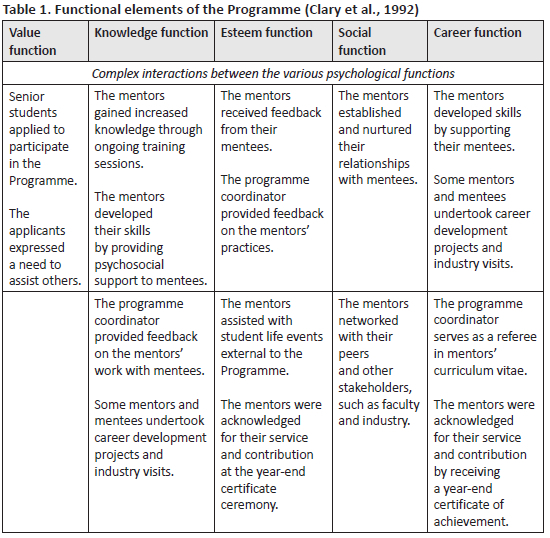
Examining the Programme within Clary et al.'s (1992) framework allowed for uncovering the critical functional elements and challenges. Table 1 presents an outline of the critical Programme elements for satisfying the mentors' motivational needs (Clary et al., 1992).
Table 1 shows that the Programme can fulfil the motivational needs of volunteer peer mentors. Altruistic helping behaviour is typically self-initiated and undertaken without expectation of external reward (Phillip & Phillip, 2011). The Programme's changed remuneration structure suggests that volunteer mentoring was not self-initiated and that not all students who applied to mentor first-year students had strong altruistic needs. Altruism is generally considered "the most obvious motive for acting for the common good" (Phillips & Phillips, 2011, p. 25). Self-service or egoism is central to rational economic decision-making and contradicts selfless behaviour or altruism. The tension between egoistic and altruistic needs could have motivated some applicants to the Programme to disguise egoism as altruism during the recruitment and selection processes. This dynamic underscores the need for intentionally recruiting and selecting peer mentors with specific characteristics (Clary et al., 1992; McConney & Fourie-Malherbe, 2022). The focus group study findings are presented next.
Focus group study
The enhancement function was the most important motivator for the participants who volunteered at the UoTSA, followed by the value, understanding, career, and social functions (in that order). The participants regarded the protective function as unimportant, consistent with global and local research on volunteer motivation (Clary et al., 1992; Van den Berg et al., 2015). The participants' strongest motivators, enhancement, value and understanding, are now presented.
The enhancement function
The esteem enhancement function as the most important motivator for the UoTSA participants contradicts global research findings on volunteering, including studies on South African student volunteers (Chacón et al., 2017; Gage & Thapa, 2011; Grönlund et al., 2011; Van den Berg et al., 2015). This finding emphasised the participants' need for respect and appreciation. Esteem needs are fulfilled when volunteers participate in activities that make them feel important, wanted, and good about themselves (Clary et al., 1992). Maslow (Green, 2000) holds that esteem comprises both lower and higher needs. Respect, acknowledgement, and appreciation from others, as well as status and dignity, satisfy lower self-esteem needs.
On the contrary, feelings of confidence, competence, adequacy, achievement, mastery, independence, and freedom satisfy higher-esteem needs. The analysis revealed that the participants' lower esteem needs were unmet. The lack manifested when Participant 8 said, "[A]s we communicate with our lecturers, some of them tend to tell us that 'I see you as a student"'. Not being recognised by lecturers was interpreted as undervaluing the mentor role, suggesting an implicit loss of role status and self-worth. Likewise, Participant 3 indicated, "It would have been nice to be appreciated by the institution, [for them] to see how we help the first-year students, to see our work." A perceived lack of appreciation for the function of mentors is obvious. Lecturers or the institution's non-recognition of the peer mentor role contradicts Mawere et al.'s (2016) view of community building as essential to Africans' motivation. The participants' unsatisfied lower esteem needs may have contributed to unhappiness, discouragement, and inferiority, which could have manifested as low morale, disinterest and dropout. However, the satisfaction of higher esteem needs was apparent when Participant 1 said: "... if [first-year students] can trust me now to be their mentor, then it is an amazing feeling. I feel good about myself. I feel good about the things that I can do." Likewise, Participant 8 held that volunteerism is something that helped me ... [with] self-confidence, uplifting my self-esteem [and] my life satisfaction
Satisfaction of the participants' higher esteem needs may have resulted in feelings of self-worth, worthiness, strength, capability, and being valuable and necessary in the world (Maslow, 1943, as cited in Green, 2000). Higher needs fulfilment generated a sense of confidence, competence and self-respect in most participants. Self-respect is regarded as a healthy ego state or identity because it is more difficult to lose than to lose esteem from others (Boeree, 2006; Green, 2000). Meeting the participants' higher esteem needs influenced their willingness to keep volunteering despite the challenging programme conditions and discouraging experiences at the UoTSA.
The value function
The second most important function for most participants was the value or altruistic function, which was consistent with the findings of Van den Berg et al. (2015). Participant 2 said, "I just love helping. I just love being there for others. I just love seeing others prosper in whatever they do", demonstrating concern for first-year students. However, others, like Participant 5, held different views:
I knew from the start that we were volunteering, but I did expect we would get a little bit of something to support ourselves. I had a kind of expectation [regarding] finances because previous mentors told us there is a certain [amount of] money.
Similarly, Participant 2 stated that mentors' desire for stipends increased because they knew "Friends and cousins at other universities are getting stipends and all those things, so they are no longer into volunteering [..]. It is very concerning." These views reflected the participants' normative tension about volunteering as mentors (Clary et al., 1992). In a market world, money is a valued commodity, and work is not for free. Therefore, "the price of something or someone's efforts is a proof of value, [which] is expressed in money" (Kampen et al., 2019, p. 994). Hence, volunteering in a market world has reduced the value of the mentor role at the UoTSA, implying a loss of role status or prestige and self-worth.
Moreover, scholars argue that volunteer motivations based on esteem, understanding, career, and social functions are egoistic (Clary et al., 1992; Van den Berg et al., 2015). They contend that egoistic reasons drive volunteers to enhance their psychological self, increase their knowledge and skills, and enrich their experiences and CVs. As a result, participants may have been motivated to volunteer by egoistic reasons. Nevertheless, because people are complex creatures, altruistic and egoistic motivations for volunteering are often not mutually exclusive (Van den Berg et al., 2015). Participant 3 demonstrated this coexistence of such seemingly contradictory motivations: "When you get into the Programme, you already know that you are doing it for free, doing it voluntarily, doing it for others, and you are doing it for yourself."
Furthermore, there were indications that most participants' perspectives on volunteering may have changed. Participant 5 mentioned, "You do not always get what you wish for, but you sometimes get enough of what you want to get out of whatever you do." This statement underscored that sufficient need satisfaction was required to continue volunteer behaviour (Clary et al., 1992). Kampen et al. (2019, p. 1001) regard volunteer actions as a spontaneous and internalised feeling of passion, suggesting that inspired volunteer actions are motivated by "a desire to create, and certainly not by money".
The understanding function
Participant 5 demonstrated that the understanding function is the third most important motivator for participants, stating that being a mentor "gave us nice networking skills and experience". Similarly, Participant 2 mentioned, "I wanted to get better communication skills and some other skills, and I improved a lot." The understanding function contrasts with the findings of previous studies on African youth and student volunteers, where the understanding function is regarded as the strongest motivator for volunteering (Patel et al., 2007; Van den Berg et al., 2015). In South Africa, where youth unemployment is higher than the national average and economic opportunity is limited, skills development and gaining experience are promoted to enhance employability (Dhliwayo, 2023). This difference is of interest and calls for further investigation.
Discussion
The functional elements of the Programme that contributed to the satisfaction of the participants' motivational and psychological needs were identified. Examining the Programme's design elements uncovered greater emphasis on the knowledge and career functions and less on the value or altruistic function (Clary et al., 1992). Tension between differing values (e.g. altruism versus egoism) was indicated. The focus group results indicated that self-enhancement or esteem was the strongest motivator for the participants, followed by value expression or altruism and a desire to increase their knowledge and skills. The motivators reported by the participants contradict the findings of global and local research studies on student volunteering.
Global self-esteem is an individual's overall feeling of personal worth (Schmitt & Allik, 2005). Social self-esteem is a dimension of global self-esteem derived from how individuals perceive themselves concerning other people and incorporate those views into their self-concept (Terblanche et al., 2020). The way peer mentors are handled by lecturers, or how contextual factors impact their self-worth, is significant. Therefore, paying attention to mentor-lecturer interactions is necessary to promote mentors' self-esteem and sustained mentoring activities. Similarly, it is crucial to consider the influence of contextual factors (e.g. market-driven ideologies, structural disposition of the Programme and institutional expectation of altruistic behaviour) on mentors' self-worth.
Another important finding was that despite the challenging programme conditions, the volunteer peer mentor experience strengthened most participants' healthy ego functioning, as evidenced by their insights, readiness to adopt new ideas, acceptance of change, compassion for their mentees, self-directedness, purpose, increased agency and self-esteem. Needs fulfilment culminates into self-realisation, inner potential, growth and meaning (Maslow, 1943, as cited in Green, 2000). Seeking meaning is essential to identity development processes (Van der Walt, 2019). The participants' healthy ego functioning, or identity, contributed to a meaningful peer mentor experience. Meeting most participants' motivational needs could have been critical to their continued volunteering efforts. Mentor needs should therefore be considered when recruiting, selecting, and designing mentorship programmes and remuneration structures.
These findings serve as a basis for developing strategies and interventions that can be implemented in similar programmes and universities. To encourage sustained mentoring efforts, student affairs practitioners may consider the following recommendations:
• Increase advocacy for the Programme by developing focused marketing strategies that require faculty, mentors and first-year students to understand the Programme's goals and benefits better.
• During the recruitment and implementation stages, highlight aspects of the Programme designed to meet mentors' motivational and psychological needs. Intentionally select mentors to enhance the Programme goals (Clary et al., 1992; McConney & Fourie-Malherbe, 2022).
• Meet the mentors' need for incentives and rewards (both symbolic and material) per the Programme goals and develop an affordable incentive and reward structure based on their needs (e.g. data contracts, identifying attire, mentor
of the year award, and monetary incentives throughout the service period). Appreciation letters from faculty, programme heads and first-year students may also be considered incentives.
• Interventions should be developed to enhance peer mentor purpose and meaning in life, which may indirectly strengthen their ego and aid identity development and perseverance (Van der Walt, 2019).
Limitations and future directions
There were some limitations to the current data. From the viewpoint of a single university, the results offer a partial understanding of student motivators for volunteering as peer mentors. Different qualitative conclusions could have been reached if the study sample had included volunteer peer mentors who had left the Programme. The Programme coordinator assisted with the fieldwork, which could have unintentionally influenced the participants' responses, for example, by introducing social desirability bias and the study participants giving more socially acceptable responses than their true beliefs or actions.
Mawere et al. (2016) critiqued the application of Maslow's Western-centric theory in some African contexts based on contrasting motivational ideologies (e.g. individualistic versus collectivistic cultures). The applicability of Maslow's theory to student populations at UoTSA needs further investigation. Contextual factors (e.g. neoliberalism, market ideology, university as a market, social justice, socio-economic development, and advancement) were not explored and could have impacted students' ideological motivations and volunteer behaviour. A study exploring the motivational ideologies of contemporary HE students has the potential to contextualise their views on volunteerism further.
Conclusion
This study offered insights into student motivations in volunteering as peer mentors in the Programme at UoTSA and promoting sustained participation in mentoring activities. The strongest motivators were enhancing esteem, value expression, and desire to develop knowledge and skills. The participants' sustained mentoring efforts were encouraged by the partial fulfilment of their motivational needs, growth, self-worth, and finding meaning as volunteer peer mentors.
The complexity of peer mentorship programmes, mentors' needs, and the influence of context on mentor behaviours and programme implementation in a market-driven world were highlighted. The findings can serve as a beacon for enhancing peer mentorship programme design, marketing, selection, engagement and reward strategies across various university landscapes. Meeting peer mentors' needs - either altruistic, egoistic or both - can result in increased efforts and benefits not only for them as volunteers but also for first-year students and the university itself. Therefore, student affairs practitioners should assist peer mentors in developing their knowledge, skills, attitudes, ego strength, and identity to persevere, grow, and find purpose and meaning in circumstances of plenty or scarcity.
Ethics statement
Ethics approval for this study was obtained from the Vaal University of Technology's Central Research Ethics Committee (Human). Reference number: CREC 24/08/2021-001.
Potential conflict of interests
There is no known conflict of interests for the author to declare.
Funding acknowledgementThe author declares that no financial support was received for the research underpinning this article, its development, authorship, or publication.
References
Boeree, C. G. (2006). Personality theories: Abraham Maslow. Shippensburg University - CGBoer. https://webspace.ship.edu/cgboer/Maslow.pdf
Boughey, C., & McKenna, S. (2021). Understanding higher education: Alternative perspectives. African Minds.
Acknowledgements
I acknowledge Mothusi Samosamo, who assisted with the project's fieldwork.
Literature review
- Chacón, F., Gutiérrez, G., Sauto, V., Vecina, M. L., & Pérez, A. (2017). Volunteer functions inventory: A systematic review. Psicothema, 29(3), 303-316. https://doi.org/10.7334/psicothema2016.371
- Clary, E. G., Snyder, M., & Ridge, R. (1992). Volunteers' motivations: A functional strategy for the recruitment, placement, and retention of volunteers. Non-Profit Management, 2(4), 333-350. https://ellisarchive.org/sites/default/files/2019-07/Contract_20190726_0001_0.pdf
- Creswell, J. W., & Poth, C. N. (2018). Qualitative inquiry and research design: Choosing among five approaches (4th ed.). SAGE.
- Dhliwayo, R. (2023, September 13). Harnessing the employability of South Africa's youth. United Nations Development Program. https://www.undp.org/south-africa/blog/harnessing-employability-south-africas-youth
- Green, C. D. (2000, August). A theory of human motivation: A. H. Maslow. Classics in the History of Psychology. https://psychclassics.yorku.ca/Maslow/motivation.htm
- Hawksley, C., & Georgeou, N. (2019). Gramsci 'makes a difference': Volunteering, neoliberal 'common sense', and the sustainable development goals. Third Sector Review, 25(2), 27-56. https://search.informit.org/doi/10.3316/ielapa.929306512882392
- Hennink, M. M., Kaiser, B. N., & Weber, M. B. (2019). What influences saturation? Estimating sample sizes in focus group research. Qualitative Health Research, 29(10), 1483-1496.
- Joseph, B. M., & Carolissen, R. (2019). Citizenship: A core motive for South African university student volunteers. Education, Citizenship and Social Justice, 14(3), 225-240.
- Kampen, T., Veldboer, L., & Kleinhans, R. (2019). The obligation to volunteer as fair reciprocity? Welfare recipients' perceptions of giving back to society. Voluntas, 30, 991-1005.
- Kleinheksel, A. J., Rockich-Winston, N., Tawfik, H., & Wyatt, T. R. (2020). Demystifying content analysis. American Journal of Pharmaceutical Education, 84(1), 127-137.
- Lunsford, L. G., Crisp, G., Dolan, E. L., & Wuetherick, B. (2017). Mentoring in higher education. The SAGE Handbook of Mentoring, 20, 316-334.
- Mawere, M., Mubaya, T. R., van Reisen, M., & van Stam, G. (2016). Maslow's theory of human motivation and its deep roots in individualism: Interrogating Maslow's applicability in Africa. In M. Mawere & A. Nhemachena (Eds.), Theory, knowledge, development and politics: What role for the academy in the sustainability of Africa? (pp. 55-72). Langaa RPCIG.
- McConney, A., & Fourie-Malherbe, M. (2022). Facilitating first-year student adjustment: Towards a model for intentional peer mentoring. Journal of Student Affairs in Africa, 10(2), 163-177. https://doi.org/10.24085/jsaa.v10i2.3781
-
Noltemeyer, A., James, A.G., Bush, K., Bergen, D., Barrios, V., & Patton, J. (2021). The relationship between deficiency needs and growth needs: The continuing investigation of Maslow's theory. Child & Youth Services, 42(1), 24-42. DOI: 10.1080/0145935X.2020.1818558.
» https://doi.org/10.1080/0145935X.2020.1818558 - Nyimbili, F., & Nyimbili, L. (2024). Types of purposive sampling techniques with their examples and application in qualitative research studies. British Journal of Multidisciplinary and Advanced Studies: English Language, Teaching, Literature, Linguistics & Communication, 5(1), 90-99. https://doi.org/10.37745/bjmas.2022.0419
- Patel, L., Perold, H., Mohamed, S. E., & Carapinha, R. (2007). Five-country study on service and volunteering in Southern Africa: CSD research report No. 07-19. Washington University in St. Louis. https://openscholarship.wustl.edu/cgi/viewcontent.cgi?article=1816&context=csd_research
- Phillips, L., & Phillips, M. (2011). Altruism, egoism, or something else: Rewarding volunteers effectively and affordably. Southern Business Review, 36(1), 23-35. https://digitalcommons.georgiasouthern.edu/sbr/vol36/iss1/5
- Phillips, R., Seaborne, K., Goldsmith, A., Curtis, N., Davies, A., Haynes, W., McEnroe, R., Murphy, N., O'Neill, L., Pacey, C., Walker, E., & Wordley, E. (2022). Student loneliness through the pandemic: How, why and where? The Geographical Journal, 188, 277-293. https://rgs-ibg.onlinelibrary.wiley.com/doi/pdf/10.1111/geoj.12438
-
Pokhrel, S., & Chhetri, R. (2021). A literature review on impact of COVID-19 pandemic on teaching and learning. Higher Education for the Future, 8(1), 133-141. DOI: 10.1177/2347631120983481.
» https://doi.org/10.1177/2347631120983481 - Rojas, M., Méndez, A., & Watkins-Fassler, K. (2023). The hierarchy of needs empirical examination of Maslow's theory and lessons for development. World Development, 165, 106185. https://doi.org/10.1016/j.worlddev.2023.106185
- Schmitt, D. P., & Allik, J. (2005). Simultaneous administration of the Rosenberg Self-Esteem Scale in 53 nations: Exploring the universal and culture-specific features of global self-esteem. Journal of Personality and Social Psychology, 89(4), 623-642. https://psycnet.apa.org/doi/10.1037/0022-3514.89.4.623
- Schreier, M. (2012). Qualitative content analysis in practice. SAGE.
- Swart, A. J., Coughlan, L., & Joannou, N. (2019). Student perspectives of a peer mentorship programme introduced at a university of technology in South Africa. Global Journal of Engineering Education, 21(3), 220-226. http://ir.cut.ac.za/bitstream/handle/11462/2175/J138%20%20%20AJ%20Swart%20et.al%20-%20GJEE%20-%20Mentorship.pdf?sequence=1
-
Terblanche, W., Fakir, D., Chinyamurindi, W., & Mishi, S. (2021). Impact of self-esteem and student-and-lecturer interaction on academic performance in a chartered accounting programme. Journal of Further and Higher Education, 45(4), 464-480. DOI: 10.1080/0309877X.2020.1781801.
» https://doi.org/10.1080/0309877X.2020.1781801 - UoTSA's University Capacity Development Program 2024 - 2026 Funding proposal. (2024).
- Van der Walt, C. (2019). The relationships between first-year students' sense of purpose and meaning in life, mental health and academic performance. Journal of Student Affairs in Africa, 7(2), 109121. https://doi.org/10.24085/jsaa.v7i2.3828
Accepted 28 October 2024
Published 28 July 2025