"It's not always neat": Psychological resources in the messy reality of university life
Abstract
This qualitative study examined how first-year university students perceive the roles of psychological resources (resilience, hope, and optimism) in relation to student success (academic performance and well-being). Data were collected through semi-structured interviews with 13 first-year university students (7 female, 6 male, age range: 18-25). The analysis revealed that resilience played a crucial role in promoting well-being and managing emotional stressors. Students referred to the relevance of hope as a driving force for them to persist in pursuing long-term academic goals. Additionally, hope, especially in the form of critical hope, sustained motivation by combining realistic acknowledgement of systemic challenges with a forward-looking commitment to personal and collective transformation. Optimism helped students reframe setbacks positively and maintain confidence in their long-term goals. The data indicated that these psychological resources form an interdependent ecosystem that students draw on to navigate the complexity of university life. The study emphasises not only the individual importance of these constructs but also their integrative and justice-oriented role in promoting student success. Findings support the need for holistic, contextually responsive student development and support services.
First-year university students; hope; optimism; psychological resources; resilience; student development and support (SDS)
Abstract
Hierdie kwalitatiewe studie het ondersoek ingestel na hoe eerstejaar-universiteitstudente die rolle van sielkundige hulpbronne (veerkragtigheid, hoop en optimisme) beskou in verband met studentukses (akademiese prestasie en welstand). Data is ingesamel deur middel van semi-gestruktureerde onderhoude met 13 eerstejaarstudente aan die universiteit (7 vroulik, 6 manlik, ouderdom tussen 18 en 25 jaar). Die analise het getoon dat veerkragtigheid 'n deurslaggewende rol gespeel het in die bevordering van welstand en die hantering van emosionele stresfaktore. Studente het verwys na die belangrikheid van hoop as 'n dryfkrag om volharding in die strewe na langtermyn-akademiese doelwitte te ondersteun. Daarbenewens het hoop, veral in die vorm van kritiese hoop, motivering volgehou deur 'n realistiese erkenning van sistemiese uitdagings te kombineer met 'n toekomsgerigte verbintenis tot persoonlike en kollektiewe transformasie. Optimisme het studente gehelp om terugslae positief te herinterpreteer en selfvertroue in hul langtermyn-doelwitte te behou. Die data het aangedui dat hierdie sielkundige hulpbronne 'n onderling afhanklike ekosisteem vorm waarop studente staatmaak om die kompleksiteit van universiteitslewe te navigeer. Die studie beklemtoon nie net die individuele belang van hierdie konstrukte nie, maar ook hul geïntegreerde en geregtigheidsgerigte rol in die bevordering van studentukses. Bevindinge ondersteun die behoefte aan holistiese, konteks-sensitiewe studentontwikkeling en ondersteuningsdienste.
Eerstejaar-universiteitstudente; hoop; optimisme; sielkundige hulpbronne; veerkragtigheid; studentontwikkeling en -ondersteuning (SDS)
Introduction
Transitioning from high school to university is a crucial developmental milestone and achievement for young people (Arnett, 2014; Cabras & Mondo, 2018; Cameron & Rideout, 2020). Researchers agree that this transition is particularly stressful because first-year university students must navigate multiple demands, including adapting to a new academic environment, establishing new interpersonal relationships, and managing greater academic workloads (Amirkhan et al., 2023; Gause et al., 2024). Schlossberg and colleagues' transition theory provides a valuable framework for understanding this adjustment period by emphasising how individuals experience, interpret, and cope with transitions (Schlossberg, 1984; Schlossberg et al., 1995).
According to Schlossberg (1984), the transition to university can be categorised as an anticipated transition; however, its impact varies greatly depending on the student (self), their situation, support, and strategies (Schlossberg et al., 1995). Among these, the self plays a crucial role, encompassing psychological resources such as personal resilience, hope, and an optimistic belief in one's ability to succeed. Previous research has highlighted the positive associations between psychological resources, such as resilience, hope, and optimism, and student success (Xiang et al., 2024; Yýldýrým et al., 2022). The concept of student success encompasses not only academic achievement but also personal well-being, life satisfaction, and the development of self-regulatory capacities (O'Shea & Delahunty, 2018; Sinclair, 2019; van der Zanden et al., 2018).
Given the inherent challenges associated with the transition into and challenges during the higher education journey, student development and support (SDS) services provide guidance and support relating to academic and psychological challenges (Blokland & Kirkcaldy, 2022; Gause et al., 2024; Pascarella & Terenzini, 2005). These services, which are included in the overarching framework of student affairs, are particularly relevant in South Africa, where access to higher education has transformative potential, especially for students from historically marginalised communities (Eloff & Graham, 2020; Luescher et al., 2023; Lewin & Mawoyo, 2014).
SDS services help students develop and cultivate, inter alia, psychological resources such as resilience, hope, and optimism, which are essential for navigating university life (Guse & Vermaak, 2011; Maniram, 2022; Van Wyk et al., 2022). By fostering psychological resources and offering support through various avenues, SDS services help students manage stressors, meet academic demands, and develop self-efficacy, which are critical for ensuring a successful university experience (Guse & Vermaak, 2011; Maniram, 2022; Van Wyk et al., 2022).
However, despite the growing body of research highlighting the importance of resilience, hope, and optimism, much of the existing work has primarily utilised quantitative approaches (Carpenter & Peña, 2017; Mlotshwa, 2019; Sabodogo, 2024). While valuable, quantitative methods may not fully capture students' lived experiences of navigating university life (Sabouripour et al., 2021). Moreover, limited attention has been given to understanding these psychological resources within the diverse South African higher education context (Cherrington & De Lange, 2016; Mason, 2024). Addressing these gaps is crucial for supporting South African university students. The concepts of resilience, hope and optimism are discussed in the following section.
Psychological resources for student success: Resilience, hope and optimism
A growing body of research has indicated that resilience, hope, and optimism are important psychological factors influencing student achievement (Kotzé & Kleynhans, 2013; Rashid et al., 2024; Van Wyk et al., 2022). Resilience, which refers to the capacity to adapt and flourish despite adversity, provides students with essential coping strategies to navigate the inevitable obstacles and stressors encountered throughout their academic pursuits (Gause et al., 2024; Leon, 2021). Students demonstrating resilience can recover from setbacks, such as academic pressures, acclimate to the novel university setting, and sustain well-being amidst the pressures associated with academic life (Kotzé & Kleynhans, 2013; Maniram, 2022). Baxter Magolda's (2001, 2008) self-authorship theory reiterates these sentiments, indicating that students who cultivate psychological resources, such as internal confidence and self-authored beliefs, are more likely to successfully navigate transitions by viewing difficulties as opportunities for development and growth. In this regard, Richardson's (2002) resilience theory emphasises the role of adversity in shaping personal growth, suggesting that resilient students who develop hope and optimism as protective factors are better equipped to overcome academic and social challenges.
Hope, a motivational drive that encourages students to establish and pursue long-term goals, has been linked to positive adjustment to the university context (Mason, 2020; Zhu et al., 2025). According to Lopez (2013) and Snyder (2002), hope comprises two interlinked components: (i) pathways thinking (finding and believing in possible ways to achieve one's goals) and (ii) agency (believing one can make changes and move closer to their objectives). Additionally, hope includes envisioning a favourable future, which can promote students' capacities to remain focused and persevere, even when facing challenges (Guse & Vermaak, 2011; Snyder, 2002). Peters et al. (2010) emphasise the importance of a future vision that pulls students toward their yet-to-be-actualised potentialities. Hence, a vision of a positive future can motivate students to approach present-day challenges constructively (Mason, 2024). Whereas research has highlighted the importance of hope-based goal setting and motivation among South African university students, it can also be conceptualised beyond individualised strategies, particularly through the lens of critical hope (Freire, 1994; Giroux, 2018).
The concept of critical hope refers to a grounded optimism that recognises systemic barriers to success but maintains a commitment to transformation through reflective action (Bozalek et al., 2014). Critical hope is particularly relevant in the South African higher education context, where socio-economic inequities remain pervasive. Building on this, critical hope empowers students not only to adapt to adversity but also to interrogate and challenge the structures that perpetuate educational disadvantage (Giroux, 2018). It cultivates a sense of collective agency, encouraging students and educators alike to engage in transformative practices that reimagine what equitable and inclusive education can look like (Grain & Lund, 2018). In doing so, critical hope becomes both a psychological resource and a sociopolitical stance that sustains resilience without denying the realities of structural injustice (Cherrington & De Lange, 2016).
Optimism, intrinsically linked to resilience and hope, entails sustaining a constructive perspective and belief in one's potential to succeed (Cabras & Mondo, 2018; Guardino et al., 2023). Students who report higher levels of optimism are more likely to approach rather than avoid academic challenges, thereby mitigating stressors and enhancing student success (Rand et al., 2011). Empirical studies have demonstrated that optimism can act as a buffer against stress, facilitate coping, and promote psychological well-being, all of which are critical for sustaining academic performance during periods of heightened stress (Lai et al., 2024; Luo et al., 2023; Nes & Segerstrom, 2006). However, Osche (2012) warns that overly optimistic students may overpredict their academic performance, which could prove maladaptive in the academic context. Other researchers have noted that realistic optimism among students can enhance their success (Mason, 2024; Rand, 2011).
Viewed through the student development theory lenses of Schlossberg's (1984) transition theory, Richarson's (2002) resilience theory, and Baxter Magolda's (2001, 2008) self-authorship theory, resilience, hope, and optimism serve as critical psychological assets that support students in navigating the challenges they could encounter in the higher education context. Collectively, these theories provide a holistic framework for understanding how psychological resources influence student success. The literature also emphasises that resilience, hope, and optimism are adaptive traits that promote independent identity development, academic persistence, and long-term well-being (Leon, 2021; Lopez, 2013; Maniram, 2022). However, there is a paucity of qualitative research that captures how students themselves perceive and make meaning of these psychological resources, particularly within the unique socio-educational landscape of South Africa (Carpenter & Peña, 2017; Mason, 2024; Sabouripour et al., 2021).
The present research
Transitioning from secondary education to university is an important developmental milestone that presents students with academic, social, and personal challenges (Cameron & Rideout, 2020; Lewin & Mawoyo, 2014; Zhu et al., 2025). As students acclimate to the university environment, they encounter a range of additional stressors that can impact student success (Eloff & Graham, 2020; Scott, 2018). In response to these challenges, SDS services aim to help students enhance their internal psychological resources, such as resilience, hope, and optimism, to promote academic success and overall well-being.
While the importance of resilience, hope, and optimism for student success has been widely acknowledged (Guse & Vermaak, 2011; Mason, 2024; Snyder, 2002), much of the existing research is dominated by quantitative research designs (Carpenter & Peña, 2017; Sabouripour et al., 2021). Although valuable, these approaches often fail to capture the nuanced, subjective realities of students' lived experiences (Colla et al., 2022; Mason, 2020). In particular, the role of psychological resources from students' perspectives remains underexplored within the South African higher education context, where structural inequalities and unique socio-cultural factors may shape these experiences in distinct ways (Cherrington & De Lange, 2016; Marsay, 2020).
This study aimed to address these gaps by examining how first-year university students perceive and experience resilience, hope, and optimism in relation to their academic success. The study was guided by the following research question: How do first-year university students perceive the roles of resilience, optimism, and hope in student success?
Research design and methodology
Building on the need to deepen understanding of how students qualitatively experience resilience, hope, and optimism, this study adopted interpretative phenomenological analysis (IPA) as the guiding methodological framework (Brocki & Wearden, 2016). IPA is particularly suited to investigating how students interpret, apply, and develop psychological resources in the context of their academic and personal transitions and experiences. A phenomenological approach enables an in-depth, idiographic examination of participants' subjective experiences, resulting in a rich, participant-driven exploration of the psychological factors influencing university adaptation (Creswell & Poth, 2018).
Participants and setting
Participants were recruited through open invitations extended to students who had attended a psycho-educational program to support first-year university students. A total of 13 students (7 female, 6 male; age range = 18-25) volunteered to participate. The study was conducted at a South African metropolitan university, which enrols approximately 40,000 students annually, half of whom are first-year students. This setting was selected due to its diverse student population and the unique challenges students face within the South African university context.
Data collection and procedures
Data were collected using semi-structured interviews, each lasting between 30 and 45 minutes. The following five questions guided these interviews:
1. What do resilience, hope, and optimism mean for you?
2. How would you describe the role of resilience, hope, and optimism in your academic life?
3. Can you share an experience where resilience, hope, and optimism helped you at university?
4. Reflecting on your first year of studies, how have these psychological resources impacted your academic performance and well-being?
5. What advice would you give incoming first-year students about managing their well-being and academic success?
Various prompts (e.g. "Can you provide an example to illustrate that point?") and invitations to share additional information (e.g. "Please tell me more about that experience.") were used to gather further feedback from participants. The semi-structured format allowed for a flexible yet focused exploration of the key themes. Participants could freely express their thoughts and experiences while the interviewer guided the discussion to cover the key topics. All interviews were audio-recorded with participants' informed consent and transcribed verbatim to ensure accuracy in data representation. The research ethics committee of the university where the data were collected approved the study (REC2020/08/002).
Data analysis and trustworthiness
The data were analysed using thematic analysis, following the steps outlined by Henning et al. (2011). First, the researcher immersed himself in the data by reading and re-reading the transcripts and engaging in qualitative memoing regarding initial impressions. Second, the transcripts were systematically coded to identify significant data features relevant to the research questions. This process entailed line-by-line and descriptive coding based on participants' phrasing. These initial codes were then grouped into clusters of focused codes based on recurring ideas. Third, the focused codes were collated into potential themes, bringing related ideas together into broader categories. The identified themes were reviewed and refined to ensure they accurately captured the intended meaning and were relevant to the research objectives. Fourth, each theme was assigned clear definitions and names, encapsulating their essence and relevance. The final step involved writing a detailed account and integrating the themes into a coherent narrative.
In line with the interpretive nature of this study, it is important to note that, although the analysis was grounded in participants' voices, the development of themes required active participation from the researcher (Cresswell & Poth, 2018). As such, the researcher engaged with the data, the research questions, and theoretical framing to identify and report on patterns that were most consistently present in the data. Henning et al. (2011) explain that such a process ultimately requires disciplined subjectivity, analytical reasoning and interpretive judgement. Hence, the qualitative interpretation was thoughtfully developed by the researcher in dialogue with participants.
Several strategies were adopted to ensure trustworthiness (Braun & Clarke, 2006). First, the participants were requested to review and comment on the accuracy of the transcripts and the interpretations of their data, thereby enhancing the credibility of the findings. Second, descriptions of the context and participants' experiences were provided to allow readers to assess the transferability of the findings to other settings. Third, peer debriefing and discussions were conducted to refine the analysis and ensure that the findings were credible and well-supported by the data. Finally, the qualitative interpretation was evaluated, and a discussion was conducted in relation to a literature check (Braun & Clarke, 2006).
Findings
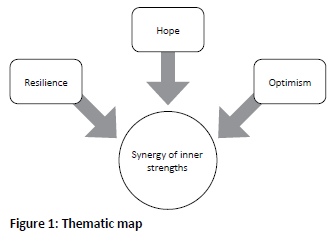
Four key themes emerged following the qualitative analysis, namely (1) resilience as the path to maintaining balance, (2) hope as the fuel for motivation, (3) navigating academic challenges with optimism, and (4) the synergy of inner strengths. Table 1, a coding summary, summarises the developed themes, providing definitions, identified sub-themes, key supporting quotes, and associated theoretical frameworks.
In addition to the coding summary presented above, a thematic map (Figure 1) was developed to illustrate the interrelationships among the key themes.
The thematic map presented in Figure 1 illustrates the interrelationship between the three key psychological strengths - resilience, hope, and optimism - and their integration into a central theme: the synergy of inner strengths. Each theme contributes dynamically to this unifying construct, highlighting how students draw on multiple psychological resources to adapt, persist, and thrive within the often complex and unpredictable university environment. The qualitative themes are now discussed. The referencing system used to attribute the verbatim quotes in parentheses denotes participant numbers (e.g. Participant 1), age (e.g. 20, indicating 20 years of age), and sex (male or female).
Resilience as the path to maintaining balance
Resilience emerged as a critical factor in helping first-year university students maintain their mental well-being amidst the stressors associated with university life. This theme highlights how students utilise resilience to cope with challenges, recover from setbacks, and adapt to new environments. Three sub-themes emerged, namely (1) adapting to change, (2) recovering from poor grades and (3) emotional coping strategies.
Adapting to change
Students mentioned the difficulties they experienced adjusting to the university context. Participant 4, a 20-year-old female, noted that "the change from school to university was big. There were emotional challenges, finances were uncertain, I didn't know people or have any friends." Participant 8, an 18-year-old male, added, "academics were tough, it was difficult to understand how to study and deal with all the new experiences ... that was where resilience was important. I was resilient because of the strength not to give up and keep going when things were very hard." As a follow-up to the student's response, the question was posed "How did the strength of not giving up play out for you in the university context?" Participant 8 responded by explaining that strength was not linear but cyclical: "there were times I felt defeated . I knew I couldn't give up on this chance to be here. It was me picking myself up again and again. When I think about it, learning from failure made me stronger" (18, male). This cyclical process of experiencing ongoing challenges reflects Richardson's (2002) concept of resilient reintegration. Thus, students not only return to baseline functioning after disruption but can also emerge stronger through the use of intentional coping strategies and meaning-making (Mlotshwa, 2019). This sentiment was also expressed by others, for example Participant 10 (23, male) explained "I tried to have plans ready for everything, but sometimes you need to be strong in the moment and make a plan ... you grow from those times that you fail at something ... failure is important to grow as a person".
Students generally regarded resilience as the ability to adapt to changes effectively, enabling them to manage the stress associated with leaving home, making new friends, and facing increased academic demands. They also agreed that resilience was an iterative process during which they were challenged and had to seek out resources ("Connecting to the tutors was a source of strength for me" (Participant 9, 18, male)) and focus relevant priorities ("I was lost at first, but I learned to adapt by focusing on small wins, like getting to know my classmates and getting used to the workload" (Participant 10, 23, male)).
Recovering from poor grades
Academic setbacks, such as receiving lower-than-expected grades, were common and cyclical challenges that tested students' resilience. Some students reported such setbacks as opportunities for growth ("That first maths test was difficult, but it forced me to get serious and spend more time in front of my books" (Participant 12, 19, male)). In contrast, others struggled to deal with the emotional demands associated with poor grades ("I often felt like giving up. When you study and still don't pass, it isn't easy to be positive. Even now, I think I have this fear of failing, which affects me negatively" (Participant 6, 18, female)). The data showed that students' inclinations to deal resiliently with challenges, such as poor grades, were critical in remaining engaged in their academic studies. In this regard, a student noted that poor grades in her first test week "forced me to reassess how I studied, I seeked help, and could then bounce back and get better marks in the second test week" (Participant 5, 25, female). These qualitative opinions are consistent with earlier studies that pointed to the importance of resilience as a psychological factor in promoting student success (Kotzé & Kleynhans, 2013; Van Wyk et al., 2022).
Emotional coping strategies
Resilience also affected how students managed their emotional well-being. They discussed various coping strategies, such as seeking social support, maintaining a balanced routine, and participating in university activities, which helped them stay grounded despite the pressures of university life. For example, a student mentioned, "When I feel overwhelmed, I take time to talk to my residence friends. It helps me to deal with the worries I have" (Participant 2, 19, female). Another student indicated that she learned "dealing with emotions is important in university ... I learned that you must accept the stress and deal with it, else it keeps affecting your sanity" (Participant 5, 25, female).
Recognising the importance of resilience can help staff working in SDS-related environments establish resources and create programs that enhance students' ability to cope with university-related stress. A critical step in this regard is to normalise the stressful nature of the university experience while reframing challenges as opportunities to engage constructively with various role players (Maniram, 2022; Van Wyk et al., 2022). Additionally, focusing on building resilience through various initiatives such as workshops, webinars, peer support groups, and counselling services, these units can support students in enhancing the quality of their overall university experience (Blokland & Kirkcaldy, 2022).
Hope as a motivational driver for long-term goals
Hope emerged as an important motivational factor for first-year university students, helping them focus on their long-term academic and career aspirations. The theme is explored through three sub-themes, highlighting how students' hope for future success drives their persistence and dedication, particularly when faced with immediate challenges or setbacks.
Future career aspirations
Many students linked their academic efforts directly to their hopes for future career success. Hope was described as a powerful motivator, pushing them to strive for academic excellence as this quote indicates: "Hope is believing you can achieve what you have set your mind to" (Participant 13, 20, male). Students expressed that envisioning a successful career also helped them maintain their drive, even during tough academic periods. One student remarked, "Whenever I feel like giving up, I remind myself of a better future" (Participant 8, 18, male). Participant 3 (18, female) echoed this sentiment by stating, "the hope to be better in the future, or to achieve my goals for my life, keeps me moving forward".
Persistence despite difficulties
The students' hope for future achievements often helped them persevere through immediate challenges, such as difficult courses or personal struggles. One student explained, "University can open doors for me. I know I must not give up ... hold on to that belief that I can do it" (Participant 11, 19, male). This hope was rooted in the belief that their efforts would eventually lead to success, no matter how difficult the journey. Another student shared, "It's not easy, but believing in a better future keeps me from quitting when things get tough" (Participant 13, 20, male). This qualitative interpretation aligns with Snyder's (2002) hope theory, which posits that students' persistence reflects both agentic beliefs and pathways through obstacles as they continue to reimagine and be motivated by a future vision.
Critical hope
In addition to serving a motivational role, hope was also referred to by students as a means of navigating hardship and systemic adversity. Participant 10 (23, male) explained that "the system is not fair ... funds are scarce and paying for nice things at university isn't always possible. The system is sometimes stacked against you, but you must play the cards you were dealt". Participant 8 (18, male) endorsed this insight, elaborating:
there is a history when you come to university. Your parents may struggle, and things are not fair for everyone. There are always challenges, like some have it easy and others have it difficult in life. That doesn't mean you must give up. But it is hard to have hope when there's lots of hardship.
These reflections align with critical hope, as they express both a recognition of difficulty and a refusal to surrender to despair. Furthermore, students' qualitative perspectives reflect a pedagogical orientation that acknowledges structural injustice while fostering the possibility for change (Bozalek et al., 2014; Freire, 1994). Rather than adopting naïve optimism, students articulated a grounded sense of purpose, what critical hope theorists refer to as educated hope, which is rooted in both awareness and action (Cherrington & De Lange, 2016; Giroux, 2018).
Navigating academic challenges with optimism
Students referred to the role of optimism in helping them persist through difficult academic situations. They described how maintaining a positive outlook kept them motivated, especially when facing challenging coursework or exams. This qualitative perspective is discussed in terms of three interlocking sub-themes.
Positive mindset during exams
The students emphasised that adopting a positive mindset during exams helped reduce anxiety and increase confidence. This mindset enabled them to approach exams with confidence, believing in their ability to succeed, which in turn improved their performance. One student mentioned, "Even when I felt unprepared, telling myself that I could do it made a big difference" (Participant 7, 18, female). In this regard, Seligman's concept of learned optimism emphasises that individuals who consciously adopt positive expectations tend to experience reduced anxiety and enhanced performance (Maier & Seligman, 2016). Similarly, Peters et al. (2010) found that visualising success fosters motivation and persistence. However, another student argued that realistic optimism is needed to succeed at university, as this quote indicates: "It's no good to daydream. You must do the work and understand that your mind and what you do must speak to each other" (Participant 9, 18, male). This student's reflection aligns with Osche's (2012) argument that being overly optimistic could be maladaptive within the academic milieu. A balance between optimistic beliefs and proactive effort is key to student success (Mason, 2024). Additionally, this observation is consistent with the awareness and action frame of reference espoused by critical hope theorists (Bozalek et al., 2014; Freire, 1994). Finally, these qualitative conceptions are consistent with Schlossberg (1984) and Schlossberg et al.'s (1995) emphasis on the relevance of psychological resources and strategic actions for navigating academic challenges effectively.
Belief in future success
Students' belief that their hard work would pay off in the long term was a strong motivator. They described how optimism about their future careers and academic goals kept them focused ("ßy focusing on my goal, I motivate myself to keep moving in the right direction" (Participant 10, 23, male)), even when faced with setbacks ("When studies and university becomes difficult, you must force yourself to be positive . focus on that goal that matters" (Participant 12, 19, male)). Viewed through a theoretical lens, students' perspectives on future success, which served as buffers against the immediate pressures of university life, echo Peters et al.'s (2010) argument that imagining a best possible future self increases positive expectancies and persistence. Consequently, long-term academic and career goals could serve as psychological capital, helping students cope with the immediate stressors of university life (Richardson, 2002).
Overcoming setbacks
Optimism played a crucial role in helping students recover from various stressors and setbacks. Instead of feeling defeated, students explained that setbacks were temporary challenges that could be overcome with effort and perseverance. They often reframed failures as learning opportunities, which helped them maintain their motivation and strive towards their goals. One participant shared, "When my first relationship at university didn't work out, I told myself that it was a learning experience instead of a failure" (Participant 5, 25, female). Other participants agreed ("I kept focussing on the next step . one step at a time" (Participant 11, 19, male)) and pointed to optimistic frames of mind when addressing various challenges, as this quote indicates: "When I moved into my university residence, I felt lonely. but I focused on the chance to make new friends" (Participant 2, 19, female)."
The aforementioned qualitative perspectives align with Cabras and Mondo's (2018) findings, which highlight that students with higher optimism are more likely to approach rather than avoid academic challenges. Additionally, the qualitative interpretation is consistent with Schlossberg's perspective, which posits that successful adaptation depends on students' ability to reframe challenges constructively (Schlossberg, 1984; Schlossberg et al., 1995).
The synergy of inner strengths
Whereas the three earlier themes delineated resilience, hope, and optimism as distinct psychological constructs, the student narratives also pointed to more intricate and dynamic interplay among these qualities. Students consistently described university life not as a neatly segmented experience requiring discrete skills at isolated times but as a fluid and "not always neat, but often messy or chaotic experience" (Participant 13, 20, male) wherein resilience, hope, and optimism merge into a singular, adaptive inner strength.
This fusion of psychological resources highlights a lived reality of complexity, which cannot necessarily be compartmentalised based on the mentioned qualities in isolation. Thus, there is a synergy between these inner strengths that could enhance students' capacities to deal with the stressful university experience.
Participants agreed that university life is "messy" - a term loaded with unpredictability, emotional turbulence, and uncertainty. One student mused, "Optimism and being resilient keep me going ... it keeps me pushing forward, no matter what comes my way ... it is also not just about being resilient ... it is about my strength, my religious conviction, friends, family, everything playing a role" (Participant 1, 18, female). Participant 13 (20, male) emphasised, "University is full of challenges ... finances, studies, personal things. It's not always neat. Having this strength means finding ways to keep going when things are tough".
These qualitative reflections illuminate how students do not experience resilience, hope, or optimism as isolated psychological resources but as interdependent and mutually reinforcing capacities mobilised simultaneously in response to evolving challenges. Furthermore, the sense of messiness reflects Schlossberg's (1984) emphasis on situational and personal variables in transition, particularly how the specific nature of the transition influences an individual's ability to adapt, their characteristics, available support systems, and the coping strategies they employ. Moreover, students' emphasis on internal psychological scaffolding reflects Baxter Magolda's (2001, 2008) concept of internalised self-authorship, which involves developing an internal framework of values and identity that shapes decisions and actions independently of external influence.
The interconnection of these constructs emerges not merely as an academic abstraction but as a lived necessity. In this regard, Participant 10 (23, male) poignantly reflected, "Hope reminds me that every step forward brings me closer to my dreams", suggesting that hope infuses both resilience and optimism with forward-looking energy. While hope emerged as a motivational driver, the narratives revealed a more profound insight among the participants: a belief in change despite adversity. For example, Participant 13's reflection ("It's not always neat, but often messy") signalled a grounded recognition of systemic complexity and personal hardship. These reflections line up with the framework of critical hope, where motivation is sustained by embracing, not ignoring, harsh realities (Bozalek et al., 2014).
In sum, the qualitative insights compels a reconceptualisation: supporting student success requires not the bolstering of individual traits in silos but the nurturing of an integrated psychological ecosystem within a complex world. In this model, resilience, hope, and optimism function as dynamic, interacting forces that collectively enable students to persist, adapt, and thrive in the face of the inevitable complexities of higher education. Therefore, recognising and fostering this synergistic complexity may be essential to designing interventions that authentically reflect the lived experiences of students navigating their academic journeys.
Discussion
Analysing first-year university students' experiences revealed a complex interplay between resilience, hope, and optimism. The first three qualitative themes - (i) navigating academic challenges with optimism, (ii) resilience as a key to mental health stability, and (iii) hope as a motivational driver for long-term goals - are interconnected and form a comprehensive framework for understanding how students cope with the demands of university life. Additionally, these themes are consistent with Schlossberg's transition theory, highlighting the salience of personal and social supports during life transitions (Schlossberg, 1984; Schlossberg et al., 1995). Students demonstrated an evolving "self" dimension, actively constructing meaning and drawing upon intrapersonal resources, coherent with Baxter Magolda's (2008) thesis.
With reference to psychological resources, resilience and optimism are closely linked, as both buffer students against the challenges they face. Optimism helps students maintain a positive mindset during exams and academic setbacks, fostering resilience by encouraging them to view failures as temporary and surmountable. This optimistic outlook is essential for resilience, as it empowers students to adapt to change, recover from poor grades, and implement effective emotional coping strategies. For example, a student's belief in future success, fueled by optimism, directly supports their ability to remain resilient in the face of academic pressures and personal challenges (Mason, 2024).
While resilience and optimism operate in the immediate context of academic and emotional challenges, hope is a sustaining force that drives long-term persistence and goal achievement. Hope motivates students to persevere through difficulties by focusing on their future aspirations and goals. This long-term vision, rooted in hope, reinforces students' resilience, helping them stay motivated and committed despite the ups and downs of university life. Hope, as described by Snyder (2002), and the internal decision-making processes noted by Baxter Magolda (2001) converge in students' self-authored motivations and identities, revealing how first-year students anchor long-term goals despite short-term disruptions (Leon, 2021).
The fourth theme suggests that resilience, hope, and optimism do not operate as discrete constructs. Instead, they converge into a dynamic, interdependent psychological ecosystem that students mobilise to navigate the inherent messiness of university life. Rather than sequentially deploying isolated traits, students experience these strengths as a cohesive and fluid inner resource that sustains adaptation, perseverance, and emotional resilience in the face of complexity. This integrated reality challenges reductionist approaches that seek to reinforce singular traits in isolation, giving credibility to the relevance of qualitative research in this area. The findings suggest cultivating a holistic psychological ecosystem wherein resilience scaffolds optimism, and hope infuses forward momentum. Recognising and fostering this synergistic interplay may prove relevant to supporting students in ways that authentically mirror their multifaceted, often turbulent lived experiences within the university context.
In summary, the findings emphasise that resilience, hope, and optimism should not be addressed in isolation but cultivated collectively as an interconnected psychological network. By reinforcing adaptability through resilience, sustaining long-term motivation through hope, and fostering a positive outlook through optimism, universities can more effectively support students in navigating the complexities and unpredictabilities inherent to academic life. Such a holistic approach acknowledges the dynamic, lived reality of student experiences, offering a more authentic and nuanced foundation for interventions that promote academic success and broader personal growth and well-being.
Implications
The findings from this study have several important implications for practice, particularly for SDS services in higher education institutions. These implications can guide the development of support programs to enhance first-year students' resilience, hope, and optimism, which are critical for their academic success and overall well-being. The following sections discuss these implications.
First, SDS services can focus on developing support programs that enhance resilience, hope, and optimism among first-year students. These could include awareness programs, workshops, and peer mentoring. For example, resilience training could help students develop strategies to cope with academic setbacks and adapt to new environments, while sessions on optimism focus on cultivating a positive mindset and realistic expectations for university life. Drawing from Richardson's (2002) perspective, such programs could facilitate resilient reintegration by helping students build adaptive responses and integrate academic setbacks into narratives of personal growth.
Second, by incorporating resilience, hope, and optimism modules into mental health services, academic advising, and career counselling, SDS can help students develop a well-rounded approach to managing academic and personal challenges. This integration can foster a supportive community where peers and staff encourage and model positive behaviours.
Third, SDS initiatives could benefit from explicitly cultivating critical hope programs that not only build students' internal resources but also acknowledge the social challenges they face. This might include reflective spaces for students to discuss systemic barriers, co-developing action strategies, or engaging in peer-led social justice-related mentoring.
Fourth, staff working in SDS-related units can utilise the insights gained from this study to tailor their approaches to meet the individual needs of students. For instance, practitioners could emphasise the development of hope and optimism in students struggling with long-term motivation. At the same time, resilience training could be a valuable focus for individuals who frequently encounter academic setbacks. Personalised support that aligns with students' unique challenges and aspirations can significantly enhance their university experience and outcomes.
Finally, the study's findings can inform institutional policies to support first-year students, particularly those from disadvantaged backgrounds who may face additional challenges in their transition to higher education. Policies prioritising the development of resilience, hope, and optimism can help create an institutional culture that values and supports student well-being as a foundation for academic success. Additionally, resource allocation for SDS services can be optimised to ensure these critical areas are adequately supported.
Limitations of the study and further research
The findings reported here should be read with certain limitations in mind. First, the study was conducted with a small sample of 13 first-year students who volunteered to participate. This small sample size, coupled with the fact that all participants were attending the same psycho-educational support program, limits the qualitative transferability of the findings to the broader population of first-year students. Additionally, the sample was relatively homogeneous in terms of age range, and other demographic factors, such as socio-economic background, were not collected or reported.
Future research should aim to include a larger and more diverse sample that encompasses students from various universities, socio-economic backgrounds, and academic disciplines. This would allow for a more comprehensive understanding of how different groups of students experience and perceive resilience, hope, and optimism within the context of higher education.
Second, the study relied entirely on self-reported data collected through semi-structured interviews. While this method effectively captures qualitative experiences, it may also introduce social desirability bias, where participants may present themselves in a more favourable light or downplay specific challenges. Additionally, the reliance on memory recall can lead to inaccuracies in reporting past experiences. Future studies could benefit from a mixed-methods approach, combining qualitative interviews with quantitative measures such as surveys or psychological assessments that objectively evaluate students' resilience, hope, and optimism. This triangulation of data sources would help validate the findings and reduce potential bias.
Third, the study was conducted within a specific cultural and educational context at a South African university. The findings, therefore, may not be fully applicable to students in different cultural or academic environments, where the factors influencing resilience, hope, and optimism may differ. Future research should consider conducting similar studies in diverse cultural and educational contexts to explore how these factors vary across different settings. Comparative studies could also be undertaken to identify universal and context-specific elements of resilience, hope, and optimism, thereby enriching the understanding of these concepts in various student populations.
Conclusion
This study explored how first-year university students perceive the roles of resilience, hope, and optimism in their academic performance and overall well-being. Using a qualitative phenomenological approach, the research captured the lived experiences of 13 students as they transitioned and adapted to university. Through semi-structured interviews, the study uncovered four key themes: (i) the role of resilience in maintaining mental health stability, (ii) the influence of hope as a motivational driver for long-term goals, (iii) the importance of optimism in navigating academic challenges, and (iv) how these psychological strengths form an interdependent ecosystem.
Resilience was found to be crucial in helping students adapt to new environments and recover from poor grades, thereby supporting their mental health. Hope emerged as a sustaining force, driving students to remain focused on their long-term academic and career aspirations, even in the face of immediate challenges. While this study identified hope as a key resource, these findings may also be understood as expressions of critical hope, reflecting an ethical stance that affirms human dignity and agency in the face of challenges. Supporting this type of hope involves not only enhancing intrapersonal strengths but fostering collective spaces for dialogue, meaning-making, and transformative possibility.
The findings revealed that optimism helps students maintain a positive mindset, particularly during exams and when facing academic setbacks. Moreover, the qualitative data indicated that the psychological resources are not discrete variables as often investigated in quantitative studies, but form part of a qualitative tapestry reflecting students' efforts to deal with university and related stressors. Hence, the psychological resources form a synergistic whole that can help students navigate the university terrain.
In conclusion, this study contributes to a deeper understanding of the psychological resources influencing first-year students' success in higher education. It highlights the importance of nurturing resilience, hope, and optimism, particularly in South African universities, where these internal strengths can empower students to embrace higher education as a means to enhance their life chances.
References
- Amirkhan, J. H., Manalo, R. Jr., & Velasco, S. E. (2023). Stress overload in first-generation college students: Implications for intervention. Psychological Services, 20(3), 636-646. https://doi.org/10.1037/ser0000650
- Arnett, J. J. (2014). Emerging adulthood: The winding road from the late teens through the twenties (2nd ed.). Oxford University Press. https://doi.org/10.1093/acprof:oso/9780199929382.001.0001
- Baxter Magolda, M. B. (2001). Making their own way: Narratives for transforming higher education to promote self-development. Stylus.
- Bozalek, V., Leibowitz, B., Carolissen, R., & Boler, M. (Eds.). (2014). Discerning critical hope in educational practices. Routledge. https://www.researchgate.net/publication/236271270
- Braun, V., & Clarke, V. (2006). Using thematic analysis in psychology. Qualitative Research in Psychology, 3(2), 77-101. https://doi.org/10.1191/1478088706qp063oa
- Brocki, J. M., & Wearden, A. J. (2006). A critical evaluation of the use of interpretative phenomenological analysis (IPA) in health psychology. Psychology and Health, 21(1), 87-108. https://doi.org/10.1080/14768320500230185
- Cameron, R. B., & Rideout, C. A. (2020). 'It's been a challenge finding new ways to learn': First-year students' perceptions of adapting to learning in a university environment. Studies in Higher Education, 47(3), 668-682. https://doi.org/10.1080/03075079.2020.1783525
- Carpenter, A. M., & Peña, E. V. (2017). Self-authorship among first-generation undergraduate students: A qualitative study of experiences and catalysts. Journal of Diversity in Higher Education, 10(1), 86-100. https://doi.org/10.1037/a0040026
- Cherrington, A. M., & De Lange, N. (2016). 'I want to be a hope champion!' - Research as hope intervention with rural South African children. Journal of Psychology in Africa, 26(4), 373-378. https://doi.org/10.1080/14330237.2016.1208954
- Colla, R., Williams, P., Oades, L. G., & Camacho-Morles, J. (2022). "A new hope" for positive psychology: A dynamic systems reconceptualization of hope theory. Frontiers in Psychology, 13, 809053. https://doi.org/10.3389/fpsyg.2022.809053
- Creswell, J. W., & Poth, C. N. (2018). Qualitative inquiry and research design: Choosing among five approaches (4th ed.). Sage.
- Eloff, I., & Graham, M. (2020). Measuring mental health and well-being of South African undergraduate students. Global Mental Health, 7, e34. https://doi.org/10.1017/gmh.2020.26
- Freire, P. (1994). Pedagogy of hope: Reliving pedagogy of the oppressed (R. R. Barr, Trans.). Continuum.
- Gause, G., Sehularo, L. A., & Matsipane, M. J. (2024). Coping strategies used by undergraduate first-year nursing students during transition from basic to higher education: A qualitative study. BMC Nursing, 23, 276. https://doi.org/10.1186/s12912-024-01938-5
- Giroux, H. A. (2018). Pedagogy and the politics of hope. Theory, culture, and schooling: A critical reader [eBook edition]. Routledge. https://doi.org/10.4324/9780429498428
- Grain, K. M., & Lund, D. E. (2018). The social justice turn in service-learning: Cultivating "critical hope" and engaging with despair. In D. E. Lund & P. R. Carr (Eds.), The Wiley international handbook of service-learning for social justice (pp. 17-39). Wiley. Retrieved from https://community.mcmaster.ca/app/uploads/2024/02/The-Wiley-International-Handbook-of-Service%E2%80%90Learning-for-Social-Justice-2018-Lund.pdf
- Guardino, C. M., Whittaker, F., Williams, E. A., & Franchini, M. (2023). Resilience resources, coping, and health outcomes in college students during the Covid-19 pandemic. Journal of American College Health, 73(4), 1395-1405. https://doi.org/10.1080/07448481.2023.2269446
- Henning, E., Van Rensburg, W., & Smit, B. (2011). Finding your way in qualitative research. Van Schaik.
- Kotzé, M., & Kleynhans, R. (2013). Psychological well-being and resilience as predictors of first-year students' academic performance. Journal of Psychology in Africa, 23(1), 51-59. https://doi.org/10.1080/14330237.2013.10820593
- Leon, L. M. (2021). Embedding acceptance and commitment therapy in teaching and learning practices to enhance psychological flexibility in psychology honours students. [Unpublished doctoral thesis]. University of South Africa.
- Lopez, S. J. (2013). Making hope happen: Create the future you want for yourself and others. Atria.
- Luo, J., Cao, W., Zhao, J., Zeng, X., & Pan, Y. (2023). The moderating role of optimism between social trauma and depression among Chinese college students: A cross-sectional study. BMC Psychology, 11, 1-9. https://doi.org/10.1186/s40359-023-01314-z
- Maier, S. F., & Seligman, M. E. (2016). Learned helplessness at fifty: Insights from neuroscience. Psychological Review, 123(4), 349-367. https://doi.org/10.1037/rev0000033
- Marsay, G. (2020). A hope-based future orientation intervention to arrest adversity. South African Journal of Education, 40(1), 1559. https://doi.org/10.15700/saje.v40n1a1559
- Mason, H. D. (2020). "My name is Matshepo ... mother of hope": Examining hope amid the first-year experience. Journal of Student Affairs in Africa, 8(2), 105-122. https://doi.org/10.24085/jsaa.v8i2.4455
- Mason, H. (2023). Hope and its relation to grit and subjective well-being among first-year South African university students. Journal of Psychology in Africa, 33(2), 99-105. https://doi.org/10.1080/14330237.2023.2181927
- Mason, H. D. (2024). The duality of hope and challenges: A phenomenological study of first-year university students' experiences in South Africa. Frontiers in Psychology, 15, 1470943. https://doi.org/10.3389/fpsyg.2024.1470943
- Mclnerney, P. (2012). Rediscovering discourses of social justice: Making hope practical. In B. Down & J. Smyth (Eds.), Critical voices in teacher education. Explorations of educational purpose (Vol. 22, pp. 27-43). Springer, Dordrecht. https://doi.org/10.1007/978-94-007-3974-1_3
- Mlotshwa, P. P. Z. (2019). Academic resilience attributes of Tembisa Township post-school youth of Gauteng province in South Africa [Unpublished doctoral dissertation]. North-West University.
- Nes, L. S., & Segerstrom, S. C. (2006). Dispositional optimism and coping: A meta-analytic review. Personality and Social Psychology Review, 10(3), 235-251. https://doi.org/10.1207/s15327957pspr1003_3
- O'Shea, S., & Delahunty, J. (2018). Getting through the day and still having a smile on my face! How do students define success in the university learning environment? Higher Education Research & Development, 37(5), 1062-1075. https://doi.org/10.1080/07294360.2018.1463973
- Pascarella, E., & Terenzini, P. (2005). How college affects students: A third decade of research. Jossey-Bass.
- Peters, M. L., Flink, I. K., Boersma, K., & Linton, S. J. (2010). Manipulating optimism: Can imagining a best possible self be used to increase positive future expectancies? The Journal of Positive Psychology, 5(3), 204-211. https://doi.org/10.1080/17439761003790963
- Rand, K. L., Martin, A. L., & Shea, A. M. (2011). Hope, but not optimism, predicts academic performance of law students beyond previous academic achievement. Journal of Research in Personality, 45(6), 683-686. https://doi.org/10.1016/jjrp.2011.08.004
- Rashid, Z., Rashid, S., & Rashid, M. (2024). The impact of psychological wellbeing on the academic performance of tertiary education in Sindh: Does psychological capital matter? The Asian ßulletin of Green Management and Circular Economy, 4(1), 181-194. https://doi.org/10.62019/abgmce.v4i1.104
- Richardson, G. E. (2002). The metatheory of resilience and resiliency. Journal of Clinical Psychology, 58(3), 307-321. https://doi.org/10.1002/jclp.10020
- Sabodogo, J. J. A. (2024). The role of student affairs in promoting student success and retention. Journal of Education and Practice, 8(6), 71-87. https://doi.org/10.47941/jep.2207
- Sabouripour, F., Roslan, S., Ghiami, Z., & Memon, M. A. (2021). Mediating role of self-efficacy in the relationship between optimism, psychological well-being, and resilience among Iranian students. Frontiers in Psychology, 12, 675645. https://doi.org/10.3389/fpsyg.2021.675645
- Schlossberg, N. K. (1984). Counseling adults in transition: linking practice with theory. Springer.
- Schlossberg, N. K., Waters, E. B., & Goodman, J. (1995). Counseling adults in transition (2nd ed.). Springer.
- Scott, I. (2018). Designing the South African higher education system for student success. Journal of Student Affairs in Africa, 6(1), 1-17. https://doi.org/10.24085/jsaa.v6i1.3062
- Snyder, C. R. (2002). Hope theory: Rainbows in the mind. Psychological Inquiry, 13(4), 249-275. https://doi.org/10.1207/S15327965PLI1304_01
- van der Zanden, P. J. A. C., Denessen, E., Cillessen, A. H. N., & Meijer, P. C. (2018). Domains and predictors of first-year student success: A systematic review. Educational Research Review, 23, 57-77. https://doi.org/10.1016/J.EDUREV.2018.01.001
- Van Wyk, M., Mason, H. D., Van Wyk, B. J., Phillips, T. K., & Van der Walt, E. (2022) The relationship between resilience and student success among a sample of South African engineering students. Cogent Psychology, 9(1), 2057660. https://doi.org/10.1080/23311908.2022.2057660
- Xiang, Y., Shuai, C., Zhang, Y., & Li, Y. (2024). The mental health of college students and the level of academic achievement: Knowledge about psychological well-being, self-control, and college learning. Ceskoslovenska Psychologie, 68(1), 80-95. https://doi.org/10.51561/cspsych.68.1.80
- Yýldýrým, M., & Arslan, G. (2022). Exploring the associations between resilience, dispositional hope, preventive behaviours, subjective well-being, and psychological health among adults during early stage of COVID-19. Current Psychology, 41, 5712-5722. https://doi.org/10.1007/s12144-020-01177-2
- Zhu, Y., Lu, H., Wang, X., Ma, W., & Xu, M. (2025). The relationship between perceived peer support and academic adjustment among higher vocational college students: The chain mediating effects of academic hope and professional identity. Frontiers in Psychology, 16, 1534883. https://doi.org/10.3389/fpsyg.2025.1534883
Accepted 23 September 2025
Published 5 December 2025