Retrospective analysis of selection tools in the School of Therapeutic Sciences at a leading South African university
Abstract
The Faculty of Health Sciences at the University of the Witwatersrand uses the National Senior Certificate (NSC) and the National Benchmark Test (NBT) to select and place students for academic programmes. The NBT assesses students' skills in three domains: (1) mathematics, (2) academic literacy, and (3) quantitative literacy. While selection tests are often criticised for restricting access to education, they help assess preparedness and identify students in need of support. This study examined the predictive value of NBT domains and four NSC subjects on first-year performance among Pharmacy, Occupational Therapy, and Physiotherapy students (2012-2018). The NBT domains and the four NSC subjects accounted for 15% and 12% of the variance in first-year academic performance. Hierarchical regression showed that these variables explained 28% of the variance R2 = 0.278, F(7, 922) = 50.638, p < 0.001. ANOVA revealed significant performance differences based on NBT domains, emphasizing their role in identifying students at risk. These findings highlight the NBT's value in guiding academic interventions and supporting students with lower preparedness levels to improve their success.
Admission tests; health sciences; NSC; NBT; predictive validity
Abstract
Umkhakha wezifundo zezempilo eNyuvesi yaseWitwatersrand usebenzisa isitifiketi sebanga leshumi nambili kanye ne-National Benchmark Test (NBT) ukukhetha nokubeka afundi ezinhlelweni zezemfundo. I-NBT ihlola amakhono abafundi emikhakheni emithathu: i-NBT Mathematics, i-Academic Literacy kanye ne-Quantitative Literacy. Nakuba izivivinyo zokukhetha abafundi zivame ukugxekwa ngokuthi zingase zinciphise amathuba okungena emfundweni ephakeme, ziyasiza ekuhloleni ukuzilungiselela kwabafundi nasekuhlonzeni abafundi abadinga ukwesekwa. Lolu cwaningo lwahlola amandla okubikezela emikhakha ye-NBT kanye nezifundo ezine ze-NSC ekusebenzeni kwabafundi onyakeni wokuqala ezifundweni ze-Pharmacy, Occupational Therapy, kanye ne-Physiotherapy phakathi kuka-2012 no-2018. Imikhakha ye-NBT kanye nezifundo ezine ze-NSC zachaza u-15% no-12% wokwehluka ekusebenzeni kwabafundi onyakeni wokuqala. Ukuhlehla kwesigaba (hierarchical regression) kwabonisa ukuthi lezi zinguquko zachaza u-28% wokwehluka, R2 = 0.278, F(7, 922) = 50.638, p < 0.001. I-ANOVA yaveza umehluko obalulekile ekusebenzeni kwabafundi ngokusekelwe emikhakheni ye-NBT, igcizelela indima yayo ekuhlonzeni abafundi abasengcupheni yokungaphumeleli. Lemiphumela igqamisa izinga lokubaluleka kwe-NBT ekuqondiseni izinhlelo zokungenelela nalapho kwesekwa abafundi abanamazinga aphansi okulungela imfundo ephakeme ukuze bathuthukise impumelelo yabo.
Ukuhlolwa kokungena; isayensi yezempilo; NSC; i-NBT; ubuqiniso bokubikezela
Introduction
The National Benchmark Test (NBT) was initiated in 2015 at the request of Higher Education South Africa (HESA), now Universities South Africa (USAf), to develop a criterion-referenced test to assess the academic readiness of students (Frith & Prince, 2018). The NBT has three domains, (1) academic literacy (NBT AL), (2) quantitative literacy (NBT QL), and (3) mathematics (NBT MA). The NBT AL examines prospective students' language and reasoning abilities, which are crucial for successful engagement with the language demands of higher education (Mabizela & George, 2020; Prince, 2017). The NBT QL examines students' readiness for quantitative-related academic tasks in mathematics and statistics (Mabizela & George, 2020; Prince, 2017). The NBT MA assesses the understanding of mathematical concepts from the school mathematics curriculum, disciplines such as mathematics, physics, and chemistry, and is written by students planning to study for programmes that involve mathematics (Frith & Prince, 2018). The NBT results are categorised according to three performance levels: proficient, intermediate and basic. Because most prospective students' results position them at the intermediate level in all NBT domains, the band was split into intermediate upper (IU) and intermediate lower (IL) to illustrate the level of support the students will require (Frith & Prince, 2018). The students admitted with proficiency results are unlikely to encounter academic problems. Students who achieve intermediate upper results may require additional support, while those who achieve intermediate lower results should be enrolled in an extended degree programme. The students with basic levels may struggle to cope in the absence of long-term assistance, especially for degree purposes.
There are always many new applicants for health sciences programmes; however, very few spaces are available (Van der Merwe et al., 2015). While policies mandate that access be expanded to include students from previously excluded schools (mostly before 1994) and from lower quintile schools (Mzangwa, 2019), a high proportion of admitted students have attended quintile five schools (Mabizela & George, 2020; Orton et al., 2020). Eight years ago, five South African health science faculties employed the NBT and the NSC to select and place students in the health sciences programmes (Van der Merwe et al., 2015); other faculties are still using NSC and interviews to select students (Orton et al., 2020). The NBT is a criterion-referenced assessment, which could be described as a test designed to illustrate students' competency levels in clearly defined domains that demand mastery (Bond, 1996; Foxcroft & Roodt, 2009). The NSC is a norm-referenced evaluation designed to categorise and rank learner-performance from top to bottom. At the time the study was conducted, both the National Benchmark Test (NBT) and National Senior Certificate (NSC) results were used to determine applicants' eligibility, with each contributing 50% to the composite index (CI). Although the study focused on three health sciences programmes, this admission policy was applied across all nine programmes in the Faculty of Health Sciences. The admission policy has since been revised. Five subjects are utilised to select and rank pupils using a composite index of NSC subjects and NBT domains. Level five is a requirement for English, mathematics, and life or physical sciences, the best two subjects and varying results in the NBT domains (Mabizela & George, 2020). The students' selection is based on four admission categories where 40% of places are reserved for top-performing students, and 20% of the remaining 60% are reserved for top rural students, top quintile one, and top black and coloured students.
The three health sciences programmes (Bachelor of Pharmacy, Bachelor of Occupational Therapy, and Bachelor of Physiotherapy) share some courses but also include programme-specific ones. All students take Introduction to Medical Sciences (18 NQF credits). Pharmacy students must complete CHEM1048A0 (36 NQF credits), while Occupational Therapy (OT) and Physiotherapy students take CHEM1029A and CHEM1028A (18 NQF credits each). Students in all three programmes must complete physics, but Pharmacy and OT students take PHYS1008A, while Physiotherapy students take PHYS1009 (all 18 NQF credits). Additional shared courses include first aid and computer literacy. Programme-specific courses include Pharmacy courses such as pharmaceutical practice and health systems sciences, while OT students take fundamentals of occupational science and Occupational Therapy. Physiotherapy students take Introduction to Physiotherapy (36 NQF credits). Both OT and Physiotherapy students also take courses such as basic principles of group and individual psychology, introduction to psychology, and human behavioural sciences (all 18 NQF credits). The courses are all designed to equip students with the foundational knowledge required for their respective fields, with some courses carrying different NQF credits across the programmes.
The Office of Student Success (OSS) offers health science students a wide range of support. First, a tutoring programme is available to all students, irrespective of the year of study. Further, students who need support are identified early through needs and class identification. OSS also offers personalised learning strategies, peer-tutoring initiatives for challenging subjects, targeted support for students from lower socio-economic backgrounds, and counselling and mental health resources (Mabizela & George, 2020). The concerns are that the NBT results are not used to identify students who need assistance, even though they provide insight into their levels of preparation for higher education. These services are tailored to meet the educational needs of students as many enter university with entry-level skills, which may not be considered adequate for higher education demands (Smit, 2012).
Aim of the study
Understanding the predictive capacity of the admission tests and identifying the most significant predictors of first-year success, institutions can tailor academic support programmes, refine selection criteria, and ensure that students are adequately prepared for the academic demands of higher education. The aim of this study was to retrospectively understand the influence of the criterion- and norm-referenced selection tests among students who have successfully passed the first year of study. The first objective was to determine the extent of variability accounted for by the three NBT domains, while controlling for four NSC subjects, and the second objective was to identify significant predictors associated with passing the first year of study. The final objective was to determine whether significant differences in first-year academic performance exist for students admitted with different NBT proficiency levels.
The patterns of privilege, especially social class and socio-economic status, have been singled out as significant predictors of participation in higher education (Mzangwa, 2019; Orton et al., 2020; Smit, 2012). The unequal standards of education that plague the South African basic education system may be understood by the school quintile system, which ranks schools based on the unemployment rate and literacy of the community where the school is located (Ogbonnaya & Awuah, 2019; Van Dyk & White, 2019). The school quintile ranges from one to five, with quintile one schools being the poorest and quintile five the most affluent (Venkat & Spaull, 2015). As a result, the school quintile system has largely reproduced educational disparities even though the intention was to do the opposite (Mabizela & George, 2020). According to existing literature, the lower quintile schools (1-3) produce learners who are not adequately prepared for higher education programmes (Walton et al., 2016). Venkat and Spaull (2015) posit that teachers with high content knowledge (Mathematics) are concentrated in quintile five schools. Quintile four and five schools produce the largest body of students in higher education, students who meet admission requirements and graduate (Walton et al., 2016).
There is adequate evidence for higher education institutions to contemplate an additional selection test for the NSC in choosing students for higher education programmes. The National Senior Certificate (NSC) was found to account for 24% of the variance in academic success in a radiography study programme (Kridiotis et al., 2016). The academic performance of first-year UNISA students was found to have a variance of only 26.7% attributable to the NSC (Visser & Van Zyl, 2013). By Cohen's (1988) convention, the effect sizes of the R2 coefficients mentioned above range from large to medium (Allen et al., 2014). When used together, NSC results and NBT domains accounted for 45% of the variance in the academic success of first-year medical students (Mabizela & George, 2020). Similar results were observed in the Physiotherapy programmes, where the NSC and NBT explained 41% of the variance for students who passed the first year of study (Mabizela et al., 2020).
These results demonstrate the compatibility of the two selection tests in explaining students' academic success, rather than relying on the NSC alone. More recently, there have been concerns about the appointment and competency of the NSC examiners. The author argues that the limitations of the existing examination process necessitate an additional assessment criterion to help the institution better understand the abilities and preparedness of prospective students. (Van Wyk et al., 2020).
According to Anderton et al. (2016), the results of admission tests have a significant impact on the academic trajectory of students. Meagher et al. (2006) conducted a study to examine the predictive validity of the Pharmacy College Admission Test. The results of the study indicated that the test was a reliable predictor of academic success in the completion of the Pharmacy programme. Furthermore, a study comprising three cohorts was conducted to gain a deeper comprehension of the determinants of academic success in the field of health sciences. The study revealed that students who had accomplished an Australian Tertiary Admission Rank (ATAR) in human biology, chemistry, and physics demonstrated higher average scores compared to their peers (Anderton et al., 2016). Whereas Anderton et al. (2016) found no correlation between socio-economic factors and academic performance, the quality of education and school quintiles remain significant threats to students' academic outcomes, particularly in low- to middle-income nations. The sources cited in the text are Kim et al. (2019) and Van Dyk and White (2019).
Low student retention and throughput rates are arguably a universal concern (Crosling et al., 2009). However, the disparities in access to quality education at a basic level influence students' readiness for higher education in South Africa (Agherdien et al., 2018; Hobden & Hobden, 2015; Walton et al., 2016). The curriculum structure, financial issues, adjusting to campus life, and studying in a second language often deter smooth academic progress (Bojuwoye, 2002; Manik, 2015; Smit, 2012). As a result, poor academic performance and low throughput rates are still defining features of higher education in South Africa (Ayuk & Koma, 2019; Manik, 2015).
Methodology
Sample
The School of Therapeutic Sciences offers four programmes: (1) Bachelor of Nursing, (2) Bachelor of Physiotherapy, (3) Bachelor of Pharmacy, and (4) Bachelor of Occupational Therapy. Only the last three programmes were selected because the admission requirements results are the same. The study's population comprised 1,581 students who were newly registered between the years 2012 and 2018.
Research design
Hierarchical multiple regression was used to explore the variance explained by the three NBT domains and four NSC subjects. Hierarchical regression is a statistical method that examines the linear relationship between a continuous dependent variable and two or more independent variables (Mabizela, 2025). The hierarchical multiple regression allowed the NBT and the NSC to be entered into two separate blocks to compare the R2 coefficients for each set of variables and identify statistically significant variables predicting success in the first-year of study. The analysis included 930 students who successfully completed their first year. The reasons for exclusion are explained below.
A total of 651 cases were excluded: 260 due to failure or discontinuation, 247 for missing NSC subjects, 12 for missing NBT results, and 132 for violating regression assumptions normality, outliers, multicollinearity, and homoscedasticity (Allen et al., 2014; Ghorbani, 2019; Osborne & Waters, 2002; Williams et al., 2013). The p-value of the ANOVA F statistics was used to confirm the model fit before interpreting and reporting the results (Allen et al., 2014). The R2, which shows the accurate proportion of the variation explained by the NBT and the NSC, was reported. The study reported unstandardised (B) and standardised (β) coefficients with significance levels to identify key predictors of first-year academic success (Allen et al., 2014). Lastly, the effect size of the model was reported based on Cohen's convention (Cohen, 1988).
The study employed ANOVA to assess the means and identify any significant statistical disparities in the academic achievement of first-year students who were admitted based on their NBT domains. These domains comprised proficient, intermediate upper, intermediate lower, and basic levels. Fewer students had basic levels for NBT AL and QL, so the intermediate lower and basic level cases were merged. The data were subjected to assumptions testing for the ANOVA analysis and n = 1,377 of the total sample was analysed. The NBT domains were categorised according to the performance levels used as independent grouping variables, while the first-year progression outcome was entered as a continuous dependent variable. Gabriel's procedure was utilised because NBT results varied across domains, and it has a statistically significant advantage when group sizes are unequal (Allen et al., 2014). The ANOVA test for variability between and within groups, Gabriel's post-hoc results using p = 0.005, and the effect size are all reported.
Results
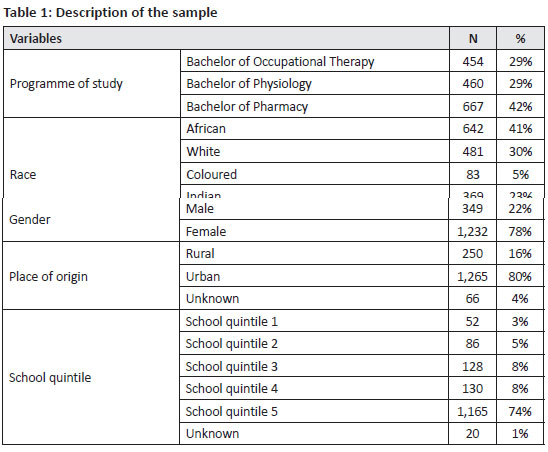
The results show that 41% (n = 642) were African students and 30% (n = 481) were white students. More female students, 78% (n = 1,232), were admitted compared to 22% male students (n = 349). Also, 80% (1,265) of the students were from urban origin. See the sample description in Table 1 below.
Descriptive statistic
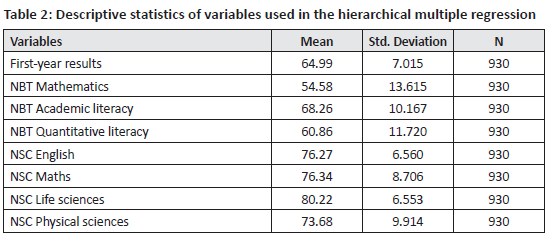
The results show that students performed better in NSC subjects than in NBTs. First-year results averaged 64.99% (SD = 7.02). NSC mathematics (76.34%) and life sciences (80.22%) had the highest means, while NBT mathematics was lower (54.58%, SD = 13.62). Academic literacy (68.26%) and quantitative literacy (60.86%) were moderate. The differences suggest that NSC scores reflect curriculum-based knowledge, while NBTs assess broader cognitive skills. These trends suggest strong NSC performance relative to the more varied outcomes in NBT domains, highlighting potential differences in preparedness for higher education.
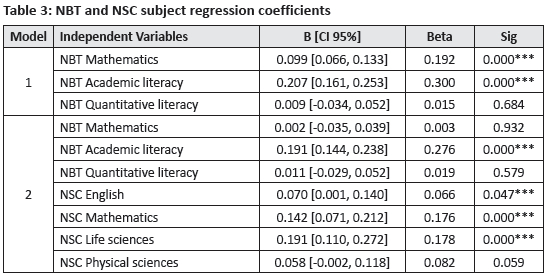
The results indicate that the NBT domains alone explained 15% of the variance in first-year performance, R2 = 0.154, F (3, 926) = 56.061, p < 0.000, with NBT mathematics and NBT academic literacy being significant predictors. When NSC English, mathematics, physical sciences, and life sciences were added, they explained an additional 12% of the variance, R2 = 0.124, F (4, 922) = 39.566, p < 0.000. The final model, combining both NBT and NSC variables, accounted for 28% of the variance R2 = 0.278, F (7, 922) = 50.638, p < 0.000, highlighting the strong predictive power of NSC mathematics, life sciences, and academic literacy. By Cohen's (1988) convention, the effect size of this model was large, f = 0.38. See Table 3 below.
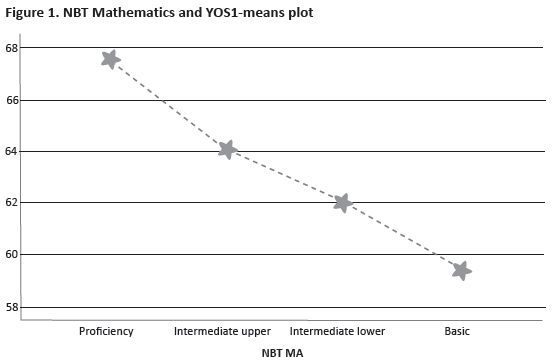
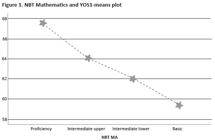
The ANOVA test for NBT mathematics (MA) was statistically significant, indicating that the performance levels influenced the first-year progression outcome, F (3, 1373) = 36.386, p = 0.000, η2 = 0.074. Gabriel's post-hoc procedure showed that students with proficient levels (M = 67.58, SD = 7.98) had higher academic scores than students with lower performance levels, IU (M = 64.13, SD = 8.05), mean difference 3.45, p < 0.000; IL (M = 62.08, SD = 7.49), mean difference 5.507, p < 0.000, and basic (M = 59.52, SD = 7.53), mean difference 8.06, p < 0.007. See Figure 1 below, showing the mean scores by the NBT proficiency levels.
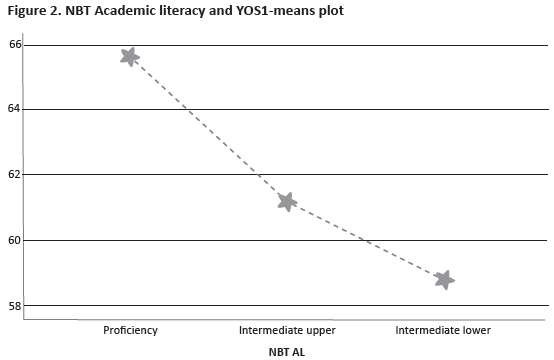
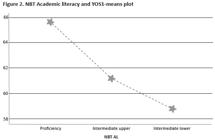
The ANOVA test for NBT AL was statistically significant, indicating that the NBT AL performance levels influenced the first-year grade-point average, F (2, 1374) = 78.468, p = 0.000, η2 = 0.103. Gabriel's post-hoc procedure showed that students with proficient levels (M = 65.64, SD = 7.92) had higher academic scores than students with IU (M = 61.15, SD = 7.45), a mean difference of 4.48, p < 0.000, and students with IL (M = 58.77, SD = 6.72), with a mean difference 6.871 p < 0.003. See Figure 2 below, showing the mean scores by the NBT proficiency levels.
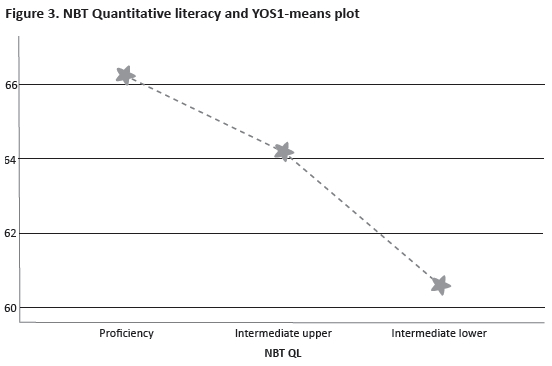
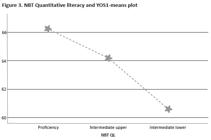
The ANOVA test for NBT QL was statistically significant, indicating that the NBT QL performance levels influenced the first-year grade-point average, F (2, 1374) = 53.563, p = 0.000, η2 = 0.062. Gabriel's post-hoc procedure showed that students with proficient levels (M = 65.64, SD = 8.05) had higher academic scores than students with lower performance levels IU (M = 61.15, SD = 7.88), with a mean difference of 2.07, p < 0.000, and IL (M = 58.77, SD = 7.45), with a mean difference of 5.66, p < 0.000. See Figure 3 below, showing the mean scores by the NBT proficiency levels.
Discussion
The study found that both the NBT domains and NSC subjects significantly predicted first-year academic success, explaining 15% and 12% of the variance, respectively. In hierarchical regression, NBT academic literacy (AL) and NSC English, mathematics, and life sciences were significant predictors. The model had a large effect size f = 0.38. ANOVA results showed significant differences in academic performance based on NBT domain proficiency, with students admitted at higher proficiency levels performing better. These findings highlight the importance of providing support to students with lower entry-level skills in the NBT domains.
The NBT is a criterion-referenced assessment that complements the NSC and accurately predicts success in the first years of study (Wilson-Strydom, 2012). Mabizela and George (2020) found that the NBT and NSC accounted for 26% and 19% of the variation in academic accomplishment among medical students. Furthermore, Rankin et al. (2012) also submit that the NBT and the NSC results are crucial predictors of academic success in first-year economics. These results indicate the value of using the NBT as an additional tool for selecting and placing students (Wadee & Cliff, 2016) against the backdrop that the NSC is linked with limited predictive capacity (Rankin et al., 2012).
As the NBT assesses student ability in three domains related to the higher education curriculum, the results of this study indicate that NBT MA and AL were critical variables for passing the first year. The predictive capacity of the NBT AL for success in the first year has been confirmed in other studies (Mabizela et al., 2020; Wilson-Strydom, 2012), and the NBT MA and QL have been identified as significant predictors in the early years of medical education (Mabizela & Green-Thompson, 2019). The NBT QL was not associated with predicting success in the first year of study and similar results were observed in a study which assessed the predictive capacity of the AP scores and NBT domains on first-year semester modules (Wilson-Strydom, 2012). The NSC English, mathematics, and life sciences were significant predictors. This study's results strengthen the notion of a complementary relationship between the two assessments in selecting the students (Rankin et al., 2012).
Taking the discussion of the NBTs further, the performance levels of the NBT domains are critical for both students and higher education institutions. On the one hand, the students need to know their entry-level academic skills such as writing, reading, comprehension, and study skills and the available support before beginning their study programmes. On the other hand, the institutions are responsible for providing support to the students in need. The concern is how effectively the institution under study, as well as other universities, are using the NBT to guide their support programmes and how prepared lecturers are to teach students with low entry-level skills. In this study, ANOVA results revealed that statistically significant differences in academic performance exist for all three NBT domains. The students with proficiency levels have higher mean scores than those admitted with lower proficiency levels. There are similar results where the academic performances of students with proficiency levels outweigh those of students with intermediate upper, lower, or basic levels (Mabizela & George, 2020). These results confirm the assumptions of the NBT performance levels and suggest that students admitted with intermediate upper (IU), intermediate lower (IL), and basic proficiency should receive targeted academic support to strengthen their entry-level skills. In practice, this could include extended orientation programmes, foundational or bridging courses, as well as structured tutorial support. Additionally, academic advising, early alert systems to identify at-risk students, and peer-assisted learning initiatives could be implemented to address specific challenges.
Limitations and implications for future studies
The first limitation of this study is that the first-year progression outcome used as a dependent variable is derived from first-year subjects of the three programmes. These programmes share similar subjects, but there are also subjects unique to each programme. Concerns about overlaps of these subjects may influence the students' first-year progression outcome. However, the study has offered perspectives on the links between selection tools and students' academic performance in the first year of study. Also, the number of first-year subjects within these programmes is not the same. Future studies should consider assessing the link between academic performance and the disparities in levels of preparedness arising from the different school quintiles.
Conclusion
The results of this study highlight the importance of the NBT as an additional tool beyond the selection of students. First, the NBT must be used as a guiding tool to follow the academic performance of students admitted with lower performance levels and provide necessary curriculum support to them to increase possibilities for academic success and student retention. Second, the NBT domains should be used to inform the student's language, mathematics, and quantitative academic support needs to promote their chances of success. Lastly, educators also need assistance to create a supportive and inclusive teaching environment that caters for the needs of underprepared students.
Ethics statement
This study was conducted in accordance with the Declaration of Helsinki and was approved by the Human Research Ethics Committee (Medical) of the University of the Witwatersrand (No.: M220561). The students' secondary data were obtained from the Business Intelligence Service Unit for research purposes. The permission to conduct research on students was granted by the university Registrar. Informed consent was waived as secondary data analysis was used.
Potential conflict of interests
There are no conflicts of interests.
References
Funding acknowledgement
No funding was received.
Literature review
- Agherdien, N., Mey, M., & Poisat, P. (2018). Factors impacting on students' readiness for higher education. Africa education review, 15(1), 52-71. https://doi.org/10.1080/18146627.2016.1224596
- Allen, P., Bennett, K., & Heritage, B. (2014). SPSS Statistics version 22: A practical guide (3rd ed.). Cengage Learning.
- Ayuk, P. T., & Koma, S. B. (2019). Funding, access and quality conundrum in South African higher education. African Journal of Public Affairs, 11(1), 176-195. https://journals.co.za/doi/pdf/10.10520/EJC-15641a97a6
- Bojuwoye, O. (2002). Stressful experiences of first year students of selected universities in South Africa. Counselling Psychology Quarterly, 15(3), 277-290. https://doi.org/10.1080/09515070210143480
- Bond, L. A. (1996). Norm- and criterion-referenced testing. Practical Assessment, Research & Evaluation, 5(2), 2. https://doi.org/10.7275/dy7r-2x18
- Cohen, J. (1988). Statistical power analysis for the behavioral sciences (2nd ed.). Lawrence Erlbaum Associates. https://doi.org/10.4324/9780203771587
- Crosling, G., Heagney, M., & Thomas, L. (2009). Improving student retention in higher education: Improving teaching and learning. The Australian Universities' Review, 51(2), 9-18.
- Foxcroft, C., & Roodt, G. (2009). Introduction to psychological assessment in the South African context (3rd ed.). Oxford University Press.
- Ghorbani, H. (2019). Mahalanobis distance and its application for detecting multivariate outliers. Facta Universitatis Series: Mathematics and Informatics, 34(3), 583-595. https://doi.org/10.22190/FUMI1903583G
- Hobden, S., & Hobden, P. (2015). A study of the transition pathways of school level scholarship recipients into work and tertiary education. South African Journal of Education, 35(3), #1054. https://doi.org/10.15700/saje.v35n3a1054
- Kridiotis, C. A., Bezuidenhout, J., & Raubenheimer, J. (2016). Selection criteria for a radiography programme in South Africa: Predictors for academic success in the first year of study. Health SA Gesondheid, 21(1), a955. https://doi.org/10.1016/j.hsag.2016.01.005
- Mabizela, S. (2025). Navigating parametric and non-parametric statistical analyses: A practical guide in health sciences research. Wits Journal of Clinical Medicine, 7(1), 41-44. https://doi.org/10.18772/26180197.2025.v7n1a9
- Mabizela, S., & Green-Thompson, L. (2019). Exploring the association of the National Benchmark Test results with the academic performance of medical students who completed the degree in minimum time. Journal of Education, (75), 44-55. https://doi.org/10.17159/2520-9868/i75a04
- Mabizela, S. E., & George, A. Z. (2020). Predictive validity of the National Benchmark Test and National Senior Certificate for the academic success of first-year medical students at one South African university. BMC Medical Education, 20(1), 152. https://doi.org/10.1186/s12909-020-02059-8
- Mabizela, S. E., Roos, R., Myezwa, H., & Potterton, J. (2020). Predictors for the academic success of first-year physiotherapy students at a South African university. South African Journal of Physiotherapy, 76(1), Article 1418. https://doi.org/10.4102/sajp.v76i1.1418
- Manik, S. (2015). Calibrating the barometer1: Student access and success in South African public higher education institutions. Alternation Special Edition No. 17, 226-244. Retrieved from https://alternation.ukzn.ac.za/wp-content/uploads/2025/11/12-Manik-F-min.pdf
- Meagher, D. G., Lin, A., & Stellato, C. P. (2006). A predictive validity study of the pharmacy college admission test. American Journal of Pharmaceutical Education, 70(3), 53. https://europepmc.org/article/pmc/1636944
- Mzangwa, S. T. (2019). The effects of higher education policy on transformation in post-apartheid South Africa. Cogent Education, 6(1). https://doi.org/10.1080/2331186X.2019.1592737
- Orton, P. M., Essack, S., Nokes, K. M., & Brysiewicz, P. (2020). Creating an instrument to measure perceptions about access to health-related higher education programmes in South Africa. South African Journal of Higher Education, 34(6), 185-200. https://doi.org/10.20853/34-6-3446
- Osborne, J. W., & Waters, E. (2002). Four assumptions of multiple regression that researchers should always test. Practical Assessment, Research, and Evaluation, 8(2). https://doi.org/10.7275/R222-HV23
- Rankin, N., Schöer, V., Sebastiao, C., & van Walbeek, C. (2012). Predictors of academic performance: National Senior Certificate versus National Benchmark Test. South African Journal of Higher Education, 26(3), 564-585. https://hdl.handle.net/10520/EJC136738
- Smit, R. (2012). Towards a clearer understanding of student disadvantage in higher education: Problematising deficit thinking. Higher Education Research & Development, 31(3), 369-380. https://doi.org/10.1080/07294360.2011.634383
- Van der Merwe, L. J., Van Zyl, G. J., St Clair Gibson, A., Viljoen, M., Iputo, J. E., Mammen, M., Chitha, W., Perez, A. M., Hartman, N., Fonn, S., Green-Thompson, L., Ayo-Ysuf, O. A., Botha, G. C., Manning, D. M., Botha, S. J., Hift, R., Retief, P., van Heerden, B. B., & Volmink, J. (2015). South African medical schools: Current state of selection criteria and medical students' demographic profile. South African Medical Journal, 106(1), 76-81. https://repository.up.ac.za/items/ef0ced21-c6a9-47f7-9c34-54c0ca0b61d1
- Van Dyk, H., & White, C. J. (2019). Theory and practice of the quintile ranking of schools in South Africa: A financial management perspective. South African Journal of Education, 39(s1). https://doi.org/10.15700/saje.v39ns1a1820
- Van Wyk, P., Teise, K., & le Roux, A. (2020). Threats to the quality of marking of the national senior certificate examinations in the Northern Cape. Perspectives in Education, 37(1), 115-129. https://doi.org/10.18820/2519593X/pie.v37i1.9
- Venkat, H., & Spaull, N. (2015). What do we know about primary teachers' mathematical content knowledge in South Africa? An analysis of SACMEQ 2007. International Journal of Educational Development, 41, 121-130. https://doi.org/10.1016/j.ijedudev.2015.02.002
- Visser, H., & Van Zyl, D. (2013). Assessment of academic readiness to achieve student success and retention. South African Journal of Higher Education, 27(2), 330-352. https://doi.org/10.20853/27-2-249
- Wadee, A. A., & Cliff, A. (2016). Pre-admission tests of learning potential as predictors of academic success of first-year medical students. South African Journal of Higher Education, 30(2), 264-278. https://doi.org/10.20853/30-2-619
- Walton, E., Bowman, B., & Osman, R. (2016). Promoting access to higher education in an unequal society. South African Journal of Higher Education, 29(1), 262-269. https://www.journals.ac.za/index.php/sajhe/article/view/462
- Williams, M. N., Grajales, C. A. G., & Kurkiewicz, D. (2013). Assumptions of multiple regression: Correcting two misconceptions. Practical Assessment, Research, and Evaluation, 18(11), 11. https://doi.org/10.7275/55HN-WK47
- Wilson-Strydom M. (2012). Using the NBTs to inform institutional understandings of 'under-preparedness': Implications for admissions criteria. South African Journal of Higher Education, 26(1), 136-151.
Accepted 28 September 2025
Published 18 August 2026