Exploring character strengths among South African university students: Insights from a WhatsApp-based intervention
Abstract
Character strengths, such as resilience, justice, and appreciation of beauty, play a key role in student well-being and academic engagement. This study explores the strengths profiles of 302 students at a South African university and evaluates the effectiveness of a six-week WhatsApp-based intervention designed to enhance self-awareness and strengths application. Using the VIA Character Strengths Survey, we found 'kindness', 'love of learning' and 'fairness' were the most highly endorsed strengths, while 'zest', 'bravery' and 'self-regulation' were lowest. Daily reflective prompts encouraged students to apply their strengths in different contexts. Post-intervention survey results from 55 participants indicated that most found the course beneficial for increasing self-awareness (90%) and understanding how to apply their character strengths in daily life (87%). Additionally, 93% of respondents reported that the daily messages helped them understand how to use their strengths to achieve their goals. Findings are discussed in relation to South Africa's social and cultural landscape, highlighting the potential of low-cost, digital interventions to support student development. While limited to a single institution, this study suggests promise for culturally responsive, strengths-based courses in higher education.
Character strengths; positive psychology; student well-being; higher education; university students; strengths-based interventions; WhatsApp; self-awareness; personal development; South Africa
Abstract
Les forces de caractère, telles que la resilience, la justice et l'appréciation de la beauté, jouent un rôle essentiel dans le bien-être et l'engagement académique des étudiants. Cette étude explore les profils de forces de 302 étudiants d'une université sud-africaine et évalue l'efficacité d'une intervention WhatsApp de six semaines, conçue pour améliorer la conscience de soi et l'application de ces forces. L'enquête VIA sur les forces de caractère a révélé que la gentillesse, l'amour de l'apprentissage et l'équité étaient les forces les plus fréquemment citées, tandis que l'enthousiasme, le courage et l'autorégulation étaient les moins mentionnées. Des réflexions quotidiennes ont encouragé les étudiants à mobiliser leurs forces dans différents contextes. Les résultats de l'enquête post-intervention menée auprès de 55 participants indiquent que la majorité a trouvé le cours bénéfique pour accroítre la conscience de soi (90 %) et mieux comprendre comment appliquer leurs forces de caractère au quotidien (87 %). De plus, 93 % des répondants ont déclaré que les messages quotidiens les avaient aidés à comprendre comment utiliser leurs forces pour atteindre leurs objectifs. Les résultats sont analysés à la lumière du contexte social et culturel sud-africain, soulignant le potentiel des interventions numériques à faible cout pour soutenir le développement des étudiants. Bien que limitée à un seul établissement, cette étude ouvre des perspectives prometteuses pour des cours d'enseignement supérieur culturellement adaptés et centrés sur les forces.
Forces de caractère; psychologie positive; bien-être étudiant; enseignement supérieur; étudiants universitaires; interventions axées sur les forces; WhatsApp; conscience de soi; développement personnel; Afrique du Sud
Introduction
The well-being and success of university students are central goals for higher education institutions worldwide, particularly in post-apartheid South Africa, where education continues to play a crucial role in societal transformation (Soudien, 2013). South African universities face the challenges of addressing historical inequalities, promoting inclusivity, and supporting students who often face socio-economic hardships and mental health challenges (Walker, 2019). Programmes to enhance resilience and personal growth promise to empower students to navigate academic and life challenges more effectively.
We draw inspiration from the positive university framework (Oades et al., 2011), which is grounded in Seligman's (2011) PERMA model, emphasising positive emotions, engagement, relationships, meaning, and accomplishment as key components of student flourishing. Expanding on the five domains outlined in the positive university framework, we introduce a virtual space in the form of a WhatsApp group. Within this space, we implemented a character strengths programme delivered through WhatsApp text messages during the summer vacation, designed to enhance student well-being in a structured yet accessible way.
Character strengths - defined as positive traits that contribute to one's ability to thrive - are increasingly recognized as valuable for students' personal and academic development (e.g. Wagner et al., 2020). Prior studies show that awareness and application of character strengths can enhance students' resilience, well-being, and motivation (Park & Peterson, 2009), and character strength recognition can contribute to a positive university (Oades et al., 2011). In South Africa, character strengths like perseverance, fairness, and appreciation of beauty may hold particular relevance due to the nation's social and cultural context, where justice, reconciliation and diversity are promoted. However, limited research exists on character strengths among South African university students, leaving a gap in understanding how these strengths may be expressed and nurtured within this context.
This study aims to address this gap by exploring the character strengths of South African university students and assessing the impact of a brief, WhatsApp-based character strengths intervention. The research examines both the character strengths profile of students and their responses to the intervention, seeking insights into how character strengths support well-being and academic engagement in a uniquely South African setting.
Theoretical framework
This study is grounded in the character strengths model, developed by Peterson and Seligman (2004), which categorizes 24 character strengths into six core virtues: wisdom, courage, humanity, justice, temperance, and transcendence. This model offers a scientifically validated framework for assessing character strengths across diverse populations, enabling individuals to identify their unique strengths profiles. Research shows that cultivating and applying these strengths is linked to numerous positive outcomes, such as improved life satisfaction, mental well-being, and resilience (Niemiec, 2012; Park & Peterson, 2009). In educational contexts, the character strengths model has been used to promote student engagement, promoting personal growth, and supporting academic resilience (Green, 2024).
However, research on character strengths within South Africa is limited, leaving a gap in understanding how South African students' unique sociocultural and historical context influences their character development and expression. South Africa's legacy of Apartheid, combined with current socio-economic inequalities, presents unique challenges to students in higher education. Character strengths like resilience, social intelligence, and fairness may hold particular importance for these students, given the demands for perseverance in the face of structural challenges, and a need for empathy and inclusivity in navigating a diverse society. Previous studies have found that character strengths can be deeply contextual, reflecting cultural values and historical experiences (Browning et al., 2018; Wagner et al., 2020). This study builds on this literature, investigating character strengths within a South African university setting to examine how the nation's social and political history may shape students' strengths profiles.
The VIA Character Strengths Survey serves as the primary tool for measuring character strengths in this study. This self-report survey provides a structured means of identifying individuals' top strengths, offering insights into the personal qualities that South African students find most relevant and meaningful. The VIA survey has been validated globally, including in diverse cultural contexts (McGrath, 2014), making it a suitable tool for exploring character strengths among South African students.
In addition to assessing students' strengths profiles, this study introduces a brief WhatsApp-based intervention designed to activate and support students' character strengths. The intervention consists of daily messages encouraging reflection on specific strengths and their application in daily life. This approach draws on theories of positive psychology and behaviour change, which suggest that regular engagement with strengths-based content can reinforce self-awareness and increase well-being (Niemiec, 2018). The use of WhatsApp, a widely accessible and familiar platform, aligns with research indicating that strengths interventions are more effective when they are integrated into participants' daily routines and conducted through familiar, accessible media (Sin & Lyubomirsky, 2009).
Research context and objectives
The dual goals of the study are: (1) understanding the character strengths profiles of South African university students within their sociocultural context, and (2) exploring the impact of a low-cost, accessible intervention on students' awareness and application of their strengths. This study aims to fill critical gaps in the literature by contributing to the limited body of research on character strengths in African higher education settings and by examining the effectiveness of a digital, strengths-based intervention in enhancing well-being and engagement among students.
Methods
Participants and measures
Participants for this study were recruited through an open call to students and staff organized by the Department of Student Affairs at the University of Cape Town, a major research-intensive university in South Africa with approximately 30 000 students and 5 000 permanent staff members. Participation in the course was voluntary and free of charge. A total of 611 individuals (98.5% students) initially registered for the six-week character strengths course. Ethical considerations included informed consent emphasising the voluntary nature of participation, confidentiality, and the participants) right to withdraw at any time without penalty.
The two main measures used for data collection were:
1. The VIA character Strengths Survey: At the start of the course, participants completed the VIA Character Strengths Survey, a validated 120-item self-report assessment. This survey is widely used to measure 24 character strengths across six virtues, as conceptualized by Peterson and Seligman (2004). The VIA survey provides each participant with a personalized profile of their top character strengths, which served as a baseline for understanding the strengths that participants brought into the course.
2. The Post-Intervention Survey: After completing the course, participants were invited to complete an evaluation survey assessing their experience and the perceived benefits of the intervention. The survey link was distributed via WhatsApp. The survey included Likert-scale items to quantify their self-reported increases in self-awareness, understanding of character strengths, and perceived impact on well-being. In addition, open-ended questions allowed participants to share qualitative feedback on their experiences and the practical applications of character strengths in their daily lives.
Intervention overview
The six-week WhatsApp-based character strengths course was designed to encourage daily reflection and practical engagement with individual strengths. Each morning, participants received a brief, structured WhatsApp message focusing on a specific character strength, followed by an evening affirmation message. The messages were intentionally concise to ensure ease of engagement and included a short prompt to encourage self-reflection and active use of the highlighted strength, for example, participants might be asked to reflect on a time they demonstrated kindness or to apply curiosity by exploring something new in their surroundings. Some messages included questions or challenges, encouraging participants to consider how they could use each strength in future situations.
Since the course ran over the summer vacation, when many participants are not on campus and might have to pay for data through mobile networks to participate, the WhatsApp group was set up to be unidirectional, with only the administrator able to send messages. Optional weekly discussion sessions were held on MS Teams, providing an opportunity for participants to ask questions and discuss the strengths introduced during the week.
Data collection and analysis
Quantitative and qualitative approaches provide a comprehensive view of participants' experiences and the course's impact.
Quantitative analysis
On sign-up, participants received a project-specific link to the VIA Character Strengths Survey. The survey results were downloaded and analysed on a spreadsheet. Character strengths were ranked from highest to lowest mean scores and the most common top five and bottom five strengths were calculated. The post-intervention Google Form survey automatically calculated percentages for Likert-scale item responses and displayed results on pie charts.
Qualitative analysis
Thematic analysis (Braun & Clarke, 2006) was used on the 55 responses to the open-ended questions in the post-intervention survey. Both authors independently read and grouped responses into codes and then themes. Consensus was reached through email exchange between the authors, and a final summarised list was compiled. For example, "Have mini quizzes at the end of each week as a reflection exercise" was a recommendation submitted for the course's improvement. This was coded as 'engagement' and 'mini-activities' and grouped with other codes in two themes: 'community, support, and interaction' and 'additional resources and learning tools'.
Results
character strengths distributions
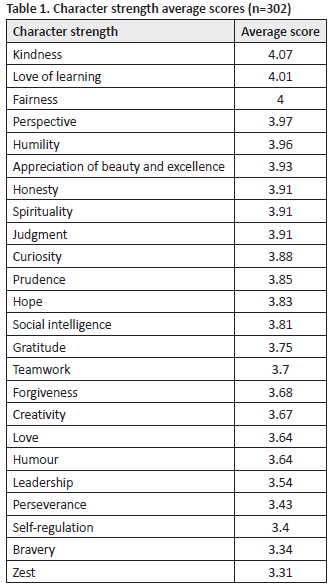
The overall highest ranked strengths when averaging over the 302 students at a South African university were 'kindness' (with an average score of 4.07), 'love of learning' (4.01), 'fairness' (4), 'perspective' (3.97) and 'humility' (3.96). Lowest ranked strengths were 'zest' (3.31), 'bravery' (3.34), 'self-regulation' (3.4), 'perseverance' (3.43) and 'leadership' (3.54). The average scores for all 24 character strengths are shown in Table 1.
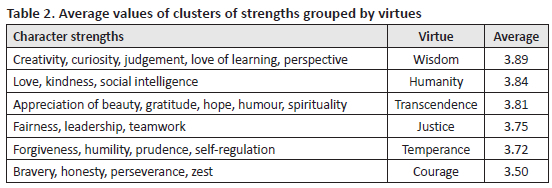
Table 2 shows the average values of clusters of strengths grouped by virtues. The virtue of wisdom (comprising the strengths of 'creativity', 'curiosity', 'judgement', 'love of learning', 'perspective'), was the highest ranked virtue with an average score of 3.89, while the virtue of courage (comprising 'bravery', 'honesty', 'perseverance', 'zest') was lowest ranked with an average score of 3.50. Courage ranks far below the other virtues: the difference between the average score for courage and the second lowest virtue, temperance, (3.72 - 3.50 = 0.22) is greater than the differences between temperance and the top-ranked virtue, wisdom (3.89 - 3.72 = 0.17).
'Kindness', 'spirituality' and 'fairness' were most frequently ranked in the top five strengths of the 302 participants. 'Zest', 'bravery' and 'self-regulation' were most frequently ranked in the lowest 5. Every strength appeared in the top 5 and lowest 5 for some participants, with frequency ranging from 3% to 52% of participants.
The top 10 strengths, based on the frequency of their appearance in participants' top 5, are 'kindness' (41%), 'spirituality' (41%), 'fairness' (38%), 'love' (31%), 'honesty' (31%), 'love of learning' (30%), 'humour' (27%), 'humility' (26%), 'perspective' (25%) and 'appreciation of beauty and excellence' (24%).
Similarly, the lowest 10 strengths, based on the frequency of their appearance in the bottom 5, are 'zest' (ranked 20 to 24 by 52% of participants), 'bravery' (45%), 'self-regulation' (45%), 'leadership' (36%), 'perseverance' (34%), 'humour' (27%), 'teamwork' (25%), 'love' (24%), 'forgiveness' (23%), 'prudence' (21%).
WhatsApp character strengths intervention analysis
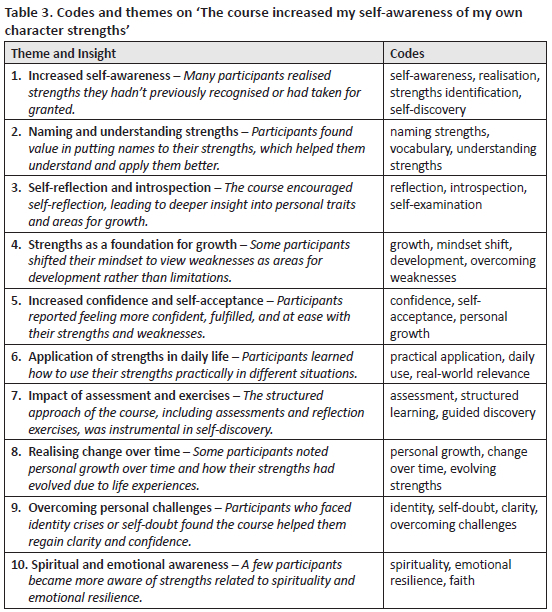
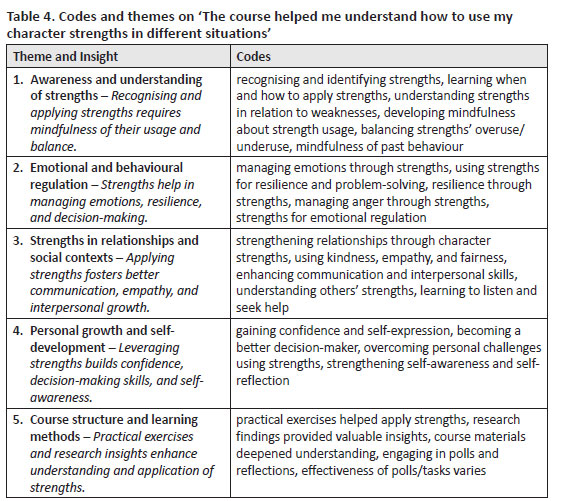
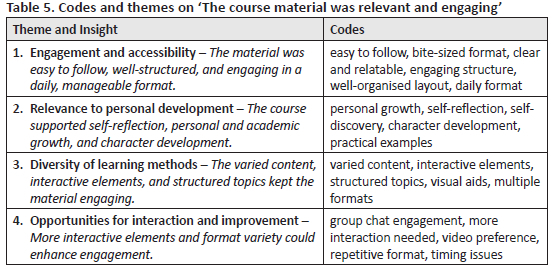
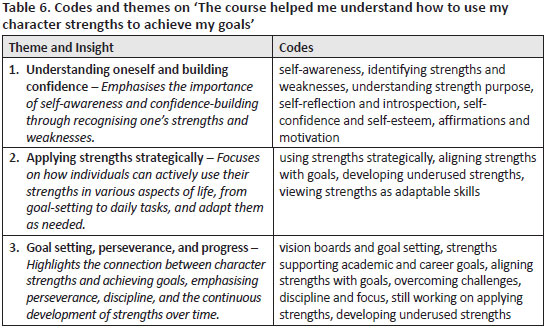
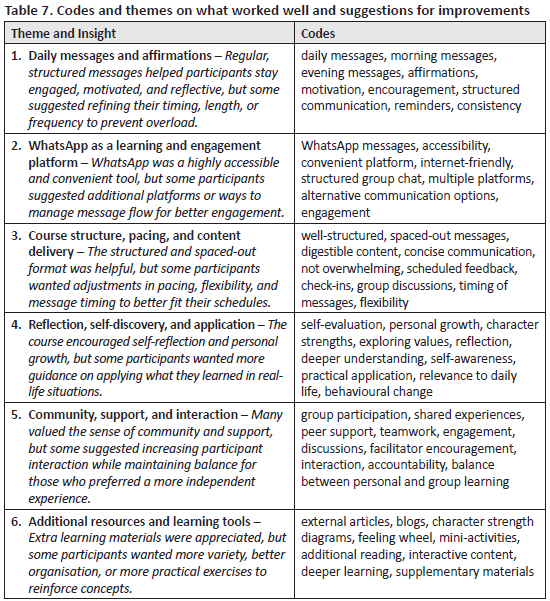
The codes and themes emerging from the qualitative responses to the evaluation survey are given in the appendix. The findings are summarised below.
Self-awareness and strengths identification
A key outcome of the intervention was the increased self-awareness participants gained regarding their character strengths. Many reported moments of self-discovery, realising strengths they had not previously recognised. The process of naming and reflecting on their strengths provided clarity on personal growth areas and allowed them to apply these strengths more effectively in different contexts.
This qualitative insight is strongly supported by the survey results, where 90.9% of participants agreed or strongly agreed that the course increased their self-awareness of character strengths. The structured nature of the intervention, including daily messaging and guided exercises, played a crucial role in fostering these realisations.
Application of strengths in daily life
Participants highlighted how the course helped them use their strengths more deliberately in various aspects of life. Many reported improved emotional regulation, resilience, and decision-making as they became more mindful of when and how to apply their strengths. The structured exercises were particularly valuable in translating theoretical concepts into practical strategies, especially in managing relationships and navigating personal or professional challenges.
Survey data reinforces this theme, with 87.3% of participants agreeing that the course increased their understanding of how to use character strengths in different situations, and 92.7% indicating that they gained a clearer understanding of how to use their strengths to achieve goals. These findings suggest that the intervention effectively bridged the gap between self-awareness and practical application.
Personal growth and confidence
A recurring theme across participant reflections was the link between self-awareness and personal growth. Many described a shift in perspective, viewing their weaknesses not as fixed limitations but as areas for development. This mindset shift contributed to greater self-acceptance and confidence. Some participants also noted that their strengths had evolved over time, influenced by life experiences and personal challenges.
These insights align with the reported benefits of the intervention's structure. The combination of guided reflection, strengths-based messaging, and interactive discussions created an environment where participants could recognise their growth and build confidence in their abilities.
Course structure and engagement
The intervention's format was widely appreciated for its accessibility and ease of engagement. Participants valued the bite-sized content, daily WhatsApp messages, and structured reflection activities. Many found that these elements made the learning process manageable and effective, allowing them to integrate new insights without feeling overwhelmed.
The survey results confirm this positive reception: 89.1% of participants agreed that the daily morning messages were useful and contributed to their well-being, while 83.6% found the evening character affirmation messages beneficial. While most participants found the structure effective, some suggested improvements in pacing and flexibility, with a preference for more interactive elements to enhance engagement.
Practical application and reflection
While participants appreciated the opportunity for self-reflection, many expressed a desire for deeper guidance on applying their strengths in real-world situations. Suggestions included incorporating more structured exercises, concrete examples, and opportunities for peer interaction. Some participants noted that while group discussions were helpful, a balance needed to be maintained for those who preferred a more independent learning experience.
The intervention's strengths-based approach was particularly effective in helping participants explore and apply different character strengths. Many found that structured check-ins and scheduled feedback sessions provided valuable opportunities to learn from others' perspectives. Additionally, participants noted that short expert blogs and external articles reinforced key concepts and enriched their learning experience.
Recommendations for improvement
While the intervention was well-received, participants identified areas for enhancement. Specifically, they suggested incorporating:
• Short video clips to complement the text-based materials.
• Incentives for attending review sessions to encourage deeper engagement.
• Quizzes and assessments to reinforce learning and track progress.
Despite these suggestions for refinement, the intervention was overwhelmingly endorsed by participants, with 100% stating they would recommend the six-week WhatsApp course to a friend.
Discussion
Cultural and social context of findings
The VIA Character Strengths results align with characteristics that may be especially meaningful in the South African context. For instance, the high scores for 'kindness' and 'fairness' could be influenced by the ubuntu philosophy common in African cultures (Kamwangamalu, 1999), which emphasises human co-dependence and is associated with hospitality, sociability, sharing and sympathy, among others. Given the country's diverse and vast resources of natural beauty, appreciation for beauty and excellence might reflect a broader coping strategy among students who use this strength to find solace and positivity in their surroundings.
At the low end of the ranking are the character strengths of 'zest' and 'bravery' (in the virtue of courage) and 'self-regulation' (temperance). A possible explanation for this placement is that the education system does not give much flexibility or choice to students who aim to study at university. High academic performance is essential for students who need to find bursaries to study and their determination to succeed by obediently completing tasks set out for them leads to a deprioritization of 'zest' and 'bravery'.
Implications for student development and academic engagement
The WhatsApp-based intervention demonstrated promise in enhancing students' self-awareness and application of character strengths. The structured daily prompts allowed students to reflect on their strengths, helping them recognise how specific traits could support their academic journeys and well-being. The feedback indicates that students benefitted from the simplicity and accessibility of the intervention, suggesting that mobile-based interventions may be particularly suitable for higher education settings in South Africa, where students often seek flexible, digital solutions for self-development.
Practical implications
The low-cost, text-focused WhatsApp intervention gave the greatest opportunity for participation by students who had no access to Wi-Fi connectivity during the summer vacation and relied on data to participate. Making the group closed for posting apart from the administrator meant that participants could budget for the data cost and expected time to keep up with the daily messages. For those with limited bandwidth or connectivity, the optional MS Teams meetings could not be attended. Recordings or meeting summaries could allow asynchronous catch-up when in areas that offer free Wi-Fi.
To better meet individual preferences for the timing of posts (e.g. twice or once daily, only on weekends, during vacations or semesters), different versions of the course can be offered to allow students to engage in a way that suits them. While this may increase the administrative load and initial setup, most resources would be shared. To sustain the course in the long term, volunteers could be trained to manage groups. Volunteers might be leaders in student organizations and could guide the modification of the course for their context. Bespoke groups could be set up for participants in a common residence, or who would like to have in-person discussion groups on character strengths, or who would like to practice using strengths in teamwork activities such as sports, crafts or games.
Limitations and future research
Among the study's limitations is, first, the drawing of the sample exclusively from a single university, which may affect the generalisability of the results to other institutions or regions. The self-report nature of the VIA Character Strengths Assessment introduces the possibility of response bias, as students may overestimate socially desirable traits.
Future research could expand on this study with larger, more diverse samples and by employing complementary qualitative methods, such as in-depth interviews, to validate and expand upon the findings. A qualitative approach could provide a richer understanding of how the South African sociopolitical landscape shapes character strengths. Statistical analyses could search for correlations between strengths and self-reported benefits. Future research could explore questions such as: Are there trends from self-reported benefits that suggest which students might benefit most from such an intervention (e.g. those with love of learning as a top strength), and which may do better with a different form of intervention?
The design of the WhatsApp intervention aimed to keep data costs low by restricting interactivity and sticking to text-based messages instead of videos, voice-notes and live calls. Different formats, such as in-person meetings, weekly quizzes on strength identification, a WhatsApp discussion group for peer support, reflective journaling, varied engagement levels for participants, and the use of different platforms could be tested in future studies.
Conclusion
This innovative intervention provided students with a low-cost, accessible way to explore and apply their character strengths. Delivered at low cost over six weeks during the summer vacation, the course attracted 611 sign-ups, with 302 students completing the VIA Character Strengths Survey and 55 participating in the post-intervention survey. The most frequently reported strengths were 'kindness', 'love of learning', and 'fairness', while wisdom and humanity emerged as the top virtues. The results also highlighted a diverse distribution of strengths, with each strength appearing among both the top and lowest five for different students. This provides a valuable South African benchmark for international studies on character strengths.
The WhatsApp-based approach proved to be a scalable and cost-effective model for fostering self-awareness and well-being among university students. The use of one-way text messages - rather than data-heavy formats like voice-notes or videos - allowed for broad participation, particularly during vacations when Wi-Fi or mobile data access can be limited. This model can be adapted for other low-cost educational and well-being initiatives, delivering structured content, affirmations, and reflection prompts in a simple yet effective format.
Student affairs professionals at African universities could tailor this approach to support co-curricular or extra-curricular programmes aimed at student well-being. Future research can build on these findings to develop culturally relevant, strengths-based interventions that enhance student thriving in diverse educational settings.
Ethics statement
This study adhered to ethical guidelines established by the UCT Senate Ethics in Research Committee. Informed consent was obtained from all participants, with assurances that participation was entirely voluntary and that responses would remain confidential. Participants were also informed of their right to withdraw at any time without penalty.
Potential conflict of interests
The authors declare that there are no conflicts of interest related to this study.
Funding acknowledgementThis work is based on the research supported in part by the National Research Foundation of South Africa (TTK240419215024).
Acknowledgements
The authors are grateful to Shaun Mahabeer for facilitating the WhatsApp groups, to the Residence Academic Development Committee, UCT, for funding the project administration, and to the VIA Institute on Character for permitting the use of participants' VIA Character Strengths Survey results for this research.
References
- Braun, V., & Clarke, V. (2006). Using thematic analysis in psychology. Qualitative Research in Psychology, 3(2), 77-101. https://doi.org/10.1191/1478088706qp063oa
- Browning, B. R., McDermott, R. C., Scaffa, M. E., Booth, N. R., & Carr, N. T. (2018). Character strengths and first-year college students' academic persistence attitudes: An integrative model. The Counseling Psychologist, 46(5), 608-631. https://doi.org/10.1177/0011000018786950
- Green, Z. A. (2024). Strengths intervention imparted through a blended learning approach to advance personal growth initiative among Pakistan's university students during COVID-19. Studies in Educational Evaluation, 81, 101343. https://doi.org/10.1016/j.stueduc.2024.101343
-
Kamwangamalu, N. M. (1999). Ubuntu in South Africa: A sociolinguistic perspective to a pan-African concept. Critical Arts, 13(2), 24-41. DOI: 10.1080/02560049985310111.
» https://doi.org/10.1080/02560049985310111 - McGrath, R. E. (2014). Character strengths in 75 nations: An update. The Journal of Positive Psychology, 10(1), 41-52. http://dx.doi.org/10.1080/17439760.2014.888580
- Niemiec, R. M. (2012). VIA character strengths: Research and practice (The first 10 years). In H. Koop & A. Delle Fave (Eds.), Well-being and cultures: Perspectives from positive psychology (Vol. 3, pp. 11-29). Springer. https://link.springer.com/chapter/10.1007/978-94-007-4611-4_2
- Niemiec, R. M. (2018). Character strengths interventions: A field guide for practitioners. Hogrefe Publishing.
- Oades, L. G., Robinson, P., Green, S., & Spence, G. B. (2011). Towards a positive university. The Journal of Positive Psychology, 6(6), 432-439. https://psycnet.apa.org/doi/10.1080/17439760.2011.634828
- Peterson, C., & Seligman, M. E. (2004). Character strengths and virtues: A handbook and classification (Vol. 1). Oxford University Press.
- Seligman, M. E. P. (2011). Flourish: A visionary new understanding of happiness and wellbeing. Simon & Schuster.
- Soudien, C. (2013). Bearding the capability deprivation machine: The pedagogical deal for postapartheid young South Africa. Critical Studies in Teaching and Learning, 1(1), 53-79. https://www.ajol.info/index.php/cristal/article/view/125976
- Wagner, L., Holenstein, M., Wepf, H., & Ruch, W. (2020). Character strengths are related to students' achievement, flow experiences, and enjoyment in teacher-centered learning, individual, and group work beyond cognitive ability. Frontiers in Psychology, 11, 1324.
Accepted 6 June 2025
Published 28 July 2025
Appendix 1: Codes and themes from qualitative analysis