Predictors of student mental health and academic competence
Abstract
Promoting tertiary students' academic success and mental health is increasingly recognised as a critical issue in education. In an effort to develop strategies to promote student success and mental health, an existing dataset was re-analysed to identify predictors of student academic competence and mental health, using the Biopsychosocial Model as a theoretical framework. Cross-sectional data collected from university students (n = 3,239) via an online survey during the COVID-19 pandemic were used. Structural equation modelling used various domains of wellness (physical, emotional, social, spiritual, financial, environmental, intellectual) as well as hope, coping and satisfaction with institutional support to predict mental health and academic competence (as proxy for academic success). Hope, coping and academic competence were the main direct predictors of mental health as well as several domains of wellness (intellectual, spiritual, emotional) through coping as mediator. Intellectual wellness, coping and satisfaction with institutional support were the most important predictors of academic competence. Tertiary institutions can use these findings to plan appropriate resources and services to promote and sustain students' mental health and academic functioning.
Mental health; academic competence; tertiary students; student support services; structural equation modelling
Abstract
Kukuza mafanikio ya kitaaluma na afya ya akili ya wanafunzi wa elimu ya juu kunaendelea kutambuliwa kama suala muhimu katika sekta ya elimu. Katika jitihada za kuandaa mikakati ya kukuza mafanikio ya wanafunzi na afya yao ya akili, seti ya takwimu iliyokuwepo ilichambuliwa upya iii kubaini viashiria vya umahiri wa kitaaluma na afya ya akili ya wanafunzi, kwa kutumia modeli ya kibaiosaikojamii kama mfumo wa nadharia. Takwimu za sehemu mtambuka zilizokusanywa kutoka kwa wanafunzi wa chuo kikuu (n=3,239) kupitia utafiti wa mtandaoni wakati wa janga la COVID-19 zilitumika. Uundaji wa milinganyo ya upimaji ulitumia maeneo mbalimbali ya ustawi (kimwili, kihisia, kijamii, kiroho, kifedha, kimazingira na kiakili) pamoja na matumaini, mbinu za kukabiliana na hali, na kuridhika na msaada wa taasisi iii kutabiri afya ya akili na umahiri wa kitaaluma (kama kiashirio mbadala cha mafanikio ya kitaaluma). Matumaini, uwezo wa kukabiliana, na umahiri wa kitaaluma vilikuwa viashiria vikuu vya moja kwa moja vya afya ya akili, pamoja na maeneo kadhaa ya ustawi (kiakili, kiroho na kihisia) kupitia uwezo wa kukabiliana kama kiungo cha upatanishi. Ustawi wa kiakili, uwezo wa kukabiliana, na kuridhika na msaada wa taasisi vilikuwa viashirio muhimu zaidi vya umahiri wa kitaaluma. Taasisi za elimu ya juu zinaweza kutumia matokeo haya kupanga rasilimali na huduma zinazofaa iii kukuza na kudumisha afya ya akili ya wanafunzi pamoja na utendaji wao wa kitaaluma.
Afya ya akili; umahiri wa kitaaluma; wanafunzi- wa elimu ya juu; huduma za msaada kwa wanafunzi; uundaji-wa mi!inganyo ya upimaji
Introduction
Promoting tertiary students' academic success and mental health (MH) is increasingly recognised as a critical issue in higher education. High dropout, reduced pass and low graduation rates have been reported (Marwala & Mpedi, 2022; Mbuvha et al., 2021). In 2021, only 44% students completed their degrees in the minimum time (Mbuvha et al., 2021). Additionally, literature increasingly highlights students' mental health challenges, which influence their success. A multi-country survey conducted by the World Health Organization (WHO) which sampled 13,984 first-year students from 19 institutions in eight countries reported rising rates of psychological distress. A third of the students screened positive for at least one common DSM-IV disorder - anxiety, depression, or substance use (35.3% lifetime, 31.4% past 12 months) (Auerbach et al., 2018). This paints a disturbing picture of mental health in higher education. International and local studies conducted during the COVID-19 pandemic showed how various aspects of student wellbeing were negatively affected (Bain et al., 2023; Cao et al., 2020; Genç & Arslan, 2021; Moosa & Bekker, 2022; Sifunda et al., 2024). In a large study including 6,810 students from various South African universities, one-third of participants reported mild to severe distress during the pandemic. Younger students, females and those with high levels of COVID-risk perception reported higher rates of distress (Sifunda et al., 2024). Based on data from a longitudinal study of South African students initiated in 2015, Bantjes et al. (2023) argue that the increase in mental health issues during the pandemic was part of a pattern of steadily increasing mental disorders among students. The authors regard the pandemic as just one more stressor affecting students amidst ongoing adversity (such as poverty, unemployment, gender-based violence, student financing) and campus disruptions in recent years (Bantjes et al., 2023).
The high rates of academic challenges and mental disorders among students emphasized in recent research (Bantjes et al., 2023; Mbuvha et al., 2021) highlight the importance of campus-based support to promote student wellbeing because wellness factors affect academic success (Bantjes et al., 2023; Bruffaerts et al., 2018; Goodall et al., 2018). Bantjes et al. (2020a) show that providing effective treatment to first-year students with major depressive and/or attention deficit hyperactivity disorders could yield a 23% proportional reduction in the prevalence of academic failure. This highlights the importance of mental health to promoting academic success. However, new development and support strategies should be developed because the research of Bantjes and colleagues (2020b) reports very low mental healthcare utilisation. They found that among first-year university students in South Africa, 18% of a sample of 1,402 students and 29% of those reporting mental health challenges in the past 12 months utilised student support services. Students thus do not adequately benefit from the mental health and support services currently available at tertiary institutions.
To support the development of appropriate services to optimally benefit students in higher education, this study aimed to identify variables that predict mental health and academic success of current South African students. In this article, we report on a re-analysis of quantitative data from a large sample of students collected through an online survey during the COVID-19 pandemic (Law-van Wyk et al., 2025; Visser & Law-van Wyk, 2021), to determine how different domains of subjective wellness contribute to students' mental health and academic competence (AC; as a proxy of academic success). The results can be used to suggest ways to promote student wellness and academic success. Although the data were collected during the pandemic, the results can also be relevant in non-crisis times.
Theoretical background
This research uses the Biopsychosocial Model (BPS) of health (Engel, 1977) and its recent developments, as theoretical framework. The model is built on the principle that health/outcome behaviour depends on dynamic interactions between biological, psychological, and social factors. All three components are in dynamic interaction, with each having the capacity to influence and transform the other. In line with this, the WHO (1995) defines wellness as a state of complete physical, mental, and social wellness, not merely the absence of disease. By renaming the model the 'sociopsychobio' model of health, Haslam et al. (2021) emphasize the influence of social components (i.e. social identity) on the psychological and biological components of people's lives.
In a recent development of the model, Sulmasy (2002) proposes an extension of the model by adding a spiritual component to form the biopsychosocial-spiritual model. This means that health/outcome behaviour involves the interdependent interaction of physical, mental, social and spiritual components, contributing to holistic health or wellbeing. In keeping with systems interaction (Hanson, 2013), more dimensions of health and wellbeing can be added to provide a more comprehensive understanding of human functioning and wellbeing.
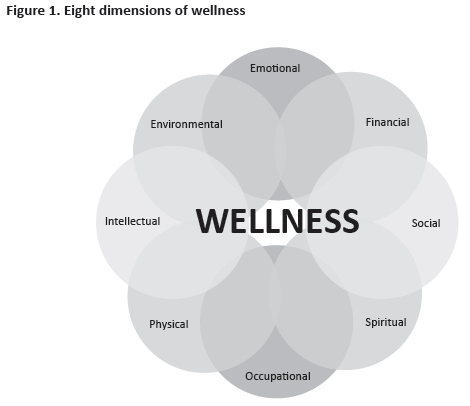
The Eight Dimensions of Wellness (EDW) Model (Swarbrick & Yudof, 2015) is such an extension of the BPS model. The EDW model identifies eight core interconnected dimensions of human existence: (1) environment, (2) occupational, (3) financial, (4) social, (5) emotional, (6) physical, (7) intellectual, and (8) spiritual. The overlapping circles (Figure 1) illustrate the multidirectional interplay between the dimensions, where imbalances in one or a combination of dimensions, may cause a sense of non-fulfilment or mental health problems. For example, academic stress can result in emotional stress, which can lead to physical symptoms and less social interaction.
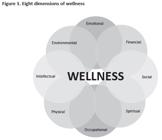
The eight dimensions of wellness are briefly defined below.
Emotional wellness is conceptualised in terms of three concepts in this research: (i) emotional wellness (EW), (ii) mental health and (iii) hope. Emotional wellness and mental health are differentiated based on Westerhof and Keyes's (2010) Two-Continua Model, where mental health and mental illness are not conceptualised as opposites, but as coexisting on separate continua, creating different states of subjective wellness. In this research, emotional wellness describes the presence or absence of emotional difficulties on the mental illness continuum, while mental health refers to the continuum between flourishing and languishing (i.e. between functioning well and experiencing subjective feelings of incompleteness, emptiness, or stagnation). The core components of MH include psychological wellbeing (purpose in life, self-realisation) and social wellbeing (being of social value) (Westerhof & Keyes, 2010). This links to the WHO's (2022) definition of mental health as a state of wellbeing that enables people to cope with stress, realise their abilities, learn well, work well, and contribute to their community. Hope is defined as the capacity to develop pathways to desired goals and motivate oneself through agency to use those pathways (Snyder, 2002). It is a goal-oriented dimension indicating a positive expectation toward future outcomes (Krafft et al., 2019). The fact that hope and optimism are linked to various indicators of health and wellbeing has been thoroughly documented (Krafft et al., 2019).
Academic competence (AC) is operationalised by drawing from the concepts of academic enablers (DiPerna, 2006), academic self-concept, self-efficacy and self-regulated learning (Ferla et al., 2010; Zimmerman, 2002), and psychological capital, which is a set of positive psychological resources including self-efficacy, optimism and resilience (Ortega-Maldonado & Salanova, 2018). In this research, academic competence is defined as a student's ability to manage academic work by demonstrating high self-efficacy and self-regulating behaviour towards learning, motivation, level of engagement and productivity, managing distractions and remaining committed to goal-directed behaviour. Students' perceived academic competence was assessed as a proxy for academic performance, as it was not possible to link anonymous respondents to their academic records.
Physical wellness includes maintaining a healthy lifestyle, including physical activity, a healthy diet, weight management, adequate sleep, and healthcare consultations to maintain physical health (Swarbrick & Yudof, 2015). These practices promote physical health and also impact people's mental and emotional health.
Spiritual wellness involves meaning, purpose and a sense of balance and peace (Swarbrick & Yudof, 2015). For many people, it involves religious activities.
Intellectual wellness involves lifelong learning, curiosity, the application and sharing of knowledge (Swarbrick & Yudof, 2015). In this research, intellectual wellness was conceptualised as confidence in cognitive abilities, such as attention, information processing, learning and memory, decision-making, reasoning, critical thinking, and exploring new or different points of view.
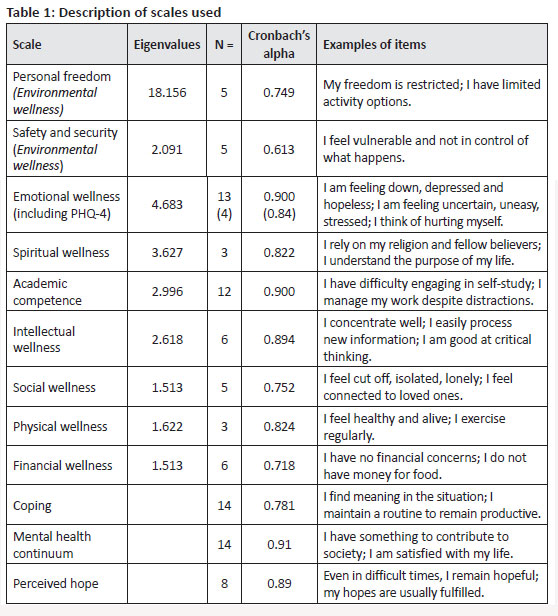
Environmental wellness involves being in safe, healthy, and stimulating physical and social environments that support wellness (Swarbrick & Yudof, 2015). In this research, environmental wellness is represented by two factors, that is (i) personal freedom and (ii) safety and security (see Table 1).
Financial wellness encompasses having sufficient resources to meet one's needs and control over one's finances (Swarbrick & Yudof, 2015). It relates to managing money wisely, living within one's means, and preparing for emergencies, while recognising that everyone's financial situation differs.
Social wellness involves a sense of connectedness and belonging, as well as building effective, supportive social networks with friends, family, and the community, developing meaningful relationships and creating safe and inclusive spaces (Swarbrick & Yudof, 2015).
In this research two variables that could act as mediating factors between dimensions of wellness and mental health and academic competence were added: (i) coping as a personal variable, and (ii) satisfaction with institutional support (SIS) as a contextual variable. These variables can be seen as navigating points that explain the process through which variables are related.
Coping is defined as "… cognitive and behavioural efforts to manage specific internal or external demands that are appraised as taxing or exceeding the resources of the person" (Lazarus & Folkman, 1984, p. 141). The way in which people perceive or appraise stressful situations often determines how they choose to respond in order to cope with the stress of the situation. Through effective coping, students can manage difficult situations and stressors in their academic work and relationships.
Institutional support describes university support services and resources available to students, such as study material, communication technology, guidance from lecturers, counselling services, and student leisure activities that could contribute to the wellbeing and academic success of students. During the pandemic, the university also provided free internet access, computers on loan, regular communication and online tutoring and support. These resources could contribute to student success.
The research hypotheses and objectives
This research aimed to determine (a) the impact of wellness dimensions (physical, social, emotional, hope, spiritual, intellectual, environmental) on students' mental health and perceived academic competence; and (b) the mediating effects of coping and satisfaction with institutional support (SIS) on the relationship between wellness dimensions and outcomes in mental health and academic competence.
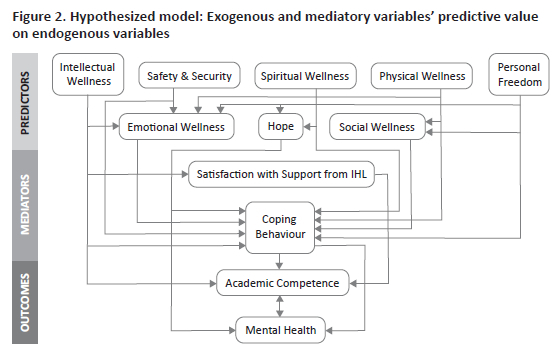
We hypothesized that most of the wellness domains would contribute to coping as a mediating factor affecting mental health and academic competence. Additionally, we hypothesized that mental health would be significantly affected by hope and academic competence and that satisfaction with institutional support and intellectual wellness would predict academic competence. The hypothesized interactions are presented in Figure 2.
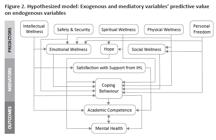
Specifically, we hypothesized that mental health would be influenced by physical, emotional, social and spiritual wellness, as well as hope. Intellectual wellness and a sense of academic competence is needed to have the confidence to succeed. Safety and security is needed to create an environment conducive to mental health.
To succeed academically, students need some level of overall wellness (Maharaj, 2018). Their physical needs (i.e. nutrition, sleep, health) must be met, they need to feel safe, secure, and have adequate accommodation to attend to academic work. They need a sense of individual autonomy (personal freedom), while also belonging to a community, with healthy relationships, especially with their lecturers and peers, whilst being supported within the larger educational environment. Emotional wellbeing and mental health are essential as students in emotional distress may not be able to function optimally on social and cognitive levels. A sense of intellectual wellness is also essential for academic success and feelings of competence within the educational context.
Research methods
Sampling
A cross-sectional study was conducted by sending an online survey link to all registered students (n = 48,571) of a large residential university during the COVID-19 pandemic in July 2020. The 5,074 respondents constituted a 10.4% response rate. After controlling for missing values, 3,239 questionnaires were included in the analysis. This was a self-selected volunteering sample.
Data collection instruments
The Eight Dimensions of Wellness Model (Swarbrick & Yudof, 2015) was used to develop questions to assess the dimensions of wellness as outlined above. A three-point Likert-type scale (almost never, occasionally, nearly every day) was used as the response format. Responses were coded so that higher scores reflected better wellness. Examples of the items per scale are provided in Table 1.
The Brief COPE questionnaire (Carver, 1997) informed coping items which reflected problem-focused, adaptive and non-adaptive emotion-focused coping. The 14 items were answered on a 3-point scale (not at all, sometimes, always). Items were scored so that a high score reflected constructive coping.
Three existing scales were included to comprehensively explore students' emotional wellness and mental health. The Patient Health Questionnaire for Depression and Anxiety (PHQ-4; Kroenke et al., 2009) was used to assess subjective experiences of depression and anxiety as part of the emotional wellness scale (mental illness continuum). It consists of two depression items (PHQ-2) and two anxiety items (GAD-2), which are shortened versions of the PHQ-9 and GAD-7, respectively. The two-item scales have been found to explain 84% of the variance of the extended versions. Both scales have good internal reliability (>0.80) and construct and clinical validity, and have been widely used in research as ultra-brief screening tools (Kroenke et al., 2009).
The Perceived Hope Scale (PHS; Krafft et al., 2019) assesses hope as a positive expectation about the future. The scale has demonstrated strong psychometric properties, including good validity and internal consistency (Cronbach's alpha 0.87-0.89).
The 14-item Mental Health Continuum (MHC-SF) (Keyes & Lopez, 2002), used to assess mental health, contains three items that assess emotional wellbeing, six that assess Ryff's dimensions of psychological wellbeing and five items that measure Keyes' dimensions of social wellbeing (being of value to society). Responses were recorded on a 4-point scale (a reduced scale). A high score indicated flourishing, and a low score, languishing (Keyes & Lopez, 2002). This scale has been widely used worldwide and demonstrates good internal consistency (>0.80) and validity in the South African context (Keyes et al., 2008).
Students' satisfaction with institutional support (SIS) was assessed with one question, rated on a sliding scale (1-100).
Factored scales and reliability
After analysing the suitability of the data for factor analysis, the 78 survey items were subjected to exploratory factor analysis (EFA) using robust diagonally weighted least squares (RDWLS) and weighted varimax. All items of the dimensions of wellness questionnaire were forced to load on nine wellness factors and oblique rotation provided the best-defined factor structure with strong loadings. Nine factors with eigenvalues greater than one were identified and labelled according to a dimension of wellness. A factor loading cut-off score of 0.4 was used and any loading with a value less than 0.4 was discarded. Survey items with cross-loadings were retained on factors that made theoretical sense (Table 1).
Eight dimensions of wellness matched well with seven of the nine factors, and were labelled accordingly. Environmental wellness did not correspond to any factor, although aspects of environmental wellness were reflected in two factors: (1) personal freedom and (2) safety and security, which together explained 20.25% of the variance. This was thought to be conceptually sound as the pandemic and the lockdown fundamentally altered people's environments through restrictions to freedom and also impacted their sense of safety and security. Reliability was assessed using Cronbach's alpha. The factored scales, reliability and examples of items are presented in Table 1.
Confirmatory factor analysis (CFA) validated the three existing scales used to explore students' emotional and mental health: PHQ-4, mental health continuum, and perceived hope. The reliability of these scales for this data is reported in Table 1.
Data analysis
Descriptive analysis was performed, using SPSS Statistics version 26, after confirming that the constructed scales accurately measured the dimensions of wellness (through EFA and CFA). Mean scores for all scales were calculated and standardised for comparison. An inter-correlational matrix showed that all correlations were below 0.80 (highest was 0.65), indicating that multicollinearity was not a concern. Structural Equation Modelling (SEM) was performed, using the Jamovi software version 2.6.17. SEM is a second-generation multivariate technique that combines exploratory factor analysis and path analysis (Khairi et al., 2021; Schreiber et al., 2006), which allows researchers to simultaneously test and estimate latent, exogenous, and endogenous variables, including indicator variables (Khairi et al., 2021). A SEM was estimated using the Maximum Likelihood Robust (MLR) method with the NLMINB optimisation algorithm. A total of 3,239 observations and 60 free parameters were included in the analysis. Robust Huber-White standard errors were applied, and the Yuan-Bentler T2* scaled test statistic was used to account for non-normality. To improve the model, modification indices were used, which suggested the addition of the following relationships: Hope → Coping, Emotional Wellness → Hope, Mental Health → Hope, Academic Competence → Intellectual Wellness, Social Wellness → Mental Health, and Emotional Wellness → Intellectual Wellness.
The model yielded the following fit indices: SRMR = 0.035; RMSEA = 0.068; CFI = 0.970; and TLI = 0.943. These values fall within the recommended thresholds, indicating that the revised model provides a good fit to the data (Hu & Bentler, 1999; Kline, 2016). P-values of < .05 are considered statistically significant. The standardised β indicates the weight of the effect, that is whether the effect is small (β = 0.10), moderate (β = 0.30), or large (β = 0.50), with the positive or negative signs indicating the direction of the relationship.
Ethics
Research approval was obtained from the Ethics Committee of the Faculty of Humanities, University of Pretoria (HUM019/0420). Respondents consented and completed the survey voluntarily and anonymously.
Results
Respondent characteristics
The respondents from all academic faculties included 83.3% undergraduate students and 67.1% female students, with 59.2% aged between 18 and 21 years.
Identifying predictors of mental health and academic competence
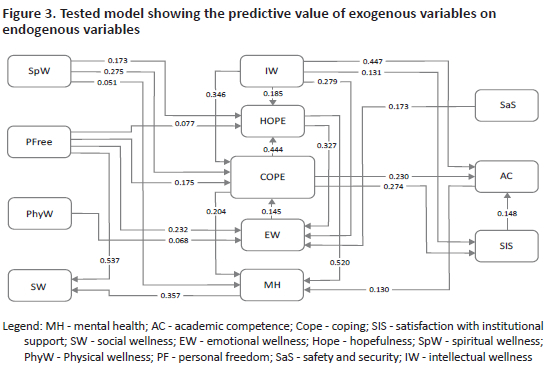
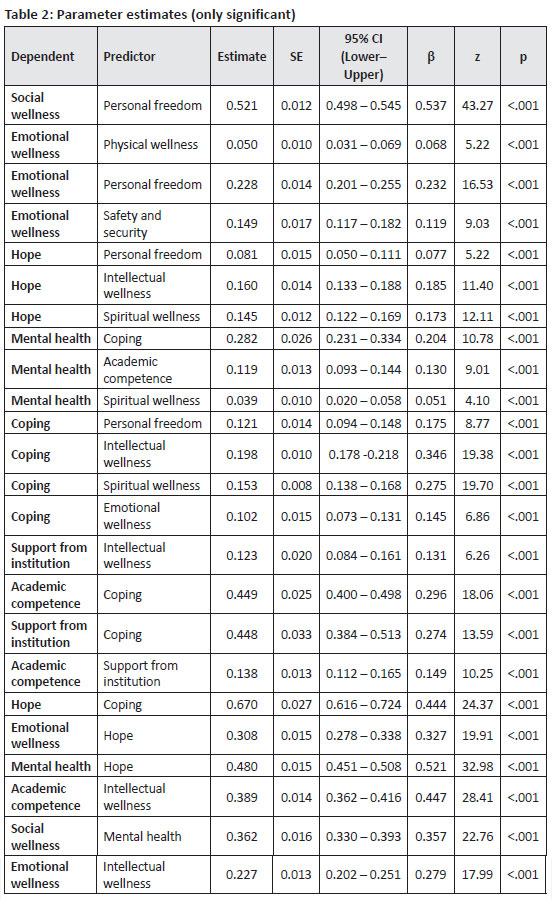
In this research, SEM was used for exploratory purposes to identify variables that contribute to student mental health and academic competence. Variables believed to influence (mediate) the relationships included coping and satisfaction with institutional support. The hypothesized model is shown in Figure 2, while the tested model is graphically presented in Figure 3 and summarised in Tables 2 and 3.
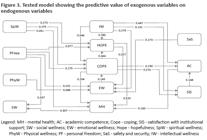
Mental health was strongly predicted by hope (β = 0.52, p < .001), with additional contributions from coping (β = 0.20, p < .001), academic competence (β = 0.13, p < .001) and spiritual wellness (β = 0.06, p < .001 small effect). Higher mental health in turn predicted better social wellness (β = 0.36, p < .001).
Academic competence was primarily predicted by intellectual wellness (β = 0.45, p < .001), followed by coping (β = 0.30, p < .001) and satisfaction with institutional support (β = 0.15, p < .001). Coping also predicted satisfaction with institutional support, which suggests a direct and mediated influence on academic competence (β = 0.041, p < .001) (Table 3), though with a small effect size.
As a mediating variable, coping was predicted by intellectual (β = 0.35), spiritual (β = 0.28) and emotional wellness (β = 0.14) and personal freedom (β = 0.18). Coping on the other side, predicted hope (β = 0.44), alongside intellectual (β = 0.19) and spiritual wellness (β = 0.17), and hope predicted emotional wellness (β = 0.33). Other variables predicting emotional wellness were intellectual wellness (β = 0.28), personal freedom (β = 0.23), and low values from safety and security (β = 0.12) and physical wellness (β = 0.06). Higher personal freedom predicted social wellness with a large effect (β = 0.53), emotional wellness with a moderate effect (β = 0.23), and coping with a small effect (β = 0.18).
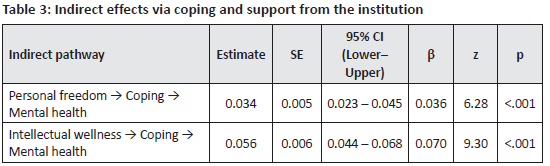
Coping and SIS as mediators: Various exogenous constructs were mediated by coping to predict mental health, mainly with small effect (Table 3). Within the defined parameters, the most significant indirect effect indicated that intellectual wellness predicted coping, which in turn was associated with academic competence (β = 0.102) and predicted mental health (β = 0.070) with small effect. Other small predictors of coping were spiritual (β = 0.056) and emotional wellness (β = 0.029), and personal freedom (β = 0.036). Spiritual (β = 0.081) and emotional wellness (β = 0.043) and personal freedom (β = 0.052) contributed to academic competence with small effect through coping. Coping's positive impact on academic competence was also mediated by satisfaction with institutional support (β = 0.041). A summary of the indirect effects on mental health and academic competence via coping and satisfaction with support is presented in Table 3.
Discussion
In the proposed model for analysis, the wellness domains, alongside hope, served as predictors. Coping and satisfaction with institutional support were expected to act as mediators. The endogenous variables considered were mental health and academic competence (as a proxy for academic success).
The SEM analysis showed that students' mental health was significantly impacted by their level of hope and positive coping, as well as academic competence and spiritual wellness (small influence). These findings align with our hypotheses. The importance of hope as a predictor of mental health has been supported by research (Krafft et al., 2019; Venning et al., 2011), as it fosters resilience in the face of various challenges. Similarly, effective coping has been shown to improve students' mental health (Esmaeilimotlagh et al., 2018), while unhealthy coping was found to be related to mental illness in university students (Stallman et al., 2020).
As expected, our data showed that academic competence directly impacted students' mental health (though with small effect). This is supported by the research of Acosta-Gonzaga (2023) that found when students lack confidence in their academic abilities, they may experience negative emotions, leading to mental detachment. Students struggling academically thus need appropriate academic and psychosocial support to deal with the negative emotional consequences. In contrast, some other studies found no direct link between academic performance and mental health, though stress factors correlated with performance (Mohamad et al., 2018).
An interesting relationship between mental health and social wellness was identified. The model showed a unidirectional association from mental health to social wellness (with moderate effect), indicating that students with better mental health reported greater social wellness, whereas the reverse path (social → mental health) was not supported. This refines the common assumption that social activity drives mental health; rather, our data suggest that mentally healthier students are more likely to seek and sustain social interactions, elaborating on evidence that social relationships safeguard student wellbeing (Eloff, 2021). The context of the pandemic could have influenced this finding. Social connection was highly restricted which negatively influenced social wellness, as almost half of the students felt isolated and lonely (Visser & Law-van Wyk, 2021).
Academic competence refers to having adequate academic skills and enablers, such as intrinsic motivation, effective study techniques, and engagement (DiPerna, 2006). In the model, academic competence was mainly predicted by intellectual wellness, followed by coping and satisfaction with institutional support. This confirms our hypothesized model and is supported by the literature (Kakada et al., 2019; Law-van Wyk et al., 2025; McNaughton-Cassil et al., 2021). The results suggested that students who are confident in their cognitive abilities, use effective coping strategies, and utilise available support resources tend to feel more competent in their academics. Acosta-Gonzaga (2023) confirmed that motivated students tend to engage more in their academics, and metacognitive engagement is a predictor of academic success, as it enables them to plan, monitor, and self-regulate their learning.
Interestingly, our analysis revealed that mental health did not exhibit predictive power over academic competence, contrary to our hypothesis and the existing literature, which states that students' wellness affects academic success (Bantjes et al., 2023; Bruffaerts et al., 2018; Van Zyl et al., 2012). During the pandemic (when the data were collected), student mental health was generally low (Visser & Law-van Wyk, 2021) and they reported having difficulty adjusting to online learning (Law-van Wyk et al., 2025). This may be the reason that coping was a more prominent predictor of academic competence than mental health.
In this model, a few important variables that predict mental health and academic competence were identified.
Coping. Coping moderated the relationship between most variables (except between social wellness and mental health and academic competence). Coping functioned both as a direct pathway to academic competence and mental health and also served as a mediator, enhancing intellectual wellness and satisfaction with institutional support, thereby contributing to academic competence (though with small effect size). This highlights the importance of effective coping for students' wellness.
A finding that was not predicted in the original model was the significant influence of coping on hope, suggesting that students who were able to cope had more positive future expectations. In turn, hope was the most significant predictor of mental health.
The results also showed that students' sense of personal freedom and intellectual, spiritual, and emotional wellness (being free from emotional distress) contributed to better coping. As such, students in this research who employed active and adaptive coping strategies (such as acceptance, positive reappraisal, spirituality, and social support) reported higher scores on mental health and academic competence. Research by Janse van Rensburg (2023) also found that students' resilience and adaptability were improved by using positive coping strategies. Unfortunately, descriptive statistics in our research showed that almost one-third of students did not implement adaptive coping skills, but used maladaptive strategies such as disengagement, avoidant coping and substance use to cope with life stresses and academic pressures during the pandemic (Law-van Wyk et al., 2025). These maladaptive coping strategies thus negatively influenced students' mental health and academic competence.
Satisfaction with institutional support (SIS) was predicted by coping and intellectual wellness, which in turn predicted academic competence. Students' satisfaction with institutional support, such as access to communication technology and guidance from lecturers, increased students' self-perceived academic competence, aligning with findings from Eloff et al. (2021) and Wilson Fadiji and Eloff (2024). Various academic and personal support services helped students manage their coursework effectively, especially during the pandemic. Understanding the types of support students need is thus crucial.
Hope. Our research showed that hopeful students reported higher levels of mental health and emotional wellness, although there were no direct or indirect relationships between mental health and emotional wellness - this aligns with the Two-Continua Model (Westerhof & Keyes, 2010). Individuals with a hopeful outlook may be better equipped to remain emotionally healthy, navigate challenges and employ effective coping strategies (Snyder, 2002; Venning et al., 2011). In this research, coping, intellectual and spiritual wellness contributed most to hope. To develop students' hope may be a strategy to improve their wellness.
Intellectual wellness was a predictor of several key variables. It was the most prominent direct predictor of academic competence. It was also a strong predictor of coping, emotional wellness and hopefulness, therefore also contributing to mental health. Students' confidence in their cognitive abilities helped them accept academic challenges, enhance learning, and contributed to independent learning (Phan, 2010). Freedom from emotional distress could also promote optimal cognitive functioning, and intellectual wellness could serve as a buffer against emotional distress.
This research highlighted the interactional nature of the dimensions of wellness and showed how the pandemic influenced many aspects of mental health and academic competence. Intellectual wellness, coping, hope, and support from the institution were identified as important factors in promoting mental health and academic competence of students.
Strengths and limitations
This article presents a re-analysis of an existing large database with data collected on a large number of variables during the COVID-pandemic. The advantage of using SEM in a dataset with many interrelated variables is that relationships between all variables are explored to identify directional paths which have the greatest effect on the outcome variables mental health and academic competence.
We acknowledge the significant conceptual overlap between key concepts like mental health and hope (0.63) and hope and coping (0.65) that impacted the validity of the findings. In an intercorrelational matrix we found some high correlations, but fortunately, it did not threaten the validity of the SEM analysis.
Since a volunteering sample of students was used, the generalisability of the findings could be affected due to a degree of self-selection bias. Self-reported data could create response bias, as participants' subjective perspectives may not fully present objective and testable realities. For example, students' perceived academic competence was assessed as it was not possible to access their actual academic performance through anonymous research. Additionally, the unique contextual factors related to the COVID-19 pandemic and the unique experiences of students during this period have clearly influenced the generalisability of findings.
Implications of the research
This research highlighted predictors of mental health and academic competence among tertiary students, which stakeholders in tertiary education can use to improve students' academic success and mental health. A climate can be created to stimulate students' intellectual wellness, hope, positive coping and mental health, and strengthen institutional support. Although most higher education institutions have implemented counselling services, these services are often understaffed and under-resourced and frequently only utilised by students when they are in crisis (Bantjes et al., 2020b). This article argues for a proactive and integrated approach to student support and development. More can be done to build students' coping skills, hope and intellectual wellness, and to improve institutional support available to students to promote their wellness and academic performance.
Promoting mental health
A proactive approach involves mental health awareness and capacity building to cultivate hope, resilience and adaptive coping strategies. Awareness campaigns, including life-skills training or social-emotional learning (SEL) as accredited courses, can serve as proactive approaches to promoting students' mental health. Specifically, students need to develop adaptive coping strategies, emotional intelligence, stress management and self-care skills. A further consideration is to personalise interventions based on a health-focused mobile application to assess students' emotional wellbeing. Subsequently, students can be required to complete a personalised credit-bearing online mental health module. Such proactive initiatives could promote students' wellness (Turner & Gonzalez, 2024) and enable early identification of at-risk students. These interventions to address students' real-life challenges should be developed in collaboration with students.
Strengthening intellectual wellbeing and academic skills
Cognitive development programmes should be integrated into academic curricula to enhance students' cognitive skills and self-regulatory learning (Zimmerman, 2002). Insights from the transdisciplinary field of neuroeducation (Jolles & Jolles, 2021) could be used to enhance students' intrinsic motivation, attention, memory, executive functioning and academic independence. Students could be sensitised to specific threats to brain health, such as substance use, lack of sleep and untreated mental health difficulties, enabling them to take responsibility for their intellectual wellness and academic competence. If not managed effectively, generative artificial intelligence has the potential to negatively impact students' learning, intellectual development and wellbeing, as well as their academic competence, particularly when cognitive processes such as critical thinking are not developed but outsourced to large language models. Further research can be done to identify factors that promote or erode students' academic competence, such as the effect of digital media on students' attention span and cognitive engagement (Pranathi & Jacobs, 2025). Furthermore, student success could be enhanced through early evidence-based identification of students' support needs and by providing academic and psychosocial resources through programmes such as the STARS Mentorship Programme (2025) that identifies students at risk and matches them with mentoring and skill-building opportunities to improve their adjustment and academic success.
Development of institutional support
The diverse needs of students require a comprehensive, needs-based approach to institutional support. Lecturers should be sensitive to the specific needs of students and support them accordingly. Dependable IT support services and training in online learning management systems would benefit students with using technology. Higher education institutions should also aim to alleviate mild to severe threats that affect financially insecure students, particularly those at risk of housing and food insecurity (Coetzee et al., 2024). Further research into the specific types of institutional support students need is necessary to develop targeted, responsive interventions to promote student wellness and academic success.
Conclusion
This study provided insight into predictors of students' mental health and academic competence. Although the data were collected during the COVID-pandemic, the research contributed to knowledge about the functioning and needs of the student population. These findings have practical implications for how institutions of higher education, lecturing staff and students can collaborate to promote student wellbeing and academic success.
Ethics statement
Research approval was obtained from the Ethics Committee of the Faculty of Humanities, University of Pretoria (HUM019/0420).
Potential conflict of interests
The authors have no conflicts of interests to declare.
Funding acknowledgement
The research was not externally funded.
References
- Acosta-Gonzaga, E. (2023). The effects of self-esteem and academic engagement on university students' performance. Behavioral Sciences, 13(4), 348.
- Auerbach, R. P., Mortier, P., Bruffaerts, R., Alonso, J., Benjet, C., Cuijpers, P., Demyttenaere, K., et al., & WHO WMH-ICS Collaborators. (2018). WHO World Mental Health Surveys International College Student Project: Prevalence and distribution of mental disorders. Journal of Abnormal Psychology, 127(7), 623-638. Retrieved from https://www.apa.org/pubs/journals/releases/abn-abn0000362.pdf
- Bain, K., Hassem, T., Bemath, N., De Andrade, V., & Laher, S. (2023). In the wake of COVID-19: The developmental and mental health fallout amongst South African university students. Emerging Adulthood, 14(1), 1055-1067. https://doi.org/10.1177/21676968231180960
- Bantjes, J., Saal, W., Gericke, F., Lochner, C., Roos, J., Auerbach, R. P. (2020a). Mental health and academic failure among first-year university students in South Africa. South African Journal of Psychology, 51(3), 396-408. https://doi.org/10.1177/0081246320963204
- Bantjes, J., Saal, W., Lochner, C., Roos, J., Auerbach, R. P., Mortier, P., Bruffaerts, R., Kessler, R. C., & Stein, D. J. (2020b). Inequality and mental healthcare utilisation among first-year university students in South Africa. International Journal of Mental Health Systems, 14, 5. https://doi.org/10.1186/s13033-020-0339-y
- Bantjes, J., Swanevelder, S., Jordaan, E., Sampson, N. A., Petukhova, M. V., Lochner, C. (2023). COVID-19 and common mental disorders among university students in South Africa. South African Journal of Science, 19(1/2). https://doi.org/10.17159/sajs.2023/13594
- Bruffaerts, R., Mortier, P., Kiekens, G., Auerbach, R.P., Cuijpers, P., Demyttenaere, K. (2018). Mental health problems in college freshmen: Prevalence and academic functioning. Journal of Affective Disorders, 225, 97-103.
- Cao, W., Fang, Z., Hou, G., Han, M., Xu, X., Dong, J., & Zheng, J. (2020). The psychological impact of the COVID-19 epidemic on college students in China. Psychiatry Research, 287, 112934. https://doi.org/10.1016/j.psychres.2020.112934
- Carver, C. S. (1997). You want to measure coping but your protocol's too long: Consider the brief COPE. International Journal of Behavioral Medicine, 4(1), 92-100. https://link.springer.com/content/pdf/10.1207/s15327558ijbm0401_6.pdf
- Coetzee, B., Booysen, D. D., Padmanabhanunni, A., & Kagee, A. (2024). Demographic correlates of indices of psychological well-being and COVID-19 related distress among South African university students. International Journal of Mental Health, 53(2), 192-211. https://doi.org/10.1080/00207411.2024.2324403
- DiPerna, J. C. (2006). Academic enablers and student achievement: Implications for assessment and intervention services in the schools. Psychology in the Schools, 43(1), 7-17. https://doi-org.uplib.idm.oclc.org/10.1002/pits.20125.
- Eloff, I. (2021). College students' well-being during the COVID-19 pandemic: An exploratory study. Journal of Psychology in Africa, 31(3), 254-260. https://doi.org/10.1080/14330237.2021.1939055
- Eloff, I., O'Neil, S., & Kanengoni, H. (2021). Students' well-being in tertiary environments: Insights into the (unrecognised) role of lecturers. Teaching in Higher Education, 28(7), 1777-1797. https://doi.org/10.1080/13562517.2021.1931836
- Engel, G. L. (1977). The need for a new medical model: A challenge for biomedicine. Science, 196(4286), 129-136. https://www.jstor.org/stable/1743658
- Esmaeilimotlagh, M., Oveisi, K., Alizadeh, F., & Asadollahi Kheirabadi, M. (2018). An investigation on coping skills training effects on mental health status of university students. Journal of Humanities Insights, 2(01), 37-42.
- Ferla, J., Valcke, M., & Schuyten, G. (2010). Judgments of self-perceived academic competence and their differential impact on students' achievement motivation, learning approach, and academic performance. European Journal of Psychology of Education, 25(4), 519-536. https://doi.org/10.1007/s10212-010-0030-9
- Genç, E., & Arslan, G. (2021). Optimism and dispositional hope to promote college students' subjective well-being in the context of the COVID-19 pandemic. Journal of Positive School Psychology, 5(2), 87-96. https://mail.journalppw.com/index.php/jpsp/article/view/127
- Goodall, J., Fisher, C., Hetrick, S., Phillips, L., Parrish, E. M., & Allott, K. (2018). Neurocognitive functioning in depressed young people: A systematic review and meta-analysis. Neuropsychology Review, 28(2), 216-231. https://doi.org/10.1007/s11065-018-9373-9
- Hanson, B. G. (2013). General systems theory: Beginning with wholes. Routledge.
- Haslam, S. A., Haslam, C., Jetten, J., Cruwys, T., & Bentley, S. V. (2021). Rethinking the nature of the person at the heart of the biopsychosocial model: Exploring social changeways not just personal pathways. Social Science & Medicine, 272, 113566. https://doi.org/10.1016/j.socscimed.2020.113566
- Hu, L., & Bentler, P. M. (1999). Cutoff criteria for fit indexes in covariance structure analysis: Conventional criteria versus new alternatives. Structural Equation Modeling: A Multidisciplinary Journal, 6(1), 1-55. https://doi.org/10.1080/10705519909540118
- Janse van Rensburg, E. S. (2023). Resilience of undergraduate health sciences students during COVID-19: An integrative review. Health SA Gesondheid, 28, a2331. http://dx.doi.org/10.4102/hsag.v28i0.2331
- Jolles, J., & Jolles, D. D. (2021). On neuroeducation: Why and how to improve neuroscientific literacy in educational professionals. Frontiers in Psychology, 12, 752151. https://doi.org/10.3389/fpsyg.2021.752151
- Keyes, C. L. M., & Lopez, S. J. (2002). Towards a science of mental health. In C. R. Snyder, & J. L. Lopez (Eds.), Handbook of positive psychology (pp. 45-59). Oxford University Press.
- Keyes, C. L. M., Wissing, M., Potgieter, J. P., Temane, M., Kruger, A., & Van Rooy, S. (2008). Evaluation of the Mental Health Continuum Short Form (MHC-SF) in Setswana-speaking South Africans. Clinical Psychology and Psychotherapy, 15(3), 181-192. https://doi.org/10.1002/cpp.572
- Khairi, M. I., Susanti, D., & Sukono, S. (2021). Study on structural equation modeling for analyzing data. International Journal of Ethno-Sciences and Education Research, 1(3), 52-60.
- Kline, R. B. (2016). Principles and practice of structural equation modeling (4th ed.). The Guilford Press.
- Krafft, A. M., Martin-Krumm, C., & Fenouillet, F. (2019). Adaptation, further elaboration, and validation of a scale to measure hope as perceived by people: Discriminant value and predictive utility vis-à-vis dispositional hope. Assessment, 26(8), 1594-1609. https://doi.org/10.1177/1073191117700724
- Kroenke, K., Spitzer, R. L., Williams, J. B. W., & Löwe, B. (2009). An ultra-brief screening scale for anxiety and depression: The PHQ-4. Psychosomatics, 50(6), 613-621. https://doi.org/10.1016/S0033-3182(09)70864-3
- Law-van Wyk, E., Visser, M., & Masenge, A. (2025). Factors that affected South African students' sense of self-perceived academic competence during the COVID-19 lockdown and the rapid transition to online learning. COVID, 5(2), 17. https://repository.up.ac.za/server/api/core/bitstreams/6e85bbef-94d6-43d1-ba0d-7457828bcf44/content
- Lazarus, R. S., & Folkman, S. (1984). Stress, appraisal, and coping. Springer.
- Marwala, T., & Mpedi, L. (2022, November 29). If we want to fix our economy, we must increase university graduation rates. Daily Maverick. https://www.dailymaverick.co.za/opinionista/2022-11-29-if-we-want-to-fix-our-economy-we-must-increase-university-graduation-rates/
- Mbuvha, R., Zondo, P., Mauda, A., & Marwala, T. (2021). Predicting higher education throughput in South Africa using a tree-based ensemble technique. aRxiv. https://arxiv.org/abs/2106.06805
- McNaughton-Cassill, M. E., Lopez, S., Knight, C., Perrotte, J., Mireles, N., Cassill, C. K., Silva, S., & Cassill, A. (2021). Social support, coping, life satisfaction, and academic success among college students. Psi Chi Journal of Psychological Research, 26(2), 150-156. https://doi.org/10.24839/2325-7342.JN26.2.150
- Mohamad, M. H., Baidi, N., Asshidin, N. H. N., Mohamad, M., & Subhi, N. (2018). The relationship between mental health, stress and academic performance among college student. In N. Nadiah Ahmad, N. Raida Abd Rahman, E. Esa, F. Hanim Abdul Rauf, & W. Farhah (Eds.), Interdisciplinary sustainability perspectives: Engaging environmental, cultural, economic and social concerns, Vol. 44. European Proceedings of Social and Behavioural Sciences (pp. 562-572). Future Academy. https://dx.doi.org/10.15405/epsbs.2018.07.02.60
- Moosa, M., & Bekker, T. (2022). Working online during COVID-19: Accounts of first-year students' experiences and well-being. Frontiers in Psychology, 13, 794279. https://doi.org/10.3389/fpsyg.2022.794279
- Ortega-Maldonado, A., & Salanova, M. (2018). Psychological capital and performance among undergraduate students: The role of meaning-focused coping and satisfaction. Teaching in Higher Education, 23(3), 390-402. https://doi.org/10.1080/13562517.2017.1391199
- Pranathi, J. S. R., & Jacob, A. M. (2025). Impact of short form videos on attention span mediated by sleep quality and stress. International Journal of Interdisciplinary Approaches in Psychology, 3(4), 11-31.
- Schreiber, J. B., Nora, A., Stage, F. K, Barlow, E. A., & King, J. (2006). Reporting structural equation modeling and confirmatory factor analysis results: A review. The Journal of Educational Research, 99(6), 323-337. https://doi.org/10.3200/JOER.99.6.323-338
- Sifunda, S., Sewpaul, R., Mokhele, T., Mabaso, M., Naidoo, I., Dukhi, N., Parker, S., Davids, A., Zungu, N., Shisana, O., Makgalemane, R., Thakoordeen-Reddy, S., & Reddy, P. (2024). Psychological distress and mental health challenges among college and university students during the COVID-19 lockdowns in South Africa. Frontiers in Education, 9, 1484849. https://doi.org/10.3389/feduc.2024.1484849
- Stallman, H. M., Lipson, S. K., Zhou, S., & Eisenberg, D. (2020). How do university students cope? An exploration of the health theory of coping in a US sample. Journal of American College Health, 70(4), 1179-1185. https://doi.org/10.1080/07448481.2020.1789149
- STARS Assessment and Mentorship Programme (2025). About. https://www.up.ac.za/stars-mentorship-programme/article/3256767/about
- Swarbrick, M., & Yudof, J. (2015). Wellness in the 8 dimensions [Booklet]. Collaborative Support Programs of NJ, Inc. https://www.center4healthandsdc.org/uploads/7/1/1/4/71142589/wellness_in_8_dimensions_booklet_with_daily_plan.pdf
- Van Zyl, L. E., & Rothmann, S. (2012). Flourishing of students in a tertiary education institution in South Africa. Journal of Psychology in Africa, 22(4), 593-599. https://doi.org/10.1080/14330237.2012.10820573
- Visser, M., & Law-van Wyk, E. (2021). University students' mental health and emotional wellbeing during the COVID-19 pandemic and ensuing lockdown. South African Journal of Psychology, 51(2), 229-243. https://doi.org/10.1177/00812463211012219
- Westerhof, G. J., & Keyes, C. L. M. (2010). Mental illness and mental health: The two continua model across the lifespan. Journal of Adult Development, 17(2), 110-119. http://doi:10.1007/s10804-009-9082-y
-
Wilson Fadiji, A., & Eloff, I. (2024). Student wellbeing and academic support in higher education. Frontiers of Education, 9, 1119110. doi: 10.3389/feduc.2024.1119110
» https://doi.org/10.3389/feduc.2024.1119110 - WHO (World Health Organization) (1995). Constitution of the World Health Organization. Retrieved from: https://apps.who.int/iris/bitstream/handle/10665/121457/em_rc42_cwho_en.pdf
- WHO (2022, June 17). World mental health report: Transforming mental health for all. https://iris.who.int/server/api/core/bitstreams/40e5a13a-fe50-4efa-b56d-6e8cf00d5bfa/content
- Zimmerman, B. J. (2002). Becoming a self-regulated learner: An overview. Theory Into Practice, 41(2), 64-70. https://doi.org/10.1207/s15430421tip4102_2
Accepted 15 December 2025
Published 18 August 2026