Using a student organisation to promote student-centredness at a South African university
Abstract
This reflective article focuses on the Chemical Engineering Students Association (CESA) at a South African university, which was established as a voluntary student organisation to alleviate the problems of student isolation and inadequate orientation programmes by promoting student-centredness and development. The article aims to examine CESA's role in promoting student-centredness and to highlight CESA's role in community engagement. CESA was initiated by two lecturers in the chemical engineering department who served as departmental representatives. Following the Gibbs reflective cycle, data in the form of reflections were collected and analysed from the CESA departmental representatives to ascertain CESA's effectiveness in alleviating the problem of student isolation by creating a student-centred environment and engaging students in community service. The community engagement activities consisted of a Nelson Mandela Day stationery drive and a Women's Day sanitary towel drive to contribute to a local women's and children's shelter. The students actively participated in these activities, demonstrating their commitment to social responsibility and community service. CESA also organised various student development activities to equip students with essential skills and knowledge for their future careers. The students actively participated in these workshops, showing a keen interest in their personal and professional growth. Successfully implementing CESA was made possible through collaboration and support from other faculty members in the chemical engineering department, and the university's community engagement and marketing departments. The article emphasises CESA's practical contributions and presents it as a model for other institutions in establishing effective student organisations. Overall, the reflections indicated CESA's effectiveness in promoting student-centredness.
Student organisations; community engagement; student leadership development; student-centredness; social responsiveness
Abstract
Cet article de reflexion porte sur l'Association des étudiants en génie chimique (CESA) d'une université sud-africaine, qui a été créée en tant qu'organisation d'étudiants bénévoles visant á atténuer les problèmes d'isolement des étudiants et d'inadéquation des programmes d'orientation en promouvant le centrage et le développement des étudiants. L'article vise á examiner le röle de la CESA dans la promotion du centrage sur l'étudiant et á souligner le röle de la CESA dans l'engagement communautaire. La CESA a été initiée par deux membres personnel enseignant du département de génie chimique agissant en tant que représentants du département. Suivant le cycle de réflexion de Gibbs, des données sous forme de réflexions ont été recueillies auprès des représentants départementaux de la CESA puis analysées afin de vérifier l'efficacité de la CESA á atténuer le problème de l'isolement des étudiants en créant un environnement centré sur l'étudiant et en impliquant les étudiants dans le service á la communauté. Les activités d'engagement communautaire ont consisté en une collecte de papeterie á l'occasion de la Journée Nelson Mandela et une collecte de serviettes hygiéniques á l'occasion de la Journée de la femme, au profit d'un centre d'accueil local pour les femmes et les enfants. Les étudiants ont participé activement á ces activités, démontrant ainsi leur engagement en matière de responsabilité sociale et de service á la communauté. La CESA a également organisé diverses activités de développement destinées aux étudiants afin de les doter de compétences et de connaissances essentielles pour leurs futures carrières. Les étudiants ont participé activement á ces ateliers, montrant un vif intérêt pour leur développement personnel et professionnel. Le succès de la mise en ceuvre de la CESA a été rendu possible grace á la collaboration et au soutien d'autres membres personnel enseignant du département de génie chimique, ainsi que des départements d'engagement communautaire et de marketing de l'université. Cet article met l'accent sur les contributions pratiques de la CESA et la présente comme un modèle pour la création des associations des étudiants efficaces dans d'autres institutions. Dans l'ensemble, les réflexions démontrent l'efficacité de la CESA dans la promotion du centrage sur l'étudiant.
Organisations étudiantes; engagement communautaire; développement du leadership étudiant; centré sur l'étudiant; responsabilité sociale
Introduction
The Chemical Engineering Students Association: Background and mission
Student isolation remains a problem in the higher education environment, as it negatively impacts students' success rates and employability after graduation (Lim & Vignarajah, 2018). To help alleviate this problem, the Chemical Engineering Students Association (CESA) was formally re-established in 2020 during the COVID-19 pandemic lockdown by two lecturers. Sensing the students' isolation during the lockdown, CESA aimed to establish a sense of connectedness and community among the students. As a voluntary organisation, only interested students were admitted. During the lockdown (2020 and 2021), an online module was created to communicate with the students through shared announcements and facilitate discussions regarding funding and graduate employment opportunities. CESA has two goals: to coordinate and promote student events, and to function as a liaison between students and lecturers in the department, to ensure that any issues between students and lecturers are amicably resolved. After the lockdown was lifted, CESA held its first physical interactions. Two class representatives were voted from each undergraduate year, while two honours students were voted as CESA chair-people to facilitate the student events. These events include community engagement, peer mentorship programmes, and student development and support programmes. The community engagement initiatives include donation drives to collect stationery, clothing, and sanitary towels to support a local women and children's shelter. We argue that CESA helps to create a sense of community among students, thus promoting student-centredness.
Significance of CESA and impact on student development
Orientation programmes and first-year seminars are transient strategies to help students acquaint with their new peers, lecturers, and the higher education learning environment. Considering that orientation generally occurs in one day, new students may not have adequate time and focus to fully grasp the nuances of the higher education terrain - which is vastly different to that of high school. The 'small fish in a big pond' require additional measures of much-needed support, guidance, and mentorship to excel in their studies and create well-rounded identities for themselves - not just as students, but as future leaders. We argue that the inadequate orientation programmes play a role in student isolation. CESA aids in compensating for the deficiencies of student orientations (Lillis, 2011; Cuseo, 2010). Additionally, CESA helps to promote leadership development (Ferdiansyah & Meutia, 2017) and instilling a sense of social responsibility and impact through community engagement (Bender, 2008), while the student development opportunities aid in career development (Ferdiansyah & Meutia, 2017). These reported deficiencies of student orientations comprise the knowledge gap being addressed in this article.
Aligned with Tinto's theory of educational departure (Tinto, 1986; Schreiber et al., 2014), CESA uses the tool of student engagement to promote academic performance and student-centredness. The theory expounds that if students are adequately engaged in the learning environment - not just in class, but outside as well - they are more likely to foster a desire to succeed. A sense of belonging, individuality, and community is required to promote a student-centred environment that is conducive to students' short- and long-term development and success.
Article purpose and structure
The aims of this article seek to address the problem of the reported deficiencies in traditional student orientation programmes. This reflective practice article firstly aims to examine the role of CESA as a long-term strategy to help students (new and returning) to connect with each other, create a sense of community, and to collaborate with, and seek the mentorship of other students. Second, this article aims to highlight the role of CESA in community engagement involving student participants, and the role of community engagement participation on student leadership within a major South African university. Through these aims, the authors highlight how CESA is used to promote student-centredness, thus alleviating student isolation. As a reflective practice article, the authors' reflections are captured and analysed to ascertain whether CESA can address the deficiencies of student orientation programmes and alleviate student isolation using the Gibbs reflective model. Considering that the authors served as sources of data, no ethical clearance was required in this study. However, reflections were undertaken in relation to the literature and based on the Gibbs reflective model to promote objectivity.
The Gibbs model of reflection
Gibbs (1988) proposed a reflective cycle to guide the process of reflecting after an experience. According to Jasper and Rosser (2013), refection enables learning from experiences, to incorporate the new knowledge to inform future practice (Huseb0 et al., 2015). The Gibbs reflective cycle is comprised of key questions, which must be answered to yield knowledge from previous experiences by invoking feelings, thoughts, and future recommendations (Huseb0 et al., 2015). The Gibbs cycle is comprised of six steps: description, feelings, evaluation, analysis, conclusion, and action plan (Gibbs, 1988).
The Gibbs reflective model is integrated into the article's structure by outlining the experiences of the authors as CESA facilitators, their feelings and thoughts, an evaluation and analysis of the overall CESA impacts, and the conclusion and action plan for CESA, enabling a reflection on experiences, outcomes evaluation, and formulation of a future action plan.
Describing the experience of managing CESA
Rishen's experience of CESA's inception and the role of the chairpersons
During the initial lockdown, the CESA interactions were limited to remote and online. Post-lockdown, physical interactions occurred for the first time under the leadership of the new departmental chairpersons. A colleague and I (two new departmental lecturers) served as the departmental chairpersons/representatives, a role which included developing CESA's mission and goals, physically engaging with classes at each year of study to promote CESA, and encouraging students to join, planning, promoting, and facilitating CESA events, and serving as liaisons between the students and lecturers within the department. The main aim underpinning CESA's goals is to cultivate a student-centred environment 'for the students, by the students'. Hence, we were required to innovate and implement methods through which students felt supported, included, cared for, and purposeful. Considering that human beings are social creatures, this notion applies especially to students undertaking a challenging field of study, such as chemical engineering. Hence, we strive to make every student feel included, safe, and comfortable within CESA. Much of the inspiration to achieve such student-centredness stems from our own experiences of shortcomings during our undergraduate studies, which we are actively trying to change, such that the new generation of students feel more 'at ease, and at home'.
Naadhira's experience as the previous (pre-COVID-19) CESA chairperson
As the previous CESA representative from the chemical engineering department, I observed an active student body running the CESA initiatives which were inherited from the previous students. I took over with no handover from the previous department representative, not really knowing the role I should fulfil. Hence, I assisted students by facilitating meetings, booking and organising boardrooms and coordinating the Chemical Engineering Ball and charity initiatives. I assisted students in creating posters and posting around campus for donation drives and the Engineering Ball. My office was the collection point for the stationery and baby clothes and supplies for the donation drives. Through the offered assistance, I was able to create a safe space for students to come to me to seek help and encouragement, a student-centred environment. Overall, there was a lack of structure in the CESA initiatives, and the previous CESA students were much more 'hands on' than the current ones.
Rishen's initial feelings, thoughts, and expectations as the latter CESA chairperson
Taking over from Naadhira, I was initially unsure where to begin regarding the re-establishment of CESA in the department. I was aware that students were facing isolation amidst the global pandemic, which accentuated the socio-economic challenges faced by most. Hence, I felt pressured to create a reliable 'starting point' which could be improved upon with the passage of time. Considering that teaching and research responsibilities are the dominant key performance areas for academics, the pressure to succeed in creating a glimmer of student-centredness through CESA was overwhelming. It was important that this starting point would also become a tangible gesture to enable the remote students feel an immediate sense of connection to each other, and a sense of belonging to the department, faculty, and institution. Throughout the lockdown, I ran the online organisation like a blog, in which I would post announcements regarding useful funding, bursary and graduate employment opportunities. I hoped that students would perceive my posts as messages from someone who cared for their development, future success, and overall well-being. My line manager instructed that CESA required a formal grounding, such that if I left the institution, another colleague could easily take over. Hence, when the lockdown was lifted, another colleague was recruited as the second CESA (co-)chairperson to help formalise the structure, and aid in implementing physical events.
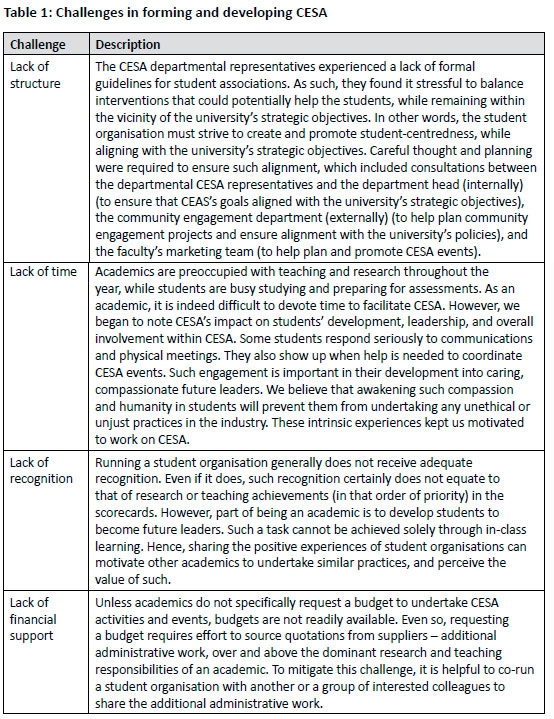
Challenges in forming and developing CESA
An overview of the main challenges in forming and developing CESA, along with their corresponding mitigation factors are shown in Table 1, based on reflections by the CESA departmental representatives.
Describing the planning and execution of CESA activities
The typical CESA events/activities include community engagement, peer mentorship, student development, awards and recognition. Each activity is conceptualised by the CESA departmental representatives. Once the details are finalized, they are presented to the department head for approval. Once the approval is obtained, flyers are created to promote the events, which are then posted to the online CESA group. A meeting is then set to clarify and guide the CESA students regarding their participation. The CESA student representatives for each year, and the student chairpersons then further delegate responsibilities among the CESA students. The student leaders are consulted to ensure that things are 'on track' and that challenges are dealt with. Development aspects such as leadership, communication, and management attributes (planning, organising, leading and controlling) are inherently passed down from the CESA academic coordinators to the student representatives through this structure. The sense of involvement aids in student retention.
Feelings and thoughts
Reflection on personal experiences as the chairpersons Rishen's reflections
I often reflect on my unpleasant experiences as an engineering undergraduate student. Many of my colleagues agree that studying engineering was a 'cold and clinical' experience with zero to very limited engagement with other students or lecturers. Reflecting on my own undergraduate experiences, many were very stressful. There were times when I was severely depressed and distraught due to the lack of support and motivation. Based on my experiences, I wanted to create an entirely different learning environment for my students. I want them to feel heard, supported, and cared for. I also wanted my students to feel confident, purposeful, motivated, encouraged, and feel like individuals who are established within a community - not just as numbers. Based on these core values, first, I teach the way I wanted to be taught. Second, I try to create a fun, light-hearted and supportive student community through CESA. I believe that helping the less fortunate is a value that all South Africans can relate to, in the spirit of ubuntu. Hence, I implemented community engagement as one of CESA's pillars. Through community engagement, the local community benefits from the combined efforts of students and staff, while the students benefit from a sense of connection with their fellow students, and their lecturers. For me, it is important to break down the barriers between students and lecturers. I believe that students can only learn when they start to perceive their lecturers as older versions of themselves. Such perceived relations can inspire students to believe in the potential within themselves. After all, their lecturers were once in the same phase of life as them.
My overall experiences as a CESA co-chairperson/department representative have been positive. Despite the challenges, I remain motivated and committed to working with and through CESA to positively impact my students. Through CESA, I get to develop my own students (second year) and those in other years of study. I also become familiar with first-year students, build a rapport with them, and look forward to teaching them in second year. As a new academic, I joined the university just before the pandemic lockdowns. Hence, I did not get the opportunity to engage with my colleagues and establish myself in the department for almost two years of the lockdown. Hence, CESA also gave me a chance to find my purpose in the department, and to connect with my colleagues and students in my role as a co-chairperson.
Naadhira's reflections
As the previous CESA departmental representative, I had an overall positive experience although maybe not entirely making the greatest impact we could have. The greatest benefit was working with students from all years of study and facilitating and assisting them in their CESA projects. I was able to create relationships with students that have now become colleagues and friends. CESA ran very few initiatives with two charity drives and a Chemical Engineering Ball as well as awards for the best lecturers every year. Students looked forward to the awards and ball as social highlights of the year.
Evaluating the impact of CESA activities on participants and the community
Last year, CESA facilitated a stationery collection drive in honour of Nelson Mandela Day and a sanitary towel drive for Women's month. The combined drives culminated in the collection of 70 packs of sanitary towels, at least four bags of clothing, and some stationery items, which were donated to a local women and children's shelter. An official handover ceremony took place towards the end of the year, where the donations were presented to the founder of the identified shelter. The event was attended by the faculty's marketing coordinator, the university's community engagement representative, the chemical engineering department head, the chemical engineering CESA co-chairs, and the CESA students. After each of the esteemed guests reflected on their experiences in the pilot drives, the founder of the shelter expressed her gratitude by indicating that the donated items were much needed and welcomed. During the emotional event, all the attendees experienced the social impact of their contributions to the local community and vowed to try harder to secure more donations in the forthcoming drives. Growing up in a tough economic climate and being plagued by social ills, such as substance abuse and gender-based violence, both staff and students valued the positive impacts made through CESA's community engagement initiatives.
Last year, an informal workshop was held on developing good LinkedIn profiles to help students who were near completion of their studies to possibly market themselves and secure employment using LinkedIn as a professional networking platform. Almost none of the students had previous experiences with LinkedIn, and asked questions, took notes, and requested additional resources. At the end of the workshop, the attendees expressed their gratitude and asked further questions.
Reflecting on the social, and developmental impacts made by CESA's activities last year, Rishen was motivated to build on these experiences and intensify CESA's activities this year by introducing a peer mentoring programme, in which student mentors and mentees volunteer to impart and seek professional and developmental advice from each other.
Analysing personal growth, skills development, and leadership opportunities
CESA provides an opportunity for students to grow as well-rounded contributing members of society by demonstrating that becoming engineers and professionals in the workplace is not on its own an adequate contribution to society. Learning to care for the well-being of the less fortunate and becoming proactive in community engagement even as students without much financial agency, is just as important as contributing to the productivity of a company in their future engineering professions.
Soft skills, such as time management, effective communication, peer collaboration, conflict resolution, and intrinsic learned behaviours, such as compassion and empathy, all contribute to the development of future leaders within CESA.
By joining the CESA community and actively participating in the exciting activities, students are afforded a break from their academic studies in a constructive and fulfilling manner. New students are also afforded a long-term opportunity to integrate into the wider university community and network with senior students for information. Such opportunities are not possible during the shorter orientation programmes for new students.
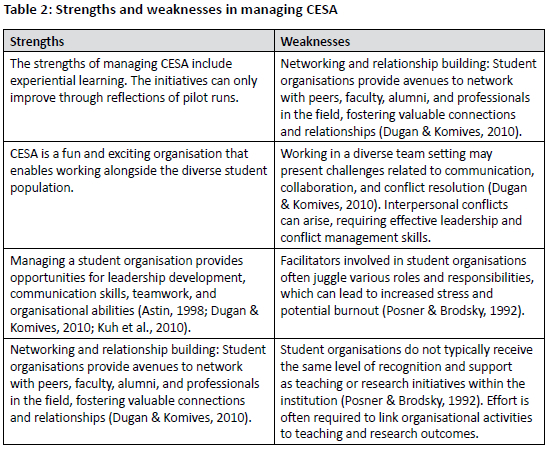
Identifying the strengths and weaknesses in managing CESA
Based on the reflections of the CESA departmental representatives, the strengths and weaknesses of managing CESA are shown in Table 2.
Evaluation and analysis
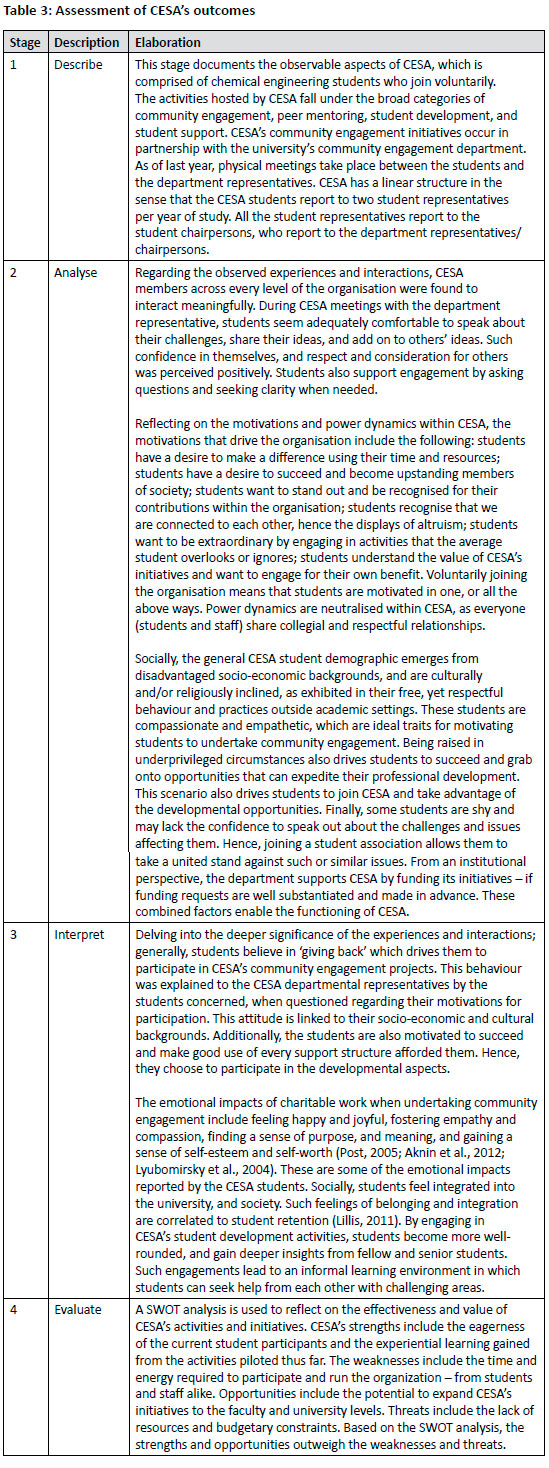
Assessing CESA's outcomes and achievements
The four stages in the framework for reflexive evaluation in student engagement (Healey & Jenkins, 2009) were used to guide the CESA departmental representatives' assessment of CESA's outcomes and achievements in Table 3.
Evaluating personal development and lessons learned as the chairpersons
Managing CESA has helped the CESA chairpersons to develop several skills: leadership, time management, communication and interpersonal skills, organisational and planning abilities, networking, and relationship building, problem-solving and adaptability, self-confidence and self-efficacy and personal growth and self-reflection (Astin, 1998; Dugan & Komives, 2010; Posner & Brodsky, 1992; Kuh et al., 2010).
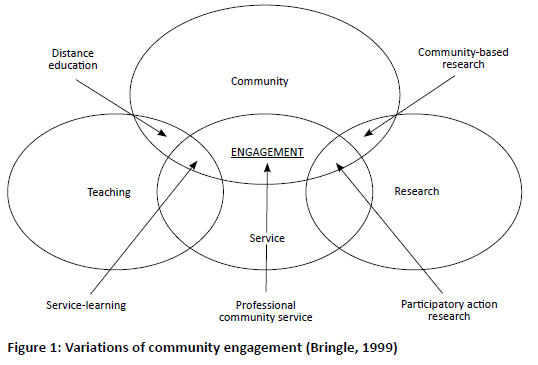
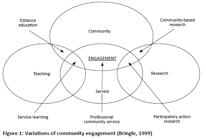
One of the biggest lessons learned is that initiatives to create student-centredness do not receive as much recognition as research and teaching related achievements in academia. Hence, effort is required to link CESA's activities and initiatives to teaching and research outcomes. According to Lazarus et al. (2008), community engagement combines and integrates service with teaching and research related and applied to identified community development priorities. As such, Figure 1 shows the ways in which community engagement can be linked to other key aspects of academia (Bringle, 1999). Future work will focus on attempting to integrate community engagement as a key CESA activity with research and teaching.
Discussing the relationship between CESA's activities and student-centredness
CESA uses its initiatives and activities as tools to promote student-centredness and development. Community engagement enables students to apply leadership and organisational skills in the 'real world' and provides a greater sense of personal identity, spirituality, and moral development (Bandy, 2011).
Regarding student development, Chickering and Reisser's (1993) psychosocial development theory outlines seven factors that govern student development: developing competence, managing emotions, moving through autonomy toward interdependence, developing mature interpersonal relationships, establishing identity, establishing, and clarifying purpose, and developing integrity (Foubert & Urbanski, 2006). Considering that each of these development factors were correlated to students' involvement in student clubs and organisations (Foubert & Urbanski, 2006), it is evident that CESA aids in student development through its student initiatives.
In addition, Magolda and Astin (1993) investigated the effects of students being involved in extra-curricular organisations. The study found that public speaking, leadership, and interpersonal skills correlated strongly with the time students spent participating in student organisations. Magolda and Astin (1993) believed that a student's peer group greatly influences their cognitive and affective development, as peers can involve each other more intensely in shared experiences (Foubert & Urbanski, 2006). However, it is worth clarifying that positive outcomes are typically only achieved when engaging with 'good quality' peers. In CESA's case, students join voluntarily with the desire to improve themselves and uplift others, thus befitting the "good quality" category. Interactions with peers of such calibre contributes to interpersonal competence, cognitive complexity, and humanitarianism (Kuh, 1995; Terenzini et al., 1996). Comparatively, new students who join student organisations have higher scores on developing purpose than those who do not join (Jackson & Bruegmann, 2009). Hence, getting first-year students to join CESA remains a priority.
Such claims were supported by Foubert and Urbanski (2006) who quantitatively found that participation in student organisations correlated to psychosocial development, in terms of students' purpose, educational involvement, career planning, life management, and cultural participation. Considering that students who participate in student organisations demonstrated higher levels of development (Foubert & Urbanski, 2006), they outlined the significance of creating meaningful involvement opportunities for students, to promote overall development. Hence, the motivation to use experiential learning to ensure CESA's continuous improvement.
Conclusion and action plan
Summarising the key experiences, thoughts, and evaluations of the CESA departmental representatives
The key experiences, thoughts, and evaluations can be summarised as follows: the inception of CESA under the leadership of the departmental chairpersons aimed to create a student-centred environment and address the shortcomings of student isolation and deficient student orientation programmes. The chairperson role involved developing CESA's mission and goals, engaging with students, planning and facilitating events, and acting as liaisons between students and other lecturers.
The re-establishment of CESA was initially unclear. The pressure to create a reliable starting point that would foster student-centredness was overwhelming. Running the online organisation like a blog during the lockdown helped to provide support and promote students' development and well-being.
Forming CESA was challenging, due to a lack of structure, time constraints, limited recognition, and financial support. Mitigation strategies included aligning CESA's goals with the university's strategic objectives, highlighting the impact on students' development, sharing positive experiences to motivate the participation of other academics, and co-running the organisation to share administrative work.
Community engagement initiatives formed a significant part of CESA's activities, aiming to benefit both the local community and the students. Examples included stationery and sanitary towel drives, as well as student development workshops. The positive impact of these activities was evident in the donations received and the gratitude expressed by the community.
Managing CESA provided personal growth opportunities, skills development, and leadership experiences. It allowed the chairperson to create a different learning environment for students, foster a sense of connection and belonging, and develop students into caring and compassionate future leaders.
Strengths in managing the organisation included experiential learning and the opportunity to work with a diverse student population. Weaknesses included challenges related to structure, time, recognition, and financial support, but these could be mitigated through careful planning, collaboration, and sharing responsibilities.
Overall, the chairperson experience was positive, and the commitment to positively impact students through CESA remained strong.
Reflecting on the lessons learned from the CESA experiences
Based on the reflections of the CESA chairpersons, regarding their personal development and lessons learned, various skills were required to manage CESA, such as leadership, time management, communication, organisational abilities, networking, problemsolving, and self-confidence. Acknowledging that student-centredness initiatives are not as recognised as research and teaching achievements in academia, the chairpersons plan to integrate CESA's activities with teaching and research outcomes to highlight the importance of student-centredness.
The reflective article considered the relationship between CESA's community engagement activities and student development. Community engagement provides students with opportunities to apply leadership and organisational skills in real-world contexts, fostering individuality, spirituality, and moral development. Overall, the article suggests that involvement in student clubs and organisations, such as CESA, correlates with positive student development outcomes, as referenced in literature findings. Studies by Astin and Sax (1998) and Foubert and Urbanski (2006) support the idea that participation in student organisations enhances students' cognitive and affective development. Positive peer interactions in student organisations contribute to interpersonal competence, cognitive complexity, and humanitarianism. The article emphasises the importance of involving first-year students in CESA to foster purpose development. Participation in student organisations is associated with psychosocial development in areas such as educational involvement, career planning, life management, and cultural participation. In conclusion, these combined benefits effectively cultivate a culture of student-centredness. Hence, the reflections support the argument of the article.
Proposed action plan for CESA's future improvement and growth
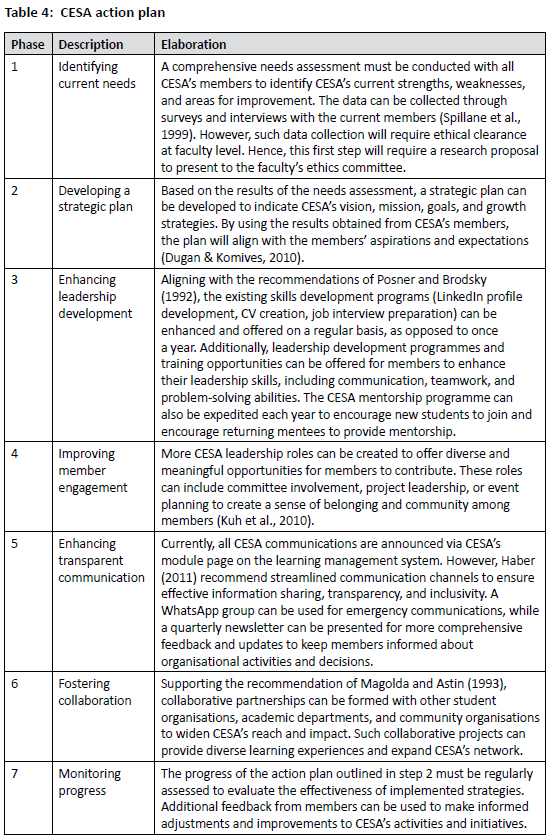
A seven-step action plan is proposed to ensure CESA's future improvement and growth (Table 4).
Ethical considerations
No ethical clearance was required, as the data were sourced from the authors.
Potential conflict of interest
There were no conflicts of interest involved in authoring this article.
Funding acknowledgement
No funding was required in authoring this article.
References
- Aknin, L. B., Dunn, E. W., & Norton, M. I. (2012). Happiness runs in a circular motion: Evidence for a positive feedback loop between prosocial spending and happiness. Journal of Happiness Studies, 13(2), 347-355.
- Astin, A. W., & Sax, L. J. (1998). How undergraduates are affected by service participation. Journal of College Student Development, 39(3), 251-263.
- Bandy, J. (2011). What is service learning or community engagement? Center for Teaching, Vanderbilt University. https://cft.vanderbilt.edu/guides-subpages/teaching-through-community-engagement.
- Bender, T. (2008). Discussion-based online teaching to enhance student learning: Theory, practice, and assessment. Stylus Publishing.
- Bringle, R. G. (1999). Integrated learning: The significance of community service for student development. Michigan Journal of Community Service Learning, 6(1), 30-35.
- Chickering, A. W., & Reisser, L. (1993). Education and identity. The Jossey-Bass Higher and Adult Education Series. Jossey-Bass.
- Cuseo, J. (2010). The empirical case for the first-year seminar: Promoting positive student outcomes and campus-wide benefits. In The first-year seminar: Research-based recommendations for course design, delivery, and assessment (pp. 1-33). Kendall/Hunt.
- Dugan, J. P., & Komives, S. R. (2010). Developing leadership capacity in college students: Findings from a national study. ACPA-College Student Educators International.
- Ferdiansyah, D., & Meutia, H. (2017). The impact of a student organization (OSIS) on leadership identity development (LID) [Unpublished master's thesis]. University of Tampere.
- Gibbs, G. (1988). Learning by doing: A guide to teaching and learning methods. Further Education Unit.
- Healey, M., & Jenkins, A. (2009). Developing undergraduate research and inquiry. Higher Education Academy.
- Huseb0, S. E., O'Regan, S., & Nestel, D. (2015). Reflective practice and its role in simulation. Clinical Simulation in Nursing, 11(8), 368-375.
- Jackson, C. K., & Bruegmann, E. (2009). Teaching students and teaching each other: The importance of peer learning for teachers. American Economic Journal: Applied Economics, 1(4), 85-108.
- Jasper, M., & Rosser, M. (2013). Reflection and reflective practice. In M. Jasper, M. Rosser & G. Mooney (Eds.), Professional development, reflection and decision-making in nursing and healthcare (2nd ed., pp. 41-82). Wiley-Blackwell.
- Kuh, G. D., Kinzie, J., Schuh, J. H., & Whitt, E. J. (2010). Student success in college: Creating conditions that matter. John Wiley & Sons.
- Lim, S. Y. J., & Vighnarajah, V. (2018). Influence of student isolation on students' university learning experiences: Perspectives of academic, social and psychological development. SHS Web of Conferences, 53, 05005.
- Lyubomirsky, S., Tkach, C., & Sheldon, K. M. (2004). Pursuing sustained happiness through random acts of kindness and counting one's blessings: Tests of two six-week interventions. [Unpublished manuscript].
- Magolda, M., & Astin, A. (1993). What matters in college: Four critical years revisited. Educational Researcher, 22(8), 32.
- Posner, B. Z., & Brodsky, B. (1992). A leadership development instrument for college students. Journal of College Student Development, 33, 231-237.
- Post, S. G. (2005). Altruism, happiness, and health: It's good to be good. International Journal of Behavioral Medicine, 12(2), 66-77.
- Spillane, J. P., Halverson, R., & Diamond, J. B. (1999). Distributed leadership: Toward a theory of school leadership practice. Institute for Policy Research, Northwestern University.
- Terenzini, P. T., Cabrera, A. F., & Bernal, E. M. (1996). Swimming against the tide: The poor in American higher education. American Journal of Education, 104(4), 366
Accepted 25 October 2023
Published 14 December 2023