Navigating bounded agency in exercising climate action: Insights from Malawian and Zambian university students
Abstract
The pressing issue of climate change has galvanized a global movement, with young people at the forefront as advocates for environmental action. However, various structural and institutional factors often constrain the ability of university student environmentalists to translate their concerns into meaningful action. Using the concept of bounded agency within the capability approach, this qualitative study explored the perspectives of students from two universities, one in Malawi and one in Zambia, to better understand the challenges and opportunities they encounter in their efforts to translate their environmental concerns into tangible outcomes. The study reveals that while participants are deeply committed to environmental concerns, they encounter significant obstacles, including a lack of institutional support and resources, sociocultural norms, and university power structures that marginalize their voices. Despite these challenges, students employ strategies such as building cross-institutional collaborations with NGOs, leveraging social media, and engaging in grassroots advocacy to navigate their bounded agency. The findings of this study contribute to a deeper understanding of the complex dynamics that shape the landscape for student environmentalists' climate action efforts in the Global South, highlighting the resilience and resourcefulness of student environmentalists in overcoming barriers to drive environmental sustainability.
Climate action; students; bounded agency; capability approach
Abstract
Nkhani yofunikira kwambiri yakusintha kwanyengo ikupangisa maiko ambiri kutengapo gawo pantchito zosamalira chilengwedwe. Mwa ena, achinyamata nawo akuonetsa chidwi chochuluka potengapo gawo polimbikisa ntchito zosamalira chilengedwezi. Ngakhale izi zili choncho, achinyamatawa akukumuna ndi ziphinjo zosiyanasiyana kuti akwanilise maloto awowo. Pogwilitsa ntchito tsanamira za kuunikila zothekela mwa munthu muntchito zosiyanasiyana, kafukufukuyu anaunikila maganizo a achinyamata ochokela musukulu za ukachenjede ziwiri, ina yaku Malawi ndipo ina yaku Zambia kuti timvese bwino ziphinjo zomwe achinyamatawa amakumana nazo musukuluzi akafuna kupititsa patsogolo ntchito zosamalira chilengedwe. Zotsatira zakafukufukuyu zaonetsa kuti ngakhale achinyamata akutenga gawo pa ntchito yosamalira zachilengedwe ndipo akudzipereka kwambiri pantchitoyi, amakumananso ndi mavuto osiyanasiyana monga: kusowa kwa chithandizo chochokera ku utsogoleri wamasukulu awo, kusowa kwa zinthu zogwiritsa ntchito pogwira ntchito imeneyi, zikhulupiriro za anthu a zikhalidwe zosiyanasiyana komanso kupondelezedwa ndi anthu a udindo m'sukulu zaukachenjedezi. Ngakhale pali mavuto amenewa, ophunzirawa amakhazikitsa njira zosiyanasiyana zothetsela mavuto awo monga: kukhazikitsa ubale ndi mabungwe omwe si aboma kuti azipeza thandizo la zida zogwilira ntchito, kugwiritsa bwino ntchito masamba a mchezo pofalitsa ntchito zawo, komanso kukhala nawo mmagulu a anthu olimbikitsa za kasamaliridwe kachilengedwe. Zotsatira za Kafukufukuyu zikutsindikiza nsanamira zosiyanasiyana zomwe zingathandize achinyamata kutengapo gawo posamalira zachilengwedwe ku maiko akummwela kwa Afrika polimbikitsa kupilira komanso kuthekela komwe achinyamata ali nako popititsa patsogolo ntchito zosamalira chilengedwe.
Kugwila ntchito zosamalira chilengedwe; ophunzira; kuthekela; kuchepesa ziphinjo
Introduction
Climate change has emerged as one of the defining challenges of our time, with far-reaching consequences for the global environment, economies, and human well-being (Leal Filho, 2023a; McCowan, 2020; IPBES, 2019; IPCC, 2019). Young people, particularly university students, have been at the forefront of the environmental movement, advocating for immediate and decisive action to address this crisis (Owojori et al., 2022; Gharabaghi & Anderson-Nathe, 2018). For example, students have organised climate strikes and protests to raise awareness and demand policy changes from governments and institutions (Gorman, 2021; Prendergast et al., 2021). They have also initiated campus-based sustainability projects, such as renewable energy installations, waste reduction initiatives, and sustainable food programmes (Leal Filho, 2024; Benayas et al., 2010). With the number of students expanding exponentially in the Global South, where climate impacts are mostly felt (Reimers, 2024), student environmentalists, with their passion, energy, and fresh perspectives, have played a crucial role in mobilizing their peers and communities to advocate for climate action and demand climate justice and sustainable solutions (Lozano et al., 2013).
Despite their efforts, this student action remains not fully recognised in higher education in terms of how the sector can effectively advance climate action initiatives through diagnosis, research, and action (Gorman, 2021; Prendergast et al., 2021). Even worse, students often encounter obstacles to fully achieving their goals and aspirations, including a lack of institutional support, limited resources, and resistance from some university administrators (McCowan, 2020). These challenges often limit their ability to effectively advance climate action initiatives. Unsurprisingly, given the wide range of student roles in advancing sustainable environmental actions, climate education is also a gradually increasing challenge in higher education, especially in sustainability-related fields (McCowan, 2020). Universities are under increasing pressure to demonstrate institutional commitment towards sustainable community well-being, necessitating the active engagement and empowerment of students as key stakeholders in the fight against climate change (Ojala, 2016; Gharabaghi & Anderson-Nathe, 2018). However, the capacity or agency of these young advocates to translate their concerns into meaningful and lasting change is often constrained by various structural and institutional factors, a term referred to as bounded agency in the capability approach. Bounded agency sheds light on this complex dynamic, highlighting how individual agency is shaped and limited by the social, political, and economic contexts in which it is exercised (Evans, 2007). This is particularly relevant in sustainable environmental actions, where student environmentalists navigate a web of institutional barriers, resource constraints, and entrenched power dynamics (Ojala, 2016).
In this article, we explore the perspectives and experiences of student environmentalists from two public universities, one in Malawi and one in Zambia. Our aim is to understand the limitations and constraints these individuals or groups face in their efforts to enact change, even when they are motivated and willing to do so. The research questions are as follows:
• What factors shape student climate actions?
• How do students navigate the constraints of bounded agency, and what strategies do they employ to advance climate action despite these challenges?
The findings of this study contribute to a deeper understanding of the dynamics surrounding student environmentalism in the Global South. Understanding the factors that shape students' climate actions will illuminate the various social, economic, and cultural influences at play, revealing both the opportunities and barriers they encounter. Additionally, examining how students navigate the constraints of bounded agency will shed light on their resilience and resourcefulness in overcoming challenges. The strategies they employ to advance climate action can inform educators, policymakers, and organisations seeking to empower young advocates, ultimately enhancing support systems and fostering a more robust movement for environmental sustainability.
Following this introduction, the next section reviews relevant literature on climate change and students action in that regard. The theoretical underpinning of this article, drawing on the concept of bounded agency, is then discussed. We then describe the methodological approach before delving into the pertinent findings of the study. Lastly, we provide recommendations and a conclusion.
climate action and its determinants: Knowledge, norms and values
In climate change discourse there are varying perspectives regarding the factors that motivate students to adopt climate-sensitive behaviours such as advocacy and activism, eco-conscious consumerism, knowledge and awareness, adoption of sustainable practices, etc., and actions. Kolenaty et al. (2022) emphasise knowledge as a primary driver for climate action. Their research highlights that awareness and understanding of climate change positively influence individuals' willingness to act, their actions, and their sense of efficacy in addressing climate issues. This aligns with the premise that climate-related education is essential for fostering proactive behaviours among individuals. The acquisition of knowledge not only empowers individuals but also paves the way for broader national initiatives and commitments to combat the climate crisis (UNESCO & UNFCCC, 2016). Conversely, other studies present a more nuanced view. Research by Koessler et al. (2022) and Busch et al. (2019) indicate a weak correlation between knowledge and concern, or behaviours related to climate action. These findings suggest that while knowledge is important, it may not be a strong determinant of climate-conscious behaviours among young people. In their effort to construct an empirically supported theoretical model for youth engagement in climate action, Busch et al. (2019) argue that social norms are more significant predictors of climate-conscious behaviours than knowledge itself. Literature further supports this notion, showing that social factors like political affiliation and identity, in terms of how individuals perceive climate change and their willingness to act based on their sense of self and their connection to social, cultural, or political groups, significantly influence individual actions concerned with climate change (Fielding & Hornsey, 2016). Additionally, individuals who engage in discussions about climate change with peers and family tend to develop a heightened sense of concern regarding their environmental impact (Koessler et al., 2022).
Another substantial body of literature suggests that individuals' values are pivotal in determining climate-conscious action. Values, defined as the goals and desires individuals strive to achieve, can vary significantly in their endorsement across individuals (Hanel, 2018; Schwartz, 2017; Maio, 2016). In the context of climate action, values help shape how individuals prioritize environmental concerns in relation to other personal or societal goals. For example, individuals who hold 'biospheric values' - those that emphasise concern for nature and the well-being of the planet - are more likely to see themselves as environmental stewards and take actions aimed at mitigating climate change. These values become a core part of their identity, influencing their attitudes, behaviours, and even social affiliations. Steg (2014) and Dietz (2015) identify four distinct types of values that influence the extent to which individuals engage in climate action: biospheric, altruistic, egoistic, and hedonic.
• Biospheric values reflect a general care and concern for the environment.
• Altruistic values indicate a concern for the well-being of others.
• Egoistic values focus on personal status and economic possessions.
• Hedonic values pertain to the pursuit of comfort and pleasure.
While biospheric and altruistic values are often seen as conducive to positive environmental actions, the literature suggests that egoistic and hedonic values also play a significant role in shaping individuals' decisions to act - or not act - on climate issues (Bouman et al., 2018; Steg et al., 2014).
The role of education in climate action
Education is a crucial determinant of climate action, shaping students' understanding and engagement in environmental initiatives. Akrofi et al. (2019) indicate that students' knowledge about climate change significantly influences their involvement in sustainability efforts. Furthermore, the integration of climate education into university curricula enhances students' comprehension of environmental issues and empowers them to act (Leal Filho et al., 2023a). A study by Leal Filho et al. (2022) emphasises the importance of integrating sustainability into curricula across various disciplines. The authors argue that when students are equipped with knowledge about environmental issues, they are more likely to engage in activism.
Similarly, research by Chawla and Cushing (2021) suggests that experiential learning opportunities, such as fieldwork and community projects, enhance students' understanding of climate issues and empower them to act. These educational experiences foster a sense of agency, enabling students to believe their efforts can lead to meaningful change. However, challenges persist within current educational frameworks. For instance, environmental curricula often overload students and lack practical relevance, hindering their ability to apply theoretical knowledge to real-world challenges (Ishaque et al., 2025). This disconnect between theory and practice can diminish students' agency and effectiveness in climate action (Rieckmann et al., 2021). Liston and Devitt (2020) articulate this concern by comparing the classroom experience to a passive environment, akin to being in 'church,' where students are mere recipients of information rather than active participants in their learning journey. This observation emphasises the need for more interactive and experiential learning opportunities that can stimulate students' critical thinking and problem-solving abilities.
A rationale for climate action among student environmentalists?
Scholars have recognised that the expectations to respond to climate change encompass a wide range of economic, social, technological, political, and individual factors (Rieckman et al., 2021; Vargas-Callejas et al., 2018). Among these factors, one primary motivation for student environmentalists is their desire to create a sustainable future and express deep concern about the long-term implications of climate change, not only for their own lives but also for future generations (Kelsey et al., 2022). This sense of urgency is often fuelled by personal experiences with environmental degradation, such as extreme weather events and local pollution (Sullivan et al., 2021). The drastic increase in climate-induced disasters in recent years has heightened awareness among youth regarding the critical need for sustainability. This awareness stems from the belief that the current generation will bear the brunt of climate change's adverse effects (UNDP, 2023). Consequently, climate action, manifested through various forms of activism and personal endeavours, has evolved significantly over time.
University students have increasingly become active participants in responding to the climate crisis globally. Leal Filho et al. (2023b) note that universities possess an unparalleled potential to equip students with knowledge about climate change and foster their engagement in climate action. This involvement is crucial, especially considering the undermining influence of climate change on achieving long-term sustainability (Haq & Ahmed, 2020; Mugambiwa & Dzomonda, 2018). Furthermore, research by Hsu and Ritchie (2023) highlights that students are increasingly motivated by a moral obligation to address climate injustice, particularly as marginalized communities disproportionately bear the brunt of environmental harm. As students' attitudes and behaviours regarding sustainability are influenced by the knowledge they possess about climate change (Akrofi et al., 2019), the expectations for student environmentalists to drive climate action continue to grow.
Issues affecting climate action among students
A foundational issue affecting climate action among students is the level of awareness and understanding of climate change. According to Hine et al. (2021), many students exhibit a limited understanding of climate science, which can lead to apathy and disengagement. The authors further argue that educational institutions must prioritize comprehensive climate education to foster informed activism. Similarly, McCright and Dunlap (2018) emphasise that misinformation surrounding climate change can skew perceptions and reduce the urgency for action among students. Other scholars have highlighted motivation as a critical factor in driving student engagement in climate action. According to O'Brien et al. (2020), feelings of helplessness and despair regarding climate change can inhibit student activism. They suggest that fostering a sense of agency - where students believe their actions can make a difference - is essential for motivating climate action. Furthermore, research by Dempsey et al. (2022) indicates that peer influence significantly impacts students' willingness to engage in climate initiatives, highlighting the importance of social networks in fostering a culture of activism.
Socio-economic background significantly influences students' capacity to engage in climate action. A study by Esakkimuthu and Banupriya (2023) found that students from lower socio-economic backgrounds often face barriers such as lack of access to resources, time constraints, and competing responsibilities, which limit their ability to participate in climate initiatives. The authors argue that addressing these disparities is vital for inclusive climate action. Additionally, research by Pahl et al. (2021) highlights that financial concerns can deter students from participating in sustainability programmes, suggesting that institutions need to provide more accessible opportunities for engagement.
Institutional support is another critical factor affecting student climate action. According to a study by Leal Filho et al. (2022), universities that actively promote sustainability through policies, funding, and dedicated programmes see higher levels of student participation in climate initiatives. The authors emphasise the need for institutions to create supportive environments that encourage student-led sustainability projects. Conversely, lack of institutional support can lead to frustration and decreased motivation among students, as highlighted by Gough et al. (2023). Studies show that partnerships with non-governmental organisations (NGOs) and access to funding significantly enhance students' capabilities to implement meaningful environmental projects (Bennett, 2022). For example, collaborations with local organisations can provide students with the necessary tools, mentorship, and networking opportunities to translate their environmental advocacy into actionable plans. However, many students face bureaucratic hurdles and insufficient support from their universities which can stifle their motivation and engagement (Sule, 2024).
Conceptual framework
In this study, we draw upon the conceptual perspectives of the capability approach (Sen, 1999; Nussbaum, 2011) which provide a nuanced understanding of the concept of bounded agency as experienced by student environmentalists in Malawi and Zambia. In the context of this study, the capability approach underscores the need to consider the multidimensional factors that enable or constrain the agency of student environmentalists in exercising their rights and freedoms to advance climate action initiatives. The concept of agency in the capability approach emphasises that individuals should actively participate in driving change rather than being passive recipients of it (Sen, 1999). Alkire (2010) adds that the different opportunities for agency empower people to promote the common good, giving them a voice and the ability to engage in processes that impact their lives. Therefore, students' agency in participating in climate and environmental action can be seen in terms of their freedom or accomplishments, depending on how they utilise opportunities for climate action. This perspective sheds light on the structural, institutional, and sociocultural barriers that can limit the agency of student environmentalists, thereby restricting their ability to participate fully in the process of human development and environmental sustainability.
As such, bounded agency highlights the complex interactions between individuals and the structures in which they exist and function. It points to the consideration of people as having a sense of ability to engage in things they regard as meaningful, but being shaped by different realities (Róbert, 2012). Therefore, the concept of bounded agency, as applied in this study, acknowledges that the ability of student environmentalists to exercise their agency is not an absolute or unconstrained phenomenon. Rather, it is shaped by the interplay of individual, institutional, and societal factors that enable or constrain their capacity to translate environmental concerns into meaningful action. Their perspectives and experiences should be understood within the broader context of their capabilities, access to resources, and the structural and institutional environments in which they operate.
Methodology
This study employed a qualitative research design to explore the perspectives and experiences of student environmentalists in Malawi and Zambia. These countries, situated in sub-Saharan Africa, face unique challenges in addressing climate change, with limited resources, infrastructure, and institutional capacity to support environmental initiatives (IPCC, 2022). This article draws on the empirical findings of two PhD projects that focused on environmental sustainability and climate action. The study conducted in Malawi, titled University Community Partnerships for Climate Change Adaptation in Malawi: A Human Development Perspective, was undertaken between 2021 and 2023 with Lilongwe University of Agriculture and Natural Resources (LUANAR) as a case study. It focused on engaging university stakeholders, including staff and students, as well as community members, to explore how partnerships for climate adaptation can be operationalized to promote sustainable community well-being. This study aimed to bridge the gap between academic institutions and local communities by fostering collaborations that address climate-related challenges and enhance resilience through collective action. Meanwhile, the study in Zambia, titled The Role of Environmental Education in Fostering Agents of Environmental Sustainability in Zambia, was carried out between 2022 and 2024 and focused on the University of Zambia (UNZA). This research engaged students, university staff, and government stakeholders to investigate the influence of environmental education on both past and present students of the university. The study specifically examined how environmental education shaped students' agency and capacity to drive positive environmental change and sustainability efforts. By focusing on the transformative potential of education, the study sought to understand the extent to which environmental education equips individuals to act as agents of change in addressing pressing environmental issues.
Both studies employed qualitative research methodologies to collect and analyze data. In Malawi, qualitative data provided insights into the dynamics of university-community partnerships and their potential to foster sustainable development, with a particular focus on students' agency in advancing climate action. Similarly, in Zambia, qualitative methods allowed for an in-depth exploration of the impact of environmental education on students' attitudes, behaviours, and actions toward environmental sustainability. Together, these studies contribute valuable knowledge on how academic institutions, through partnerships and education, can play a pivotal role in supporting students navigate challenges in advocating for climate action. In this article we draw from the key findings in the two research papers to highlight what can be learnt from the two converging cases because they explored interrelated issues. The findings presented in this article provide an in-depth understanding of the contextual factors that shape the climate action efforts of these young advocates.
Participants and recruitment
We explicitly targeted students from the two selected universities who had been actively involved in environmental organisations or initiatives during their studies. We identified 20 participants (all undergraduate students), 10 from each university, using a purposive sampling technique to ensure diverse representation in terms of gender, academic discipline, and level of involvement in environmental activities. The students who participated in the study were drawn from environmental education and environmental science programmes. These programmes were selected because they share similarities in their curriculum design, with both emphasising foundational knowledge in climate change, environmental sustainability, and ecological conservation. The overlap in content across these programmes provided a robust basis for understanding how students from different but related academic disciplines approach climate action. We defined students' environmental actions broadly, encompassing various activities, initiatives, and advocacy efforts undertaken by students to promote sustainable environmental practices, raise awareness, and enact positive change. Some of these initiatives include but are not limited to campus-based initiatives that directly reduce the environmental footprints of their educational institutions, community engagement initiatives and policy, advocacy and research initiatives. The decision to target these two universities was based on the relevance of the institutions in environmental scholarship and the geographical location as the two are neighbouring countries in Southern Africa, sharing similar socio-economic and environmental challenges.
Recruitment and participation of the participants was voluntary and was facilitated by department heads sending participation requests through class representatives, allowing students to make informed and voluntary decisions to participate. Targeted students were those involved in environmental clubs which among other things provide opportunities for students to engage in sustainable initiatives and environmental advocacy. The voluntary nature of the recruitment process and the targeting of students involved in environmental clubs ensured that the participants were self-motivated and actively engaged in environmental issues, which was important for the study to capture the nuanced perspectives and experiences of student environmentalists.
Data collection
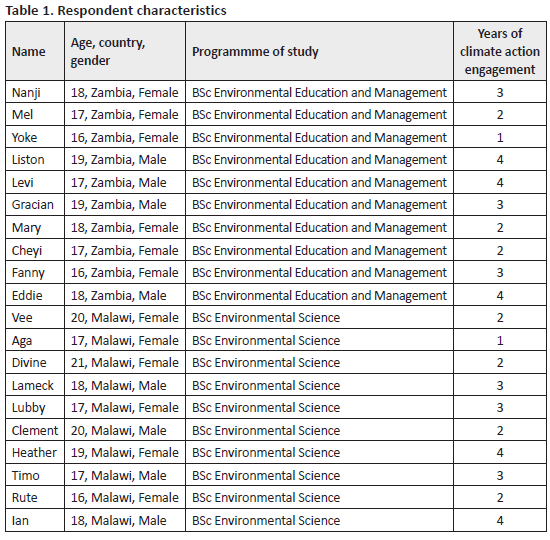
The primary method of data collection was semi-structured interviews, which allowed for the exploration of participants' perspectives, experiences, and the contextual factors that influenced their agency in addressing climate change. The interview guide was developed based on the conceptual framework and the key themes of the capability and human development approaches. Some of the key questions included were: "What factors have influenced your decision to engage in climate action initiatives, and how have these factors shaped your approach to addressing environmental challenges?" and "What challenges or barriers have you faced in your efforts to promote climate action, and what strategies have you employed to overcome these challenges? We conducted the interviews in person or via video conferencing, depending on the participants' availability and location. Table 1 contains the details of the students who participated in the interviews (n=20). The participants were given pseudonyms to secure their identities and any sensitive personal information that could compromise confidentiality has been omitted. Each interview lasted approximately 60 to 90 minutes and was recorded with the consent of the participants. In terms of transcription, the authors uploaded the recordings on notta.ai and then carefully listened to each recording while reading what had been translated and correcting where necessary. The centrality of this process was to translate and transform all recorded sounds into comprehensible text.
Data analysis
The analysis of the interview data adhered to the principles of reflexive thematic analysis as outlined by Braun and Clarke (2022). The analysis process involved familiarising oneself with the data, making initial annotations, reflectively developing themes, establishing connections, and revising the themes. Coding was based on the research questions and N-Vivo was employed to refine the key themes and develop a comprehensive understanding of the participants' perspectives and experiences. The authors discussed the emergent themes including self-reflexivity, choice of narrative frame, and final naming. Consensus was reached by the authors
Findings and discussion
Factors that shape students' climate action Education and awareness
Being environmentally knowledgeable may appear to influence one's actions, as highlighted by Misra and Panda (2017). However, data from the study revealed that higher education plays a pivotal role in shaping students' understanding of climate and environmental issues. This understanding, gained through education, directly impacts their decisions to engage in sustainability actions. Furthermore, higher education also influences the extent to which students are willing and able to pursue these sustainability efforts. Such findings align with the conclusions of Weckroth and Ala-Mantila (2022), which indicate that higher education positively influences individuals' intentions to engage in climate-related activities and increases the number of such actions they are likely to undertake. Participants affirmed that a curriculum that integrates these topics not only informs them about the state of the planet but also equips them with the knowledge necessary to make informed decisions. By engaging with subjects such as ecology, renewable energy, and sustainability practices, students grasp the complexity of climate change and its multifaceted impacts. For instance, Gracian (19, Zambia, Male) shared that the foundational knowledge empowers them to act, whether through personal lifestyle changes or active participation in community initiatives:
... I never fully understood the gravity of climate change until I joined Lilongwe University of Agriculture and Natural Resources, (LUANAR). Learning about the effects of deforestation and the importance of renewable energy opened my eyes to the challenges our planet faces. I remember a project where we had to analyze local water sources and their pollution levels. It was shocking to see how our actions directly impacted our community's health and the environment. This knowledge inspired me to join the environmental club where we could advance recycling initiatives at our school and organise clean-up days in our neighborhood. I realised that even small actions could make a difference. Education gave me the tools to not only understand the issues but also to feel empowered to advocate for change, both in my life and in my community.
Aside from classroom knowledge, which the students appeared to have been sufficiently taught, students further shared that participating in social clubs such as the environmental club strengthens their critical thinking and problem-solving skills which encourages them to develop innovative solutions to environmental challenges, fostering a sense of responsibility and agency in addressing climate issues. Rute (16, Malawi, Female) exemplifies this point below:
Participating in our school's environmental club has been a game-changer for me. In addition to learning about climate change, our school's environmental club encouraged us to critically think about the problems we face. For our final project, we had to identify an environmental issue in our community and propose a solution. We chose to focus on beekeeping and entrepreneurial activity to help our group and communities generate income from the sales of honey. We also came up with a plan to create an awareness campaign on campus on recycling. This experience taught me that we can't just complain about problems; we need to actively seek solutions. It made me realise that I have the power to make a difference and that responsibility drives me to keep advocating for my community.
The above reflections suggest that education and awareness serve as foundational elements in shaping students' understanding and actions regarding climate change. Students' insights underscore the transformative potential of an integrated curriculum that not only imparts knowledge but also fosters critical thinking and problem-solving skills. While students like Gracian and Rute demonstrate a growing sense of agency through their educational experiences, it is essential to recognise that their ability to effect change is influenced by the resources and support available to them. Their narratives illustrate a shift from passive recipients of knowledge to active participants in environmental advocacy, highlighting the role of education in expanding their capabilities (Nussbaum, 2011). Moreover, education is not just a means to an end but a fundamental component of human flourishing and societal progress (Tilbury, 2011). Further, the collective approach to environmental challenges, as exemplified by students collaborating and devising solutions that benefit themselves and communities, reflects the interconnectedness of human development and sustainability, reinforcing the idea that empowering individuals through education can lead to broader societal change (UNESCO, 2017).
Peer influence
In light of the ongoing literature on how peer influence shapes and enhances learning outcomes (Shao et al., 2024; Filade et al., 2019; Lubbers et al., 2006), this study further established that social dynamics among students significantly impacted their engagement in climate activism. In both countries, participants shared that friends and social networks often serve as powerful motivators, encouraging individuals to participate in collective actions such as environmental campaigns which involve sweeping and cleaning campus premises. The following narrations provide further insights:
It was inspiring to see how our enthusiasm for climate action ignited a spark in others. One of my friends, Sarah, had been hesitant about joining any activism before, but when she saw us rallying together for a campus clean-up event, she couldn't resist. She motioned to me that is 'If you're doing it, I want to be part of it too'. (Nanji, 18, Zambia, Female)
I remember sitting in the cafeteria when a couple of my friends started discussing the need for bigger bins on campus and who was responsible for that and how the university should assist with installing bigger ones. Their conversation quickly turned into a passionate debate, and one of my colleagues I was sitting next to joined in. We ended up approaching the student council to ask management to address the issue. (Yoke, 16, Zambia, Female)
When I just arrived at LUANAR, I joined an environmental club, and it was eye-opening to see how continuing students influenced my perspective. One afternoon, while discussing our upcoming projects, my friend Lucy shared her story of participating in a local treeplanting event. Inspired by her experience, I decided to join the next event. It was amazing to see how her passion not only motivated me but also encouraged others in our group to get involved. (Lubby, 17, Malawi, Female)
The students' narratives above illustrate the social dynamics at play, where peer influence catalyzes individual involvement in climate action. For instance, Nanji's transformation from hesitation to active participation reflects how supportive social environments can enhance personal agency, allowing individuals to overcome barriers to engagement (Robeyns, 2005). Similarly, the collaborative efforts to address campus issues demonstrate that when individuals come together, they can advocate for systemic changes, thereby improving their collective capabilities. Ultimately, these insights underscore the importance of fostering supportive peer networks to enhance individual and collective agency in pursuit of sustainable development goals (Pelenc et al., 2016). Such findings further resonate with existing literature that highlights the role of social networks in fostering environmental engagement among youth (Koessler et al., 2022; Fielding & Hornsey, 2016). The collective enthusiasm among peers not only fosters a sense of belonging but also amplifies the impact of individual actions, thereby enhancing the overall effectiveness of climate initiatives.
Access to resources and institutional support
The availability of resources has enhanced students' ability to engage in efforts and movements aimed at addressing and combating climate change and its impacts. With the support of materials such as educational materials, funding from NGO projects, and platforms for organising events, most participants acknowledged that they now were embarking on a combination of climate action interventions within and beyond the university. In the case of LUANAR, this study found that students from the Bunda Environmental Club partnered with the Jesuit Centre for Ecology and Development (JCDE) and Trocaire to empower young people and foster their passion for environmental conservation. It further emerged that through such partnerships, students accessed additional resources, mentorship, and networking opportunities, empowering them to implement meaningful changes within their communities. The following excerpts provide further insight into this:
Having access to vital resources has transformed us from passive observers into active participants in the fight against climate change. (Eddie, 18, Zambia, Male)
With the support of networks and funding opportunities, we've been able to turn our environmental passions into tangible actions that really resonate in our communities. (Vee, 20, Malawi, Female)
In addition to resources, students shared that the universities actively prioritize environmental stewardship by granting them access to university space to conduct awareness campaigns and other activities.
Therefore, the availability of resources enhances students' capabilities from passive observers into active participants, thus contributing to the broader literature that emphasises the importance of empowerment in driving climate action (Bennett, 2022; Salvador Costa et al., 2022). From the excerpts, the availability of resources enables students to initiate a diverse range of climate action interventions within and beyond their university settings. Such integration of resources and support systems is essential for fostering student-led environmental initiatives, as it empowers and inspires them to lead impactful actions (Mathie & Wals, 2022; O'Brien, 2020, 2019; Wals, 2019). Moreover, the concept of bounded agency, discussed by Giddens (1984), suggests that available resources and opportunities influence individuals' actions. The partnerships formed by students illustrate how access to additional resources can expand their agency, enabling them to implement meaningful changes within their communities.
Personal experience of disaster events
Interviews with participants revealed that direct experiences with the impacts of climate change profoundly shaped their motivations to advocate for change. Students primarily from rural areas, who had firsthand experience with events such as recent cyclones, floods, and droughts, reported that these experiences served as wake-up calls, prompting them to recognise the reality of climate issues. This was common in Malawi, where students indicated that such personal encounters often led to a heightened sense of urgency and a desire to act, whether through grassroots organising, community service, or educational outreach:
After the cyclone IDA hit our village, I saw the destruction firsthand. Homes were washed away, and families lost everything. It was a wake-up call for me. I realised that climate change is not just a distant issue; it's affecting us now. (Heather, 19, Malawi, Female)
The excerpt above highlights that when students witness the consequences of climate change first-hand, it can transform their understanding, fuelling their passion for advocacy and engagement in sustainability efforts. These experiences transform abstract concepts of climate change into immediate, personal realities, fostering a sense of agency and responsibility and a need for action.
Navigating challenges: Students' resilience in advancing climate action Institutional barriers
In their climate activism pursuits, students frequently encounter significant institutional barriers that impede their agency and limit their capacity to undertake desired climate actions. Many students reported facing bureaucratic hurdles that slow down or obstruct their initiatives, creating a frustrating environment for climate action. For instance, lengthy approval processes to use university premises for proposed projects often stifle momentum, leading to disillusionment and reduced engagement. Additionally, a lack of financial resources further constrains their efforts; students highlighted the challenges posed by insufficient funding to support essential interventions, such as community workshops or sustainability initiatives. This financial shortfall is compounded by inadequate administrative and technical support, which leaves students feeling unsupported in their endeavours.
As Aga (17, Malawi, Female) articulated, "Without the backing of NGOs that have been funding most of our initiatives, it feels like we are fighting an uphill battle." Such barriers diminish students' motivation and highlight the need for systemic changes within educational institutions to empower youth-led climate action effectively. Other students shared concerns about backlash from administration or peers potentially deterring students from participating in climate action. For instance, Vee (20, Malawi, Female) mentioned that garnering support for advocacy from fellow students can be a challenge, especially those who study economics as they often prioritize short-term profitability and growth over long-term sustainability. This suggests the need to integrate interdisciplinary approaches that bridge the gap between economic priorities and sustainability goals, fostering a holistic understanding of how both can coexist and complement each other. Consider the excerpt below:
They are taught to chase numbers and profits. Climate change feels like an afterthought in our discussions.
In navigating the bureaucratic hurdles, students shared that they often resort to grassroots organising and coalition-building, leveraging peer networks to amplify their voices and create collective pressure for climate action. This aligns with Sen's capability approach, as it highlights the importance of creating opportunities and removing barriers that enable individuals to exercise their agency and achieve valuable outcomes. It demonstrates that empowering students with the freedom to mobilize resources, build networks, and act collectively is critical for enhancing their capacity to address climate challenges effectively. Further, it aligns with the findings of Robeyns (2005), who emphasises that social networks can enhance individual agency by providing support and resources. Moreover, students have sought alternative funding sources, such as crowdfunding and hosting fundraising initiatives or partnerships with local NGOs, to finance their initiatives. This adaptability illustrates their ability to navigate constraints creatively, reinforcing the idea that bounded agency does not equate to a lack of agency but rather highlights the dynamic nature of agency within restrictive environments. Ultimately, while institutional barriers present significant challenges, students' agency in navigating these constraints underscores the potential for transformative action within the bounds of their agency. Thus, students must learn to work within these constraints while leveraging their creativity and adaptability to maximize impact. Bounded agency does not signify powerlessness; rather, it emphasises the need to develop skills such as strategic thinking, collaboration, and resourcefulness. For instance, in navigating institutional bureaucratic challenges, students mentioned that they engage informally with faculty and staff to seek support from those sympathetic to their cause(s), who can advocate for student initiatives within the institution.
Time as a barrier
Students cited limited time as a significant barrier that impedes their agency and ability to undertake climate actions. Over half of the interviewed students expressed the challenge of balancing rigorous academic commitments with their passion for environmental action, often feeling overwhelmed by the demands of coursework, exams, and extracurricular obligations. As one student (Ian, 18, Malawi, Male) noted, "It's hard to dedicate time to climate action when I'm constantly juggling assignments and studying for tests." This struggle is compounded by other factors, such as part-time jobs and family responsibilities, which further constrain the time they have for activism. Research by Sule (2024) indicates that time constraints can significantly affect youth engagement in social movements, highlighting the need for supportive structures that allow students to integrate activism into their lives without compromising their educational goals. Consequently, addressing these time-related challenges is crucial for fostering a more supportive environment for student-led climate action.
Despite these limitations, students shared that they navigate their circumstances with creativity and determination, often seeking to integrate their activism into their existing schedules. For instance, some students reported organising study groups that double as platforms for discussing climate issues, thereby merging their academic and activist pursuits. This adaptive strategy reflects the notion of agency as a dynamic process, where individuals actively seek to maximize their impact within the constraints they face (Sen, 1999). Students also shared that they utilise time management techniques and prioritization strategies to carve out spaces for climate action. As highlighted by Sule (2024), effective time management can enhance individual agency, allowing students to engage meaningfully in their studies and advocacy efforts. Others shared that they collaborate with peers to share responsibilities, forming collective action groups that distribute the workload and create a supportive network. This aligns with the idea that social connections can bolster agency, enabling individuals to tackle challenges more effectively (Robeyns, 2005). Ultimately, while time limitations present significant barriers, students' resourcefulness in navigating these challenges reflects a proactive engagement with their circumstances, highlighting the potential for meaningful involvement in climate action despite the pressures they face.
Curriculum mismatch
Students reported that curriculum in their institutions is highly multidisciplinary, offering a broad range of subjects. While this diversity can enhance employability and specialization opportunities for future environmentalists, it also presents significant challenges in terms of harnessing their practical skills for climate action. This was attributed to the experience that during academic semesters, the transition of courses is not progressive, as students are introduced to new courses almost every semester. Thus conceived, it diminishes the opportunities for the students to gain deeper understanding of course content and how to apply it practically to real-world settings. Many students expressed concerns that the curriculum is overloaded and overly academic. One student articulated this sentiment:
The programme is generally good, but sometimes we feel the courses are too many and mostly not progressive. It is like new concepts and content each new semester. I think if it were specialised and had a systematic flow, our learning would be more impactful. (Aga, 17, Malawi, Female)
While the multidisciplinary nature of the curriculum offers a breadth of knowledge, it often lacks depth and contextual relevance. Another student noted:
The content is usually wide, but I think it lacks a concentration on our real-life environmental issues. It is more general rather than specific to the Zambian context. So, we learn but it doesn't really expose us to relatable knowledge or the opportunity to gain realistically relevant skills. (Cheyi, 17, Zambia, Female)
The disconnect between academic content and real-world applicability reflects the limitations of students' agency. In both universities, the curriculum's failure to address local environmental challenges restricts students' ability to develop the competencies required for effective climate action. Such issues around curriculum overload have been identified as hurdles to enhancing proficiency and effective learning (Akhtar, 2023).
Related to the issue of curriculum was contextual relevance. While the environmental programme is deemed advantageously multidisciplinary, students were of the view that the content is not contextually relevant. These content/context inconsistencies were mainly attributed to power structures within and outside the university which characterise the development and implementation of the environmental curriculum.
While acknowledging such gaps, students shared that they navigate the challenges posed by an overloaded and contextually irrelevant curriculum by proactively seeking supplementary learning opportunities outside the formal educational framework even though this adds to their already demanding work schedules. This often involves engaging in community projects through school outreach clubs and collaborating with local organisations focused on environmental issues. Such initiatives not only allow students to apply theoretical knowledge in practical settings but also foster a sense of agency and empowerment in their climate activism. Consider, for instance, the experience of a student named Mary (18, Zambia, Female):
Participating in local clean-up campaigns and tree-planting initiatives has been transformative for me. It's one thing to learn about environmental issues in class, but seeing the impact of our actions in the community makes it real. These experiences have helped me understand how I can contribute to climate action, even with the limitations of our curriculum.
Engaging in extracurricular activities provides a critical platform for students to bridge the gap between theory and practice. By engaging directly with their communities, students gain invaluable skills and insights that are often overlooked in their formal education (Phiri, 2024; Mazinga, 2021; Mtawa, 2017). This hands-on experience not only enhances their understanding of environmental challenges but also equips them with practical tools to address these issues effectively. Consequently, such initiatives empower students to exercise their agency, allowing them to become proactive contributors to climate action, despite the constraints of their academic programmes.
Pedagogy
Connected to the curriculum are pedagogical issues, which encompass the content delivery process within university spaces. Empirically, the predominant method of teaching within the two universities is the teacher-centred approach. However, students were of the view that over-dependence on the lecture method for practical environmental programmes diminishes the opportunities for practical learning experiences to stimulate students' agency for action. Liston (19, Zambia, Male) in his forthright expression of his learning experience as being as though he is in church, exemplifies the strong sentiments about pedagogical issues. He explained:
From the programme name, one assumes there is a lot of practical experiences, but unfortunately, we learn more in class rather than outside of it. And it is usually the lecturer Just dictating notes while we sit and write as though we are in 'church'.
Liston's account shows a sense of the need for not only a practical experience in learning but also the centrality of active engagement within the learning process. This commentary resonates with the findings of scholars who have noted that student-centred pedagogies can enhance positive learning outcomes and deeper engagement in the learning process (Phiri, 2024). However, these environmental students felt reduced to mere recipients or consumers of academic content by their learning experiences. This in many ways affects not only their assimilation of academic content but their agency as potential contributors to the learning process. Moreover, with a teacher-centred approach students' capacity for agency is diminished. According to Sen's "agent-oriented view", these students ought to have opportunities to be "active participants rather than passive and docile recipients" (Sen, 1999, p. 281) if they are to thrive as agents. In reflecting on issues raised by students, it was empirically observed that while other factors such as lecturers' attitudes towards teaching (their agency) and other learning needs of different individual students influence the environmental learning process, many of these issues are escalated by limited institutional resources and bureaucratic issues. According to the students, the inclination towards non-practical modes of learning was because there were insufficient resources to allow students to go on field trips or conduct practical environmental activities. Without opportunities to fully acquire knowledge, skills and cultivate a sense of attachment to real life environment issues learning becomes limited. This further impacts students' capacity to fully comprehend environmental issues or function as key players within climate action spaces.
Students shared that they navigate such constraints by actively seeking supplementary learning opportunities that extend beyond traditional classroom settings, utilising a variety of resources to enhance their understanding of environmental issues. For instance, many students turn to online platforms such as YouTube, where they access educational videos and documentaries that provide real-world examples of climate action and environmental sustainability. They shared that channels dedicated to environmental education often feature experts discussing innovative solutions, case studies, and practical strategies that students can apply in their communities. Additionally, students frequently engage with social media platforms, where they follow environmental activists and organisations that share valuable insights and resources. This digital engagement allows them to stay informed about current environmental challenges and initiatives, fostering a sense of global connectedness and urgency. For example, one student from Malawi (Ian, 18, Malawi, Male) shared that platforms like Instagram and Twitter are rich with campaigns that encourage youth participation in climate action, providing students with ideas for grassroots initiatives they can implement locally. According to Hase and Kenyon (2000), these informal learning experiences can significantly enhance learners' motivation and engagement, allowing them to take ownership of their education. Similarly, Houghton and Sheehan (2021) emphasise that digital platforms can serve as vital resources for students seeking to supplement their formal education, enabling them to connect theory with practice. Hence, students effectively navigate the limitations of their educational environments, reinforcing their roles as active contributors to climate action.
Opportunities for further research
While this study provides interesting and relevant results, we highlight the following as limitations and opportunities for further research that need to be acknowledged. First, while the study provides valuable insights into the experiences and strategies of student environmentalists, it does not capture the viewpoints of those in positions of authority within the universities who play a crucial role in shaping the institutional environment. Future research could benefit from including these institutional voices to develop comprehensive strategies for overcoming barriers and fostering collaboration between students and university authorities in pursuit of environmental sustainability. Second, the study provides a snapshot of student climate action at a particular time but does not consider how these efforts and institutional responses evolve over time. A longitudinal approach could offer insights into the sustainability and impact of student-led initiatives.
Conclusion
This article has explored the notion of bounded agency in view of climate action in Malawi and Zambia. Owing to the crucial potential of youth to advance climate action, we explored the perspectives and experiences of student environmentalists from two public universities in Malawi and Zambia. We sought to understand the factors that particularly shape student environmentalists' agency in climate action. Three research questions guided this study: What are the perspectives and preferred climate action traits of student environmentalists? What factors shape students' climate actions? How do students navigate the constraints of bounded agency, and what strategies do they employ to advance climate action despite these challenges? We discussed the factors that shape students' climate action under the following themes: education and awareness, peer influence, access to resources and institutional support, and personal experience. The study found that alongside their motivations and desires to enact change in their preferred and meaningful ways, students in Malawi and Zambia face limitations and constraints.
These limitations include inadequate or lack of institutional support and resources from their universities. In many ways, this results in their inability to effectively organise and implement climate-action oriented initiatives. Additionally, students are further inhibited from exercising their climate consciousness by structural issues related to power within the university as well as the influence of sociocultural norms. In their perspectives, students' ability to drive change through voice and meaningful efforts are predominantly marginalized and their efforts are undermined. However, amid all these limitations, students in the study demonstrated a sense of agency through various strategies they employ to navigate their bounded agency. The strategies include building cross-institutional collaborations with NGOs and other stakeholders, leveraging social media platforms to amplify their message, and engaging in grassroots advocacy and community-based projects.
The perspectives on how students navigate their bounded agency for climate action were discussed under the following themes: institutional barriers, time as a barrier, curriculum mismatch and pedagogy.
This article provides critical insights into the lived experiences of environmentalist youth in pursuit of positive environmental change through climate action. We have unpacked the barriers and opportunities for climate action in Malawi and Zambia, prompting reflections on how supportive structures can be impactful in advancing youth action. The voices of student participants in both countries illuminate the resilience they demonstrate to foster environmental sustainability. Significantly, this study contributes to a deeper understanding of the complex dynamics that shape the landscape for climate action efforts of student environmentalists in the Global South.
Ethics statement
All ethics protocols were observed by the authors. Ethical clearance was provided by the General/Human Research Ethics Committee of the University of the Free State.
Potential conflict of interests
The authors declare no conflict of interests.
Funding acknowledgementThis article draws on research that received funding from the South African National Research Foundation (NRF) [grant number 86540].
References
Acknowledgements
Our deepest thanks to participants from both Malawi and Zambia and Prof. Mikateko Mathebula
Literature review
- Akrofi, M. M., Antwi, S. H., & Gumbo, J. R. (2019). Students in climate action: A study of some influential factors and implications of knowledge gaps in Africa. Environments, 6(2), 12. https://doi.org/10.3390/environments6020012
- Alkire, S. (2010). Human development: Definitions, critiques, and related concepts. OPHI Working paper No. 36. SSRN. https://dx.doi.org/10.2139/ssrn.1815263
- Benayas, J., Alonso, I., Alba, D., & Pertierra, L. (2010). The impact of universities on the climate change process. In W. Leal Filho (Ed.), Universities and climate change: Introducing climate change to university programmes (pp. 47-65). Springer.
- Braun, V., & Clarke, V. (2022). Conceptual and design thinking for thematic analysis. Qualitative Psychology, 9(1), 3-26. https://psycnet.apa.org/doi/10.1037/qup0000196
- Busch, K. C., Ardoin, N., Gruehn, D., & Stevenson, K. (2019). Exploring a theoretical model of climate change action for youth. International Journal of Science Education, 41(17), 2389-2409. https://doi.org/10.1080/09500693.2019.1680903
- Chawla, L., & Cushing, D. (2021). Learning and action: The role of experiential education in environmental activism. Environmental Education Research, 27(6), 829-846.
- Clancy, S., & Holford, J. (2023). Bounded agency in policy and action: Empowerment, conversation. Sustainability Science, 10(3), 451-462.
- Corner, A., Roberts, O., Chiari, S., Völler, S., Mayrhuber, E. S., Mandl, S., & Monson, K. (2015). How do young people engage with climate change? The role of knowledge, values, message framing, and trusted communicators. WIREs Climate Change, 6(5), 523-534.
- Dempsey, J., Smith, R., & Jones, A. (2022). The role of peer influence in student climate action. Journal of Environmental Education, 45(3), 215-230.
- Dietz, S., & Stern, N. (2015). Endogenous growth, convexity of damage and climate risk: How Nordhaus' framework supports deep cuts in carbon emissions. The Economic Journal, 125(583), 574-620. https://doi.org/10.1111/ecoj.12188
- Dyck, I., & Kearns, R. A. (2006). Structuration theory: Agency, structure and everyday life. In S. Aitken & G. Valentine (Eds.), Approaches to human geography (pp. 86-97). Sage.
- Elsen, P. R., Oakes, L. E., Cross, M. S., DeGemmis, A., Watson, J. E. M., Cooke, H. A., Darling, E. S., Jones, K. R., Krester, H. E., Mendez, M., Surya, G., Tully, E., & Grantham, H. S. (2023). Priorities for embedding ecological integrity in climate adaptation policy and practice. One Earth, 6(6), 632-644.
- Esakkimuthu, K., & Banupriya, S. (2023). Awareness about climate change among students: A sustainable future. ComFin Research, 11(4), 1-6.
- Evans, K. (2007). Concepts of bounded agency in education, work, and the personal lives of young adults. International Journal of Psychology, 42(2), 85-93.
- Fielding, K. S., & Hornsey, M. J. (2016). A social identity analysis of climate change and environmental attitudes and behaviors: Insights and opportunities. Frontiers in Psychology, 7, 121.
- Filade, B. A., Bello, A. A., Uwaoma, C. O., Anwanane, B. B., & Nwangburuka, K. (2019). Peer group influence on academic performance of undergraduate students in Babcock University, Ogun State. African Educational Research Journal, 7(2), 81-87.
- Gharabaghi, K., & Anderson-Nathe, B. (2018). Children and youth in the era of climate change. Child & Youth Services, 39(4), 207-210. https://doi.org/10.1080/0145935X.2018.1557882
- Giddens, A. (1984). The constitution of society: Outline of the theory of structuration. University of California Press.
- Gorman, J. (2021). Disobedient youth: Lessons from the youth climate strike movement. Partnership between the European Commission and the Council of Europe in the field of Youth.
- Gough, A., Scott, W., & Taylor, J. (2023). Institutional barriers to student engagement in climate action. Sustainability in Higher Education, 12(1), 45-60.
- Hanel P. H. P., Litzellachner, L. F., & Maio, G. R. (2018). An empirical comparison of human value models. Frontiers in Psychology, 9, 1643.
- Hase, S., & Kenyon, C. (2000). From andragogy to heutagogy. Ulti-BASE In-Site.
- Hine, R., Montague, D., & Walker, J. (2021). Understanding student perspectives on climate change: The need for comprehensive education. Climate Change Education Review, 8(2), 123-140.
- Houghton, R., & Sheehan, M. (2021). Digital engagement and climate action: The role of online platforms in youth activism. Environmental Education Research, 27(3), 365-380.
- Hsu, S., & Ritchie, M. (2023). Climate justice and student activism: A moral imperative. Global Environmental Politics, 23(4), 112-130.
- IPBES (Intergovernmental Science-Policy Platform on Biodiversity and Ecosystem Services) (2019) Global assessment report of the Intergovernmental Science-Policy Platform on biodiversity and ecosystem services. IPBES.
- IPCC (Intergovernmental Panel on Climate Change) (2019). Global warming of 1.5°C: IPCC special report on impacts of global warming of 1.5°C above pre-industrial levels in context of strengthening response to climate change, sustainable development, and efforts to eradicate poverty. Cambridge University Press.
- IPCC. (2022). Climate change 2023 synthesis report: Summary for policymakers. Cambridge University Press. https://www.ipcc.ch/report/ar6/syr/downloads/report/IPCC_AR6_SYR_SPM.pdf
- Ishaque, B., Paul, I. A., & Fatima, H. (2025). Exploring environmental education content and pedagogical skills for trainee teachers: A study on ecological literacy, environmental issues, and practical teaching approaches. Open Journal of Social Sciences, 13, 154-174. https://doi.org/10.4236/jss.2025.131009
- Kelsey, R., Thompson, L., & Green, D. (2022). The future is now: Student perspectives on climate action. Journal of Youth Studies, 25(2), 150-165.
- Kessler, E. (2021). Climate change concern among youth: Examining the role of civics and institutional trust across 22 countries. Education Policy Analysis Archives, 29(124). https://doi.org/10.14507/epaa.29.4849
- Koessler, A. K., Vorlaufer, T., & Fiebelkorn, F. (2022). Social norms and climate-friendly behavior of adolescents. PLoS One, 17(4), e0266847.
- Kolenaty, M., Kroufek, R., & Cincera, J. (2022). What triggers climate action: The impact of a climate change education program on students' climate literacy and their willingness to act. Sustainability, 14(10), 10365. https://doi.org/10.3390/su141610365
- Leal Filho, W., Shiel, C., & Zint, M. (2022). The impact of institutional support on student engagement in sustainability. International Journal of Sustainability in Higher Education, 23(2), 301-318.
- Leal Filho, W., Weissenberger, S., Luetz, J. M., Sierra, J., Simon Rampasso, I., Sharifi, A., Anholon, R., Henrique, J., Pires Eustachio, P., & Kovaleva, M. (2023a). Towards a greater engagement of universities in addressing climate change challenges. Scientific Reports, 13(1), 19030.
- Leal Filho, W., Yayeh Ayal, D., Wall, T., Shiel, C., Paco, A., Pace, P., Mifsud, M., Lange Salvia, A., Skouloudis, A., Moggi, S., LeVasseur, T., Vinuesa Antonio, G., Azeiteiro, U. M., Ioannis, N., & Kovaleva, M. (2023b). An assessment of attitudes and perceptions of international university students on climate change. Climate Risk Management, 39. https://www.sciencedirect.com/science/article/pii/S2212096323000128
- Liston, J., & Devitt, A. (2020). Positioning development education and climate change education at the heart of initial teacher education? Policy & Practice: A Development Education Review, (30), 57-80.
- Lubbers, M. J., Van Der Werf, M. P., Snijders, T. A., Creemers, B. P., & Kuyper, H. (2006). The impact of peer relations on academic progress in junior high. Journal of School Psychology, 44(6), 491-512.
- Maio, G. R. (2016). The psychology of human values. Taylor and Francis.
- Mathevet, R., Bousquet, F., Larrère, C., & Larrère, R. (2018). Environmental stewardship and ecological solidarity: Rethinking social-ecological interdependency and responsibility. Journal of Agricultural and Environmental Ethics, 31, 605-623.
- Mathie, R. G., & Wals, A. E. J. (2022). Whole school approaches to sustainability: Exemplary practices from around the world. Wageningen University.
- Mazinga, M. K. (2021). The role of public universities in fostering graduates' capabilities for rural development in Malawi [Unpublished PhD dissertation]. University of the Free State.
- McCowan, T. (2020). The impact of universities on climate change: A theoretical framework. Transforming Universities for a Changing Climate Working Paper Series, No. 1. Institute of Education.
- McCright, A. M., & Dunlap, R. E. (2018). The political divide on climate change: Partisan polarization and the role of misinformation. Environmental Politics, 27(3), 453-472.
- Mtawa, N. N. (2017). Exploring the role of service-learning in human development: Perspectives of staff, students and community members [Unpublished doctoral dissertation]. University of the Free State.
- Mugambiwa, S. S., & Dzomonda, O. (2018). Climate change and vulnerability discourse by students at a South African university. JÀMBÁ: Journal of Disaster Risk Studies, 10(1), a476.
- Nussbaum, M. (2011). Creating capabilities: The human development approach. Harvard University Press.
- O'Brien, E. (2020). How can higher education institutions utilise community engagement to support the learning of enterprising behaviour in disadvantaged communities? [Unpublished doctoral thesis]. Technological University Dublin.
- O'Brien, E., Cooney, T. M., & Blenker, P. (2019). Expanding university entrepreneurial ecosystems to under-represented communities. Journal of Entrepreneurship and Public Policy, 8(3), 384-407.
- O'Brien, K., Selboe, E., & Hayward, B. M. (2018). Exploring youth activism on climate change: Dutiful, disruptive and dangerous dissent. Ecology and Society, 23(3), 42. https://doi.org/10.5751/ES-10287-230342
- O'Brien, K., Sygna, L., & Haugen, J. (2020). Climate change and the challenge of agency: A student perspective. Global Environmental Change, 62, 102063.
- Olalere, F. E. (2021). Sustainable printing workflow: A strategic response to climate change. The International Journal of Climate Change: Impacts and Responses, 13(1), 65.
- Owojori, O. M., Mulaudzi, R., & Edokpayi, J. N. (2022) Student's knowledge, attitude, and perception (KAP) to solid waste management: A survey towards a more circular economy from a rural-based tertiary institution in South Africa. Sustainability, 14(3), 1310.
- Pelenc, J., Lompo, M. K., Ballet, J., & Dubois, J.-L. (2016). Sustainable human development and the capability approach: Integrating environment, responsibility and collective agency. In O. Lessman & F. Rauschmayer (Eds.), The capability approach and sustainability (eBook edition, pp. 76-93). Routledge.
- Prendergast, K., Hayward, B., Aoyagi, M., Burningham, K., Hasan, M. M., Jackson, T., Jha, V., Kuroki, L., Loukianov, A., Mattar, H., Schudel, I., Venn, S., & Yoshida, A. (2021). Youth attitudes and participation in climate protest: An International Cities Comparison Frontiers in Political Science special issue: Youth activism in environmental politics. Frontiers in Political Science, 3, 696105.
- Reimers, F. M. (2024). Education purposes for a sustainable future. Prospects, 54(2), 285-292.
- Rieckmann, M., Hoff, H., & Bokop, K. (2021). Effective community-academic partnerships on climate change adaption and mitigation: Results of a European delphi study. Sustainability and Climate Change, 14(2), 76-83.
- Robb, J. (2010). Beyond agency. World archaeology, 42(4), 493-520.
- Róbert, P. (2012). The sociodemographic obstacles to participating in lifelong learning across Europe. In S. Riddell, J. Markowitsch, & E. Weedon (Eds.), Lifelong learning in Europe: Equity and efficiency in the balance (pp. 87-101). Policy Press.
- Robeyns, I. (2005). The capability approach: A theoretical survey. Journal of Human Development, 6(1), 93-117.
- Salvador Costa, M. J., Leitão, A., Silva, R., Monteiro, V., & Melo, P. (2022). Climate change prevention through community actions and empowerment: A scoping review. International journal of environmental research and public health, 19(22), 14645.
- Schwartz, S. H. (2017). The refined theory of basic values. In S. Roccas & L. Sagiv (Eds.), Values and behavior: Taking a cross-cultural perspective (pp. 51-72). Springer.
- Sen, A. (1999). Development as freedom. Oxford University Press.
- Shao, Y., Kang, S., Lu, Q., Zhang, C., & Li, R. (2024). How peer relationships affect academic achievement among junior high school students: The chain mediating roles of learning motivation and learning engagement. BMC psychology, 12(1), 278.
- Steg, L., Perlaviciute, G., van der Werff, E., & Lurvink, J. (2014). The significance of hedonic values for environmentally relevant attitudes, preferences, and actions. Environment and Behavior, 46(2), 163-192. https://doi.org/10.1177/0013916512454730
- Sule, J. O. (2024). Optimizing university administrative structures: Strategies for enhancing efficiency and effectiveness in higher education institutions in Nigeria. Journal of Advanced Research and Reviews, 24(1), 278-290.
- Sullivan, S., Martinez, J., & Kim, H. (2021). Personal experiences and environmental activism among students. Environmental Education Research, 27(3), 345-360.
- Thunberg, G. (2019). 'Our house is on fire'. Greta Thunberg, 16, urges leaders to act on climate. The Guardian. https://www.theguardian.com/environment/2019/jan/25/our-house-is-on-fire-greta-thunberg16-urges-leaders-to-act-on-climate
- Tilbury, D. (2011). Education for sustainable development: An expert review of processes and learning. UNESCO.
- United Nations. (2023). Climate action. https://www.un.org/en/climatechange/climate-solutions/education-key-addressing-climate-change
- UNDP (United Nations Development Programme). (2023, June 30). Climate change is a matter of justice - here's why. https://climatepromise.undp.org/news-and-stories/climate-change-matter-justice-heres-why
- UNESCO (United Nations Educational Scientific and Cultural Organization). (2017). Education for sustainable development goals: Learning objectives. UNESCO Publishing.
- UNESCO & United Nations Framework Convention on Climate Change (UNFCCC). (2016). Action for climate empowerment: Guidelines for accelerating solutions through education, training and public awareness. UNESCO.
- Vargas-Callejas, G., Barba-Núñez, M., Carvalho, A., Vicente-Mariño, M., Arto-Blanco, M., & Meira-Cartea, P. A. (2018). How do students perceive and evaluate responses to climate change? The International Journal on Climate Change: Impacts and Responses, 10(2), 1-19. https://doi.org/10.18848/1835-7156/CGP/v10i02/1-19
- Wals, A. E. (2019). Sustainability-oriented ecologies of learning: A response to systemic global dysfunction. In Ecologies for learning and practice (pp. 61-78). Routledge.
- Weckroth, M., & Ala-Mantila, S. (2022). Socioeconomic geography of climate change views in Europe. Global Environmental Change, 72, 10245.
Accepted 17 April 2025
Published 28 July 2025