Postgraduate retention strategies at higher education institutions: A systematic review
Abstract
Postgraduate retention is key for ensuring postgraduate success and the capacitation of the higher education sector. Retention is a complex and multifaceted issue, requiring interventions at various levels and stages in the postgraduate lifecycle. A systematic review was conducted to synthesise evidence of postgraduate retention strategies used in higher education institutions internationally. The review followed the PRISMA framework, including identification, screening, eligibility and appraisal, ensuring methodological rigour and transparency of reporting. A total of 1,719 peer-reviewed, published articles were identified, and after screening and appraisal, 32 were included in the synthesis. Various retention and success strategies were reported. The findings identified supervision as a key area of support for retention, noting the importance of supervisor selection, mentorship within the supervisory relationship, and collaborative supervisory approaches in supporting postgraduate success. Various supplementary support initiatives were noted, targeting academic and socio-emotional development, such as academic coaching, writing camps, peer mentorship and counselling. It is recommended that institutions consider implementing multiple interventions, embedded within institutional practices, targeting the needs and stages of the postgraduate lifecycle, to ensure that postgraduate students are well supported. Interventions are also needed for stakeholders providing key support, specifically supervisors, to ensure that the support provided is effective and aligned with best practice evidence.
Doctoral education; higher education; mentorship; peer-mentorship; postgraduate studies; postgraduate education and training; postgraduate supervision; retention and throughput; student success; student support services; supervisory relationships; writing support
Abstract
Ukugcinwa kwabafundi beziqu eziphakeme kubalulekile ukuze kuqinisekiswe impumelelo yabo kanye nokuthuthukiswa kwemfundo ephakeme. Nokho, lokhu kuyindaba eyinkimbinkimbi edinga izindlela ezahlukene zokweseka abafundi ezigabeni ezihlukahlukene zokufunda kwabo. Lolu cwaningo lwenze ukubuyekezwa okuhlelekile ukuze kuhlanganyelwe ulwazi mayelana namasu asetshenziswa emhlabeni jikelele ukugcina abafundi ezikhungweni zemfundo ephakeme. Ucwaningo lulandele indlela ye-PRISMA, okuhlanganisa ukuhlonza, ukuhlunga, ukuhlola ukufaneleka kanye nekhwalithi yezifundo, ukuze kuqinisekiswe ukuthembeka nokucaca kwemiphumela. Kwatholakala izihloko eziyi-1,719 ezibuyekezwe ontanga, kanti ezingama-32 kuphela ezagcina zifakiwe ocwaningweni. Imiphumela ikhombise ukuthi ukuqondiswa kwabafundi (supervision) kubalulekile kakhulu ekubasizeni bahlale ezifundweni zabo. Lokhu kufaka phakathi ukukhethwa kahle komqondisi, ubudlelwane obuhle phakathi komqondisi nomfundi, kanye nokusebenza ngokubambisana. Kutholakale nezinye izindlela zokweseka abafundi, njengokuqeqeshwa kwezifundo, amakamu okubhala, ukwesekana phakathi kwabafundi, kanye nokwelulekwa ngokwengqondo. Kunconywa ukuthi izikhungo zemfundo ephakeme zisebenzise izindlela eziningi zokweseka abafundi, ezihambisana nezidingo zabo ezigabeni ezahlukene zokufunda. Lokhu kungasiza ekuqinisekiseni ukuthi abafundi bathola ukwesekwa okwanele. Kubalulekile futhi ukweseka labo abahlinzeka ngosizo, ikakhulukazi abaqondisi, ukuze umsebenzi wabo ube nempumelelo futhi uhambisane nezindlela ezinhle ezisekelwe ocwaningweni.
Imfundo yobudokotela; imfundo ephakeme; ukwelulekwa; ukwesekana kwabafundi; izifundo zeziqu eziphakeme; ukuqondiswa kwabafundi; ukugcinwa kwabafundi nokuphothula; impumelelo yabafundi; izinsizakalo zokweseka abafundi; ubudlelwane bomqondisi nomfundi; ukwesekwa kokubhala
Introduction
Postgraduate students are a strategic focus area for higher education institutions (HEIs), as key knowledge producers and for capacitating the higher education (HE) sector, particularly in the African context (AUC, 2015). South Africa is a hub of postgraduate education in Africa (Kahn & Oghenetega, 2021). A substantial number of international students, primarily from sub-Saharan neighbours, are enrolled at South African HEIs (Kahn et al., 2019). Student dropout is a global concern, both at undergraduate and postgraduate levels (Paideya & Bengesai, 2017). Various factors are linked to student retention and success, including funding and financial support (Lindley et al., 2020), the supervisory relationship (Matheka et al., 2024), mentorship (Benzon et al., 2020), institutional support (Lehan et al., 2021), sense of belonging (Collier & Blanchard, 2023), and peer support (Debray et al., 2024). Retention is therefore complex and multifaceted.
Student retention needs to consider the individual student, their supervisor, and the HEI as stakeholders in postgraduate development (Albertyn et al., 2018). The thesis or dissertation is a key component of postgraduate degrees; thus, the research supervisor has a central role (Senekal et al., 2025). The rapport and trust in a supervisory relationship are pivotal for the postgraduate experience and student success (Belavy et al., 2020; Matheka et al., 2024). Approaches to supervision, which traditionally followed a master-apprenticeship model, are shifting towards collaborative models, such as the cohort model, as these models allow for greater reciprocal support (McKenna & van Schalkwyk, 2024). The HEI itself supports and develops postgraduate students through various initiatives, including writing retreats and supplementary skills training (Frantz et al., 2021). Beyond the transfer of knowledge, institutional support also facilitates peer networking and socialisation (Senekal et al., 2025). Peer support enhances success and sense of belonging (Matheka et al., 2024). Socialisation during postgraduate studies exposes students to the academic community, preparing them to become academic staff (Aarnikoivu, 2023). Students and graduates attribute their persistence to social and intrapersonal factors, not just cognitive competence (Senekal et al., 2024). Therefore, support from various role-players within the HEI environment is essential for addressing student retention.
Retention is multifaceted, requiring agile strategies based on ongoing learning (Beer & Lawson, 2017). Interventions for postgraduate retention may include various approaches, such as peer-learning, alternative access programmes, curriculum-based interventions, and professional discipline (Paideya & Bengesai, 2017). With many possible interventions, consolidation of empirical evidence of what initiatives have been implemented is needed in order to make feasible recommendations. The study aimed to synthesise international evidence of the strategies used to retain postgraduate students in HEIs.
Methodology
A systematic review was used to answer the question: What strategies are used to retain postgraduate students in HEIs? The Preferred Reporting Items for Systematic Reviews and Meta-Analyses (PRISMA) framework (Page et al., 2021) was used to guide the study, ensuring methodological rigour and transparent reporting.
Inclusion criteria
The following inclusion criteria were considered:
Articles published between 2020 and 2024;
Qualitative, quantitative, mixed methods or review methods;
Postgraduate student populations;
Interventions or strategies for retention and/or student success;
International HEI contexts;
Published in English; and
Peer-reviewed.
Articles that did not meet all the inclusion criteria were excluded. Articles without full-text access, despite reasonable efforts, were excluded.
Search strategy
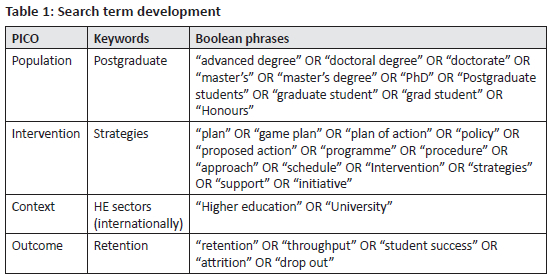
The search was conducted via the University of the Western Cape's online library platform, uKwazi. uKwazi allows for the composite search of all subscribed electronic databases, enhancing the systematic nature of the review. The PICO (Population, Intervention, Context, Outcome) framework was used to develop the research questions, keywords and Boolean phrases for the search (Table 1). Boolean phrases were entered into uKwazi, using "AND" operators between the strings, in a single, composite search of all databases. Filters were applied for publication date (2020-2024) and peer-reviewed status.
Study selection
The review followed the PRISMA levels of identification, screening, eligibility, and inclusion (Page et al., 2021). Articles identified in the search were extracted to Covidence, an online systematic review platform. Titles and abstracts were evaluated against the inclusion criteria for relevance, and reasons for exclusions were captured. The eligibility of each remaining article was assessed through full-text review for relevance. The remaining articles were evaluated for methodological quality using the Smith, Franciscus and Swartbooi (SFS) critical appraisal tool, Version E (Smith et al., 2015), which is inclusive of various study designs. A minimum threshold score of 60% was set for inclusion, to ensure that only high-quality research was included (Smith et al., 2015). Articles that scored less than 60% were excluded. Each level of screening, eligibility and appraisal was conducted independently by two reviewers, and disagreements were resolved through discussion.
Data extraction and synthesis
Data were extracted from articles selected for inclusion, using a data extraction tool that was self-developed for the review in alignment with the research objectives and inclusion criteria. The data extraction template was piloted on three articles to ensure clarity, accuracy and completeness. The review findings were analysed using thematic synthesis (Gough et al., 2017).
Ethics
Ethics clearance was obtained from the UWC Humanities and Social Sciences Research Ethics Committee (HSSREC) (HS24/6/7). As staff members, the authors had legal access to articles through the UWC Library. The review upheld ethical research practice through adhering to the rigour of the review method and appropriately citing all sources used.
Findings
The process results of the review itself are presented first, followed by an overview of the studies included. Lastly, the synthesis of the interventions and strategies is reported, focusing first on supervision and then supplementary related support and interventions.
Process results
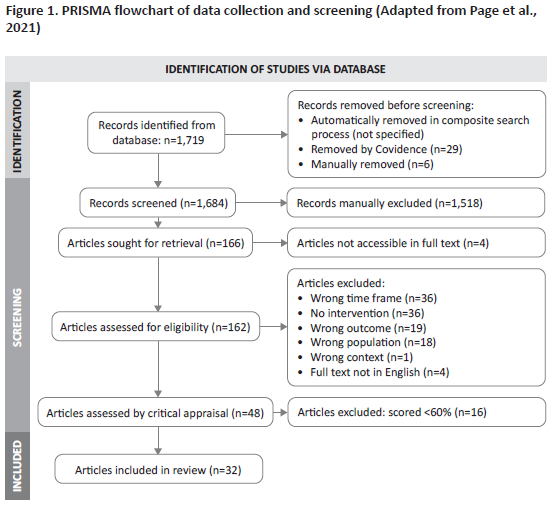
The search yielded 1,719 articles, 35 of which were flagged as duplicates (Figure 1). After removing irrelevant articles, 162 remained for full-text eligibility appraisal. Four articles could not be retrieved in full text, and 114 did not meet the inclusion criteria. The remaining 48 were appraised for methodological quality, and 16 were excluded as they did not meet the 60% threshold. This left 32 articles for synthesis.
Study characteristics
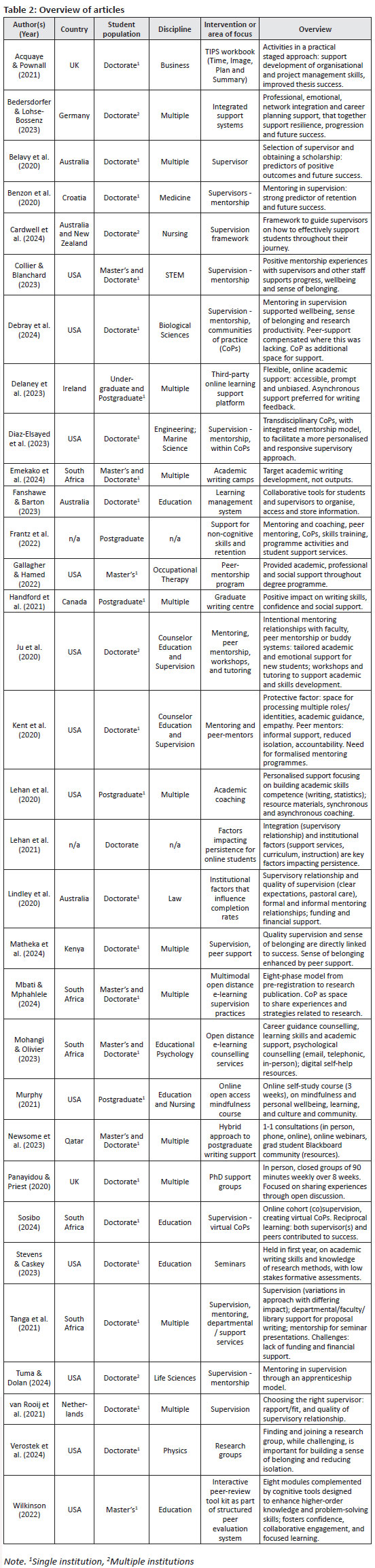
The 32 included studies reflected a range of retention and support strategies across 12 countries and many universities (Table 2). Studies were primarily from countries in the Global North, including USA (n = 12), Australia (n = 4), New Zealand (n = 1), Canada (n = 1) and across Europe (n = 6). Studies from the African context included South Africa (n = 5) and Kenya (n = 1). A single study was from Qatar, and two were review articles. Most studies focused on single HEIs (n = 26), four studies implied multiple institutions, and the remaining two were reviews. Many studies identified specific disciplines where intervention or support took place (n = 17), and others were multidisciplinary (n = 13). The study populations included doctoral students specifically (n = 20), doctoral and master's students (n = 5), master's students specifically (n = 2), postgraduate students generally (n = 4), or both under- and postgraduate students (n = 1). Overall, the studies reflected interventions and support strategies for postgraduate retention, from diverse disciplines across international HE systems.
Retention strategies
Various interventions and support strategies aimed at enhancing retention and postgraduate success at HEIs were reported (Table 2). Some articles detailed formalised interventions, while others described embedded strategies related to student success and retention. The areas of support were categorised as supervision related or supplementary support.
Supervision related support
The first category was that of support provided through supervision, and interventions related to supervision. The quality of supervisory relationships was identified as a key factor for supporting postgraduate retention (Lehan et al. 2021; Lindley et al., 2020; Matheka et al., 2024). The impact of the relationship starts with the intentional selection of the right supervisor, in terms of rapport, fit and research alignment (Belavy et al., 2020; van Rooij et al., 2021). Studies focused on the importance of mentorship within the supervisory relationship (n = 5). Positive experiences of mentorship, with supervisors in particular, supported student progress, wellbeing, and sense of belonging (Collier & Blanchard, 2023; Debray et al., 2024), predicting retention and future success (Benzon et al., 2020). The mentorship component took place within traditional apprenticeship supervision models (Tuma & Dolan, 2024), and in collaborative supervisory approaches (Diaz-Elsayed et al., 2023).
Collaborative practices included CoPs (n = 6), with various formats: transdisciplinary CoPs with an integrated mentorship model (Diaz-Elsayed et al., 2023), virtual CoPs (Mbati & Mphahlele, 2024; Sosibo, 2024), and more structured research groups (Verostek et al., 2023). Benefits of CoPs included a more personalised approach, space to share experiences, reciprocal learning, reduced isolation and a sense of belonging, that supported improved retention and success. Tools to support effective supervision are noted, including a framework for supervisors on how to effectively support students throughout their postgraduate journeys (Cardwell et al., 2024), collaborative tools for students and supervisors on learning management systems (Fanshawe & Barton, 2023), and the TIPS tool, which is a practical workbook that students may use, with supervisor oversight, to improve project management and thesis success (Acquaye & Pownall, 2021). As such, support and intervention at the level of the supervisory relationship is important, particularly in the provision of mentorship, and the sense of community fostered through collaborative approaches, that support the retention of postgraduate students.
Supplementary supportSupplementary support, outside of the supervisory relationship, promotes postgraduate retention and success. Approaches to supplementary academic support included institutional support services' initiatives (Frantz et al., 2022; Lehan et al., 2021), such as writing centres (Handford et al., 2021), centres for teaching and learning (Emekako et al., 2024), third party online platforms (Delaney et al., 2023), and departmental initiatives (Stevens & Caskey, 2023). The format of support included individual consultations (Lehan et al., 2020; Newsome et al., 2023), using synchronous and/or asynchronous approaches. The flexibility of online support was beneficial (Delaney et al., 2023; Lehan et al., 2020; Newsome et al., 2023), and asynchronous writing support was preferred in one study (Delaney et al., 2023). Group support was also available through skills training and workshops (Frantz et al., 2022; Ju et al., 2020; Tanga et al., 2021), online webinars (Newsome et al., 2023), in-person seminars (Stevens & Caskey, 2023), and writing camps (Emekako et al., 2024). Learning management systems were also utilised for resource repositories (Lehan et al., 2020; Newsome et al., 2023).
Socio-emotional support initiatives were also evident, as this is crucial for postgraduate student success (Bedersdorfer & Lohse-Bossenz, 2021). Socio-emotional support was provided through institutional support services, such as the Directorate of Counselling and Career Development (Mohangi & Olivier, 2023). An online self-study mindfulness course supported overall wellbeing and learning (Murphy, 2021). Mentorship with other academic staff, outside of the supervisory relationship, was beneficial (Frantz et al., 2022; Ju et al., 2020; Lindley et al., 2020), particularly around shared experiences, for example, motherhood (Kent et al., 2020). Peer-mentorship, whether formal or informal, provides academic and socio-emotional support, enhancing sense of belonging and reducing isolation (Frantz et al., 2022; Gallagher & Hamed, 2022; Ju et al., 2020; Kent et al., 2020; Matheka et al., 2024). However, formalised (peer) mentoring programmes are needed to ensure increased accessibility (Kent et al., 2020). Formalised peer engagements in CoPs enhance reciprocal learning and a sense of belonging, as noted above. In-person support groups focused on shared experiences and were facilitated by staff (Panayidou & Priest, 2020). Another more formalised peer-related intervention was a peer-review tool kit as part of a peer evaluation system (Wilkinson, 2022). This tool supported problem-solving skills, but confidence and collaborative appreciation as well. As such, there are various approaches to supporting postgraduate students' outside of the supervisory relationship, to enhance their academic skills and support socio-emotional wellbeing, towards retention and success.
Discussion
The review study reveals that while formalised interventions exist, many successful practices remain embedded in supervisory relationships and institutional support systems. The findings of the review highlight the role of supervisor support in the postgraduate journey, in alignment with previous research (Albertyn et al., 2018). The approach to supervision is important, and the review findings identify the benefit of collaborative approaches to supervision, in particular, the benefits of CoPs for reciprocal learning and support. The move away from the master-apprentice model towards more collaborative supervisory practice is evident in the literature (McKenna & van Schalkwyk, 2024). The supervisor's role includes that of academic support, together with the socialisation and development of the student (Aarnikoivu, 2023). The review findings emphasize how the supervisory relationship necessarily includes a mentorship component, which is a key factor in supporting postgraduate student retention. However, it is not the supervisor alone who is responsible for supporting the postgraduate student. Supplementary support for both academic and socio-emotional support is also evidenced in the review findings. Previous studies have identified the interconnected roles of institutional support, peer support and the supervisor in doctoral student development (Senekal et al., 2025), and in postgraduate students more generally (Albertyn et al., 2018). The review findings demonstrate that academic and psychosocial support in various forms and modes is beneficial, typically provided through institutional support services, and that both formalised and informal mentorship and peer mentorship are needed.
Recommendations
The supervisor plays a key role in supporting postgraduate retention; thus, HEIs need to provide sufficient training and support for supervisors. Novice and experienced supervisors need to be trained to engage with pedagogical shifts (i.e. to more collaborative approaches), and the importance of mentorship within the supervisory relationship. Structural shifts within certain HEIs may be needed to support collaborative supervisory approaches. Ongoing investment in support services, such as the library, postgraduate support offices, counselling services and writing centres, is needed to continue providing vital supplementary academic and socio-emotional support. Formalised peer-mentorship and departmental mentorship programmes are needed to foster a sense of belonging and reduce loneliness. Training and writing camps that are focused on skills development, rather than outputs, are needed to overcome skills gaps. Learning management systems can be strategically utilised to provide flexible access to asynchronous services and resources.
As awareness is a significant barrier to the utilisation of support (Senekal et al., 2025), support must be provided at multiple levels. The onus remains on the student to make use of available support. The strategic use of existing institutional support units is recommended in the context of resource construction. HEIs should design support and training initiatives in alignment with their respective postgraduate student needs. HEIs should strategically utilise capacity development grants and/or collaborations with other local and international HEIs, to ensure greater reach and sharing of best practice.
Research on the efficacy of retention strategies within HEIs is recommended, particularly in the Global South, where initiatives may be taking place but not published. Evaluation of support services is needed to demonstrate evidence-based practice and impact. Explorations of pedagogical approaches within supervisory relationships is needed to support improved practice and stakeholder awareness. Comparative studies of interventions across HE contexts would also be beneficial, to explore context-related factors and differing best-practice approaches.
Strengths and limitations
The review considered evidence of postgraduate retention and success strategies, not just formalised interventions. This allowed for the consideration of strategies that are being used within HEIs and embedded in educational practice. By necessity, the review was limited to specific criteria; therefore, relevant strategies and initiatives may have been excluded.
Conclusion
Interventions and support for postgraduate retention need to be responsive to the complex and multifaceted challenge of retention. Supervisors play a pivotal role, guiding postgraduates academically in their research, but also through mentorship and facilitating collaborative engagements. Intervention to strengthen supervisory practice, will in turn support postgraduate retention. Supplementary academic and socio-emotional support should be strategically embedded within departmental and institutional support services. Existing practices and services can be enhanced by aligning with evidence-based practice, to support postgraduate retention. Through strategic investment in postgraduate retention and success, the HE sectors in the South African and broader African context may be strengthened.
Ethics statement
Ethical clearance (HS24/6/7) for this work was provided by the UWC's Humanities and Social Sciences Research Ethics Committee.
Potential conflict of interests
There are no conflicts of interest to declare.
Aarnikoivu, M. (2023). Through and towards an interdisciplinary research community: Navigating academia as a lone doctoral scholar. In D. L. Elliot, S. S. E. Bengtsen, & K. Guccione (Eds.), Developing researcher independence through the hidden curriculum (pp. 19-29). Springer. https://doi.org/10.1007/978-3-031-42875-3_2
Funding acknowledgement
The project received no funding.
References
- Acquaye, D., & Pownall, I. (2021). Guiding without prescribing - A structured image approach to postgraduate research support. The International Journal of Management Education, 19(2), 100509. https://doi.org/10.1016/j.ijme.2021.100509
- African Union Commission (AUC). (2015). Agenda 2063: The Africa we want. African Union Commission. Retrieved from https://www.afdb.org/fileadmin/uploads/afdb/Documents/Policy-Documents/Agenda2063_Popular_Version_English.pdf
- Bedersdorfer, R., & Lohse-Bossenz, H. (2023). "Help, I need somebody, help …": Supporting doctoral candidates in different fields of research. Journal for New Generation Sciences, 21(1), 25-51. https://doi.org/10.47588/jngs.2023.21.01.a3
- Beer, C., & Lawson, C. (2017). The problem of student attrition in higher education: An alternative perspective. Journal of Further and Higher Education, 41(6), 773-784. https://doi.org/10.1080/0309877x.2016.1177171
- Belavy, D. L., Owen, P. J., & Livingston, P. M. (2020). Do successful PhD outcomes reflect the research environment rather than academic ability? PLoS ONE, 15(8), e0236327. https://doi.org/10.1371/journal.pone.0236327
- Benzon, B., Vukojevic, K., Filipovic, N., Tomić, S., & Durdov, M. G. (2020). Factors that determine completion rates of biomedical students in a PhD programme. Education Sciences, 10(11), 336. https://doi.org/10.3390/educsci10110336
- Cardwell, R., Nelson, K., Duncan, R., Copnell, B., & Moss, C. (2024). Being effective and supervising for thesis success in nursing coursework master degrees: A qualitative descriptive study. Journal of Advanced Nursing, 80(12), 5050-5063. https://doi.org/10.1111/jan.16164
- Collier, K. M., & Blanchard, M. R. (2023). Toward a holistic understanding of factors that support or inhibit graduate student success. Trends in Higher Education, 2(3), 389-408. https://doi.org/10.3390/higheredu2030023
- Debray, R., Dewald-Wang, E. A., & Ennis, K. K. (2024). Mentoring practices that predict doctoral student outcomes in a biological sciences cohort. PLoS ONE, 19(6), e0305367. https://doi.org/10.1371/journal.pone.0305367
- Delaney, L., Brown, M., & Costello, E. (2023). Between the lines: An exploration of online academic help-seeking and outsourced support in higher education: Who seeks help and why? Education Sciences, 13(11), 1147. https://doi.org/10.3390/educsci13111147
- Diaz-Elsayed, N., Acuna, J. A., Henderson, M., Isaacs, W., Cantarino, D., Bosson, J. K., Polk, T., Robinson, P., Batson, B., & Zayas-Castro, J. L. (2023). Building inclusive excellence in STEM: A 15-year analysis and lessons learned of the Alfred P. Sloan Foundation Minority Ph.D. Program at the University of South Florida. Frontiers in Education, 8. https://doi.org/10.3389/feduc.2023.1192853
- Emekako, E., Ajose, D. J., & Shemfe, O. (2024). Empowering and optimising postgraduate research: An in-depth exploration of the impact of writing camps on academic writing skills and self-efficacy. E-Journal of Humanities, Art and Social Sciences, 5(6), 887-903. https://doi.org/10.38159/ehass.2024568
- Fanshawe, M., & Barton, G. (2023). PhD by LMS: Using a learning management system to facilitate self-directed learning in a doctoral study. Australasian Journal of Educational Technology, 39(4), 104-126. https://doi.org/10.14742/ajet.8615
- Frantz, J., Cupido-Masters, J., Moosajee, F., & Smith, M. R. (2022). Non-cognitive support for postgraduate studies: A systematic review. Frontiers in Psychology, 12. https://doi.org/10.3389/fpsyg.2021.773910
- Gallagher, R. G., & Hamed, R. (2022). Benefits of peer-mentorship for entry-level occupational therapy students: A descriptive study. The Open Journal of Occupational Therapy, 10(4), 1-10. https://doi.org/10.15453/2168-6408.1946
- Gough, D., Oliver, S., & Thomas, J. (Eds.). (2017). An introduction to systematic reviews (2nd ed.). SAGE.
- Gough, D., & Richardson, M. (2024). Systematic reviews. In P. Brough (Eds.), Advanced research methods for applied psychology (pp. 71-86). Routledge.
- Handford, V., Dobson, J., & Liu, Y. (2021). Student, faculty, and graduate teaching assistant perceptions of support provided by a graduate student writing centre. Studies in Self-Access Learning Journal, 12(2), 148-176. https://doi.org/10.37237/120203
- Kahn, M., & Oghenetega, J. (2021). Origins and destinations known: A tracer study of international African doctoral graduates from South Africa's universities. Industry and Higher Education, 35(5), 559-569. https://doi.org/10.1177/0950422221989645
- Kent, V., Runyan, H., Savinsky, D., & Knight, J. (2020). Mentoring doctoral student mothers in counselor education: A phenomenological study. The Professional Counselor, 10(4), 532-547. https://doi.org/10.15241/vk.10.4.532
- Lehan, T., Hussey, H., & Hotz, T. (2021). Factors associated with online doctoral student persistence: A critical integrative review of the literature. Current Issues in Education, 22(2). https://cie.asu.edu/ojs/index.php/cieatasu/article/view/1961
- Lehan, T., Shriner, B., & Shriner, M. (2020). It's complicated: The relationship between participation in academic coaching and program completion in online graduate students. Online Learning, 24(3), 19-34. https://doi.org/10.24059/olj.v24i3.2142
- Lindley, J., Skead, N., & Montalto, M. (2020). Enhancing institutional support to ensure timely PhD completions in law. Legal Education Review, 30(1), 1-28. https://doi.org/10.53300/001c.17448
- Matheka, H. M., Jansen, E. P., Suhre, C. J., & Hofman, A. W. (2024). The influence of supervisors and peers on PhD students' sense of belonging and their success at Kenyan universities. Studies in Graduate and Postdoctoral Education, 16(1), 25-39. https://doi.org/10.1108/sgpe-09-2022-0059
- Mbati, L., & Mphahlele, R. S. (2024). Innovative multimodal open distance e-learning (ODeL) supervision practices for master's and doctoral candidates. Journal of Learning Development in Higher Education, (30). https://doi.org/10.47408/jldhe.vi30.1057
- McKenna, S., & van Schalkwyk, S. (2024). A scoping review of the changing landscape of doctoral education. Compare: A Journal of Comparative and International Education, 54(6), 984-1001. https://doi.org/10.1080/03057925.2023.2168121
- Mohangi, K., & Olivier, H. (2023). Counselling support for postgraduate open and distance e-learning students in South Africa: A case study. Transformation in Higher Education, 8, a265. https://doi.org/10.4102/the.v8i0.265
- Murphy, J. L. (2021). Exploring the impact of an open access mindfulness course with online graduate students: A mixed methods explanatory sequential study. Online Learning, 25(2), 299-323. https://doi.org/10.24059/olj.v25i2.2292
- Page, M. J., McKenzie, J. E., Bossuyt, P. M., Boutron, I., Hoffmann, T. C., Mulrow, C. D., Shamseer, L., Tetzlaff, J. M., Akl, E. A., Brennan, S. E., Chou, R., Glanville, J., Grimshaw, J. M., Hróbjartsson, A., Lalu, M. M., Li, T., Loder, E. W., Mayo-Wilson, E., McDonald, S., McGuinness, L. A., Stewart, L. A., Thomas, J., Tricco, A. C., Welch, V. A., Whiting, P., & Moher, D. (2021). The PRISMA 2020 statement: an updated guideline for reporting systematic reviews. BMJ, 372, 71. https://doi.org/10.1136/bmj.n71
- Paideya, V., & Bengesai, A. (2017). Academic support at the University of KwaZulu-Natal: A systematic review of peer-reviewed journal articles, 2010-2015. Journal of Student Affairs in Africa, 5(2), 55-74. https://doi.org/10.24085/jsaa.v5i2.2702
- Panayidou, F., & Priest, B. (2021). Enhancing postgraduate researcher wellbeing through support groups. Studies in Graduate and Postdoctoral Education, 12(1), 42-57. https://doi.org/10.1108/sgpe-06-2020-0038
- Senekal, J. S., Munnik, E., & Frantz, J. M. (2024). Multi-stakeholder perceptions of doctoral graduate attributes: A South African perspective. South African Journal of Higher Education, 38(4), 240‒264. https://doi.org/10.20853/38-4-5857
- Senekal, J. S., Munnik, E., & Frantz, J. M. (2025). Doctoral graduate attribute development: Lessons from the South African context. International Journal of African Higher Education, 11(2), 19-41. https://doi.org/10.6017/ijahe.v11i2.17923
- Smith, M. R., Franciscus, G., Swartbooi, C., Munnik, E., & Jacobs, W. (2015). The SFS scoring system. In M. R. Smith (Ed., Chair), Symposium on methodological rigour and coherence: Deconstructing the quality appraisal tool in systematic review methodology. 21st National Conference of the Psychological Association of South Africa, South Africa.
- Sosibo, L. (2024). Key factors contributing to postgraduate students' success: Making a case for Coronavirus-19 and beyond. South African Journal of Higher Education, 38(1), 62-81. https://doi.org/10.20853/38-1-6263
- Stevens, D. D., & Caskey, M. M. (2023). Building a foundation for a successful doctoral student journey: A scholarship of teaching and learning investigation. Innovative Higher Education, 48(3), 433-455. https://doi.org/10.1007/s10755-022-09624-7
- Tanga, M., Megbowon, F. K., Nkonki, V., & Rulashe, T. (2021). Accounting for the faculty differentials in the production of PhD graduates in a South African university. South African Journal of Higher Education, 35(3), 220-238. https://doi.org/10.20853/35-3-3655
- Tuma, T. T., & Dolan, E. L. (2024). What makes a good match? Predictors of quality mentorship among doctoral students. CBE-Life Sciences Education, 23(2). https://doi.org/10.1187/cbe.23-05-0070
- Verostek, M., Miller, C. W., & Zwickl, B. M. (2024). Physics PhD student perspectives on the importance and difficulty of finding a research group. Physical Review Physics Education Research, 20(1), 010136. https://doi.org/10.1103/PhysRevPhysEducRes.20.010136
- Wilkinson, K. L. (2022). Evaluating a structured online peer evaluation system among graduate-level communication capstone students through action research. Online Learning, 26(1), 93-129. https://doi.org/10.24059/olj.v26i1.3077
Accepted 20 March 2026
Published 18 August 2026