Navigating identity and adaptation: International student adjustment and success at the University of Namibia
Abstract
This study examined the cognitive orientation of international students at the University of Namibia main campus in Windhoek, focusing on cultural identity, cultural adaptation and adaptation to university life. Guided by Bandura's Social Learning Theory and the conceptual model of international student adjustment, adaptation was explored as three interrelated processes influencing the success of an international student in a foreign country. A qualitative research design was employed, using semi-structured interviews with 12 international students. The study revealed three main themes: (1) cultural identity, (2) cultural adaptation, and (3) adaptation to university life. Cultural identity was found to carry connotative meanings shaped by geographical influences. Adjustment emerged as a complex process affected by multiple factors, with successful adaptation closely linked to societal support from nationals, institutional structures, and networks with fellow international students. It is recommended that higher education institutions develop tailored programmes and processes responsive to their specific contexts and student populations. Such initiatives should facilitate smoother cultural adaptation and university adjustment while preserving students' cultural identities, as these are critical factors for the academic success of international students.
Cognitive orientation; collectivism; cultural adaptation; cultural identity; emotional affect; psychological impact; Namibia
Abstract
Ukushiya isimo esisodwa semfundo uye kwesinye kanye nokuthuthela ezweni elisha ukuze uyofunda sekuyinto eyenzeka kakhulu. Umthelela wezengqondo nemizwa kumfundi wezizwe ohamba kuye kwelinye izwe uletha ubunzima njengoba bengaphazanyiswa yizinto ezinhlobonhlobo njengezifundo kanye nezokuhlalisana, ezingase zithinte ukwakheka kobunjalo bamasiko abo futhi ekugcineni kuthinte nokuphumelela kwabo ezifundweni. Lolu cwaningo luhlole ukulungiseka kwengqondo kubafundi bezizwe endaweni yobumbano eNyuvesi yaseNamibia eWindhoek, kusetshenziswa ithiyori yokufunda kwezenhlalo (Social Learning Theory) ka-Bandura kanye nemodeli yokuqonda ukujwayela nokuzivumelanisa nezimo kubafundi bezizwe. Kulokhu, ukuzivumelanisa nezimo kubhekwa njengezinqubo ezintathu ezihlobene zokuhlola ukujwayela kwabo impilo yasenyuvesi, ukuhlola ukuqonda kwabo ngobunjalo bamasiko, ukuzivumelanisa namasiko, nokuthi lokhu kuthinta kanjani ukuphumelela kwabo njengabafundi. Kusetshenziswe indlela yocwaningo lohlaziyo lohlobo ukuze kuhlolwe ukuqonda kwabafundi bezizwe ezindaweni zobumbano kusetshenziswa indlela yemibuzo. Ulwazi lwaqoqwa kubafundi bezizwe abayi-12 kwathi ukuhlaziywa kwayo kwenziwa ngethematic analysis, lapho kwahlonishwa khona izihloko abalulekile ezindabeni zabahlanganyeli. Imiphumela iveze izihloko ezingamakhulu amathathu: ubunjalo bamasiko, ukuzivumelanisa namasiko, nokujwayela impilo yasenyuvesi. Imiphumela iveze ukuthi umqondo wobunjalo bamasiko unencazelo ejulile ethonywa yindawo umuntu aphuma kuyo. Ngaphezu kwalokho, imiphumela ikhombise ukuthi ukujwayela kuyinqubo eyinkimbinkimbi ethonywa yizinto eziningi, futhi ukuzivumelanisa ngempumelelo kuhlobene kakhulu nosizo lomphakathi oluvela kubantu bomdabu, ukusekelwa yisikhungo, kanye nosizo oluvela kwabanye abafundi bezizwe. Ngokusekelwe kule miphumela, ucwaningo lutuse ukuthi izikhungo zemfundo ephakeme kufanele zibe nezinqubo nezinhlelo ezenziwe ngokukhethekile kuye ngezikhungo zabo nabafundi, ezizogxila ekwenzeni lula ukuzivumelanisa namasiko nokujwayela inyuvesi, kuyilapho kugcinwa ubunjalo bamasiko njengezinto ezibalulekile ukuze abafundi bezizwe baphumelele ezifundweni zabo.
Ukubheka nokuqonda kwengqondo; ubunye/ukubambisana komphakathi; ukuzijwayeza kwamasiko; ubunjalo besiko; isimo semizwa; umthelela wezengqondo; iNamibia
Introduction
The psychological impact of student migration resonates both subjectively and objectively, particularly for international students in African contexts. Subjectively, student migration entails international students crossing borders with the intent of completing an entire degree or qualification outside their country of origin (Weber & Van Mol, 2023); while from an objective perspective, student migration is an intrinsic part of broader processes of development and social transformation associated with processes of modernisation and industrialisation driven by various macro-, meso- and micro-level factors (De Haas et al., 2020). International student mobility has increased sharply over the past two decades, rising from 2.2 million in 2001 to more than 6 million in 2021, and effectively tripling within 20 years (Unesco, 2023; Chellaraj, 2019). Relocating to a new academic environment poses challenges, as international students are often affected by academic and social factors that influence the construction of their cultural identities (Roy & Al Harthy, 2022). Mahmood and Galloway Burke (2018) shared that many international students, especially in the United States, experience acculturation challenges that shape their overall academic and social experiences.
With this increase in mobility, cultural adaptation has become increasingly significant as students navigate new academic, social, and cultural landscapes. Existing studies have tended to focus on daily fluctuations in cultural identity salience, neglecting the underlying developmental processes (Meca et al., 2021). Students entering university life, whether from Western or African backgrounds, bring diverse cultural heritages that can enrich intercultural awareness (Girmay, 2017); however, those from collectivist cultures, such as Asia, often face acculturative stress when navigating contrasting norms and values (Ma et al., 2020). Collectivism itself shapes students' beliefs about higher education and their roles within it (Carson, 2009), yet also creates tension when confronted by dominant, non-collectivistic cultural perspectives. As Adegbola et al. (2018) observe, international students frequently struggle with identity negotiation in contexts where they face contrasting cultures from various environments.
Against this backdrop, the present study explored the cognitive orientation of international students in a collectivist setting at the University of Namibia, focusing on cultural identity, cultural adaptation, and adaptation to university life as key dimensions influencing academic success. This article is structured as follows. First, an overview of the literature and the theoretical frameworks is provided. Then, the aim and guiding research question are presented. This is followed by a discussion of the methodological approach and the findings from the qualitative study. The article concludes with a summary of the main findings and proposed avenues for further research.
This review of the literature considers three broad areas. First, the conceptual foundations of international student adaptation are considered. Then, the dynamics of integration in multicultural contexts are considered. The section concludes with considering the conceptual framework of the study.
Conceptual foundations of international student adaptation
International student adaptation is shaped by interdependent constructs that situate identity within sociocultural, cognitive, and affective domains. First, cultural identity, anchored in race, ethnicity, and geography, delineates both communal distinctiveness and individual self-construal (Unger, 2011; Karjalainen, 2020). Cultural identity also operates across macro levels of national or regional belonging and micro levels of psychological orientation, encompassing attitudes, cognitions, and emotions toward specific groups (Yan, 2018).
Cultural adaptation refers to the internal changes necessary to function effectively in unfamiliar cultural settings, encompassing behavioural adjustment, the acquisition of new knowledge, and the development of intercultural competence (Czajkowska, 2017; Kim, 2012; Cui, 2023). Within collectivist societies, adaptation is further influenced by values such as interdependence, social harmony, and communal responsibility (Cheng et al., 2020). Emotional affect and psychological impact capture the motivational and dispositional consequences of these processes, extending from acute affective responses to broader patterns of social and psychological functioning (Barrett & Bliss-Moreau, 2014; Schnall et al., 2010; de Oliveira et al., 2013).
Adaptation to university life demands recalibration to advanced pedagogical methods and more complex social structures. It requires balancing independence, responsibility, and decision-making while navigating less structured environments (Gonta & Bulgac, 2019; Nasr & Faid, 2020). This process, defined as the dynamic alignment between student and educational environment, integrates both interpersonal and institutional dimensions (Shamionov et al., 2020). Cognitive orientation exerts a decisive influence on adaptation: while Peer et al. (2015) emphasize its instrumental role in mediating self-environment relations, Kreitler et al. (2012) conceptualise it as a meaning system composed of beliefs, goals, and norms that shape cognition and behaviour. The latter definition is adopted in this study to foreground cognition as an active determinant of adaptation trajectories.
Dynamics of integration in multicultural contexts
The transition into African multicultural universities amplifies the interaction between cultural identity, cognition, and adaptation, producing hybridised forms of belonging and integration. Immersion is neither a passive assimilation nor a unilateral cultural absorption. Instead, drawing on Bhabha's (1994) concept of the third space, international students construct hybrid cultural spaces that blend elements of their home and host traditions (Cena et al., 2021; Bhandari et al., 2018). This hybridity fosters placemaking and deeper immersion (Covarrubias et al., 2015) while simultaneously confronting students with discourses of otherness that perpetuate boundaries between "us" and "them" (Roy & Al Harthy, 2022). Immersion is therefore best conceptualised as a reciprocal negotiation in which cultural identity is both destabilised and reconstituted.
Adaptation is critically shaped by motivational expectations and the value attached to successful adjustment. Zhou and Curle (2026), applying the Expectancy-Value Model, demonstrate that both expectation of success and perceived value drive academic, sociocultural, and psychological outcomes. In African collectivist settings, Social Support Theory (Cobb, 1976) and Acculturation Stress Theory (Berry, 2006) underscore the buffering role of supportive peer networks in mitigating stress and facilitating wellbeing (Oduwaye et al., 2023; Leahy-Warren, 2014). Failure to integrate into these networks, by contrast, exacerbates marginality and identity confusion (Ren & Jiang, 2021). Yet, the literature remains underdeveloped regarding the role of language barriers and cultural dissonance, particularly for students from individualistic societies adapting within strongly collectivist contexts.
Social integration represents the culmination of adaptation processes and is predicated on the formation of belonging and social identity. Hybrid cultural identities enhance belonging, which is recognised as a critical psychological need in higher education (Allen et al., 2021). Social Identity Theory posits that integration occurs when students align with university groups that affirm and stabilise self-identity (Tajfel & Turner, 1979; Hogg, 2018). Multicultural Personality Theory further suggests that traits such as openness and emotional stability support effective functioning in diverse environments (Ramirez, 1998; Oduwaye et al., 2023). Thus, integration is both affective and behavioural, securing students' embeddedness within the social fabric of the university.
Conceptual framework of the study
The theoretical conceptualisation of this study is informed by the work of Schartner and Young (2020), who situate international students within the broader category of temporary migrants who intend to return to their home country after completing a specific purpose abroad, such as academic study, diplomatic service, or humanitarian work (Sussman, 2002; Ward et al., 2001). Recognising the multifaceted nature of cross-cultural transitions, Zhou et al. (2008) argue for an integrative model to address the distinct yet interconnected domains of adjustment and adaptation. Schartner and Young (2020) provide a crucial distinction between these two constructs. First, adjustment is conceptualised as the longitudinal process of change over time. In contrast, adaptation refers to the measurable outcomes in key areas, namely the psychological, sociocultural, and academic domains.
This distinction builds upon established frameworks. Psychological adjustment pertains to the affective response and emotional wellbeing in a new environment (Searle & Ward, 1990; Anderson et al., 2002), while sociocultural adjustment concerns the behavioural competence in managing everyday life and social interactions within the host culture (Black et al., 1991; Ward et al., 2001). Schartner and Young's (2020) model synthesizes these ideas, viewing adjustment as the process (involving cognitive appraisal, coping strategies, and learning) and adaptation as its outcome.
It is against this conceptual backdrop that the integrated framework of Social Learning Theory and Schartner and Young's (2020) model was deemed appropriate for this study. This combination offers a robust lens for understanding how multiple dimensions of identity influence international students' perceptions of cultural belonging and their adjustment to university life.
However, while Social Learning Theory powerfully emphasizes the role of modelling and observational learning (Bandura, 1977), its application has limitations. The theory has been critiqued as a loosely organised framework that does not fully account for the role of innate cognitive processes and stable personality traits in information processing and behaviour (Nabavi & Bijandi, 2012; Zeidner, 2008; Corr & Matthews, 2020). This uncertainty regarding the foundational elements of personality raises questions about the effectiveness of modelling complex psychological issues using the theory alone, thereby justifying its integration with a more specific model of student adaptation.
Aim and research question
The study being reported on qualitatively explored the cognitive orientation of international students at the University of Namibia's main campus in Windhoek, a multicultural environment. Drawing on Bandura's (1977) Social Learning Theory and Schartner and Young's (2020) conceptual model of international student adjustment, the research examined students' adaptation to university life.
The following research question guided the study:
How do the cultural identity dynamics and cognitive orientations of international students shape their cultural immersion, adaptation to university life, and social integration within African multicultural university environments?
The research methodology that guided the qualitative study is unpacked in the next section.
Research methodology
This study was grounded in an interpretivist paradigm, which posits that social reality is subjectively constructed through cultural and historical contexts (Ryan, 2018). To align with this philosophy, a qualitative phenomenological design was employed to explore the lived experiences and cognitive orientations of international students within collectivist environments (Neubauer et al., 2019). This approach prioritises the participants' subjective meanings as the primary source of knowledge.
A purposive sampling strategy was employed to select participants who were information-rich regarding the phenomenon of interest (Boddy, 2016). The final sample consisted of 12 international undergraduate students from the University of Namibia main campus. The sample size was consistent with established qualitative recommendations to achieve data saturation rather than statistical generalisability (Guest et al., 2006).
Recruitment of participants commenced after obtaining formal approval from the University's Research Ethics Committee and institutional permission from the International Office. A call for participation was disseminated, and interested students were screened against predefined inclusion criteria. To uphold the highest ethical standards, informed consent was secured from all participants. Anonymity was guaranteed using pseudonyms, and all data were stripped of personally identifiable information. The principle of non-maleficence was rigorously upheld by prioritising participant wellbeing throughout the research process.
Data were collected through in-depth, semi-structured interviews, chosen for their capacity to generate rich, detailed accounts while ensuring key thematic areas were consistently explored (Brinkmann & Kvale, 2018). An interview guide, developed from an extensive literature review, provided a flexible framework to enhance the robustness and cultural sensitivity of the instrument. A pilot study was conducted with three students, allowing for the refinement of question clarity and prompts. Each formal interview lasted 30-40 minutes, was audio-recorded, and subsequently transcribed verbatim for analysis. In accordance with phenomenological principles, the researcher practised bracketing (epoché), which involved the conscious setting aside of pre-existing assumptions and biases during data collection and the initial phases of analysis to ensure that interpretations were derived as faithfully as possible from the participants' own accounts.
The data were subjected to a reflexive thematic analysis following the six-phase framework of Braun et al. (2019). This involved an iterative process of (1) familiarisation with the data, (2) generating initial codes, (3) searching for themes, (4) reviewing themes, (5) defining and naming themes, and (6) producing the report. Inductive coding was used in this study. Inductive coding prioritises the data, enabling researchers to discover themes and patterns directly from the data by immersing themselves in it to cultivate a rich understanding of the subject matter. The analysis was informed by a contextualist paradigm (Braun et al., 2019), which seeks to understand participants' lived experiences (an essentialist element) while acknowledging how these accounts are shaped by broader social discourses (a constructionist element). A reflexive journal was maintained to critically engage with the researcher's interpretive influence throughout the analytical process.
The trustworthiness of the findings was established by addressing the principles of credibility, dependability, confirmability and transferability (Guba & Lincoln, 1982). Credibility was enhanced through theoretical triangulation (interpreting data through multiple conceptual lenses) and the pilot study (Stahl & King, 2020). Dependability and confirmability were achieved through a comprehensive audit trail that meticulously documented all data collection and analytical decisions, ensuring the process was logical, traceable, and transparent. Transferability was facilitated through thick, contextual description and reflexive auditing, providing sufficient detail for readers to assess the applicability of findings to other settings (Rice & Ezzy, 2006).
Additionally, intercoder agreement checks, member validation, peer debriefing and audit trails were used to ensure the trustworthiness of the findings. Intercoder agreement checks were administered by comparing the coding of the same data by different coders within the research team to ensure consistency and reliability. For member checking, data were returned to selected participants to verify accuracy and resonance with their experiences. The researchers achieved peer debriefing by engaging with colleagues and experts to review their interpretations and the methodology used in the study, while audit trails were created by providing a detailed, transparent record of the research process.
Qualitative findings
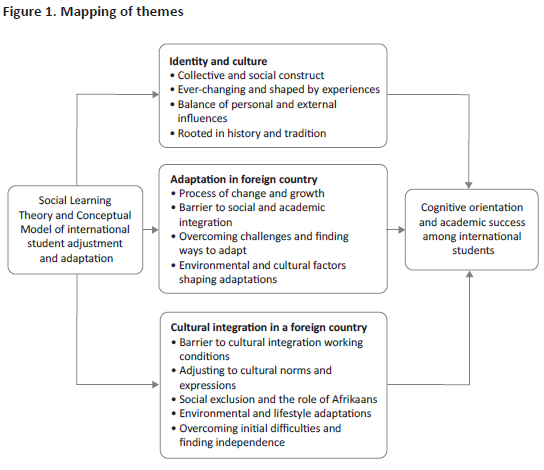
Three key themes were identified in the study: (1) identity and culture, (2) adaptation and language barriers in a foreign country and (3) adaptation and cultural integration in a foreign country. Identity and culture emerged as social constructs shaped by collective belonging, evolving through experiences while balancing personal and external influences, and rooted in history and tradition.
Adaptation in a foreign country was described as a gradual and transformative process influenced by prior exposure, social support, and environmental factors. Language barriers posed significant challenges to social and academic integration, creating exclusion and difficulties in communication, particularly with Afrikaans.
Cultural integration required individuals to navigate social norms, expressions, and lifestyle changes, with some embracing local customs, while others struggled with exclusion. Overall, adaptation was seen as a journey of resilience and self-growth, requiring openness, perseverance, and engagement with new experiences.
The three overarching themes, and relevant sub-themes, are discussed in the sections that follow. This section is concluded with a discussion on "mapping the themes."
Theme 1: Identity and culture
Participants were first required to deconstruct the terms 'identity' and 'culture'; from their opinions, they demonstrate how identity and culture are intricately entwined, influencing both individual and societal life. Both are social and collective constructions that influence how people define themselves and how communities foster a sense of unity. They are also malleable and influenced by life events, changing as individuals move through various settings, engage with others, and develop personally. Identity and culture also entail striking a balance between individual characteristics and social influences, necessitating that people balance their perspective of themselves with that of others. Additionally, both have historical roots and have been transmitted via customs, rituals, and communal memory, which guarantees continuity while permitting change.
Identity and culture as collective and social constructs
Both identity and culture are seen as deeply rooted in collective belonging, shaped by social groups, environment, and traditions.
John ties both concepts together: "Identity is a person's collective being," and "Culture is a group of people's way of identifying themselves." This suggests that identity is formed within cultural frameworks. Beth similarly connects the two: "Identity, to me, would be my source-how I view myself," while stating that "Culture more so must do with the people around me and the impact of behaviors and norms instilled in me."
The study's findings reinforce the notion that cultural norms influence personal identity. Central to this process is observational learning, whereby individuals acquire new behaviours by observing others (Ryckman, 2013). International students actively create a "hybrid space" by blending their native cultural backgrounds with the local culture they learn from societal influences (Cena et al., 2021). This act of hybridity is a crucial mechanism for identity creation and is powerful enough to facilitate a sense of placemaking in the new cultural context, thereby enabling deeper immersion (Covarrubias et al., 2015; Bhandari et al., 2018).
Identity and culture as ever-changing and shaped by experiences
Both concepts are viewed as fluid rather than fixed, constantly evolving over time, through experience, and exposure to diverse environments. Kate describes identity as "not stagnant, something ever-changing with experiences and time." Rick similarly describes culture as "acquired or socialised behaviours that one gets accustomed to growing up or during the course of life."
The participants' view of identity and culture as ever-changing and shaped by experiences is supported by the Social Learning Theory (1977) and Ryckman (2013), who agree that individuals acquire new behaviours (culture) by observing others over time.
Identity and culture as a balance of personal and external influences
Many participants expressed that both identity and culture are shaped by a combination of internal self-perception and external societal expectations. Belle describes identity as "personal traits mixed with environmental factors," while defining culture as "a set of environmental factors that a collective group may believe in or follow." This suggests an ongoing negotiation between personal identity and cultural expectations, which are shaped by social influences (Bhandari et al., 2018; Roy & Al Harthy, 2022).
Identity and culture as rooted in history and tradition
Some participants emphasized the historical nature of both identity and culture, seeing them as inherited from previous generations. Ash defines culture as "lineage passed on, mannerisms, rituals, celebrations, events, and clothes," highlighting its historical continuity. Jade describes culture as "characteristic beliefs, norms, and values of a community that unite them." Claire links identity to cultural continuity, stating, "Identity is shaped by background, the things that piece the world together." The assertion of culture being rooted in history and tradition is supported by Unger (2011) and Yan (2018), who advise that cultural identity operates at both macro and micro levels and is traditionally deeply rooted in national and regional affiliations.
Theme 2: Adaptation and language barriers in a foreign country
Participants' experiences illustrate that adaptation is a gradual process influenced by personal background, prior exposure, and local support systems. Some found the transition easier due to past experiences or cultural familiarity, while others struggled with environmental, social, and bureaucratic challenges. However, over time, friendships, familiarity with local customs, and personal growth helped them navigate their new environment, ultimately fostering independence and resilience.
Adaptation as a process of change and growth
Participants described adaptation as a gradual and evolving process that involved both positive transformations and initial challenges.
John noted that his personality had shifted due to the host country's overall structure, quietness, and work-life balance: "Overall, I have become a lot quieter, more relaxed, and calmer. The lack of noise and the idea of ending work at seven really make things easier." Belle, who has dual nationality, emphasized that her background had made her more adaptable: "Being of dual nationality means you need to be quick on your feet when it comes to adapting."
The participants' assertion that adaptation is a process of change and growth is supported by Schartner and Young (2020), grounding their theory of the study, which conceptualises adaptation as the longitudinal process of change over time. Additionally, Shamionov et al. (2020, p. 816) define adaptation to university life as "the process and result of student adjustment to the educational environment, including the system of interpersonal relations in education, educational activities, and educational growth".
Language as a barrier to social and academic integration
Language barriers amplified adaptation difficulties, as participants found themselves excluded in certain conversations and environments. David expressed how language limited his sense of belonging: "As much as you'd want to fit in, it's impossible if you don't speak their language."
Ash recalled her frustrations in meetings, where English was supposed to be the medium of communication but wasn't always used: "No matter how many times I asked them to speak in English, they didn't …"
Language as a barrier to social and academic integration assertion by participants is supported by Schartner and Young's (2020) conceptual model of international student adjustment and adaptation theory which guides that adjustment is a longitudinal process of change over time as it could take some time before international students fully learn any language in the host country, however on fully comprehending that language their adaptation process is fast tracked.
Overcoming challenges and finding ways to adapt
Despite these difficulties, participants found ways to navigate language barriers and integrate into the new environment. Richard, Eve, Jane, and Jade acknowledged that while English was widely spoken, differences in accents and contextual language use posed additional challenges. John, Belle, and Rick highlighted the importance of understanding Afrikaans, as it played a major role in social interactions. Belle and Claire demonstrated resilience and gradual progress in adapting to the language: Belle: "Language barriers have slowed my adaptability, but not to the point where I can't adapt." Claire: "Still a bit difficult, but slowly learning. As time passes, I will adapt."
Environmental and cultural factors shaping adaptation
Beyond language, other environmental and cultural elements influenced how participants adapted to their new surroundings. Rick initially struggled with the climate and different sunrise/sunset times: "Adjusting to life was tough … The weather and the sunrise/sunset times were so different." Claire found it challenging to make friends due to the language barrier but gradually overcame it: "It's not too hard to make friends, but communication-wise, it can be difficult."
Adaptation in a foreign country is a multifaceted process influenced by language, cultural differences, environment, and personal resilience. While participants can initially face exclusion due to language barriers, they gradually found ways to navigate communication challenges, form social connections, and adjust to new cultural norms. Adaptation is ultimately a journey of self-growth, requiring openness to change, perseverance, and the willingness to engage with new experiences.
Theme 3: Adaptation and cultural integration in a foreign country
Adapting to a foreign country is a complex process that involves both personal transformation and cultural integration. Individuals must navigate language barriers, social norms, environmental differences, and lifestyle changes, all while striving to maintain their identity. Cultural integration extends beyond adaptation, requiring individuals to adopt local customs, foster relationships, and establish a sense of belonging within their new environment.
Language as a barrier to cultural integration
Language was a significant challenge for many participants, making communication, cultural expression, and social integration difficult. David highlighted how language creates exclusion in social settings: "It's impossible for you to fit in if you don't speak their language." Ash felt alienated when local languages were used in formal settings: "No matter how many times I asked them to speak in English, they didn't. They expect me to learn their language."
Adjusting to cultural norms and expressions
Cultural differences in communication styles, social norms, and traditions required adaptation. Beth noted the reserved and submissive communication style of Namibians: "They have a humble, submissive way of communicating, and my assertiveness can feel overpowering." Eve admired the warmness and friendliness of Namibians despite hardships: "They still have this kindness in them despite everything."
Social exclusion and the role of Afrikaans
Afrikaans was noted as a common language that influenced social inclusion. Belle felt isolated in group settings when Afrikaans was spoken: "I was the only non-Afrikaans speaker." Rick saw Afrikaans as essential for social inclusion: "There's some exclusion if you don't know Afrikaans - it's a common mode of communication here."
The Afrikaans language is widely used as a medium of communication in many Namibian social and formal settings; thus, the language could prove to be a barrier to international students quickly adapting to the local environment if they do not fully understand the language. While participants could feel initially excluded due to language barriers, they gradually find ways to navigate communication challenges as in time they get to learn and understand the language (Schartner & Young, 2020; Shamionov et al., 2020).
Environmental and lifestyle adaptation
Participants had to adjust to new environmental and lifestyle factors in Namibia. John found Namibia's quietness and structured lifestyle enjoyable: "I have become quieter, more relaxed. The structured work-life balance makes things easier." Rick struggled with weather differences and daily routines: "The new setting, new environment, different sunrise and sunset times-it was tough at first."
The participants assertion of the impact of environment and on lifestyle adaptation can be traced from the belief that an individual's functioning is determined by the continuous, reciprocal interaction of three sets of factors: (a) personal factors (e.g. cognition, emotion), (b) behaviour, and (c) environmental influences (Bandura, 1978; Little, 2018).
Overcoming initial difficulties and finding independence
For many, adaptation was initially challenging but fostered growth and independence. Ash described adaptation as humbling yet empowering: "Being alone in a foreign country is isolating, but I've learned so much. It's made me more independent." Jane found administrative challenges difficult: "We were lost because no one told us what was happening. But people were kind and tried to help us."
Adaptation and cultural integration in a foreign country involve navigating language barriers, social norms, environmental changes, and personal growth. While challenges like exclusion, communication barriers, and administrative struggles exist, the process ultimately fosters independence, cultural awareness, and resilience.
Mapping of themes
Figure 1 below serves as a graphical synthesis of Bandura's Social Learning Theory (SLT) and Anderson's Conceptual Model of Adjustment (Anderson et al., 2016) to create a more dynamic, process-oriented understanding of international student adaptation. The findings demonstrate that adaptation is an active process of social learning, where students observe, imitate, and model local behaviours to overcome barriers driven by motivations to avoid social exclusion and achieve belonging. This learning mechanism explains how students navigate the stages of adjustment, with language emerging as the paramount environmental barrier and identity negotiation as a critical cognitive factor. Ultimately, the research provides an integrated framework showing that successful adaptation results from the continuous interaction between personal agency (SLT) and contextual challenges (Conceptual Model), offering a nuanced lens for developing targeted support strategies that address both practical and psychological needs.
Discussion
The study reveals that identity and culture among international students are fundamentally social and collective constructs, shaped through shared environments, traditions, and interpersonal relationships (Ward et al., 2001; Sussman, 2002). Similarly, Schartner and Young (2020) outline that participants consistently link identity to their internal sense of self, while viewing culture as a collective framework that informs and influences that self-perception. Identity and culture are viewed not as fixed but as fluid and evolving over time, through experience, and with exposure to new settings (Zeidner, 2008; Nabavi & Bijandi, 2012). The fluid and evolving nature of identity and culture, emphasized by Kate and Rick, is consistent with Kim's (2012) view of adaptation as an internal transformation process, where individuals gradually develop new cultural competencies (Czajkowska, 2017; Cui, 2023). The participants' reflections on identity and cultural adaptation closely align with established theoretical frameworks, notably Social Learning Theory (Bandura, 1977) and the Conceptual Model of International Student Adjustment and Adaptation (Schartner & Young, 2020).
International students' experiences illustrate that cultural identity, as articulated by Unger (2011) and Karjalainen (2020) emerges through both a sense of collective belonging and individual psychological processes (Yan, 2018). Participants described identity as shaped by cultural norms but ultimately constructed through personal interpretation. Language barriers, highlighted by David and Ash, illustrate the sociocultural adjustment challenges central to Schartner and Young's (2020) model. In contrast, adaptive strategies such as John's contextual interpretation of Afrikaans exemplify Bandura's (1977) concept of observational learning in cross-cultural settings.
Moreover, the collectivist context of Namibia, as experienced by Eve and Beth, reinforces Oladipupo's (2022) characterisation of African collectivism, where group harmony and interdependence shape the adaptation process. Emotional challenges, such as Ash's feelings of isolation, reflect the emotional affect described by Barrett and Bliss-Moreau (2014), underscoring how environmental changes influence psychological wellbeing (de Oliveira et al., 2013). These findings validate the multidimensional nature of adaptation proposed by Schartner and Young (2020), encompassing psychological, sociocultural, and academic dimensions. However, they also expose the limitations of Social Learning Theory in accounting for intrinsic personality differences in adaptation outcomes (Nabavi & Bijandi, 2012).
Experiences of adaptation highlighted the dual influence of personal agency and external societal expectations, where individuals negotiate who they are within the boundaries of cultural norms and histories (Berry, 2006; Corr & Matthews, 2020). While historical traditions and lineage give a foundation for cultural identity (Furnham & Bochner, 1982), as experienced by Ash, adaptation challenges - such as language barriers, climate differences, and unfamiliar social structures - prompt growth and transformation (Schartner & Young, 2016). Language emerged as a key barrier to both social integration and academic success, contributing to feelings of exclusion and difficulty in communication (Oduwaye et al., 2023), as shared by David.
Nevertheless, participants demonstrated resilience, gradually overcoming these challenges through relationship-building, learning local customs, and gaining a deeper understanding of their host environment (Schartner & Shields, 2023). Thus, identity and culture are shown to be dynamic and interdependent, constantly reshaped by individual experiences, collective interactions, and the broader process of cultural integration (Zhou et al., 2008; Anderson & Bushman, 2002; Bierwiaczonek & Waldzus, 2016).
Ultimately, the participants' narratives reveal the complex interplay of identity negotiation, cultural learning, and environmental factors in the adaptation process, emphasizing the need for institutional support that addresses both the cognitive and emotional dimensions of cross-cultural transitions.
Recommendations
International students are recommended to prepare thoroughly before arriving in host countries. This not only includes researching the culture, history, and university environment, but also ensuring that all necessary documentation is in order. Furthermore, understanding the immigration process and obtaining the required permits is important, thereby avoiding administrative challenges that may hinder one's adjustment. Second, students should approach their experience with an open mind, thereby embracing cultural differences and being willing to adapt to new environments. By cultivating a positive attitude towards learning about the host culture, an individual cannot only create meaningful connections with others but also foster a sense of belonging. Third, it is recommended that international students should view the first year as a period of adjustment rather than one of immediate success. Therefore, ensuring that individuals develop an understanding of the university system and set realistic expectations can lay a strong foundation for social and academic success in subsequent years. Students are also encouraged to seek assistance when needed, but to exercise discernment in choosing trustworthy sources of help. The utilisation of university resources, such as counselling services and mental health programmes, can provide culturally sensitive support and create a safe space for addressing emotional and psychological concerns.
Implications
Universities should provide more explicit guidance on the immigration process, including the obtaining of study permits and document certification. Specifically, the International Students Office could collaborate with local immigration authorities to provide detailed pre-arrival guidance, including step-by-step instructions on obtaining the correct visa, required documents, deadlines, and potential delays, along with a checklist shared well in advance of students' arrival on campus. To ensure efficient communication, the university could establish dedicated channels, such as a hotline or email address, for direct communication between students and immigration officials. This would allow students to track their visa applications and resolve issues promptly. Additionally, the university could implement a streamlined appointment system for document certification, allowing students to book time slots in advance and avoid long lines.
To further reduce delays, the university could negotiate with local authorities to prioritise student visa processing during peak enrolment periods, thereby ensuring faster turnaround times. Beyond the first month of school, ongoing guidance should be provided, and an emergency support system could be established for students facing urgent visa issues, ensuring timely resolution with local authorities. A feedback system should be established to enable students to report delays or issues, thereby allowing the university to address inefficiencies promptly. Moreover, regular reminders about deadlines could also help students stay on track.
Lastly, an online platform could be developed to allow students to track document submission and certification processes in real time, where they can not only upload documents for pre-approval but also book appointments, thereby further improving efficiency and reducing wait times. Universities should enhance their administrative processes to ensure timely and effective communication with international students. This includes promptly responding to inquiries, providing clear instructions for registration, and offering proactive support for selecting modules. An easy to find international student service desk could also streamline these processes and create a more welcoming environment.
Universities should expand their support for cultural and social integration. Initiatives such as international student meetups, language exchange programmes, and cultural workshops can help bridge cultural gaps and foster connections between local and international students. These efforts would also address challenges related to language barriers and feelings of exclusion.
Limitations
Whilst this article emphasized the benefits of modelling and observational learning, several limitations should also be noted. First, the lack of constructive alignment between observational learning and societal personality traits, as it is inconclusive to assume that all individuals will carry out imitation in the mind of the observer.
Furthermore, the study was conducted at a specific university campus in Windhoek, Namibia and focused solely on undergraduate students. Therefore, this focus restricts the transferability of the qualitative findings to other contexts. However, single-site, small-sample designs can significantly impact the generalisability of research findings due to sampling ignorability, variability and bias, statistical analysis and the type of research questions administered to participants.
The findings point to the importance of further research to investigate re-entry adjustments for international students upon returning to their home country. This encompasses the exploration of how their experiences in Namibia and the personal changes they underwent during their stay influence their reintegration into their home cultures. Therefore, such inquiries facilitate an understanding of the long-term implications of cultural adaptation processes.
Finally, the study did not influence the psychological domain. Consequently, there was insufficient evidence to construe the implications of demographic characteristics on the participants' adaptation processes. It was beyond the scope of this study to address the social and cultural theoretical implications of cognitive development, positing the influence of culture-specific tools, private speech, and the zone of proximal development on international students (Rahmatirad, 2020). Following all this, there is a need to apply the findings of this study in other contexts. Implications for applying the findings in other contexts are crucial for ensuring that research findings can be utilised effectively in different circumstances.
Conclusion
The goal of this study was to explore the cognitive orientation of international students at the University of Namibia's main campus in Windhoek, a multicultural environment. Following a qualitative exploration, the study showcased three main themes: (1) cultural identity, (2) cultural adaptation, and (3) adaptation to university life. The findings revealed that the perceived notion of cultural identity harboured connotative implications, which were influenced by geographical influences. Furthermore, the findings indicated that adjustment is a complex process influenced by multiple factors, and successful adaptation was closely related to societal assistance, from nationals, institutional support, and help from other international students.
Based on these findings, it is recommended that institutions of higher learning develop tailored processes and programmes responsive to their specific contexts and student populations. Such initiatives should prioritise facilitating cultural adaptation and adjustment to university life while simultaneously affirming the importance of maintaining one's cultural identity. These factors are critical for enabling international students to thrive academically and socially. In conclusion, the study highlights that the psychological impact of student migration extends beyond an individual struggle to become a shared institutional responsibility, one that involves cultivating environments that foster identity, adaptation, and a sense of belonging.
Ethics statement
Ethics approval for this study was obtained from the University of Namibia Research and Ethics Committee (Human), reference number 2023-RECH-0120-244.
Potential conflict of interests
The authors declare that there are no conflicts of interests regarding the publication of this manuscript.
References
Funding acknowledgement
No financial support or funding was received for the research underpinning this article, nor for its development or writing.
Literature review
- Adegbola, O., Labador, A., & Oviedo, M. (2018). African students' identity negotiation and relational conflict management: Being "foreign", being "careful." Journal of Intercultural Communication Research, 47(6), 474-490. https://doi.org/10.1080/17475759.2018.1486876
- Allen, K.-A., Kern, M. L., Rozek, C. S., McInerney, D. M., & Slavich, G. M. (2021). Belonging: A review of conceptual issues, an integrative framework, and directions for future research. Australian Journal of Psychology, 73(1), 87-102. https://www.tandfonline.com/doi/full/10.1080/00049530.2021.1883409
- Anderson, C. A., & Bushman, B. J. (2002). Human aggression. Annual Review of Psychology, 53(1), 27-51. https://doi.org/10.1146/annurev.psych.53.100901.135231
- Anderson, J. R., Guan, Y., & Koc, Y. (2016). The academic adjustment scale: Measuring the adjustment of permanent resident or sojourner students. International Journal of Intercultural Relations, 54, 68-76.
- Bandura, A. (1971) Social learning theory. General Learning Press.
- Bandura, A. (1978). Social learning theory of aggression. Journal of Communication, 28(3), 12-29. https://doi.org/10.1111/j.1460-2466.1978.tb01621.x
- Bandura, A. J. (1977). Social learning theory. Prentice Hall.
- Barrett, L. F, & Bliss-Moreau, E. (2009). Affect as a psychological primitive. Advances in Experimental Social Psychological Primitive, 41, 167-218. https://doi.org/10.1016/S0065-2601(08)00404-8
- Berry, J. W. (2006). Contexts of acculturation. In D. L. Sam, & J. W. Berry (Eds.), The Cambridge handbook of acculturation psychology (pp. 27-42). Cambridge University Press. https://doi.org/10.1017/CBO9780511489891.006
- Bhabha, H. (1994). The location of culture. Routledge.
- Bhandari, R., Robles, C., & Farrugia, C. (2018). International higher education: Shifting mobilities, policy challenges, and new initiatives. Background paper prepared for the 2019 global education monitoring report. United Nations Educational, Scientific, and Cultural Organisation. https://unesdoc.unesco.org/ark:/48223/pf0000266078 (open in a new window)
- Bhugra, D. (2004). Migration, distress and cultural identity. British Medical Bulletin, 69(1), 129-141. https://doi.org/10.1093/bmb/ldh007
- Black, J. S., Mendenhall, M., & Oddou, G. (1991). Toward a comprehensive model of international adjustment: An integration of multiple theoretical perspectives. The Academy of Management Review, 16(2), 291-317. https://doi.org/10.2307/258863
- Braun, V., Clarke, V., Hayfield, N., & Terry, G. (2019). Thematic analysis. In P. Liamputtong (Ed.), Handbook of research methods in health social sciences (pp. 843-860). Springer Singapore. https://doi.org/10.1007/978-981-10-5251-4_103
- Brinkmann, S., & Kvale, S. (2018). Doing interviews. SAGE Publications Ltd.
- Chellaraj, G. (2019). The economics of international student and scholar mobility: Directions for research [Policy Research Working Paper 8848]. Office of the Chief Economist, Europe and Central Asia Region, World Bank Group. https://doi.org/10.1596/1813-9450-8848.
- Cheng, A., Rizkallah, S., & Narizhnaya, (2020). Individualism vs. collectivism. In B. Carducci, & C. S. Nave (Eds.), The Wiley-Blackwell encyclopedia of personality and individual differences (pp. 287-297). Wiley-Blackwell.
- Cobb, S. (1976). Social support as a moderator of life stress. Psychosomatic Medicine, 38(5), 300-314.
- Cooper, J. O., Heron, T. E., & Heward, W. L. (2007). Applied behavior analysis (2nd ed.). Pearson Education.
- Corr, P. J., & Matthews, G. (Eds.). (2020). The Cambridge handbook of personality psychology (2nd ed.). Cambridge University Press. https://doi.org/10.1017/9781108264822
- Covarrubias, R., Romero, A., & Trivelli, M. (2015). Family achievement guilt and mental well-being of college students. Journal of Child and Family Studies, 24(7), 2031-2037. https://doi.org/10.1007/s10826-014-0003-8
- Cui, W. (2023). A qualitative study on the cultural adaptation of Chinese students studying in Japan. Proceedings of the 2nd international conference on culture, design and social development (CDSD 2022) (pp. 428-439). https://doi.org/10.2991/978-2-38476-018-3_49
- Czajkowska, Z. (2017). Theory of cognitive adaptation. In V. Zeigler-Hill, & T. Shackelford (Eds.), Encyclopedia of personality and individual differences. Springer. https://doi.org/10.1007/978-3-319-28099-8_1019-1
- de Haas, H. (2021). A theory of migration: The aspirations-capabilities framework. Comparative Migration Studies, 9(35), 8. https://doi.org/10.1186/s40878-020-00210-4
- de Oliveira, A. M., Buchain, P. C., Vizzotto, A. D. B., Elkis, H., & Cordeiro, Q. (2013). Psychosocial impact. In M. D. Gellman, & J. R. Turner (Eds.), Encyclopedia of behavioral medicine (pp. 1583-1584). Springer. https://doi.org/10.1007/978-1-4419-1005-9_919
- Furnham, A., & Bochner, S. (1982). Social difficulty in a foreign culture: An empirical analysis of culture shock. In J. W. Berry (Ed.), Field methods in cross-cultural research (pp. 177-193). Sage Publications.
- Girmay, F. (2017). African immigrant and international students: A qualitative study on the socio-cultural adjustment of students into U.S. universities [Unpublished doctoral dissertation]. University of Michigan. https://hdl.handle.net/2027.42/137006
- Gonta, I., & Bulgac, A. (2019). The adaptation of students to the academic environment in university. Revista Romaneasca Pentru Educatie Multidimensionala, 11(3), 34-44. https://doi.org/10.18662/RREM/137
- Guba, E. G., & Lincoln, Y. S. (1982). Epistemological and methodological bases of naturalistic inquiry. ECTJ, 30(4), 233-252.
- Hogg, M. A. (2018). Social identity theory. In Understanding peace and conflict through social identity theory: Contemporary global perspectives (pp. 3-17). Springer International Publishing.
- Kim, Y. Y. (2012). Cross-cultural adaptation. In V. S. Ramachandran (Ed.), Encyclopedia of human behavior (2nd ed., pp. 623-630). Academic Press. https://doi.org/10.1016/B978-0-12-375000-6.00115-4
- Kreitler, S., Margaliot, A., & Alkalay, Y. (2012). Motivation for cognition: The cognitive orientation approach. In A. M. Columbus (Ed.), Advances in psychology research (pp. 97-118). Nova Science Publishers.
- Leahy-Warren, P. (2014). Social support theory. In J. J. Fitzpatrick, & G. McCarthy (Eds.), Theories guiding nursing research and practice: Making nursing knowledge development explicit (pp. 85-101). Springer Publishing Company.
- Little, B. (2018). Reciprocal determinism. In V. Zeigler-Hill, & T. Shackelford (Eds.), Encyclopedia of personality and individual differences (pp. 1-3). Springer. https://doi.org/10.1007/978-3-319-28099-8_1807-1
- Ma, K., Pitner, R., Sakamoto, I., & Park, H. Y. (2020). Challenges in acculturation among international students from Asian collectivist cultures. Higher Education Studies, 10(3), 34. https://doi.org/10.5539/hes.v10n3p34
- Mahmood, H., & Galloway Burke, M. (2018). Analysis of acculturative stress and sociocultural adaptation among international students at a non-metropolitan university. Journal of International Students, 8(1), 284-307. https://doi.org/10.32674/jis.v8i1.166
- Nasr, N. E. A., & Faid, R. A. A. M. (2020). Factors affecting adaptation to university life for new students in light of the Corona pandemic (Descriptive study). Palarch's Journal of Archaeology of Egypt/Egyptology, 17(6), 13581-13604.
- Neubauer, B. E., Witkop, C. T., & Varpio, L. (2019). How phenomenology can help us learn from the experiences of others. Perspectives on Medical Education, 8(2), 90-97.
- Rahmatirad, M. (2020). A review of socio-cultural theory. SIASAT, 4, 23-31. https://doi.org/10.33258/siasat.v4i3.66
- Ramirez, M. (1998). Multicultural/multiracial psychology: Mestizo perspectives in personality and mental health. Bloomsbury.
- Rice, P. L., & Ezzy, D. (2006). Qualitative research methods: A health focus. Oxford University Press.
- Ryan, G. (2018). Introduction to positivism, interpretivism and critical theory. Nurse Researcher, 25(4), 14-20.
- Ryckman, R. M. (2013). Theories of personality (10th ed.). Wadsworth, Cengage Learning.
- Schartner, L. A., & Young, T. J. (2020). Intercultural transitions in higher education: International student adjustment and adaptation. Edinburgh University Press.
- Searle, W., & Ward, C. (1990). The prediction of psychological and sociocultural adjustment during cross-cultural transitions. International Journal of Intercultural Relations, 14(4), 449-464. https://doi.org/10.1016/0147-1767(90)90030-Z
- Shamionov, R. M., Grigoryeva, M. V., Grinina, E. S., & Sozonnik, A. V. (2020). Characteristics of academic adaptation and subjective well-being in university students with chronic diseases. European Journal of Investigation in Health, Psychology and Education, 10(3), 816-831. https://doi.org/10.3390/EJIHPE10030059
- Shapiro, S., Farrelly, R., & Tomaš, Z. (2014). Fostering international student success in higher education. TESOL International Association. https://commons.emich.edu/faculty_sch/730
- Stahl, N. A., & King, J. R. (2020). Expanding approaches for research: Understanding and using trustworthiness in qualitative research. Journal of Developmental Education, 44, 26-28.
- Sussman, N. M. (2002). Testing the cultural identity model of the cultural transition cycle: Sojourners return home. International Journal of Intercultural Relations, 26(4), 391-408. https://doi.org/10.1016/S0147-1767(02)00013-5
- Tajfel, H., & Turner, J. C. (1979). An integrative theory of intergroup conflict. In W. G. Austin, & S. Worchel (Eds.), The social psychology of intergroup relations (pp. 33-48). Brooks/Cole.
- Unger, J. B. (2011). Cultural identity and public health. In S. J. Schwartz, K. Luyckx, & V. L. Vignoles (Eds.), Handbook of identity theory and research (pp. 811-825). Springer Science + Business Media. https://doi.org/10.1007/978-1-4419-7988-9_34
- United Nations Educational, Scientific and Cultural Organization (Unesco). (2023). Education data release 2023.
- Ward, C., Bochner, S., & Furnham, A. (2001). The psychology of culture shock. Routledge.
- Weber, T., & Van Mol, C. (2023). The student migration transition: An empirical investigation into the nexus between development and international student migration. Comparative Migration Studies, 11(1), 5.
- Zeidner, M., Roberts, R. D., & Matthews, G. (2008). The science of emotional intelligence: Current consensus and controversies. European Psychologist, 13(1), 64-78. https://psycnet.apa.org/doi/10.1027/1016-9040.13.1.64
Accepted 15 September 2025
Published 18 August 2026