Governing technical and vocational education and training: Efficiency and accountability in the form and function of college councils
Abstract
The councils that govern technical and vocational education and training (TVET) colleges add a local layer of authority to the governance hierarchy of vocational education. The councils are made up of internal stakeholders and ministerial appointees and are meant to oversee the efficient and effective delivery of training and to provide accountability for college operations. This study investigated whether the form of this governance model matches its function. The study draws its findings from a survey of 300 council members in 48 colleges and from interviews with the principals, chairpersons and academic board representatives of nine colleges. Based on our findings, we argue that college councils have considerable responsibilities but that the structure, operational procedures and capacity of the councils are not sufficiently capable of carrying the weight of these responsibilities. This is evident in the confusing lines of accountability, from meetings that do not drive strategy and from a deficiency of industry experts serving on councils. Thus college councils add another layer of accountability to TVET colleges without necessarily contributing to their institutional development.
Technical and vocational education and training (TVET); college councils; governance; accountability
Introduction
The devolution of governance responsibilities of technical and vocational education and training (TVET) colleges from national and provincial level to local college councils has been an important policy lever in the changing landscape of the TVET sector. College councils have been tasked with a wide range of responsibilities that are intended to improve the accountability and efficiency of colleges. In this study, we examined what the policy suggests is meant by accountability and efficiency and we examine the implications of the decentralised system of governance for the form that councils take. We reviewed the extent to which college councils are able to fulfil their mandates under the current model and where their strengths and weaknesses lie. This study therefore investigates whether the form that TVET councils take aligns with their functions. A description of the form councils take includes their structure, operational procedures and capacity. Based on the principle that form should follow function, we chart the extent to which councils have an established form to support the development of colleges and the promotion of technical and vocational training.
The findings of this study are based on semi-structured interviews conducted with the principals, council chairpersons and academic deputy principals from nine TVET colleges. A total of 25 interviews were conducted via virtual platforms. A college in each province was selected to participate in the research and the research team tried to balance the selection of urban and rural colleges, large and small colleges, and those with positive and negative audit outcomes. Further interviews were also conducted with the Department of Higher Education and Training (DHET), the South African Public Colleges Organisation (SAPCO), the TVET Governance Council and the South African Further Education and Training Students Association (SAFETSA).
In addition, a survey was developed and distributed to the council members of 48 TVET colleges. Two of the colleges were under administration at the time of conducting the survey and the survey was not extended to them. The researchers received approximately 300 responses to the survey from council members, which is a response rate of 40%. Using a Likert scale, we requested council members to rate the effectiveness of council meetings, the perceived scale of corruption and the overall success of the council in achieving its legislated tasks.
The study also consolidated and analysed the self-evaluation forms that council members completed for DHET in the second half of 2023. Ninety-seven responses to this survey were received. This self-evaluation reviewed council performance in six dimensions:
• Leadership and oversight;
• Structures and relationships;
• Accountability;
• Compliance;
• Performance, and
• Meetings and communication.
The article begins with a review of the policy related to TVET governance and the rationale behind the form or model of governance. We then review whether councils have been effective in meeting their mandates before reporting on our research findings about the way in which councils' structures, operational models and capacity have developed. Given that form follows function, we argue that it is not sufficiently clear in the policy whether councils are primarily meant to serve as oversight of management and/or act as representatives of stakeholders and/or provide skills for the efficient implementation of vocational education. Although the legislation mandates councils to perform explicit tasks, such as approving strategic plans, it is in the implicit interpretation about which role players have the authority to make decisions and who is accountable to whom that disputes arise.
Functions of governing councils
The concept of governance refers to the oversight of the management and administration of institutions. The King IV Report on Corporate Governance (Institute of Directors in South Africa (IoDSA), 2016), which came into effect on 1 April 2017, describes corporate governance as being about the exercise of ethical and effective leadership of a governing body to achieve the governance outcomes of ethical culture, good performance, effective control and legitimacy. The tasks of a governance structure include that stakeholders:
• Have the information needed to evaluate an organisation's performance;
• Define its strategic goals;
• Ensure the integrity of the organisation's external reporting; and
• Adopt a stakeholder-inclusive approach that balances the interests of material stakeholders against the long-term best interests of the organisation (IoDSA, 2016:43-71).
While the King Reports (2016) on governance have been applied to public organisations, the transfer of principle, function and form from corporate to public institutions is not straightforward. Corporate governance usually has clear performance indicators regarding profit and a restricted hierarchy between management and the board; and external stakeholders have a limited influence on strategic decisions. However, the public sector operates in a more complex political environment, with a range of interest groups and multi-layered and cross-referential management structures. College councils are the governance structures at local level that are overseen by DHET but their decisions need to consider the requirements of a number of other statutory councils in the post-school sector, such as those responsible for regulating occupations. The outcomes of public institutions are not always technically measurable, such as by measuring profit, but they do include social, cultural and transformation outcomes. Moreover, decisions are, at least symbolically, subject to democratic principle. Peters (2001:22) explains that
the tasks of governing [in the public sector] are almost inherently more difficult than the tasks of managing in the private sector, given the multiple goals, the constraints on action, and the demands for accountability that characterise the public sector.
It is because of the additional function of democratic accountability among a wide range of stakeholders that the form that governance has adopted in the TVET sector is one of decentralising responsibilities to college level. As Wedekind notes, an important concept for making sense of governance reforms is that of decentralisation (Wedekind, 2010:306).
The Continuing Education and Training (CET) Act 16 of 2006 gives college councils substantial autonomy from the national DHET. TVET institutions have the authority to draft strategic plans that include mission statements and funding goals; to respond to discrimination on the basis of race, gender and disability; and to develop safety measures. They are also tasked with determining a language policy and an admissions policy and with ensuring that all learning programmes offered at the college are accredited. In consultation with the Student Representative Council (SRC), the council determines and provides student support services. Councils are also permitted to appoint additional staff who are remunerated from funds raised by the college. Financial records must be kept and internal audits and risk management systems must be set up. Councils report to the Minister of DHET on the finances, the functioning of management, governance and the performance of students.
Greater decentralisation and autonomy of college councils is often interpreted positively. The two main benefits of decentralisation are efficiency and accountability, both of which contribute to the overall effectiveness of TVET institutions. As Mokoena (2020:11) points out: 'Councils do not only provide oversight and monitoring of executives, they also provide access to networks of resources and help steer the performance of the college'.
With regard to efficiency, the argument in favour of decentralisation is that it enables colleges to be nimbler and more responsive to local needs and to tailor their programmes to regional labour markets (Wedekind, 2010:306). Industry's presence on the councils in the form of donor representatives, for example, is to ensure that they are cooperating with colleges to create opportunities for in-service training and internships and to secure private-sector funding. Katsamunska (2016:139) points out that the concept 'good governance' is focused on 'the problem of how efficiently state institutions and regulatory environments operate and to be more neutral as to the role of the state and to what tasks the state undertakes directly'.
But a more critical interpretation of efficiency is that college councils ensure that colleges are aligned to business principles that do not suit the public-sector educational system (Needham, 2019). This is where the emphasis is on commercial or corporate efficiency rather than on cutting bureaucratic red tape or finding ways to work cooperatively. As Gleeson, Abbott and Hill (2011:786) point out,
the post-modern ideal of distributed governance is little more than a reworking of the state's neo-liberal ambitions designed to exert greater central control of service delivery - through governance networks that favour market hegemony, at local level.
Although there is a loosening of the grip of control by central government, policies on the way in which colleges should deliver vocational education and training are still directed from the national level. Wedekind (2010:310) stated that, while there was a shift 'towards an "output'' orientation in the governance policy [...], "input" in the form of rules and regulations still dominated the governance model'. For example, further education and training (FET) colleges were never granted autonomy to develop their own programmes (Needham, 2019:91): the 'efficiency' directive in the system is top-down rather than bottom-up. And any gains in efficiency derive from how cost-effectively a college council can implement policy.
Another benefit of decentralisation is that it enhances accountability. A council contributes additional skills to ensure that a college runs efficiently and adheres to auditing protocols and transformation goals. However, the meaning of accountability and who holds councils to account is not clear. Although some of the council members are representatives of stakeholder groups, such as staff, students and donors, they are not required to account to their constituencies regarding policy or the way it is implemented. They are neutral arbiters of administrative-type duties. The minister is required to
ensure broad public participation in the development of further education and training policy and the representation of stakeholders in the governance of all aspects of the further education and training system (Higher Education and Training Laws Amendment Act 25 of 2010 (section 41C(m)).
However, college councils are not the structures through which such consultation is mediated. Mbatha (2023:188) notes that there is 'a gap between the actual representation of group interests at the council level and the theoretical expectation of taking stakeholders' input into account in practice'.
College councils therefore have a communitarian basis because it is assumed that the representative members share a common vision for the college that is aligned with the national policy. Katsamunska (2016) points out that the 'good governance' model presumes that there is a pre-existing notion of the 'common good' or strategic intent among the participants in the governing structures. Without it, there may not be coherence in the system as a whole. Political differences are downplayed, as are differences of opinion on TVET. This makes the council model vulnerable 'if societal subsystems [are] immature in terms of solidarity and the search for common good' (Katsamunska, 2016:139). Where interest groups, or even individuals, have a self-interested intent, councils either become sites of conflict or are easily swayed to those members who are most persuasive or determined to see their advantage win out. As Katsamunska (2016:139) indicates, the 'good governance' model favours more active stakeholders.
It is possible to combine the different notions of efficiency with the different approaches to accountability and to arrive at very different models of the role of college councils. Where efficiency is implemented as a top-down, cost-cutting exercise matched with bottom-up accountability, and where the national government holds the college council to account, then governance at college level is little more than an administrative function. In such instances, the councils have negligible power to determine the implementation of vocational training.
Another combination is bottom-up efficiency, where the members of council determine which vocational programmes to implement and the way in which to do so. This is matched with top-down accountability, where the national department is accountable to the college council for support to implement council plans. In this instance, TVET councils have much greater authority to make changes in colleges.
In essence, the policy on TVET governance is not clear about the purpose of college councils. Although the policy sets out the tasks that councils are expected to perform, it is not clear about the intentions or objectives of those tasks. This article draws on our research to determine whether the form that councils take affects their functioning. In other words, are councils set up in ways that enhance their efficiency and accountability? Or do they operate on the premise that there is a shared vision of the common good for the college, or are there internecine conflicts that result from the composition of the council?
Effectiveness of councils
Assessments regarding how well TVET councils are performing are mixed, but concerns have been expressed that the governance of colleges is weak. Zungu and Munakandafa (2014:14) point out that the College Improvement Project (CIP) was initiated by DHET in 2011 because FET college councils were found to be 'dysfunctional' and did not provide 'strategic leadership and guidance in colleges'. The White Paper for Post-School Education and Training (PSET) (DHET, 2013) also highlighted problems of poor administration, financial and human resource management, and student support. The PSET White Paper (DHET, 2013:19) postulates that, in many colleges, the quality of leadership does not meet the required standard and that, while there are several exceptional colleges, the majority operate at a level that is below the required standard (DHET, 2013).
One indicator of good governance is financial oversight. An analysis of a sample of 28 college annual reports for 2021/2022 revealed that 40% of these did not include the required financial reporting attachments. Only 21% of colleges had an unqualified audit opinion. According to the Auditor-General, the majority of colleges had material misstatements in their reports and insufficient controls in financial processing and the reconciliation of financial transactions.
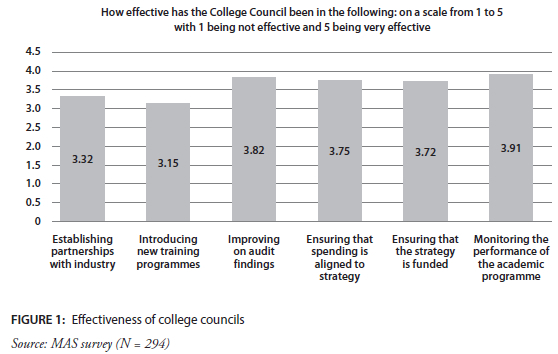
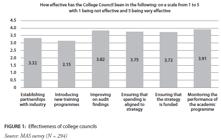
But there are also positive assessments of council performance. According to Badenhorst and Radile (2018:3), the governance system encourages autonomy. Mothapo (2014:40) argues that TVET governance was implemented in accordance with the criteria provided in the King II Report (IoDSA, 2002), 'which places a strong emphasis on the value[s] of fairness, accountability, responsibility, and transparency'. In our survey of TVET college councillors, respondents were generally confident when asked about the effectiveness of college councils, with 'monitoring the performance of the academic programme' rated as being the most successful of council tasks. The 'introduction of new training programmes' was rated the lowest.
Form and function of TVET college councils
We have argued that TVET governance is decentralised to college council level, largely to improve the efficiency of policy implementation and to add another layer of accountability to the system. The functions of councils are stated in legislation (CET Act 16 of 2006). However, there is still room for interpretation of the purpose of TVET governance - whether the focus should be on accountability or efficiency - and the way in which these terms are understood. 'Efficiency' can be understood either as more effective implementation of policy or as cost-saving measures. 'Accountability' can be directed either to central government or to a variety of other stakeholders. In this article, we consider how the implicit rationale is expressed in the form that councils take. If form follows function, then the structure of councils, their working procedures (meetings) and the capacities of council members all need to be set up to achieve those goals. We are therefore interested in the way in which the interaction between the form and the function of councils provides us with an understanding of the implicit function of local TVET governance. Our findings also reveal some of the strengths and weaknesses of councils in carrying out their duties.
Structure of councils
Efficiency and accountability are structured into TVET governance in a number of ways. One way is for the councils to have a significant degree of autonomy from the national government. The assumption is that, without the encumbrance of bureaucracy and the red tape involved in seeking permission from national government, college councils can respond quickly to strategic needs as they arise. Accountability can also imply that, because college council members have direct contact with the colleges, they have a better knowledge of the activities in the college in order to hold management to account than national government would have. Whether or not college councils view themselves as accountable to the national department, to their colleges or to constituencies outside of colleges, such as employers - or as a body that balances accountability to all these stakeholders - can have an impact on the relationships between council members and affect the way in which they carry out their functions.
The interview respondents were generally satisfied with the current level of autonomy from national government. However, some council members asserted that councils should have more autonomy and power, especially over human resource matters, as illustrated by the following comments:
We need more power. DHET is micromanaging TVETs. So, quality of people is very important. We want proper and qualified people.
If the department could review delegations of authority in terms of recruitment of staff and allow principals to appoint staff up to the deputy principals, that would work. We are sitting with a high vacancy rate at colleges because of the centralised function in terms of appointment from assistant directors up to deputy principals, which is a huge problem for colleges. The department takes even three, four years to appoint at our college.
Although autonomy is meant to improve efficiency, there are still areas where centralised procedures and formalities are viewed by council members as stumbling blocks to the smooth running of the colleges. Council decisions are often dictated by templates and forms provided by DHET, which also has the power to dictate terms to colleges through funding allocations. For example, through the National Qualifications Framework (NQF) Act 67 of 2008, DHET broadly prescribes which occupational qualifications should be offered by colleges (DHET, 2021). These qualifications were developed to include work experience and they are therefore intended to be responsive to labour market needs. However, currently, only a small number of occupational qualifications have been funded by DHET.
Whereas councils appear to want greater autonomy from the national DHET to be able to make decisions about human resources and training programmes, they are accountable to the department for the overall performance of the TVET colleges. At the same time, the councils are given complicated and ambiguous authority over college management. Mothapo (2014:74) points to a lack of clarity regarding the role of council members in relation to the role of executive management as a major shortcoming in good governance. He writes, 'there is a tendency on the part of some college councils to engage in micromanaging the institution, thus undermining the executive management team (EMT)' (Mothapo, 2014:74).
Principals report to DHET regarding their performance agreements and are held accountable by the council on matters and functions allocated to them by the council. A chairperson stated:
Principals just listen to the department, not to the council. We cannot fire them; we cannot discipline them. The directors-general (DGs) at DHET are friends with them, and the issues do not get to the Minister.
Lines of accountability are unclear. One chairperson stated:
Should the principal not be able to control and manage their deputies, you would have to take the matter to the regional office where the manager of the principal is sitting, and, should you fail in that, then you will have to approach the DG. This process is frustrating for someone who comes to the council meeting once a quarter and doesn't work for the organisation. Accordingly, this creates four phases of accountability before you get to someone who can make a final decision. The phases are the principal, regional office, DG of TVET, and, finally, the governance office within DHET.
A principal notes that there is confusion between corporate boards and councils. Council members with prior experience on boards expect councils to be the de facto employer. He explained:
This is one of the issues that poses a challenge in running a college with the council that thinks they are the board members and should dictate what must happen instead of playing their oversight role in terms of the CET Act.
The tensions between councils and management run along disjointed lines of accountability and uncertainty about who has the final authority over colleges. Suspicion runs both ways. Council members indicate that management does not adequately implement their decisions or report appropriately. However, management holds the opinion that council members involve themselves in operational matters, trying to influence appointments and the awarding of tenders. According to a chairperson,
[there is] resistance and pushback when enquiring about resources. There is a need to understand that governance is not interference but support. That is building trust between operations and governance.
While councils may view their role as keeping management accountable, management is as likely to consider the council to be a conduit for corruption:
Some are in denial; they continue to interfere and micromanage the college. Some resigned because they realised that the latest council is not allowing that type of interference.
People wanting to have their hands in the cookie jar, which is quite concerning, and them not being available to make any valuable contributions.
Political organisations want to interfere with the running of the college. A business unit in one of our areas wanted to see us, because they were complaining that they see tenders and they're not even informed about that. They are the first people who need to be cared about and they wanted to be part of it.
Despite the above examples of relationship challenges, though, there is also positive feedback from approximately a third of the interviewees. Building relationships and trust between councils and management is a key requirement for ensuring that governance structures function. One principal stated,
We are blessed with a chairperson of that nature who brings people together, but more important is the vision. If we have the chairperson of the council who shares the vision with the CEO, then we are blessed because you will share that vision in terms of execution, and you share the vision in terms of oversight. So you are speaking the same language. That's one thing. The other thing is [that] people with expertise in council is also key . We are not talking about educated people. ... It's about culture, social cohesion, and the ability to work with others. So we have become an effective council because it indeed upholds the social cohesion that we talk about.
This case confirms Katsamunska's (2016) argument that the good-governance model assumes that stakeholders already agree on strategy and their role is to find the most efficient way to implement it. But, for the most part, the ideal that greater decentralisation will lead to improved accountability is accompanied by suspicion between management and council members over corruption and of people vying for the spoils of tenders.
Another way in which accountability and efficiency are built into governance functions is through constituency representation on the council. Council members are either elected by stakeholders or appointed by the minister, usually to bolster the skills needed to govern. The former are seemingly meant to represent the interests of specific groups. The incorporation of SRC representation in the college council, for example, was a key indication of inclusive governance practice in TVET colleges (Sithole, 2019). Although council members may be appointed to councils as representatives of a particular group, such as staff, students or industry, there is no obligation for them to report back to their constituencies. The induction material given to councillors explains this.
The individuals on the council are acknowledged as stakeholders, except for the external members, and the internal members are elected to represent the respective groups. However, they cannot report back to the group that elected them, since they are not answerable to them (DHET, 2019:49).
Council members therefore stand in as representatives of interest groups but are not expected to be accountable to them. Presumably, they are elected, or selected, on the basis that the stakeholders trust them to represent their interests. But as Mbatha (2023:189) notes, 'this viewpoint raises significant problems about stakeholder responsibility and representation within the governance framework'. The extent to which representatives are practically able to advocate on behalf of their interest groups depends on the individual's capacity and attentiveness to insert their cause on the council's agenda. For Mbatha (2023:189), 'actively including stakeholders strengthens the decision-making processes by incorporating their viewpoints and input'.
One constituency in which interviewees generally agreed that representation is ineffective is that of students. Although student representation on councils is viewed positively, particularly because the calibre of student leadership is established through setting benchmarks on academic performance, a very practical challenge for student representation is the annual turnover of SRCs (Mbatha, 2023). It was generally agreed that student representatives started contributing to council meetings only by the third or fourth meeting, which is shortly before their term of office ends. Moreover, the strategic issues dealt with at the council level were often not the priority issues on students' minds. As a principal explained:
Students are interested in their issues and these are often dealt with outside council.
At the same time, the council would get directly involved in mediating and restoring relations between college management and students, as in the case of an urban college:
Some of the issues which culminated [in] strikes and some unrest were as a result of poor relations with - management, especially top management, and especially ... the principal and some staff, and other people will use students to react. But then we had to sit down and develop a plan to at least engage all the stakeholders.
Student representatives are often the least experienced members of council and the high-level strategic issues discussed in council meetings may be distant from the day-to-day issues that affect them. Nevertheless, their presence on the council is a reminder of the importance of students as key stakeholders in a college.
Another 'constituency' often absent from councils is industry. Provision is made for the appointment of a 'donor member' on the council. This person should be an industry representative but it seems to be the most difficult appointment to make, and the position therefore continues to remain vacant on some college councils. It is also difficult to find one person who represents the breadth of the industry that surrounds colleges. Given that the policy intent is for colleges to become more relevant to the needs of the labour market, working relationships with industry are becoming increasingly important. Colleges need industry to secure placements for work experience for students, for their lecturers to gain exposure in order to understand what is happening in industry, and to understand the way in which they should adjust their programme qualification mix (PQM). However, there is little involvement from the councils to improve industry relationships and this is left to college management. One interviewee explained:
It is the college that should invite industry. But we are not giving industry the opportunity to support us. They are willing. We are not giving them the opportunity.
Nevertheless, it appears that colleges are taking relations with industry more seriously. The chair of a rural college council pointed out the following:
It is only recently that the council was given the rights to form a donor committee. The current terms of reference that [are] adopted now [give] a council almost a full right and full support of the integration between the industry and other donors with the college. But before that it was very difficult because it was more like the straightforward relationship where the council was not directly involved.
Another interviewee stated:
Industry has always been included as part of our consultants in council. So, they form part of the invited members to sit in various committees. And that in itself is open to the industry to learn more about the college.
Councils appear to have been structured with both accountability and efficiency in mind. Members of councils include those representing stakeholders and those who are selected to be on the council because of the skills they bring to it. However, their roles on councils have been constrained by regulations and directives from DHET, and confusing lines of accountability mean that they have very little authority over college management.
Council operational procedures
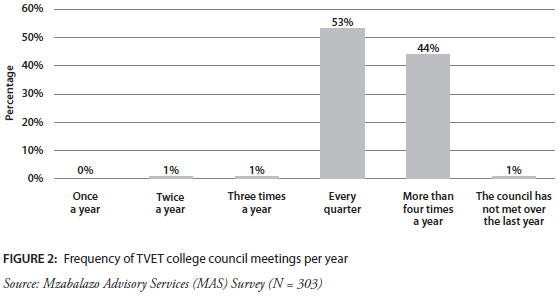
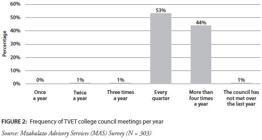
The second way in which the form of councils might influence the way accountability and efficiency are interpreted lies in the mechanisms that councils use to carry out their functions. Council meetings are at the centre of governance activities; it is at these meetings that members interact, receive reports, discuss issues and make decisions. The general view expressed by interviewees was that governance meetings were conducted reasonably well and were productive. More than half (53.47%) of the survey respondents indicated that the college council met four times a year, which aligns with legislated requirements. An analysis of the 2021/2022 annual reports revealed that some councils had 12 council meetings per year and one college council held 16 meetings, more than one per month.
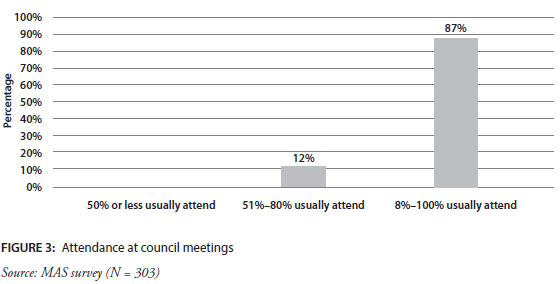
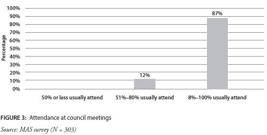
With some exceptions, meetings are well attended but a few of the interviewees believe attendance is good simply because council members receive a fee for attending the meetings.
Approximately 50% of the interview respondents indicated that meetings generally last between two and four hours, but in some instances they could go on for up to 14 hours, well into the night. Some chairpersons are of the view that the effectiveness of management's preparation has an impact on the duration of meetings:
Their lack of preparedness makes it impossible to go through the material quickly, as the material is being explained during the meeting.
However, management countered that it is the council members who come unprepared. One principal complained of
long meetings that mostly turn out to be fruitless.
Another principal remarked:
Topics include delayed meeting payments and personal interests. Personal issues overshadow institution-related matters. Meetings become contentious and unpleasant. Meetings are often unproductive despite their length. Council members should assist and strengthen governance, not become problems for the institution.
Subcommittee reports are viewed as helping council meetings move with a certain level of productivity and direction. As one chairperson explained:
Committees are doing the robust work, and by the time it gets to the council it is clear [...] what [...] management is seeking from the council through the committees.
However, some council members believe that these reports often take up significant time.
More than 80% of the council members who responded to the self-evaluations indicated that council meetings are conducted to ensure open and transparent communication, meaningful participation and timely resolution of issues. Although meetings generally followed an agenda, there were several examples where meetings were derailed, as the following three quotations from principals demonstrate:
I will be brutally honest: you would feel that sometimes when you have a particular issue that you want approved, you wish that a particular member would not be present. Because you know, once they start talking, their discussion changes the entire meeting agenda to a different direction.
They are aware that they are the highest decision-making body; without them, you can't approve your own budget as a principal. You can't approve the strategic plan.
We often receive council members that do not have an interest in academic matters; they are here for their own interests. Although it is indirect, [...] it is very easy to pick it up.
As Katsamunska (2016) points out, the composition of a council in which representatives do not necessarily have to account to their constituents results in more active members using their influence to sway decisions in favour of an interest group or in their own interests rather than in the interests of the college.
Meetings constitute the main activity of governance councils, but, to be productive, council members are required to have knowledge of the way in which the TVET system works and to be up to date with reports on the college and, more broadly, on policy and research. We now turn to the capacities of council members.
Capacities of TVET college council members
The third issue that affects the efficiency and accountability of TVET governance is the capacity of councils and the human resources available on councils. In order to achieve efficiency, council members require skills and knowledge about the way that college operations work and on ways of improving them. According to the CET Act (2006, Chapter 3, Section 10(4)), the 16-member council includes: the principal; lecturer, staff and student representatives; five ministerial appointees; one external member representing donors; and four additional external members with a broad spectrum of competencies in the fields of education, business, finance, law, marketing, information technology and human resource management (appointed by the council in consultation with the minister). The council should demonstrate a level of decision-making that, although not fully democratic, at the very least includes a wider range of participants - some of whom represent stakeholder groups - when making strategic decisions. While ministerial appointees have a slightly greater representation than other stakeholders, councils are structured so as to include a range of representatives. This also has instrumental value: it offers a wider range of ideas for consideration and improving the chances that there will be buy-in if decisions are made collectively.
At the time of this research in 2023, most college councils were established and constituted. However, only 16 (32%) had all their members appointed according to the requirements of the CET Act. King IV (IoDSA, 2002) requires the governing bodies to be adequately diverse. However, the data indicate otherwise: based on data provided by DHET in the Council profiles report of February 2023 (DHET, 2023), 36.9% of council members are female and 63.1% are male. Furthermore, of the total of 697 council members counted, 84.6% are African, 7.1% Coloured, 5.7% white and 2.6% Indian.
Moreover, the interviewees indicated that DHET's process for vetting and appointing ministerial council members is lengthy, with the result that positions remain vacant for long periods. However, the vetting process has not guaranteed that all ministerial appointees are suitable council members. At least three principals interviewed argued that they had had problems with ministerial appointees who came into councils with political agendas. One principal made a plea against 'cadre deployment'. Another explained:
Even politicians will phone you and ask, 'Do you have a vacant position in council?'; 'Why?; 'We want someone to get in'; and I said, 'No, I don't appoint members. The minister does.'
The chairperson of a third institution noted:
Sometimes the minister appoints people from communities who are educators or department officials. They come onto council and act like it is a glorified school and act like the principal's keeper. We have to look at the competencies when appointing people to council. People should have done King IV training.
The ethical conduct of council members was also raised in interviews with regard to individuals viewing their positions on council not as a voluntary service but rather a means of extracting money from the college. The interviewees indicated that some individuals treat council membership as a career or as a source of income and try to influence appointments and procurement accordingly. There is also a general view that many council members attend meetings primarily for the meeting fee they receive.
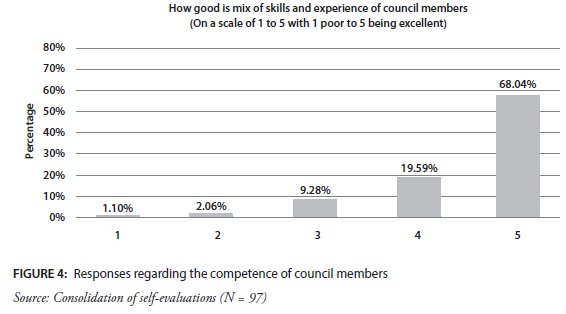
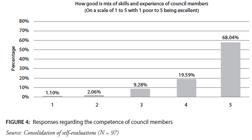
Most respondents indicated that both the representation and the size of college councils and committees are appropriate as there is a balance of skills. On the view that councils are too large, one interviewee commented:
Effective boards are nothing more than eight people.
They also stated that there are too many subcommittees.
The interviewees noted that a lack of knowledge and experience among council members contributed to several governance problems, leading to their impeding the council's capacity to carry out its fiduciary duties and governance responsibilities. As one principal noted:
To be honest, there are council members that I believe do not have any knowledge of the sector and feel that they don't add any value. You've got those who know more and a whole lot, and then you've got those who don't. And, I think, unfortunately, those who don't are appointed by the minister. You can't say anything as a principal - you get given these people.
Another interviewee noted that, while some professionals join a council possessing technical knowledge, they lack sensitivity to the way in which governance in the public service differs from that in the private sector. In this regard, one chairperson stated:
The way councils are constituted, they are not getting 100% participation from the stakeholders. [...] We must bring in more industry. We need to bring in more people who understand the college council or, rather, the TVET sector. Bring people who understand the impact of the TVET sector on our economy. Bring more current stakeholders from [...] business, [the] community, education and training, in particular from a SETA, university and research perspective.
However, more than 80% of the council members who completed the self-evaluation agreed that councils comprise members with an appropriate mix of skills and experience.
Conclusion
The rationale for TVET college councils is not made explicitly clear in the relevant legislation. Instead, it can be inferred from the list of tasks given to councils to perform that they are meant to improve the accountability and efficiency of TVET colleges. But these terms are vaguely used. For example, the policy does not clarify the lines of authority and accountability. 'Efficiency' may refer to initiatives to cut costs and/or to improve procedures and/or respond to industry skills needs. While accountability and efficiency are not contradictory, they are ambiguous, and this can lead to a complex form of the way councils are structured and operate and of the capacities they require. It is the multiplicity of tasks and the criss-crossing lines of accountability that render the work of college councils complex in ways that may detract from both their efficiency and their accountability. The form councils take is not always appropriate given the fact that their functions are broadly defined and vague.
While, in principle, form should always follow function, in this article we have drawn on our research to show that, in the case of TVET college councils, function is often a response to the form that councils take. TVET councils are expected to be accountable for the efficient operation of colleges, but they have been hamstrung by the way that they are structured, by their operational procedures and by their human resource capacities. There are confusing lines of accountability, council meetings that do not drive strategy and a deficiency of industry experts on councils. And although tasks are decentralised to councils, DHET still holds the reins on some of the most important levers that are necessary to improve the efficiency of colleges. These include the appointment of senior staff, the allocation of funding for DHET-approved programmes and centralised performance management. As a result, college councils add another layer of accountability to TVET colleges but they do so without necessarily contributing to their institutional development.
REFERENCES
- Badenhorst, JW & Radile, RS. 2018. Poor performance at TVET colleges: Conceptualising a distributed instructional leadership approach as a solution. Africa Education Review, 15(3):91-112.
- DHET (Department of Higher Education and Training). 2013. White Paper for Post-School Education and Training. DHET.
- DHET (Department of Higher Education and Training). 2019. TVET college council: Induction manual. DHET.
- DHET (Department of Higher Education and Training. 2021. National Qualifications Framework Act 67 of 2006: Occupational Qualifications Sub-Framework Policy (1463).
- DHET (Department of Higher Education and Training). 2023. Council profiles report, DHET. Pretoria: Chief Directorate, Institutional Governance and Management Support.
- Gleeson, D, Abbott, I & Hill, R. 2011. Governing the governors: A case study of college governance in English further education. British Educational Research Journal, 37(5):781-796.
- IoDSA (Institute of Directors in South Africa). 2002. King II report on corporate governance for South Africa 2002. IoDSA.
- IoDSA (Institute of Directors in South Africa). 2016. King IV report on corporate governance for South Africa 2016. IoDSA.
- Mbatha, LL. 2023. Journeying through the tempest: A council member's reflection on the South African TVET college governance system. In: M Naude, I Martins, U Singh, M Gungea, T Luckho & P Appavoo (eds), Global trends in management, IT and governance in an e-world (e-MIG 2023). University of KwaZulu-Natal and Open University, Mauritius.
- Peters, BG. 2001. The future of governing. 2nd ed. University Press of Kansas.
- RSA (Republic of South Africa). 2006. Continuing Education and Training Act (previously known as Further Education and Training Colleges Act) 16 of 2006.
- RSA (Republic of South Africa). 2010. Higher Education and Training Laws Amendment Act 25 of 2010.
- Sithole, MD. 2019. Enhancing management structures at TVET colleges: A case of uMgungundlovu TVET College. Master in Public Administration dissertation, University of KwaZulu-Natal.
- Wedekind, V. 2010. Chaos or coherence? Further education and training college governance in postapartheid South Africa. Research in Comparative and International Education, 5(3):302-315.