Using a design-based research approach to improve Financial Mathematics comprehension among vocational college students
Abstract
This study examined challenges in understanding Financial Mathematics in technical and vocational education and training (TVET) colleges, where abstract concepts and traditional pedagogy impede comprehension. The aim was to improve understanding through systematic error analysis embedded in a design-based research (DBR) approach. Situated Learning Theory (SLT) framed the work by foregrounding authentic tasks, participation, and iterative refinement of instruction. Two purposively selected National Certificate (Vocational) Level 2 classes formed the target group. Iterative cycles of design, implementation, and analysis drew on preparatory examination scripts, classroom feedback, and formative assessment to diagnose misconceptions and inform successive prototypes. Many students struggled with definitions. Contextually grounded activities and personalised feedback improved conceptual clarity and performance.
Financial Mathematics; technical and vocational education and training (TVET); design-based research; error analysis; Situated Learning Theory; NC(V)
Introduction and background
The present study was conducted in respect of the National Certificate (Vocational) (NC(V)) Level 2 Mathematics Engineering programme at a technical and vocational education and training (TVET) college where Mathematics is a core subject. This curriculum integrates Financial Mathematics into the broader mathematics framework rather than it existing as a separate component within Pure Mathematics (DHET, 2011). Explicitly designed for Engineering students, this integration ensures that Financial Mathematics is not treated as an isolated subject but as a fundamental skill that is essential to academic progression and real-world application. The subject equips students with practical financial competencies, including calculating interest rates, managing annuities, understanding schedules and performing investment appraisals (Dos Santos et al., 2016). These skills are crucial to making informed financial decisions in both professional and personal contexts, and they serve to reinforce the essential role of financial literacy in technical and vocational education.
Despite its importance, mastering Financial Mathematics poses significant challenges for students in TVET colleges. In South Africa, TVET colleges provide vocational and occupational programmes, including the (NC(V)), which aim to equip students with both academic knowledge and practical skills. The inherently abstract nature of financial concepts, compounded by a lack of contextual learning and reliance on traditional pedagogical strategies, makes it difficult for students to fully grasp and apply these concepts (Makonye, 2020). The present study was guided by situated learning theory (SLT) (Lave & Wenger, 1991) and emphasised learning through participation in authentic real-life contexts. The abstract nature of Financial Mathematics and its disconnection from students' lived experiences make this theory especially relevant to designing interventions that embed learning within meaningful financial practices. Dos Santos et al. (2016) underscore the need for contextualised teaching approaches in TVET settings, noting that traditional methods often fail to connect mathematical content to real-world scenarios, which can hinder students' comprehension.
Our review of the literature indicated that there is limited research on this topic, particularly in the context of TVET colleges. This gap in the literature underscores the importance of this study, as it contributes to the ongoing debate in an essential realm of Mathematics. This is crucial not only for students' financial benefit but also for their professional decision-making capabilities. Closing this gap is vital, as Financial Mathematics is a critical skill that supports both individual financial literacy and professional competence.
As a result of these abstract concepts, students in TVET colleges often struggle to understand the practical implications of Financial Mathematics, which leaves gaps in their knowledge and skills (Khalo et al., 2022). While Hernández-Cortes et al. (2023) highlighted similar challenges in understanding Financial Mathematics, the context of the current study differs significantly, as it focuses specifically on the unique challenges faced in TVET colleges; these institutions have distinct educational needs and environments compared with other educational settings. Traditional teaching methods, which frequently rely on rote memorisation and procedural learning, lack the necessary real-world context that would make these financial concepts more accessible and relevant to students' daily lives (De Souza et al., 2024). These authors also state that this approach does not foster deep understanding or critical thinking; this results in ill-equipped students who are unable to apply Financial Mathematics effectively in both their academic and real-world situations.
Resolving these challenges requires innovative teaching methods that convey the theoretical underpinnings of Financial Mathematics and enhance students' critical thinking and problem-solving abilities. This study aimed to achieve this by integrating error analysis within a design-based research (DBR) approach. The DBR approach allows for an iterative design, implementation, and refinement of instructional strategies based on empirical data and student feedback. Furthermore, the study used SLT as the lens through which to interpret the findings. By focusing on the students' misconceptions and cognitive processes through examining their errors, this approach provided a more tailored and effective learning experience.
The study was designed to offer contextualised learning experiences that bridge the gap between theoretical concepts and real-world applications. By doing so, it seeks to equip students with the skills necessary to navigate complex financial scenarios in their future careers, in the process making Financial Mathematics more accessible and relevant.
Research question
How can a DBR approach be used to enhance overall student understanding of Financial Mathematics at TVET colleges?
This question guided the study's exploration of innovative instructional strategies that are able to leverage error analysis to enhance student comprehension and application of Financial Mathematics, ultimately aiming to improve students' educational outcomes in the TVET context.
Design-based research approach
DBR is a methodology that combines empirical educational research with theory-driven design of learning environments. It resolves complex educational problems through iterative analysis, design, development and implementation cycles, producing practical solutions and theoretical insights (DBR Collective, 2003; Armstrong et al., 2020). This study adopts DBR as its research design, which is discussed further in the methodology section.
Error analysis in education
Research in Mathematics education widely acknowledges that errors are not merely signs of failure but essential components of the learning process. According to Radatz (1979), errors reflect underlying cognitive processes and, when they are systematically analysed, they can reveal students' conceptual misunderstandings. Borasi (1994) also argues that engaging with errors can promote deeper learning by encouraging reflection and metacognition. This perspective is supported by Hattie and Timperley (2007), who emphasise that feedback, based on error diagnosis, is among the most effective strategies for improving student achievement. More recently, Ekasari and Putra (2023) demonstrated that analysing students' errors provides actionable insights for instructional scaffolding, leading to improved comprehension, particularly in Financial Mathematics. Therefore, error analysis is a diagnostic and instructional tool that enables educators to develop targeted interventions, overcome specific learning difficulties and enhance comprehension.
Naicker (2017) explored the conceptual and procedural difficulties in factorisation among 30 NC(V) Level 4 students and interpreted the findings using the Kilpatrick, Swafford and Findell framework (2001). The study revealed that students made conceptual and procedural errors across all forms of factorisation. This was reflected in their written assessments and emphasises the challenges that students face in order to bridge procedural fluency with conceptual understanding. These studies contribute meaningfully to the broader discourse on error analysis in TVET contexts and build a foundation for improving instruction in general and, in particular, in Financial Mathematics.
Mbeki (2023) extended this line of enquiry by analysing the ways in which NC(V) Level 3 students approached rational algebraic fractions through an ethnomethodological lens.1Although the study was not focused on Financial Mathematics, it provided relevant insights into error patterns and reasoning habits in the broader TVET Mathematics context. Mbeki (2023) found that students relied heavily on procedural strategies and often lacked conceptual awareness. This is similar to the challenges observed in Financial Mathematics topics such as interest calculations and budgeting, where students apply formulas without understanding them. These findings underscore the broader challenge in vocational education, that is, bridging the gap between procedural fluency and conceptual mastery across mathematical domains.
Further contributing to the discussion, Motseki and Luneta (2024) used the Newman error hierarchical model to conduct a qualitative case study examining TVET students' responses to optimisation problems. Although the study focused on optimisation rather than Financial Mathematics, the findings are relevant to the broader context of mathematical problem-solving in TVET settings. Their findings revealed that students struggled to apply prerequisite knowledge when solving optimisation problems, probably because of an instructional approach that is heavily reliant on isolated facts and procedures. The study also noted that a cohort of NC(V) Level 4 students consistently made transformation errors - regardless of their chosen problem-solving approach - falling within the broader category of systemic errors. Based on these observations, the authors recommended targeted instructional interventions, emphasising enhanced teaching strategies and continuous formative feedback to overcome persistent misconceptions and to improve conceptual engagement.
Supporting these findings, Ngoveni and Machaba (2024) examined the effectiveness of different questioning techniques in Mathematics instruction at TVET colleges while teaching and learning Financial Mathematics topics. Their study revealed that higher-order questioning strategies significantly enhance students' critical thinking and problem-solving abilities. Together, these studies highlight the importance of responsive teaching approaches that promote deeper understanding, particularly in Financial Mathematics where conceptual reasoning is essential. The importance of systematic error analysis in improving students' mathematical understanding is well documented in the literature. For instance, Laelasari et al. (2019) examined students' errors in solving mathematics problems requiring higher-order thinking skills and found that conceptual and encoding errors were most prevalent; this underscores the value of structured error diagnosis in educational settings. Similarly, Rushton (2018) found that incorporating error analysis activities into mathematics instruction improved conceptual understanding over time. In the context of Financial Mathematics specifically, Ngoveni (2025) applied Newman's error analysis model to identify persistent errors among NC(V) Level 2 students. The study demonstrated how diagnostic feedback, grounded in students' error patterns, could be used to inform instructional adjustments with measurable results.
Collectively, the reviewed literature highlights the critical role of contextually grounded research in shaping effective Financial Mathematics instruction. Several studies explicitly conducted in TVET colleges - such as those by Mbeki (2023), Motseki and Luneta (2024), Ngoveni and Machaba (2024) and Ngoveni (2025) - provide insight into the persistent procedural and conceptual challenges students face across mathematical domains. These studies emphasise the diagnostic power of error analysis, the value of higher-order questioning and the importance of responsive instructional strategies tailored to the needs and challenges that face vocational students. Complemented by broader evidence on error-based feedback and teaching through error analysis (Hattie & Timperley, 2007; Rushton, 2018), this study has established a strong foundation. In response, the current research adopts a DBR approach to overcoming the specific learning difficulties encountered by Financial Mathematics students in order to develop and refine practical, theory-informed interventions in the TVET context.
Theoretical framework
This study was theoretically underpinned by SLT (Lave & Wenger, 1991), which adopts the position that learning is fundamentally tied to authentic social contexts and practical experiences. SLT emphasises that knowledge acquisition is deeply influenced by the context in which it occurs, suggesting that meaningful learning occurs through participation in realistic tasks embedded in students' social and cultural environments (Lave & Wenger, 1991).
Central to SLT are the concepts of legitimate peripheral participation (LPP) and communities of practice (CoPs). LPP suggests that students initially engage in learning tasks from the periphery and progressively move towards more active participation as their competence and understanding deepen (Hanks, 1991; Lave & Wenger, 1991). CoPs are groups in which individuals learn by actively engaging with shared practices, common goals and collaborative interactions. This then leads to the co-construction of knowledge and skills (Wenger, 1998).
In the context of this study, the students at TVET colleges were engaged in authentic Financial Mathematics tasks directly connected to their everyday financial realities. These included drawing up budgets based on actual incomes (allowances, bursaries, part-time employment) and exploring financial scenarios commonly encountered in their communities, including informal savings schemes (stokvels) and informal lending practices (mashonisas) (Van Wyk, 2017; Krige, 2019; Ngoveni, 2025). This alignment directly reflects the tenets of SLT, suggesting that student comprehension improves when learning experiences reflect their lived realities and practical applications (Maharaj, 2013; Khalo et al., 2022).
By situating Financial Mathematics in realistic scenarios, we were able to help the students to transition from perceiving Financial Mathematics as an abstract concept to improving their understanding in ways that enabled them to participate actively in relevant financial practices. Peer collaboration in small-group case analyses further exemplified the CoP concept, where students interacted socially, negotiated meaning collectively and built shared understandings of financial concepts (Jones & Tanner, 2002; Sullivan, 2018).
Therefore, integrating SLT provides a robust theoretical justification of the reasons for and the way in which the pedagogical interventions in this study effectively enhanced the students' comprehension of complex Financial Mathematics concepts. These interventions included, in particular, contextualisation, practical engagement and peer collaboration (Makonye, 2020). This theory explains the improved educational outcomes and reinforces the importance of authentic, socially embedded learning practices in vocational education contexts (Hattie & Timperley, 2007; Hernández-Cortes et al., 2023).
Methodology
This study employed qualitative methods in a DBR approach in order to iteratively develop and refine instructional strategies for teaching Financial Mathematics at TVET colleges. The DBR framework follows a cyclical process of designing, testing and refining educational interventions based on empirical evidence and theoretical insights (DBR Collective, 2003; Armstrong et al., 2020). DBR was selected for its ability to integrate research with systematic instructional design, which allowed interventions to be tested and improved iteratively. Although DBR structured the development and refinement of the intervention, its design was conceptually informed by SLT. This theory supported the integration of real-life financial tasks, enabling students to engage meaningfully with concepts in socially and culturally relevant contexts.
The study involved two independent cohorts of NC(V) Level 2 students enrolled in the Electrical Engineering programme, for which Mathematics is a compulsory subject. This programme consistently registered the highest enrolment of Level 2 NC(V) Mathematics students at the selected TVET college. In 2021, a cohort of 17 students completed a trial examination in Financial Mathematics, which served as the initial implementation of the intervention and is referred to in this article as Prototype I. In 2022, a different cohort of 17 students completed the same examination after refinements had been made, which is referred to as Prototype II. These cohorts were distinct but had similar academic backgrounds, programme structure and course content, ensuring comparability in the students' performance.
The selection of Level 2 students was intentional, as students at this stage solidify fundamental mathematical concepts critical to their progression to higher levels (Kilpatrick et al., 2001). Although the two cohorts were from different academic years, comparability was ensured. Both groups were enrolled in the same NC(V) Level 2 Electrical Engineering programme at the same TVET college, wrote the identical Question 4.1 under the same assessment conditions, and were assessed with the same rubric. These controls allowed performance differences to be reasonably attributed to the intervention rather than to group characteristics.
To ensure the comparability across the two cohorts, the trial examination was set internally, invigilated under strict conditions and moderated. The researcher requested that Question 4 from the 2021 examination be repeated in the 2022 examination, providing a direct basis for comparing the students' performance. The academic schedule guided the focus on Financial Mathematics, ensuring that the data collection aligned with the syllabus timing in both years.
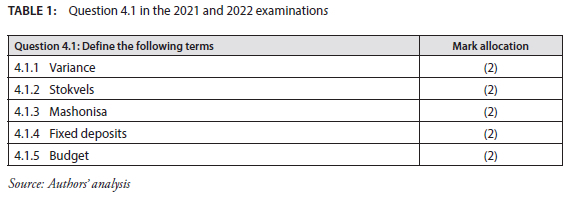
The trial examination included five sub-questions under Question 4.1. These required the students to define key financial terms: variance, stokvels, mashonisa, fixed deposits and budget, which are described below. Each sub-question carried two marks, totalling 10 marks for the question overall. The same questions were used in both years to ensure methodological rigour and reliable comparisons (Nguyen, 2023). These five terms are described below:
• Variance is the difference between the budgeted or expected amount and the actual amount spent or received. It is commonly used in budgeting and financial planning to assess either overspending or underspending (Gitman et al., 2011).
• A stokvel is a community-based, informal savings scheme in which members contribute a fixed amount regularly and take turns in receiving lump-sum payouts; it is commonly employed in South African communities (Van Wyk, 2017).
• A mashonisa is an informal moneylender who operates outside the formal banking sector, typically offering short-term loans at high interest rates to individuals with limited access to traditional credit (Krige, 2019).
• A fixed deposit refers to a bank account where money is deposited at a fixed interest rate for a set period, offering a secure investment option with limited accessibility until maturity.
• A budget is a financial plan that outlines expected income and expenses over a specific period and is used to manage resources and guide financial decisions (Gitman et al., 2011).
Error analysis was the primary method used to examine the students' responses and identify common misconceptions and learning difficulties. In 2021, students struggled with concepts such as variance and fixed deposits while demonstrating a better understanding of stokvels and mashonisa (Radatz, 1979). Based on these findings, the intervention was refined to correct misconceptions through practical activities and contextual learning experiences (Jones & Tanner, 2002; Sullivan, 2018).
In 2022, the same trial examination was administered and error analysis revealed notable improvements in the students' understanding of the five concepts. For example, the number of students correctly defining variance increased from two in 2021 to seven in 2022, reflecting the effectiveness of real-life contextual learning strategies such as creating personal budgets (Borasi, 1994; Jones & Tanner, 2002; Santagata, 2005).
The study adhered to consistent examination questions and marking procedures to ensure that the data across both cohorts remained reliable and comparable. Using actual student scripts provided authentic data for analysis, strengthening the validity of the findings (Hattie & Timperley, 2007).
Ethical clearance was obtained from the Ethics Committee of the South African university at which the study was conducted, ensuring compliance with research ethics. The confidentiality and anonymity of the student data were maintained throughout the study. To protect the participants' confidentiality and anonymity, pseudonyms were used throughout the reporting process; all the data, including students' scripts and responses were securely stored in password-protected digital folders accessible only to the researchers. Informed consent was obtained from all of the participants, ensuring their awareness of the study's purpose and role (Lincoln et al., 1985). These ethical considerations upheld the integrity of the research process.
Findings
This section examines students' responses to Financial Mathematics tasks, highlighting common misconceptions and error patterns. It also explores the effects of the instructional intervention by comparing student performance before and after its implementation.
The following is a presentation of Question 4.1 from the examination paper administered in both 2021 and 2022.
Analysis of definitions of financial concepts
The objective of each sub-question was to define the five financial concepts.
Error analysis of academic year 2021
Seventeen students took the test in 2021 and the total of all the marks that they scored was 68 out of a possible 170 marks, which is 40% of the possible score. Although this percentage exceeds the minimum requirement of 30% to pass this subject, it is relatively low given that three concepts (stokvels, mashonisa and budget) are presumably frequently encountered in the students' daily lives.
Considering that most students are likely to possess a certain level of familiarity with the concept 'fixed deposit', it can be anticipated that even a student who is not adequately prepared would find it relatively easier to define this concept. In contrast, it was anticipated that the concept 'variance' would prove difficult for a number of students, as it is not a term that is familiar to most students. Each of the 17 student scripts was assigned a numerical value ranging from 1 to 17, and each of the scripts was numbered according to the student's script number and the year of the test, for example 1/2021. Similarly, in 2022, the students' scripts were numbered from 1 to 17 and identified by their number and the year of the test, for example 1/2022.
Question 4.1.1 Variance
Among the 17 students, notable difficulty was experienced in understanding the concept of 'variance', as only two students achieved satisfactory results.
• Nine students did not attempt to define this concept. Below is an example of someone who made no attempt to answer: Student: 5/2021: 4.1.1
• Examples of the incorrect answers provided in the seven attempted answers: Student: 4/2021: 4.1.1 Variance = interest calculated through a certain percentage. Student: 7/2021: 4.1.1 Variance = the number of people in a group.
Question 4.1.2 Stokvels
The students demonstrated some understanding of stokvels, with 11 students achieving a maximum score, one student earning a single mark, and five students receiving a zero score.
Noteworthy responses were provided by students 1/2021, 2/2021 and 6/2021, as indicated below.
• A student provided an intriguing perspective by connecting stokvels with women: Student 1/2021: 4.1.2 Stokvels is the money that women are paying per month.
• Students used their prior knowledge, such as budgeting for food expenses: Student: 2/2021: 4.1.2 Stokvels - a group of people saving money for grocery or some other things.
Student: 6/2021: 4.1.2 Money that you save as a group and you share at the end of the year.
Question 4.1.3 Mashonisa
Most of the students had no difficulty defining the concept of mashonisa, with 11 of them achieving full marks.
• Two students scored one because they forgot that the money borrowed from a mashonisa should be repaid with interest:
Student 1/2021: 4.1.3 Mashonisa is the people is lending money.
• Some students provided intriguing responses, demonstrating their familiarity with the concept and ability to connect their answers to their community contexts: Student 4/2021: 4.1.3 Mashonisa - a person that borrow people money and they return it extra. Like when borrowing R100 you bring extra with R50, then it's R150.
• The remaining four students demonstrated partial comprehension of the concept yet struggled to express it properly. For example, one student stated that 'mashonisa' refers to a specific sum of money rather than an individual:
Student 12/2021: 4.1.3 Mashonisa is a person who owe people money.
Student 17/2021: 4.1.3 Mashonisa is an amount that you borrow ... come back with an interest.
Question 4.1.4 Fixed deposits
The term 'fixed deposit' is commonly used and students may have encountered it at some point in their daily lives. However, only four students were able to achieve marks on this question. Of these four, two scored two marks each, while the other two students managed to score only one mark each.
• The concept of fixed deposits was frequently misconstrued, as evidenced by this response:
Student 3/2021: 4.1.4 An amount of money that you pay every month such as rent.
• Four students defined a fixed deposit as a sum of money regularly deposited monthly, for example:
Student 5/2021: 4.1.4 Money that is deposited every month into your bank account.
• One student defined this concept as the regular deposit of money into a fixed account, resulting in the gradual growth of the account balance due to the accrual of interest. However, this description was awarded one mark, which is appropriate because it refers explicitly to a monthly deposit rather than a single lump-sum deposit: Student 6/2021: 4.1.4 Money that you save in your fixed account and it is increase every month.
• The student who achieved a maximum score on this question provided a straightforward explanation of this concept:
Student 14/2021: 4.1.4 Fixed deposits - money put in the account and cannot be withdrawn without notice.
Question 4.1.5 Budget
The concept of 'budget' was not clearly defined as anticipated, as only five students achieved a maximum score, while three received only one mark. Nine students failed to define this concept accurately, while three out of these nine did not even attempt an answer. Several students were confused about the concept of keeping a monthly budget and setting funds aside to purchase a specific item. The students did not perceive saving money as an element of the budgeting process but rather as the budget itself.
• Students 10/2021 and 17/2021 provide evidence for this claim:
Student 10/2021: 4.1.5 Budget - is the money that you invest in your bank account of from other savings received.
Student 17/2021: 4.1.5 Budget - is an amount that you budgeted for something ... keep it safe.
• This misconception is also visible in a student's statement that a budget refers to the money saved after receiving payment:
Student 13/2021: 4.1.5 Budget - money that is saved after getting paid.
Student learning outcomes and conceptual improvements
The intervention aimed, through an initial error analysis, to enhance students' understanding of Financial Mathematics at a TVET college and to overcome the difficulties identified. In 2021, students were taught Financial Mathematics, including the five concepts discussed, which allowed the researchers to reflect on their teaching practices and incorporate error analysis into their lessons. The initial analysis revealed significant challenges with abstract concepts such as variance and fixed deposits, while the students were more familiar with everyday terms such as stokvels and mashonisa. This reflection and analysis guided the design of an intervention that integrated targeted teaching strategies into everyday teaching and learning activities, focusing on error analysis and real-life examples to improve conceptual understanding.
Using a DBR approach, we iteratively developed and refined our teaching strategies and materials, implemented initial prototypes during regular classroom sessions and collected performance data to inform continuous improvements.
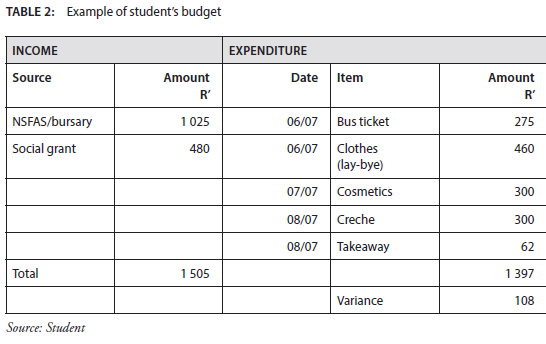
In 2022, we made significant changes to the approach. Instead of providing students with hypothetical income and expenses to create a budget, we allowed them to use their actual income, whether from allowances or bursaries, as reflected in the example in Table 2 below. This hands-on task helped the students to gain a better understanding of budgeting, as it was directly relevant to their financial situations. The error analysis from 2021 showed that the students often misunderstood a budget as money set aside rather than a process involving planning and saving. By using their real incomes, the students could view and understand budgeting as a practical, comprehensive process.
Personalised feedback and support were provided through individual feedback sessions, enabling the students to overcome their unique challenges. Formative assessments, including individual and group activities and reflection sessions, were conducted to monitor their progress, while pre- and post-tests measured their overall improvement. The success of the interventions was ensured through iterative refinement based on assessment results and stakeholder feedback, ultimately enhancing the students' proficiency in Financial Mathematics and their ability to apply these concepts in both academic and real-world contexts.
Error analysis of definition questions 2022
An error analysis was conducted in 2021 to evaluate the effectiveness of Prototype I and determine whether any revisions were necessary. Moreover, a thorough error analysis was considered indispensable for Prototype II. The analysis served a twofold purpose on this occasion. First, it provided a basis for the initial assessment of Prototype II to determine whether Prototype III should be implemented or if Prototype II is sufficient. Second, the analysis results were employed in the summative assessment, specifically in comparing the two prototypes to measure the impact of the revised model.
Question 4.1.1 Variance
In 2021, the students did not respond well to Question 4.1.1, which required them to explain the concept of variance, with only two students achieving a full score. Nevertheless, there was a significant improvement in 2022, as seven students attained a full score and only three did not attempt to answer the question. Among the five definition questions, this particular question showed the most significant improvement in performance between 2021 and 2022: a significant increase of 11 marks in the total score was evident, making it the most improved question.
• Most of the students' responses demonstrated a higher level of understanding than in the previous year. The achievement can be credited to implementing the intervention outlined in the preceding paragraphs. This is one student definition: Student 16/2022: 4.1.1 Variance - a difference between a budget amount and actual amount.
Question 4.1.2 Stokvels
This question required students to define the term 'stokvel'. It received the second-highest score when adding students' marks on this question, earning a total of 28 marks. The number of students who achieved a perfect score rose from 11 in 2021 to 14 in 2022, resulting in a five-point increase.
The improvement in performance can be ascribed to the students' ability to demonstrate a strong comprehension of the concept. Nevertheless, while engaging in discussions, certain students encountered difficulties in expressing their comprehension in writing. This compelled the researchers to guide them to express themselves more clearly. The approach focused on highlighting the importance of presenting the concept in a manner that assumes the reader has no prior understanding of the concept and explaining it in a way that is easily understandable. It is probable that this guidance improved the students' performance, not only on this question but also in their answers to other questions. It is crucial to emphasise the importance of relating learning activities to students' real-life experiences, as this promotes a more profound comprehension and improves academic performance. These are two student definitions:
Student 10/2022: 4.1.2 is the group of people that have agreement of certain money to invest at the end they share it.
Student 12/2022: 4.1.2 Stokvels - money that a group of people that contribute monthly and give one the amount until they get it all.
Question 4.1.3 Mashonisa
Students were asked to define the term 'mashonisa'. In 2022, 15 students obtained a perfect score on this question. One student scored one point, while the remaining student did not attempt the question. In this question, the students obtained the highest total score of 30 marks out of a possible 170. In 2022, four more students achieved full marks for this question in comparison with the previous results of 2021. The students' performance in this question was commendable, indicating their overall involvement in class discussions regarding this concept.
According to the reports from 2021, the majority of the students defined a mashonisa as an individual who provides loans without explicitly disclosing the associated interest rates. In contrast, a significant proportion of students in 2022 incorporated interest into their explanations, suggesting an enhanced comprehension of the concept or a more effective means of articulating it. The students' enhanced capacity to articulate the concept can be ascribed to the guidance they were offered - similar to that for the previous questions -instructing them to define a concept using their own words. This methodology improved the students' comprehension and expression of the concept, leading to a notable improvement in their overall academic achievement. Here are two definitions of mashonisa:
Student 6/2022: 4.1.3 Mashonisa is the person who give people a certain amount and need it with interest.
Student 10/2022: 4.1.3 is the person that borrow other's money with the high amount of interest when you return it.
Question 4.1.4 Fixed deposits
The students were tasked with defining the concept of fixed deposit in this question. Out of the total number of students, ten achieved full marks, while three chose not to answer the question. This led to a six-point increase in the overall performance compared with the previous year. The class generally exhibited a commendable comprehension of the concept compared with the previous group in 2021. The 2022 cohort successfully avoided the confusion between the concept of a fixed deposit and that of fixed costs, which posed a difficulty for the 2021 cohort. One student defined the term as follows:
Student 2/2022: 4.1.4 Fixed deposits - Money invested in a bank for a specific period at a fixed rate of interest.
This enhancement implies that the instructional and learning methodologies employed in the classroom successfully enhanced the overall understanding of the concept, resulting in a greater number of students being able to engage actively with the material and apply it during the examination. Some students could not attain any marks in this question, yet they exhibited a certain degree of comprehension of the concept:
Student 16/2022: Fixed deposit - is the fund that when you wanna buy something the you have to make some deposits first.
Student 4/2022: Fixed deposit - an exert money deposited.
Question 4.1.5 Budget
In this question, the students were required to explain the concept of a budget. In general, the students demonstrated strong performance, as 13 students achieved full marks and only two did not attempt the question. The question achieved the third-highest ranking in Question 4.1 of the test, falling behind mashonisa and stokvel in performance.
As previously mentioned in the discussion on variance, incorporating the students' real-life experiences was essential to enhancing their comprehension of the concept. In 2021, the students encountered difficulties in accurately explaining the notion of a budget, as most mistakenly defined it as solely pertaining to a predetermined sum of money set aside or invested for a particular objective. However, following their participation in an activity involving the creation of personal budgets using their bursaries or allowances and considering monthly expenses, the students acquired an improved comprehension of, and perspective on, the concept. This approach probably played a role in the substantial enhancement of the students' performance in the 2022 examination. Here is one of the best definitions of the concept:
Student 9/2022: Budget statements which you write all your things that you are going to need with that money and write it down in order to know how much you are going to spend on each thing that you need to buy.
As per the marker's assessment, student 6/2022 failed to answer this question accurately, although they displayed a partial grasp of the budget concept. The student's difficulty seems to have been expressing their response with clarity. The marker could have assigned the student one mark because the student had mentioned using money after getting paid:
Student 6/2022: Budget is the amount of money that you use after getting your income.
Comparison between the two years
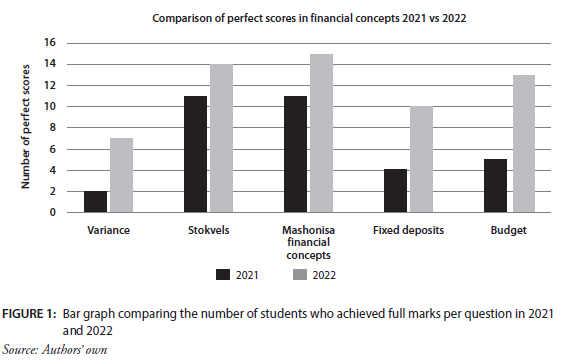
The bar chart in Figure 1 visually represents the number of students who obtained maximum scores in 2021 and 2022 for each financial concept. The data clearly illustrate student performance improvement across all concepts after the intervention.
This comparison of the 2021 and 2022 results reveals some interesting and significant findings:
• Variance: The number of students achieving maximum scores increased from 2 in 2021 to 7 in 2022.
• Stokvels: There was an increase from 11 maximum scores in 2021 to 14 in 2022.
• Mashonisa: The maximum scores rose from 11 in 2021 to 15 in 2022.
• Fixed deposits: The number of students achieving maximum scores increased from 4 in 2021 to 10 in 2022.
• Budget: The maximum scores increased from 5 in 2021 to 13 in 2022.
These improvements highlight the effectiveness of the intervention strategies implemented, particularly contextualised learning, personalised feedback and iterative refinement of teaching methods within a DBR framework.
Discussion of findings
This discussion integrates the study's findings with the DBR approach, error analysis, SLT and relevant literature to provide a comprehensive understanding of the study's impact on improving student performance in Financial Mathematics at TVET colleges.
Role of design-based research
The study employed a DBR approach characterised by iterative design, implementation, analysis and redesign cycles. This iterative process enabled the continuous refinement of teaching strategies based on the students' performance. The significant improvement in their performance between 2021 and 2022 highlights the effectiveness of this approach. As Collins et al. (2004) highlighted, DBR is particularly valuable in developing and testing educational interventions in real-world settings, because it ensures that the solutions are practical and grounded in classroom experiences. The iterative cycles in DBR, as noted by Shavelson et al. (2003), enhance educational practices by making them theoretically sound and practically applicable.
In the implementation of the prototypes, Prototype I in 2021 identified that the students experienced considerable challenges with abstract financial concepts, which led to the development of targeted teaching strategies in Prototype II. The focus on real-life applications and personalised feedback in Prototype II improved the students' performance in 2022. This aligns with the study of Armstrong et al. (2020), who stress the importance of iterative refinement and practical applicability in educational research. These refinements were intentionally aligned with SLT, ensuring that instructional strategies were socially and contextually meaningful.
Error analysis
Error analysis played a crucial role in identifying specific areas of student difficulty, such as misconceptions about some terms: for example, 'variance' and 'fixed deposits'. Black and Wiliam (1998) have emphasised the importance of formative assessments in diagnosing and resolving student misunderstandings. The clear identification of these misconceptions guided the development of targeted interventions. Both Radatz (1979) and Santagata (2005) also underscore the value of error analysis in diagnosing and correcting misconceptions.
In the present study, targeted interventions were then designed to overcome these misconceptions, incorporating hands-on activities such as personal budgeting to render abstract concepts more relatable and comprehensible. This approach is consistent with that of Ngoveni and Mofolo-Mbokane (2019), who demonstrated that overcoming fundamental misconceptions through targeted interventions significantly improves student understanding. The marked improvement in the students' ability to define terms such as 'variance' between 2021 and 2022 demonstrates the efficacy of this targeted approach.
This diagnostic process was enhanced by SLT's emphasis on understanding the students in their own social and cultural environments, which made more authentic identification of their misconceptions possible.
Enhancing comprehension through contextual learning
The literature supports the implementation of contextualised learning and real-life applications in enhancing student understanding. Maharaj (2013) emphasises that practical and applied learning experiences are crucial to deepening students' comprehension. The present study's findings that students understood financial terms such as 'stokvels' and 'mashonisa' better when these are contextualised in their community experiences align with Makonye's (2020) argument that learning is more effective when it is relevant to a student's cultural and social context.
This study also drew on Dewey's (1938) concept of experiential learning, where students learn through doing. By engaging in practical applications of financial concepts, students could move beyond theoretical definitions to understand the functional aspects of financial management. Lave and Wenger (1991) support this approach, arguing that learning is a situated activity that occurs through participation in social practices. These findings are reinforced by SLT, which adopts the position that, when students engage with problems which mirror their everyday experiences, they are more likely to construct meaningful understanding.
This personalised guidance functioned in the social interactions characteristic of SLT's CoPs, which encouraged the students to refine their understanding through peer and instructor collaboration. Personalised feedback and formative assessment, which are central to the study's intervention, are well supported by Black and Wiliam (1998), who emphasise the importance of formative assessment in identifying and resolving students' misunderstandings. The iterative refinement of teaching strategies contributed significantly to the improvements observed in the students' understanding and performance, which is consistent with the findings of Hattie and Timperley (2007).
Financial Mathematics in TVET colleges
Financial Mathematics is a crucial discipline for TVET college students, because it equips them with the essential skills for making informed financial decisions. However, the study revealed that traditional teaching methods often fail to overcome the abstract nature of Financial Mathematics, leading to significant challenges in student understanding. As Jones and Tanner (2002) and Nguyen (2023) have noted, these methods typically rely on rote memorisation and procedural learning, which do not necessarily promote deep understanding or critical thinking.
The study's integration of error analysis within the DBR framework and innovative teaching methods that foster critical-thinking and problem-solving skills resolved these challenges effectively. Higher-order questioning techniques, as advocated by Ngoveni and Machaba (2024), also enhanced the students' understanding of complex mathematical concepts.
The significant improvement in the students' ability to define the identical financial terms between 2021 and 2022 highlights the effectiveness of this intervention. Hiebert and Grouws (2007) emphasise the importance of connected and coherent instruction to deepen students' understanding; this study's findings support that principle. The improvements suggest a deeper comprehension of financial concepts, moving beyond rote memorisation to meaningful application. The evidence of improved performance illustrates not just pedagogical success, but also the students' deeper integration into real-life financial practices, as framed by SLT.
Recommendations
To enhance students' understanding of Financial Mathematics it is essential to integrate contextualised learning experiences that relate mathematical concepts to real-world applications. This approach helps students to connect theoretical knowledge with practical scenarios, making abstract concepts more tangible and relevant. As demonstrated in the intervention, activities such as creating personal budgets using actual income should be incorporated into the curriculum.
Educational institutions should adopt DBR methodologies to refine and improve teaching strategies continuously. The iterative process of DBR allows for the development of practical solutions that are responsive to students' needs. Regular design, implementation, analysis and redesign cycles should resolve specific learning challenges and enhance educational practices.
Limitations of the study
The study was conducted with two small, independent cohorts of 17 students each (2021 and 2022), which limits the generalisability of the findings. While the results provide valuable insights, a larger sample size would be needed to confirm the effectiveness of the intervention across a more diverse group of students.
The study was conducted in a single TVET college, which may limit the applicability of the findings to other educational contexts. Differences in institutional resources, teaching practices and student demographics could influence the effectiveness of the intervention.
The study focused on a limited number of financial concepts (variance, stokvels, mashonisa, fixed deposits and budget). While these concepts are important, the study's findings may not fully capture the challenges inherent in other Financial Mathematics topics or the learning needs of those students studying Financial Mathematics.
Conclusion
The 2021 and 2022 examination results analysis, supported by a well-designed intervention, highlights the importance of DBR, error analysis and contextualised learning to improving students' understanding of abstract concepts in Financial Mathematics. The iterative cycles of design and refinement in this study ensured that the teaching strategies were practical and effective. The error analysis provided valuable insights into student misconceptions and served to guide targeted interventions. The literature on experiential learning and formative assessment supports the findings, emphasising the need for teaching strategies that bridge the gap between academic content and students' lived experiences. This approach is essential to enhancing the relevance and effectiveness of education in TVET colleges and beyond. Grounding the intervention in SLT allowed for a meaningful connection to be made between mathematical content and students' lived financial experiences, which suggests the importance of socially contextualised teaching practices in vocational mathematics education.
Armstrong, M, Dopp, C & Welsh, J. 2020. Design-based research. The Students' Guide to Learning Design and Research, 1-6. Available at: <https://open.byu.edu/education_research/design_based_research>.
REFERENCES
- Black, P & Wiliam, D. 1998. Assessment and classroom learning. Assessment in Education: Principles, Policy & Practice, 5(1):7-74. Available at: <https://doi.org/10.1080/0969595980050102>
- Collins, A, Joseph, D & Bielaczyc, K. 2004. Design research: Theoretical and methodological issues. Journal of the Learning Sciences, 13(1):15-42.
- DBR Collective (Design-Based Research Collective). 2003. Design-based research: An emerging paradigm for educational inquiry. Educational Researcher, 32(1):5-8. Available at: <https://doi.org/10.3102/0013189X032001005>
- Dewey, J. 1938. Experience and education. Macmillan.
- DHET (Department of Higher Education and Training). 2011. Mathematics subject guidelines: National Certificate (Vocational) Level 2. DHET. Government Printer. Available at: <https://www.dhet.gov.za/National%20Certificates%20NQF%20Level%202/NC%28Vocational%29%20Subject%20Guidelines%20Level%202/Fundamentals/Mathematics.pdf>.
- Dos Santos, RP, Veiga, VJ & De Sá, IP. 2016. Basic concepts of financial mathematics and their relationship with the traditional contents of mathematics. TECCEN Electronic Journal, 4(2):25. Available at: <https://doi.org/10.21727/teccen.v4i2.268>
- Ekasari, A & Putra, DJ. 2023. Error analysis of learners' problem-solving abilities in financial mathematics: A Newman approach. Jurnal Pendidikan Sains, 12(1):44-51. Available at: <https://doi.org/10.17977/jps.v12i12024p044>
- Gitman, LJ, Joehnk, MD & Billingsley, RS. 2011. Personal financial planning. Cengage Learning.
- Hanks, WF. 1991. Foreword. In: J Lave & E Wenger (eds), Situated learning: Legitimate peripheral participation. Cambridge University Press, 13-24.
- Hernández-Cortes, R, León, C-VDD, Ramos-Rosas, ME, Davila-Torres, JI & Galan-Montero, JA. 2023. Mathematics and finance interaction: Challenges and opportunities in the understanding and application of financial concepts. International Journal of Engineering Technologies and Management Research, 10(8):1-7. Available at: <https://doi.org/10.29121/ijetmr.v10.i8.2023.1346>
- Hiebert, J & Grouws, DA. 2007. The effects of classroom mathematics teaching on students' learning. In: FK Lester (ed), Second handbook of research on mathematics teaching and learning: A project of the National Council of Teachers of Mathematics, Volume 1. IAP, 371-404.
- Kilpatrick, J, Swafford, J & Findell, B (eds). 2001. Adding it up: Helping children learn mathematics. National Academies Press.
- Laelasari, L, Darhim, D & Prabawanto, S. 2019. Analysis of students' mathematics resilience abilities on linear material. Journal of Physics: Conference Series, 1280(4):042005. Available at: <https://doi.org/10.1088/1742-6596/1321/3/032065>
- Lave, J & Wenger, E. 1991. Situated learning: Legitimate peripheral participation. Cambridge University Press.
- Maharaj, A. 2013. An APOS analysis of natural science students' understanding of derivatives. South African Journal of Education, 33(1):1-19. Available at: <https://hdl.handle.net/10520/EJC130323>
- Naicker, SA. 2017. Conceptual and procedural difficulties experienced by National Certificate (Vocational) Level 4 students in solving factorisation problems at a Kwazulu-Natal technology centre. Master of Education dissertation. University of South Africa.
- Ngoveni, MA. 2025. Enhancing financial literacy for national curriculum (vocational) mathematics students: A design-based approach using Newman's error analysis. Adults Learning Mathematics: An International Journal. Available at: <https://alm-online.net/wp-content/uploads/2025/05/Ngoveni-2025_Enhancing-Financial-Literacy-for-National-Curriculum-Vocational-Mathematics-Students>.
- Ngoveni, MA & Mofolo-Mbokane, B. 2019. Students' misconceptions in algebra: A case of National Certificate (Vocational) Level 2 Engineering Mathematics students. Association for Mathematics Education of South Africa, 1(2):32-54.
- Rushton, SJ. 2018. Teaching and learning mathematics through error analysis. Fields Mathematics Education Journal, 3(1):1-12. Available at: <https://doi.org/10.1186/s40928-018-0009-y>
- Shavelson, RJ, Phillips, DC, Towne, L & Feuer, MJ. 2003. On the science of education design studies. Educational Researcher, 32(1):25-28. Available at: <https://doi.org/10.3102/0013189X0320010>
- Sullivan, P. 2018. Challenging mathematical tasks: Unlocking the potential of all students. Oxford University Press.