Systems analysis of the national performance management system for TVET lecturers in South Africa
Abstract
A quality performance appraisal (PA) and continuing professional development (CPD) system is an essential component of a national performance management system for TVET lecturers. It is intended to support an improvement in lecturer quality and accountability, strengthens student graduation rates and feeds national human resource development for sustainable employment. The aim of this research study was to contribute to improvements in the functional integration and synergies between PA and the CPD system as applied in TVET colleges. The study involved the collection of qualitative data at six South African TVET colleges in order to develop a general description that captures the key features and interactions commonly shared across the case studies in a general analytic model. Data collection, coding and analysis informed the iterative development of a systems model based on causal loop analysis (CLA). This application of the CLA tool provided the means to represent multiple relationships and the feedback loops between them visually. We found that four main causal loops strongly influence the dynamics of PA and the CPD system. The findings offer an analytic platform for further research towards strengthening and reviewing the overall performance management system for TVET lecturers.
Performance appraisal; continuing professional development (CPD); causal loop analysis (CLA); TVET colleges; TVET lecturers
Introduction
This article is devoted to a research study that explored the ways in which technical and vocational education and training (TVET) lecturers' performance appraisals (PA) and continuing professional development (CPD) activities take place in the institutional environment of TVET colleges. The intention was to identify systematically the course of the PA process, including the formal transactions between individual lecturers and their managers, according to mandated processes, requirements and deliverables. The research also explored the quality of the mechanisms and resources required for an institution to support the process and the intended achievements that might lead to improvements in the quality of teaching and learning experienced by students.
The critical importance of the measures in place to evaluate the quality of TVET lecturer performance (Wedekind et al, 2024) lies in their contribution to national human resource development by equipping young people with intermediate technical and vocational skills that will enable them to enter the world of work and engage in productive and decent employment (HRDCSA, 2022). Improving the synergy between TVET lecturers' PA and their CPD can lead to enhanced lecturer competencies and therefore to the enhanced training and graduation prospects of college students. This research is therefore directed towards understanding the tenor and characteristics of both PA and CPD at the college level, with a particular interest in fathoming lecturers' perceptions and experiences of the processes. The research aimed to generate a system map that highlights the features of the PA-CPD's functioning which, from the perspective of TVET lecturers and managers, are conspicuous for their effect on the quality of the professional development process for lecturers.
Causal loop analysis as a data-gathering and an analytic tool
Causal loop analysis (CLA) has been advanced by the systems dynamics research community and is frequently applied to organisational settings (Richardson, 2004; Peters, 2014; Acaroglu, 2017). This approach has been applied to medical systems (e.g. Sarriot et al., 2015; Renmans, Holvoet & Criel, 2017; ) and less frequently to education systems (e.g. Groff, 2013). The application of CLA to TVET systems is relatively untested and constitutes an important part of this article: to experiment with the application of CLA with a specific focus (namely on PA and CPD) in a manner that could enable it to be applied to other studies in TVET.
CLA offers analytic value because the approach provides a structure according to which complex systems can be unravelled and analysed (Richardson, 2004; Peters, 2014). CLA as an analytic method is an aid to understanding system complexity. In other words, CLA is a simplification of reality that is used by researchers or management to comprehend a system's operation during a specified period. It is frequently necessary to explain the outcome of a CLA, for which a narrative or storytelling technique is useful (Richardson, 1997). In the context of systems thinking and CLA, cause-and-effect relationships are central to understanding the way different elements in a system interact with and influence, or have an impact on, one another. Changes in one variable can affect many elements in the system because they are linked and interdependent (Richardson, 1984). Accordingly, the CLA method is grounded in understanding a cause-and-effect relationship that occurs when a change in one variable ('the cause') leads to a change in, or a consequence for, another variable ('the effect').
The cause is therefore what initiates (or contributes to) the effect. The cause may, on its own, have a direct effect or may only indirectly (contribute to or) bring about an effect. The effect involves a change in the characteristics of the receiving variable, which then changes the way it interacts with the other variables to which it is related. This interaction produces one or more chains of cause-and-effect relationships between variables in the system. The systems under analysis in this research primarily involve human social and individual interactions. Unlike an analysis of systems that deal with inanimate objects - for instance, manufacturing systems - human interactions and communications are more complex, so that very rarely are the 'causes' of either increases or decreases in one variable due solely to any one interaction between any two variables.
Complex systems that are inclined to change over time are known as dynamic systems. The dynamic behaviour of a system may contribute to evolving patterns and behaviours that can frequently exhibit non-linear patterns reflecting uncertainties and non-linearity. This means that even in a system that consists primarily of a set of variables designed to work in combination to achieve a common purpose, this may not necessarily occur as intended. Interactions between the elements may lead to new, sometimes unanticipated, conditions that may have positive or negative consequences for the participants or institutions in the system (Richardson, 1984). Because of these uncertainties, complex systems are challenging to predict, understand or steer. Examples of complex systems include ecosystems, economies, population systems and social networks. Systems analysis emphasises a methodical and interdisciplinary approach to understanding such systems and provides a method for examining the relationships and interactions among system variables to identify opportunities for improvement in the system's efficiency, effectiveness and user-friendliness.
The CLA methodology is oriented towards generating a visual representation of the system variables and their cause-and-effect interrelations in the form of causal loop diagrams (CLDs). These CLDs are used to depict dynamic interrelationships between variables graphically. Furthermore, CLDs allow us to visualise these variables and their relationships over time. They explain the behaviour of a system by depicting a set of interconnected nodes together with the feedback loops created by the connections. One or more of the nodes may present the core symptoms of a problem; and identifying the affected nodes will help to trace the causal chains leading to the challenges preventing the system's full success. Therefore, CLDs enable the researcher to visualise holistically how the parts of a system interact in order to have a positive or a negative impact on a particular outcome (Richardson, 1984).
Our approach was therefore to use CLA to investigate the challenges and opportunities in the current configuration of PA and CPD for TVET lecturers. Our main research question was this: 'How can the relationship between PA and CPD be enhanced within the overall performance management system for South African TVET lecturers?' The research was premised on the critical role of TVET lecturers and the extent to which a fair accountability process in TVET colleges can make the sector more efficient and, by implication, better able to contribute to resolving the country's challenges in job creation and skills development.
Using CLA in the systems analysis approach in this study offered analytic value by providing a structured methodology according to which the complex system could be unpacked and analysed to identify:
• the relevant variables influencing engagement with PA and the CPD system; and
• the quality of the interactions between variables and how these influence the outcomes of the PA process and the developmental role of CPD in it.
Data-gathering was conducted using a qualitative approach. Individual and small focus-group interviews were used to gather information, first, about the PA processes and the lecturers' and the departmental heads' understandings and experiences of it. And, second, about the links between PA and CPD as core elements of the performance management system. The fieldwork also examined the participants' understanding of how well PA and CPD processes are integrated in the system. The processes investigated included access to CPD opportunities, the impact of lecturer motivation, and stakeholder involvement and feedback in the system. Fieldwork was followed by data-coding, data-capturing, analysis and the creation of CLDs.
Driven by the aim of contributing to improvements in TVET college institutional quality and development, the analysis focused on identifying good or promising practices and also on less effective elements in conducting PAs and weaker links between the PA and CPD processes. Challenges and potential gaps affording opportunities to make improvements were sought. Interviews were held with TVET lecturers, their supervisors and senior TVET managers (campus manager or college principal). Interviews covered the PA and CPD processes, lecturer experiences and the functioning of the systems at departmental and institutional levels.
The analysis also aimed to identify patterns of similarity between, and variations in, PA and CPD implementation across institutions to understand how colleges have adapted these processes to their specific needs. The interview findings were then used to develop a draft CLD that serves as a visual representation of the current PA processes and CPD activities in the participating colleges. The CLD also mapped the positive and negative influences on the effectiveness and quality of PA and CPD, as represented through interdependencies and feedback loops. The CLD was then refined so that it conveyed simultaneously occurring activities, dynamics and tensions in the system. It could then be used as input for a group discussion, with the feedback being used to refine the diagram further to represent the workings and interaction of system elements more closely.
The main challenge in using the CLA method was to unpack the complexity of multiple relationships between variables in the identified system. The initial two-step process involved: (1) identifying the variables that make up the system; and (2) identifying cause-and-effect relationships between variables in the system through exploration and analysis of the interview data.
The third step was to create a graphical representation illustrating the system's interdependencies and feedback loops. These relationships are represented graphically in the CLD, where arrows show the direction of cause and effect between variables and loops to reflect the way the impact of changes in one variable could percolate throughout the system.
This mapping exercise aimed to identify, describe and represent the variables in the system and their interrelationships. The term 'mapping' is used as a convention only and should not be taken to imply that the resulting diagram represents a fixed landscape. Furthermore, this research exercise was deliberately framed within the broader institutional landscape in which the core PA and CPD functions interact. This means that, while internal and environmental factors such as financing that have an impact on the PA and CPD processes in each institution are central to this study, the vertical articulation of the PA and CPD process at the national, provincial, college and campus levels, though not central to this study, do need to be kept in mind. Nonetheless, the human resources (HR) management functions relating to the governance, resourcing and operation of the PA and CPD processes are referred to from the college perspective only, to retain the research focus at that institutional level.
It must, however, be re-emphasised that systems thinking and CLA as an analytic method are an aid to understanding system complexity but do not solve the inherent complexity on their own. However, the systems-based nature of the CLA analysis allows for a more holistic and nuanced understanding of institutional processes and dynamics within which professional relationships and experiences relating to performance appraisals and professional development opportunities play out.
Approach to data analysis
The process of identifying the relevant variables consisted of two steps:
• Inductive coding of interview transcripts to identify an initial long list of variables and the frequency with which they appeared across all the interviews; and
• Iterative re-evaluation of the prominence of variables according to interviewee observations as to the relative influence of variables in shaping the PA process.
Although we took into account the frequency with which interviewees mentioned variables during coding, our approach was otherwise largely qualitative. When evaluating the prominence of variables, we focused on the phrasing and tone that interviewees used in describing the variables and on the polarity they attached to each variable.
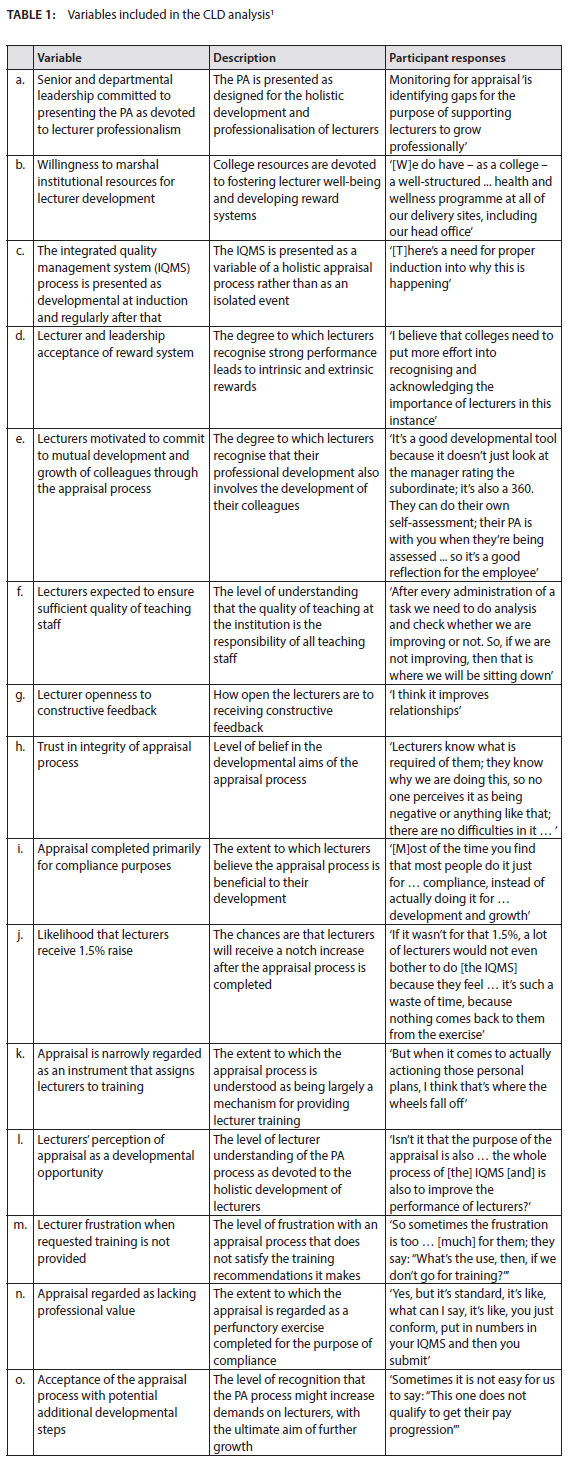
Table 1 lists the 15 main variables that emerged by focusing specifically on variables related to the PA and CPD procedures which participants identified that they were involved in in their capacity as lecturers, campus management (the main unit responsible for implementing the PA and CPD) or college management.
Having identified these variables, the next step was to identify the links between the variables by framing the following questions for each one. For example, with reference to a hypothetical Variable X:
1. 'Which other variables will Variable X influence?' This question helps to uncover the direct effects of Variable X on other variables within the system. It helps to identify the downstream variables that are influenced by changes in Variable X.
2. 'Which other variables will influence Variable X?' This question explores the influences on Variable X, highlighting the upstream variables that can affect the behaviour or state of Variable X. It helps to identify the variables contributing to changes in Variable X.
These core questions therefore helped to identify those variables that have a direct impact on, or which are being affected by, other variables. This means that the questions also enabled the direction (or polarity) of impact to be established.
Polarity and impact power of causal loops
The relationships between variables are represented by arrows that show the direction of influence -these are known as 'loops'. A combination of loops in a process can influence the conditions in a system. Loops can be either reinforcing (positive feedback in a certain direction) or balancing (negative feedback in the opposite direction), which contributes to the system's overall behaviour.
A positive effect in a causal loop indicates a relationship in which an increase (or a decrease) in one variable leads to a corresponding increase (or decrease) in another variable. Positive effects can create reinforcing loops that can either enhance or strengthen the system or amplify negative aspects. A negative effect in a causal loop diagram refers to a relationship where an increase (or a decrease) in one variable leads to a decrease (or an increase) in another variable. A system may have both balancing (or stable) and reinforcing loops. The presence of balancing loops can stabilise the system in a particular state that could be either virtuous or negative (Richardson, 1986; Richardson, 1997; Haraldsson, 2004).
The polarity of a variable indicates its potential to have an impact on another variable in a positive or a negative way. This analysis has therefore contributed to the study in two ways: by identifying variables relevant to and influencing the outcomes of the PA and the CPD system; and by associating each variable with having a positive or a negative impact on the system.
The identification of variables, including the polarity of their impact, is useful to policymakers and regulators for mapping variables in relation to each other in the system. This information needs to be augmented by evidence about the strength of the variables to influence other important variables and so shift the outcome of a system in its entirety. A limitation of this study is that it could not be designed to examine the strength of the variables identified due to the limited availability of quantitative data on the impacts of variables on each other.
Discussion and analysis of the causal loop diagram (CLD)
Primary variables in the performance appraisal (PA) and continuing professional development (CPD) processes
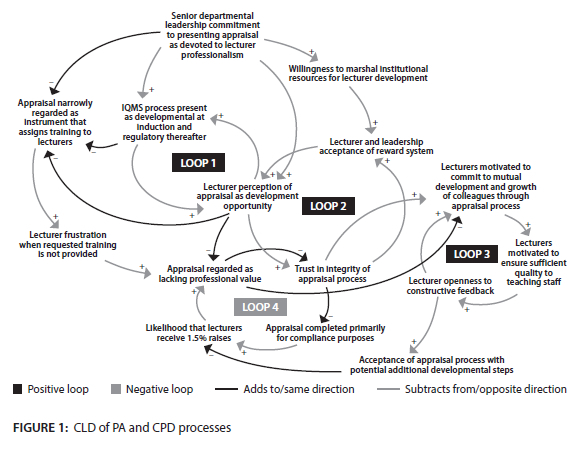
The CLD that follows maps out the topography of the variables in the study, usefully identifying a group of three primary variables that are closely connected to other variables in the PA and CPD processes.
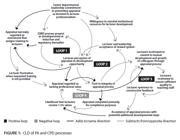
The three primary variables that are highly connected to other variables within the PA and CPD processes were identified as being the following:
• Leadership commitment to the process of PA and CPD informed by an aspiration towards professionalism: Important because a fundamental assumption of professionalism is that practitioners proactively take up opportunities to improve their personal or professional development.
• Lecturer perception of the appraisal as a developmental opportunity: Important because it emphasises lecturers' growth in contrast to instances where lecturers perceive the appraisal as being narrowly directed to evaluation that may be top-down or used only as a tool for allocating CPD opportunities.
• Trust in the integrity of the appraisal process: Important to secure the common shared trust of both the lecturer and the supervisor. The appraisal is a high-stakes process and trust is an important foundation from which lecturer participants draw confidence and motivation to improve their personal growth and performance. Likewise, the supervisor, who may also find the process challenging, must feel reassured that the process provides satisfactory guidance and workable checks and balances.
Interconnectivity and polarity
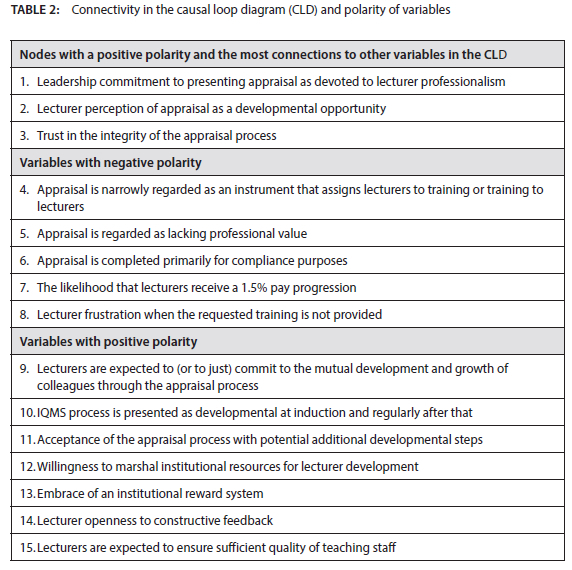
Identifying the nodes with the highest number of connections by counting the number of interconnections for each variable is useful because changes in these nodal variables will probably have an impact on a higher number of variables with which they are linked. The variables presented in the CLD figure above are presented in Table 2 for ease of reference. This table confirms our interpretation of the CLD figure. It is also important to note that the most connected nodes are shared between lecturers and leadership. This implies that the PA and CPD system may work to its maximal potential only where both leadership and lecturers have, from their perspectives, bought into and supported the process.
The polarity of variables can influence the overall potential of the system to generate a positive or a negative outcome. Where the most connected variables are linked into causal loops with a positive polarity, this means that they have the potential to have a more powerful impact on outcomes from the PA and CPD system. Where this is not the case, it is unlikely that the system as a whole will function optimally, except in pockets where an important variable with a high polarity is present in lecturer and leadership behaviour and attitudes.
The variables with a negative polarity bear further scrutiny because they identify particular areas that may be viewed as potential weaknesses in the process. All of these variables reflect characteristics of the process that can degrade lecturers' inclination to engage. The CLD outcome indicates that lecturers question the intrinsic value of the PA as an obligation that has little value for their occupational advancement. They are frustrated with the poor delivery, or non-delivery, of training opportunities, which inhibits a growth mindset.
Regarding the 1.5% annual salary increase reward, in some colleges this is taken for granted as practically all lecturers qualify for this by submitting the required documents. Only non-compliant lecturers - a small minority - may be denied this reward. In this case, it may be difficult to justify the increase as being an incentive and it may rather be viewed as having no particular polarity. In other words, the 1.5% annual salary increase reward does not operate as an incentive - it is neutral.
Depending on the college context, there were significant variations in experiences regarding the PA process, as demonstrated through negative variables (4), (5) and (6). For instance, in some colleges, the PA process was understood and experienced as being part of a holistic design of the working environment in which the college, as employer, was seen to have demonstrated consideration for lecturers' general well-being beyond its immediate function of providing teaching services to meet the college's mandate. However, at other colleges, the lecturers observed that the PA process was mainly a 'paper exercise' performed simply to fulfil institutional performance requirements and was consequently without any professional or personal value.
It is necessary to consider the underlying consequences for a college, campus or department where the PA status quo is a paper exercise and the participants go through the motions without meaningful engagement. In these instances, the fundamental intention of the PA, which is to advance professional growth and the quality of lecturer performance, may not be fulfilled.2 The difficulty that emerges from these scenarios is that lecturers may not be held substantively accountable for their performance and professional development. Lecturer criticism of the PA as being an authoritarian 'corrective' exercise carried out by a supervisor3instead of being collegial and respectful was not apparent.
The variables with a positive polarity refer to three management-related actions:
• Directing institutional resources to fund and support lecturer development (12);
• Developing and implementing reward systems (13), and
• Promoting the personal appraisal process as a developmental exercise throughout the year (10).
Variables with a positive polarity for lecturers include the following:
• Contributing through collegial participation in appraisals (9);
• Collegial support for improved collective lecturer performance (15);
• Acceptance of the consequences of the PA, including the requirement to undertake additional actions mandated for personal development (11), and
• Openness to learning from each other (14).
Causality and predictability
The CLD of a particular institution's system with changing variables displays a dynamic and interconnected set of relationships in the system. A degree of variability is expected between each particular institutional context due to the different polarities of the variables and the unique variances in the characteristics of each TVET college's PA and CPD processes.
The CLD depicted above was constructed using interview data from five TVET colleges in five of the six Department of Higher Education and Training (DHET) regions. The CLD focuses on the ways in which management and lecturers view and experience the PA process as it currently operates. The group of participating colleges represents 10% of all colleges nationally, although a larger proportion would have been desirable. Nonetheless, from our snapshot of colleges we found significant differences not only in the ways in which the colleges approach the PA process, but also in the way principals, campus managers, heads of department (HoDs) and lecturers regarded its meaning and importance.
The CLD is therefore not aspirational but rather a rendering of the elements of PA as presented in the TVET colleges we visited. In the diagram, we outline both positive and negative dynamics, which are labelled as positive and negative loops. On the one hand, we highlight positive, virtuous processes that promote and reinforce staff development, professionalism, collaboration and lecturer well-being. On the other hand, we also identify variables that contribute to an appraisal process which emerges from and further engenders institutional inertia. In what follows, we draw out the most integral variables that shape appraisal outcomes; then we explain each loop in turn, referencing any interview data as necessary.
Before proceeding, a note on terminology. While the IQMS frequently came up in our interviews, it should be viewed as only one variable of the PA process, not as the core element. Indeed, regarding the IQMS as the core of the appraisal process is, as we shall see, a contributor to negative PA outcomes and to inertia in the PA process. All references to the IQMS in our diagram and in this narrative should therefore be taken as specific only to the tool authorised by DHET to track lecturer performance, determine growth areas and score lecturer performance according to specific metrics (knowledge of specific learning fields, discipline, diversity, etc).
Our conception of PA, it will become clear, is more expansive, encompassing the institutional promotion of lecturer professionalism, mechanisms for recognising and rewarding staff and a general understanding that the appraisal process is an opportunity for individual development as teacher, colleague and technician. The PA process is therefore above and beyond the use of the IQMS for observing and assessing lecturers, developing codified personal growth plans (PGPs) and scoring for notch raises. If lecturers accept this conception of PA, they will, as one campus manager emphasised, understand that it 'is something ^ for [their] own personal growth'. Therefore, 'having that in mind should actually be an intrinsic motivation' for seeking out improvement.
In our diagram, three prominent variables are rendered in bold characters. These constitute what we determined to be the most influential factors in assessing institutional commitments to the professionalisation of staff and, by extension, in promoting effective teaching and learning. These variables are: (1) 'Senior and departmental leadership are committed to presenting appraisal as devoted to lecturer professionalism'; (2) 'Lecturer perception of appraisal as a developmental opportunity'; and (3) 'Trust in the integrity of the appraisal process'.
If we focus broadly on Loop 1, we can see numerous effects of leadership presenting the appraisal as developmental in orientation. Crucially, this informs a positive institution framing for the IQMS at induction and after that as a variable in the larger PA process that is developmental in orientation. As a campus manager noted, induction is an opportunity for the appraisal process to be presented to the lecturer as something that is 'not to punish or police ... but it's for ... developmental purposes'. Management must, in the words of a campus head, 'sell that idea in that mind frame', and then 'people begin to understand that this is there to support so that they can improve'. If this vision of the PA process is successfully promoted, then this can contribute to (2), 'Lecturer perception of appraisal as a developmental opportunity'. This perception leads to positive feedback, by which the developmental orientation of the appraisal process is reaffirmed during induction. As one campus manager noted, 'there's a need for proper induction into why this is happening'. These elements constitute the positive virtuous loop.
If leadership does not continually present and reaffirm the appraisal process as developmental and/or this idea is not internalised by lecturers, the dynamic changes significantly. A narrow conception of appraisal emerges. And, without framing the appraisal as developmental, the PA process in general and the IQMS process more directly become seen as bureaucratic mechanisms for assigning lecturers to training. If lecturers' training needs are not met, as specified in their personal growth plans (PGPs), then the appraisal process loses its meaning. As one senior lecturer noted, 'it will take me maybe five years to be considered for such a course' as indicated in the PGP: '[T]here's just too much red tape to get to where you are supposed to get to in terms of development.' The whole process, then, becomes seen as perfunctory or 'punitive', for 'you don't feel as if whatever action you have taken is serving you'.
In this situation, the negative Loop 4 becomes operative: 'The appraisal [is] regarded as lacking professional value.' This view leads, in turn, to a decline in (3), 'Trust in the integrity of the appraisal process', and to the 'Appraisal [being] completed primarily for compliance purposes'. As the same senior lecturer emphasised, filling in the IQMS then becomes a perfunctory action directed at receiving a 1.5% notch pay increase: 'the reason why people will mainly commit to doing it, then naturally you will get your pay progression . . If it wasn't for that 1.5%, a lot of lecturers wouldn't even bother to do it.' IQMS then becomes a check-box exercise, further reinforcing lecturers' perceptions that the IQMS and the PA processes more generally lack professional value, as they do not promote lecturer professionalisation.
Another crucial element here, as embodied in Loop 2 and Loop 3, is the role of the PA process in recognising and rewarding lecturers. If (1) 'Senior and departmental leadership [are] committed to presenting appraisal as devoted to lecturer professionalism', then this, for those we interviewed, leads to the marshalling of institutional resources for the holistic development of lecturers and the development of a rewards system. At some colleges, 'the appraisal is an opportunity to give the credit' to 'the lecturers' who do 'amazing things'. When the appraisal is used this way, it contributes not only to lecturer recognition of the PA process as a developmental opportunity and trust in its integrity (as rendered in Loop 2), but also to a broader commitment by lecturers to the college and to the growth and the increasing professionalism of their colleagues (depicted in Loop 3). Furthermore, when the appraisal is viewed as not simply a check-box exercise, it can be experienced as a vehicle for openly giving and accepting constructive feedback, which, in turn, motivates lecturers to invest in the further professional development of their colleagues. At some colleges, however, feedback is given inconsistently; consequently, these colleges do not develop a culture of growth in which lecturers are motivated to pursue improved teaching quality.
Link between PA and CPD
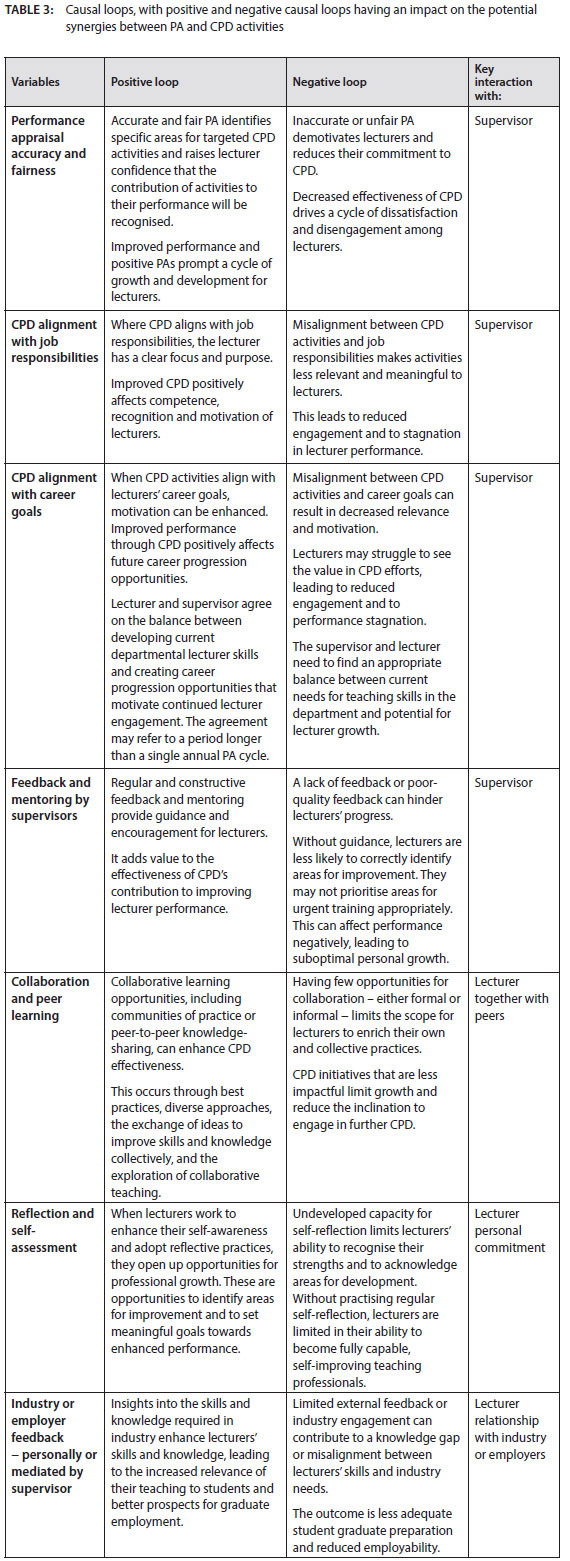
Table 3 captures the factors that have an impact on the relationships between the PA and the CPD of TVET lecturers through positive and negative feedback loops. The first column of the table depicts each variable. In the second column, the variable's positive potential is depicted through a virtuous loop, while the third column draws attention to the possibility of a negative interaction between PA and its support programme. The personnel likely to be affected are presented in the last column. The variables identified as being relevant to this bilateral relationship are the following:
• Performance appraisal accuracy and fairness;
• CPD alignment with job responsibilities;
• CPD alignment with career goals;
• Feedback and mentoring by supervisors;
• Collaboration and peer learning;
• Reflection and self-assessment, and
• Industry or employer feedback, either personally or mediated by a supervisor.
Overarching observations
Applying a CLA tool to the TVET lecturer PA and CPD system has enabled us to identify several inputs or interventions that could improve the internal dynamics of the system that - by shifting feedback loops in the right direction - contribute to a better experience for all the participants. This outcome, in turn, improves lecturer quality and, ultimately, student success in the labour market.
Recognition and rewards
Recognition has an intrinsic effect because it emphasises the value of a lecturer's work beyond extrinsic reinforcement; it also has a psychological impact in that it boosts an individual's sense of self and their motivation, which can engender pride and encourage purpose in further professional achievements. Recognition also has a broader effect in fostering a positive culture and, furthermore, it can enhance a sense of community that is able to feed into collaborative activity. Lecturers will benefit not only from management recognition, but also from peer recognition, and so the means of achieving this need to be devised.
Student feedback
Student feedback is a valuable area of engagement because it can encourage a sense of student belonging to a community that is aligned with an institution's aspirations for quality performance and student success. More importantly, student feedback provides information on dimensions of a college's provision of multilevel service delivery. Regular-feedback mechanisms or channels (such as surveys, focus groups, workshops (including online and in-person interactions)) can help a college to assess the effectiveness of its programmes and to make the necessary adjustments.
Appropriate emphasis on vocational purpose of teaching and learning
A perception exists among lecturers that the IQMS document does not cater adequately for the vocational aspects of the curricula or teaching. Too much emphasis is said to be placed on the pedagogical aspects of teaching (such as the way the lecturers use their teaching and workshop resources and interact with students) and insufficient on the pedagogical tactics that lecturers could use to impart on-the-job, occupation-specific technical skills. The TVET sector is, however, predominantly an occupation-based sector, with many lecturers being artisans who are then given facilitated training on appropriate teaching practice once they join the staff of a college. They therefore do not come in as trained teachers. It is, however, now mandatory that all lecturers have a teaching qualification, although this has been met with some resistance as it requires quite a change of mindset - although less so from 'younger staff members, who are quite eager' to upgrade their teaching skills.
Responsiveness and feedback during the annual cycle of planning and procuring training and development opportunities need to be improved
The lack of follow-through in putting into action training requests put forward in lecturers' PGPs is seen as a reason for lecturers not being motivated to take the PA seriously as a document that unlocks concrete opportunities for relevant professional development. A further consequence is that lecturers feel they are not being heard. A critical uncertainty in planning and providing training lies in understanding the roles of lecturers and their supervisors and/or HoDs, the way the HR management and procurement sections in the college head office finalise the desired training requests, and the extent to which there can be consultation about these processes. There is also a perceived lack of support for lecturers' further studies.
Lack of access to work-integrated learning
A concern expressed by some lecturers in trade and technical occupations was their limited access to work-integrated learning (WIL). This concern contributes to the overall impression among lecturers that their colleges demonstrate limited responsiveness to their needs despite the longstanding policy emphasis on WIL as a pillar of lecturer development and a means of aligning lecturer performance with the demand for industry skills. This apparent contradiction between policy direction and limited implementation leaves lecturers feeling frustrated, even ignored, by TVET governance.
Accountability practices are weak
A college is the unit according to which qualifications are awarded and it is therefore accountable for the overall quality and pass rates of learners as a whole and also by programme and certification. Lecturers are held accountable within the boundaries of this process. A campus manager explained that college programmes which finish low in national rankings while their lecturers claim to have scored high in the PA would be subjected to queries. This means that all PA scores 'must be linked to evidence'. For some colleges, this requires a meeting with senior lecturers, HoDs and lecturers to discuss the reasons for awarding certain scores. This therefore motivates the appraisers to engage in meaningful feedback with the lecturer in question regarding their appraisal mark so that the correct score can be agreed on. And if the score is low after such consultation, then corrective measures such as additional training need to be implemented.
Digitisation of appraisal processes will be more efficient
There is evidence that colleges are moving towards digitising their PA processes and documentation because this can produce substantial savings in time and administrative effort for the participants. The main advantage is that appraisal and evidence documents are shareable and accessible to both supervisors and lecturers in the cloud. One college has partly redesigned the PA document to make it easier to complete electronically. Note that these improvements support the in-person appraisal meeting and do not replace it. The emergent digitisation process gathered pace during the COVID-19 pandemic when staff were home-based and a nationwide initiative aimed at digitising the appraisal process by initiating the creation of a cloud for each college which would help to make the process more efficient.
Lecturer (or staff) well-being programmes are necessary
Some colleges have undertaken initiatives to alleviate the professional and personal pressures on lecturers. Such initiatives may contribute to lecturers being aware that the institution is concerned with their well-being. They can include:
• programmes and professional services to support lecturers' mental health (e.g. counselling and relaxation and mindfulness programmes);
• stress-reduction and stress-management workshops; and
• health and wellness programmes such as fitness classes, wellness check-ups and nutrition advice.
Capacity-building programmes for lecturers and managers
Based on the outcome of this research, an opportunity has arisen to begin implementing capacity-building programmes for lecturers and managers. These are aimed at enhancing their understanding of the value and implications of using CLA to support better-informed institutional decision-making processes at a personal or an institutional level. Lecturers could be motivated and empowered to contribute actively to the process; moreover, the quality and accuracy of a CLD would benefit from such broader participation.
Conclusion
This research has identified several leverage points where specific TVET colleges have taken the current system, with all its limitations, and have proactively enhanced its quality. For example, one college has built supportive overarching organisational cultures that reinforce the professional development of TVET lecturers and, in addition, reflect their concern beyond the PA towards fostering the personal growth of each individual holistically by the introduction of wellness programmes.
We have demonstrated that the relationships between PA and CPD can be made more explicit through the CLA process. For instance, the research observed a key weakness: that the PA gives greater prominence to the pedagogy of theory subjects than to the pedagogy of skills-based instruction. This inequity, lecturers from a technical background experience as diminishing their expertise. Critically, the IQMS is perceived as time-consuming, overly bureaucratic, and characterised by limited induction and preparation and poor communication. These and the other insights discussed above are generated via the CLA, which provides greater rigour and clarity that more traditional qualitative methodologies alone may not have been able to generate. In turn, these findings provide a solid foundation for further development by incorporating further quantitative data to assess the strength and impact of particular causal relationships with the aim of improving the overall performance management system for South African TVET lecturers.
A further iteration of this research could provide an important opportunity to advance our understanding of the complex dynamics of TVET lecturer PA and CPD systems. This could be achieved by undertaking further iterations of the causal loop analysis to enable insights to be developed into the causative mechanisms that are so valuable to policymakers.
Acaroglu, L. 2017. Tools for systems thinkers: The six fundamental concepts of systems thinking. Available at: <https://medium.com/disruptive-design/tools-for-systems-thinkers-the-6-fundamental-concepts-of-systems-thinking-379cdac3dc6a>.
ACKNOWLEDGEMNT
This article draws from the report prepared by JET Education Services as part of the five-year TVET research programme managed by the University of the Western Cape (UWC), commissioned by the Department of Higher Education and Training (DHET), and funded by the National Skills Fund (NSF): A Paterson, Z Vally, L Mthembu-Salter, N Matlin & P Molokwane. 2024. Towards a performance management framework for TVET lecturers in South Africa. Report produced under the Five-Year Research Programme on TVET Colleges, commissioned by the Department of Higher Education and Training (DHET) and funded by the National Skills Fund (NSF). Pretoria (ISBN number: 978-1-77018-973-7). Available at: <https://www.jet.org.za/resources/towards-a-performance-management-framework-for-tvet-lecturers-in-south-africa/view>.
REFERENCES
- Groff, JS. 2013. Dynamic systems modeling in educational system design & policy. Journal of New Approaches in Educational Research, 2(2):72-81.
- Haraldsson, HV. 2004. Introduction to system thinking and causal loop diagrams. Lund: Department of Chemical Engineering, Lund University. Available at: <https://www.researchgate.net/profile/Hoerdur-Haraldsson/publication/258261003_Introduction_to_system_thinking_and_causal_loop_diagrams/links/5bcceed6458515f7d9d01e81/Introduction-to-system-thinking-and-causal-loop-diagrams.pdf>
- HRDCSA (Human Resources Development Council of South Africa). 2022. The Human Resource Development Strategy: Towards 2030. Available at: <https://hrdcsa.org.za/wp-content/uploads/HRDC-StrategyDocument.pdf>.
- Paterson, A, Vally, Z, Mthembu-Salter, L, Matlin, N & Molokwane, P. 2024. Towards a performance management framework for TVET lecturers in South Africa. Report produced under the Five-Year Research Programme on TVET Colleges, commissioned by the Department of Higher Education and Training (DHET) and funded by the National Skills Fund (NSF). Available at: <https://www.jet.org.za/resources/towards-a-performance-management-framework-for-tvet-lecturers-in-south-africa/view>.
- Peters, DH. 2014. The application of systems thinking in health: Why use systems thinking? Health Research Policy and Systems, 12:1-6. Available at: <https://doi.org/10.1186/l478-4505-12-51>
- Richardson, G. 2004. Thinking about systems thinking: How we improve. System Thinking and Dynamic Modelling in K-12 Education Conference in Skamania, Washington. Available at: <http://www.clexchange.org/news/conference/2004conference.asp>.
- Sarriot, E, Morrow, M, Langston, A, Weiss, J, Landegger, J & Tsuma, L. 2015. A causal loop analysis of the sustainability of integrated community case management in Rwanda. Social Science & Medicine, 131: 147-155.
2 There are contributing factors. In employment environments, the PA is commonly experienced as personally trying for both parties - the person rating their colleague and the person being rated - owing to known psychological and emotional factors which need to be countered through mechanisms that include the development of relationships of mutual respect and trust (Tziner & Murphy, 1999; Spence & Keeping, 2011).
3 Meaning a manner that is perceived or experienced as corrective or correctional and which emphasises inequality or 'uncollegiality' in supervisor-lecturer relationships.