What is a 'quality TVET lecturer'? Problematising the concept of quality in vocational education
Abstract
Notions of 'quality' in technical and vocational education and training (TVET) and the 'quality TVET lecturer' are often referred to in policy and public discourse in South Africa but are rarely defined. This leads to only partial identification of what is necessary for driving up quality. This article reports on a review and survey of how the 'quality TVET lecturer' is understood in academic literature and public and policy discourse in South Africa. Through the Bourdieusian lens of fields, we identify the quality TVET lecturer as a player in two fields - education and the economy, which have distinct identities, rules and power dynamics. We argue that knowledge, skills, expertise and qualifications from both the education and the economic fields are important. Therefore, attempts to improve quality by focusing on the competence and commitment of TVET lecturers according to their teaching is likely to have a limited impact on TVET lecturer quality. While the model presented is based on work in South Africa, this framing of quality is relevant to Sustainable Development Goal 4 and the challenge faced by many TVET systems of linking TVET to industry.
TVET lecturers; quality; Bourdieu; fields; South Africa; SDG4
Introduction: Problematic notion of quality
The notions of 'quality' in technical and vocational education and training (TVET) in South Africa and of a 'quality TVET lecturer' are often referred to in policy and public discourse. For instance, the policy on professional qualifications for lecturers in TVET sought to contribute to 'the availability and development of quality lecturers for the TVET sector by putting in place a set of suitable higher education qualifications ' (DHET, 2013:7). The National Plan for Post-School Education and Training (NPPSET) refers to the government's vision of building a 'quality post-school system' and 'improving lecturer quality' (DHET, 2023:24, 32). The recent TVET Research Programme of the Department of Higher Education and Training (DHET) included more than 30 research projects, one of which focused specifically on the quality of TVET lecturers (Wedekind et al., 2024). As is evident from the foregoing policy documents, the term 'quality' is frequently used but rarely conceptualised.
The importance of 'quality' TVET and TVET lecturers is also evident beyond South Africa. The African Union (AU) described the delivery of quality TVET as being dependent on the theoretical, technical and pedagogical skills of the TVET lecturer (AU, 2007:9). Moreover, the International Commission on the Futures of Education stated that teachers are the most significant factor in attaining and delivering educational quality (International Commission, 2021:22). In addition, a UNESCO-UNEVOC study on trends in future-oriented, 'high-quality' TVET systems focused frequently on the quality training and support required by TVET teaching staff, particularly through industry exposure and private-sector partnerships (UNESCO-UNEVOC, 2020:22, 36). This notion of 'quality TVET lecturers' is often associated with student outcomes as measured by qualifications and skills and the importance of their relationships with industry. However, the challenge - to which we turn in this article - is that there is no clear consensus or definition of what is meant by a 'quality TVET lecturer', which only serves to undermine attempts to identify and improve quality.
The word 'quality' is a noun when used in reference to a person: 'excellence of character, good nature, virtue' (OED, 2024); or 'the special feature or characteristic' of a thing; it also functions as an adjective: 'of high quality, excellent' (OED, 2024). The term is also used and defined differently in various contexts. Quality management systems use process-based approaches to manage, improve and demonstrate organisational commitment to quality (ISO, 2024). In agriculture, 'quality' can refer to the attributes of a fruit or vegetable and the different needs and wants of customers (Shewfelt, 1999). In healthcare, 'quality' can denote the optimal balance between possibilities realised and a framework of norms and values constructed in interactions between people (Harteloh, 2003). Here 'quality' is linked to the internal dynamics, norms and values of a system, organisation or process which interact with external contexts, conditions, norms and interests. In TVET policy, there is often an assumption that qualifications are a proxy for such internal-external dynamics (DHET, 2013; DHET,2023).
There are multiple expectations of the quality TVET lecturer internally regarding the educational or pedagogic processes of teaching, curriculum application and student development in the classroom (Rauner, 2007; Gamble, 2013; Wheelahan, 2015; Mulder, 2017). Externally, a primary objective is to prepare young people for the world of work, bridging the gap between TVET and the labour market (Republic of South Africa, 2014). This external quality is often promoted through work-integrated learning1 (WL) both for students and to 'improve the quality of lecturers' (DHET, 2023:68,73). The 2030 National Development Plan (NDP) also framed TVET as helping to tackle societal challenges through its role in economic development, tackling poverty and a more knowledge-intensive economy (National Planning Commission, 2012:28,48). Similarly, the DHET policy on TVET lecturer qualifications states that social and economic growth 'relies heavily on the development and maintenance of a viable, responsive and effective TVET sector' (DHET, 2013:3). Such statements reflect increasing expectations about what TVET can deliver in transforming societies and domestic economies and the resultant implications for the TVET lecturer (Barnett, 2006; Papier, 2011), who faces both the internal world of TVET and the external world of work.
South African scholars recognise the problem of poor-quality TVET lecturers in South Africa (Blom, 2016; Wedekind, Watson & Buthelezi, 2016; Buthelezi, 2018; Blom et al., 2022). In part, this is because few TVET lecturers possess the perceived ideal combination of attributes alluded to in policy documents: significant industry experience, good academic qualifications and sound pedagogical knowledge (DHET, 2013; DHET 2023). TVET lecturers have also faced major challenges, including: curriculum reforms; institutional mergers; massive growth in student enrolments; low salaries; issues regarding morale and rates of staff retention; and inadequate equipment and resources - despite recapitalisation efforts. Given these challenges, to understand and conceptualise quality fully it is necessary to consider not only questions of pedagogic practice, professional identity and qualifications, but also factors such as the institutions themselves, industry linkages and power relations. For this purpose, we adopt a sociological perspective to frame our empirical approach to conceptualising the quality TVET lecturer in relation to the wider socio-economic dynamics of TVET.1
If quality is assumed and not explicitly defined, it is difficult to understand and identify poor and/or low quality or to design appropriate interventions and policy instruments that support and improve the quality of TVET lecturers. In what follows, we present a sociological framework based on the Bourdieusian concept of fields. Bourdieu viewed the social world as a field of power comprising multiple relatively autonomous fields, where fields each have distinct rules, struggles and positions of power and are subordinated to different degrees to the economic field (Bourdieu, 1985). Bourdieu's concept of a field is different from that of a broad area of academic study such as the field of education or medicine, although the Bourdieusian logics of power and a tacit sense of knowing how to play the game could indeed be applied to academic fields. Following the Bourdieusian concept of field, individuals enter the field of education (and the subfield of TVET with its own orthodoxy) with the ability to think, act and respond to the opportunities offered. However, they do so with unequal amounts of capital, such as inherited wealth or family connections and habitus which may or may not resemble the dominant structures and values of that field (Grenfell & James, 1998). Therefore, from Bourdieu's conceptualisation of education, TVET as a subfield of education is a space which promotes the idea (or illusion) that academic capital and/or market-compatible skills can be gained and converted into employment in the economic field (Black, 2022; Ronnie, 2023).
We now present an empirical review of the ways in which the quality TVET lecturer is understood in South Africa by drawing on three sources: the academic literature, policy discourse and a survey of key TVET stakeholders. We then discuss this critically through the Bourdieusian lens of fields. This lens provides a more institutional, systemic level of analysis of the quality TVET lecturer as being co-located in two fields, TVET and the economy. In conclusion, we summarise our sociological conceptualisation of TVET lecturer quality and discuss the implications for the literature, policy and professional development.
Bourdieu, fields and TVET lecturers
To make sense of the multifaceted dimensions associated with quality TVET lecturers, we draw on the work of French social theorist, Pierre Bourdieu. Bourdieu's work was influential as part of a wider reinvigoration of the sociology of education in the 1970s. His concepts of cultural capital, habitus and field have become central to the study of education over the past half-century. Bourdieu's concepts provide a language of description that enables us to discuss the dynamics of quality and identify the key domains in which the work (and habitus) of a TVET lecturer reside. As discussed later, this framing builds upon a nascent body of South African literature that is applying Bourdieusian analysis to TVET in South Africa.
In this article, we cannot engage in a detailed discussion of Bourdieu's work and his contribution to education research. However, we are conscious that his concepts have at times been misappropriated and used in isolation. Grenfell and James (1998:16) argue that concepts such as habitus and field are often used without reference to their theoretical basis and sometimes in ways which indicate a misunderstanding of them. Scholars have explored the methodological implications of Bourdieu's ideas and have argued that researchers should ensure that they do not use Bourdieu's concepts superficially - like 'hairspray sprayed across an academic text' (Reay, 2004; Reay, 2019). We seek to guard against this by recognising the context in which Bourdieu's work originated and the relationship between Bourdieu's concepts of field and cultural capital and habitus. These three key concepts locate the TVET lecturer in the social conditions (systems, history and discourses) in which power relations are produced, reproduced and contested (Emirbayer & Johnson, 2008; Black, 2022).
Bourdieu developed his ideas through empirical anthropological studies between the late 1950s and the early 1990s, informed by his family background, education and work in France, and later as a conscripted soldier in Algeria. Therefore, his ideas emerge from specific times and places and need to be suitably modified for different contexts. Bourdieu sought to develop a theory of practice that is robust enough to be objective and generalisable, yet one that also accounts for individual, subjective thought and action (Bourdieu, 1990; Bourdieu, 1993; Grenfell & James, 1998). Bourdieu's work was in part a reaction to the overly deterministic nature of Marxist understandings of the social world that ultimately reduced all aspects of social organisation to the economic field. While recognising the importance of the economic field, Bourdieu's work tried to understand the role that other fields play in society. Instead of understanding everything as a class conflict, Bourdieu argued that social space is multidimensional (Bourdieu, 1985).
Here we are particularly concerned with the Bourdieusian concept of field. A field is a structured system in which individuals, institutions and groupings all exist in relation to one another (Grenfell & James, 1998:16). Fields each have different power structures, hierarchies of influence, logics and habits of practice due to their relational nature with power (expressed as forms of social, cultural or economic capital) and embodied habitus - the minimum amount of knowledge, skill or talent required to be accepted as a player (Bourdieu, 1993; Lingard & Christie, 2003:320; Emirbayer & Johnson, 2008). As Bourdieu stresses,
the whole history of a social field is present in a materialized form - in institutions ... - and in an embodied form - in the dispositions of the agents who operate these institutions or fight against them (Bourdieu, 1985:738-739).
Therefore, fields operate with distinct logics, rules, boundaries and forms that reflect the struggles and power relations within that 'field of play' over time.
The concept of a field is part of a wider theory of practice, one that identifies social spaces, the practices that constitute a field and the positionality of individuals within that field. For the researcher, these structural positions and their generating principles can either be located or mapped (Grenfell & James, 1998:16). In applying the concept of a field to TVET lecturers, we also turn to recent work applying Bourdieu's work to the TVET sector in South Africa. Ronnie (2023) drew upon Bourdieu's concepts of field, illusio and institutionalised cultural capital to understand the barriers that prevent TVET colleges from supporting graduates to convert the academic capital of their vocational qualification into employment. One of the key recommendations was the pivotal role that actors outside of TVET - specifically industry - can play in ensuring a more inclusive and meaningful TVET sector. They can do so not least by including industry players in integrated policy on, and strategy processes regarding, skills and TVET that lead to more relevant curricula for TVET colleges to offer their students. Nzembe (2018) also focused on educational outcomes in a TVET college in South Africa. Through the lens of cultural capital, Nzembe found that sociocultural factors such as student preparedness for the TVET curriculum, the language of instruction, approaches to assessment, academic support programmes and educational resources all had the potential to 'make or break students' chances' of accessing and succeeding in their academic programmes (Nzembe, 2018:40).
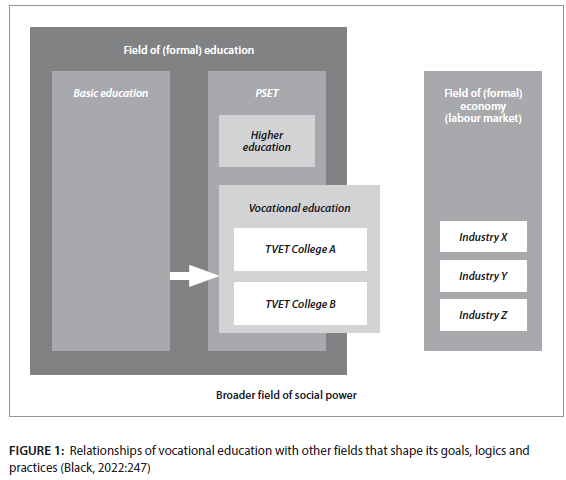
Most relevant to the objective of this article is the study by Black (2022). Black used the relational nature of Bourdieu's key concepts as a framework for analysing the way or ways in which TVET is positioned in relation to both basic education and broader political economic forces. This, he writes, entails juggling issues of quality in the classroom while having to articulate with multiple other fields. In Black's representation (see Figure 1), the field of TVET (as a subfield of education) is shaped by the different goals, logics, practices and power dynamics that characterise the fields of education and the economy. These fields reside within the broader field of social power, where factors such as race, class, language, religion, gender and geography all shape opportunities and experiences in life and TVET (Black, 2022:246).
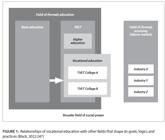
Black notes that within the subfield of TVET the position of a college is complex: it is often required to function simultaneously as a provider of post-school education for adults and as an alternative education route for students who have been alienated by mainstream education (Black, 2022:242). Beyond that, against the backdrop of the broader field of social power, the TVET college also supports the instrumental acquisition of skills and recognised certificates that can be traded for future economic and cultural capital (Black, 2022:245). This, in turn, means that TVET and TVET colleges are interconnected with the logics of the economic field and the subfields of industry with their distinct industry trends, standards and changing demands for which they are attempting to prepare students (Black, 2022:246).
Whereas Black (and Nzembe and Ronnie) does not focus specifically on TVET lecturers or lecturer quality, Black's study underscores (as do those of Nzembe and Ronnie) the value of a sociological approach for situating the notion of TVET lecturer quality within the socioeconomic and institutional dynamics of the TVET system. In Figure 1, the concept of field illuminates the interconnected nature of TVET with other fields, but immediately points to the problem of understanding and defining the quality TVET lecturer: In which field does the TVET lecturer reside?
Naturally, one might position a TVET lecturer in a TVET college. However, as alluded to in policy documents, TVET lecturer quality is also linked to the field of the economy. Black visualises the field of the formal economy and the labour market as industry subfields. In a Bourdieusian sense, these denote different hierarchically organised workplaces and occupational fields (within the economic field and the broader field of social power), each with its own distinct forms of capital (in the form of qualifications or networks) and industry-shaped habitus (Runcieman, 2018). We note, of course, that much work also occurs in the informal economy and in other fields, but for the purposes of framing TVET lecturer quality in public TVET we begin our analysis with Black's framing of the fields of formal education and the formal economy. To begin to understand quality in this context, we first turn to the ways in which the research literature discusses quality lecturers and then report on our empirical data.
Understandings of 'quality" TVET lecturers
For the purposes of our research project, we first identified the ways in which the quality TVET lecturer has been defined and conceptualised in the South African academic literature. We searched online libraries such as Web of Science (Clarivate) and Google Scholar using keyword strings2 on the theme of quality TVET lecturers in South Africa, with 59 articles emerging from our review. To understand how 'quality' and the quality TVET lecturer were discussed and conceptualised, we collated the following information in an Excel database:
• Does the article define quality (yes, no, partly, unclear)?
• Number of times the word 'quality' is used.
• Is TVET lecturer quality discussed and, if so, how?
'Quality' frequently used but not defined in the literature
The literature survey showed that, while there are differences in research contexts, numerically, the term 'quality' is used frequently but in relation to a variety of different aspects of TVET rather than about TVET lecturers per se. For example, studies have been conducted on the quality of the curriculum (Masoabi & Alexander, 2021), the quality of educational processes (Wedekind & Mutereko, 2016) and quality work-integrated learning (WIL) (Mesuwini & Mokoena, 2023) work-integrated learning (WIL. Most of them, however, did not define 'quality' in a comprehensive manner and very few directly mentioned the term 'quality TVET lecturers'.
Most of these studies presented a vague picture of the quality TVET lecturer. Out of 59 studies, 22 did not use the word 'quality' or engage with the notion of 'TVET lecturer quality'. Of the remaining 37, only a few referred directly to the notion of TVET lecturer quality - for example Mesuwini, Thaba-Nkadimene and Kgomotlokoa (2021) and Mesuwini et al. (2023) specifically to establish the nature of their learning and determine how the lecturers understood their learning. However, since the launch of this WIL initiative, what these lecturers learnt, and how they understand their learning has not been researched. This study sought to investigate the nature of learning of these lecturers. The study was conducted in three TVET colleges in KwaZulu-Natal (KZN, in reference to the need for professional qualifications, Papier (2021) on quality teachers with the necessary abilities and pedagogies to prepare students for the workplace in a changing world, and Van der Bijl (2021) on the critical function of industry experience in improving the quality of TVET lecturers.
Quality: Associated with knowledge, competencies and WIL
Whereas the phrase 'quality' was used but rarely defined, it was possible to identify key assumptions underlying the knowledge and competencies of the quality TVET lecturer. Many studies confirmed that both theoretical and practical subject knowledge (underpinning a specific occupation) was necessary in order to be a proficient TVET lecturer (Gamble, 2013; Wheelahan, 2015; Van Der Bijl & Oosthuizen, 2019). Pedagogical knowledge was regarded as something that helps quality TVET lecturers to cope with diverse student needs (Yassim. Rudman & Maluleke, 2019), combined with curriculum and assessment processes that build occupational competence and prepare students for the workplace (Papier, 2021; Teane, 2021). Finally, up-to-date industry knowledge is also regarded as critical to preparing students for employability (Wedekind & Mutereko, 2016; Papier, 2017). But whereas subject and industry knowledge were associated with notions of quality, much research focused on pedagogical knowledge, suggesting that this is regarded as particularly important for enhancing the quality of TVET lecturers.
From the studies in our analysis, various competencies are also associated with quality, though the use of the concept was highly diversified. For instance, TVET lecturer quality was associated with student-centred competencies related to student well-being, inequality and post-apartheid social justice (Gaffoor & Van Der Bijl, 2018; Yassim et al., 2019). Training, professional qualifications and continuing professional development (CPD) that build TVET lecturer competencies are also important (Van Der Bijl & Oosthuizen, 2019; Blom et al, 2022). TVET lecturer quality is also associated with WIL, that is, those competencies learned in the workplace that help to bridge the gap between education and work for students (Van der Bijl & Taylor, 2016; Van der Bijl, 2021) and formalised professional development for TVET lecturers (Govender & Dhurumraj, 2024).
Finally, many studies also refer to low-quality TVET lecturers as one of many challenges facing the sector. Studies note the tension between idealised perceptions of the TVET lecturer and, in contrast, factors such as a restrictive assessment culture, systemic weaknesses and persistent inequality (Allais, 2012; Govender & Dhurumraj, 2024). It is notable, then, that, across the published studies reviewed, discussions about the quality of TVET lecturers consistently lacked a consideration of the positioning of the TVET lecturer in the wider socio-economic system.
Overall, the literature showed that multiple knowledges, competencies and professionalisation routes might be regarded as important to forming a quality TVET lecturer. As stated at the outset, though, the notion of 'quality' is frequently used but rarely defined, reflecting a lack of clarity about what is meant by quality in TVET and, more specifically, the quality TVET lecturer. In the second stage of our empirical analysis, we conducted a survey to explore perceptions of TVET lecturer quality among key stakeholders.
Public and policy perceptions of the quality TVET lecturer
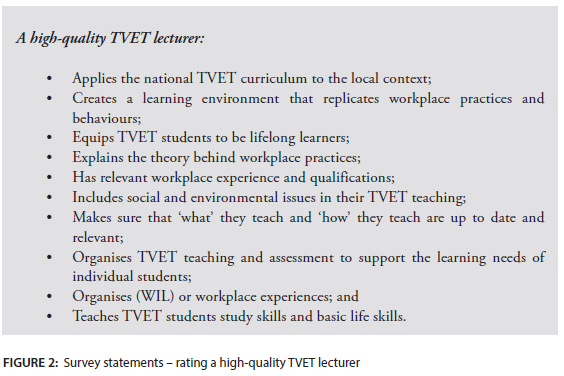
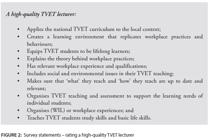
To build on the insights that emerged from our literature review, we conducted a survey designed to help us understand the perceptions of TVET lecturer quality among key stakeholders. The survey was grounded in a framing of quality presented in policy discourse. The respondents were asked to rank a series of 10 statements in terms of what was most and least important for quality TVET lecturers (see Figure 2).3 As an organising framework for the survey statements, we used the knowledge mix outlined in the 2013 DHET Government Gazette policy on professional qualifications for lecturers in TVET. This policy refers to the necessity for TVET lecturers to be specialists in their disciplines and specialist teachers who understand both the context in which they are working and the learning needs of a diverse range of students (DHET, 2013:13). Here, competent pedagogic practice is viewed as a combination of integrated and applied knowledge forms that do not exist independently of one another (DHET, 2013:9-11).
After this quantitative ranking exercise, two qualitative follow-up questions were posed to help us understand the respondents' perspectives on the most important characteristics of a quality TVET lecturer. We recognised that key actors in the TVET system (TVET institutions, the private sector and government) might have differing expectations of quality as it pertains to TVET lecturers; therefore, the survey targeted a wide range of participants in South Africa, including TVET lecturers, college principals, academics, policymakers, TVET students and industry.
Broad understanding of quality
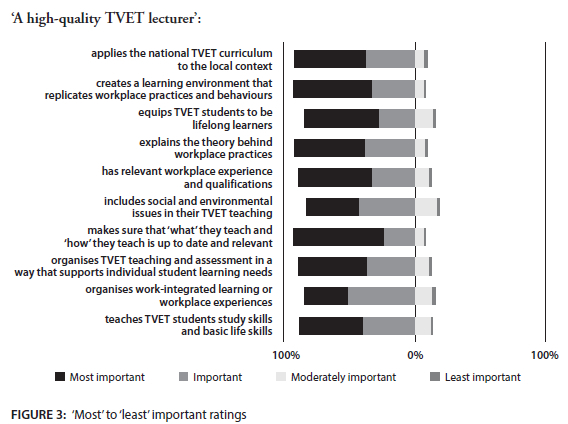
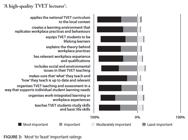
More than 81% of the respondents rated all 10 statements as being either important or most important (see Figure 3). This indicated a perception that the notion of the 'quality' TVET lecturer includes a wide range of topics and responsibilities. One respondent (a TVET lecturer) commented:
They are all important; [it's] just not possible to do all the above in [the] time frame given in class.'
In terms of what was rated most important, the high-quality TVET lecturer 'applies the national TVET curriculum to local contexts', ensures that 'what they teach and how they teach are up to date and relevant' and explains the 'theory behind workplace practices' while creating 'a learning environment that replicates workplace practices and behaviours'.
Dedication of the quality TVET lecturer
The respondents were also given the opportunity to explain why they rated statements as 'most important'. The primary theme among those who responded was the connection between lecturer and student and an ability to identify and manage different student learning needs:
A lecturer who takes time to understand student backgrounds, who plays a parental role, and skills and knowledge of [the] workplace. [TVET lecturer]
She uses blended learning to the maximum of her capabilities and still finds innovative ways to teach the content. She stays relevant and up to date with the world of work with resources and examples. [TVET college leader/manager]
Quality was associated with equipping students for the realities of the workplace, often by being connected to industry with relevant industry skills, knowledge and expertise:
Vocational education is complex and needs a dynamic lecturer who is engaged with his/her material, learners and workplace. [Policy/civil servant]
Lecturers need to be engaged and exposed to industry practices as much as possible. [TVET college leader/manager]
The narrative responses conveyed the sense that quality was not just about qualifications and the curriculum. The respondents referred to TVET lecturers who went beyond the call of duty and who were dedicated and passionate despite being confronted by overwhelming challenges and resource constraints:
Dedicated to [the] task - not the highest qualified but keeps an eye out for new technology and new developments in the industry that the students are being trained for. [Academic/research]
Even . [with] no resources . [they care] about students - that they get quality education that will equip them for the working environment. [TVET lecturer]
Finally, the survey did not include questions related to factors that undermine or hinder the quality TVET lecturer because we felt that such a focus was unlikely to yield new insights about the challenges facing TVET and the quality TVET lecturer. However, when participants were asked if there was 'anything else' they would like to tell us about quality TVET lecturers, many cited challenges such as the lack of resources, poor-quality students, ineffective recruitment practices (including patronage) and the need for industry connections:
Lecturers need to be educated or trained about the new technology in industry and include it . [in] their curriculum so that learners can be relevant in industry. [Policy/civil servant]
Work-based training must be ongoing to keep up with relevant and up to date industry trends/4IR/AI technology. [TVET lecturer]
The respondents also asked that this research communicate to DHET that lecturers 'do care', that they are 'doing the best they can with limited resources' and that they are desperate to see the TVET system improved.
Summary
Our analysis of the literature showed that the term 'quality' is used frequently but that most papers did not define 'quality' or the quality TVET lecturer. It was, however, possible to identify common assumptions in the academic literature and key policy documents which emphasised the need for quality TVET lecturers to be professionally qualified and equipped with subject, industrial and pedagogical knowledge while at the same time possessing the competencies to satisfy students' needs and the demands of the workplace.
In the survey responses, a wide range of topics and responsibilities were linked to the notion of quality, including the curriculum, workplace knowledge that is theoretical and locally relevant, WIL, and an emphasis on empowering the students - despite the significant challenges. Across our dataset, theoretical, practical and pedagogic practice (internally) within the classroom and external connections to workplace and industry were seen as important.
In the remainder of this article, we consider these wide-ranging perceptions of what it means to be a quality TVET lecturer through the Bourdieusian lens of fields.
Discussion: Thinking in terms of fields
Field of education and TVET subfield
From the conceptual perspective of fields, the dominant field within which the TVET lecturer is located is the field of education. It comprises both formal and informal education components spanning a person's life course, but it is discursively dominated by the formal system that prioritises young people in schools and various forms of post-school activity, including TVET.
Within the field of education, discourses about education focus on learning and teaching processes and relationships, with conceptual languages focused on pedagogy, curriculum, assessment, didactics and so on, and also on the systemic arrangements that facilitate these processes in various settings. TVET lecturers are expected to master such educational knowledge if they are to practise effectively in this field. The literature review and survey both demonstrate that the notion of TVET lecturer quality is directly associated with good general pedagogic practice such as lesson planning, assessment techniques and the use of educational technology, which suggest that the TVET lecturer is primarily located in this field.
As a subfield of education, TVET shares many of the characteristics of the superordinate field but is distinguished by a specific purpose: to prepare students for the transition to, or within, the separate field of the economy (UNESCO-UNEVOC, 2020; Black, 2022). This focus on the world of work and preparing students for the workplace suggests that a quality TVET lecturer requires skills that are distinct from the general education habitus and skills: the literature and our survey refer to specific TVET pedagogies linked to work, particularly WIL. For TVET lecturers, this distinct feature of TVET requires experience (and often relevant work-related qualifications) linked to the field of the economy. To understand this connection to the field of the economy, it is necessary to explore the distinct dynamics of that field.
TVET lecturers and the field of the economy
The field of the economy is complex, consisting of many subfields and institutions, with the human activity of work at the core. The dominant discourses focus on work arranged in jobs, often defined as occupations, carried out in various public and private organisational settings. There is also increasing recognition of the importance of the informal economy and unpaid work such as childcare and domestic labour. However, the TVET subfield is generally expected to prepare students for the formal part of the economy and for specific occupations and occupational tiers.
Distinct knowledges, competencies and practices (often uncodified) are tied to occupational activities in workplace settings. Such knowledges might be generated informally through communities of practice and formally through processes which vary from setting to setting (e.g. from firm to firm); they are therefore usually best learned through practice. For TVET lecturers to prepare learners in the field of education for the transition to occupations in the economic field, they need to master such knowledges.
Mastering knowledges in the field of the economy might be achieved if TVET lecturers are experienced in their chosen occupation or have developed expertise through forms of simulation of work activity such as in training facilities. However, because activities in the economic field are constantly changing, it is not sufficient simply to build up knowledge of the economic field and then move back to the education field. From a fields perspective, the notion of having a 'connection' to industry or bridging the gap between the college and local industry is not the same as actually being in the field. To be a player in a field, one has to maintain the habitus and cultural and social capital of the field and not simply be connected to it. This points to our key argument regarding the notion of quality: the quality lecturer must necessarily be able to move between the two fields.
Building upon what is known from the literature, public or policy assumptions and our own analysis of fields, it is possible to identify quality and, in particular, the quality TVET lecturer as residing in two distinct fields. The survey statements and the literature emphasise a broad range of competencies that locate quality within the fields of education and economy. In the classroom (in the TVET subfield), this includes competencies related to understanding and responding to student mental, emotional and learning needs while recognising the impact of wider socioeconomic histories, particularly the ongoing legacies of apartheid. Industry knowledge and familiarity with the demands of business and industry are also critical to equipping students for the workplace. In part, this refers to the ability of the TVET lecturer to embody the habitus and forms of capital of a workplace (in the economic field) in order to assist the TVET student to acquire the necessary habitus and capital.
Quality is playing in two fields
The concept of field provides a metaphor for describing the positioning of a TVET lecturer in a particular context, and a language for describing how that context relates to other fields and influences, and is influenced by, those fields. Fields are semi-autonomous and interrelated; and certain fields, particularly the economic field, have a direct impact on other fields, though not always in a deterministic way. By applying the Bourdieusian lens of field, it is possible to frame the quality TVET lecturer as an active player in two fields. This lecturer needs to be cognisant of the different expectations, power relations, influences and roles of other fields.
Using the analogy of sport, the quality TVET lecturer is akin to being a player in two fields -for example, a Bafana Bafana footballer in one field and a Springbok rugby player in another.4Football and rugby are two completely different sports, and so being a quality player in both fields of play requires two distinct sets of skills and understandings of the different formal and informal, unwritten or hidden, rules of the game which also define how to act and succeed (habitus). For example, there are similar formal rules of player conduct vis-à-vis the referee in both sports, while, informally, it is normal to shout at the referee in one field (football) but culturally frowned upon in the other (rugby). However, the framing of quality in the literature focuses primarily on the rules and dynamics of one field (TVET as a subfield of education) and very seldom includes a holistic understanding of the pressure of being a player in two different fields.
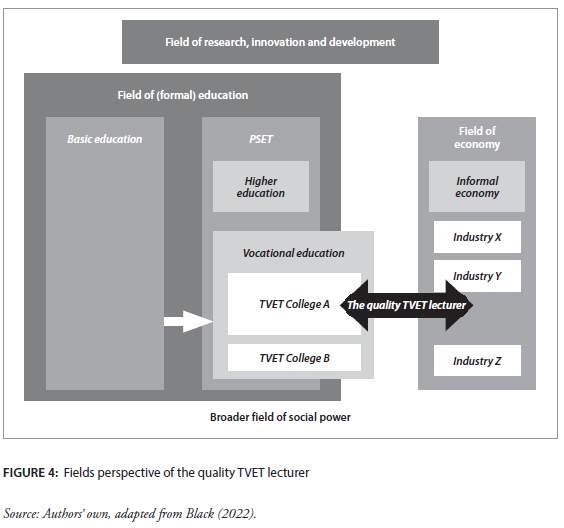
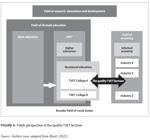
We visualise this in an expanded version of Black's work. Our model, a fields perspective on the quality TVET lecturer (see Figure 4), frames the duality or co-location of the quality TVET lecturer as being situated both within the TVET subfield (of education) and within the economic field. It is not sufficient to focus narrowly on only one field when exploring quality. This dual-field dynamic means that the TVET lecturer is required to be co-located (physically at times, but more commonly in respect of their sense of self or identity) in both fields. Therefore, quality is not only a set of personal attributes or skills or knowledge but it is also bound to a set of relationships in each of the two fields.
Multi-field dynamics
While we locate the TVET lecturer as a player in two distinct fields in our model, this somewhat binary - though novel - dual-field framing does not sufficiently capture all the dynamics of quality that we are aware of in the literature and as evidenced in our data. Fields are not tightly bounded spaces; rather, the dynamics both within and between fields and subfields can all affect the individual lecturer and the TVET system. In particular, the political field directly affects both the education and the economic fields and shapes discourses, rules, regulations and flows of resources in each. Education is highly regulated by most states (particularly with respect to children and young people) and the economy is central to ensuring that resources are available for the state to deliver education and other services to its citizens. In the case of TVET, actors in the field of politics shape curricula and qualifications, determine institutional forms and funding, and play a direct role in quality assurance measures. TVET lecturers do not have to be political, but they need to be aware of how this field interacts with the fields of education and the economy and the subfields of TVET and industry.
The field of research, innovation and development (RID) is also linked to quality in TVET. For example, developments in disciplinary knowledges underpin knowledges applied in the workplace and find their way into university curricula and eventually into the school and TVET curricula. Innovations (from the economic and education fields) also find their way into the world of work through new technologies, processes and products. Being able to recognise the implications of such innovations for future developments in the economic field is crucial if the TVET curriculum is to remain relevant. As with the field of politics, TVET lecturers do not need to be located in the field of RID, but they do need to be aware of and understand how such processes can both constrain and enable the work that they do.
A further dimension in the multi-field dynamics of quality is the field of social power. This is evidenced by policy expectations related to the social role of TVET colleges as second-chance institutions for individuals who have dropped out of the schooling system and as an alternative route into higher education. Similarly, the informal economy has links to TVET that need to be foregrounded, given the scale and scope of this sector in the context of South Africa. A quality TVET lecturer accordingly needs to explore ways in which their students might use their skills for livelihoods that may reside in the informal economy. Therefore, while it is not included in our analysis, we depict the informal economy as a subfield of the economic field.
The fields concept points to a much broader set of fields that interact with and affect quality and the quality TVET lecturer; therefore, Figure 4 represents a more complex understanding of quality. While the TVET lecturer is usually not directly located in the field of politics and RID, their co-location within the fields of education and the economy is strongly affected by these fields and the broader field of social power. Quality, then, is not only about an individual and whether they strive to be a quality lecturer; it is also rooted in these complex multi-field dynamics. The simultaneous positioning in two discrete fields and the multi-field dynamic has serious implications for policy and theory. This we turn to in the final section of our article.
Implications for policy and theory
Recognising that the quality TVET lecturer is akin to being both a professional footballer and a professional rugby player fundamentally challenges the way DHET and the wider TVET system might think about and support quality. The co-located nature of the TVET lecturer as presented in our model decentralises the dominant view in policy and theory that more training and professional qualifications leads to quality TVET lecturers. While the development of professional qualifications specifically for TVET lecturers responds to a gap in South African TVET, these are education qualifications ranging from a diploma in TVET to a postgraduate diploma in TVET,5 delivered by public universities, admittedly with requirements for WIL components (DHET 2013:7-12; DHET, 2023). The fields perspective reiterates the point that knowledge, skills, expertise, training and qualifications from both the education and the economic field are important. However, TVET policy continues to equate quality with academic teaching qualifications; and while lecturers' limited experience of industry is well noted (Hofmeyr & Vally, 2022; DHET 2023), the emphasis on pedagogy creates a misalignment with what is predominantly an occupation-based TVET sector (Paterson et al., 2024:10). Draft strategy documents envisage a greater role for business and industry as part of the effort to enhance quality - by providing WIL opportunities for lecturers, for example. But, in the main, this has not transpired and the minimal involvement of industry in TVET continues to be a major weakness in South African TVET - as it is in many countries (Hofmeyr & Vally, 2022:55). Therefore, any notion that quality can be improved by focusing only on the competence and commitment of the TVET lecturer as measured by their professional teaching qualifications in the education field is likely to have a limited impact on overall TVET lecturer quality.
The quality TVET lecturer has to embody the habitus and capital of an educator working in a college and be embedded in the relevant social and material networks within the economic field in order to be an active player in that field. An emphasis on qualifications in one field while not placing equal focus on access to, and experience in, the workplace undermines the dual functionality of the TVET lecturer. This would be similar to investing only in improving skills as a football player while reducing an individual's ability to perform on the rugby pitch.
Consequently, the model presented here has implications for the way TVET and TVET lecturers in particular are connected to industry. For the purposes of our model, industry encompasses the variety of sectors, business types and industries that exist in the economic field. Consequently, the outworking of this dual field functionality is likely to be dependent upon which industry and occupations the TVET lecturer is most closely associated with. It will also be different for those TVET lecturers who teach more general subjects, although even here the connection to the world of work is important.
There are also implications for the time and resources required to enable the TVET lecturer to play the game, that is, to understand new techniques and changes in the rules of the game in two fields, and to build and maintain the occupational identity of somebody in both education and industry. The findings outlined above confirm the consensus in the literature and in policy and public discourse that outdated curricula and a lack of resources, technologies and WIL opportunities undermine quality in TVET.
If, then, as we argue, the quality TVET lecturer resides in two fields, quality is fundamentally undermined where resource constraints restrict TVET lecturers to being located only in the education field - a challenge that is compounded where policy, capacity-building and training agendas focus primarily on only the education field.
Conclusion: The complex co-field dimensions of quality
Research to date has not adequately defined quality or the quality TVET lecturer, leading to the partial identification of what is necessary for driving up quality in TVET. What we have demonstrated is that, by placing the TVET lecturer at the centre of the analysis, it is possible to build a more complex understanding of quality. Through Bourdieu's concept of field we identified the quality TVET lecturer as a player in two fields, each of which is dependent upon distinct identities, rules and power dynamics (capital and habitus) and the need to have more than just these two fields in the frame. This suggests that it is not enough to focus on capabilities, qualifications and subject- or industry-specific knowledges and having a connection to industry. Instead, TVET lecturers need to be part of industry in some form, in ways that are appropriate to their occupational specialism and remit as a TVET lecturer.
Further work is required to analyse and theorise what it means to facilitate the quality TVET lecturer as a player in two fields. This includes a consideration of the different dimensions of quality that underpin this co-location, such as pedagogic practice, building and maintaining links to industry and the workplace. and more complex multi-field dimensions such as the future world of work. Moreover, there are important implications of the model in its application to the individual and the specifics of their occupational specialism and the TVET college type, and their physical proximity to local industry, for example.
The research underpinning this article took place in South Africa, funded by the national DHET, but the implications of our model are relevant to other TVET contexts, and, specifically, to the transformation of TVET in alignment with the TVET aspect of Sustainable Development Goal 4 (UNESCO, 2021). Globally, challenges remain in linking TVET to industry so that TVET lecturers possess the necessary knowledge, skills and competencies to prepare students for the future world of work (UNESCO-UNEVOC, 2020). The co-field location of the quality TVET lecturer in both the education and the economic fields provides a novel foundation for reframing and (re)theorising this TVET-industry challenge and the ongoing pursuit of quality within TVET.
REFERENCES
- Allais, S. 2012. Will skills save us? Rethinking the relationships between vocational education, skills development policies, and social policy in South Africa. International Journal of Educational Development, 32(5):632-642.
- AU (African Union). 2007. Strategy to revitalize technical and vocational education and training (TVET) in Africa. Addis Ababa: AU.
- Barnett, R. 2006. Vocational knowledge and vocational pedagogy. In M Young & J Gamble (eds), Knowledge, curriculum and qualifications for South African further education. Cape Town: HSRC Press.
- Black, S. 2022. Understanding the TVET game: A case study on maximising available opportunities for open educational practices within the broader TVET field in South Africa. In T Mayisela, S Govender & CA Hodgkinson-Williams et al. (eds), Open learning as a means of advancing social justice: Cases in post-school education and training in South Africa. Cape Town: African Minds, 241-268.
- Blom, R. 2016. Throwing good money after bad: Barriers South African vocational teachers experience in becoming competent educators. In A Paterson & A Kraak (eds), Change management in TVET colleges: Lessons learnt from the field of practice. Cape Town: African Minds, 47-63.
- Blom, R et al. 2022. Positioning TVET lecturer identities at the centre ofTVET lecturer education and training in a post-COVID-19 context. In F Bünn, G Spöttl & H Stolte (eds), Technical and vocational teacher education and training in international and development co-operation: Models, approaches and trends. Singapore: Springer Nature, 291-307. Available at: <https://doi.org/10.1007/978-981-16-6474-8_18>.
- Bourdieu, P. 1985. The social space and the genesis of groups. Theory and Society, 14(6):723-744.
- Bourdieu, P. 1990. The logic of practice. Cambridge: Polity Press.
- Bourdieu, P. 1993. The field of cultural production. Cambridge: Polity Press.
- Buthelezi, Z. 2018. Lecturer experiences of TVET college challenges in the post-apartheid era: A case ofunintended consequences ofeducational reform in South Africa. Journal of Vocational Education &Training, 70(3):364-383. Available at: <https://doi.org/10.1080/13636820.2018.1437062>
- DHET (Department of Higher Education and Training). 2013. Policy on professional qualifications for lecturers in technical and vocational education and training. Vol 576, No. 36554. Pretoria: DHET.
- Emirbayer, M & Johnson, V. 2008. Bourdieu and organizational analysis. Theory and Society, 37(1):1-44. Available at: <https://doi.org/10.1007/s11186-007-9052-y>
- Gaffoor, A & Van der Bijl, A. 2018. The importance of teacher development in the completion of business programmes in South African vocational education. Journal of Contemporary Management, 15(1):677-694.
- Gamble, J. 2013. Why improved formal teaching and learning are important in technical and vocational education and training (TVET). In Revisiting global trends in TVET: Reflections on theory and practice. Bonn: UNESCO-UNEVOC, 204-238.
- Govender, S & Dhurumraj, T. 2024. Opening up TVET lecturer professional learning and development through work-integrated learning in South Africa: A social justice perspective. In T Mayisela, S Govender & CA Hodgkinson-Williams (eds), Open learning as a means of advancing social justice: Cases in post-school education and training in South Africa. Cape Town: African Minds, 338-373. Available at: <https://doi.org/10.47622/9781928502425_15>
- Grenfell, M & James, D. 1998. Bourdieu and education: Acts of practical theory. London; Bristol: PA Falmer Press.
- Harteloh, P. 2003. The meaning of quality in health care: A conceptual analysis. Health Care Analysis, 11:259-267. Available at: <https://doi.org/10.1023/B:HCAN.0000005497.53458.ef>
- Hofmeyr, J & Vally, Z. 2022. Towards the professionalisation of TVET lecturers. Johannesburg: JET Education Services.
- International Organisation for Standardisation (ISO). 2024. ISO 9001:2015. Available at: <https://www.iso.org/standard/62085.html>.
- Lingard, B & Christie, P. 2003. Leading theory: Bourdieu and the field of educational leadership. An introduction and overview to this special issue. International Journal of Leadership in Education, 6(4):317-333. Available at: <https://doi.org/10.1080/1360312032000150724>
- Masoabi, CS & Alexander, G. 2021. Possible merger, entrepreneurship education in TVET engineering studies: A case for South Africa. Journal of Entrepreneurship Education, 24(2):1-20.
- Mesuwini, J & Mokoena, SP. 2023. TVET lecturer work-integrated learning: Opportunities and challenges. International Journal of Learning, Teaching and Educational Research, 22(8):415-440.
- Mesuwini, J, Thaba-Nkadimene, KL & Kgomotlokoa, L. 2021. Nature of TVET lecturer learning during work-integrated learning: A South African perspective. Journal of Technical Education andTraining, 13(4):106-117.
- Mesuwini, J, Thaba-Nkadimene, KL, Mzindle, D & Mokoena, S. 2023. Work-integrated learning experiences of South African technical and vocational education and training lecturers. International Journal of Work-integrated Learning, 24(1):83-97.
- National Planning Commission. 2012. National Development Plan 2030. Our future - make it work. Pretoria: National Planning Commission.
- Nzembe, A. 2018. Access, participation and success: The tri-dimensional conundrum of academic outcomes in a South African TVET college. Academic Journal of Interdisciplinary Studies, 7(2):31-42. Available at: <https://doi.org/10.2478/ajis-2018-0044>
- OED (Oxford English Dictionary). 2024. quality, n. & adj. meanings, etymology and more. Oxford English Dictionary, OED. Oxford University Press. Available at: <https://www.oed.com/dictionary/quality_n>.
- Papier, J. 2011. Vocational teacher identity: Spanning the divide between the academy and the workplace. Southern African Review of Education with Production, 17(1):101-119. Available at: <https://doi.org/10.10520/EJC99005>
- Papier, J. 2017. Improving college-to-work transitions through enhanced training for employment. Research in Post-Compulsory Education, 22(1):38-48. Available at: <https://doi.org/10.1080/13596748.2016.1272084>
- Papier, J. 2021. 21st-century competencies in technical and vocational education and training: Rhetoric and reality in the wake of a pandemic. Journal of Education (University of KwaZulu-Natal), 84:67-84.
- Paterson, A, Vally, Z, Mthembu-Salter, L, Matlin, N & Molokwane, P. 2024. Towards a performance management framework for TVET lecturers in South Africa. Report produced under the Five-Year Research Programme on TVET Colleges, commissioned by the Department of Higher Education and Training (DHET) and funded by the National Skills Fund (NSF). Pretoria.
- Reay, D. 2004. 'It's all becoming a habitus': Beyond the habitual use of habitus in educational research. British Journal of Sociology of Education, 25(4):431-444. Available at: <https://doi.org/10.1080/0142569042000236934>
- Reay, D. 2019. Thinking allowed, A special programme on Pierre Bourdieu. Available at: <https://www.bbc.co.uk/programmes/b07gg1kb>.
- RSA (Republic of South Africa). 2014. White Paper for post-school education and training. Pretoria: Government Printer. Available at: <https://www.dhet.gov.za/SiteAssets/Latest%20News/White%20paper%20for%20post-school%20education%20and%20training.pdf>
- Ronnie, L. 2023. The South African TVET sector: A Bourdieusian perspective. Diaspora, Indigenous, and Minority Education, 17(3):182-197. Available at: <https://doi.org/10.1080/15595692.2022.2164270>
- Runcieman, A. 2018. The professions and Bourdieusian theory. In The identity of the professional interpreter. Singapore: Springer. Available at <https://doi.org/10.1007/978-981-10-7823-1_3>.
- Teane, FM. 2021. What we assess is what we produce: Moving towards the development of skills in South African FET colleges. Community College Journal of Research and Practice, 45(9):663-673. Available at: <https://doi.org/10.1080/10668926.2020.1758241>
- UNESCO (United Nations Educational, Scientific and Cultural Organization). 2021. UNESCO strategy for TVET (2022-2029) - Discussion document. Paris: UNESCO.
- UNESCO-UNEVOC. 2020. Future of TVET teaching. Bonn: UNESCO-UNEVOC International Centre for TVET.
- Van der Bijl, A & Taylor, V. 2016. Nature and dynamics of industry-based workplace learning for South African TVET lecturers. Industry and Higher Education, 30(2):98-108. Available at: <https://doi.org/10.5367/ihe.2016.0297>
- Wedekind, V, Russon, J, Zungu, Z, Liu, Z & Li, M. 2024. The quality of TVET College lecturing staff. Report produced under the Five-Year Research Programme on TVET Colleges, commissioned by the Department of Higher Education and Training (DHET) and funded by the National Skills Fund (NSF). Pretoria.
- Wedekind, V, Watson, A & Buthelezi, Z. 2016. Lecturers in distress: Fractured professional identity amongst TVET college staff in South Africa. SAQA Bulletin, 15(1):117-142.
- Wheelahan, L. 2015. Not just skills: What a focus on knowledge means for vocational education. Journal of Curriculum Studies, 47(6):750-762. Available at: <https://doi.org/10.1080/00220272.2015.1089942>
- Yassim, K, Rudman, N & Maluleke, L. 2019. Enabling vocational lecturer capacities toward sustainable human development: Toward radical revisioning. In S McGrath et al. (eds), Handbook of vocational education and training: Developments in the changing world of work. Cham: Springer International Publishing, 291-308. Available at: <https://doi.org/10.1007/978-3-319-94532-3_6>
2 TVET lecturer quality, TVET South Africa, TVET teacher education, teacher development in TVET, teacher learning in TVET.
3 We conducted a pilot study during the period October-December 2022 and in response we reduced the statements from 12 to the 10 listed here and dealt with the technical difficulties of ranking the 10 statements. The official survey was conducted between January and July 2023.
4 Bafana Bafana and the Springboks are the popular names of the South African national men's teams for football (soccer) and rugby union. We deliberately used football and rugby in this sporting analogy because these two sports (along with cricket) are the three most popular sports in South Africa, reflecting early British colonial influences. Pervasive social and cultural dynamics related to race and wealth in these sports are somewhat akin to the interrelated nature of Bourdieu's concept of field, capital and habitus.
5 Optional academic qualifications in education are also available to TVET lecturers interested in pursuing academic research and/or professional development (DHET, 2013:12).