Reframing student performance in South African technical and vocational education and training colleges: A realist capability approach
Abstract
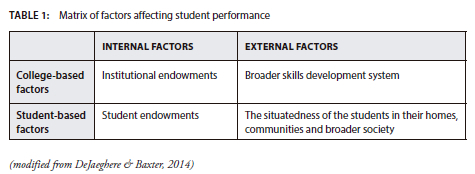
This article examines the factors influencing student performance in South Africa's vocational education and training colleges, reframing achievement not as an individual outcome but as a function of students' capabilities to convert educational opportunities into meaningful success. Grounded in the realist capability approach, the study developed a four-dimensional framework. These dimensions emerged both from conceptual reasoning and through principal component analysis of survey data supported by interviews with college students and staff. Findings show that performance is shaped by factors such as student support and English-only instruction, alongside students' own motivation and resilience, poverty, insecure housing and gendered vulnerability. This study offers a multidimensional and justice-orientated perspective on student success. It calls for a systemic shift from evaluating students in isolation to recognising the relational, institutional and social ecosystems that shape their real opportunities to thrive.
Vocational education and training; student performance; student success; realist capability approach; principal component analysis (PCA); capability deprivation