Reframing student performance in South African technical and vocational education and training colleges: A realist capability approach
Abstract
This article examines the factors influencing student performance in South Africa's vocational education and training colleges, reframing achievement not as an individual outcome but as a function of students' capabilities to convert educational opportunities into meaningful success. Grounded in the realist capability approach, the study developed a four-dimensional framework. These dimensions emerged both from conceptual reasoning and through principal component analysis of survey data supported by interviews with college students and staff. Findings show that performance is shaped by factors such as student support and English-only instruction, alongside students' own motivation and resilience, poverty, insecure housing and gendered vulnerability. This study offers a multidimensional and justice-orientated perspective on student success. It calls for a systemic shift from evaluating students in isolation to recognising the relational, institutional and social ecosystems that shape their real opportunities to thrive.
Vocational education and training; student performance; student success; realist capability approach; principal component analysis (PCA); capability deprivation
Introduction
South Africa's technical and vocational education and training (TVET) colleges occupy a critical space in the post-school education and training (PSET) system. Tasked with the dual mandate of addressing youth unemployment and providing skills for economic development, the sector faces persistent challenges in student retention, progression and graduation. Despite significant public investment and ambitious policy goals, including those set by the National Development Plan (NDP), student success rates at TVET colleges remain unacceptably low. A 2024 Department of Higher Education and Training (DHET) report revealed that only 10.9%, 13.2% and 10.8% of National Certificate Vocational (NCV) students completed their programmes within the standard three-year period in the years 2019, 2020 and 2021, respectively (Khuluvhe, Netshifhefhe & Gwantshu, 2024).
While these statistics signal systemic inefficiencies, they also invite deeper questions about how student performance is conceptualised, measured and supported in the TVET context. Mainstream approaches - rooted in psychological and managerial traditions - tend to isolate student attributes or institutional processes as the key to success. However, such approaches risk obscuring the broader structural, social and institutional contexts in which TVET students navigate their educational journeys. This article addresses that gap by advancing a framework informed by the realist capability approach (Powell & McGrath, 2019), which draws on the philosophical foundations of critical realism and the capability approach (Sen, 1990; Nussbaum, 2000) to offer a more contextually grounded understanding of student performance.
It is based on a study undertaken as part of the DHET five-year TVET Research Programme, launched in 2019, and draws its empirical findings from the related report titled Factors affecting student performance at TVET colleges (Powell, Muronda & Tini, 2024). It is further based on a mixed-methods investigation of the factors affecting student academic achievement at TVET colleges. Drawing on both quantitative and qualitative data, we developed a four-dimensional construct to conceptualise student performance, integrating institutional 'endowments' (DeJaeghere & Baxter, 2014:69), student endowments, the broader skills development system and socio-economic situatedness. These dimensions are not presented as fixed variables but as 'relational capabilities' (DeJaeghere, 2020:18), that is, the conditions that enable students to pursue and achieve the lives they have reason to value.
What is conceptually and methodologically significant is that the same four-dimensional matrix emerged independently from both the theoretical framework and the empirical data. The study thus not only proposes a conceptual lens through which to understand student performance, but also demonstrates its empirical validity through data-driven analysis. These four dimensions - institutional endowments, student endowments, the broader skills development system and socio-economic situatedness - are presented as interrelated domains that shape students' ability to succeed. In doing so, this article offers both a diagnostic and a conceptual contribution. It identifies the principal components shaping student performance while also reimagining what 'success' might mean in the context of students' lived realities.
Ultimately, it calls for a more just and inclusive TVET system - one that recognises students not as deficient, but as capable agents navigating uneven terrain.
The article begins in the next section by outlining three dominant approaches to student performance - psychological, managerial and critical - and positions the realist capability approach as a framework that synthesises and extends them. Thereafter, the methodology section details the study's mixed-methods design, including the principal component analysis and qualitative interviews. This is followed by the findings that are presented using the four-dimensional construct, with each dimension explored as a site of capability expansion or constraint. This is followed by a discussion that reflects on the implications of the findings for educational justice, policy design and institutional practice. The article concludes by reaffirming the value of a capabilities perspective in reimagining student success in vocational education and training.
Conceptual framework: Realist capability approach
The literature on student performance in vocational education and training systems has traditionally focused on throughput, pass rates, retention and graduation. Dominant approaches, rooted in psychological and managerial paradigms, emphasise either individual attributes such as motivation, self-efficacy or time management or institutional efficiency, measured through inputs, outputs and resource optimisation as key determinants of success (Powell & McGrath, 2014).
Educational psychology has generated important insights into the conditions that enable academic achievement. In this tradition, the learner is the unit of analysis. For instance, Nye et al. (2012) explore the relationship between interest and vocational performance, while Tarnongu (2016) and others (cf. Lens and Vansteenkiste, 2008) examine the intrinsic motivation and academic achievement. Winne and Nesbit (2010) distinguish between two key domains: the structural features of instruction that influence learning, and learners' active engagement through metacognition and self-regulation. While sociocultural strands within educational psychology, such as those informed by Vygotsky (Vygotsky & Cole, 1978), have long foregrounded the role of context, social interaction and cultural tools in shaping learning, such approaches are underutilised in understanding TVET performance and have largely been applied to vocational pedagogy, teacher education and learning mediation (Moll & Naiker, 2024; Lenyai, 2019; Ngoveni & Machaba, 2024).
The management tradition, by contrast, focuses on aligning inputs and processes to maximise institutional outputs, often using efficiency and effectiveness indicators (Bess, Johnstone & Dee, 2023; Powell & McGrath, 2019). Badenhorst and Radile (2018), for example, argue that South Africa's TVET system suffers from fragmentation and weak leadership, issues that a narrow focus on individual performance cannot address. They call instead for systemic reforms, including stronger collaboration and distributed leadership, to enhance performance across TVET colleges. This was further illustrated by Hagos and Van Kemenade (2013) who opined that, by adopting total quality management (TQM) principles, TVET reforms in developing countries can focus on achieving specific learning outcomes, leading to improved student success. While valuable, these approaches tend to frame achievement within narrow technicist or behaviourist logics, neglecting the broader socio-economic and institutional contexts in which students are embedded.
Multi-scalar approaches attempt to bridge this gap by recognising that individual and institutional performance are interconnected. Zepke and Leach (2005) categorise these as efforts to better integrate the learner into the institutional context. Bronfenbrenner's (1979) bioecological model, often cited here, identifies five interrelated systems, micro, meso, exo, macro and chrono, that shape learners' experiences and outcomes.
Critical traditions foreground structural constraints and power relations. Grounded in the political economy of skills (Hall & Soskice, 2001; Allais, 2012), this perspective emphasises how institutional and structural arrangements both shape, and are shaped by, the vocational education system. Allais (2012) explored South Africa's experiences with skills development, highlighting the failure of policy interventions to increase the number of skilled workers despite numerous initiatives which include TVET programmes. These traditions highlight the role of poverty, unequal access to resources and the enduring academic-vocational divide in reproducing social stratification. South African scholarship is particularly strong here, with contributions from Webster and Leger (1992), Chisholm (1992), Vally and Motala (2014), Wedekind (2013) and McGrath et al. (2020). This body of work challenges human capital assumptions underpinning vocational education (Vally & Motala, 2014), exposes the limitations of supply-demand models (Allais et al., 2021) and advocates for human development orientations (Powell, 2021). While essential, the critical tradition can sometimes underplay the agency and aspirations of students themselves.
The realist capability approach
To navigate this tension, this article draws on the realist capability approach (Powell & McGrath, 2019), which combines elements of critical realism with Sen's and Nussbaum's capability approach to offer a justice-oriented, context-sensitive framework for understanding educational and social transformation. It foregrounds human agency, well-being and the real freedoms individuals have to live the lives they value, rather than focusing narrowly on outcomes such as economic productivity, student achievement or access to services. Drawing on Sen and Nussbaum, the capability approach defines development in terms of expanding people's capabilities - the genuine opportunities to achieve valued functionings (beings and doings). However, having resources does not automatically result in capabilities. The conversion of resources into capabilities is shaped by institutional, social and environmental conversion factors, such as curriculum relevance, recognition and support systems. Critical realism complements this by offering a deep ontology that helps researchers uncover the often-hidden structures and mechanisms shaping outcomes. It asks not only what works, but also for whom, in what contexts, and why (Pawson & Tilley, 1997).
Following DeJaeghere and Baxter (2014), we distinguish between endowments (resources or assets available to students and institutions), capabilities (real opportunities to achieve valued outcomes) and functionings' (Sen, 1990:43) (actual achievements). Access to education does not guarantee capabilities; students must be able to convert these into meaningful outcomes (Walker & Unterhalter, 2007). Here, 'conversion factors' (Robeyns, 2005:99), such as language, instructional quality, financial stability and social norms, are central (Robeyns, 2005).
The realist component of the framework draws attention to underlying causal mechanisms and patterned social structures that shape or constrain agency. These include institutional norms, policy environments, socio-economic backgrounds and everyday practices that are often invisible in outcome metrics but critical to explaining persistent disparities. Student achievements are shaped by a combination of these elements. For instance, conversion factors such as teaching quality or access to learning materials can enable or inhibit capability development. Institutional endowments, such as infrastructure and support services, are vital, as are student endowments like motivation, academic preparation and financial security. Social and institutional contexts are equally significant. Factors such as household income, rural-urban divides, parental education and labour market dynamics intersect with student and institutional capacities in complex ways.
The realist capability approach emphasises the dynamic interplay between structure and agency, recognising that individuals act within, and are shaped by, broader social, institutional and historical contexts. Within the realist capability approach, agency is central to human development, as it highlights not only the importance of having choices, but also the ability to act on them meaningfully. While individuals are seen as capable of shaping their own lives, their agency is exercised within structural contexts that can either enable or constrain their choices. This dual recognition, of people as active agents and of the social conditions that affect their actions, allows for a nuanced understanding of how development and educational outcomes are achieved. Supporting agency, therefore, requires not just access to resources, but also the removal of structural barriers and the creation of enabling conditions that expand real opportunities for action. In this way, researchers are able to engage with questions of justice, inequality and transformation by asking not only what programmes or policies achieve, but also how they impact individuals' capabilities, and whether they support genuine empowerment and well-being.
Operationalising the realist capability approach allowed us to develop a four-dimensional construct capturing the key domains influencing student performance:
1. Institutional endowments: Culture, capacity and material conditions of the college (e.g. infrastructure, lecturer quality, language policy).
2. Student endowments: Personal and social resources (e.g. financial means, psychological readiness, academic background).
3. The broader skills development system: Policy, funding structures and labour market alignment.
4. Situatedness: Students' embeddedness in social realities including family, community and structural inequality.
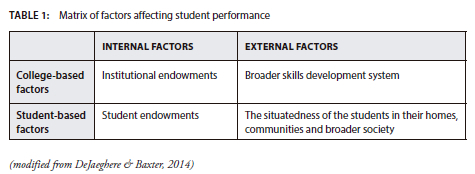
This framework (see Table 1) organises the principal components into an integrated matrix, allowing analysis not only of what resources exist, but also of how they are accessed and converted into achievement. It challenges deficit narratives that cast vocational students as 'the poor, the desperate, and the academically weak' (Powell & McGrath, 2019:22). Instead, by illuminating the systemic and relational factors shaping performance, it offers a more generative view of student potential that acknowledges that TVET students' achievements are shaped by a combination of these elements.
By applying this framework, we aim not only to identify the factors influencing performance, but also to reconceptualise student success as a function of capability expansion. The following section outlines the study's design and what it reveals about the lived realities of students in South African vocational colleges.
Methodology
This study employed a mixed-methods design to investigate the complex interplay of factors affecting student performance in South African TVET colleges. As part of DHET's five-year TVET Research Programme, the research was guided by a commitment to understanding student achievement not simply as an outcome to be measured but as a relational phenomenon shaped by institutional, systemic and socio-economic dynamics.
The research design was sequential and explanatory. It began with the development and administration of a survey instrument comprising 108 variables related to institutional support, student background, motivation, pedagogical quality and social conditions. The quantitative survey administered online to the 50 TVET colleges in the country gathered data from over 1,042 students, which was subjected to principal component analysis (PCA). This was followed by in-depth qualitative interviews with 27 TVET college principals and managers, 36 lecturing staff and 77 TVET college students. Qualitative data was collected through semi-structured interviews and focus-group discussions with students and academic staff. We purposively drew our sample from five provinces, namely the Eastern Cape, KwaZulu-Natal, the Western Cape, Gauteng and the Free State.
Ethical clearance was obtained through the relevant institutional review board. All participants provided informed consent, and care was taken to ensure anonymity and confidentiality. The research process was guided by an ethic of respect for student voice and experience, with particular attention to how structural inequalities shape their engagement with the TVET system.
The qualitative phase was followed by analysis. Quantitative analysis of the survey was conducted using PCA, a dimension-reduction, quantitative analytical technique that distilled and ranked the factors that affect student performance at TVET colleges from the survey. PCA reduced the number of variables in the analysis whilst retaining as much of the information contained in the original dataset as possible. As detailed in the results, the 108 measured variables were reduced to 4 principal components/factors/dimensions.
Thematic analysis was used to identify patterns in the narratives. This iterative, mixed-methods approach allowed for deeper engagement with the data and supported a capabilities-informed reinterpretation of student performance, moving beyond surface indicators to consider students' real freedoms and constraints.
In this study, the PCA was utilised in three ways: (i) first, to discover and identify the linear combinations of the measured variables (principal components) that contain the most variation (eigenvalues) in the dataset; (ii) second, to discover if the measured (manifest) variables, when organised in a particular way, reflect another new underlying variable (principal component); and (iii) third, to confirm a belief held a priori, based on theory and literature as discussed above, that student performance is a multidimensional construct and could be analysed in a four-dimensional construct.
Findings: A realist capability-informed perspective on student performance
The principal component analysis (PCA) revealed four key dimensions influencing student performance: institutional endowments, student endowments, the broader skills development system and socio-economic situatedness. Together, these components accounted for 56% of the overall variance in the dataset and reinforced the conceptual framework guiding the study. They also structured the analysis of qualitative interview data collected from students, lecturers and college leaders.
The interview findings aligned closely with categories identified in the literature, confirming the relevance of this four-dimensional construct for understanding student performance in vocational education and training colleges. Rather than treating these dimensions as fixed variables, the framework conceptualises them as dynamic enablers of, or constraints on, students' capability expansion: their real opportunities to pursue and achieve educational success and valued life outcomes.
Table 2 presents the four principal components and their respective subfactors, drawn from 108 survey variables. Each factor is shown with its eigenvalue (indicating variance explained) and key contributing variables with corresponding component loadings. Eigenvalues show how much each principal component contributes to explaining the data's variation. A larger eigenvalue means the component is more important, capturing a bigger chunk of the data's differences. A smaller eigenvalue means the component is less important, explaining only a small part of the variation. Loadings closer to ±1 indicate a stronger correlation between the variable and its associated principal component.
Each dimension reflects a potential site of transformation, shaped by the interplay between resources (endowments), conversion factors and the functionings students are able to realise. This framework thus offers a richer and more relational understanding of how educational opportunity is experienced and navigated.
In the sections that follow, we explore each quadrant of the matrix in turn, drawing on qualitative interviews to deepen the interpretation of the survey data. The matrix is structured with college-based factors (internal and external) represented across the top row, and student-based factors across the bottom. Vertically, the first column captures internal factors, and the second external ones. Each quadrant represents a distinct intersection:
• PC1: Internal + college-based - institutional endowments
• PC2: Internal + student-based - student endowments
• PC3: External + college-based - broader skills development system
• PC4: External + student-based - socio-economic situatedness
This matrix provides a capabilities-informed lens through which to examine how performance is shaped not only by resources, but also by the systems, structures and relationships that enable or constrain their conversion into success.
PCI: Institutional endowments: Enabling environments or missed potential
Institutional endowments emerged as the most significant component in the principal component analysis (PCA), comprising 13 variables and accounting for the largest share of variance in student performance. This dimension includes a range of internal, college-based factors - material and relational - that shape the conditions under which students learn. These include student support services, administrative systems, lecturer engagement, alignment between theory and practice, and the overall ethos of the college environment.
Survey responses reflected strong student emphasis on support systems. Statements such as 'My TVET college has all the support services to assist students' (loading: 0.74) and 'My college is well managed' (loading: 0.73) loaded highly. However, students described understaffed bursary offices and delayed NSFAS processing. This finding is supported by Viljoen (2020), who focused on students at two Western Cape colleges, and student support emerged as contributing to academic achievement.
Students noted that financial aid offices were understaffed and often lacked the necessary knowledge to manage NSFAS-related processes effectively. One participant remarked, 'In some institutions the financial aid committees do not sit and there is a lot of maladministration happening at the bursary offices' Another added, 'Thousands of applications are sitting at the college to be checked by a bursary officer who is not even equipped [to deal with them].'
Students and staff also highlighted the value, but frequent inadequacy, of counselling services. 'We need those people called social workers because these people can help us with the challenges, [such as] being unable to manage our time, the stresses, our personal lives, and our education as well,' said one student, affirming the link between psychosocial support and academic engagement.
Administrative responsiveness was another recurring theme. Delays in issuing academic results, errors in registration and poor communication were frequently cited as demoralising. These were not simply bureaucratic frustrations - they represented concrete interruptions in students' learning journeys and constrained their capability for continuity. The item 'The college provides adequate administrative support' had a strong loading of 0.72, underscoring its importance.
Lecturer engagement was experienced unevenly. Some students praised their lecturers' commitment, while others critiqued absenteeism and poor subject knowledge. One student remarked, 'There are lecturers that you can see teaching is not their calling. 'Interviews confirmed that, when colleges fostered a sense of belonging, students felt more capable and determined. Conversely, lack of encouragement and institutional opacity left students disengaged.
The theory-practice balance which is so central to TVET's purpose - as it provides students with both a capability and a conversion factor (Forcher-Mayr & Mahlknecht, 2020) - was valued by students, who found this alignment empowering. One lecturer described vocational education as livelihood preparation: 'They want to follow a vocational side of things... starting their own business.' Yet others flagged gaps. A lecturer shared: 'The college does not invest in information technology and engineering... our students end up just doing theory.' This compromises students' ability to convert learning into practical capability. These statements illustrate how practical learning can serve both as a capability and a conversion factor.
From a capabilities perspective, these findings underscore the importance of relational and procedural factors, not just material resources, in shaping student outcomes. Institutional endowments do not translate automatically into educational success; their effectiveness depends on students' ability to access and convert them into functionings. This requires not only adequate provisioning, but also intentional design, inclusive practices and responsiveness to student diversity. Where colleges are well managed, empathetic and student-centred, they function as enabling spaces. Where they are disorganised, opaque or indifferent, they become sites of exclusion.
PC2: Student endowments: Aspirations, agency and motivation
Student endowments, referring to the personal, social and educational resources that students bring to their studies, emerged as the second-most influential component in the PCA (eigenvalue: 5.2). Variables loading onto this component included motivation, time management, self-responsibility, programme alignment and educational aspiration. While often treated as individual-level factors, the findings suggest these are deeply shaped by institutional systems and structural conditions.
The survey item 'I take my studies as a personal responsibility' (loading: 0.58) scored highly. Interview data confirmed this, with many students demonstrating determination and goalsetting, even in hugely challenging circumstances. One student shared, 'Persevere even if things get tough... . Dont let anything get you down. Say to yourself, "Don't give up!'" Another student explained how personal aspiration was rooted in early experiences of informal apprenticeship: 'I am always helping my uncle, who is an electrician... . I said to myself, "Let me study electricity because I can do some of the things. "'These stories illustrate the presence of the capacity to aspire (Appadurai, 2004: 69) or capability to aspire (Powell, 2012:p. 9) rooted in lived realities and imagined futures.
However, students' aspirations were frequently constrained by programme placement practices. The item 'I selected the programme I am enrolled in, and I am happy that I'm here' loaded at 0.63, yet interviews revealed this was often not the case. One student recalled, 'I was told motor mechanics ... [was] full. Then the campus manager said there were afternoon classes, and that is how I got the place.' A lecturer confirmed, 'Most of the time, the student applies for a programme and, when it's full, they take the next-available programme.' This redirection compromises choice and weakens the alignment between student interest and programme content. The survey item 'I am not interested in the programme I am enrolled in also loaded highly (0.61), highlighting this disconnect.
At the same time, lecturers noted frustration with students' inconsistent engagement. One remarked, A student just goes outside [because] the phone is ringing in class.' This tension reveals the gap between educator expectations and the socio-economic pressures students navigate daily, pressures that shape how responsibility is enacted.
Despite such challenges, students frequently saw vocational education as a bridge to future possibilities. 'There is a lot that we are taught... it will help us with finding a job', said one student. Another added that the programme offered 'plenty of work opportunities'. The belief that vocational pathways could lead to employment underpinned student perseverance and framed the system as an engine of hope, even where structural limitations persisted.
Still, goal orientation cannot be separated from social context. Students bring with them uneven educational backgrounds, varying levels of academic preparedness and differential access to support at home. The item 'I am in this course because all other courses were full' loaded negatively (-0.54), underscoring the lack of meaningful choice available to some students. In such cases, aspirations may be present, but the capacity to realise them is constrained by structural conditions.
Student agency, then, is not a given. It is exercised in constrained contexts - limited by placement decisions, financial insecurity and domestic obligations. The negatively loading item 'I am in this course because all other courses were full' (loading: -0.54) highlights how lack of choice undermines engagement. Even highly motivated students can feel disengaged when their aspirations are displaced by institutional pressures.
Despite these constraints, many students maintain a strong sense of purpose. The item 'Studying at the TVET college has increased the possibility of achieving my goals' (loading: 0.55) suggests that, for many, TVET education is experienced as a bridge to a better future. 'There is a lot that we are taught at school and college that will help us with finding a job; it will be much easier'said one student. Others noted that the programme offered 'plenty of work opportunities', revealing a perceived link between education and employability. These perspectives support DHET's aspiration for TVET to become an institution of choice that expands employability and livelihood opportunities (DHET, 2013).
From a realist capability perspective, these findings show that student endowments must be seen not as static traits but as dynamic capabilities that are shaped by institutional processes, socio-economic conditions and personal histories. Even traits like time management and resilience are unequally distributed, not in terms of willpower, but in terms of students' life circumstances. For example, a student juggling academic work with family care, inadequate housing and financial stress may appear 'unmotivated' when in fact their capacity to act is simply overwhelmed by competing survival needs. While students demonstrated notable levels of agency and vision, their success depends on whether colleges and the broader system enable or inhibit that agency. A capability-friendly environment recognises not just what students bring, but what they need in order to thrive.
PC3: The broader skills development system: Systemic disjunctures and capability constraints
Principal component 3 (PC3), with an eigenvalue of 4.5, captures the external institutional conditions that shape student success, particularly the role of NSFAS and English as the language of instruction. While beyond the control of individual colleges, these factors emerged as critical conversion mechanisms that either enable or obstruct students' ability to turn educational access into success.
The strongest-loading variable was 'NSFAS is the biggest cause of student dropout at the college' (loading: 0.68). Despite NSFAS's role in widening access, students reported severe administrative failures: delayed payments, unclear communication and inadequate support. 'Many students drop out during the waiting period of the NSFAS allowance,' one student said. Others reported skipping meals or being evicted due to delays. These disruptions were especially gendered. The item 'NSFAS pushes girls into uncomfortable relationships with boyfriends who can help support them' (loading: 0.57) points to the vulnerability students face when financial systems collapse. One student noted, 'We live in accommodation that is not accredited. some female students [turn to] immoral ways of raising money. Others drop out.' NSFAS also contributed to long-term financial insecurity. The item 'NSFAS puts students and their families into debt' (loading: 0.55) reveals how aid mechanisms, when mismanaged, may worsen the very inequalities they aim to redress. In these cases, the financial aid system intended to expand educational opportunity paradoxically exacerbates students' precarity - highlighting the importance of student financial aid serving as a meaningful opportunity, rather than as a resource provision that does not convert the educational opportunity into a meaningful opportunity but, instead, perhaps serves to expand multidimensional poverties.
The second major theme was the language of instruction. English is the medium of instruction, although most students speak it as an additional language. 'I would say, language is the barrier,' one student stated. Another described a complex multilingual reality: 'I am 100% Xhosa... I get a lecturer that's Xhosa-speaking or afrikaans-speaking, yet English is the medium of communication. 'Language affects more than comprehension, as it shapes students' confidence, ability to participate and sense of inclusion. Where students are forced to operate in a language in which they are not fully fluent, they may struggle to articulate their knowledge, interpret assessments or engage in classroom discussion. This creates a significant barrier in which existing knowledge and potential cannot be realised in academic performance. Some students attempted to overcome this challenge through peer-led multilingual study groups - an impressive display of agency but one that points to institutional failure to support learning in the linguistically diverse TVET context.
Mathematics also emerged as an important factor in academic performance, with concern that South African schoolchildren had the lowest competency out of 39 countries (Mullis et al., 2019). Mathematics components in TVET programmes thus decrease student success rates. As one college principal indicated, 'I think of engineering subjects, both at NCV level and Report 191; because of Mathematics they [are the more difficult], as you need Mathematics, or you should have... Mathematics.'
In the realist capability approach, both NSFAS and language of instruction are not simply 'contextual variables; they are structural conditions that either support or suppress students' capabilities. Financial aid and instructional language are central to students' capability for learning with dignity, capability for continuity and capability for participation. When these mechanisms function poorly, the result is not just inconvenience or frustration but a severe capability deprivation.
It is worth noting that some support structures exist. University-based centres such as the Govan Mbeki Mathematics Development Centre and the Schools Development Unit have developed interventions to support TVET students and lecturers. Yet these initiatives remain marginal to core institutional practices.
The findings from PC3 reinforce a critical insight: student performance is inseparable from system performance. When financial systems are erratic, or language policies exclusionary, students' capabilities are eroded even before they set foot in a classroom. These are not simply operational issues - they are foundational to the kind of educational justice envisioned in the National Development Plan and the Sustainable Development Goals.
For TVET colleges to become truly inclusive institutions of choice, policy and planning must address these systemic disjunctures directly. NSFAS must be reformed not only to deliver funds efficiently, but also to support student dignity and academic focus. Similarly, language policy must be revisited to create space for multilingualism - not as a remedial measure, but as a resource for learning and teaching. Until these shifts are made, the broader skills development system will remain a barrier to, rather than a builder of, student capability.
PC4: Socio-economic situatedness - poverty, place and the persistence of structural inequality
The fourth principal component, socio-economic situatedness, with an eigenvalue of 2.8, reflects the socio-economic conditions in which students live - conditions that, while outside the direct control of the institution or the individual, profoundly affect learning. This includes multidimensional poverty, housing quality, access to basic services, household income and family responsibilities.
The survey data indicated strong associations between material deprivation and academic struggle. The items 'My home has tap water' (loading: 0.42) and 'I live in an informal dwelling' (loading: -0.37) reflected infrastructure deficits that directly affected students' learning environments. One student explained, 'There's usually no electricity, no water... the location where I am is also affecting my academics.' Housing insecurity was a recurring theme; with 35% of respondents living in informal dwellings and over half from households reliant solely on social grants, students' lives are marked by financial precarity.
Many students were the first in their families to attend tertiary education. 'My parents are not educated. If I had not left my village, I don't think I would be studying today,' said one student. Their determination often clashed with daily hardship. Crime, gender-based violence and poor health infrastructure compounded the instability of already marginalised communities. 'Students were being raped, students are poor, students have no support from home,' noted one college principal.
Beyond housing, crime and violence in students' communities emerged as barriers to educational continuity. This context of everyday insecurity not only limits students' ability to study, but also heightens the risk of dropping out or disengagement. The survey item 'Have you repeated a level?' (loading: 0.42) confirms that socio-economic pressures can directly interfere with academic progression. Repeating a level often results in the loss of NSFAS support, further compounding financial strain and decreasing students' ability to continue.
Importantly, the student voices in this study demonstrate not only vulnerability, but also resilience and determination. Many were first-generation tertiary students, navigating new systems without guidance. Their presence in college was itself a form of agency, a refusal to be defined by poverty. But as the realist capability approach reminds us, agency is not enough if it is persistently undermined by structural unfreedoms. Students can aspire, but without secure housing, electricity, safety or family support the conversion of aspiration into functioning becomes tenuous at best. As Nussbaum (2000) argues, capabilities must be understood in terms of real, rather than merely formal, freedom. A student may formally be 'enrolled' and have 'access' to a learning programme, but if they are hungry, unsafe and unsupported that access is hollow. Their capability to learn with dignity is effectively denied.
From a policy and planning perspective, PC4 compels us to reconsider the boundaries of institutional responsibility. While many of these challenges lie beyond the TVET college per se, they intersect with student performance in inescapable ways. The idea that colleges can remain neutral or unaffected by social conditions is not just outdated, it is unachievable. A genuinely inclusive and just TVET system must be understood as part of broader skills ecosystems (see Powell, 2021; Lotz-Sisitka & McGrath, 2023) that works with housing, health, transport and social development sectors to create the enabling environments in which students can flourish.
Colleges themselves, and as they currently exist, can also play a role. Many students expressed appreciation for counselling, lecturer support and peer networks that helped them navigate the stress of poverty and marginalisation. These services, though often overstretched, represent sites of potential resilience-building and were consistently rated as crucial by learners, not just academically but emotionally and practically.
In conclusion, socio-economic situatedness is not a peripheral concern; it is a central determinant of performance in the South African TVET system. Addressing it requires not only intersectoral collaboration, but also a shift in mindset: from blaming students and lecturers for 'underperformance' to understanding performance as a negotiated outcome between individual agency and structural constraint.
Discussion: Beyond student deficits - understanding performance as conversion
The findings of this study offer compelling evidence that student performance at South African TVET colleges is shaped by a multidimensional constellation of factors: material, social, institutional and psychological. These factors do not operate in isolation, nor do they align neatly with the deficit explanations that have too often characterised discourse on student 'underperformance'. Instead, what emerges is a layered story of students navigating real opportunity gaps in their institutional environments, broader systemic structures and everyday lives.
At the heart of this analysis is a powerful convergence: the four-dimensional framework developed through the realist capability approach was not only conceptually coherent, but also empirically confirmed through the PCA, and then through the interviews. The same four domains - institutional endowments, student endowments, the broader skills development system, and socio-economic situatedness - surfaced both in theory and in students' lived accounts. This dual emergence strengthens the legitimacy of the framework and positions it as a powerful tool for both understanding and responding to the complex determinants of student success.
Rather than asking why TVET students 'fail', this study asks: what conditions are required for students to succeed meaningfully? The answer lies not in personal traits or effort alone, but in students' ability to convert available resources into valued outcomes - what the capability approach calls functionings. When conversion fails, it is often not due to a lack of student will, but a lack of enabling context. Consider, for instance, the student who is placed in a programme they did not choose, or the one whose NSFAS allowance arrives late, threatening housing and food security. Or the student who knows the answer but cannot express it fluently in English. Or the student who returns each evening to an informal settlement without water or electricity. These are not students who lack motivation. These are students navigating an education and socio-economic systems that frequently fail to create the conditions necessary for their capabilities to expand.
The findings also demonstrate that institutional environments matter deeply. Where colleges are well managed, where lecturers are committed, where theory and practice are balanced, and where student support services are robust, students not only survive, they thrive. One student said it simply: 'Just dont give up.' That sentiment was repeated often, but hope should not be a substitute for structure. Colleges must do more than inspire resilience; they must contribute to reducing the need for it.
The realist component of the framework invites us to examine how patterned structures -policies, funding systems, housing markets, language regimes - shape educational outcomes. But it also holds space for agency: the student who persists in the face of instability, the lecturer who arrives early and leaves late, the peer groups who form multilingual study circles to bridge the language gap. These are not heroic anomalies, they are signs that students and staff alike are making education work despite the system, not because of it.
This dual lens enables a richer understanding of performance. Students are not simply at risk; they also have agency. But agency, in this view, is never just a personal or individual asset. It is always relational: dependent on institutional responsiveness, systemic coherence and socioeconomic infrastructure. To ignore this interdependence is to mistake constraint for failure.
The implications of this research extend beyond academic debate. If TVET colleges are to become institutions of choice - as envisioned by national policy - they must be redesigned as capability-enhancing spaces. That means moving beyond access to inclusion, and beyond curriculum coverage to pedagogical care.
Conclusion
This article set out to investigate the factors influencing student performance in South Africa's TVET colleges, not through a deficit lens but through the prism of the possibilities of what students might achieve when institutions and systems enable, rather than restrict, their capabilities. Drawing on the realist capability approach and supported by a mixed-methods design, the study produced a four-dimensional framework - emerging both theoretically and empirically - that captures the complex interplay of institutional, individual, systemic and socio-economic dynamics shaping academic outcomes.
The significance of this framework lies not only in its explanatory power, but also in its ethical stance. By shifting the unit of analysis from student performance to the conditions that make performance possible, the study challenges longstanding narratives of failure. It demonstrates that what is often described as 'underachievement' is, in fact, a product of conversion failure of students being unable to turn access into achievement due to gaps in support, resources, recognition or basic security.
Theory and data coalescing around the four domains - institutional endowments, student endowments, the broader skills development system, and socio-economic situatedness - provides both a diagnostic map and a strategic guide. It directs attention not only to what students lack, but also to what the system must become. It urges us to design colleges, policies and funding mechanisms that support students as full human beings - not only as trainees for labour markets, but also as people seeking dignity, stability and a future.
In highlighting the key findings of this study, several recurring and deeply interrelated factors emerged as critical in shaping student performance. These include: the use of English as the sole language of instruction, which poses substantial barriers to comprehension and engagement for many students; the mathematics components of certain programmes, which continue to have a disproportionately negative effect on pass rates; and the ongoing challenges associated with NSFAS, including delayed disbursements and administrative bottlenecks. Inadequate infrastructure, insufficient student support services and the impact of multidimensional poverty, including housing insecurity, food instability and exposure to unsafe environments, further constrain students' ability to learn with dignity. These findings underscore the importance of attending to both systemic and institutional conversion factors if student capabilities are to be meaningfully expanded.
TVET students are not the 'weakest' in the system. They are among the most resilient. They are often first-generation, working-class, and under pressure to succeed against the odds. That many do succeed is a testament to their agency. But when they do not, the failure is rarely theirs alone. It is shared by the institutional environments that overlook them, by NSFAS that delays or excludes them, by the English tuition policy that alienates them, and by social conditions that compromise their ability to study, participate and flourish.
In response, this study offers not only critique, but also a framework for reimagining what success could mean in post-school education. It invites policymakers, practitioners and researchers to centre the question of capability: What real opportunities do students have to succeed? And how might those opportunities be expanded?
For future research, this framework could be used comparatively across regions or applied longitudinally to track how institutional and systemic reforms shape student trajectories over time. For policy, it offers a multidimensional tool for identifying bottlenecks and investing resources where they will have the greatest capability-expanding effect.
In the end, a just and effective TVET system cannot be built on the assumption that students must adapt to broken systems. Instead, it must be built on the commitment to repairing those systems so they adapt to the lives, aspirations and realities of students. Only then can TVET become not a second choice, but a real pathway - to meaningful opportunities, to achievement and to lives that students have reason to value.
We are especially grateful to the TVET colleges that participated in the study, and to the student movement, particularly the South African Technical and Vocational Education and Training Student Association (SATVETSA) and the South African Students Congress (SASCO), for their crucial role in shaping the survey instruments and contributing to interviews and dialogues.
Acknowledgements
We gratefully acknowledge the Department of Higher Education and Training's (DHET) five-year TVET Research Programme, which was funded by the National Skills Fund (NSF), for funding the research on which this article is based. The research was undertaken as part of DHET's Technical and Vocational Education and Training (TVET) Research Programme. We extend particular thanks to the DHET TVET Branch and the Research Directorate for their consistent support and guidance. Our sincere appreciation also goes to colleagues at the Institute of Post-School Studies (IPSS) at the University of the Western Cape, especially Professor Joy Papier, programme lead, and Dr Seamus Needham, programme manager, for their exceptional leadership in coordinating this national initiative.
REFERENCES
- Allais, S. 2012. Will skills save us? Rethinking the relationships between vocational education, skills development policies, and social policy in South Africa. International Journal of Educational Development, 32(5):632-642. Available at: <https://doi.org/10.1016/j.ijedudev.2012.01.001>
- Appadurai, A. 2004. The capacity to aspire: Culture and the terms of recognition. In: V Rao & M Walton (eds), Culture and public action. Stanford CA: Stanford University Press, 59-84.
- Badenhorst, JW & Radile, RS. 2018. Poor performance at TVET colleges: Conceptualising a distributed instructional leadership approach as a solution. Africa Education Review, 15(3):91-112.
- Bess, J., Johnstone, DB & Dee, JR. 2023. Understanding college and university organization: Theories for effective policy and practice: Volume II - Dynamics of the system. Routledge.
- Bronfenbrenner, U. 1979. The ecology of human development experiments by nature and design. MA: Harvard University Press.
- Chisholm L. 1992.South African education in the era of negotiations. South African Review-SARS, 6:279-293.
- DeJaeghere, J & Baxter, A. 2014. Entrepeneurship education for youth in sub-Saharan Africa: A capabilities approach as an alternative framework to neoliberal's individualizing risks. Progress in Development Studies, 14(1):61-76.
- DHET (Department of Higher Education and Training). 2013. White Paper for post-school education and training. Building an expanded, effective and integrated post-school system. Available at: <https://doi.org/10.1080/19452829.2019.1677576>.
- Forcher-Mayr, M & Mahlknecht, S. 2020. A capability approach to entrepreneurship education: The sprouting entrepreneurs programme in rural South African schools. Discourse and Communication for Sustainable Education, 11(1):119-133. Available at: <https://doi.org/10.2478/dcse-2020-0011>
- Hall, PA & Soskice, D. 2001. An introduction to varieties of capitalism. Debating varieties of capitalism: A reader, 21-74.
- Lens, W & Vansteenkiste, M. 2008. Promoting self-regulated learning A motivational analysis. In: DH Schink & BJ Zimmerman (eds), Motivation and self-regulated learning: Theory, research, and applications. Lawrence Erlbaum Associates Publishers, 141-168.
- Lenyai, S. 2019. Addressing language barriers to learning at a technical and vocational education and training (TVET) college: Bojanala District, North West (NW). Doctoral thesis. University of South Africa.
- Lotz-Sisitka, H & McGrath, S. 2023. Introducing VET Africa 4.0. A social skills ecosystem perspective, 1.
- McGrath, S, Powell, L, Alla-Mensah, J, Hilal, R & Suart, R. 2020. New VET theories for new times: The critical capabilities approach to vocational education and training and its potential for theorising a transformed and transformational VET. Journal of Vocational Education and Training, 1-22. Available at: <https://doi.org/10.1080/13636820.2020.1786440>.
- Moll, I & Naiker, V. 2024. Learning theories in TVET pedagogy. In: R Dlamini, I Moll & V Naiker (eds), Technical and vocational teaching in South Äfrica: Practice, pedagogy and digitalisation. Cham: Springer Nature Switzerland, pp. 163-198.
- Mullis, IV, Martin, MO, Foy, P, Kelly, DL & Fishbein, B. 2019. TIMSS 2019 International results in mathematics and science. Available at: <https://timss2019.org/reports/>.
- Ngoveni, MA & Machaba, MF. 2024. Effectiveness of questioning techniques in Mathematics: An analysis of lecturers' practices at TVET colleges. Journal of Pedagogical Sociology and Psychology, 6(3):21-33.
- Nussbaum, MC. 2000. Women and human development: The capabilities approach (Vol. 3). Cambridge: Cambridge University Press.
- Nye, CD, Su, R, Rounds, J & Drasgow, F. 2012. Vocational interests and performance: A quantitative summary of over 60 years of research. Perspectives on Psychological Science, 7(4):384-403. Available at: <https://doi.org/10.1177/1745691612449021>
- Pawson, RD & Tilley, N. 1997. Realistic evaluation. London: Sage.
- Powell L. 2012. Reimagining the purpose of VET-Expanding the capability to aspire in South African Further Education and Training students. International Journal of Educational Development, 32(5): 643-653.
- Powell, L. 2021. Planning for freedom : From human capital to human capabilities. Journal of Education (University of KwaZulu-Natal), 84:85-105.
- Powell, L & McGrath, S. 2019. Skills for human development. Transforming vocational education and training. Routledge.
- Powell, L, Muronda, F & Tini, S. 2024. Factors affecting student performance at TVET colleges. Report produced under the Five-Year Research Programme on TVET, commissioned by the Department of Higher Education and Training (DHET) and funded by the National Skills Fund (NSF). Pretoria (ISBN: 978-1-77018-985-0).
- Robeyns, I. 2005. The capability approach: A theoretical survey. Journal of Human Development, 6(1):93-117. Available at: <https://doi.org/10.1080/146498805200034266>
- Vally, S & Motala, E. 2014. Education, economy and society. UNISA.
- Viljoen, PJ. 2020. Possible risks related to academic success in Income Tax N6 at two TVET coleges in the Western Cape Province. Doctoral thesis. Stellenbosch: Stellenbosch University.
- Vygotsky, LS & Cole, M. 1978. Mind in society: Development of higher psychological processes. Harvard University Press.
- Walker, M & Unterhalter, E. 2007. The capability approach: Its potential for work in education. In M Walker & E Unterhalter. Amartya Sens capability approach and social justice in education. New York: Palgrave Macmillan US, 1-18.
- Webster, E & Leger, J. 1992. Reconceptualising skill formation in South Africa. Perspectives in Education, 13(2):53-66.
- Wedekind, V. 2013. Education, training and the 'precariat': An overview of the South African education and skills landscape. Fifth BRICS Academic Forum on Brics and Africa: Partnership for Development, Integration and Industrialisation, 108-116.
- Zepke, N & Leach, L. 2005. Integration and adaptation: Approaches to the student retention and achievement puzzle. Active Learning in Higher Education, 6(1):46-59. Available at: <https://doi.org/10.1177/146978740504994>