Analysing the continuing education needs of Swiss in-company trainers: An approach based on the latent class analysis
Abstract
In the Swiss dual vocational education and training (VET) system, access to continuing 'extra-professional'education for in-company trainers remains relatively limited, despite their acknowledged pedagogical role. Accordingly, this study examined the continuing education needs of in-company trainers by analysing their postures in relation to different continuing-education offerings. Hence, an online questionnaire was completed by in-company trainers (n = 5 295) across Switzerland. The survey questions focused on a number of varied themes and characteristics of continuing education programmes. Latent class analyses enabled us to identify four classes of in-company trainer, distinguished by their relationship with continuing education ('thirsty for continuing education' vs 'indifferent for continuing education'), on the one hand, and by their relationship with the trainer's function ('apprentices' caretaker' vs 'dedicated to the trainer's function'), on the other. Several differences were highlighted regarding the socio-demographic characteristics and preferences for practical courses between the four classes. Our study provides an insight into this population's heterogeneity and a finer distinction between attitudes existing among in-company trainers about continuing education. In addition, these findings reflect the challenge of recognising in-company trainers as pedagogical figures for apprentices, and not merely as 'occupation transmitters'. Based on the results, some practical implications for the field are also raised.
Vocational education and training (VET); latent class analysis; Swiss in-company training; dual apprenticeships; continuing education
Introduction
In the Swiss educational context, after compulsory schooling, two out of three young people embark on initial vocational education and training (IVET) (FSO, 2023a). In contrast to most European countries (with the exception of Germany), the vocational education and training (VET) system in Switzerland plays a particularly important role and is globally valued (Gonon, 2017; Wettstein, Schmid & Gonon 2018), this valorisation being reflected both nationally and internationally. However, there are regional differences: the German-speaking part of the country is more in favour of the VET system than the French- and Italian-speaking parts.1
There are two types of apprenticeship: full-time, which takes place exclusively in vocational schools (with the possibility of in-company traineeships), and dual, which alternates between one or two days a week of theoretical courses in a vocational school and four to five days a week in a training company. The dual form of apprenticeship is predominant in Switzerland, with 90% of young people undertaking their vocational training in this way (SERI, 2022). As with the overall proportion of young people in VET, depending on the Swiss geographical region and sector of activity, the proportion of apprentices in dual VET can also vary. For example, the French-speaking cantons in the west of the country have a particularly high number of full-time vocational schools that are closer to the French model. In contrast, in German-speaking Switzerland, as in Germany and Austria (Pilz, 2012; Fürstenau, Pilz & Gonon 2014), the dual system is king (Berner & Bonoli, 2018). Given the importance of the dual system, this requires close collaboration between the private and public partners (Confederation, cantons and professional associations). It also requires a strong commitment from the companies offering apprenticeships. In this configuration, apprentices have to find a company willing to train them,2 sign an employment contract - like any other employee - and commit themselves for the entire duration of the apprenticeship, that is, from two to four years, depending on the type of diploma planned and the occupation. From the start of their contract, apprentices are therefore the responsibility of a key figure in dual vocational training: the in-company trainer.
Central role of in-company trainers
Since the most important part of dual VET takes place in a training company (Gehret et al., 2019), the persons responsible for training apprentices play a central role, in particular professionally and pedagogically (Bausch, 1997; Lamamra & Masdonati, 2009). Moreover, whereas vocational teachers undergo between 300 and 1800 hours of pedagogical training, in-company trainers need just 40 hours of training to perform their function. This disparity in the time devoted to pedagogical training seems to show that, despite the central pedagogical role of in-company trainers, very little training - in comparison with teachers - is required of them to fulfil their function. In most cases, an in-company trainer's function is additional to that of employee and/or company owner. As a result, they not only need to master their occupation, but also to implement it well, that is, to be capable of providing a certain amount of knowledge, know-how and soft skills for apprentices. They regularly assign marks reflecting the acquisition of vocational knowledge and skills and are also informed of the marks obtained by apprentices at school.
Owing to their position between workers and trainers, they have to face several challenges, typical of the dual VET system, but in particular the tension between production and training (Moreau, 2003).
Challenges and needs of in-company trainers
The tension between producing and training (Moreau, 2003) is one of the greatest challenges facing in-company trainers when training apprentices. This tension, which is a fundamental component of dual training, is characterised by two concomitant injunctions: the necessity to be productive and the importance of training apprentices. This means finding the time to support apprentices' learning, to show them tasks, to develop pedagogical approaches adapted to workplace learning, and to organise the training with other colleagues or departments, but also to give them the opportunity to practise and monitor their progress in their chosen occupation. Bringing these two logics together can give rise to tensions because in-company trainers are torn between several roles and functions of a different nature (Bahl, 2013; Kiepe, 2021; Nicklich, Blank & Pfeiffer, 2022) and 'wear different hats' in the company.
Moreover, as their function is little known by colleagues, managers and also sometimes at the institutional level, in-company trainers regularly claim a need for recognition (Besozzi, Perrenoud & Lamamra 2017; Bahl & Schneider, 2022). On the one hand, they insist on having the time to train apprentices properly, time that is often in short supply because of the production logic in which they operate. On the other hand, in-company trainers ask, among other things, to have a set of specifications clearly indicating that they train apprentices, but also a specific status and a commitment from the company regarding their function. Recognition can also be materialised through a salary or compensation of some kind. These different factors illustrate that, beyond the recognition issue, there is another: professionalising the function. What is more, in view of the latter, which requires both professional and pedagogical commitment, in-company trainers would need continuing education that goes beyond the purely professional (technical refresher courses related to the occupation). In other words, in-company trainers should be equipped with the necessary tools to deal effectively with apprentices, both interpersonally and formally.
Accordingly, taking an interest in the continuing education needs of in-company trainers goes beyond the 'simple' issue of lifelong learning; it involves much deeper issues relating to in-company trainers' function in the dual VET.
Our study: Aims and research questions
Despite their importance in the dual system, neither companies nor trainers have received much attention.3 Accordingly, this study aimed to identify the needs and interests of Swiss VET in-company trainers and the differences in their responses to continuing education. More precisely, the study was part of a wider project commissioned by a foundation4 which focused on assessing the situation of in-company trainers. The first stage involved interviews with different VET stakeholders (mainly in-company trainers, apprentices and company owners, but also some trade associations) which, among other things, helped to highlight the most salient issues regarding continuing training needs. These were then used to develop an online questionnaire on the needs and preferences for continuing-education courses. Descriptive and comparative analyses were initially carried out, whereas in this study we opted for an exploratory approach - using latent class analysis5 - to gain more information about in-company trainers. Several main research questions guided the study:
• Which needs regarding continuing education do in-company trainers have?
• Which socio-demographic features distinguish in-company trainers regarding continuing education?
• Which practical aspects of continuing education (formats, modalities, etc.) distinguish in-company trainers regarding continuing education, and how do they do so?
We hypothesise that the latent class analyses will make it possible to further explore the needs and preferences of in-company trainers regarding access to, and the content of, continuing education related to their trainer function. This person-centred statistical approach allows respondents to be grouped according to their answers and therefore enables researchers to study trends in the responses of distinct groups.
Methodology
The participants in the study together with the data, data collection and data analysis are presented in this section.
Participants
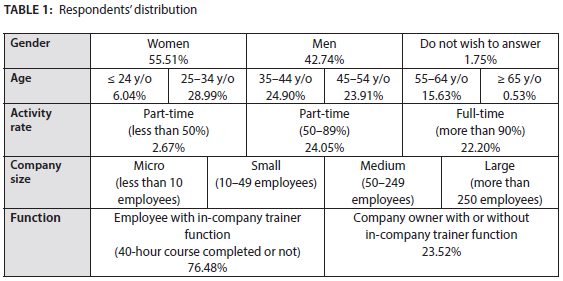
The sample comprised 5 295 respondents, 75% (or 3971) of whom were in-company trainers (i.e. employees carrying out the trainer function, having already completed the 40-hour course, or not yet having done so) and 25% of whom were company owners (with or without the trainer function). In this respect, we initially identified four functions related to apprentices' training:
1. Employees with in-company trainer function (40-hour course completed; 64.15%);
2. Employees with in-company trainer function (40-hour course not yet completed; 12.33%);
3. Company owner with in-company trainer function (17.52%); and
4. Company owner without in-company trainer function (6.00%).
Following preliminary analyses, we were able to observe that the two groups of employees with a training function responded in a similar way, as did the two groups of company owners. For this reason, the main analyses were carried out by considering the function indicator in a dichotomous way, that is, by contrasting the group of in-company trainers with the group of company owners. In addition, we decided to retain the latter, as they are in any event responsible for training apprentices even if they do not directly train them.
In addition, most of the sample (i.e. 73.28%) indicated that they worked full-time, that is, at least 90% of the time. All the Swiss regions (with a majority of German-speaking respondents, 83.68%), professional sectors6 and company sizes were represented (see Table 1).
Data and data collection
An online questionnaire targeting in-company trainers and company owners who train apprentices was sent out at the beginning of October 2022 by most of the Swiss cantons, the Swiss Trade Association7 and the Swiss Employers' Association to training companies directly or to organisations representing the world of work. The deadline for responses was set at one month; at the end of this period, 5 295 valid questionnaires had been received.
The survey was structured as follows:
• Proposals8 for continuing-education programmes (with themes based on the analysis of the interviews and the trends identified by the Confederation for vocational training):
- knowledge of adolescents (psychology, development, etc.);
- social and family issues;
- intercultural issues relating to apprenticeship training;
- roles of company trainers, tasks and challenges;
- relationship and communication competences;
- teaching methods;
- time management (production/training);
- digital competences;
- networks (contacts, professional associations, vocational schools, etc.);
- general knowledge of the vocational training system; and
- legal issues relating to apprenticeship training (VPETA, LL, CO, GEA, etc.).9
• Classification of continuing-education offerings.
• Formats, methods, periods and other characteristics of continuing education.
• Framework conditions for effective apprentice training.
• Socio-demographic information.
Data analysis
In order to identify similar groups of in-company trainers according to their preferences for 'extra-professional'10 continuing education, we carried out a latent class analysis (LCA) using the MPlus software (version 7.11; Muthén & Muthén, 2013). We grouped respondents according to one criterion, namely their responses to various continuing-education offers linked to their trainer function (see Appendix D for the detailed list of courses). The aim of this type of analysis was to identify groups of in-company trainers who had responded in comparable ways to continuing-education offers. In the LCA, this translates into the probability of each individual belonging to one class rather than another (Sinha, Calfee & Delucchi 2021; Bauer, 2022). In addition, to highlight differences between in-company trainer groups, chi-square and ANOVA tests were also performed.
Results
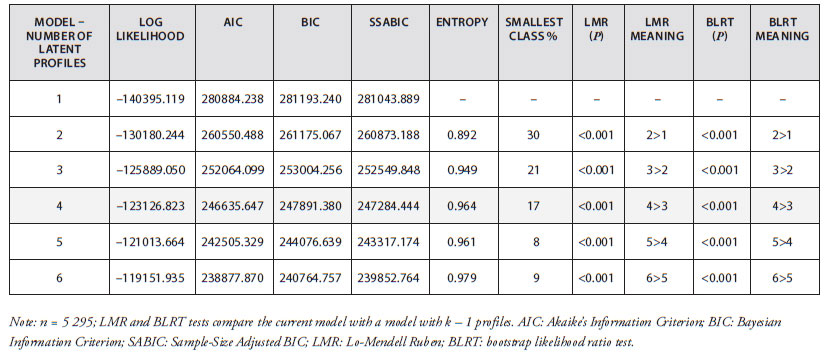
To answer the first research question, that is, to know how many and which classes reflect in-company trainers' needs for continuing education, we performed latent class analyses (Ferguson, Moore & Hull, 2020). After testing models with one to six profiles, we finally opted for the four-class solution (see Appendix B, i.e. fit indices for each tested model), for several statistical and theoretical reasons:
• The improvement in the Bayesian Information Criterion (BIC) index11 is greater in the four-class solution than when adding classes. Although this index is constantly improving, this would probably be due to the large size of the sample (Sinha et al., 2021; Bauer, 2022);12
• This solution has an entropy index greater than .80, which is the recommended threshold for a satisfactory solution (Weller, Bowen & Faubert 2020; Bauer, 2022);
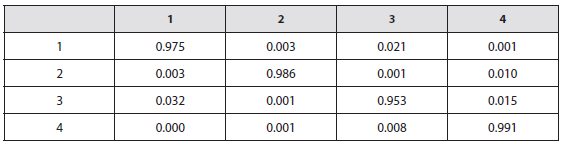
• The average latent posterior probabilities are greater than .90, which is considered to be a good cut-off value in LCA (see Appendix C; Bauer, 2022); and
• In the literature, four profiles had already been identified - although using an ideal-typical approach (Besozzi, 2023) - and the choice of four classes could enable us to compare our results with those already observed. In this sense, the literature advises that the final solution should also be chosen based on its interpretability (Bauer, 2022).
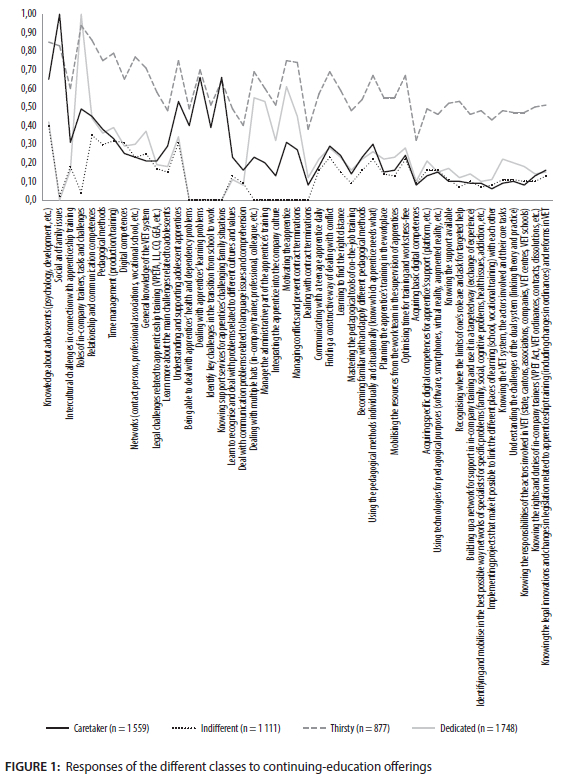
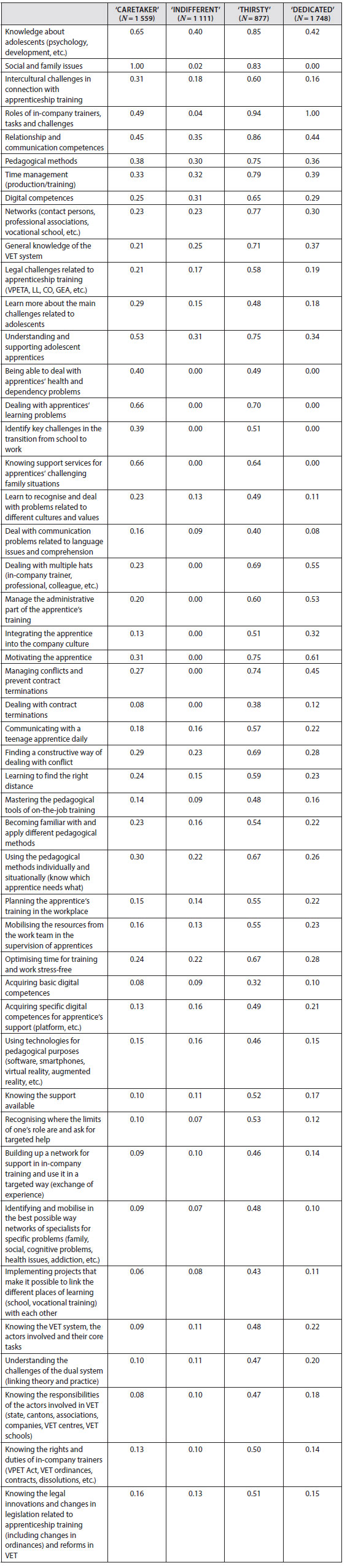
The four-class solution enabled us to identify several distinct groups (see Appendix D for the detailed results as shown in Figure 1).

Class 1, or the 'apprentices'caretaker' (n = 1 559)
This profile is characterised by a greater interest in social and family problems and social issues (transition and support services), and in supporting teenagers. More than in-company trainers and transmitters of knowledge and know-how, they are caretakers. Their aim, over and above passing on an occupation, is to support young people in this phase of their lives (entry into adulthood) and in their transition to the world of work.
Class 2, or the 'indifferent to continuing education (n = 1 111)
This profile is characterised by a withdrawal from almost any course attracting their interest: the highest score is 40% (knowledge about adolescents), apart from an interest in relationship and communication competences (35%) and understanding and supporting adolescents (31%).
Two hypotheses could explain this situation:
1. People who distance themselves from the job, or even from work in general, and do not wish to invest in continuing education. From their in-company trainers' role, they retain above all the 'adolescent issue' and the need to communicate and relate to this particular public.
2. Pragmatic, work-focused people considering that their previous career or their position gives them the necessary competences to pass on knowledge and know-how, and who do not consider that they need any continuing education other than professional development. They consider that they have the professional competences and skills to pass on the occupation. As a result, they identify adolescent issues only as potentially interesting knowledge that they do not have.
Respondents of Class 2 do not identify themselves as caretakers like Class 1 or as in-company trainers like 'the dedicated' (Class 4). In addition, they are the exact opposite of Class 3 ('the thirsty').
Class 3, or the 'thirsty for continuing education' (n = 877)
People in this profile are interested in continuing education in a variety of areas: the role of the in-company trainer, social issues, time management, teaching methods, understanding and motivating apprentices, relationship and communication competences, and teaching competences. Almost everything seems to be of interest to them, and all the offers exceed 40%, apart from acquiring digital competences or dealing with contract terminations. This group also stands out for its marked interest not only in general themes, but also in the sub-themes proposed (whereas in the other three groups the latter are of less interest overall).
There are three possible explanations for this:
1. People who have distanced themselves from their initial job and function and who want to give meaning back to their daily lives by investing heavily in continuing education, perhaps with a view to leaving their job or function (career bifurcation).
2. People who are over-invested in their job, who want to do more training to improve their qualifications for the job, perhaps with a view to becoming a fully fledged in-company trainer in a training centre or becoming a VET teacher (career bifurcation to a more training-oriented function).
3. People who are just starting out in the job and who want to train in a 'one-size-fits-all' way, touching on a bit of everything, because they are not yet aware of the day-to-day needs, challenges and constraints. Unlike the other two profiles, which seem to indicate a desire to change careers, this third hypothesis mainly involves people seeking to invest in the in-company trainer function.
Class 4, or the 'dedicated to the trainer's function (n = 1 748)
This profile is marked by a strong professional identity as an in-company trainer. The courses chosen by the 'dedicated' relate to an in-company trainer's role, tasks, and challenges involved, such as motivating the apprentice, managing multiple roles and managing the job's administrative side. With a more pragmatic profile, the question of the in-company trainer's function is considered through the constraints linked to the function, the numerous tasks, and the multiple roles or the administrative part of the function. This seems to reflect the interests of people with experience in the role who want to equip themselves to train despite these constraints.
Overall, these four profiles illustrate, on the one hand, the relationship with the function of in-company trainer (the 'caretaker' and the 'dedicated') and, on the other, the relationship with continuing education (the 'thirsty' and the 'indifferent'). In terms of their relationship to the job, the 'dedicated' are focused on the job and its challenges whereas the 'caretakers' are more focused on the apprentices (beyond simply passing on the job). Furthermore, regarding continuing education, the 'thirsty' are highly motivated by the variety of courses on offer whereas the 'indifferent' are more inclined to reject continuing education.
In addition, it is interesting to note that the most represented class of the four is the 'dedicated' (n = 1 748), followed by the 'caretakers' (n = 1 559), the 'indifferent' (n = 1 111) and the 'thirsty' (n = 877): the most prevalent classes are those that characterise in-company trainers in their relationship to their function. This result confirms that the responses inform us about in-company trainers' situations and needs.
Classes and socio-demographic features
To answer the second research question - that is, to know how the different classes differ in their socio-demographic features - we also performed chi-square (x2) tests.
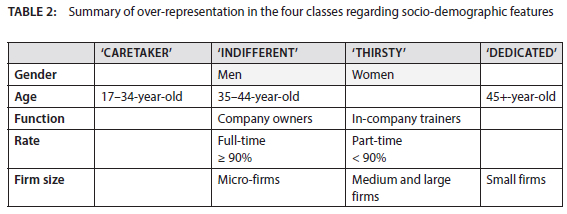
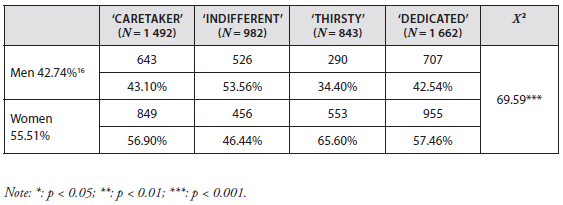
First, regarding respondents' gender, the two classes which emerge are those that relate globally to continuing education: men are more strongly represented among the 'indifferent' than in the other classes, and less strongly among the 'thirsty'. The opposite trend is observed among women, who are more strongly represented among the 'thirsty' and less so among the 'indifferent' (x2 (3, n = 4 979) = 69.59, p < 0.001). In the light of Swiss statistics on continuing education (FSO, 2022), this result is interesting. Indeed, if there is no major difference between males and females concerning professional continuing education (with the gaps gradually narrowing), females are much more concerned with extra-professional continuing education. This prevalence in the 'thirsty' class could indicate that these offers have been evaluated as non-professional.
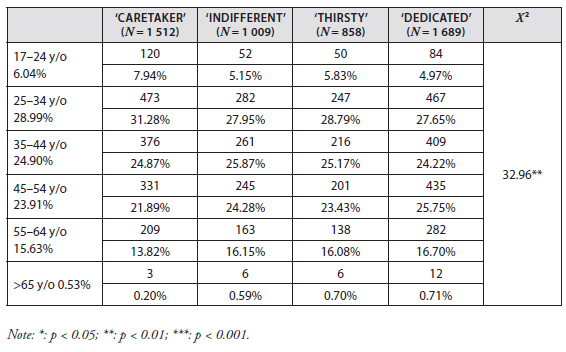
Concerning the respondents' ages, the first thing to note is that the classes are mainly those that differ in their relationship to the function. The youngest members of the group (aged 17-34) are in the 'caretaker' group, whereas the oldest members (aged 45+) are those who are in the 'dedicated' class (x2 (15, n = 5 068) = 32.96, p = 0.005). Interestingly, the youngest respondents seem to have a more global vision of their role regarding support in the transition from school to work or towards adulthood - perhaps because these issues are still close to them. In contrast, the 'dedicated' are those who have the most experience in the role of in-company trainer and are more familiar with the issues and difficulties involved. The 'indifferent' group is made up primarily of middle-aged people (aged 35-44), that is, those who are mainly focused on work at an age when they are building or stabilising their careers. But this group also comprises people who consider that their competences and experience do not necessarily require continuing education. This result contrasts with the Swiss statistics on continuing education (FSO, 2022) showing that the 35-44 age group is the one that undertakes the most continuing education in Switzerland (FSO, 2022).
In this regard, there are two possible hypotheses:
1. Their already enormous involvement in continuing education makes it impossible to take on more courses.
2. It indicates that these offers do not appear as continuing professional development (CPD) but as 'extra-professional'. This second hypothesis echoes the difference already mentioned regarding the gender-oriented attitude towards these courses.
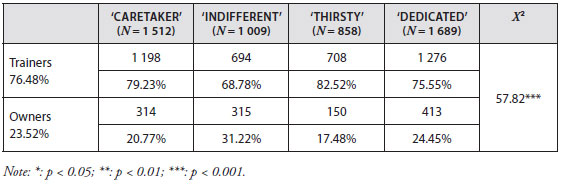
Regarding the respondents' function, in-company trainers are more strongly represented among the 'thirsty' and less so among the 'indifferent' group, whereas the opposite is true for company owners (x2 (3, n = 5 068) = 57.82,p < 0.001). This division can be interpreted as a way for in-company trainers to underline the importance of their role and their desire to become even more involved in their function: requesting a large number of continuing-education courses is also a way of seeing their tasks recognised at their true value and showing that there are issues of professionalisation. This means that specific and general skills are needed to take on this function.
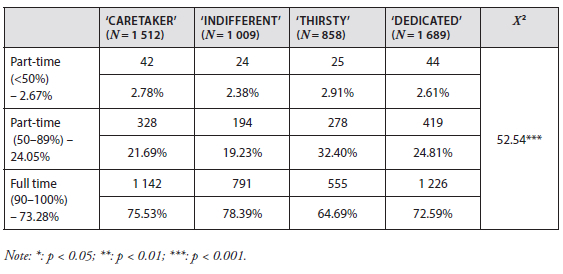
Regarding the activity rate, there is a clear separation between classes based on their relationship to continuing education: part-timers are more likely to be in the 'thirsty' class and, conversely, there are likely to be fewer 'indifferents'. These results are reversed for full-time workers, where the number of people in the 'indifferent' profile is particularly high (χ2 (6, n = 5 068) = 52.54, p < 0.001).
Interestingly, in the general Swiss population, full-time workers proportionally undertake more continuing education than part-timers (FSO, 2022). However, this result could be explained by the fact that full-time workers have easier access to continuing education. Furthermore, if we examine the nature of these courses, full-time workers take far more professional continuing-education courses than part-time workers, but fewer extra-professional courses (FSO, 2022). This can also be compared with the results presented above regarding gender attitude towards these offers, knowing that, in Switzerland, part-timers are mostly women (FSO, 2023b).
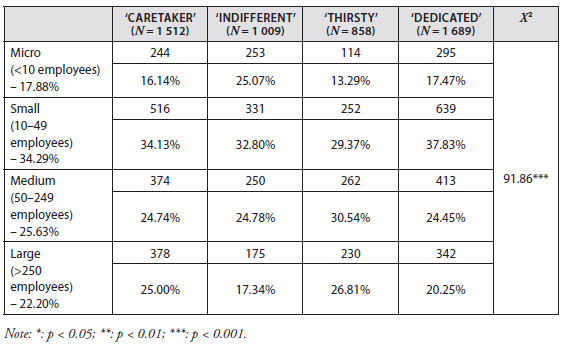
Finally, regarding company size, the 'indifferents' are more present than those in other classes in micro-businesses, whereas the 'dedicated' are over-represented in small businesses and the 'thirsty' in medium and large businesses (x2 (9, n = 5 068) = 91.86, p < 0.001). These results seem to reflect a contextual effect, as the constraints (pressure to produce, less room for manoeuvre in the event of someone being absent, organisation of apprentice training) are particularly strong for micro-firms and, as a result, their propensity for continuing education is lower. Conversely, it is hardly surprising to find a high proportion of the 'thirsty' class in medium-sized and large firms, which can manage in-house or external continuing education for their staff. Finally, the over-representation of the 'dedicated' class in small firms seems to reflect the reality that the latter make up a significant proportion of training companies in Switzerland. Indeed, this class reflects the strong commitment of people from this type of company to apprentice training. Table 2 summarises the results regarding over-representation in each class in respect of socio-demographic features (see also Appendix E for detailed results).
Overall, it is interesting to note that the 'indifferent' class is over-represented by men in the 35-44 age bracket who are full-time company owners working in micro-firms. Conversely, the 'thirsty' class is over-represented by women, in-company trainers and people who work part-time in medium-sized or large firms. The two opposing classes in respect of their relationship to the function differ mainly in their age. In other words, it is mainly the two classes characterised by their relationship to continuing education that stand out in respect of socio-demographic features.
Classes and practical features
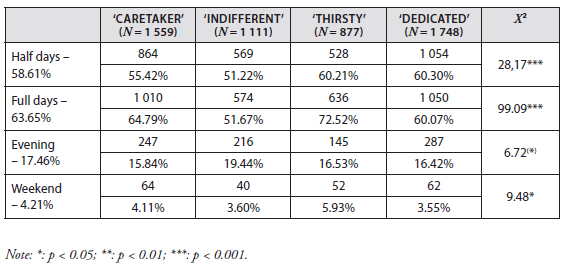
To answer the third research question, that is, on the more practical questions of course organisation (formats, modalities, etc.), we carried out and ANOVA tests (see Appendix F for detailed results). Results show that, as far as the duration of courses is concerned, the class indicating the most that they would like to have half-day courses are the 'dedicated' (x2 (3, n = 5 295) = 28.17,p < 0.001). This is probably a 'reality effect', as these people are aware of the arduous management of their tasks (production-training tension) and no doubt anticipate the difficulties caused by their absence due to continuing education. Full-day courses are more popular with the 'thirsty' (x2 (3, n = 5 295) = 99.09, p < 0.001), whereas the 'indifferent' are more likely to be prepared to take continuing-education courses in the evening, compared with the other groups (x2 (3, n = 5 295) = 6.72, p = 0.0813). Although they are generally reluctant to take part in continuing-education courses, people with this profile seem to be willing to do so, if necessary, but during their time away from work. This would be in line with hypothesis 2 concerning this profile, that is, pragmatic people focused on work and favouring continuing education outside of working hours.
As for weekends, the 'thirsty' had the highest percentage, whereas the 'dedicated' had the lowest (x2 (3, n = 5 295) = 9.49, p = 0.023). Therefore, the relationship with continuing education could predict a readiness to train at certain times outside of work, whereas the relationship with the job would indicate that continuing education is part of the job. The two classes determined on the basis of their relationship to the function ('the caretaker' vs 'the dedicated'), in contrast, do not differ in these practical elements of continuing education.
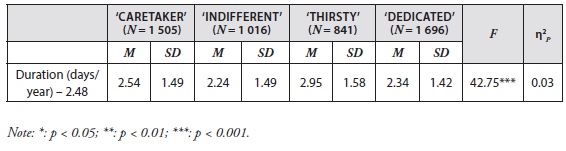
Regarding the ideal average duration of continuing-education courses, ANOVA showed statistically significant differences between groups (3, 5 054) = 42.75, p < 0.001): the 'thirsty' class indicated an average of 2.95 days per year, followed by the 'caretaker' class with 2.54 days per year, the 'dedicated' class with 2.34 days per year and the 'indifferent' class with 2.24 days per year. These results confirm the trends already highlighted with the readiness for training, with the 'thirsty' class being those who would like to devote the most time per year to continuing-education courses, whereas the 'indifferent' class would be prepared to devote less time. Except for the differences in means between the 'indifferent' and the 'dedicated' classes, all the other differences revealed by Tukey's post-hoc test were significant. This means that the 'thirsty' group would ideally like a significantly longer course than the other three groups, but also that the average durations indicated by the 'indifferent' and 'dedicated' classes are not statistically different.
Classes and ideal framework conditions
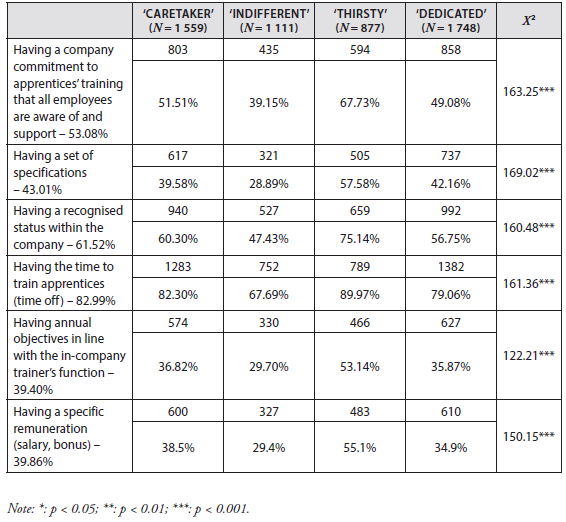
We also asked about ideal framework conditions, that is, which framework conditions in-company trainers consider to be necessary for good apprentice training. To compare the four classes' answers, we performed tests which showed that, overall, the 'thirsty' class indicated all the framework conditions to a greater extent than the other classes, whereas the 'indifferent' class had the lowest proportions of selected framework conditions. We can see from these results that the 'thirsty' class considers that good training requires not only aspects such as having specifications for in-company trainers, but also salary recognition for their function. In addition, the question of framework conditions is linked to the issue of professionalisation for in-company trainers, that is, giving their role a recognised status, which ties in with the issue of continuing training. It should also be noted that, overall, the framework condition which received the most support concerns having time to train apprentices, a finding that echoes the tension between producing and training which is characteristic of in-company trainers.
Discussion and conclusion
The many results presented above highlight several considerations about in-company trainers and their relationship with continuing education.
First, a person-centred approach through latent class analyses enabled us to account for the heterogeneity of the population studied (Lüthi, Stalder & Elferling, 2021; Wenger, Sauli & Berger, 2022; Besozzi, 2023), that is, of in-company trainers and their attitude towards continuing-education needs. In addition, and as mentioned at the beginning of this article, despite the key role played by in-company trainers in the dual VET system, there is evidence that their access to 'pedagogical' (or non-professional) continuing education is very limited (Cedefop, 2010). Accordingly, the large sample that responded to the survey highlights the relevance of continuing education as an issue for in-company trainers in the Swiss context.
Overall, the four classes that emerged from our analyses echo the statistics on continuing education in the Swiss population (FSO, 2022), but not in the way we would expect. Compared with the Swiss general population, our in-company trainer sample shows some differences in their attitudes towards continuing education: we have highlighted the over-representation of women in the 'thirsty' group and the over-representation of men in the 'indifferent' group, whereas the proportion of men and women in the Swiss population taking part in continuing education is the same for both genders (FSO, 2022). However, the behaviour of the trainers surveyed is comparable with that of the general population in respect of extra-professional continuing education, where women are over-represented. This could reveal that the training courses on offer are not considered by most of the participants as being directly related to professional continuing education.
One paradox should be noted, though: the practical aspects of continuing education (formats, modalities, etc.) in our results show that the 'thirsty' class, despite its overall profile of strong enthusiasm about the idea of taking part in continuing education, is reluctant to do so at any time, and particularly not in the evening.14 This suggests that the offer is considered as CPD that should be completed during working hours and a way of gaining skills in relation to the activity. These contrasting results reveal the tension in the 'thirsty' class between two attitudes towards continuing education: sometimes considering it as extra-professional, sometimes as qualifying. In contrast, the 'indifferent' class showed themselves to be more open to taking part in training courses outside of working hours (i.e. during evenings and/or at weekends), which seems to indicate that, overall, they consider the courses as being extra-professional training.
Linked to the perception of continuing education - either professional or extra-professional - another issue seems to be emerging: Who is responsible for offering or taking these courses? Is it in-company trainers themselves or should their employers take responsibility for continuing education? More broadly, is the continuing education of in-company trainers a private responsibility of the company owner or is it a public responsibility of the state? In some European countries, this aspect is in fact managed at the state level, which seems to enable more equal access to training for all in-company trainers (Cedefop, 2010). We know that company owners are more likely to free up time for in-company trainers to take professional or technical continuing-education courses, but what about those more related to their pedagogical role? This raises the issue of the vision regarding continuing education: although these courses are linked to the in-company trainer's activity, they are rarely considered to be professional-development training, even though they are essential for the proper monitoring of apprentices (Cedefop, 2010). The challenge is therefore to situate this type of content within continuing education, which would then be recognised as a professional activity and be assumed as a responsibility of the employer.
Accordingly, the four classes identified through the latent class analyses allow us to reflect about in-company trainers beyond the question of continuing education. The aim is to highlight the position of the function, which is partly linked to the reasons for training, but also to the vision of the apprentice (Kirpal & Wittig, 2009; Lamamra, Duc & Besozzi, 2019). In this regard, two in-company trainers' profiles have been highlighted: on the one hand, those who take care of apprentices more broadly (by accompanying them towards their transition between school and work, but also between childhood and adulthood). On the other hand, there are those who are strongly focused on their function and therefore on their challenges and trainers' issues. This reminds us of the heterogeneity of the trainers' situation, as already highlighted in the literature, the two profiles overlapping in part with some of the ideal types identified (Besozzi, 2023). This heterogeneity of profiles and postures points to the need to develop different measures to support in-company trainers in order to ensure that their role is recognised and valued, and more besides. The measures put in place must take into account the different ways of being an in-company trainer as described in this article, the motivations for the role, and the day-to-day management practices.
To conclude, we can assert that the challenges associated with continuing education for in-company trainers go well beyond 'simple' access to this type of training: on the one hand, it is a question of recognising the status of these key people in apprentice training, not only from a purely professional point of view, but also from a pedagogical perspective. From these perspectives, a more general recognition of the dual apprenticeship system can emerge, a system that too often continues to have a 'bad reputation' in post-compulsory training in Switzerland (Berger, Lamamra & Bonoli, 2018). On the other hand, access to continuing education related to the in-company trainer's function increases their competences and, consequently, the quality of VET and of the labour market too (Kirpal & Wittig, 2009; Wenger et al., 2019). Indeed, since in-company trainers are part of a production logic, giving them regular and easy access to all types of continuing education would also have a beneficial effect on the way in which they themselves train future employees (Cedefop, 2010; Kâpplinger, 2016). In addition, this same logic of production means that some of them do not consider the offers to constitute CPD, which reproduces the social representations made of them. In this way, their professionalism is recognised only in relation to their job and not in relation to their function as in-company trainers. This is a major contribution of our study findings, which should help to encourage the debate on this subject and raise the awareness of VET stakeholders. Indeed, as long as they are regarded as 'mere' workers with the additional function of training apprentices, their access to pedagogical training will remain complicated.
More generally, our study could provide food for thought about access to continuing education for people with dual status, that is, employees and 'pedagogues'. In this sense, and as we have emphasised in this article, the aim would be to highlight the possibility of in-company trainers remaining up to date not only in their profession, but also in their role as educators.
Ethics statement
This research adhered to the ethical guidelines outlined in the Declaration of Helsinki for human experimentation. Prior informed consent was obtained from all the individuals who participated in the study.
REFERENCES
- Asparouhov, T & Muthén, B. 2012. Using Mplus TECH11 and TECH14 to test the number of latent classes. Mplus Web Notes, 14:22.
- Bahl, A. 2013. Führungskrâfte unter erschwerten Bedingungen: Empirische Einblicke zur Teilhabe des ausbildenden Personals in Wirtschaftsorganisationen. [Managers under difficult conditions: Empirical insights on the participation of training staff in business organisations.] In: SM Weber, M Gohlich, A Schroer, C Fahrenwald & H Macha (eds), Organization und Partizipation. Beitrage der Kommission Organisationspadagogik. Wiesbaden: Springer VS, 209-217.
- Bahl, A & Schneider, V. 2022. Betriebliches Ausbildungspersonal in Zahlen. [Company training staff in numbers.] Berufsbildung in Wissenschaft und Praxis, 51(4):8-10.
- Bauer, J. 2022. A primer to latent profile and latent class analysis. In: M Goller, E Kyndt, S Paloniemi & C Damça (eds), Methods for researching professional learning and development: Challenges, applications and empirical illustrations. Cham: Springer International Publishing, 243-268. Available at: <https://doi.org/10.1007/978-3-031-08518-5_11>
- Bausch, T. 1997. Die Ausbilder im dualen System der Berufsbildung. Eine Strukturanalyse des betrieblichen Ausbildungspersonals. Ergebnisse aus der BIBB/IAB-Erhebung 1991/92. [Trainers in the dual system of vocational education and training. A structural analysis of in-company training personnel. Results from the BIBB/IAB survey 1991/92.] Gütersloh: Bertelsmann.
- Berger, J-L, Lamamra, N & Bonoli, L. 2018. Des enjeux de la formation professionnelle en Suisse: une introduction. In : L Bonoli, J-L Berger & N Lamamra (eds), Enjeux de la formation professionnelle. Le « modèle » suisse sous la loupe. [The challenges of vocational training. The Swiss 'model'under the microscope.] Seismo, 19-30.
- Berner, E & Bonoli, L. 2018. La formation professionnelle suisse entre Confédération et cantons. Elements d'une histoire complexe. [Swiss vocational education and training between the Confederation and the cantons. Elements of a complex history.] In : L Bonoli, J-L Berger & N Lamamra (eds), Enjeux de la formation professionnelle. Le 'modèle' suisse sous la loupe. [The challenges of vocational training. The Swiss 'model' under the microscope.] Dongguan: Seismo.
- Besozzi, R. 2023. Swiss in-company trainers: Multiple ways to train and socialize apprentices. Swiss Journal of Educational Research, 45(1):2-14.
- Besozzi, R, Perrenoud, D & Lamamra, N. 2017. Le temps au cœur des contraintes des formateurs et formatrices en entreprise. [Time at the heart of the constraints faced by in-company trainers.] Revue économique et sociale, 75(1), 53-68.
- Cedefop. 2010. Professional development opportunities for in-company trainers. A compilation of good practices. Luxembourg: Publications Office of the European Union.
- Ferguson, SLG, Moore, EW & Hull, DM. 2020. Finding latent groups in observed data: A primer on latent profile analysis in Mplus for applied researchers. International Journal of Behavioral Development, 44(5):458-468.
- FSO (Federal Statistics Office). 2022. Formation continue de la population. [Continuing education ofthe population.] Available at: <https://www.bfs.admin.ch/bfs/fr/home/statistiques/education-science/formation-continue/population.html>.
- FSO (Federal Statistics Office). 2023a. Degré secondaire II: choix de formation. [Upper secondary education: Educational choices.] Available at: <https://www.bfs.admin.ch/bfs/fr/home/statistiques/education-science/indicateurs-formation/indicators/choix-formation-secii.html>.
- FSO (Federal Statistics Office). 2023b. Travail à temps partiel. [Part-time job.] Available at: <https://www.bfs.admin.ch/bfs/fr/home/statistiques/situation-economique-sociale-population/egalite-femmes-hommes/activite-professionnelle/travail-temps-partiel.html>.
- Fuller, A & Unwin, L. 2003. Learning as apprentices in the contemporary UK workplace: Creating and managing expansive and restrictive participation. Journal of Education and Work, 16(4):407-426. Available at: <https://doi.org/10.1080/1363908032000093012>
- Fürstenau, B, Pilz, M & Gonon, P. 2014. The dual system of vocational education and training in Germany - what can be learnt about education for (other) professions. In: S Billett, C Harteis, & H Gruber (eds), International handbook of research in professional and practice-based learning. Springer International Handbooks of Education. Available at: <https://doi.org/10.1007/978-94-017-8902-8_16>.
- Gehret, A, Aepli, M, Kuhn, A & Schweri, J. 2019. Formation des apprenties: quel intérêt pour les entreprises ? Résultats de la 4ème étude coút/bénéfice. [Apprenticeship training: What's in it for business? Results ofthe 4th cost/benefit study.] IFFP. Available at: <https://www.ehb.swiss/sites/default/files/iffp_rapport_190923_fr_v3_web.pdf>.
- Käpplinger, B. 2016. Theories and theorems of the in-company continuing vocational training in Germany. Andragoške Studije, 1:9-28.
- Kiepe, K. 2021. Stellen und Ausbildung der betrieblichen Ausbilder:innen. Grundannahmen, Transformationsprozesse, Reformdiskurse. [Positions and training of in-company trainers. Basic assumptions, transformation processes, reform discourses.] Berlin: Logos Verlag.
- Kirpal, S & Wittig, W. 2009. Training practitioners in Europe: Perspectives on their work, qualification and continuing learning. Bremen: Institut Technik und Bildung.
- Kunégel, P. 2011. Les maitres d'apprentissage. Analyse des pratiques tutorales en situation de travail. [Apprenticeship masters. Analysis of on-the-job tutoring practices.] Paris: L'Harmattan.
- Lamamra, N, Duc, B & Besozzi, R. 2019. Au cœur du système dual: les formateurs et formatrices en entreprise. Résultats d'une recherche et pistes d'action pour les acteurs et actrices de la formation professionnelle. [At the heart of the dual system: In-company trainers. Research findings and possible courses of action for those involved in vocational training.] IFFP. Available at: <https://www.hefp.swiss/sites/default/files/downloads/au-coeur-du-systeme-dual_corrige.pdf>.
- Lamamra, N. & Masdonati, J. 2009. Arrêter une formation professionnelle: Mots et maux d'apprentie-s. [Stopping a vocational education and training course: Words and pains from apprentices.] Antipodes.
- Lüthi, F, Stalder, B & Elferling, A. 2021. Apprentices' resources at work and school in Switzerland: A person-centred approach. International Journal for Research in Vocational Education and Training, 8(2):224-250. Available at: <https://doi.org/10.13152/IJRVET.8.2.5>
- Muthén, LK & Muthén, BO. 2013. Mplus (version 7.11). [Computer software.] Muthén & Muthén.
- Nicklich, M, Blank, M & Pfeiffer, S. 2022. Ausbildungspersonal im Fokus. Studie zur Situation der betrieblichen Ausbilder:innen 2021. [Training staff in focus. Study on the situation of in-company trainers 2021.] IG Metall. Available at: <https://wap.igmetall.de/docs_FAU_-_Ausbilder_innenstudie_2022_f8161b3a1a38f9ccbf2c0f4ce500422dd3100804.pdf>.
- Pilz, M. 2012. Modularisation of vocational training in Germany, Austria and Switzerland: Parallels and disparities in a modernisation process. Journal of Vocational Education &Training, 64(2):169-183. Available at: <https://doi.org/10.1080/13636820.2011.628757>
- SERI (State Secretariat for Education, Research and Innovation). 2022. Vocational and professional education and training in Switzerland. Facts and figures 2022. Available at: <https://www.sbfi.admin.ch/dam/sbfi/en/dokumente/webshop/2020/bb-f-z-2020.pdf.download.pdf/fakten_zahlen_bb_e.pdf>.
- Sinha, P, Calfee, CS & Delucchi, KL. 2021. Practitioner's guide to latent class analysis: Methodological considerations and common pitfalls. Critical Care Medicine, 49(1):e63-e79. Available at: <https://doi.org/10.1097/CCM.0000000000004710>
- Veillard, L. 2017. La formation professionnelle initiale. Apprendre dans l'alternance entre différents contextes. [Initial vocational education and training. Learning by alternating between different contexts.] PUR.
- >
- Wenger, M, Sauli, F, Gross, V & Berger, J-L. 2019. Apprentices' perceptions of teachers' and in-company trainers' competences at the core of training quality. In: T Deissinger, U Hauschildt, P Gonon & S Fischer (eds), Contemporary apprenticeship reforms and reconfigurations. Lit Verlag, 88-91.
2 These are companies that have registered with their canton as training companies and have at least one in-company trainer.
3 It should be pointed out that the literature exists mainly in the educational sciences, particularly with regard to professional didactics and pedagogical orientations (Fuller & Unwin, 2003; Kunégel, 2011; Veillard, 2017). For our part, however, we are not interested in the modes of transmission and the systems implemented for this purpose, but in the conditions under which in-company trainers work, in addition to their aspirations and needs. This literature will therefore not be used.
4 The Swiss foundation TOP Ausbildungsbetrieb, in German meaning TOP training company, is a private entity that collaborates with the state at a federal level (https://topausbildungsbetrieb.ch/). Its goal is to increase quality in the training companies by offering continuing education to in-company trainers.
5 Latent class analysis is used to group together similar responses and therefore identify respondent profiles.
6 That is, agriculture, forestry and animal husbandry; industry and arts and crafts (except construction); technology and information technology (IT); construction and mining; commerce, transport and traffic; hotels, restaurants and personal services; management, administration, banking, insurance and the legal professions; and health, education, culture and scientific professions. As no significant differences were observed between the various sectors of activity, we will not consider this socio-demographic indicator.
7 This is an umbrella organisation representing associations and small and medium-sized enterprises (SMEs).
8 For each subject, secondary subjects have been proposed (see Appendix D).
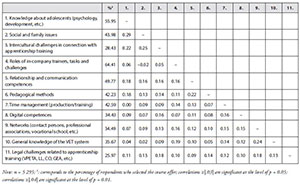
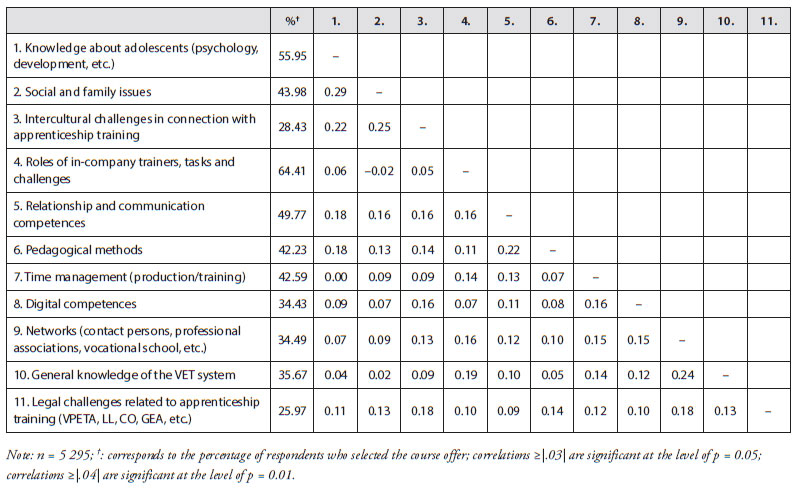
9 See Appendix A for correlations and proportions of selected continuing-education offerings.
10 By 'extra-professional' we mean offerings that are not aimed at the professional development of their primary activity.
11 The BIC is the fit index that usually plays the most important role in choosing the LCA solution (Nylund, Asparouhov & Muthén, 2007; Asparouhov & Muthén, 2012).
12 Moreover, and as Bauer points out, 'some authors consider a solution useless in which not all classes are interpretable' (2022:251), which would probably have been the case with our sample.
13 We are, however, aware that this result is based on a trend and that its interpretation must therefore be treated with caution, as the p-value is slightly higher than the 0.05 threshold.
14 That said, we would reiterate that the results of this analysis are statistically only trend-based and should therefore be treated with caution.
15 From this table on, 100% could not be calculated for the entire sample, as some people did not wish to respond or were excluded from the analyses. The numbers are therefore slightly reduced.
16 Corresponds to the percentage of the total sample.
Appendix
A. Correhtions andproportions of selected continuing education course offers
B. Fit indices for the latent class analysis
C. Average latent class probabilities for most likely latent class membership (row) by latent class (column)
D. Proportion of respondents by class who selected continuing education courses
E. Sociodemographic features15 by class (in numbers and percentages)
Respondents' sex
Respondents' age
Respondents' function
Respondents' activity rate
Respondents' firm size
F. Practical aspects of continuing education by class (in numbers and percentages)
Moments
Ideal duration of continuing education courses
Framework conditions for a good training