What does 'quality teaching and learning' mean in TVET contexts?
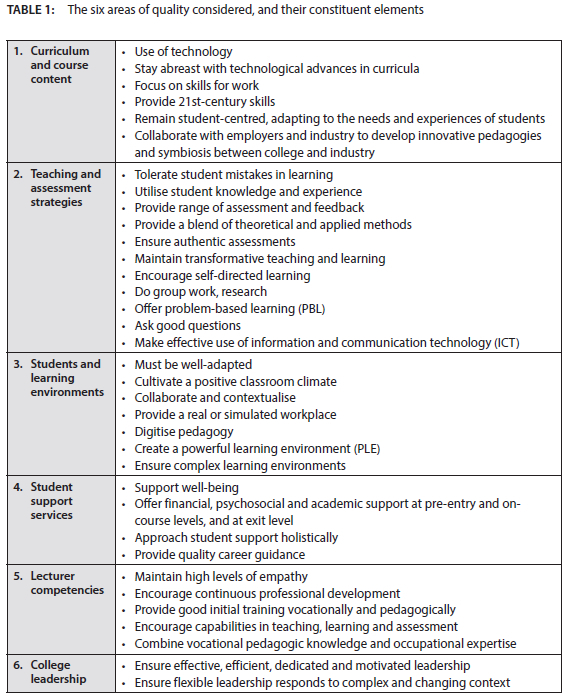
Over the years, technical and vocational education and training (TVET) colleges in South Africa have been subject to criticism for their low pass rates, raising concerns about the quality of vocational education. In contrast to this, successes at certain colleges, as documented in official reports, are less frequently acknowledged. Our research shifted the focus to these successes in order to identify the factors that are driving positive student outcomes and how they align with the understanding of quality TVET teaching and learning. A meta-review of the scholarly literature identified six thematic areas critical to quality enhancement in vocational education as being: curriculum and course content, teaching and assessment strategies, learning environment, student support systems, lecturer attributes, and leadership. Guided by these themes, we conducted research across five South African provinces using questionnaires, interviews and focus groups to gather data from TVET college students and lecturers. Key findings on successful outcomes of colleges in the study highlighted the importance of student-centred pedagogies, the integration of technology in curricula, the development of practical skills, and collaboration with industry in order to locate students' learning in practical vocational contexts. The research lays a foundation for reflecting on continuous quality improvement using empirically derived indicators that can be further developed in the South African college sector.
Technical and vocational education and training (TVET) college; student performance; quality teaching and learning; vocational education and training (VET)
 Thumbnail
 Thumbnail
 Thumbnail