The conditions for digital integration: A comparative case study of three TVET colleges in KwaZulu-Natal
Abstract
Digital technology has spread unevenly through South Africa's public technical and vocational education and training (TVET) colleges. This article examines what determines whether the technology available to a college becomes part of everyday teaching. It reports on a comparative study of three public TVET colleges in KwaZulu-Natal (KZN), ranging from a well-connected urban college to a dispersed rural college, drawing on interviews with managers, institutional documents and three complementary theoretical perspectives. The analysis identifies three conditions that must be secured together: technical reliability, institutional ownership and curricular compulsion. The cases do not support a fixed sequence in which these conditions develop; instead, each college was constrained by a different condition. Learner access remained a separate but interacting material constraint. The comparison therefore supports a diagnostic approach that identifies which condition remains insecure in a particular college, what institutional action could secure it, and where wider public provision is required.
Technical reliability; institutional ownership; curricular compulsion; student access; material constraint; diagnostic approach
Introduction
South Africa's public technical and vocational education and training (TVET) colleges teach the practical trades on which much of the economy depends, and they do so for learners drawn largely from the country's poorer communities. For most of their history, these colleges have taught in workshops and classrooms, face to face, and the digital technology available to them served administration more than teaching. Bringing that technology into teaching itself was, until recently, a slow aspiration, encouraged by national policy and by the wider talk of a fourth industrial revolution (4IR), but pursued unevenly and without urgency. When the lockdown of 2020 closed down contact teaching, colleges that had never taught online had to go on teaching without classrooms, and a shift that policy had imagined as gradual became, almost overnight, a necessity.
Colleges entered the lockdown with very different capacities for online teaching. Some had the equipment to move online but found that lecturers did not use it; others had little equipment and improvised with what their learners already had. Possession of technology did not establish whether it could be used for teaching, and the differences between colleges were not readily explained by their equipment or location. By requiring every college to attempt at once what it had previously deferred, the pandemic exposed a gap that ordinary conditions had allowed to remain unexamined. It also showed that technology alone did not determine whether that gap closed.
Digital integration in colleges of this kind is often approached as a question of access: whether an institution and its learners have the infrastructure, devices and connectivity that online teaching presupposes. Access is necessary, and its absence can halt integration, but the pandemic showed that it is not sufficient. This article therefore examines the institutional conditions that determine whether digital technology becomes part of ordinary teaching, asking why colleges governed by the same national policy and equipped with digital tools integrate them so differently.
The study compares three public TVET colleges in KwaZulu-Natal (KZN), chosen to span settings from a well-connected urban college to a dispersed rural one and focuses on the institutional decisions that shape technology use before they reach the classroom.
Over the past two decades, research on digital technology in education moved away from treating access as the whole of the problem. Early work equated the digital divide with the presence or absence of infrastructure and connectivity, but a substantial body of scholarship came to hold that access, while necessary, was far from sufficient for meaningful use (Norris, 2001; Pick & Sarkar, 2015; Van Dijk, 2020; Warf, 2013). Van Deursen and Van Dijk (2010) distinguished a first-level divide of access from second- and third-level divides of skills and of actual usage, and Warschauer (2003) and Selwyn (2013, 2021) argued that the value a technology yielded depended not on its features but on the social and institutional systems in which it was embedded. Reviewing the field after the pandemic, Lythreatis et al. (2022) sorted the drivers of the divide into nine categories and noted new forms of it emerging, while Van Deursen and Van Dijk (2019) showed that even first-level access endures as a divide, present now less as the bare absence of a connection than as unequal material access to devices and the means to keep them running. Information and communications technology (ICT) provision alone, this body of work established, said little about whether teaching had changed; what mattered was what a college and its people did with the technology available to them.
The vocational sector has drawn far less of this attention than schools or universities, and the South African TVET colleges less still, despite a strong policy push toward digital transformation from the Department of Higher Education and Training (DHET) and, at continental level, the African Union (African Union, 2025; DHET, 2020). In a survey of all 50 public TVET colleges conducted as the pandemic forced the issue, Hugo and Louton (2021) found the sector split roughly in half, with about 40% of colleges having launched e-learning, a fifth on the point of doing so and the remaining two-fifths still in the early stages or not yet beyond discussing it.
Much of this ambition has travelled under the discourse of a 4IR, and the distance between its promise and what colleges can do with it runs through the South African evidence. Writing as the pandemic forced the question, Mhlanga and Moloi (2020) found the rhetoric of 4IR-driven transformation running well ahead of the sector's capacity to deliver it. Denhere and Moloi (2021) document the same gap between 4IR policy and the readiness of lecturers on the ground, and Kana and Letaba (2024) note that colleges have taken up the language of digitalisation while pedagogical change stays limited. Interviewing managers, lecturers and learners across five South African campuses, Magadza (2025) finds 4IR technologies able in principle to widen access and improve employability yet held back by the familiar constraints of patchy infrastructure, uneven digital literacy and outdated curricula. Internationally, Yang and Wu (2024) report the UNESCO Chair's attempt to steer TVET digitalisation through cooperation, itself an admission that the ambition has run ahead of the means. Across these accounts, the 4IR reaches the colleges first as policy language, and whether it reaches their teaching depends on conditions that language does not itself provide.
Infrastructure remains a real constraint, distributed unequally across urban and rural campuses and undermined by outdated equipment, thin bandwidth and power interruptions (Aina & Ogegbo, 2022). Hugo and Louton (2021) found that, while most colleges reported Internet access, few had the infrastructure to support online or blended teaching at scale, and that provision varied sharply within colleges, with central offices having the fastest connections and rural campuses the slowest. The learning platforms that access is meant to enable are themselves often ill-suited to vocational teaching, for they are generic systems into which practical, competency-based training does not easily fit. In consequence, they are used as repositories for notes rather than as environments for teaching and lecturers fall back on familiar tools such as PowerPoint and WhatsApp (Denhere & Moloi, 2021; Khan, 2023; Ramoroka, 2021). Educators' own readiness varies widely, with many using digital tools for administration or the transmission of content rather than for teaching and being constrained less by individual skill than by uneven training, heavy workloads and weak institutional support (Mbatha, 2024; Razak et al., 2022). In the vocational sector specifically, Barboutidis and Stiakakis (2023) found learners' digital competence shaped as much by age and prior use as by access, a reminder that provision and competence move separately.
Learners add a further constraint in that the sector cannot easily reach them. Many TVET learners come from poor households with little prior exposure to digital tools and without reliable devices or data of their own, so that moving teaching online risks excluding the very learners it is meant to serve unless their access is deliberately secured (Holler et al., 2023; Jita & Munje, 2020). Schlebusch and Manyarela (2024), in studying a predominantly rural South African TVET college, trace how sparse devices and connectivity shape what e-learning can reach - the same constraint that this study meets on the learner side. The vocational character of the sector runs through all of this. TVET teaching joins theoretical instruction to practical, workshop-based training, and the frameworks used to think about technology in general education, such as the technological, pedagogical and content knowledge of Mishra and Koehler (2006), require adaptation to a setting where much of what must be taught is done with the hand and the machine (Khan, 2023; Mbele, 2021). The colleges themselves have been clear that the answer is not to move teaching wholesale online - since a large part of vocational learning is practical and cannot leave the workshop - but to blend digital and contact teaching.
Across these components, the literature increasingly locates the decisive factor at the level of the institution. Whether a college turns digital inputs into changed teaching depends on its commitment, its leadership and its governance, and colleges that pursue digitalisation without translating it into resourced and enforced institutional arrangements tend to see it remain peripheral (Selwyn, 2021; Van Deursen & Van Dijk, 2010). Van Dijk (2020) names a common pattern of symbolic policy compliance, in which institutions adopt surface-level digital strategies to meet national expectations without embedding them in their core work, while Van Deursen and Van Dijk (2010) describe institutional digital divides that separate the colleges able to convert ICT into educational outputs from those that remain at the level of access. Hugo and Louton (2021) found e-learning driven, at some colleges, by a single champion with little institutional backing and at others carried by a dedicated unit that nonetheless lacked the infrastructure, policy or standing to make headway; and they found repeatedly that, where an e-learning policy existed but was not enforced and where academic and IT structures worked in silos rather than together, even willing staff could make little progress. Beyond South Africa, Regassa and Desissa (2025), in surveying learners across five Ethiopian TVET colleges, found that access to devices and connectivity predicted little about their outcomes, while management support, instructor readiness and curriculum alignment did the explaining, placing the decisive factors in the institution rather than the equipment.
The divide has been theorised well past bare access, the institution named as the level that decides and the vocational sector's own obstacles catalogued; what remains scarce is close comparative data from inside the colleges where these conditions are supposed to operate. Even the recent reappraisals keep to the individual or the national scale. Pick and Sarkar (2025) reopen the agenda on global digital divides and Korovkin et al. (2023) rebuild the concept around the separation of digital supply from demand, yet the single institution, where a college's provision either reaches its teaching or does not, stays comparatively unexamined. The evidence draws disproportionately on the Global North and, within South Africa, on a handful of well-resourced urban colleges, so that the rural and under-resourced institutions that make up much of the sector are little studied and it rarely sets colleges within one system beside each other, leaving the sector unable to learn from its own variation. This study takes three colleges under one provincial authority, equipped on the basis of the same policy and drawing learners from the same kind of community and explains in detail what each did with the technology it had, so that the institutional conditions the literature points to can be seen working, or failing to, in specific colleges.
Theoretical framework
The adoption of digital technology has a technical aspect in the properties of the tool and what it makes possible, an institutional aspect in the rules, resources and authority that shape its adoption and maintenance, and a human aspect to how lecturers understand the tool and its relation to their work. The study therefore draws on three complementary theories: diffusion of innovations examines how technology use spreads across and at colleges; affordance theory examines how potential users perceive and enact what a tool offers; and institutional design theory examines how organisational structures enable, direct or constrain both processes.
Diffusion of innovations
Diffusion of innovations treats adoption as a social process rather than a technical consequence of provision (Rogers, 2003; Wejnert, 2002). A technology spreads when users judge it to be compatible with their work and when champions or change agents carry it beyond isolated use. Below a diffusion threshold, adoption remains dependent on continual pressure; beyond it, use begins to sustain itself. Rogers' (2003) idea of reinvention also matters in these colleges, because lecturers and institutions adapt tools to local constraints rather than adopting them unchanged.
Affordance theory
Affordance theory defines an affordance as an action possibility arising in the relation between a tool and a user, not as a capability residing in the tool alone (Gaver, 1991; Gibson, 1979; Norman, 2002, 2013). It therefore separates what technology makes possible from what lecturers perceive and can enact. Whether a learning platform is used depends on how users understand it, whether they have the capacity and conditions to act on it and whether it fits the work they are trying to do (Davis & Chouinard, 2017). This matters in TVET because a tool is judged against demonstration, calculation and workshop practice rather than by technical sophistication alone.
Institutional design theory
Institutional design theory explains how rules, authority and organised responsibility shape what members of a college do and what they regard as appropriate (March & Olsen, 2005; Scott, 2005). For digital integration, the central issue is whether a college assigns ownership of the work and backs it with resources and authority or leaves adoption to individual discretion. The theory also identifies decoupling: a college may adopt a policy formally while everyday teaching remains unchanged (Meyer & Rowan, 1977). Lipsky's account of frontline discretion helps explain how lecturers can enact, adapt or set aside a mandate when the machinery that makes it obligatory is weak (Lipsky, 1980).
An integrated framework
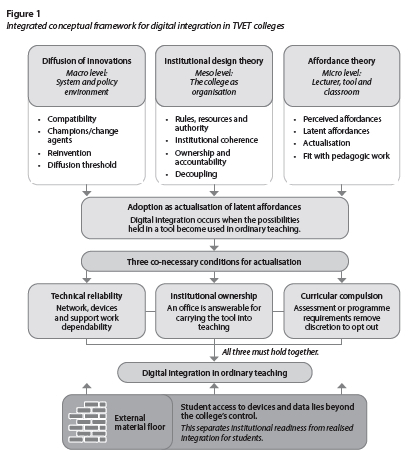
The three theories are used to follow one process across different sites of action. Affordance theory begins with the relation between a lecturer and a tool, where a technical possibility becomes pedagogically meaningful or remains unused. Institutional design theory follows the same possibility into the organisation of the college, where individual use is supported, directed or left optional. Diffusion of innovations follows whether such use remains local or becomes established across the institution. These are not successive stages: a constraint at one level can interrupt the process despite enabling conditions at the others. The framework therefore treats adoption as the actualisation of a latent affordance and uses the three theories to locate where that passage is blocked. The diagram in Figure 1 represents this relation, while placing access outside the institutional conditions as a separate material limit.

The presence of a technically capable tool does not establish that it is used. The framework therefore asks whether the possibilities afforded by a technology have entered teaching. It describes unrealised possibilities as latent affordances: a learning platform that could support whole courses but does not or a computer that could mediate teaching but is used only as an object of instruction. The term directs analysis from the presence of a tool to the conditions under which its capabilities are enacted.
The framework uses actualisation to describe the passage from a latent affordance to an established use. Three conditions shape that passage, one derived from each theoretical perspective: users must recognise a pedagogically valuable use; the institution must support and organise that use; and adoption must spread sufficiently to persist. These conditions are analytically distinct and need not arise in a fixed order. If any one remains insecure, a technology may continue to be used only intermittently even where the other two are present. This helps explain how a college can provide laptops for every lecturer and adopt a digital strategy while its learning platform remains peripheral to teaching.
Institutional coherence is the degree to which a college's stated strategy and daily practice coincide; a college may have a serious digital strategy on paper while nothing in its everyday operation requires or rewards the tools that strategy names, and where the two come apart the benefit the strategy promised never arrives. A diffusion threshold is the level of uptake below which an innovation cannot yet sustain itself; short of that level, use survives only under continual pressure and lapses the moment the pressure is lifted - and only beyond it does practice begin to carry its own weight. Adoption is the actualisation of latent affordances, and analysing a college means identifying which affordances remain latent and which condition is holding them there.
Methodology
This article draws on the second phase of a larger doctoral study of digital technology adoption across KZN's TVET colleges (Zungu, 2025). The study used a two-phase comparative case design (Yin, 2009) to examine adoption as the situated product of what colleges perceive, decide and can do. The first phase surveyed the ICT systems of all nine public colleges in the province, establishing what infrastructure each had and how its systems were configured, supported and strained. The second examined three colleges as institutional cases. Phase one provided the baseline for selecting the cases and locating them within the wider provincial sector. The study's stance was interpretivist in both phases: its central concern was how colleges understood and used the technology available to them. The descriptive statistics from the first phase mapped the distribution of infrastructure; the case analysis examined why each college did or did not use that infrastructure for teaching.
That first phase was conducted in concert with a national study of Internet use across South Africa's public colleges, carried out by the South African Broadband Education Networks (Hugo & Louton, 2021), in which all 50 colleges took part. The researcher was embedded within that study, conducted its technical surveys in KZN and was granted the use of its validated data for the doctoral work. The instruments, a pair of semi-structured questionnaires, one for academic staff and one for information technology staff, were developed from a background study and the literature on ICT infrastructure in South African education and then administered through videoconferencing during the pandemic closure. Drawing on 22 officials across the nine colleges, with at least one academic-services official and one information technology official at each, the questionnaires yielded an inventory of hardware, network configuration and support arrangements for every college, captured and analysed in spreadsheets question by question and college by college.
The three case colleges were chosen from the nine - which were anonymised alphabetically as KZN TVET Atol - based on two criteria drawn from the study's theoretical commitments. The first was geographic, since the scholarship on the digital divide holds that location conditions access (Warf, 2013), and the selection took one college in an urban setting, one in a rural setting and one whose campuses span both. The second was socio-economic, since diffusion theory holds that the character of a social system conditions its rate of adoption (Rogers, 2003), and the economic profile of each college's setting was compiled from district-municipality data covering dominant economic activities, income distribution and demographic composition. Applied together, the criteria yielded three colleges of markedly different circumstances: one in an industrial zone with campuses in urban and township areas, designated KZN TVET B; one in a predominantly agricultural region with dispersed rural campuses, designated KZN TVET F; and one in a mixed industrial and commercial zone with campuses distributed across urban, township and rural areas, designated KZN TVET D. Between them, the three colleges have 19 campuses, eight, five and six, respectively, spread across six district municipalities, a spread that carries much of the province's geographic and socio-economic range. The cases are set out in what follows from the most rural of the three to the most urban.
At each college, the study attended to the actors who direct and administer digital strategy, based on the reasoning that the decisions which govern whether a technology is taken up are made at the institutional level before they are felt in the classroom. The evidence drawn on here rests principally on semi-structured interviews with those actors, eight participants in all: at each of the three colleges, the deputy principal for academic services and the manager responsible for information technology, together with the curriculum specialist at one college and the assistant director for support services at another. The interview guides, developed from the literature and the study's theoretical framework, were reviewed and approved by each college's principal through the gatekeeper application and were then sent to participants to preview beforehand so that any items they found unclear could be refined before use.
The main interviews were conducted in 2022, with follow-up interviews in 2023, each lasting between 45 minutes and an hour. The interviews were held via videoconferencing and, where circumstances allowed, on-site. They were audio-recorded with consent, transcribed in full and supported by field notes. These accounts were triangulated against documentary evidence, among it the colleges' own ICT policies and strategies, the national policies that bind them and teaching materials. These were the documents participants referred to during the interviews, gathered into a dossier for each college, read against criteria drawn from the framework and the study's objectives, indexed to the same themes as the interview material and cross-referenced with it so that what participants reported could be set against what the institutions had committed to paper. The larger study also engaged lecturers directly; the present article concentrates on the institutional level, where the conditions that shape adoption are set, although the larger data set did inform this article.
The material was analysed using the five stages of the framework method (Gale et al., 2013; Ritchie & Spencer, 1994). A first familiarisation with the transcripts, inventories and documents was followed by the construction of a thematic framework from the recurring concerns of the data and the concepts of the study's theory; that framework, which brought the constructs of the three theories together with the study's own, took the form of an analytical matrix developed for the larger doctoral study, and it was against this matrix that the material was then indexed. The indexed material was charted into a grid that set each college's evidence out side by side, and a final mapping and interpretation drew out and read the patterns across the three colleges. The work was carried out in a colour-coded spreadsheet that set each college's material side by side for charting and comparison.
Following Shenton (2004), credibility was sought through triangulation of the institutional interviews against one another and against the documentary record, so that no single account stood unchecked, and through member checks in which each participant reviewed the transcript of their own interview; transferability was established through close description of each college's circumstances; and dependability and confirmability were ensured through an audit trail linking each interpretive claim to the indexed and charted evidence from which it was drawn. The study was conducted under ethical clearance from the University of KwaZulu-Natal's Humanities and Social Sciences Research Ethics Committee, with gatekeeper permission granted by the principal of each participating college and voluntary, informed consent obtained from every participant, none of whom received material benefit. The colleges and the individuals there are identified throughout by anonymised codes, a practice required as a condition of participation by one of the colleges and extended to all for consistency and fairness.
Findings
KZN TVET FDistance governed everything at KZN TVET F. Its campuses were scattered across three of the province's northern district municipalities, the farthest being more than 300 kilometres, one way, from the central office by road, in a catchment of some 1.4 million people where the poverty rate reached as high as 79% in places and where, as the deputy principal for academic services (DP0006) put it, a learner who wanted a usable signal would 'have to climb a hill to get' it, a thing 'out of our control'. It was the only college in the study with every campus in a rural area and with the widest spread of any in the province. For all that distance, the college's digital equipment was extensive and almost unused. It had a learning management system (LMS) that, by its information technology manager's (IT0006) account, lacked nothing: it 'allows our lecturers to put in the content, to capture the videos, to open study guides, to send assignments', and learners could download the guides and 'upload their scripts', so 'the system itself is sufficient'. 'The LMS is there,' he said, 'but at the moment we don't use it that much'; teaching thus proceeded by hand, 'with the blackboard', because 'we have not accepted it one hundred per cent'.
The network ran intermittently across those distances and no permanent technical staff were available to maintain it; the college leant on a yearly intake of interns who, in the deputy principal's words, 'come and go', so the work became 'redoing everything for the next group'. Furthermore, the providers who could mend a fault were themselves hundreds of kilometres off, a repair entailing a wait that the college could ill afford. Behind the idle platform lay a poverty the college could do nothing about. Most learners had no devices, and the national scheme meant to supply them had been slow to do so. Consequently, even a working system reached almost no one once a learner went home.
The college's answer to scarcity was to reverse the order that the richer colleges followed. Rather than hand out devices and hope competence caught up, the information technology manager held that 'we need to train them first before we can give them those laptops', since a laptop in untrained hands was one its holder 'will not be able to use' and so 'a waste of money' a poor college could not afford. This sequence reflected an attempt to avoid spending scarce funds on devices that staff or learners could not yet use effectively. The deputy principal's central task was to rebuild the college's governance to fit its geography. The old arrangement had run everything from the centre, leaving campus managers with 'a conveyor belt of messages [and] not taking ownership of their campus'; she pushed authority back out, so managers had 'leeway to make decisions aligning to the policies' while the centre kept 'the support function' of 'policies and monitoring'. A college too dispersed to be run from one point was being remade to act as one, and by her account it had worked.
A certified digital skills course, delivered through an external provider, had a champion at one campus who went to the provider's meetings and reported back to the others and an official at the centre who drove the initiative. Consequently, the college received a certificate for how well it had done. In contrast, the LMS had neither; it had only an outside provider who, though paid 'to ensure that this is working', delivered a system that 'wasn't' and was ultimately let go. The different outcomes of the two initiatives suggest that adoption depended on internal responsibility for implementation as well as the formal availability of a system. The deputy principal was moving to bridge this gap, appointing an official to 'specifically drive' e-learning and bringing the platform in-house to 'people that understand education'.
Scarcity produced improvised sharing arrangements. 'If you don't get it immediately,' the deputy principal said, 'you make another plan': a single projector set up in a shared room, with lecturers taking turns. That improvisation reached toward the one thing digital technology could give a college like this that no workshop of its own could: a way to put a distant workplace in front of learners who had no means to reach it. Its learners, she said, were held back by distance from the industries they trained for, many having never left their home town, so a far country or an unfamiliar workshop 'means nothing' to them until they see it, when 'it comes alive'; a lecturer could show hospitality learners 'what big kitchens look like' though they had never stood in one. That use, though, still lay well beyond what the college's network and its learners' devices could carry.
This progress nevertheless remained strongly dependent on the deputy principal. She was 65, and near retirement, and said only that she 'would love to leave' the work in place before she went. Her approaching retirement exposed the fragility of arrangements that had not yet been embedded beyond individual leadership.
KZN TVET BKZN TVET B's eight campuses spanned from the central business district of a coastal city, through the townships on the metro's edge and into deep rural areas where network signals came and went. The communities served by these campuses lived for the most part on the metropolitan fringe; while they were near enough to commute in for work, they were poor enough that most learners had no digital access beyond what the college provided. What proximity to the metro brought the college was reliability, stable infrastructure and service providers that the remoter colleges could only envy, and on that firm ground it had provisioned on a scale none of them could match. Facing the closure of contact teaching, it 'took a decision in 2020 to purchase laptops for all our lecturers, over three hundred of them' (DP0002) and did not stop there, adding routers and monthly data, projectors on every campus, an LMS and training. Its information technology manager (IT0002) pronounced the job done in the language of steps: 'The groundwork has been done; the foundation has been set.'
However, the foundation carried the college no further because of a habit older than the pandemic. For years, the college had owned computers and taught learners to use them, to type a document, to work on a spreadsheet, to run the particular software a trade required; what it had never done was teach anything else through them. Technology, its information technology manager said, was for 'when technology is required, [such as when] they're learning a specific software'; the college 'didn't use technology to deliver teaching and learning'. The machines had therefore been treated as objects of instruction rather than as media through which other subjects could be taught. There was, he said, no 'culture in providing the resources and the devices to the lecturers to do teaching and learning online'. Provision had preceded any institutionally established pedagogical use.
When teaching face to face stopped, that habit was worked around rather than broken. Lecturers reached first for the college website, then for the channel already in their hands, 'form[ing] WhatsApp groups with their class', a thing that was 'there informally' for reminders now pressed into teaching; some even recorded themselves and posted the video 'on to the group'. WhatsApp was accessible because it ran on the phones learners already carried, cost little in terms of data, functioned on a weak signal and required no additional training. Across South African education, it has become the tool teachers use when learners cannot be reached through formal platforms - and learners themselves have often preferred it for the same reasons (Mpungose, 2020; Rambe et al., 2020). The college called the whole arrangement 'paper-based remote learning'. With campuses limited by social distancing, learners were split into groups that alternated between attending in person and staying home, and those at home were given their activities on paper. The arrangement preserved teaching under pressure but relied principally on paper because many learners lacked devices.
The hardware itself could not always be trusted. The oldest lab computers were more than 10 years old, their operating systems unable to run current teaching software. Meanwhile, the bandwidth that had served ordinary operations buckled as teaching moved online, being slower in class and slower still in examinations. Furthermore, the remotest campuses relied on microwave links that municipal power failures and the theft of tower batteries could drop without warning. A lecturer working under those conditions kept paper within reach.
What the college had not built was something to carry the tool from strategy into teaching. Its information technology function called itself 'a support structure, a technical advisory structure'; the work of turning provision into practice thus fell to a curriculum manager who 'has always been there'. Because the institution had never created the specialised post that other colleges had - and was 'still pondering' doing so - its curriculum unit was, by its own account, 'at an early stage'. This left the unit caught on a plain difficulty: with the learners themselves without devices, it was not yet clear what the lecturers' devices were for.
KZN TVET DKZN TVET D sat within a manufacturing region built on steel, chemicals and textiles, where its long-standing ties to those industries had kept it abreast of technical practice. Consequently, the other colleges of the province named it, unprompted, the sector's leader in digital integration. Its lead was associated with a working division of labour between the people who knew teaching and those who knew technology.
Rather than buy a learning platform ready-made, KZN TVET D built its own and kept control of the development. The two functions in the college divided the work cleanly: the information technology department led on the technical side, as the deputy principal (DP0004) put it, 'because they are experts on the technical side', while the curriculum function 'indicated this is what we want and this is how far we [want] to go'. The curriculum specialist described the same division from her side, with her department deciding 'what it must be able to do, not how it must be done' (CS0004). Caught by the pandemic without a system, the college first improvised one. It then spent close to a year building a full platform from scratch, directing the hired developer to build around what its own lecturers asked for, rather than taking a product off the shelf. As each part came together, the lecturers who would use it 'were called in to engage with the service provider' and would say, 'We are happy with this, but do away with this', since, in the deputy principal's words, 'the clients are the lecturers and learners'. The same instinct put frontline staff - not 'management sitting and discussing' - in the room when a campus reported trouble. Control of the platform stayed inside the college, and the tool was made to fit its users before they were asked to use it.
The reliability beneath the platform was the firmest in the study because the college had begun long before the pandemic forced the issue. Until 2018, it had no information technology department of its own, only technicians posted to campuses and reporting to another division. In that year, it established a stand-alone department and set about standardising a stock of machines that had been 'very old and sometimes ... miscellaneous equipment' with 'no form of standardisation' and a different make in each room. It then outsourced its data centre to end a chronic downtime that had once stretched a two-week registration 'into a month and a half' (IT0004). By the time online teaching was needed, that groundwork was already years old and, by the study's end, the college's campuses carried the fastest connection of the three.
Despite this infrastructure, access remained weak. Among lecturers, the deputy principal said, the technology 'has really been a positive addition', letting them 'network with each other' and 'share best practices'; but 'on the learner population we haven't really touched the net', since 'most learners don't have devices and we are still stuck with the Wi-Fi connectivity at some campuses'. In one class, a lecturer 'trained the learners on how to access [the] LMS for this lesson', and 'only maybe five out of a class of, say, 33 were able to log on', so the lecturer 'had to revert [back] to their face to face again'. The tool worked on the lecturer's side, who had the device and the connection, but failed on the learner's, whose laptop the national scheme had not sent, whose campus signal was weak and whose platform had lost its lockdown zero-rating so that reaching it now cost data.
The college had also drawn up its own blended-learning policy, which plainly stated that lecturers were to keep their material on the platform. However, lecturers were 'focusing more on face-to-face teaching', the college had 'not really started implementing online assessments' and those who had gone furthest under pressure now drifted back to the physical way of doing things. The return to the classroom was not simply a loss. It restored the human contact that practical training depends on - and for much vocational work there is no substitute for it. What it cost was less visible: every lesson taught in the room rather than through the platform left no record behind, which meant the store of data that steady online use would have built, went unmade. The platform could carry quizzes and automated homework, but nothing required their use, and what was optional slid toward the safer channel of the classroom. The curriculum specialist put the gap between policy and practice in a phrase: the work was 'in policy, they are supposed to be doing it', and yet 'you can't force a lecturer', so the mandate was 'just not ... biting'. Part of the reason was that the necessary authority was not yet in place: the heads of department had only lately been made permanent and the senior lecturers who would hold subjects to the policy had not yet been appointed.
Uptake appeared to divide along lines of vocational identity. The more a lecturer was 'business-related', the deputy principal found, 'the more receptive and positive' they were, while those who were 'more . engineering-inclined tended to be more resistant'. Business lecturers, whose trades already involved working at a computer, took the tool up readily while Engineering lecturers, whose skill lay in the hand and the machine rather than the screen, held back; when pressed, they gave a reason that went beyond simple reluctance. While a theory lesson went onto the platform easily, with pictures and links dropped in, engineering figures and mathematics did not. Furthermore, a subject like technical drawing could hardly be transferred to a screen at all. Besides, not all of these lecturers were computer literate to begin with. Ultimately, they were refusing a tool that, for the work they did, fitted worse and offered less - which is why the college had begun hunting for other software rather than pressing harder.
A further constraint was the college's weak connection to current industry practice, as a result of which its vocational curriculum had fallen behind the trade it served: the training vehicle in the workshop still ran on 'plugs, points [and] condenser', while 'we ... are [now] sitting at electronic cars' and 'the industry [is] not giving us cars for us to train the [learners on]'. Thus a college blamed for not 'linking up with industry' could reasonably ask whether 'industry [is] giving us the tools that we can show the learners' (CS0004). Furthermore, the syllabi lagged behind the technologies that the sector used; a qualification had been 'gazetted, withdrawn and re-gazetted' because 'the department hadn't consulted with industry sufficiently'; and the lecturers meant to teach current practice were themselves seldom placed in it. Digital technology could give learners access to current practices that the college's workshops could not reproduce, but this required stronger alignment among industry, the curriculum and lecturers' workplace exposure. For KZN TVET D, the question had therefore moved beyond whether digital technology could be adopted to whether its educational use was sufficiently connected to contemporary vocational practice.
The lecturers, the information technology manager said, 'have been capacitated with the tools of [the] trade, the ICT tools ... the laptops, the routers and the data - they have all of that', and still 'you will find that [they] do the manual processes again', keeping an attendance register by hand where the system would take it live, so 'it defeats the purpose of them having the ICT'. The college had the equipment, platform and institutional alignment but no curricular mechanism made their use obligatory.
Synthesis: The conditions of digital integration
Across the three colleges, a technology became part of ordinary teaching only where three conditions held together: technical reliability, institutional ownership and curricular compulsion. Technical reliability is more than the presence of infrastructure: the network, machines and support staff must work dependably before teaching can rely on them. Without a network that stays up, nothing built on it can run. Institutional ownership requires an office with the authority and resources to carry the tool from strategy into teaching. A technology can run perfectly and still go nowhere when no one is responsible for moving it. Curricular compulsion works less directly than the phrase suggests, because a curriculum compels nothing on its own. A tool becomes non-optional through the machinery that enforces the curriculum, such as an assessment that must run through the platform or an accreditation that turns on its use. Without that machinery, use remains a matter of each lecturer's discretion and tends to drift towards the easier channel.
KZN TVET D makes the study's central distinction clear. It had drawn up its own blended-learning policy, which required lecturers to keep their material on the platform, yet its curriculum specialist still described the policy as not biting because nothing removed a lecturer's discretion to ignore it. The condition was present formally but did not govern classroom practice. Institutional theory describes this gap as decoupling. The distinction matters because adoption on paper does not establish integration unless a condition is sufficiently embedded to shape routine practice.
The three colleges formed different configurations of these conditions rather than three points on a path. KZN TVET B had the reliable base, an infrastructure the province's remoter colleges could not assume, and a provision of laptops, routers and data that reached every lecturer, but no office owned the passage into teaching and nothing in the curriculum required the tool; it had secured one of the three and not yet the other two. KZN TVET F was its mirror - a college that had built institutional ownership on ground that would not yet bear it, a governance redesign returning authority to the campuses and a post created to drive e-learning, a network that ran intermittently across great distances and a curriculum that compelled nothing; it had secured a different one of the three but not the other two. KZN
TVET D had both the reliable base and the institutional ownership, the firmest infrastructure in the study and a built division of labour between those who knew teaching and those who knew technology. Only compulsion was missing - a curriculum that required the platform its policy merely recommended. What each college lacked was not the whole of a condition but its securing, and the condition or conditions it had not yet secured which differed from one college to the next.
The three configurations might be read as stages in a sequence, with a college first establishing a reliable technical base, then creating an office to take responsibility for integration and finally requiring digital use through curriculum and assessment. However, the evidence does not support that interpretation. KZN TVET B began with technical reliability and KZN TVET F with institutional ownership; in neither case did the starting condition produce the other. At KZN TVET D, the combination of reliable infrastructure and clear institutional ownership made the absence of curricular compulsion more visible and more actionable, but the cross-sectional design cannot show that these two conditions will produce the third. The cases therefore support a configurational account in which colleges can enter the process from different points and the practical priority is determined by the condition that remains nsecure.
Student access lies partly outside these institutional conditions and remained the strongest limit on realised integration. Learners' access to devices and connectivity reflected household income and national provision as well as college arrangements. KZN TVET D had secured more of the internal conditions than the other cases yet reported that it had 'not touched the net' among learners. The platform could be actualised on the lecturer side, where devices and connectivity were available, while remaining inaccessible to learners whose laptops had not been delivered and whose access required paid data after zero-rating ended.
Taken together, the cases support a diagnostic rather than a stage model. They show where each college stood at the time of the study; determining how these configurations change requires longitudinal evidence across a larger number of colleges.
Conclusion
The comparison shows that digital integration cannot be inferred from the presence of infrastructure, a formal policy or an adopted platform. In each case, one institutional condition remained insecure. KZN TVET B had reliable infrastructure but no unit responsible for converting provision into teaching practice. KZN TVET F had begun to establish institutional ownership but lacked dependable infrastructure. KZN TVET D had secured both conditions, but curricular and assessment arrangements still left use largely to lecturer discretion. The cases therefore support diagnosis rather than a general measure of digital readiness: action should be directed towards the condition that constrains use in the particular college.
This diagnosis extends research on the digital divide by specifying the institutional work through which access becomes routine teaching: maintaining reliable systems, assigning responsibility and authority for integration and embedding digital use in curriculum and assessment. The cross-sectional cases do not establish a universal sequence or show that securing two conditions causes the third. Testing that relationship requires longitudinal research across a wider range of colleges. The study instead offers a framework for identifying where formal adoption remains decoupled from practice.
Learner access places a further limit on this institutional account. Unequal access to devices, connectivity and data reflects household income and national provision and cannot be treated simply as a failure of college implementation. Colleges can mitigate these constraints but cannot remove their structural causes. Digital integration in TVET therefore requires action at two levels: college measures that secure technical reliability, institutional ownership and curricular use; and public provision that enables learners to participate. The distinction clarifies responsibility while recognising the practical interdependence of the two levels.
References
African Union. (2025). African continental TVET strategy 2025-2034: Sustainable development, social justice and employability for all. African Union Commission.
Literature review
- Aina, A. Y., & Ogegbo, A. A. (2022). Investigating TVET college educators' experiences while transitioning from the traditional classroom to the virtual classroom during the COVID-19 pandemic. Perspectives in Education, 40(1), 129-142.
- Barboutidis, G., & Stiakakis, E. (2023). Identifying the factors to enhance digital competence of students at vocational training institutes. Technology, Knowledge and Learning, 28(2), 613-650. https://doi.org/10.1007/s10758-023-09641-1
- Davis, J. L., & Chouinard, J. B. (2017). Theorizing affordances: From request to refuse. Bulletin of Science, Technology & Society, 36(4), 241-248. https://doi.org/10.1177/0270467617714944
- Denhere, V., & Moloi, T. (2021). Readiness of public TVET for the Fourth Industrial Revolution: The case of South Africa. Innovation of Vocational Technology Education, 17(1), 37-51.
- Department of Higher Education and Training (DHET). (2020). Report of the Ministerial Task Team on the implications of the 4th Industrial Revolution for the post-school education and training system. DHET.
- Gale, N. K., Heath, G., Cameron, E., Rashid, S., & Redwood, S. (2013). Using the framework method for the analysis of qualitative data in multi-disciplinary health research. BMC Medical Research Methodology, 13, Article 117. https://doi.org/10.1186/1471-2288-13-117
- Gaver, W. W. (1991). Technology affordances. Proceedings of the SIGCHI Conference on Human Factors in Computing Systems, pp. 79-84. https://doi.org/10.1145/108844.108856
- Gibson, J. J. (1979). The ecological approach to visual perception. Houghton Mifflin.
- Holler, S., Brändle, M., & Zinn, B. (2023). How do South African TVET lecturers rate their digital competencies, and what is their need for training for a digital transformation in the South African TVET sector? Journal of Vocational, Ädult and Continuing Education and Training, 6(1), 65-89. https://doi.org/10.l4426/jovacet.v6i1.3l4
- Hugo, W., & Louton, B. (2021). The use ofthe Internet in teaching and learning at South Africa's public TVET colleges. South African Broadband Education Networks.
- Kana, N., & Letaba, P. (2024). The reshaping of curriculum transformation to address the 21st-century skill sets and employment prospects during the Fourth Industrial Revolution era: A case of the South African TVET colleges. South African Journal of Higher Education, 38(2), 157-175. https://doi.org/10.20853/38-2-5854
- Lipsky, M. (1980). Street-level bureaucracy: Dilemmas ofthe individual in public services. Russell Sage Foundation.
- Lythreatis, S., Singh, S. K., & El-Kassar, A-N. (2022). The digital divide: A review and future research agenda. Technological Forecasting and Social Change, 175, Article 121359. https://doi.org/10.1016/j.techfore.2021.121359
- March, J. G., & Olsen, J. P. (2005). Elaborating the 'new institutionalism (ARENA Working Paper No. 11). ARENA Centre for European Studies, University of Oslo.
- Mbatha, K. (2024). Meaningful learning experience using digital technologies in TVET: Towards innovative digital pedagogy. In Dlamini, R., Moll, I., & Naiker, V. (Eds). Technical and vocational teaching in South Africa. Palgrave Macmillan. https://doi.org/10.1007/978-3-031-58206-6_12, pp. 247-262.
- Mbele, C. C. (2021). An investigation of a technological integration framework to best align with the technical vocational education training sector (TVET). Master's research report. University of the Witwatersrand. WIReDSpace Repository.
- Meyer, J. W., & Rowan, B. (1977). Institutionalized organizations: Formal structure as myth and ceremony. American Journal of Sociology, 83(2), 340-363.
- Mhlanga, D., & Moloi, T. (2020). COVID-19 and the digital transformation of education: What are we learning on 4IR in South Africa? Education Sciences, 10(7), 180. https://doi.org/10.3390/educsci10070180
- Mishra, P., & Koehler, M. J. (2006). Technological pedagogical content knowledge: A framework for teacher knowledge. Teachers College Record, 108(6), 1017-1054.
- Mpungose, C. B. (2020). Emergent transition from face-to-face to online learning in a South African university in the context of the Coronavirus pandemic. Humanities and Social Sciences Communications, 7(1), 113. https://doi.org/10.1057/s4l599-020-00603-x
- Norman, D. A. (2002). The design of everyday things. Basic Books.
- Norman, D. A. (2013). The design of everyday things (Rev. and expanded ed.). Basic Books.
- Norris, P. (2001). Digital divide: Civic engagement, information poverty, and the Internet worldwide. Cambridge University Press.
- Pick, J. B., & Sarkar, A. (2015). The global digital divides: Explaining change. Springer. https://doi.org/10.1007/978-3-662-46602-5
- Pick, J. B., & Sarkar, A. (2025). Enlarging opportunities of global digital divides for IS research (Editorial). Journal of Global Information Technology Management, 28(1), 1-10. https://doi.org/10.1080/1097198X.2025.2611690
- Ramoroka, T. M. (2021). Prospects of successful blended pedagogies in South Africa: Planning, governance and infrastructure considerations. Development Southern Äfrica, 38(5), 799-815. https://doi.org/10.1080/0376835x.2021.1929079
- Razak, A. N., Noordin, M. K., & Abdul Khanan, M. F. (2022). Digital learning in technical and vocational education and training (TVET) in public university, Malaysia. Journal of Technical Education and Training, 14, 49-59. https://doi.org/10.30880/jtet.2022.14.03.005
- Ritchie, J., & Spencer, L. (1994). Qualitative data analysis for applied policy research. In Bryman, A., & Burgess, R. G. (Eds). ÄÄnalyzing qualitative data. Routledge, pp. 173-194.
- Rogers, E. M. (2003). Diffusion of innovations (5th ed.). Free Press.
- Scott, W. R. (2005). Institutional theory: Contributing to a theoretical research program. In Smith, K. G., & Hitt, M. A. (Eds). Great minds in management: The process of theory development. Oxford University Press, pp. 460-484.
- Selwyn, N. (2013). Education in a digital world: Global perspectives on technology and education. Routledge.
- Selwyn, N. (2021). Education and technology: Key issues and debates. Bloomsbury.
- Shenton, A. K. (2004). Strategies for ensuring trustworthiness in qualitative research projects. Education for Information, 22(2), 63-75. https://doi.org/10.3233/efi-2004-22201
- Van Deursen, A., & Van Dijk, J. (2010). Internet skills and the digital divide. New Media & Society, 13(6), 893-911. https://doi.org/10.1177/1461444810386774
- Van Deursen, A., & Van Dijk, J. (2019). The first-level digital divide shifts from inequalities in physical access to inequalities in material access. New Media & Society, 21(2), 354-375. https://doi.org/10.1177/1461444818797082
- Van Dijk, J. (2020). The digital divide. Polity.
- Warf, B. (2013). Global geographies of the Internet. Springer. https://doi.org/10.1007/978-94-007-1245-4
- Warschauer, M. (2003). Technology and social inclusion: Rethinking the digital divide. MIT Press.
- Wejnert, B. (2002). Integrating models of diffusion of innovations: A conceptual framework. Annual Review of Sociology, 28, 297-326. https://doi.org/10.1146/annurev.soc.28.110601.141051
- Yang, X., & Wu, W. (2024). Advancing digital transformation in TVET through international cooperation: Approaches by the UNESCO Chair on Digitalization in TVET. Vocation, Technology & Education, 1(2), e11. https://doi.org/10.54844/vte.2024.0585
- Yin, R. K. (2009). Case study research: Design and methods (4th ed.). Sage.
- Zungu, Z. N. (2025). The use of digital technologies at TVET colleges in KwaZulu-Natal: A comparative case study. Doctoral thesis. University of KwaZulu-Natal.