Imagining a South African Climate Change Adaptation-aligned school curriculum using Generative Artificial Intelligence
Abstract
This paper explores how Generative Artificial Intelligence tools, such as ChatGPT and Gemini, can be integrated into the development of a school curriculum that aligns with South Africa's climate change adaptation agenda. It emphasises the pressing need to reform the current Geography Further Education and Training Phase curriculum to address school education for climate change adaptation. This paper examines the alignment between topics generated by artificial intelligence tools and the current curriculum, highlighting the inadequacies of the Curriculum and Assessment Policy Statement in incorporating relevant and aligned content to address education for climate change adaptation. Furthermore, it posits that Generative Artificial Intelligence holds significant potential to enhance the curriculum development process. The study concludes by advocating for the integration of Generative Artificial Intelligence technologies to expedite curriculum reform in alignment with South Africa's National Climate Change Adaptation Strategy and the Sustainable Development Goals.
ChatGPT; Climate change adaptation; Education for climate change adaptation; Gemini; Generative Artificial Intelligence
INTRODUCTION
There is increasing recognition that the integration of Generative Artificial Intelligence (Gen-AI) can significantly enhance the education for climate change adaptation (ECCA) agenda (Luccioni et al., 2021; Leal Filho et al., 2022; Rane et al., 2024; Richards et al., 2024). According to the International Telecommunication Union (2024), Gen-AI can enhance ECCA by creating resources tailored to challenges like droughts or floods and incorporate local languages, cultural knowledge, and indigenous practices for any type of user. However, careful application within this framework is essential to ensure ethical considerations, including addressing data bias to reflect diverse contexts and ensuring access for marginalised communities (Lc & Tang, 2023; Atkins et al., 2024; Havlik & Pias, 2024). Reuel & Undheim (2024) emphasise the importance of collaboration between academia, industry, and government to access the necessary computational resources for advancing Gen-AI research in the scope of ECCA. Reuel & Undheim (2024) also foresee a future where artificial intelligence (AI) systems are integrated into adaptive governance structures, highlighting the need for South African government, as an example, to evolve alongside AI development to ensure effective oversight and rapid adoption in climate change adaptation (CCA). As the ability of Gen-AI to deliver reliable and unbiased access to information to the public is only now being evaluated in the African context (Senekal & Brokensha, 2023), this study seeks to address the discrepancy by investigating whether tools like ChatGPT and Gemini generate content topics that align with an ECCA agenda and are relevant to South Africa. Gen-AI tools like ChatGPT and Gemini may ensure cultural and contextual relevance by applying South Africa-specific data, including local climate reports and indigenous knowledge, to address the country's unique environmental challenges (HSRC, 2023; Shah, 2023; Mbuvha et al., 2024).
To clarify the focus on school education, this paper examines how a list of ECCA content topics could be developed specifically for inclusion in the Geography Further Education and Training Phase Curriculum and Assessment Policy Statement. It argues that Gen-AI offers potential to enhance curriculum development, aligning it with national CCA agendas, such as the National Development Plan and the National Climate Change Adaptation Strategy (DFFE, 2020), as well as Sustainable Development Goals 4 (Quality Education) and 13 (Climate Action). The adoption of the National Climate Change Adaptation Strategy (DFFE, 2020) highlights South Africa's vulnerability to climate change and the urgent need for adaptation (Sibanda & Manik, 2023; Naidoo & Heath, 2024). There is no doubt that climate change is intensifying destructive weather events in South Africa (Scholes & Engelbrecht, 2021; Xulu et al., 2023), posing significant 'threats to water resources, food security, health, infrastructure, ecosystem services, biodiversity, and other sectors of the economy' (DFFE, 2020, p.2). The development of ECCA within the framework of the National Climate Change Adaptation Strategy (DFFE, 2020) is critically important, as education forms the basis for targeted strategies and insights for addressing the unique challenges nationally, and more importantly, in regions where anthropogenic warming exceeds 2°C. A lack of ECCA underscored by CCA in South Africa raises significant concerns, as climate change is anticipated to exert the most significant influence on rainfall patterns, temperature fluctuations, and water availability which directly affect all people (Sibiya et al., 2023).
This paper references the National Climate Change Adaptation Strategy's position on the role of education in fostering awareness and building capacity (DFFE, 2020, Chapter 9). In Chapter 9 of this document, ECCA is presented as a medium-term objective (4- to 10-year goal) focused on the integration of CCA into school curricula by the government. This paper supports the argument that achieving the vision of the National Climate Change Adaptation Strategy (DFFE, 2020) in education requires the curriculum to integrate CCA content aligned with Sustainable Development Goals and national policies. This paper also highlights perspectives (Lotz-Sisitka et al., 2021, 2023; Shumba et al., 2021; Matsepe & Malukele, 2024; Naidoo & Heath, 2024) that there are inconsistencies in the representation of CCA within the current iteration of the Geography Curriculum and Assessment Policy Statement, emphasising a need for its revision.
By examining existing literature on the involvement of Gen-AI in CCA and ECCA, this paper adds to the discourse on the critical role AI technologies can play in expediting information processing and enhancing decision-making within CCA efforts (Cheong et al., 2022; Cowls et al., 2023; Senekal & Brokensha, 2023; Rane et al., 2024; Richards et al., 2024; Reuel & Undheim, 2024). The study suggests a list of ECCA-aligned content topics as generated by two Gen-AI tools (viz. ChatGPT and Gemini). Through a comparative analysis of these AI-generated topics and the existing Geography Further Education and Training Phase Curriculum and Assessment Policy Statement, the findings highlight misalignments and reinforce the argument for curriculum reform to better address contemporary ECCA needs (Lotz-Sisitka et al., 2021; Matsepe & Malukele, 2024, Naidoo & Heath, 2024). This study underscores the potential utility of Gen-AI tools in bridging gaps between educational curricula and the national CCA agenda.
Generative-Artificial Intelligence in Climate Change Adaptation
The emergence of Gen-AI offers new avenues for addressing CCA (see Luccioni et al., 2021; Rane et al., 2024; Richards et al., 2024). Gen-AI tools such as ChatGPT and Gemini, which are generative pre-trained transformers, can analyse extensive publicly available climate data to develop sophisticated models and predictions about climate impacts for the user (Senekal & Brokensha, 2023). The capabilities of Gen-AI tools are transforming our understanding of environmental challenges and CCA (Huntingford et al., 2019; Cheong et al., 2022; Gupta et al., 2022; Leal Filho et al., 2022; Rolnick et al., 2022). GenAI has the potential to simulate climate scenarios and predict the outcomes of various adaptation strategies, offering valuable insights to policymakers and stakeholders who may lack specialised expertise in CCA. However, it is not yet fully integrated into current decision-making and planning processes (Luccioni et al., 2021; Rane et al., 2024; Richards et al., 2024).
Gen-AI tools, unlike specialised and complex climate analysis tools, have a free version and can help even novice individuals devise effective adaptation measures to manage extreme weather events increasingly prevalent due to global climate change (Cowls et al., 2023). For instance, at grassroots level and to the general public, Gen-AI has been utilised to predict and manage damages from heavy rainfall (Oh et al., 2021) and wildfires (Jaafari et al., 2019), as well as associated phenomena such as human migration patterns (Robinson & Dilkina, 2018). The integration of Gen-AI into CCA strategies enhances predictive accuracy and facilitates informed decision-making processes, ensuring that CCA efforts, such as ECCA, are timely and effective. Despite these advantages, the deployment of Gen-AI in CCA is not without challenges. One primary concern is the accuracy and reliability of AI-generated outputs, which are heavily dependent on the quality and completeness of input data (Richards et al., 2024). Issues such as data bias and the need for substantial computational resources can impact the performance and accessibility of these AI tools (Lc & Tang, 2023; Mashishi, 2023; Atkins et al., 2024; Havlik & Pias, 2024). In addition, Senekal & Brokensha (2023, p.12) point out that 'Africa-specific datasets are lacking or, in some cases, even absent, is cause for concern and requires in-depth research'. Additionally, Gen-AI models are known to produce fabricated information - referred to as 'model hallucination' - and may offer inaccurate details, especially in contexts saturated with misinformation (Au Yeung et al., 2023). Senekal & Brokensha (2023, p.4) challenge this notion, asserting that Gen-AI is 'designed to avoid spreading false information and depends on a corpus of reliable sources that its developers have approved'. In addition, several researchers emphasise the necessity of incorporating robust validation mechanisms and ethical guidelines into the development and application of Gen-AI (Huntingford et al., 2019; Luccioni et al., 2021; Cheong et al., 2022; Gupta et al., 2022; Leal Filho et al., 2022; Rolnick et al., 2022; Rane et al., 2024; Richards et al., 2024). Addressing these challenges is essential for harnessing the full potential of Gen-AI in supporting effective CCA and ECCA strategies.
Generative-Artificial Intelligence and the South African government
In October 2023, the Department of Communications and Digital Technologies convened the AI National Government Summit to review progress on South Africa's AI National Plan. This summit preceded the publication of the South Africa National Artificial Intelligence Policy Framework in August 2024, which positions AI - and Gen-AI - as a transformative tool for economic growth, societal well-being, and sustainable development in South Africa. The policy framework highlights CCA, and digital transformation as strategic priorities aligned with global Sustainable Development Goals and national socioeconomic objectives (DCDT, 2024). The policy framework outlines key pillars such as talent development, ethical AI governance, and sustainability through technology for South Africa. It emphasises the potential of Gen-AI to address challenges like equitable education access, improved service delivery, and environmental resilience. While the South Africa National Artificial Intelligence Policy Framework formalises these ambitions with a structured strategy for advancing climate resilience and socio-economic equity, a notable gap remains in integrating these policy goals into South Africa's educational system, particularly the Geography school curriculum. Embedding artificial intelligence into education holds the potential to drive transformative change and strengthen ECCA. The crystallisation of the South Africa National Artificial Intelligence Policy Framework's strategic pillars can address this gap and align educational initiatives with South Africa's broader CCA objectives.
Education for Climate Change Adaptation in South Africa
The Intergovernmental Panel on Climate Change (2014) emphasises the critical role of education in bolstering climate change mitigation and facilitating transitions to CCA. However, in South Africa, the effectiveness of related policies has been constrained by unclear definitions of both climate change nomenclature and insufficient interdisciplinary communication. These challenges have impeded the exchange of crucial ideas across government departments, including the Department of Basic Education (DFFE, 2020; Feinstein & Mach, 2020). Literature indicates that the integration of ECCA into the existing Curriculum and Assessment Policy Statement is scant, with inconsistencies in how climate change and CCA are represented (Lotz-Sisitka et al., 2021; Matsepe & Malukele, 2024; Naidoo & Heath, 2024). The lack of comprehensive integration and consistent representation of ECCA can partly be attributed to the fact that the 2011 Curriculum and Assessment Policy Statement was developed during a time when the ECCA agenda was still emerging (Naidoo & Heath, 2024).
Addressing these challenges is crucial, as ECCA in South Africa involves navigating complex, interconnected social and environmental systems (Koch et al., 2007). Scholars argue that effective ECCA learning support can catalyse transformative change, advancing the country's progress towards the Sustainable Development Goals and CCA (Feinstein & Mach, 2020; Lotz-Sisitka et al., 2021, 2023; Matsepe & Malukele, 2024; Naidoo & Heath, 2024). In response, the South African government, through its National Climate Change Adaptation Strategy (DFFE, 2020), has identified education and by extension, curriculum reform as a key medium-term goal. This highlights ECCA's importance for both the government and the Department of Basic Education; however, the outcome of these efforts has not yet been observed.
The Geography Further Education and Training Phase Curriculum and Assessment Policy Statement and Education for Climate Change Adaptation
Since its implementation in 2012, the Curriculum and Assessment Policy Statements have emphasised critical thinking and active learner engagement (Ncube, 2018). Geography instruction in the school curriculum is designed to align with a constructivist, learner-centred paradigm that supports transformative education. Reflecting this approach, the Geography Further Education and Training Phase Curriculum is predominantly structured around content relevant to the South African context, divided into Theoretical and Applied Geography, rooted in Physical and Human Geography (Gatrell et al., 2018). However, despite its structure, scholars such as Lotz-Sisitka et al. (2021) argue that Geography Curriculum and Assessment Policy Statement inadequately addresses ECCA. Lotz-Sisitka et al. (2021) critique the curriculum for its lack of specificity regarding the impacts of climate change and its inconsistent treatment of sustainability. For example, although the current curriculum includes some focus on climate science topics such as the greenhouse effect, global warming, and the impacts of climate change on Africa in Grade 10, Topic 1 'The Composition and Structure of the Atmosphere' and touches sustainability in Grade 11, Topic 4 'Resources and Sustainability', there is a lack of progression and depth in the meaningful integration of ECCA. This lack of progression of ECCA from Grade 10 to 12 underscores the need to better integrate and articulate CCA.
METHODOLOGY
This paper employs an interpretivist approach, utilising relevant literature to explore how Gen-AI can help conceptualise a future school Geography curriculum that aligns with CCA content topics and themes. It contrasts this envisioned ECCA content topics with the existing content topics in the Geography Further Education and Training Phase Curriculum and Assessment Policy Statement (DBE, 2011). To gather data, two Gen-AI tools - ChatGPT and Gemini - were used to generate in total ten lists of topics likely to feature in a new, CCA-aligned Geography curriculum. The process of generating these lists underscores the variability in responses produced by Gen-AI tools. ChatGPT was selected for its popularity, having achieved hundred million monthly active users only two months after its launch (Mashishi, 2023). Gemini, formerly known as Google Bard, is advantageous due to its neural network architecture, which is trained on extensive text datasets available in the public domain (Reuel & Undheim, 2024), allowing it to produce diverse responses across various formats (Kondapaneni, 2023). ChatGPT is similarly trained on a vast array of text datasets sourced from platforms such as Google and Google Scholar, employing a multi-layer transformer architecture (Senekal & Brokensha, 2023).
In this study, the following prompt was provided to both AI tools verbatim: Prompt: Considering the current debate on education for climate change adaptation in South Africa, suggest a list of education for climate change adaptation topics that should appear in a new Geography Further Education and Training Phase curriculum. The researcher acknowledges the sensitivity of Gen-AI tools to input variations and emphasises the importance of maintaining precise verbatim accuracy to ensure the reliability of the generated responses. Although these Gen-AI tools function instantly, they may not produce identical responses for the same prompt on every occasion. Therefore, the prompt was entered into both ChatGPT and Gemini five times each, resulting in ten iterations to illustrate how identical prompts can yield different outputs.
The data obtained from ChatGPT and Gemini were subjected to thematic analysis, focusing on identifying the frequently recurring ECCA topics across the ten responses, which are then compared to the current iteration of the Geography Further Education and Training Phase Curriculum and Assessment Policy Statement. This process involved familiarising oneself with the data, coding it, identifying themes, reviewing those themes, and ultimately defining and naming them. As noted by Nowell et al. (2017), a rigorous thematic analysis can yield insightful and reliable findings, a view echoed by Braun & Clarke (2006), who highlight the flexibility of thematic analysis in identifying, describing, and interpreting themes within a dataset. This methodology is particularly suited for qualitative research addressing complex issues, such as those examined in this paper.
RESULTS
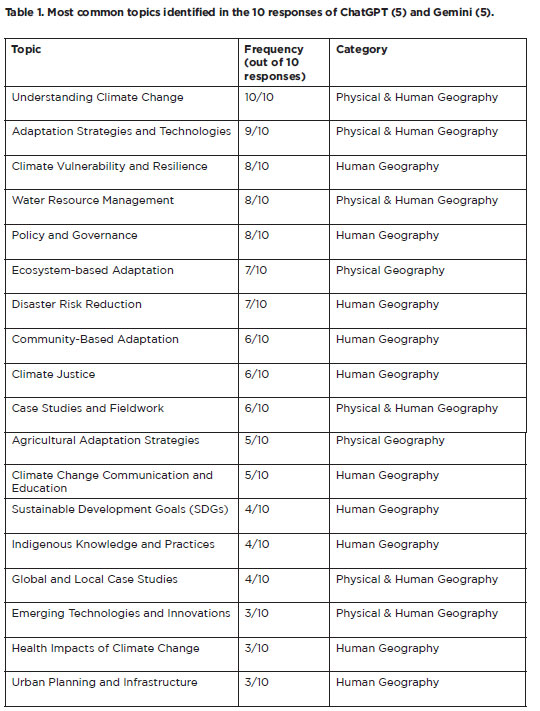
The verbatim prompt was entered into both Gen-AI tools, and the results are presented below. Table 1 summarises the most frequently recurring topics identified across the five responses from ChatGPT and five from Gemini. The full responses from ChatGPT are available in Supplementary Table 1 and Gemini in Supplementary Table 2.
Table 1 reveals a clear hierarchy of topics based on their frequency of Inclusion Into a Geography Further Education and Training Phase Curriculum and Assessment Policy Statement focused on ECCA. The most frequently Identified topic Is Understanding Climate Change, which appears in all responses (10/10, 100%). This underscores the foundational importance of this topic, as it equips learners with essential knowledge to comprehend both the scientific and socio-economic aspects of CCA. Adaptation Strategies and Technologies (9/10, 90%) is also frequently identified, reflecting the need for learners to understand practical, technology-driven solutions for CCA, which are critical for addressing the challenges posed by climate change.
High-priority topics, appearing in 80% of responses, include Climate Vulnerability and Resilience (8/10, 80%), Water Resource Management (8/10, 80%), and Policy and Governance (8/10, 80%). These topics point to the importance of both scientific and practical approaches to CCA. Climate Vulnerability and Resilience reflects the recognition that different regions and communities in South Africa face varying levels of risk from climate change, and CCA strategies must be tailored accordingly. Water Resource Management highlights the centrality of managing water resources in regions affected by drought and water scarcity in South Africa while Policy and Governance emphasises governance frameworks and policy interventions needed to support CCA.
Mid-priority topics, identified in 60% to 70% of responses, include Ecosystem-based Adaptation (7/10, 70%), Disaster Risk Reduction (7/10, 70%), Community-Based Adaptation (6/10, 60%), Climate Justice (6/10, 60%), and Case Studies and Fieldwork (6/10, 60%). These topics suggest an approach to ECCA that integrates both theoretical knowledge and practical, community-oriented strategies. Ecosystem-based Adaptation acknowledges the importance of natural ecosystems in providing sustainable solutions to climate change, while Disaster Risk Reduction highlights the proactive measures needed to reduce the risks associated with climate-induced disasters and hazards in South Africa. Community-Based Adaptation underscores the importance of locally driven solutions, recognising that South African communities must be central in developing and implementing CCA strategies. Climate Justice adds an important ethical dimension, emphasising the need for equitable distribution of resources and solutions in addressing the disproportionate impacts of climate change on vulnerable communities in South Africa. Case Studies and Fieldwork highlight the significance of experiential learning, allowing learners to engage with real-world CCA strategies and providing tangible examples of how theory is applied in practice.
Low-priority topics, identified in 20% to 50% of responses, include Agricultural Adaptation Strategies (5/10, 50%), Climate Change Communication and Education (5/10, 50%), Sustainable Development Goals (4/10, 40%), Indigenous Knowledge and Practices (4/10, 40%), and Global and Local Case Studies (4/10, 40%). While these topics were less frequently cited, they are still considered important for providing an understanding of ECCA to learners. Agricultural Adaptation Strategies is relevant, particularly in South Africa, where agriculture plays a key role in the economy and food security. Climate Change Communication and Education is also crucial for raising awareness and fostering behavioural change, but its lower frequency of mention suggests it is seen as a supplementary element rather than a core component. Sustainable Development Goals are connected to global climate policy, but their lower inclusion in the responses suggests that they are not as central to the Gen-AI imagined curriculum's focus on localised ECCA. Both Indigenous Knowledge and Practices, and Global and Local Case Studies while useful for contextual understanding, are less prioritised, likely seen as supplementary topics.
The data indicate that core topics such as Understanding Climate Change and Adaptation Strategies and Technologies should form the foundation of a ECCA aligned curriculum, and that there is also significant recognition of topics such as Policy and Governance, Climate Vulnerability and Resilience, and Water Resource Management. According to the AI tools, the high-priority topics are crucial for providing learners with a comprehensive understanding of ECCA. The AI tools suggest that integrating mid-and low-priority topics, can enrich the curriculum, ensuring it remains both contextually relevant and aligned to the CCA agenda of the country.
Upon closer scrutiny, the Al-generated topics for an ECCA-aligned South African Geography Further Education and Training Phase Curriculum and Assessment Policy Statement reveal an imbalance with a higher frequency of topics that fall under Human Geography rather than Physical Geography and the intersection of both. Of the 18 topics in Table 1, ten topics (56%) focus on Human Geography, two topics (11%) focus on Physical Geography, and six topics (33%) focus on the intersection of both. This is particularly significant as it highlights the interdisciplinary nature of ECCA while emphasising the need for a more balanced approach between Human Geography and Physical Geography.
DISCUSSION
The findings presented in this paper demonstrate that two Gen-AI tools, ChatGPT and Gemini, can effectively propose a list of CCA-aligned content topics for a revised ECCA-aligned Geography Further Education and Training Phase Curriculum and Assessment Policy Statement. This list was generated by inputting a verbatim prompt into each tool five times, illustrating the variability of responses while still identifying common content topics. While literature on this subject is sparse, scholars like Mashishi (2023) highlight the potential of Gen-AI for 21st Century curriculum change in South Africa. The empirical evidence presented in this paper supports existing literature on the integration of Gen-AI tools into the ECCA agenda. The thematic categorisation of the results indicate that 56% generated topics fall under Human Geography, and this is a concern, as a school Geography curriculum should ensure balanced focus on Physical Geography alongside Human Geography to provide a comprehensive approach to ECCA.
The current iteration of the Geography Further Education and Training Phase Curriculum and Assessment Policy Statement (DBE, 2011) insufficiently addresses ECCA (Naidoo & Heath, 2024) and lack efficacy in aligning with the AI-generated ECCA topics, as it was developed over a decade ago. However, there is limited representation of ECCA topics, with some alignment across Grades 10 to 12. For example, Understanding Climate Change aligns with Grade 10 Topic 1 'The Composition and Structure of the Atmosphere', and Water Resource Management corresponds to Grade 10 Topic 4 'Water in the World: Oceans, Flooding, and Water Management'. Grade 11 Topic 4 'Resources and Sustainability', aligns with the AI-generated ECCA topics such as Sustainable Development Goals and Community Engagement. Case Studies and Fieldwork, emphasised in AI-generated ECCA topics, align with the Curriculum and Assessment Policy Statement's focus on geographical skills, particularly in Grade 12.
Some indirect alignments exist. For example, Urban Planning and Infrastructure corresponds to Grade 12 Topic 3 'Settlement and Economic Geography', through its focus on urbanisation and sustainability, while Indigenous Knowledge ties to Grade 11 Topic 3 'Development Geography' through its limited focus on sustainability and local resource use. However, key AI-generated ECCA topics like Climate Justice, Community-Based Adaptation, and Health Impacts of Climate Change are absent. The exclusion of the AI-generated topics such as Emerging Technologies and Innovations also limits learners' understanding of ECCA. Although there is partial alignment, the current iteration of the curriculum lacks the depth needed for comprehensive coverage of ECCA topics. Integrating the findings of this paper more explicitly would better prepare learners to address the challenges of CCA in South Africa. This highlights the need for such an approach to be incorporated into future curriculum planning.
The findings in this paper align with the argument of various scholars (Lotz-Sisitka et al., 2021; Matsepe & Malukele, 2024; Naidoo & Heath, 2024) that the curriculum lacks specificity regarding climate change impacts and presents inconsistencies in its treatment of sustainable development, industrialization, and growth, despite some emphasis on promoting sustainable development. Therefore, there is a need for curriculum revision to align content with contemporary debates such as the integration of ECCA. The findings suggest that Gen-AI has significant potential to assist in aligning ECCA with the school curriculum. Subsequently, this paper posits that ECCA, and curriculum reform should be influenced by Gen-AI, which can generate relevant and actionable knowledge for policymakers (McGarry, 2023). These findings also align with the viewpoint of Matsepe and Malukele (2024), who emphasise the lack of explicit CCA content in the current Curriculum and Assessment Policy Statements (DBE, 2011) and a need for urgent revision.
CONCLUSIONS
This research underscores the potential effectiveness of two Gen-AI tools, ChatGPT and Gemini, in generating a list of CCA-aligned content topics for a revised ECCA Geography Further Education and Training Phase Curriculum and Assessment Policy Statement. Through systematic prompting, the study revealed variability in responses while identifying common content topics, thereby demonstrating the potential of Gen-AI to contribute meaningfully to curriculum development. The findings affirm the growing recognition, highlighted in existing literature, of the role Gen-AI can play in enhancing governance frameworks in South Africa (Mashishi, 2023). However, they also illuminate significant gaps in the current curriculum, particularly regarding its treatment of ECCA and climate change content topics. These deficiencies, necessitate urgent revisions to align educational content in the current iteration of the school curriculum with contemporary debates and Sustainable Development Goals for ECCA.
This research acknowledges a few limitations. Firstly, the study concentrated exclusively on two Gen-AI tools in relation to ECCA. While the findings confirm that the current Geography Further Education and Training Phase Curriculum and Assessment Policy Statement lacks sufficient CCA-aligned content topics, it is important to note that the CCA agenda has gained traction only after the publication and implementation of the current curriculum. This creates opportunities for further research to enhance these findings. Additionally, the analysis was limited to five responses generated by each of the selected Gen-AI tools, whereas numerous other Gen-AI tools are available in the public domain. Therefore, the researcher recommends that future studies address these limitations by incorporating a broader range of tools and perspectives in future studies.
REFERENCES
LITERATURE REVIEW
- Au Yeung, J., Kraljevic, Z., Luintel, A., Balston, A., Idowu, E., Dobson, R. J., & Teo, J. T. (2023). AI chatbots not yet ready for clinical use. Frontiers in Digital Health, 5, 1161098. https://doi.org/10.3389/FDGTH.2023.1161098
- Atkins, C., Girgente, G., Shirzaei, M., & Kim, J. (2024). Generative AI tools can enhance climate literacy but must be checked for biases and inaccuracies. Communications Earth & Environment, 5(1), 226. https://doi.org/10.1038/s43247-024-01392-w
- Braun, V., & Clarke, V. (2006). Using thematic analysis in psychology. Qualitative Research in Psychology, 3(2), 77-101.
- Cheong, S. M., Sankaran, K., & Bastani, H. (2022). Artificial intelligence for climate change adaptation. Wiley Interdisciplinary Reviews: Data Mining and Knowledge Discovery, 12(5), e1459. https://doi.org/10.1002/widm.1459
- Cowls, J., Tsamados, A., Taddeo, M., & Floridi, L. (2023). The AI gambit: leveraging artificial intelligence to combat climate change - opportunities, challenges, and recommendations. AI & Society, 38, 283-307.
- Department of Basic Education (DBE) (2011). Curriculum and Assessment Policy Statement Further Education and Training Phase Grades 10-12 Geography. DBE, Pretoria.
- Department of Communications & Digital Technologies (DCDT) (2024). South Africa National Artificial Intelligence Policy Framework. DCDT, Pretoria.
- Department of Forestry, Fisheries and the Environment (DFFE) (2020). National Climate Change Adaptation Strategy. DFFE, Pretoria.
- Feinstein, N. W., & Mach, K. J. (2020). Three roles for education in climate change adaptation. Climate Policy, 20(3), 317-322.
- Gatrell, J., Reid, N., & Steiger, T. L. (2018). Branding spaces: Place, region, sustainability and the American craft beer industry. Applied Geography, 90(2), 360-370.
- Havlik, D., & Pias, M. (2024). Common errors in generative AI systems used for knowledge extraction in the climate action domain. arXiv, 2402.00830v1. https://doi.org/10.48550/arXiv.2402.00830
- Human Sciences Research Council (HSRC) (2023, October 9). Navigating the impacts of generative AI in South Africa: challenges, opportunities and ethics. Available at https://hsrc.ac.za/news/latest-news/navigating-the-impacts-of-generative-ai-in-south-africa-challenges-opportunities-and-ethics/
- Intergovernmental Panel on Climate Change (IPCC) (2014). Climate change 2014: Impacts, adaptation, and vulnerability-Summary for policymakers. Cambridge University Press, New York.
- International Telecommunication Union (2024). AI for Good - Impact Report. Available at https://www.hkdca.com/wp-content/uploads/2024/11/ai-for-good-itu.pdf
- Koch, I. C., Vogel, C., & Patel, Z. (2007). Institutional dynamics and climate change adaptation in South Africa. Mitigation and Adaptation Strategies for Global Change, 12, 1323-1339.
- Kondapaneni, R. (2023). Using AI to predict NBA player statistics: ChatGPT vs Google Bard. Journal of Sports Analytics, 9(1), 75-86.
- Lc, R., & Tang, Y. (2023). Speculative design with generative AI: Applying stable diffusion and ChatGPT to imagining climate change futures. Proceedings of the 11 th International Conference on Digital and Interactive Arts, 36. https://doi.org/10.1145/3632776.3632827
- Leal Filho, W., Wall, T., Mucova, S. A. R., Nagy, G. J., Balogun, A. L., Luetz, J. M., Ng, A. W., Kovaleva, M., Azam, F. M. S., Alves, F., & Guevara, Z. (2022). Deploying artificial intelligence for climate change adaptation. Technological Forecasting and Social Change, 180, 121662. https://doi.org/10.1016/j.techfore.2022.121662
- Lotz-Sisitka, H., Mandikonza, C., Misser, S., & Thomas, K. (2021). Making sense of climate change in a national curriculum. In: Schudel, I., Songqwaru, Z., Tshiningayamwe, S., & Lotz-Sisitka, H. (eds), Teaching and Learning for Change, pp. 92-111. African Minds, Cape Town.
- Lotz-Sisitka, H., Rosenberg, E., & Ramsarup, P. (2023). Environment and sustainability education research as policy engagement: (Re-) invigorating 'politics as potentia' in South Africa. In: Rickinson, M., & McKenzie, M. (eds), Navigating the Research-Policy Relationship, pp. 61-89. Routledge, London.
- Luccioni, A., Schmidt, V., Vardanyan, V., & Bengio, Y. (2021). Using artificial intelligence to visualize the impacts of climate change. IEEE Computer Graphics and Applications, 41(1), 8-14.
- Mashishi, A. (2023). AI National Government Summit Discussion Document. DCDT, Pretoria.
- Matsepe, M., & Maluleke, M. (2024). Infusing Climate Change Education into Curriculum and Assessment Policy Statement (CAPS) as a Resilience Strategy in South Africa: Towards a Theory of Change. E-Journal of Humanities, Arts and Social Sciences (EHASS), 5(9), 73-82.
- Mbuvha, R., Yaakoubi, Y., Bagiliko, J., Potes, S. H., Nammouchi, A., & Amrouche, S. (2024). Leveraging AI for Climate Resilience in Africa: Challenges, Opportunities, and the Need for Collaboration. arXiv, 2407.05210v1. https://doi.org/10.48550/arXiv.2407.05210
- Ncube, N. (2018). ICT integration in the teaching of FET Geography in Johannesburg east. Unpublished PhD dissertation, University of the Witwatersrand.
- Rane, N., Choudhary, S., & Rane, J. (2024). Contribution of ChatGPT and similar generative artificial intelligence for enhanced climate change mitigation strategies. SSRN Electronic Journal, 2(1), 79-95.
- Reuel, A., & Undheim, T. A. (2024). Generative AI needs adaptive governance. arXiv, 2406.04554. https://doi.org/10.48550/arXiv.2406.04554
- Richards, D., Worden, D., Song, X. P., & Lavorel, S. (2024). Harnessing generative artificial intelligence to support nature-based solutions. People and Nature, 6(2), 882-893.
- Robinson, C., & Dilkina, B. (2018). A machine learning approach to modeling human migration. COMPASS'18: Proceedings of the 1st ACM SIGCAS Conference on Computing and Sustainable Societies, 30. https://doi.org/10.1145/3209811.3209868
- Rolnick, D., Donti, P. L., Kaack, L. H., Kochanski, K., Lacoste, A., Sankaran, K., Ross, A. S., Milojevic-Dupont, N., Jaques, N., Waldman-Brown, A., & Luccioni, A. S. (2022). Tackling climate change with machine learning. ACM Computing Surveys (CSUR), 55(2), 1-96.
- Scholes, R. J., & Engelbrecht, F. (2021). Climate impacts in southern Africa during the 21st century. Report for Earthjustice and the Centre for Environmental Rights, Global Change Institute, University of Witwatersrand.
- Senekal, B., & Brokensha, S. (2023). Is ChatGPT a friend or foe in the war on misinformation? A South African perspective. Communicare: Journal for Communication Sciences in Southern Africa, 42(2), 3-16.
- Shah, P. (2023). AI and the Future of Education: Teaching in the Age of Artificial Intelligence. Jossey-Bass, Hoboken, NJ.
- Shumba, O., Mandikonza, C., & Lotz-Sisitka, H. (2021). Advancing assessment thinking in education for sustainable development with a focus on significant learning processes. In: Schudel, I., Songqwaru, Z., Tshiningayamwe, S., & Lotz-Sisitka, H. (eds), Teaching and Learning for Change, pp. 201-222. African Minds, Cape Town.
- Sibanda, A., & Manik, S. (2023). Reflecting on climate change education (CCE) initiatives for mitigation and adaptation in South Africa. Environmental Education Research, 29(12), 1814-1831.
- Sibiya, N. P., Das, D. K., Vogel, C., Mazinyo, S. P., Zhou, L., Kalumba, M. A., Sithole, M., Adom, R. K., & Simatele, M. D. (2023). Overcoming Bureaucratic Resistance: An Analysis of Barriers to Climate Change Adaptation in South Africa. Climate, 11, 145. https://doi.org/10.3390/cli11070145
- Zhu, J.-J., Jiang, J., Yang, M., & Ren, Z. J. (2023). ChatGPT and environmental research. Environmental Science & Technology, 57(46), 17667-17670.
Accepted 15 December 2024
Published 30 December 2024