Individual and Community Factors as Correlates of Climate Change Awareness and Action among 15 African Countries
Abstract
In Africa, the scientific evidence on climate change awareness and action from country-based data is limited, and few studies have examined the associations between individual and community level characteristics and climate change awareness and action. A sample from country-based data (Afrobarometer Round 9), from 15 African countries was used to examine the relationship between individual and community variables and climate change awareness and action. Data were analysed by means of frequency counts, t-tests, analysis of variance, correlation and stepwise regression analyses. The findings revealed that the proportion of individuals who had heard of climate change ranged from 22% in Tunisia to 75% in Zimbabwe, and those who believed that climate change was affecting their countries ranged from 10.2% in Ghana to 53.8% in Malawi. Across the sampled countries, only 47.1% of participants had heard about climate change while 34.6% believed climate change affected them. In all the countries studied, participants believed it was the responsibility of government to check and fight climate change. However, statistical significant differences were observed in the awareness of climate change between urban and rural respondents. Age of respondents and their place of residence were found to be positively correlated with climate change awareness and action. Findings from stepwise multiple regression analysis also revealed that climate change awareness was the most parsimonious predictor of climate change action (R2=0.275). The study concluded that individual and community level variables are important precursors to climate change awareness whilst fostering willingness towards climate change action should be an integral part of any intervention.
Afrobarometer; Climate change awareness; Community perceptions; Education; Environmental change
INTRODUCTION
One phenomenon whose spatial, socioeconomic, environmental, and psychological consequences has generated much debate globally is climate change. Many communities and countries are becoming more vulnerable to the negative effects of climate change (Serdeczny et al., 2017; Sesana et al., 2021; Abbass et al., 2022). However, the degree of vulnerability differs from one country to another (Filho et al., 2018). Climate change leads to extreme weather conditions including increasing frequency of floods and droughts. Inevitably, an increasing number of communities have been forced to adapt and develop resilience to the impacts of climate change regardless of their economic, social, and personal status (Castro & Sen, 2022; Kourgialas et al., 2024; Usta & Gök, 2024). Changing climates are producing new socioeconomic inequalities, especially in marginal societies that are already impacted by histories of under-development, poor governance, or lack of access to technology and information (Parsons et al., 2024). Similarly, a high number of refugees and displaced people are experiencing the negative and adverse impacts of climate change (Berchin et al., 2017).
Despite contributing the lowest greenhouse gas emissions, African countries are the most vulnerable to the impacts of climate change (Busby et al., 2014). Systemic risks to the continent's economies, infrastructure, public health, agriculture, food and water systems, and livelihoods will arise, thereby endangering even its development progress and pushing people into extreme poverty. Consequently, climate change poses a serious threat to Africa as it will impact on progress towards achieving the Sustainable Development Goals. The factors contributing to Africa's vulnerability include economic dependency on climate-related activities and products, low adaptive capacity, weak economies, weak institutions, and generally poor governance systems (Beck et al., 2018; Diedhiou et al., 2018; Dirksmeier et al., 2023). Despite this, most Africans are unaware of the severity of climate change and its impacts. Better awareness of climate change is the catalyst for responding to its socioenvironmental challenges (Lee et al., 2015; Calculli et al., 2021). Vulnerability to climate change refers to the extent to which a system is exposed to, and is incapable of mitigating, the negative consequences of climate change. Awareness through education is an essential measure to drive active participation at all levels of communities to combat climate change impacts (Knight, 2016). Thus, existing literature suggests that individual awareness, knowledge, and attitudes are critical to attaining sustainable development (Lee et al., 2015; Calculli et al., 2021). Similarly, an individual's environmental attitude or behaviour is a function of their awareness, concern, and perceptions about environmental problems. In this way, a person or community with a high level of awareness and positive attitudes can play significant roles in the realisation of environmental sustainability.
Much research supports a positive relationship among climate change awareness, knowledge, attitude and practices (e.g. Gazzaz & Al-Masad, 2021; Sohail et al., 2022; Ricart et al., 2023). In Nepal, Adhikari et al. (2021) reported no statistical relationship between gender, occupation, land ownership and awareness of climate change. However, education, family size, and age were found to be significantly related. Thaker (2024), using Yale Meta survey data collected in 2022 across 110 countries, found that media coverage is positively related to self-reported exposure to climate change and perceived awareness. In four European countries, lancu et al. (2023) analysed data from the 2019 and 2021 Eurobarometer surveys to determine how people's perceptions of climate change have changed and how socioeconomic and demographic factors influence these perceptions. Climate change actions were found to be influenced by age, gender, and educational attainment. Filho et al. (2018) assessed coastal communities' adaptations to climate hazards in four developing nations (Bangladesh, Brazil, Cameroon, Uruguay) and found that these nations differed in terms of susceptibility, adaptive capacity and response implementation. The association between conflict, institutional trust, and awareness of climate change was examined by Dirksmeier et al. (2023). They showed that the role of violence and awareness levels of individuals about climate change had an impact on the trust they have on institutions in sub-Saharan Africa. A negative correlation between institutional trust and climate change awareness was reported. In addition, young, urban and educated individuals expressed distrust of institutions. Regional differences were also noted: people more distant from the government's sphere of influence had a lower understanding of climate change, while those who lived close had lower trust in institutions.
It is evident from the literature that awareness is an important factor towards understanding climate change impacts, adaptation and resilience. However, most studies are limited in their generalisability on the relationship between climate change awareness and action. This study examines the relationship between climate change awareness and its determinants in selected African countries, using results from the Afrobarometer survey. The study (1) describes the level of climate change awareness and action in these countries; (2) determines the statistical differences in climate change awareness and action across individual and community factors; and (3) identifies the most parsimonious factors among gender, age, education, occupation, place of residence and climate change awareness variables that would best predict climate change action.
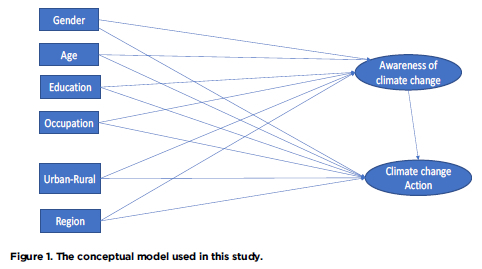
THEORETICAL FRAMEWORK AND CONCEPTUAL MODELResearch on the determinants of awareness about climate change commonly considers the behavioural theory of planned behaviour developed by Ajzen & Fishbein (1980). In their theory, they identified four concepts: beliefs, attitudes, intentions, and behaviour. Beliefs involve knowledge; attitudes to that object; intentions refer to behavioural aims; and behaviour involves actual action itself. In line with this theory, this study considered the relations between individual and community factors, climate change awareness and climate change action as summarized in Figure 1.
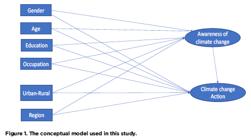
The theory of planned behaviour has been widely applied to understand, explain and predict many aspects of human-environment interactions (e.g. de Leeuw et al., 2015; Hauslbauer et al., 2022; Wu et al., 2022). Previously, the theory found application and relevance in research in green consumption, sustainable transportation, waste management, and environmental conservation (e.g. Liu et al., 2017; Ma et al., 2018; Si et al., 2019; Savari & Khaleghi, 2023). Thus, the relevance of the theory of planned behaviour to the present study is derived from its capacity to explain relationships across and among variables of interest. Its application can address the lack of comparative research on environmental behaviour in Africa.
METHODS
Data source and variables
Data used in this analysis originated from the Afrobarometer Data Round 9, a cross-national survey that provides high-quality data with a wide range of indicators that are related to the social, political, economic, and environmental issues in the African continent. The data sets were released in the year 2023 by Afrobarometer (www.afrobarometer.org). Historically, the Afrobarometer data were compiled from a representative cross-national survey conducted since 1999. The data were collected by adopting multi-stage, stratified, and random sampling techniques to select the respective populations. Stratification was first at the sub-national unit of government (state, province, sub-region, etc), and then by place of residence (urban or rural). The sample size varies due to the different population sizes in the respective countries and range from 1200 for Botswana to 3392 for Mozambique. The merged data contains 22,961 adult respondents from 15 countries (Botswana, Gambia, Ghana, Kenya, Lesotho, Liberia, Malawi, Morocco, Namibia, Nigeria, Sierra Leone, Tunisia, Uganda, Zambia, and Zimbabwe). Participants in this study received information on the study aims and were invited to participate through the Afrobarometer database.
The dependent variables in this study were respondents' awareness levels measured with two statements or items, namely, 'have heard of climate' and 'have knowledge of the effect of climate change'. Furthermore, 'climate change action' was estimated from four items summarised as 'who should be responsible to act on climate change'. The independent variables used in this analysis were individual characteristics (gender, age, occupation, educational), and community characteristics (urban or rural location and region).
Data analysis
Using the Statistical Package for the Social Sciences (SPSS v27), percentages were calculated to describe the sample characteristics, and the proportions of respondents who reported to be aware or have heard of climate change and are knowledgeable about its effects. T-test and analysis of variance (ANOVA) statistics were applied to test differences in awareness and action on climate change across individual and community variables. Pearson Product Moment Correlation was used to determine the relationship or association between individual and community variables and climate change awareness and action. Stepwise multiple regression was applied to determine the influence of each independent variables on the dependent variable of climate change action.
RESULTS
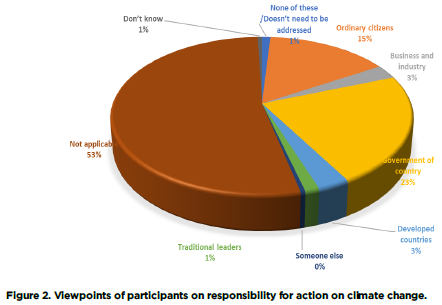
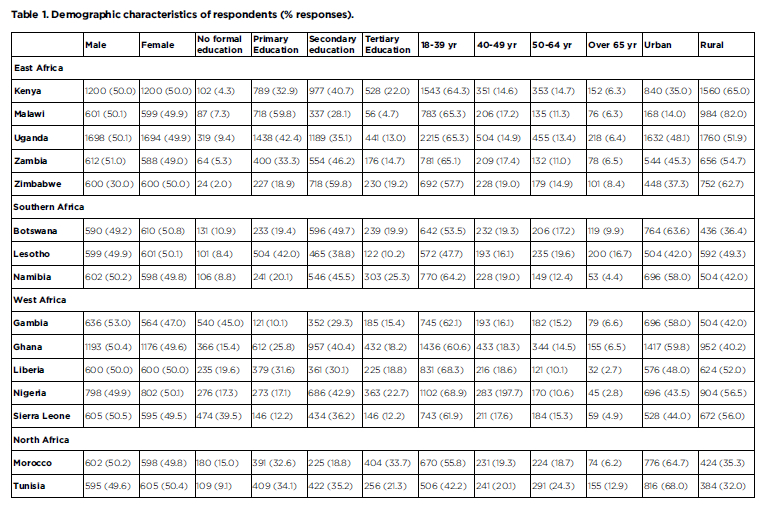
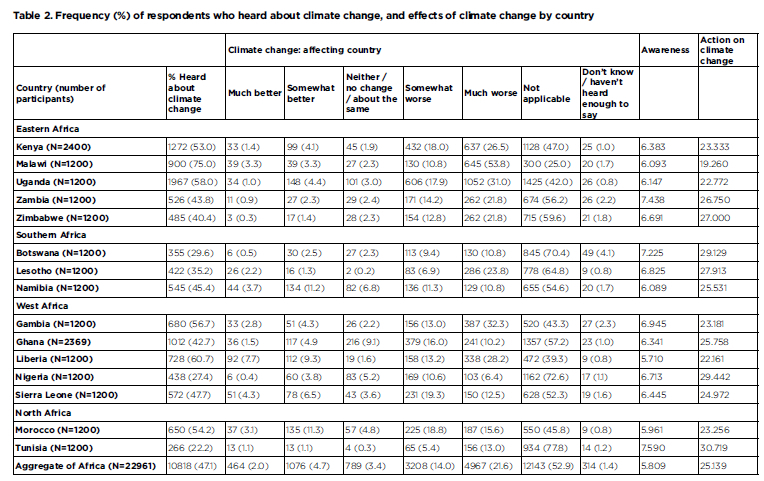
Demographic characteristics of participants, country-by-country, are presented in Table 1. In all countries, individuals in the age group 18-39 years represent more than two-thirds of all respondents. The instrument for data collection was scored on an 8-point Likert scale ranging from 'heard about climate change' to 'don't know/haven't heard enough to say'. Table 2 shows spatial variations as well as certain similarities among the sampled countries. The percentage of respondents who had heard about climate was highest in Malawi (75%) and Liberia (61%) but lowest in Lesotho (35%), Botswana (30%) and Tunisia (22%). Respondents who believed that climate change affects their countries ranged from less than 6% in Nigeria to 54% in Malawi. Based on these patterns, across the sampled countries, there is a relatively low level of climate change awareness overall. The mean value for climate change awareness ranged between 5.71 for Liberia and 7.59 for Tunisia. Figure 2 presents the respondents responses to the question of who has responsibility for action on climate change. Twenty-three percent believed it is the government, 15% said ordinary citizens while only 3% identified business and industry.
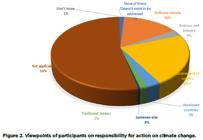
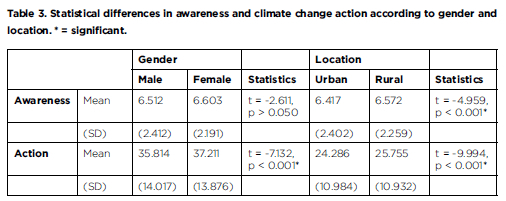
Table 3 indicates the comparison of mean scores of awareness and actions of climate change. There were no statistically significant differences between male and female respondents. However, mean scores of rural residents were higher than those of their urban counterparts, meaning that rural residents were more likely to be aware of climate change. In terms of actions to overcome climate change, a statistically significant difference was observed between male and female respondents, with female respondents likely to act more positively towards climate change mitigation than males. With the mean of rural respondents being higher than that of urban ones, it can be inferred that rural dwellers are more likely to act against climate change. This is possibly because they are more susceptible to climate change effects because they are more dependent on natural resources that are vulnerable to changes in weather and climate patterns. It is possible that rural residents draw from local or indigenous knowledge of climate change mitigation. Conversely, urban residents are more likely to be dependent on urban infrastructure and facilities in such activities as commercial trading, formal and informal employment.
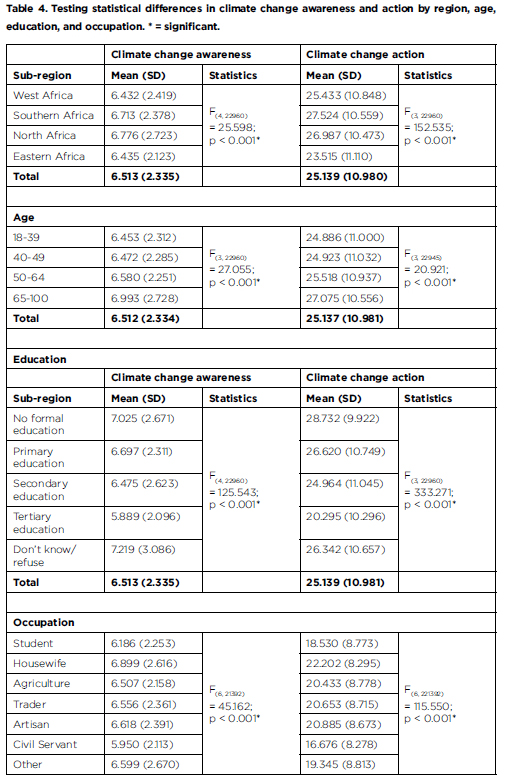
Table 4 indicates the summary of ANOVA results. There were statistically significant differences in the different regions of Africa in terms of educational levels, occupations, and age groups. The one-way ANOVA showed that the mean scores of the four sub-regions of Africa differed significantly from one another in awareness of climate change. The same pattern emerged with respect to education and age. Similarly, there were statistically significant differences in the manner of response to climate change or action by region, age, educational level and occupation.
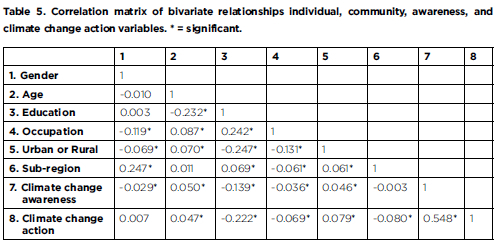
Table 5 shows that factors such as age and place of residence (urban/rural) are positively correlated with climate change awareness. Age, urban/rural and climate change awareness are significantly associated with climate change action, while gender, education, occupation and sub-region are negatively correlated with both climate change awareness and action.
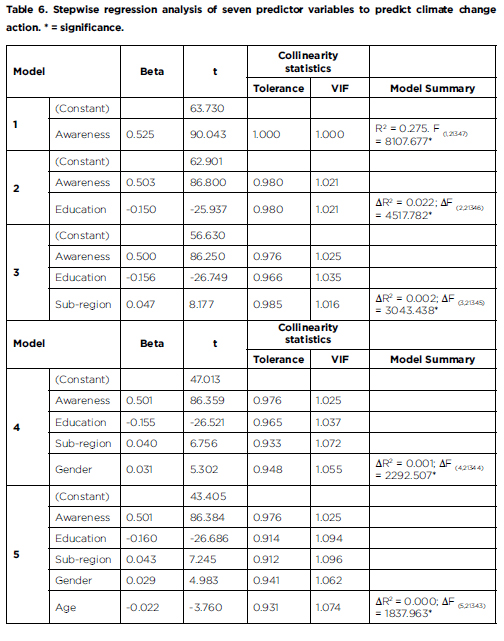
A stepwise multiple regression was conducted to determine and identify the relationships between key variables (Table 6). The results indicated that the most parsimonious set of predictors of climate change action were awareness, education, region, gender, and age. Together, these five variables explained 30.1% of the variance in climate change action in the sample. This suggests that socio-demographic characteristics or backgrounds of individuals are important factors and driving forces towards taking climate change action in Africa. Out of these variables, only place of residence (urban/rural) was not included in the model.
DISCUSSION
This study investigated the relationships among individuals and communities with regard to their awareness of climate change and actions to mitigate climate change effects. Many African nations are disproportionately vulnerable to the impacts of climate change, including droughts, floods, and sea-level rise, and these impacts directly affect livelihoods, food security, and overall human well-being (Serdeczny et al., 2017; Adom et al., 2022; Muthoka et al., 2024). The study found certain differences in the level of awareness of climate change between the countries under consideration. In 9 out of the 15 countries, frequency counts of statements such as 'having heard about climate change' were less than 50% among the respondents. This finding is consistent with results from Lee et al. (2015) and Dirksmeier et al. (2023) that over 65% of respondents from Africa, the Middle East and Asia had never heard about climate change. However, in this research, Malawi (75%), Liberia (61%), and Uganda (58%) registered the highest percentages of respondents who had heard about climate change.
This study found no statistically significant differences between male and female respondents on climate change awareness. There were, however, differences in climate change awareness and action between urban and rural areas, regions, age, education, and occupation. More rural dwellers indicated climate change action, possibly reflecting the application of local and indigenous knowledge practices. This corroborates results of Manning & Clayton (2018) who concluded that societies whose livelihoods are directly connected to local climatic conditions, such as farmers and fishers are more likely to be aware of and to act on climate change.
The findings that age and place of residence (urban/rural) were positively related to climate change awareness and action is consistent with previous studies (Owusu et al., 2019; Poortinga et al., 2019; González & Sánchez, 2022). Being aware of climate change impacts could be viewed as a first step to taking action. In this study, awareness and education were two important predictors of climate change action. This implies that climate change action can be better addressed at the individual level, a view that is consistent with Lee et al. (2015) in which education featured as the strongest predictor of climate change awareness and action.
CONCLUSIONS
This study provides insight into the relationship between individual and community factors and the extent of climate change awareness and action in selected African countries. Guided by the theory of planned behaviour, the study found that awareness and education are the strongest predictors of climate change adaptation and mitigation. Education, within the context of climate change, provides avenues for individuals and groups to acquire information, knowledge, skills and values for mitigating climate change impacts through appropriate behaviour and action at the micro and macro levels. Therefore, understanding the influence of awareness and education is a prerequisite to designing interventions that resonate with individuals and communities. There is also a need for effective information dissemination, communication, and educational programmes geared towards increasing awareness about climate change. Such interventions must be developed in line with the social, economic, cultural, political, and environmental conditions of each country. Similarly, such programmes must include opportunities for individuals to develop pro-environmental attitudes and skills for promoting sustainability. Given that some African countries are relatively ahead of others in the use of information, education and communication to promote climate change awareness, there is an urgent need to share relevant experiences to accelerate progress in climate change adaptation and mitigation across the continent.
REFERENCES
- Abbass, K., Qasim, M. Z., Song, H., Murshed, M., Mahmood, H., & Younis, I. (2022). A review of the global climate change impacts, adaptation, and sustainable mitigation measures. Environmental Science and Pollution Research, 29(28), 42539-42559.
- Adhikari, D., Prasai, R., Lamichhane, S., Gautam, D., Sharma, S., & Acharya, S. (2021). Climate Change Impacts and Adaptation Strategies in Trans-Himalaya Region of Nepal. Journal of Forest and Livelihood, 20(1), 16-30.
- Adom, R. K., Símatele, M. D., & Reid, M. (2022). The threats of climate change on water and food security in South Africa. American Journal of Environment and Climate, 1(2), 73-91.
- Ajzen, I. and Fishbein, M. (1980) Understanding Attitudes and Predicting Social Behavior. Prentice-Hall, Englewood Cliffs.
- Beck, M. W., Losada, I. J., Menéndez, P., Reguero, B. G., Díaz-Simal, P., & Fernández, F. (2018). The global flood protection savings provided by coral reefs. Nature Communications, 9(1), 2186. https://doi.org/10.1038/s41467-018-04568-z
- Berchin, I. I., Valduga, I. B., Garcia, J., & De Andrade Guerra, J. B. S. O. (2017). Climate change and forced migrations: An effort towards recognizing climate refugees. Geoforum, 84, 147-150.
- Busby, J. W., Cook, K. H., Vizy, E. K., Smith, T. G., & Bekalo, M. (2014). Identifying hot spots of security vulnerability associated with climate change in Africa. Climatic Change, 124, 717-731.
- Castro, B., & Sen, R. (2022). Everyday adaptation: theorizing climate change adaptation in daily life. Global Environmental Change, 75, 102555. https://doi.org/10.1016/j.gloenvcha.2022.102555
- de Leeuw, A., Valois, P., Ajzen, I., & Schmidt, P. (2015). Using the theory of planned behavior to identify key beliefs underlying pro-environmental behavior in high-school students: Implications for educational interventions. Journal of Environmental Psychology, 42, 128-138.
- Diedhiou, A., Bichet, A., Wartenburger, R., Seneviratne, S. I., Rowell, D. P., Sylla, M. B., & Affholder, F. (2018). Changes in climate extremes over West and Central Africa at 1.5oC and 2oC global warming. Environmental Research Letters, 13(6), 065020. https://doi.org/10.1088/1748-9326/aac3e5
- Dirksmeier, P., Nolte, K., Mewes, L., & Tuitjer, L. (2023). The role of climate change awareness for trust in institutions in sub-Saharan Africa. Environmental Research Letters, 18(9), 094043. https://doi.org/10.1088/1748-9326/acf
- Filho, W. L., Modesto, F., Nagy, G., Saroar, M., Toamukum, N. Y., & Ha'apio, M. (2018). Fostering coastal resilience to climate change vulnerability in Bangladesh, Brazil, Cameroon and Uruguay: a cross-country comparison. Mitigation and Adaptation Strategies for Global Change, 23, 579-602.
- Gazzaz, N. M., & M Al-Masad, M. (2021). Level of Knowledge of Agricultural Science Graduate Students about Climate Change Mitigation and Adaptation Practices of Agriculture. World Journal of Education, 11(6), 50-69.
- González, J. B., & Sánchez, A. (2022). Multilevel predictors of climate change beliefs in Africa. PLoS ONE, 17(4), e0266387. https://doi.org/10.1371/journal.pone.0266387
- Hauslbauer, A. L., Schade, J., Drexler, C. E., & Petzoldt, T. (2022). Extending the theory of planned behavior to predict and nudge toward the subscription to a public transport ticket. European Transport Research Review, 14, 5. https://doi.org/10.1186/s12544-022-00528-3
- lancu, I. A., Hendrick, P., Micu, D. D., & Cote, A. (2023). Pandemic-Induced Shifts in Climate Change Perception and Energy Consumption Behaviors: A Cross-Country Analysis of Belgium, Italy, Romania, and Sweden. Sustainability, 15, 14679. https://doi.org/10.3390/su152014679
- Knight, K. W. (2016). Public awareness and perception of climate change: a quantitative cross-national study. Environmental Sociology, 2(1), 101-113.
- Kourgialas, N. N., Anastopoulos, I., & Stefanakis, A. (2024). Adapting Water and Soil Management to Climate Change. Sustainability, 16(6), 2416. https://doi.org/10.3390/su16062416
- Lee, T., Markowitz, E., Howe, P., Ko, C., & Leiserowitz, A. A. (2015). Predictors of public climate change awareness and risk perception around the world. Nature Climate Change, 5, 1014-1020.
- Liu, Y., Sheng, H., Mundorf, N., Redding, C., & Ye, Y. (2017). Integrating norm activation model and theory of planned behavior to understand sustainable transport behaviour: Evidence from China. International Journal of Environmental Research and Public Health, 14(12), 1593. https://doi.org/10.3390/ijerph14121593
- Ma, J., Hipel, K. W., Hanson, M. L., Cai, X., & Liu, Y. (2018). An analysis of influencing factors on municipal solid waste source-separated collection behaviour in Guilin, China by Using the Theory of Planned Behavior. Sustainable Cities and Society, 37, 336-343.
- Manning, C., & Clayton, S. (2018). Threats to mental health and wellbeing associated with climate change. In Psychology and Climate Change, pp. 217-244. Academic Press, New York.
- Muthoka, M., Ouko, K. O., Mboya, J. B., Ndambuki, M. N., Outa, N., Ogello, E., & Njogu, L. (2024). Socio-economic impacts of climate change and adaptation actions among smallholder fish farmers in Sub-Saharan Africa. Aquaculture, Fish and Fisheries, 4(3), e182. https://doi.org/10.1002/aff2.182
- Owusu, M., Nursey-Bray, M., & Rudd, D. (2019). Gendered perception and vulnerability to climate change in urban slum communities in Accra, Ghana. Regional Environmental Change, 19, 13-25.
- Parsons, E. S., Jowell, A., Veidis, E., Barry, M., & Israni, S. T. (2024). Climate change and inequality. Pediatric Research, 96(7), 1883. https://doi.org/10.1038/s41390-024-03153-z
- Poortinga, W., Whitmarsh, L., Steg, L., Böhm, G., & Fisher, S. (2019) Climate change perceptions and their individual-level determinants: A cross-European analysis. Global Environment Change, 55, 25-35.
- Ricart, S., Gandolfi, C. & Castelletti, A. (2023). Climate change awareness, perceived impacts, and adaptation from farmers' experience and behaviour: a triple-loop review. Regional Environmental Change, 23, 82. https://doi.org/10.1007/s10113-023-02078-3
- Savari, M., & Khaleghi, B. (2023). Application of the extended theory of planned behavior in predicting the behavioral intentions of Iranian local communities toward forest conservation. Frontiers in Psychology, 14, 1121396. https://doi.org/10.3389/fpsyg.2023.1121396
- Serdeczny, O., Adams, S., Baarsch, F., Coumou, D., Robinson, A., Hare, W., & Reinhardt, J. (2017). Climate change impacts in Sub-Saharan Africa: from physical changes to their social repercussions. Regional Environmental Change, 17, 1585-1600.
- Sesana, E., Gagnon, A. S., Ciantelli, C., Cassar, J., & Hughes, J. J. (2021). Climate change impacts on cultural heritage: A literature review. Wiley Interdisciplinary Reviews: Climate Change, 12(4), e710. https://doi.org/10.1002/wcc.710
- Si, H., Shi, J., Tang, D., Wen, S., Miao, W., & Duan, K. (2019). Application of the theory of planned behavior in environmental science: A comprehensive bibliometric analysis. International Journal of Environmental Research and Public Health, 16, 2788. https://doi.org/10.3390/ijerph16152788.
- Sohail M. T., Elkaeed, E. B., Irfan, M., Acevedo-Duque, A., & Mustafa, S. (2022) Determining farmers' awareness about climate change mitigation and wastewater irrigation: a pathway toward green and sustainable development. Frontiers in Environmental Science, 10, 900193. https://doi.org/10.3389/fenvs.2022.900193
- Thaker, J. (2024). Cross-Country Analysis of the Association between Media Coverage and Exposure to Climate News with Awareness, Risk Perceptions, and Protest Participation Intention in 110 Countries. Environmental Communication, 18(4), 233-249.
- Usta, A. T., & Gök, M. (2024). Adaptation to climate change: state of art technologies. Kybernetes, https://doi/org/10.1108/K-11-2023-2517
- Wu, L., Zhu, Y., & Zhai, J. (2022). Understanding waste management behavior among university students in China: Environmental knowledge, personal norms, and the theory of planned behavior. Frontiers in Psychology, 12, 771723. https://doi.org/10.3389/fpsyg.2021.771723
Accepted 05 July 2025
Published 21 July 2025