Representation of Climate Change Adaptation in Geography Education Modules at the University of KwaZulu-Natal (UKZN)
Abstract
This article extends the existing emphasis on integrating climate change adaptation into pre-service teacher training, aligning with the South African National Climate Change Response White Paper. Employing Krippendorff's quantitative word frequency analysis based on the Glossary of International Climate Policy Terms, the study relies on Hall's theory of representation to examine education for climate change adaptation. The investigation centres on the role of pre-service teacher training at the University of KwaZulu-Natal in fostering climate change adaptation awareness in South Africa. The key findings demonstrated that, while the National Curriculum and Assessment Policy Statement faces criticism for insufficiently addressing climate change adaptation, there are areas of positive practices within the geography education modules at the University of KwaZulu-Natal, highlighting areas of good practice in course packs.
Education for climate change adaptation; Representation; Geography education; Pre-service teacher training; Content analysis
INTRODUCTION
Under the aegis of the Intergovernmental Panel on Climate Change (IPCC) and the United Nations Framework Convention on Climate Change (UNFCCC), the South African National Climate Change Response White Paper (NCCRWP) has set forth the role of education for the country's adaptation towards climate change (South Africa, 2011). While the NCCRWP is clear on the demands for Education for Climate Change Adaptation (ECCA), the representation of relevant ECCA topics in pre-service teacher training modules remains unclear. On the one hand, one of the biggest challenges is that institutions under the Department of Higher Education and Training (DHET) must develop teacher training material that follows the national Curriculum and Assessment Policy Statement (CAPS) and subsequently prepare pre-service teachers to deliver the topics outlined by the curriculum (DHET, 2006; Van Heerden, 2015). On the other hand, the literature highlights that many pre-service teachers are not trained enough to act as agents of climate resilience (Lotz-Sisitka et al., 2021a; Leal Filho et al., 2021; Anderson, 2012). Furthermore, the DHET (2006, p. 13) is also tasked to "enhance [pre-service teacher] competence and develop their knowledge in learning areas or subjects and phases where there is scarcity" in 21st century skills and knowledge and to recognise further that "the South African education system ... draws on our constitutional obligations, our own experience, and local and international" commitments in addressing climate change and ECCA. To ensure this alignment, the following legislative entities form the foundation with which teacher training institutions, such as the University of KwaZulu-Natal (UKZN), should be aligned:
• The South African Qualifications Authority (SAQA); and the
•The Minimum Requirements for Teacher Education, in terms of Section 8(2)(c) of the National Qualifications Framework Act, 2008 (Act No. 76 of 2008) (MRTEQ) (DHET, 2015).
As a result, following the directive by the DHET through the MRTEQ in 2015, UKZN was obligated to revise its curriculum in accordance with the CAPS. Thus, key lecturers and the relevant stakeholders designed an aligned curriculum after 2011 (Van Heerden et al., 2020). The newly revised teacher training curriculum had to synchronise with the topics outlined by the Geography CAPS document (Department of Basic Education (DBE), 2011). Geography education is the natural home for ECCA (Head & Rutherford, 2022), and there is an increasing need for the subject to align with the global context of environmental education (Heath, 2021). There has been a greater focus on ECCA and Education for Sustainable Development to effectively educate and teach school children climate change strategies and adaptation-related knowledge through teaching and learning in the classroom (Lotz-Sisitka et al., 2021a; Anderson, 2012). Subsequently, teachers are now viewed as agents of the Climate Change Adaptation (CCA) agenda.
However, the Geography Further Education and Training (FET) CAPS (DBE, 2011) document has been criticised by various international and South African environmental education scholars for containing inconsistencies and contradictions regarding topics such as sustainable development and CCA (e.g., Leal Filho et al., 2021; Lotz-Sisitka et al., 2021a; Lotz-Sisitka et al., 2021b; Lotz-Sisitka et al., 2016; Agbedahin & Lotz-Sisitka, 2019; Schudel, 2021; Schudel et al., 2021; Macintyre et al., 2018). There has also been little global consensus on what ECCA should look like for each country. In addition, the CAPS (DBE, 2011) and the NCCRWP (South Africa, 2011) were published in 2011 when ECCA was only gaining momentum - therefore, the ECCA agenda would have been tenuous within the CAPS (DBE, 2011). Nevertheless, the Glossary of International Climate Policy Terms (GoICPT) (Michaelowa & Koch, 2001), which was published 12 years before the CAPS (DBE, 2011) would have provided ample time for the inclusion of relevant ECCA knowledge in the curriculum.
The teacher training curriculum, influenced by socio-political and economic agendas, plays a pivotal role in shaping educational content delivery (Apple & Christian-Smith, 2017). This article focuses on how the CAPS (DBE, 2011) guides the content for pre-service Geography teachers at UKZN's School of Education. Despite the publication of the Geography FET CAPS in 2011, ECCA is a relatively recent addition, creating a gap between curriculum and emerging priorities (Anderson, 2012). This article argues for integrating ECCA into existing curricular content through teacher education, emphasising the need for curricula to align with national climate change priorities (Lotz-Sisitka et al., 2021a). Values associated with ECCA can significantly influence individuals' conceptual maps, impacting awareness of the phenomenon (Marr et al., 2004). This article examines the representation of CCA in teacher training course packs using the conceptual framework of representation as a social construct and language (Hall, 1997).
In this study, we first explore the role of geography education in the ECCA agenda and the current state of ECCA in South Africa. Secondly, we explored the current ECCA approaches in other countries located at the similar lines of latitude, and sub-Saharan Africa and other university-based and teacher training initiatives in South Africa. Finally, we show how geography education course packs from the Bachelor of Education (B. Ed.), Bachelor of Education Honours (B. Ed. Hons), and the Postgraduate Certificate in Education (PGCE) courses at UKZN represent ECCA. In this article, we refer to the theoretical framework of representation as postulated by Hall (1997; 2020a; 2020b), emphasising representation. Representation through a social constructivist and language lens implies that we apply a quantitative word frequency analysis tool (Krippendorff, 1989, 2004a, 2004b, 2004c, 2012) to determine the degree of representation of ECCA words from the GoICPT (Michaelowa & Koch, 2001). Using the theory of representation can determine the extent to which, if any, ECCA manifests in the pre-service geography education teacher training curricula. This is within the understanding that ECCA is necessary in the global effort to adapt to climate change (Anderson, 2012).
Geography education and ECCA
Geography education is the natural home for ECCA, and the subject is well placed for efforts geared towards updated CCA (Head & Rutherford, 2022). The discipline encompasses three main research subfields: (1) learning theory, (2) applied topics, and (3) teacher education, which serves the contemporary ECCA agenda. However, the role of education in South Africa has been aligned with the transformative agenda to suit the democratic regime, which gave birth to the CAPS (DBE, 2011). The CAPS syllabus has been described as demonstrating a general lack of specificity and coherence in terms of CCA, as well as inconsistencies and contradictions that arise in the representations of sustainable development, industrialisation, and ECCA (Lotz-Sisitka, 2021a). In terms of higher education, Leal Filho et al. (2021) specifically mentioned that there is a lack of synergy between ECCA and teacher training and that improvements in the representation of ECCA are needed.
ECCA approaches in Australia and Chile
Considering their similar latitudinal position, Rundel et al. (2018) highlighted the climatic regimes shared by Chile, South Africa, and Australia. In addition, Irwin and Mokdad (2010) noted similarities in governmental practices among Chile, South Africa, and Australia. Although Australia and Chile belong to the Organisation for Economic Cooperation and Development, Phelps et al. (2015) suggested that extractive industries and neoliberal trade policies have influenced patterns of foreign direct investment in these regions, akin to those observed in South Africa. Hence, given their climatic similarities and economic structures compared to South Africa, we explore educational practices in Australia and Chile.
In Australia, the literature demonstrated two key findings: (1) there is no statutory requirement in the Australian education curriculum to have interdisciplinary ECCA knowledge (Donnelly, 2015), and (2) empirical studies revealed that pre-service teachers show a lack of preparedness to teach ECCA-related topics (Sunthonkanokpong & Murphy 2019).
In Chile, Mac-Lean et al. (2017) explained that the University of Chile, for example, is still developing education, research, extension, and operational measures for ECCA. Furthermore, Mac-Lean et al. (2017) follow the contentions of Munoz-Pedreros (2014), who pointed out that almost zero importance is attached to ECCA in pre-service teacher training curricula.
ECCA approaches in some Southern African countries
In the cases of the Southern African countries, the following is of significance:
(1) Zimbabwe: The Sustainability Starts with Teachers programme is proposed to address ECCA in pre-service teacher education, though Shava et al. (2021) explored how Mutare Teachers College, for example, experiences challenges, particularly in linking environmental issues comprehensively to pre-service teacher content knowledge.
(2) Mozambique: Recommendations by Alves et al. (2020), Lotz-Sisitka et al. (2016), and Molefe and Aubin (2021) suggest that government and institutions broach the goals for environmental knowledge and skills for teachers training programmes. Therefore, there appears to be a notable gap in research on how ECCA is integrated into geography education for pre-service teacher training in Mozambique.
(3) Botswana: In Botswana, the Sustainability Starts with Teachers programme facilitates the integration of sustainable development and ECCA knowledge into teaching practices (Silo & Ketlhoilwe, 2020). Francistown College of Education, as an example, demonstrates the implementation of ECCA by utilising self-evaluation schedules for pre-service teachers to assess environmental learning (United Nations Educational, Scientific and Cultural Organisation (UNESCO), 2020).
(4) Namibia: The Third National Communication for Namibia acknowledges the current lack of sufficient awareness programmes on ECCA (Republic of Namibia, 2015). The Third National Communication further declares that there are no standalone courses on ECCA, with topics integrated into various environment-related modules across disciplines (Tshiningayamwe, 2018).
(5) Zambia: The Sustainability Starts with Teachers programme in Zambia is poised to enhance ECCA, aligning with Sustainable Development Goals 4 and 4.7 (Agbedahin & Lotz-Sisitka, 2019). Through the Sustainability Starts with Teachers programme, Change Projects in Zambian schools of education, such as at the University of Zambia and Copperbelt University, focus on developing sustainable assessment methods, content practices, and 21st-century competencies for teachers (Nyerere et al., 2021; UNESCO, 2020).
What emerged was the apparent lack of comprehensive integration of ECCA initiatives within various schools of education across Southern Africa, despite the implementation of the Sustainability Starts with Teachers programme. In certain instances, little to no emphasis or priority was placed on ECCA, diverging from the presence of various ECCA initiatives established within universities in South Africa today.
ECCA approaches at some universities in South Africa
This section discusses initiatives from selected South African universities, exploring literature on their approaches to addressing ECCA and providing an overview of their efforts. This gave context in terms of what other universities are doing. Scant literature on specific practices in schools of education countrywide prompted the reporting of broad university-based initiatives and programmes available in the literature.
(1) Rhodes University: The Environmental Learning Research Centre at Rhodes University focuses on environmental education within the School of Education, offering graduate programmes and research projects (Burt, 2020). However, there appears to be limited literature on its linkages to the university's B. Ed. , B. Ed. Hons and PGCE programmes, particularly in the Geography Department. For in-service teachers, the Environmental Learning Research Centre incorporates a programme focusing on ECCA, catering for individuals in community education, formal education, and workplace training (Lotz-Sisitka et al., 2021a). However, the programme does not directly address the pre-service training of teachers, but there will be natural cross-pollination between the staff and programmes at the School of Education (Vogel et al., 2015).
(2) Stellenbosch University: The School of Climate Studies, a new school at Stellenbosch University, focuses on climate change and its adaptation strategies (Pretorius, 2021). However, there appears to be a dearth of literature addressing the potential trans- and interdisciplinary impact this new school may have on pre-service teacher training at the university's School of Education. Nevertheless, Pretorius (2021) asserted that once fully operational, the School of Climate Studies will enrich the spectrum of sustainability knowledge and ECCA available in Stellenbosch University degrees. Paradoxically, Pretorius (2021) also observed that Stellenbosch University lacks a distinct policy on ECCA specifically tailored for pre-service teacher training.
(3) University of Cape Town: The University of Cape Town includes the African Climate and Development Initiative and the Climate System Analysis Group, both of which are advanced research entities focused on sustainable development and climate change in Africa (Cloete et al., 2018; Macintyre et al., 2018). Despite its university-wide scope, there is limited literature on how these entities will be integrated into the training of pre-service teachers enrolled in the B. Ed., B. Ed. Hons and PGCE programme. However, the understanding is that pre-service teachers entering the PGCE programme with an Environmental and Geographical Science major from the University of Cape Town would have been exposed to the Climate System Analysis Group thought and practice. While the African Climate and Development Initiative holds Centre of Excellence status and collaborates with other African institutions, scholars like Macintyre et al. (2018) argue for the formal establishment of the African Climate and Development Initiative and the Climate System Analysis Group to bolster transdisciplinary education and research. In essence, there is a paucity of literature explicating how the adopted African Climate and Development Initiative and Climate System Analysis Group will incorporate ECCA into the B. Ed., B. Ed. Hons and PGCE programme and subsequent pre-service teacher training at the University of Cape Town.
(4) University of the Witwatersrand: The University of the Witwatersrand's Global Change Institute conducts research on climate change and sustainability, engaging in adaptation planning with the City of Johannesburg (Vogel et al., 2015). Despite this, there is a lack of literature detailing the implementation of ECCA in the B. Ed., B. Ed. Hons and PGCE programmes offered by the university's School of Education through the Global Change Institute. However, the understanding is that Geography graduates from the University of the Witwatersrand entering the PGCE programme would have been exposed to the Global Change Institute thought and practice. Therefore, Ko et al. (2021) suggest cross-pollination of the Global Change Institute with existing curricula at the university. There is a noted deficiency in the literature describing how these initiatives translate into pre-service teacher training at the university, emphasising the need for a more efficient representation of CCA (Vogel et al., 2021).
University-based teacher training initiatives in South Africa
This section mentions some university-based and teacher training initiatives in South Africa.
(1) Sustainability Starts with Teachers: According to Songqwaru and Tshiningayamwe (2021, p. 261), the "Sustainability Starts with Teachers [programme] has been established by the UNESCO to support [in-service] teacher[s] to integrate Education for Sustainable Development into teacher education and professional development" in the Southern African Development Community. The Sustainability Starts with Teachers programme is identified as a crucial initiative in enhancing transformative environmental and sustainability education processes within teacher education, and it is currently underway in South Africa (Shumba et al., 2021). The central strategic emphasis lies in adopting situated and transformative learning approaches that enable pre-service teachers to comprehend pedagogical resources effectively and impart knowledge for sustainable development practices aligned with the imperative of ECCA.
(2) Fundisa for Change: Heath (2021) and Schudel et al. (2021) elucidate that the Fundisa for Change programme is a nationwide initiative coordinated by the Environmental Learning Research Centre at Rhodes University. It aims to enhance environmental and sustainability content knowledge specified in subjects such as the Geography FET CAPS curriculum. The programme is particularly relevant to geography education, covering topics like Teaching Water and Climate Change. Additionally, Fundisa for Change endeavours to support in-service teachers and subject advisors at the FET level in South Africa concerning CCA (Heath, 2021).
(3) Keep it Cool - Climate Change Education: Researchers associated with UNESCO and the Fundisa for Change initiative noted a lack of collaboration between the education and environment sectors, resulting in fragmented knowledge on climate change education (O'Donoghue, 2014; O'Donoghue et al., 2019; Vogel et al., 2015).
The Flemish funders, after discussion with other actors, strategically selected KwaZulu-Natal, Limpopo, and Eastern Cape provinces for the Fundisa for Change and Keep it Cool - Climate Change Education projects (Songqwaru & Shava, 2017).
The literature identified a gap in the representation of ECCA in pre-service teacher training, especially in B. Ed., B. Ed. Hons and PGCE programmes in South Africa and sub-Saharan Africa. While initiatives like the Environmental Learning Research Centre and Fundisa for Change show potential for integration, there is a lack of literature detailing their actual implementation.
METHODOLOGY
A comprehensive ethics application was submitted to the research office of the University of KwaZulu-Natal, resulting in a full ethics exemption (no risk) (Protocol reference number: 00014182). The methodology adopted in the research was a quantitative word frequency analysis of the geography education course packs. In the context of UKZN, a course pack refers to a module outline accompanied by assessments, prescribed and recommended readings, and lecture notes. According to Grubert and Siders (2016), a quantitative word frequency analysis is a valuable tool, presenting an opportunity to integrate alternative humanistic and social scientific inquiries into environmental sciences. This approach paves the way for a systematic critical examination of ECCA content within pre-service teacher geography education. As a result, the interpretive paradigm was chosen to scrutinise the socio-educational progression of ECCA and CCA. A mixed methods approach was employed, including quantitative elements and an interpretative paradigm. The quantitative data served a descriptive function intended to substantiate and complement the interpretative framework.
South Africa is a signatory to the UNFCCC and is obligated to use internationally accepted methodologies for greenhouse gas accounting, as stipulated by the Intergovernmental Panel on Climate Change guidelines (Taviv et al., 2008). Taviv et al. (2008) emphasise that despite the absence of a dedicated glossary for Annex II countries, it adopts the GoICPT from the Marrakesh Accord (Michaelowa & Koch, 2001) for CCA terms in line with newer glossaries.
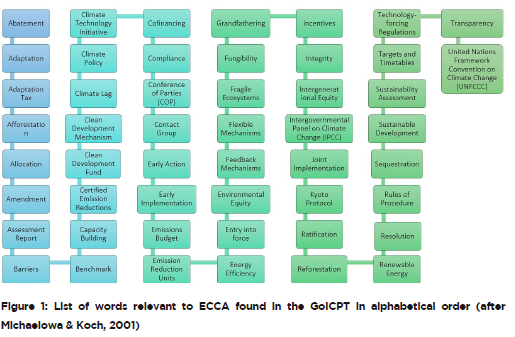
Figure 1 provides an inventory of fifty words relevant to ECCA, guiding the exploration of their manifestations in geography education course packs. The choice of the 2001 glossary was based on the rationale that it was published a decade before the latest iteration of the national curriculum, allowing for a substantial period of subsequent knowledge development focused on ECCA. The quantitative word frequency tool served as a systematic means to generate new data, enhancing the alignment of ECCA. The frequency tool was used to extract terms from the GoICPT (Michaelowa & Koch, 2001) found in geography education course packs.
The research adopted a quantitative research framework, in line with Leedy and Ormrod's (2015) recommendation for its suitability in numerical data studies to discern relationships among variables and validate or revise existing theories. The chosen quantitative approach aligns with the focus on a limited number of variables, as suggested by Leedy and Ormrod (2015). Additionally, this methodology contributes to an interpretive understanding of ECCA representation, emphasising the impact of researchers' and stakeholders' values on a study (Robson & McCartan, 2011). Quantitative research enables the identification of patterns and trends even when content analysis is used as the sole methodology, facilitating the measurement of phenomenon representation through data analysis, aligning with study objectives (Leedy & Ormrod, 2015).
Among various content analysis approaches, Krippendorff's (2004a) quantitative word frequency tool was chosen because it establishes a context for inquiry and identifies meaningful patterns in texts related to ECCA. Therefore, Krippendorff's (2004a) tool enabled a systematic examination of texts, in this case, course packs, deriving insights into ECCA for pre-service teachers. Content analysis was selected as part of the research methodology due to its detailed and systematic examination of material contents, allowing researchers to determine the frequency of climate change-related words in the course packs. The research question focuses on the frequency of CCA-related words in geography education course packs at UKZN, which contain the module course outline, assessments, prescribed and recommended readings, and lecture notes.
Consequently, the methodology for exploring representation involved a content analysis of the geography education modules containing the course outline, assessment, and lecture notes. The course outline summaries are publicly available in the faculty handbooks, but course packs are not. The theory of representation guided the methodology to articulate how words related to climate change appeared within these modules. Various facets of representation, as discussed in the literature by Hall (1997; 2020a; 2020b), conceptualise social communication as a compilation of diverse representation types. The research design utilised a quantitative word frequency tool.
RESULTS
In line with the new B. Ed. guidelines outlined by the MRTEQ document (DHET, 2015), the replacement of 'old' course packs with 'new' ones ensued from the imperative to update its curriculum in adherence to the CAPS documents after 2011. Key lecturers and pertinent stakeholders were compelled and duly engaged in crafting a curriculum aligned with these directives. The restructured curriculum resulted in 'new' course packs as mandated by the thematic content delineated by the Geography CAPS document as outlined by the DBE.
The collected course packs coalesce among B. Ed., B. Ed. Hons and PGCE modules viz. Geography for Educators 210 (old), Geography for Educators 220 (old), Geography for Educators 310 (old), Geography for Educators 420 (old), Geography for Educators Method 2 (old), Geography for Educators Method 3 (old), Geography Education 1 (Development Studies) (new), Geography Education 2 (Biogeography and Geomorphology) (new), Geography Education 4 (Mapwork & GIS) (new), and Critical Discourses in Geography in South Africa (B. Ed. Hons module). 'Old' modules focused on content, whereas 'new' modules allow for both content and method modules. Notably, some of the 'old' course packs overlap with the 'new' ones, and all the mentioned course packs are not dated older than 2019. Out of the sixteen modules specified in the university's handbook, only ten course packs were acquired from participants who responded, resulting in the researchers obtaining 62.5% of the course packs for analysis in this article.
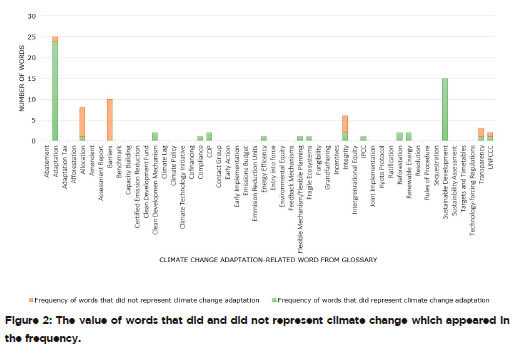
As a reference tool, the GoICPT, as a glossary, empowers individuals to engage in informed discussions and make decisions regarding CCA strategies and ECCA, contributing to the overall goal of enhancing climate change literacy and promoting effective adaptation measures. The study noted a disparity between the commitment to cross-disciplinary research and the actual preparedness of graduates for ECCA. Figure 2 illustrates the frequency of words not representative of CCA compared to those derived from the total value obtained through the word frequency analysis tool.
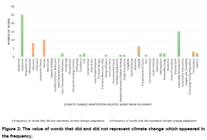
Figure 2 illustrates that among the fifty words sampled from the GolCPT (comprised 100% in this study), sixteen, or 32%, were found in the course packs. It was revealed that these sixteen words appeared at a frequency of eighty-two times across the various course packs. However, fifteen, or 93.75%, of these sixteen words represented CCA in the correct context; these words were 'adaptation,' 'allocation,' 'clean development mechanism,' 'compliance,' 'Conference of Parties,' 'energy efficiency,' 'flexible mechanism/ flexible planning,' 'fragile ecosystems,' 'integrity,' 'Intergovernmental Panel on Climate Change,' 'reforestation,' 'renewable energy,' 'sustainable development,' 'transparency,' and 'UNFCCC'. These fifteen words then appeared at a CCA contextually correct frequency of fifty-two or 63.41% times from the total eighty-two abovementioned appearances (Supplementary Table 1).
A tabulation of words found within the course packs due to the word frequency analysis tool (see Supplementary Table 1) identified the specific course pack associated with each word from the GoICPT. It included a direct quotation to illustrate the contextual usage of that word within the course pack. The inclusion of these quotations was crucial for demonstrating how each word contributed to the representation of CCA within the course packs, thereby enhancing the research findings.
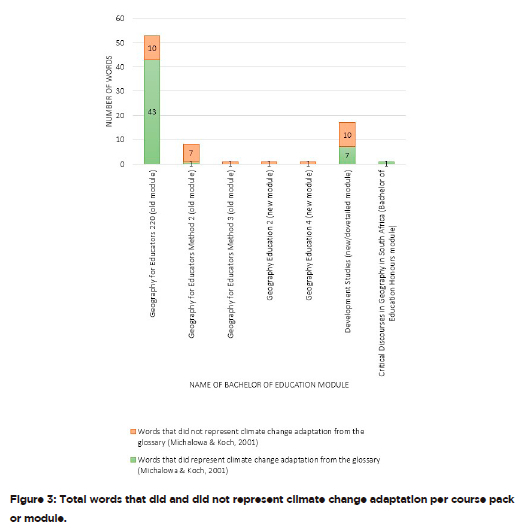
After conducting a content analysis on the eighty-two appearances of words from the GoICPT in the course packs, it was found that exactly fifty-two, or 63.41%, represented CCA in a contextually correct manner. The remaining thirty words, comprising 36.58% of the total, concerned additional aspects of geography education, such as assessment and content knowledge beyond the scope of CCA alignment, and as a result, they were excluded from Supplementary Table 1. What was notable in the results was that the course packs of 'older' and now defunct B. Ed., B. Ed. Hons and PGCE modules viz. Geography for Educators 210, Geography for Educators 220, Geography for Educators 310, Geography for Educators 420, Geography for Educators Method 2, and Geography for Educators Method 3 represented a higher frequency of CCA-related words from the GoICPT compared to the 'newer' and current modules viz. Geography Education 1 (Development Studies), Geography Education 2 (Biogeography and Geomorphology), Geography Education 4 (Mapwork & GIS), and Critical Discourses in Geography in South Africa (B. Ed. Hons module). This result is shown in Figure 3. One explanation for this phenomenon may be the adoption of 'new' modules, which align with the General Education and Training phase, whereas the 'old' modules align with the FET phase.
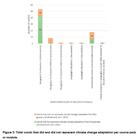
Figure 3 illustrated each course pack containing the sixteen CCA-related words, totalling eighty-two appearances, and further showed each course pack that did represent CCA appropriately across fifteen words, constituting fifty-two, or 63.41% of the total appearances. Upon analysis of Figure 3, it was revealed that in the Geography for Educators 220 course pack, an old B. Ed. module focusing on settlement geography, forty-three of fifty-three words correctly represented CCA. In the case of the Geography for Educators Method 2 course pack focused on didactics of geography education, one of eight words correctly represented CCA. The Geography for Educators Method 3, Geography Education 2, and Geography Education 4 course packs had only one quotation, which did not represent CCA, as the focus of these modules was to represent biogeography and geomorphology and mapwork content. In the dovetailed module of Geography for Educators 210 (old module), the Development Studies course pack (new module), seven of seventeen quotations correctly represented CCA. Lastly, in the B. Ed. Hons module, Critical Discourses in Geography in South Africa, one word matched the GoICPT and correctly represented CCA.
These findings indicated that out of the eighty-two appearances of sixteen words, fifty-two, or 63.41%, correctly represented CCA. The results revealed both areas of commendable practices in ECCA and shortcomings in its representation within UKZN's School of Education geography education course packs. The results from this exercise indicated that approximately two-thirds (fifty-two words) of the eighty-two appearances successfully represented CCA. Notably, not all course packs included CCA-related words, and some course packs lacked them entirely. It became evident that the older or dovetailed course packs encompassed a greater frequency of words representing the concept of ECCA compared to the newer and current geography education modules, and this is an issue because the new B. Ed. modules have not allowed the conceptual and content range of the old B. Ed. modules.
RECOMMENDATIONSHere, we provide four recommendations for future policy:
Policy Directives and Literature Perspectives: Policymakers should update policy directives, such as the NCCRWP (South Africa, 2011), to align with current debates and approaches to CCA and ECCA, with particular attention to Sustainable Development Goals 4 and 13. Literature perspectives from scholars like Lotz-Sisitka et al. (2021a) emphasise the crucial role of CCA as South Africa makes progress towards ECCA for international best practices. This perspective should be prioritised in university curricula across disciplines, especially in pre-service teacher training.
Role of Geography Education: Scholars (see Heath, 2021; Lotz-Sisitka et al., 2021a; Lotz-Sisitka et al., 2021b) identify geography education as a natural home for climate change education. It is recommended that greater prominence be given to the subject's role in the national and global CCA agenda. Stakeholders in higher education should explore a transdisciplinary or multidisciplinary approach to integrate diverse disciplines within the climate change discourse.
Curriculum Revision: The Geography FET CAPS (DBE, 2011) should undergo revision to align with current CCA and ECCA practices. Future curriculum planners should address inconsistencies and contradictions within the curriculum and ensure that it aligns with national and international best practices for greater representation of CCA.
Pedagogical Value in University Modules: UKZN's geography education modules highlight the pedagogical significance of ECCA, as the above study indicated that there is a representation of CCA from an international glossary. These modules foster critical thinking among future teachers and emphasise climate change's multifaceted nature. Elevating their visibility is essential for preparing pre-service teachers to address evolving CCA effectively.
CONCLUSIONS
In conclusion, this article contributes to the discourse on ECCA, particularly focusing on pre-service teacher training in South Africa. By employing Krippendorff's quantitative word frequency analysis tool and Hall's theory of representation, an examination of geography education modules at UKZN revealed that older and defunct modules demonstrate a higher frequency and representation of CCA-related words than newer and current modules. This finding is concerning as it implies a potential limitation in the conceptual and content breadth of the newer modules in the B. Ed. programme, which was aligned with the mandate from the DHET through the MRTEQ (DHET, 2015) to conform content to CAPS. Consequently, the recommendations provided in this article emphasise the indispensable role of pre-service teacher education in equipping teachers to address CCA effectively within South Africa's educational landscape.
REFERENCES
LITERATURE REVIEW
- Agbedahin, A. V. & Lotz-Sisitka, H. (2019). Mainstreaming education for sustainable development: elaborating the role of position-practice systems using seven laminations of scale. Journal of Critical Realism, 18(2), 103-122.
- Alves, F., Leal Filho, W., Casaleiro, P., Nagy, G. J., Diaz, H., Al-Amin, A. Q., de Andrade Guerra, J. B. S. O., Hurlbert, M., Farooq, H., Klavins, M., Saroar, M., Lorencova, E. K., Jain, S., Soares, A., Morgado, F., O'Hare, P., Wolf, F. & Azeiteiro, U. M. (2020). Climate change policies and agendas: Facing implementation challenges and guiding responses. Environmental Science & Policy, 104(2), 190-198.
- Anderson, A. (2012). Climate Change Education for Mitigation and Adaptation. Journal of Education for Sustainable Development, 6(2), 191-206.
- Apple, M. W. & Christian-Smith, L. K. (2017). The Politics of the Textbook (1st ed.). Routledge.
- Burt, J. C. (2020). Cognitive justice and environmental learning in South African social movements, [Doctoral thesis, Rhodes University, unpubl.]. Rhodes University Commons.
- Cloete, N., Bunting, I. & Van Schalkwyk, F. (2018). Research universities in Africa. African Minds. https://doi.org/10.5281/zenodo.1479114
- Department of Basic Education. (2011). Curriculum and Assessment Policy Statement Further Education and Training Phase Grades 10-12 Geography. South African Government.
- Department of Higher Education and Training. (2015). National Qualifications Framework Act (67/2008): Revised policy on The Minimum Requirements for Teacher Education Qualifications. South African Government.
- Department of Higher Education and Training. (2006) The Higher Education Qualifications Framework. South African Government.
- Donnelly, K. (2015). Review of the Australian Curriculum: A view from a member of the Review Team. Curriculum Perspectives, 35(1), 8-19.
- Grubert, E. & Siders, A. (2016). Benefits and applications of interdisciplinary digital tools for environmental meta-reviews and analyses. Environmental Research Letters, 11(9), 1-14.
- Hall, S. (1997). The work of representation. In S. Hall (Ed.), Representation: Cultural Representations and Signifying Practices (1st ed., pp. 13-71). Sage Publications Ltd.
- Hall, S. (2020a). The work of representation. In T. Prentki & A. Abraham (Eds.), The Applied Theatre Reader (2nd ed., pp. 1-47). Routledge.
- Hall, S. (2020b). Old and new identities, old and new ethnicities. In A. D. King (Ed.), Culture, Globalization, and the World-System: Contemporary Conditions for the Representation of Identity (1st ed., pp. 41-68). University of Minnesota Press.
- Heath, G. E. C. (2021). Catchment and River Management in Graduate Teacher Education: A Case Study of Student Teacher Learning and Teaching in the Upper uThukela Valley, KwaZulu-Natal [Doctoral thesis, Rhodes University, unpubl.]. Rhodes University Commons.
- Irwin, T. & Mokdad, T. (2010). Managing contingent liabilities in public-private partnerships: Practice in Australia, Chile, and South Africa. World Bank.
- Ko, D., Mawene, D., Roberts, K. & Hong, J. J. (2021). A systematic review of boundary-crossing partnerships in designing equity-oriented special education services for culturally and linguistically diverse students with disabilities. Remedial and Special Education, 42(6), 412-425.
- Krippendorff, K. (1989). Content Analysis. In E. Barnouw, G. Gerbner, W. Schramm, T. L. Worth & L. Gross (Eds.), International Encyclopaedia of Communication (Vol. 1, pp. 403-407). Oxford University Press.
- Krippendorff, K. (Ed.). (2012). Content analysis: An Introduction to its Methodology (4th ed.). SAGE Publications.
- Leedy, P. D. & Ormrod, L. E. (2015). Practical Research Planning and Design (11th ed.). Pearson.
- Lotz-Sisitka, H., Ali, M. B., Mphepo, G., Chaves, M., Macintyre, T., Pesanayi, T., Wals, A., Mukute, M., Kronlid, D., Tran, D. T., Joon, D. & McGarry, D. (2016). Co-designing research on transgressive learning in times of climate change. Current Opinion in Environmental Sustainability, 20(1), 50-55.
- Lotz-Sisitka, H., Mandikonza, C., Misser, S. & Thomas, K. (2021a). Making Sense of Climate Change in a National Curriculum. In I. Schudel, Z. Songqwaru, S. Tshiningayamwe & H. Lotz-Sisitka (Eds.), Teaching and Learning for Change, (1st ed., pp. 92-111). African Minds.
- Lotz-Sisitka, H., Rosenberg, E. & Ramsarup, P. (2021b). Environment and sustainability education research as policy engagement: (Re-) Invigorating "politics as potential" in South Africa. Environmental Education Research, 27(4), 525-553.
- Mac-Lean, C., Rojas, M., Vargas, L. & Vicencio, N. (2017). Climate Change Mitigation and Adaptation in Higher Education Institutions: The Case Study of the Faculty of Physical and Mathematical Sciences at the University of Chile. In W. Leal Filho (Ed.), Climate Change Research at Universities (1st ed., pp. 307-320). Springer.
- Macintyre, T., Lotz-Sisitka, H., Wals, A., Vogel, C. & Tassone, V. (2018). Towards transformative social learning on the path to 1.5 degrees. Current Opinion in Environmental Sustainability, 31(1), 80-87.
- Marr, B., Schiuma, G. & Neely, A. (2004). The dynamics of value creation: mapping your intellectual performance drivers. Journal of intellectual capital, 5(2), 312-325.
- Michaelowa, A. & Koch, T. (2001). Glossary of International Climate Policy Terms. Hamburgisches Welt-Wirtschafts-Archiv (Report No. 208).
- Nyerere, J., Kapfudzaruwa, F., Fadairo, O., Odingo, A., Manchisi, J. & Kudo, S. (2021). Case Study: Higher Education and the Education for Sustainable Development in Africa (ESDA) Program. In W. Leal Filho, R. Pretorius & L. O. de Sousa (Eds.), Sustainable Development in Africa (1st ed., pp. 179-199). Springer.
- O'Donoghue, R., Kibuka-Sebitosi, E., Tshiningayamwe, S. & Palmer, C. (2019). Navigating nonsense by exemplifying situated life experience and intergenerational heritage knowledge in Education for Sustainable Development learning spaces. Southern African Journal of Environmental Education, 35(2), 1-18.
- Participant 1. (2020a). Geography for Educators 220: EDGG220 EC [Unpublished lecture notes]. University of KwaZulu-Natal.
- Participant 1. (2020b). Geography for Educators Method 2: EDGG301 EC [Unpublished lecture notes]. University of KwaZulu-Natal.
- Participant 2. (2021). Critical Discourse in Geography in SA: EDGG701 E2 [Unpublished lecture notes]. University of KwaZulu-Natal.
- Participant 3. (2019). Geography for Educators 210: EDGG210 EC [Unpublished lecture notes]. University of KwaZulu-Natal.
- Participant 4. (2021). Geography for Educators: EDGO212 E2 [Unpublished lecture notes]. University of KwaZulu-Natal.
- Phelps, N. A., Atienza, M. & Arias, M. (2015). Encore for the enclave: the changing nature of the industry enclave with illustrations from the mining industry in Chile. Economic Geography, 91(2), 119-146.
- Pretorius, R. (2021). Sustainability and climate action in the higher education system. In T. McCowan, W. Leal Filho & L. L. Brandli (Eds.), Universities Facing Climate Change and Sustainability (1st ed. pp. 92-103). Körber-Stiftung.
- Republic of Namibia. (2015). Third National Communication to the United Nations Framework Convention on Climate Change. Namibian Government.
- Robson, C. & McCartan, K. (2011). Real World Research (4th ed.). Wiley.
- Rundel, P. W., Arroyo, M. T., Cowling, R. M., Keeley, J. E., Lamont, B. B., Pausas, J. G. & Vargas, P. (2018). Fire and plant diversification in Mediterranean-climate regions. Frontiers in Plant Science, 9(851), 1-13.
- Schudel, I. (2021). Theorising active learning: A historical analysis. In I. Schudel, Z. Songqwaru, S. Tshiningayamwe & H. Lotz-Sisitka (Eds.), Teaching and Learning for Change (1st ed., pp. 127-149). African Minds.
- Schudel, I., Lotz-Sisitka, H., Songqwaru, Z. & Tshiningayamwe, S. (2021). Engaging Education for Sustainable Development as Quality Education in the Fundisa for Change Programme. In I. Schudel, Z. Songqwaru, S. Tshiningayamwe & H. Lotz-Sisitka (Eds.), Teaching and Learning for Change (1st ed., pp. 3-21). African Minds.
- Shava, G. N., Mathonsi, E., Hleza, S. & Shonhiwa, S. (2021). Addressing Sustainable Development Goal 4 on quality higher education, Transforming Zimbabwe, the 2030 Agenda for sustainable development. International Journal of Research and Innovation in Social Science, 5(8), 273-285.
- Shumba, O., Mandikonza, C. & Lotz-Sisitka, H. (2021). Advancing Assessment Thinking in Education for Sustainable Development with a Focus on Significant Learning Processes. In I. Schudel, Z. Songqwaru, S. Tshiningayamwe & H. Lotz-Sisitka (Eds.), Teaching and Learning for Change (1st ed., pp. 201-222). African Minds.
- Silo, N. & Ketlhoilwe, M. J. (2020). Environmental Sustainability Education: Driving Towards Achieving Sustainable Development Goal 4 through Teacher Education. In S. O. Keitumetse, L. Hens, D. Norris. (Eds.), Sustainability in Developing Countries (2nd ed., pp. 207-223). Springer.
- Songqwaru, Z. & Shava, S. (2017). Strengthening teachers' knowledge and practices through a biodiversity education professional development programme. In H. Lotz-Sisitka, O. Shumba, J. Lupele & D. Wilmot (Eds.), Schooling for Sustainable Development in Africa (8th ed., pp. 205-218) Springer.
- Songqwaru, Z. & Tshiningayamwe, S. (2021). Teacher Professional Development in Environment and Sustainability Education. In: I. Schudel, Z. Songqwaru, S. Tshiningayamwe & H. Lotz-Sisitka (Eds.), Teaching and Learning for Change (1st ed., pp. 259-274). African Minds.
- Sunthonkanokpong, W. & Murphy, E. (2019). Sustainability awareness, attitudes and actions: A survey of pre-service teachers. Issues in Educational Research, 29(2), 562-582.
- Taviv, R., Mwakasonda, S. & Witi, J. (2008, October 1-3). Developing the Greenhouse Gas inventory for South Africa [Conference presentation].16th Annual International Union of Air Pollution Prevention and Environmental Protection Associations Regional Conference, Nelspruit, South Africa.
- Tshiningayamwe, S. (2018). Integration of Climate Change into the Namibian School Geography Curriculum. Alternation, 21(1), 234-257.
- United Nations Educational, Scientific and Cultural Organization. (2020). Education for Sustainable Development: A roadmap.
- Vogel, C., Mukute, M., Coetzer, K., Gwata, M. (2021). Creating a climate of change in the City of Johannesburg: Co-learning to adapt to climate change. South African Journal of Science, 117(10), 1-12.
- Vogel, C., Schwaibold, U. & Misser, S. (2015). Teaching and learning for climate change - the role of teacher materials and curriculum design in South Africa. Southern African Journal of Environmental Education, 31(2), 78-97.
Accepted 17 June 2024
Published 21 June 2024