Land dispossession and reform: An optic into South African Grade 12 Geography textbooks
Abstract
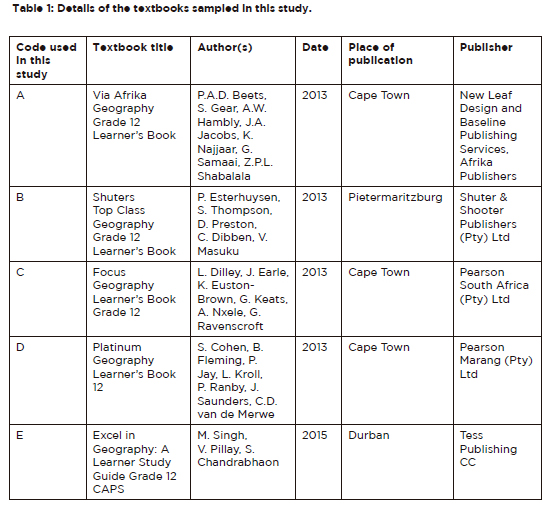
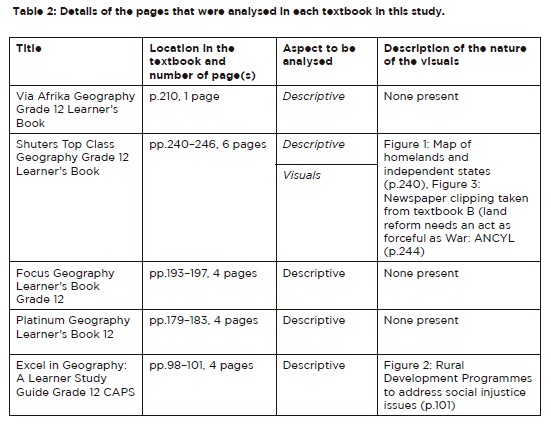
Land dispossession and reform are volatile issues in contemporary South Africa. With the transition to democracy in 1994, the post-apartheid government considered the implementation of land reform as a vehicle to redress injustices and inequalities in South Africa. This article focuses on how two discourses (social and political) on land dispossession and land reform are framed in selected Grade 12 school Geography textbooks in South Africa, and their implications. Locating the research study within a paradigm of interpretivism and approaching the research from a qualitative perspective, this case study engaged in document analysis, specific to the section on land reform in five purposively-selected textbooks. The study leans on framing theory in addition to social constructivism to highlight the role of textbook authors in presenting the social reality around land dispossession and land reform. The social and political discourses were explored through content analysis. The findings of this study establish that the social and political discourses that emerge are not mutually exclusive categories but rather are tied to a specific neoliberal ideology. The findings also reveal land reform content knowledge gaps and an unease by textbook authors in presenting racialized content in the section on land reform. The study concludes that redressing past land injustices in South Africa is entangled by several complexities. As a recommendation, the description of land dispossession and reform in the Geography textbooks can potentially be explained through multiple perspectives rather just than a singular perspective framed to gloss over the construct of South African racial categorisation and its connection to land reform and socio-economic development.
Land reform; Land redistribution; Historical injustice; Geography curriculum; Geography textbooks