Reading the "Present Time" as Queer Feminist Refuge in Lien Botha's Eco-Apocalypse
Abstract
Lien Botha's Wonderboom (2015) explores forgetting as a strategy for undermining linear historiography, and feminine unravelling as a revolt against violent masculinity, colonialism, and environmental decline. This article presents a reading of Botha's debut novel, accompanying visuals, and a selection of photographs from her oeuvre spanning at least 20 years-in counterpoint-to demonstrate how Botha fashions the present as queer feminist refuge in her engagement with troubled pasts and uncertain futures. I conduct my analyses via a postcolonial, queer and feminist framework, in order to highlight Botha's careful engagement with race, gender, and the environment, and employ Barad's hauntology to engage with Botha's disruption of the space-time continuum. To this end, the article elaborates on the many intertextual relationships between Botha's own visual and literary work, and those of a selection of South African and international literary figures. Botha's novel and her photography resist a conception of history that is linear and continuous, instead suggesting experiments with space-time configurations that question social and environmental responsibility. Botha creates a haunted space where past and future become blurred; the present, and the people and landscapes one encounters there, are revealed as a space of possibility for changed relationships with self, others, and nature.
queer feminism; photography; ecocriticism; hauntology; postcolonialism; eco-apocalypse; carnivalesque; space-time continuum; intertextuality
Introduction
Lien Botha (b. 1961) is a well-known South African author, photographer, and curator who has exhibited extensively both in South Africa and in Europe. I focus in particular on Botha's fictional debut, Wonderboom (2015), which presents what is in many ways a culmination of a lifetime of engagement with memory, history, and environmental decline. I read this work in counterpoint to some of Botha's photographic projects. Edward Said (1994, 18) proposes a contrapuntal reading of postcolonial texts that reveals how historical events from different places are intertwined, and overlap. Said's methodology shows both imperialist forces at work in the context of the production of the texts, as well as resistance to those forces, an idea central to my enquiry into Botha's work. Wonderboom explores a journey of forgetting and loss of self by way of the desert to an imagined paradise that fails to live up to its promise. Rosi Braidotti (in Casid 2005, xv) suggests that the desert is the true utopia of the nomad, who (in her formulation) is a traveller rejecting the controlling of space, and the "stocking and hoarding" typical of colonial systems. Instead, feminist subjects seek a counter-colonial Utopia, one that challenges the grand project of history and worn-out narratives of identity politics.
Botha explores the idea that in the context of the political and social context of postapartheid South Africa, the past is all but utopian, and that the possibility of a changed future seems bleak at best. She rejects the idea that a utopia can be found, or made; rather-I argue-she searches for, and actively makes space for places of refuge to be constituted in the present. Anna Tsing (in Haraway 2016, 100) suggests that the Anthropocene is characterised by the loss of "refugia" where communities of humans, animals, and plants can be reconstructed after traumatic events. Botha connects the loss of biodiversity with the increase in persons who live on the margins of society, such as refugees who have no place of safety and belonging. Similarly, Botha links violent masculinities, patriarchy, and colonisation with both suffering of people and the degradation of the environment. Her work considers the relationship that we have with nature, history, and identity, encouraging new understandings of memory, but also of vulnerability and connection with others. For Botha, colonial landscapes are overdetermined, fixed places, in which heteronormative colonial culture is continually reproduced. In contrast, the desert or wilderness is not a place of cultivation, but of movement, experimentation, negotiation, and deep loss. Botha's wilderness is akin to Braidotti's desert, which is revealed as a place of discontinuity and haunting in which the female nomad confronts the past and challenges patriarchal and colonial control over bodies and land (Laurence 2017, 85), in order to create places of refuge.
Roots
Magriet Vos, Wonderboom's protagonist, is a 50-year-old musician who has Alzheimer's disease, and lives in Betty's Bay, a seaside town not far from Cape Town. A bloody revolution led to the near destruction of most of the former territory of a lightly fictionalised, post-apocalyptic South Africa, controlled by a violent dictator known as Albino X. Magriet is a widow and is destitute and has lost most of her friends and neighbours to hunger or violence. The fortunate have left to go abroad, or to the north, where X's rule does not reach. Magriet plays the violin at Vergelegen, the residence of the dictator, but she knows that her failing memory means that she won't be able to make music much longer, and that she will be killed by X as a result. There is now barely any animal or plant life left; the few remaining trees are all owned by the state to eventually be used as firewood. Botha's narrative suggests that utopia was never possible, as is the case in many dystopian novels, but that a partial recuperation of the self and the recreation of places of refuge are possible through failure and forgetting. Indeed, Jack Halberstam (2011, 2) suggests that "failing, losing, forgetting, unmaking, undoing, unbecoming [and] not knowing, may in fact offer more creative, more cooperative, more surprising ways of being in the world." Following Halberstam, Johanthan Cane (2019, 137) reasons that failure provides a "worthy alternative to the violent triumphalism" of modernity, and the "toxic positivity" that denies the injustices served upon vulnerable groups.
The violent reign of X is characterised by total environmental destruction and absolute control over the last remaining natural resources. His home-Vergelegen-a well-known wine farm in the Western Cape, was claimed as property by Willem Adriaan van der Stel (1664-1733) when he took over the position of Governor of the Dutch East India Company's trading post at the Cape of Good Hope from his father, Simon van der Stel, in 1700. Today the farm is well-known for its gardens, notably the 300-year-old camphor trees planted under the supervision of Van der Stel at the entrance to the Manor House. The farm was later owned by mining magnate Sir Lionel Phillips (1855-1936) and his wife, Lady Florence Phillips (1863-1940), who was an avid gardener, and fervently promoted indigenous gardening. Sir Lionel was instrumental in the establishment of the Kirstenbosch Botanical Gardens in Cape Town (Foster 2008, 43, 61). Botha thus chooses the setting from which X rules as a place in which power, empire, and capitalist cultivation of nature have been intertwined throughout South Africa's history. In Botha's novel, the original gardens of Vergelegen have mostly been destroyed and the ancient camphor trees cut down for wood.
Botha situates X as a colonist of sorts whose personal symbolism and public persona seek to create an illusion of conservation and care to hide the violence of his regime. Casid (2005, 68) argues that colonial picturesque aesthetics aims to obscure the violence of conquest, but X's violent dioramas-that remind of displays typical in natural history museums-serve to remind his subjects of his frightening ability for violence and brutality, while aestheticising that violence. Wonderboom makes the violence against people and the natural world clearly visible. Although the regime of X is purported to be non-racial, black people and women are marginal and vulnerable, and most of the country's citizens are destitute. Wonderboom chronicles Magriet's journey from the ruined dystopian city of Cape Town through the interior of South Africa to the city of Pretoria, which falls outside of the powerful grip of X. She imagines her journey to end at Wonderboom, where her last family members remain and where she might find refuge.
Botha's artistic and literary work is notably linked to her biography, which should be considered alongside her creative work. Her father, Roelof Frederik "Pik" Botha (1932- 2018), was a prominent politician of the National Party, whose political career started in 1970 when he won the parliamentary seat for the Wonderboom constituency in Pretoria. Botha's Wonderboom has several references to her father and his politics, and the title of the novel points likewise to the origins of her father's-and possibly her own-political awareness. Botha's father was a controversial figure with a disputed legacy. For some, he facilitated the transition in South Africa as a cabinet minister who had secret meetings with the liberation movement, while others remember him as a defender of and apologist for white supremacist rule and military action in neighbouring African countries. In the context of this novel, the Wonderboom thus serves not only as a specific geographical point of return, but also symbolically suggests a place where Magriet has her roots, a place that has a history that she can return to in the face of the destruction around her.
Magriet undertakes her dangerous journey with a group of five musicians, tasked by X to play music to the last remaining cherry trees on a farm on the outskirts of Ceres.1 The party travels through the interior, which is rendered desolate and is roamed by murderous bandits. As they travel further and further from Cape Town, Magriet remembers less and less. She keeps a notebook in her violin case, in which she scribbles the most important details of her identity, where she is from, and where she is going. Contrary to conventional dystopian narratives, Magriet does not record the past merely because it gives her hope for a better future, or alternatively as a form of protest against oppression, but rather because recording important aspects of her identity serves to ensure that she reaches her destination safely (Human 2018, 118). Her memories are therefore not nostalgic or artistic, but utilitarian, and have the purpose to move her forward, not to keep her in the past.
Magriet's journey is figured as a series of devastating losses of people and places of refuge: first, her husband in an accident, then a beloved dog given to her as a gift by a neighbour. Her friends all move away or die, one after another. Each trauma causes her to lose her grip on reality further. When travelling through the Karoo, three of the members of her travelling party are murdered by flesh-eating bandits. Over the course of Magriet's perilous journey she alights briefly at several places where she can rest and recover from trauma before she moves on. One such place is the farm of the Wildenboers, which she visits in a chapter entitled Apteekboom (Pharmacy tree). Here Magriet and the other two survivors of the ambush, Louise and Floris, are given new clothes, hearty meals, medicine, and rest. Magriet stays on this farm, which she describes as an island, for several days. Of the Wildenboers she wonders "how these people can still live so properly in spite of the chaos of the world" (Botha 2015a, 145; own translation).
In this community, which lies just behind the Vrouwberg (woman mountain) (Botha 2015a, 164), she also meets Fleur, who lives in a makeshift hut with her dogs and Oom Silwer (Uncle Silver). Fleur is an alchemist of sorts who uses indigenous plants to make medicines. Her relationship with the earth is symbiotic; she takes only what she needs to heal others. This community can be described as a refuge within the dystopian wasteland of the novel. In this community there are no children, and the people that share the space are bound by queer kinship ties that are not based on a traditional nuclear family. Here, Magriet starts to feel a sense of freedom and safety. She can also mourn the loss of her murdered friends. The mourning of "irreversible losses," which include the destruction of nature, is according to Haraway (2016, 160) an essential purpose of places of refuge. Botha explores here how space can be transformed through alternative social orderings, landscaping practices, and queer kinship ties that are counter-colonial. The centre-margin binary is challenged, as it is shown how life at the margins, outside of power, can be transformed to offer refuge, freedom, and release from oppression. Magriet's body and spirits are renewed here to some extent, and she feels strong enough to continue her quest, although the severe trauma has accelerated her memory loss.
Objects, Photography, and Memory
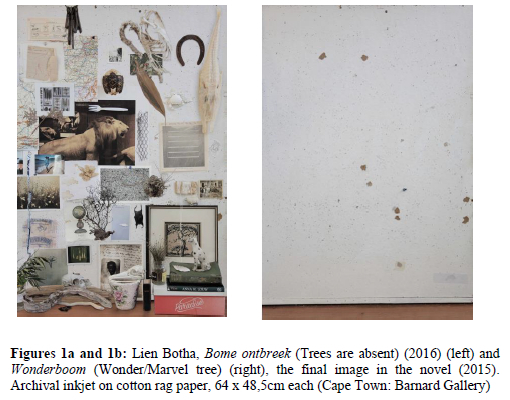
Wonderboom is a hybrid work that combines fiction and photography.2 Each of the 18 chapters in the novel is accompanied by a photograph that provides a visual accompaniment to the plot, which together form a standalone series. The photographs picture various objects and images significant to Magriet's story, some presented on a table, others pinned to a wall. Each photograph in the series corresponds to a chapter in the novel, and each one is named after a different tree. In each photograph, one object disappears, until only a bare wall is left in the final image, entitled Wonderboom. This dwindling of pictured images parallels Magriet's loss of memory, but also of some very specific material objects, persons, and aspects of her identity.
Archival inkjet on cotton rag paper, 64 x 48,5cm each (Cape Town: Barnard Gallery)
The title of the first image, Bome ontbreek (Trees are absent)-in a literal sense-points to the lack of trees in the novel, all having been cut down for firewood. Figuratively, it could, however, likewise refer to Botha's collage works as embodying a rhizomatic structure rather than being hierarchical, like that of a tree. The assemblage of images and objects pictured in this series has no central axis or obvious structure, and items are removed in no particular order. Similarly, this title, which is also the name of the first chapter, is suggestive of the form of the book as one in which the narrative sequence is continually disrupted. The title likewise refers to Magriet's memory loss, which eventually causes her to forget even her family history or family tree, thus severing the generational bond.
Botha (2015b) describes the Wonderboom series as being a culmination of her long-standing interest in the interplay between image and text and in the role of the photograph in preserving memory and recording history. The work satisfies all the requirements of Miriam Schapiro's femmage, a collective noun meant to indicate the creative combination of collage, assemblage, decoupage, and photomontage of materials "collected, saved and combined" by women throughout history, from a place of "pride, desperation and necessity" where their "spiritual survival depended on the harbouring of memories" (Schapiro and Meyer 1978, 66, 68). Botha's work crucially grapples with memory-she is trying to sort through her own, as Magriet forgets hers.
Wonderboom brings together selected aspects of Magriet's journey, and also images from Botha's earlier work, such as the lion, photographed at the South African Museum in Cape Town, from the Parrot Jungle series (2009), and the crab from Yonder (2011-2013), photographed at the Ditsong Museum of Natural History in Pretoria. Additionally, many of the images in both Parrot Jungle and Yonder seem to suggest scenes or places in Botha's novel, or from her childhood. The photographs, objects, novel, and her own biography are intertwined in complex and overlapping ways: They are Botha's memories, but also Magriet's, and as Botha documents these places and memorialises them in her novel, Magriet leaves them behind. The line between Wonderboom (the novel) and Botha's own biography becomes blurred as her own travels and that of the fictional Magriet start to overlap, confusing the timeline of Magriet's-and Botha's-fading memories.
Botha challenges the idea that one should remain anchored to a long history or tradition, suggesting instead that relinquishing or forgetting one's lineage might have more productive possibilities. This theme may seem at odds with the cherishing of fond memories by collecting and photographing, but Botha approaches the theme of memory from both critical and nostalgic angles, revealing how these simple binary classifications fail. Forgetfulness, Derrida (in Halberstam 2011, 86) reasons, spurs an "archive fever," a drive to memorialise, to collect and remember. Botha's collection of photographs for her travels and the collages in Wonderboom that represent her fading memories are emblematic of Derrida's "archive fever," but they are also an anti-archive, or a failed archive, because they obscure and disappear, rather than expand and reveal. This "negation ... and undoing," according to Halberstam (2011, 126), points to a "queer feminist genealogy" being born. Failure, says Halberstam (2011, 89), is queer, because it refuses conformity, heteronormative and capitalist reproduction, and ideological closure. Queer, feminist archives, such as Botha's, not only question what counts as historical evidence (Cooper 2016, 449), but also communicate the counterhegemonic desire to challenge conventional understandings of social formations, power, and history (Berlant in Halberstam 2011, 20).
Botha's retelling of Magriet's journey revises a familiar trope of postcolonial novels in which the protagonist returns to or visits a place they consider "home" or goes on a voyage in order to remember their past as a marker of identity. Instead, Magriet's journey questions the link between memory, place, and identity. Sara Ahmed argues similarly that the migrant imagines herself to be most authentic and "at home" in the place where she originates from; paradoxically, when she has been away from that place for a long time, it might feel the most unfamiliar. It then becomes "home through the very failure of memory" (Ahmed 1999, 330). "Home" thus loses its utopian appeal. Ahmed (1999, 343) suggests that coming home is always felt as estrangement and discomfort because "home" suggests not only a place, but a temporality to which one can never return. The failure of Magriet's individual memory unsettles the idea of the home-visit as an opportunity to learn from the past. Her loss of the sense of place and time suggests that she needs to leave behind her claim to any history or ancestry in order to find solace.
Like the collages of Wonderboom, the images from the Parrot Jungle and those from the Yonder series, when viewed as a separate body of work, may at first appear haphazard and idiosyncratic. Botha explains that these are all places or objects that she encountered before on previous journeys-including a road trip she undertook while writing Wonderboom-and later went back to photograph as a way to salvage the memory of these encounters. Botha's collections, whilst exposing and critiquing this imperial gaze, attempt to reclaim the practice of collecting to represent marginal perspectives. Furthermore, she critiques the colonial desire to label and categorise through established modes, by arranging a strange assortment of objects and images unsystematically. Her photographs seem to suggest the postapocalyptic world she imagines in Wonderboom, yet they are images of the past, haunting the present.
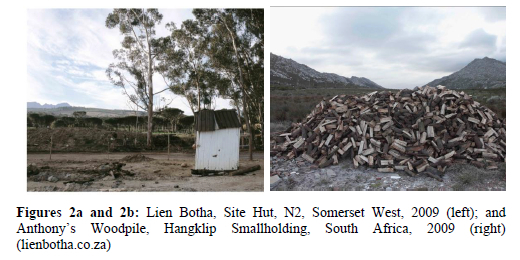
One such photograph from Yonder shows an empty and dilapidated swimming pool photographed in the Tankwa-Karoo,3 also described prominently in her novel. According to Halberstam (2011, 111), empty pools are signifiers that become available for "queer signification," because they have lost their use-value, becoming sites of loss and failure. A swimming pool filled with water beckons the tired and hot traveller to cool down, to float, and to relax, while the empty pool reveals what is behind the glittering surface (nothing). It is thus a site where desire is perverted: The dangerous emptiness nevertheless beckoning one to jump. Botha captions many of her photographs with the specific place and approximate date she encountered them, indicating her commitment to remembering where and when the memories fit into her own personal narrative. The interplay between the image-such as the one of the swimming pool- taken in the past, and the subsequent description of the image in the novel, as Magriet (and Botha) encountered it, but set in the future, or the novel's present, confuses the temporality of the image, when one reads Botha's novel and her photographs in counterpoint. Similarly, Botha photographs several make-shift huts and shelters, reminiscent of the huts Magriet finds Fleur and Oom Silver living in, and objects such as battered plastic containers and pieces of string, which she describes in the novel as being found washed up on the beach in Betty's Bay by Magriet, where Botha herself resides.
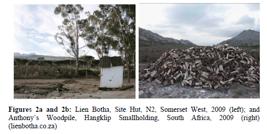
Barad (in Bell 2018, 108) uses the term "hauntology" to describe the emergence of non-linear timescapes in speculative fiction that occurs when the interactions between characters and plot suggest alternative understandings of social responsibility, rejecting colonial and patriarchal domination, and bringing readers into the experience of queer, non-linear time. Whilst capitalism presupposes a push towards the future, where heteronormativity, patriarchy, and colonial domination are continued, queer feminism envisions a future where our responsibility to each other is unending (Bell 2011, 114), and where accountability for the horrors of the past is shared. Barad's hauntology of the past and future is thus also helpful in relation to an ethical problem which Botha's narrative of forgetting poses, namely that forgetting represents a repression of the past that potentially evades responsibility for the past's injustices. Botha's forgetting is employed differently-not as repression-but as surrender, by severing her claim to a generational lineage that provides her with privilege and an identity based on white supremacy. However, this repression does have a dark side, in that an empty conscience implies a clear conscience, one that is absolved from guilt and shame. Nevertheless, Botha's work suggests forgetting not as a strategy of evading responsibility or even as a way of setting things right. This idea is furthered through the conspicuous absence of any children in her novel. Not Magriet nor anyone at the Vrouwberg community, or the proprietor of the guest house Nessum Dorma-her last stop on her journey-and another refuge in the novel, has any children. Magriet's forgetting is thus not a form of repression but a way to end a dynasty. For Botha, the past and future will always haunt the present, providing opportunities to respond-or to be response-able, in Haraway's (2016) punning and provocative call-to our present time instead of merely reconstructing history, remembering nostalgically or selectively, or speculating about uncertain futures.
The Memory of Birds
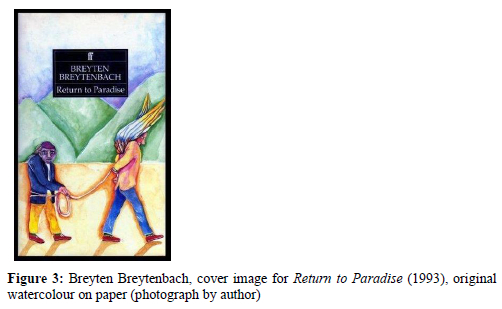
Birds are constant companions in Botha's visual and literary work, and their presence (or absence) is a marker in the same way that trees throughout the narrative act as signposts and often as warnings of impending disaster and death. Similarly, Botha's photographic work contains many images of dead birds, mostly museum specimens behind glass. Whilst birds flying might represent freedom or hope, dead or caged birds are signs of failure, disillusionment, and despair. On their way to pick up the last member of the travelling party before they set out for the north, Magriet sees a dead bloekom (blue gum or eucalyptus tree)4 with several dead birds nailed onto it in a similar way as a shrike would impale its prey. This sequence of the novel pays homage to exiled poet and painter Breyten Breytenbach's (born 1939) compilation of short stories, entitled The Memory of Birds in Times of Revolution (1996), and has specific intertextual references to a piece entitled "The Lines Have Fallen unto Me in Beautiful Places (How to Help a Character out of a Story)." In this short story, Breytenbach recounts a visit to South Africa while writing Return to Paradise (1993), a fictionalised, semi-autobiographical travelogue, in which Breytenbach seeks a new understanding of his identity by travelling to places in South Africa he had known before, noting that "identity is circumstantial and relative" (Breytenbach 1993, 73). In "The Lines Have Fallen," Breytenbach is accompanied only by his wife, whom he refers to as Lady One, also the title of an anthology of love poems by Breytenbach (2002). On their journey they are "dogged by a rather obnoxious character" who, "[f]rom the onset [...] would surface at odd moments to taunt me with sarcastic remarks." The man Breytenbach (1996, 106) refers to as Mr X is not a real person, but a character in the novel he is writing. He writes:
When it came to editing the bulky manuscript, however, it was suggested that I should leave out this shadowy figure blocking the background like an unresolved nightmare, this dog barking without a voice. It was thought that such a spectre from the past would detract from the limpidity and the present tense of the story. (1996, 106; original emphasis)
Breytenbach (1996, 106) then goes on to note that "he complied," but since then had been "ill at ease" because he could not stop "reminiscing" about the man. The persistent haunting presence of this man, and his continued harassment of Breytenbach, eventually leads him to decide to murder him. This X is described as having wings made of the decomposing carcasses of birds, and is depicted in a painting by Breytenbach, featured on the cover of Return to Paradise. The murder scene is an old blue gum (eucalyptus) tree, where Breytenbach hangs the man on a branch.
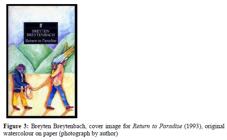
The murder of the troublesome Mr X is echoed in Wonderboom in several places besides this scene, such as Botha's naming of her dictator as Albino X, which is a possible intertextual reference to Breytenbach, who refers to himself as "the Albino Terrorist," from the title of his confessional (Breytenbach 1985), written during his time of political imprisonment in South Africa in the 1970s. Later Magriet is approached by the "horrid critic" (Botha 2015a, 122)-suggestively named Hemingway-a character that follows Magriet around ominously, taunting her with his sarcastic and sexually provocative remarks through several chapters, like Mr X followed Breytenbach. Whilst Breytenbach lures Mr X into his car to murder him, the critic Hemingway eventually tricks Magriet into his car with the intention of raping her. Hemingway takes her to see the flamingos at Kamfers dam, close to Kimberley, where he attacks her. Magriet, however, manages to coax him out of the car and then kills him by stabbing him in the neck with acacia thorns that Fleur had sewn into her dress seam.5 Like Breytenbach, Botha also needed to write this character out of her story, because his haunting presence was holding her back.
Botha (2015b) explains that her novel pays homage to, or alternatively critiques, several modern and contemporary literary and visual texts. The collages from Wonderboom contain various intertextual references to South African novels and visual culture, such as the framed print of a tree by South African modernist and nationalist artist J.H. Pierneef (1886-1957) and a copy of Anna M. Louw's novel Vos (1999).6 Similarly, Botha's novel also contains various references to important literary figures and works, that I will elaborate on briefly in this section, because of their relationships with Botha's novel. The reference to Ernest Hemingway (1899-1961) has several possible meanings or purposes here. Botha's description of Hemingway as the "nasty critic" and as a "brusque, perverted rapist, a snake with a bitter smell" (Botha 2015a, 113), and an "animal marking his territory ... smelling like mongoose piss" (122; own translation), suggests that Botha does not hold the author Hemingway in high regard; however, within the greater context of this novel, one could argue that Botha, through the way that she has structured the novel as to fall somewhere between the genres of memoir and travelogue, as well as her engagement with themes of memory and loss, simultaneously-although arguably somewhat obliquely-pays homage to Hemingway. Botha's suggestive insertion of Hemingway and his oeuvre also makes apparent her attempt to suggest that masculinity and Empire are intimately connected and how the intersection of white supremacy and patriarchy operates as markers of power. Several critics have noted Hemingway (the author's) disregard for women and people who are not white (see Armengol-Carrera 2011, 45; Cushman 2009, 468). His self-indulgent narratives have also been criticised for their celebration of a worldview that is imperialist and anti-conservationist, while supporting the exploitation of natural resources and the colonisation of Africa and its people. His excessive bravado and his dismissal of his wife, black guides, and native hunters in Green Hills of Africa (1935) position him as the ultimate hero in a narrative where women and black persons are supplementary.
Botha's Hemingway represents an agent of white power and violent masculinity: He is a hunter who carries a gun, and approaches Magriet in his car like "an animal approaching [its prey] very slowly" (Botha 2015a, 172). The flamingos at Kamfers dam, where he takes Magriet, are suggestive of the flamingos at the Ngorogoro crater in Tanzania,7 a place that Hemingway visited when he was on a hunting safari in Kenya and Tanzania in 1933, inspiring his memoir Green Hills. Curiously, however, he does not mention this place in his memoir, although he refers to Lake Manyara as well as the Serengeti Plain, which lie on either side of the crater. This omission is peculiar, if not deliberate, as Pauline Hemingway (in Cushman 2009, 465) writes in her diary that the afternoon of the 24th of December, which they spent at the crater, was "by far the most exciting time." This curious omission affirms the status of writing as an imaginative practice that is more attuned to art than fact. Like Hemingway, Magriet is also revealed as an unreliable witness, because of her failing memory and increasing disconnect from objective reality. Nevertheless, memory is exposed as slippery, and obliquely related to truth at best, but more crucially, intimately connected to place. These themes become more pertinent in Hemingway's later works, and William Adair (1983, 302) suggests that Hemingway's later work is concerned more with loss, fear of loss, and nostalgic memory or longing. Likewise, Garden of Eden is a culmination of Hemingway's growing concern with the inevitable passing of time, the betrayal of remembering, and impotence, both sexually and in being unable to make art (Lounsberry 2013, 205), all equally applicable to Botha's Wonderboom, and her photographic practice.
Botha, then, is writing in a space that Hemingway has deemed inconsequential or unworthy of his narrative for one reason or another, possibly because he was not the first European explorer to encounter this place, and would therefore not have been the first to write convincingly about the place as an "idealised paradise," newly discovered. Botha's decision to pick up her narrative at the point where Hemingway left it attests to her commitment to that which is overlooked, or which at first seems uninteresting, even unoriginal, also evidenced by her choice of subject matter in her photography. She writes within this liminal space-an unoriginal place, already written many times, and left out by an important author-attempting to construct a counter history within a blind spot. It is in this gap that Botha is able to write her own troublesome character out of the story, and move forward to the possibility of refuge.
Botha's recalling of the author Hemingway invokes the literary traditions within which she situates herself but simultaneously also attempts to challenge. The fictional Hemingway denotes the danger of physical violence, whilst the author Hemingway suggests discursive violence and possibly patriarchal control. Botha's murder of the fictional Hemingway attempts to overturn the idea of the vulnerable female protagonist as victim and possibly also Botha's position as a woman within the literary canon. Ironically the banknote and car she takes from him after the murder at Kamfers dam make it possible for her to continue her journey. The "taking" of Hemingway's property at the murder scene is suggestive of Botha's borrowing of some of Hemingway's narrative strategies, and familiar chronotopes. She communicates her resistance to certain aspects of masculine and colonial literary history, but simultaneously retains some aspects thereof. Although Magriet flees in Hemingway's Ford Torino, it soon runs out of petrol, and she continues her journey with Solange, a black Nigerian woman, driving a hearse. The implication is that stolen (or borrowed) property of another can only take one so far, and that in finding new futures Magriet will need to rely on her own creativity and the kindness and companionship of others. Although she is leaving violence and oppression behind, the hearse indicates a loss, of leaving something behind, and never being able to return.
Botha positions the murder scene as a site of creation or new beginning through a call-out to a poem by another exiled poet, Peter Blum (1925-1990). In the passage that describes the moment of Hemingway's death, Botha writes: "Woknakwyf! The ancient word sounds. Blood pumps from Hemingway's neck and he becomes quiet" (Botha 2015a, 178; own translation). Woknakwyf is a neologism that Blum uses in a poem entitled "Man wat mal word" (Man who is going mad) (1963), and translated roughly means "ancient whore." In the moment that Magriet (and Botha by implication) kills Hemingway, she therefore becomes the first woman in a new history. The Ngorogoro crater, to which Botha refers through the intertextual relationship with Hemingway, is- fittingly-popularly referred to as Africa's Garden of Eden, strengthening the idea of paradise and creation in this scene, but also in the wider context of Botha's novel. Botha's borrowing from Blum, and Breytenbach, also aligns her writing with the revolutionary spirit and aesthetic that the work of these two authors represents, especially in the case of Breytenbach, who, besides being a prominent artist and writer, was politically active during and in the immediate years after apartheid ended.
A Parrot Can Lead One Down the Garden Path
Parrots occupy a prominent position in Botha's photographic work, mostly dead, or together with their human owners, in cages. Wonderboom prominently features a parrot-named Pink Floyd-belonging to one of the travel companions, Floris. When the travelling band is stopped at a roadblock after taking the wrong turn, a policewoman demands the parrot as a bribe to let them pass. The parrot features only in this one chapter and is never mentioned after this incident despite it being like a child to Floris (Botha 2015a, 99).8 The loss of Pink Floyd is a bad omen, and a precursor to the killing of the cherry farmer, Mortimer Ehrenreich, who is murdered by X later in the chapter.
Although sometimes dismissed as passé, parrots in art and literature are highly ambiguous figurations: Their ability to speak renders them closer to humans than most birds, yet they can only mimic what they are taught, sometimes repeating nonsensical gibberish, sounds, or unwanted utterances. Parrots are never fully domesticated, and occupy a liminal space between human and animal worlds, between subjugation and agency. Graham Huggan (1994) therefore suggests that parrots might be read as a metaphor for colonial mimicry in postcolonial texts. Novels, such as Wonderboom, in their mimicking of well-known colonial works, remind the reader of the colonial (or indeed patriarchal) context of the original text, simultaneously also mocking it, or resist the contexts, forms or assumptions of those texts. In Botha's novel, the mimicking of familiar tropes, forms, and narrative strategies of carefully selected male authors is evident, and she pays homage, as well as speaks back to these texts.
Bronwyn Law-Viljoen suggests the possibility that Botha's interest in parrots has intertextual reference to Julian Barnes's Flaubert's Parrot (1984), in which the narrator has an obsessive desire with finding the actual parrot which Gustave Flaubert had on his desk whilst writing Un coeur simple (A simple heart) (1898). Botha's photographic projects attest to this desire to link objects or images with memory and meaning. This idea is reinforced by Magriet's keeping of her memories in a notebook in her violin case, and again via the 18 photographs contained in the novel that act simultaneously as repository of memories and visual representation of the fading thereof.
The collection of objects in the photographs from Wonderboom also functions as a shrine of sorts, at which loss can be mourned. In Flaubert's Un coeur simple, Félicité, the main character of this novel, likewise arranges a strange collection of objects in her room to remind her of everything and everyone she has lost. Félicité shares some character traits with Magriet: Like Botha's protagonist, she has also lost everyone she loved and, more crucially, her gradual withdrawal from civilisation causes her to become, like Magriet, somewhat detached from reality. Félicité's most beloved collected object is a stuffed parrot, Loulou, which she donates to the local priest to be used in a religious ceremony. As Félicité dies in spiritual ecstasy, the procession passes her window. In a similar fashion, Magriet, after the loss of Floris's parrot in Wonderboom, sees "the last remains of an Africa Burn convoy" (Botha 2015a, 102) pass their touring van. Unlike Félicité, who has an apparition of Loulou in the procession as the Holy Ghost, Magriet has a frightening encounter with another prominent literary figure, namely Francois Rabelais (died 1553), who seems to be mocking her. The inclusion of Rabelais in the fantastical procession9 points to Mikhail Bakhtin's notion of the carnivalesque. Indeed, many of Bakhtin's ideas about the modern novel could be applied to Botha's work. Wonderboom is a self-reflective novel that makes use of parody and intertextuality in an ironic way, and thereby criticises its own form. Moreover, Botha's experimentation with various space-time settings and her confusion of dream and reality in this novel create "bridges" between the novel and the "real world," enabling the narrative to comment on history and the social reality that Botha writes about. The carnival is not only ambivalent, but also grotesque, reminding participants that life and death are not binary opposites but intertwined (Bishop 1990, 49). The carnival provides for instances where straightforward notions of linear temporality can be overturned-an important consideration regarding the form and content of Botha's novel. Carnival, Bakhtin (in Rivkin and Ryan 2004, 686) writes, celebrates "temporary liberation from prevailing truth and from established order," and momentarily suspends the feelings of insecurity experienced due to environmental and social decline (see Hutcheon 1983, 85), thus establishing a refuge, albeit a provisional and unstable one. Although the carnival only temporarily reverses hierarchies, it does provide opportunities for embodied human relationships to be experienced, and therefore possibly for instances of "becoming, change and renewal" (Bahktin in Rivkin and Ryan 2004, 686). The challenge to artistic hierarchies is alluded to in Botha's work through inclusion of popular visual culture references and by her ironic engagement with the work of prominent male writers.
Botha not only consistently lingers within the chronotope of "the road," but she seems to be stuck there, never finding home, nor refuge. The parrot recurs as a marker of thresholds in Botha's work, such as a nursery sign depicting a parrot, halfway through Botha's photographic journey in Parrot Jungle. Similarly, in Wonderboom the parrot scene occurs roughly in the middle of the novel, just before the inclusion of the ninth image, in which a postcard with several colourful parrots disappears. The vanishing of these objects reinforces the idea that the parrot carries substance in this scene. The parrot can also be read as self-criticism: It signifies the desire to collect, or to possess and control, which is what Botha critiques, but also does herself to a certain extent.
Conclusion
Botha's work wants to find refuge through her documentation of her own travels and also that of Magriet, but a contrapuntal reading of her visual and literary work suggests that she has not (yet) found it, but continues to hope. Indeed, the world as she (Magriet? Botha?) encounters it, is a journey of loss and frustrated desire which cannot be resolved (yet). Botha's nomad continues to travel through the desert and is always followed by the past and her memories. She is a queer and unstable spectre, moving through a haunted place, continually making it her home. She is driven by a desire that has no settled place to be. Discovery, control, and capitalist cultivation of the land-Braidotti reminds us-are part of a violent masculinity, which is countered by the seemingly aimless wandering of the nomad.
In Wonderboom Magriet finally arrives in Pretoria, but she does not recognise nor remember any of it. This ending suggests that she will keep on wandering aimlessly, because her journey now has no purpose. Losing her sense of direction, her history, and even her connection to a familiar place, she finally arrives home, but she does not realise it, because "the sandstone in her head has sucked up and devoured every memory" (Botha 2015a, 218; own translation). The ties to her colonial home are finally and completely severed. Here she shows kindness, and her kindness is returned by strangers, and she finds solace in the company of her fellow travellers. Botha's work shows how interacting with nature and others serves cultural, political, social, and affective ends, and that what is deemed natural is also constructed through our dwelling within nature, and with each other. On the last page of the book, Magriet is left standing completely alone on the curb-side of Flower Street in Silverton, Pretoria, "Wonderboom being, as the crow flies, seven kilometres away" (118). The image on the next page shows a thick mat of fallen leaves from the venerated Wonderboom, dated January 2013, and titled with the exact coordinates of the tree in Pretoria.
Magriet's failed arrival and her final forgetting suggest a discontinuity or a "queering of identity" (Barad 2010, 247) in which she is radically estranged from her past, and her future is deferred. "A hauntological futurity," Elisabeth Bell (2011, 144) writes, "does not correspond to either bourgeois utopian time or neoliberal end of time. It haunts both with an ethic of not only possibility but necessity of change." In the final image in the Wonderboom photographic series, only a bare wall is left. Although this last image points to Magriet's total loss of memory, it also signals a possibility for creating something new. However, the markings and stains left behind suggest that the past will always exist as a ghost, haunting the present and troubling the creation of an uncomplicated narrative. Magriet's homecoming is thus a failure and an encounter with strangeness (Ahmed 1999, 343).
For the exile and the nomad, Ahmed (1999, 331) notes, home is always somewhere else-it is not a place-rather, it is "where the self is going." In this sense, refuge could be a utopia in the sense that it is nowhere, or "no place"-eutopos-in Thomas More's ([1516] 2012) ironic formulation. The open-ended closing of the narrative suggests that Magriet, although she has lost much and not gained anything tangible, has moved into a space of possibility where although she has no immediate purpose, she may find refuge, over and over again, not via closure but through movement. Botha's work suggests that the present time is our only refuge, as there are no new beginnings, or recognisable endings, only journeys of loss and (un)becoming.
References
- Adair, W. 1983. "Ernest Hemmingway and the Poetics of Loss." College Literature 10 (3): 294-306.
- Ahmed, S. 1999. "Home and Away: Narratives of Migration and Estrangement." International Journal of Cultural Studies 2 (3): 329-347. https://doi.org/10.1177/136787799900200303.
- Armengol-Carrera, J. M. 2011. "Race-ing Hemingway: Revisions of Masculinity and/as Whiteness in Ernest Hemingway's Green Hills of Africa and Under Kilimanjaro'" The Hemingway Review 31 (1): 43-61. https://doi.org/10.1353/hem.2011.0033.
- Bakhtin, M. 2004. "Rabelais and His World." In Literary Theory: An Anthology, 2nd ed., edited by J. Rivkin and M. Ryan, 686-692. Oxford: Blackwell.
- Barad, K. 2010. "Quantum Entanglements and Hauntological Relations of Inheritance: Dis/continuities, SpaceTime Enfoldings and Justice-to-Come." Derrida Today 3 (2): 240-269. https://doi.org/10.3366/drt.2010.0206.
- Bell, E. 2011. "Feminism and Time in Recent Speculative Fiction." LLIDS: Language, Literature, and Interdisciplinary Studies 2 (2): 107-126. https://doi.org/10.71106/SJHE8892.
- Bishop, E. 1990. "Bakhtin, Carnival and Comedy: The New Grotesque in 'Monty Python and the Holy Grail.'" Film Criticism 15 (1): 49-64.
- Blum, P. 1963. "Man wat mal word." In Enklaves van die lig, 21. Cape Town: Human and Rousseau.
- Botha, L. 2015a. Wonderboom. Cape Town: Queillerie.
- Botha, L. 2015b. "Wonderboom." Accessed December 12, 2021. www.lienbotha.co.za/wonderboom.
- Botha, L. 2015c. "Wonderboom: Opsomming." Accessed August 26, 2020. https://www.lienbotha.co.za/wonderboom-writings-2015.
- Breyten, B. 1985. The True Confessions of an Albino Terrorist. New York: Harcourt Brace.
- Breytenbach, B. 1996. "The Lines Have Fallen unto Me in Beautiful Places (How to Write a Character Out of a Story)." In The Memory of Birds in Times of Revolution, 106-116. Cape Town: Human and Rosseau.
- Breytenbach, B. 2002. Lady One: Of Love and Other Poems. San Diego: Harcourt.
- Cane, J. 2019. Civilising Grass: The Art of the Lawn on the South African Highveld. Johannesburg: Wits University Press. https://doi.org/10.18772/12019063108.
- Casid, J. 2005. Sowing Empire: Landscape and Colonization. Minneapolis: University of Minnesota Press.
- Cooper, D. 2016. "Imagining Something Else Entirely: Metaphorical Archives in Feminist Theory." Women's Studies: An Inter-Disciplinary Journal 45 (5): 444-456. https://doi.org/10.1080/00497878.2016.1186495.
- Cushman, S. 2009. "Why Didn't Hemingway Mention This Crater?" Southwest Review 94 (4): 462-477.
- Foster, J. 2008. Washed with Sun: Landscape and the Making of White South Africa. Pittsburgh: University of Pittsburgh Press.
- Groom, G., I. K. Petersen, M. D. Andreson, and A. D. Fox. 2011. "Using Object-Based Analysis of Image Data to Count Birds: Mapping of Lesser Flamingos at Kamfers Dam, Northern Cape, South Africa." International Journal of Remote Sensing 32 (16): 4611-4639. https://doi.org/10.1080/01431161.2010.489068.
- Halberstam, J. 2011. The Queer Art of Failure. Durham: Duke University Press. https://doi.org/10.2307/j.ctv11sn283.
- Haraway, D. 2016. Staying with the Trouble. Durham: Duke University Press. https://doi.org/10.2307/j.ctv11cw25q.
- Laurence, E. 2017. "The Soil Is Alive: The Female Nomad and Chiurai's Eco-Gothic
- Landscapes." In While the Harvest Rots: Possessing Worlds of Kudzanai Chiurai's Art, edited by R. Muponde and E. Laurence, 84-95. Johannesburg: Goodman Gallery.
- Lounsberry, B. 2013. 'Memory in The Garden of Eden." In Ernest Hemingway and the Geography of Memory, edited by M. Cirino and M. P. Ott, 204-212. Cleveland: Kent State University Press.
- Matt. 2005. "Nick Mason-New York City Appearance and 'The Parrot Story! '" Brain Damage-Pink Floyd News Resource, April 24. Accessed February 2, 2022. https://www.brain-damage.co.uk/archive/nick-mason-new-york-city-appearance-and-the-parrot-story.html.
- Said, E. W. 1994. Culture and Imperialism. New York: Vintage.
- Schapiro, M., and M. Meyer. 1978. "Waste Not Want Not: An Enquiry into What Women Saved and Assembled." Heresies 1 (4): 66-70.
2 There are two possibilities for the translation of the Afrikaans word "wonder" here; the first- wonder- indicates uncertainty or doubt; the second-marvel, or awe-refers to the splendour of the Wonderboom, an actual tree-a thousand-year-old fig (Ficus salicifolia) that can be found in a nature reserve north of Pretoria.
3 A semi-desert region in the Northern Cape.
4 Eucalyptus globulus, also known as blue gum, originally from Australia and Tasmania, is considered an aggressive invasive species in Southern Africa (Van Wyk, Van Wyk, and Van Wyk 2014, 137).
5 Probably Acacia karroo, or sweet thorn, a wide-spread, hardy, indigenous tree (Van Wyk, Van Wyk, and Van Wyk 2014).
6 Like Wonderboom, Louw's novel features a protagonist deteriorating psychologically while giving in to his fantasies and interacting intimately with nature. He is known simply by his first name, Vos, which Botha has taken for the surname of her main character (it also means fox or vixen).
7 The flamingos found at both the Kamfer dam near Kimberley as well as the ones at the Ngorogoro crater are lesser flamingos. Both sites are well known for large gatherings of this species of breeding flamingos. See Groom et al. (2011).
8 According to the rock band Pink Floyd's fan-site (Matt 2005), band member Nick Mason (b. 1944) was fascinated with parrots, and initially agreed to play Roger Waters's (b. 1943) song "Give Birth to a Smile from the Body" with him, on condition that he buys him a specific parrot. Mason later decided against owning the parrot and instead settled for a model of a speedboat.
9 The South African version of the Burning Man festival held annually in the Tankwa Karoo.