A ray tracer model for analysis of solar concentrating systems
Abstract
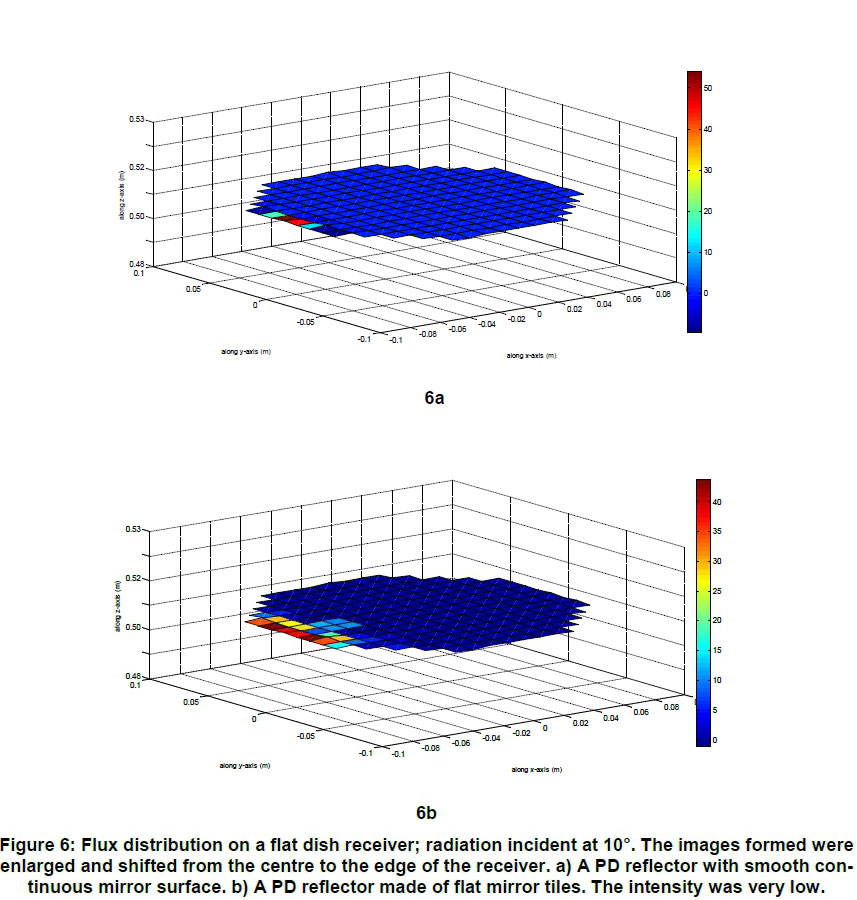
This study describes a 3D ray tracer model for analysis of a small-scale solar concentrating system where thermal heat is collected for cooking purposes. Emitted sun rays were traced from the source through all reflections until they intercepted with the receiver or were lost. The algorithm of the ray tracer and its implementation in MATLAB is clearly described. The ray tracer was programmed to contribute to the development of small-scale concentrating solar energy systems with integrated heat storage units. The ray tracer was demonstrated for selected cases where continuous reflecting surfaces and flat mirror-tiled surfaces were compared. Off-focus sensitivity analysis was shown and this could provide guidelines for the required solar tracking accuracy. The flux distribution on the absorber was analysed and found to be concentrated on a small area on the target for continuous reflecting surfaces and having high intensities. However, for reflectors with mirror tiles, an elongated image was formed centred on the focal point with low intensities. Small misalignment of the reflector in the order 0.2° had minimal impact on the interception ratio, but any further increase in the tracking errors caused a sudden drop in the interception ratio to zero. Results showed that there is close agreement in flux distribution and the tracking error impact on interception ratio, when compared with the literature. This model could be a useful tool when designing the reflection and absorption components of solar concentrators for complex systems with several components in a non-symmetric 3D arrangement. Highlights • An algorithm for a ray tracer was developed • Enlarged images centred on the focal point were formed for mirror-tiled reflectors • Small misalignment of the reflector had minimum impact on the interception ratio • The tracer model could be used as a design tool
reflectors; flat mirror tiles; smooth continuous surfaces; interception ratio; tracking errors
 Thumbnail
 Thumbnail
 Thumbnail
 Thumbnail
 Thumbnail
 Thumbnail
 Thumbnail