Optimization analysis of solar-powered average temperature Stirling heat engine
Abstract
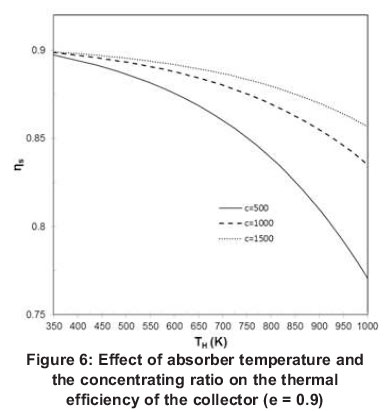
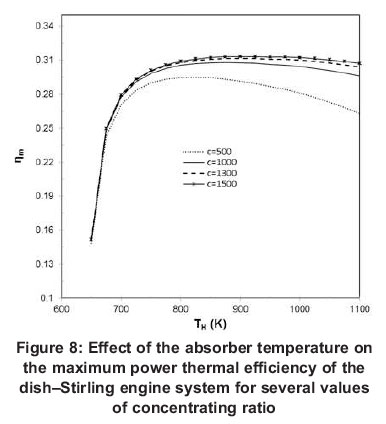
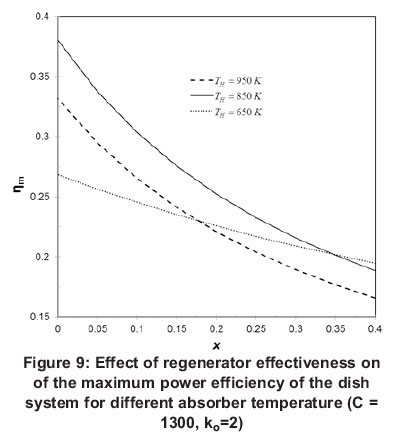
This paper investigates the performance of the solar powered dish-Stirling engine using the non-linearized heat loss model of the solar dish collector and the irreversible cycle model of the Stirling engine. Finite time thermodynamic analysis is used to investigate the influence of the finite-rate heat transfer, operating temperatures, heat leak coefficient, and ratio of volume during regeneration processes, regenerator losses, thermal bridges losses on the maximum power output and the corresponding overall efficiency. The maximum overall system efficiency is 32% corresponding to absorber temperature and concentrating ratio of 850 K and 1300, respectively. The present analysis provides the basis for the design of a solar-powered mean temperature differential Stirling engine powered by solar dish system.
Stirling engines; finite time thermodynamic; thermal losses; performance; regenerator effectiveness; numerical simulations
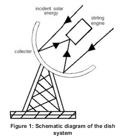 Thumbnail
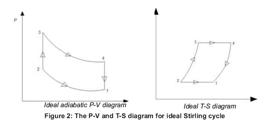 Thumbnail
 Thumbnail
 Thumbnail
 Thumbnail
 Thumbnail
 Thumbnail
 Thumbnail
 Thumbnail
 Thumbnail
 Thumbnail
 Thumbnail
 Thumbnail
 Thumbnail