Characteristics of selected non-woody invasive alien plants in South Africa and an evaluation of their potential for electricity generation
Abstract
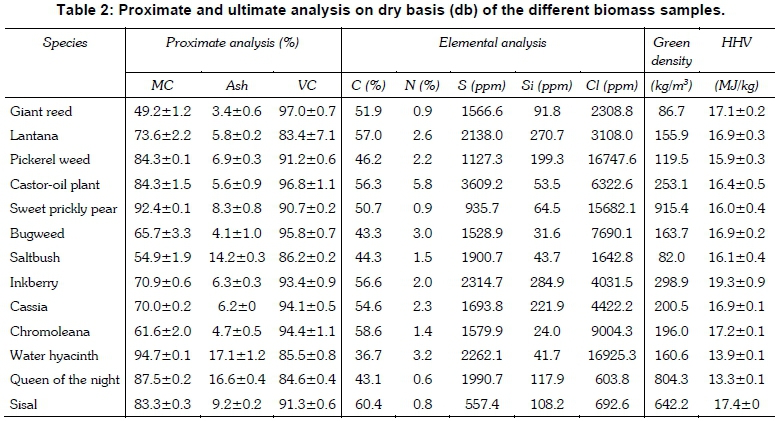
Alien invasive plants (AIPs) pose a threat to the existence of plant and animal biodiversity in the ecosystems they invade. They need to be cleared, monitored and eventually eradicated from the landscape. The potential and the economic viability to supply non-woody AIP biomass for electricity generation were assessed in this study, which was conducted on samples from 13 common non-woody AIPs in South Africa, namely: Arundo donax (giant reed), Lantana camara (lantana), Pontederia cordata (pickerel weed), Ricinus communis (castor-oil plant), Opuntia ficus-indica (sweet prickly pear), Solanum mauritia-num (bugweed), Atriplex nummularia (saltbush), Cestrum laevigatum (inkberry), Senna didy-mobotrya (peanut butter cassia), Chromoleana odo-rata (chromoleana), Eichhornia crassipes (water hyacinth), Cerus jamacaru (queen of the night) and Agave sisilana (sisal plant). Proximate and ultimate analysis was made in order to assess the suitability of the biomass for different thermo-chemical conversion techniques for electricity generation. A financial evaluation of the costs to supply biomass to the plant gate was performed by combining the harvesting, chipping and transport costs. The results showed that the biomass of giant reed, lantana, bugweed, saltbush, inkberry, cassia and Chromoleana may be used to generate electricity through combustion, although the total average cost was approximately 50% higher than that of woody biomass feedstock, requiring a 'fuel cost subsidy' to justify their utilisation for energy production. Highlights: • Physical and chemical properties make some non-woody alien invasive plants suitable for electricity generation. • Economic analysis showed that, without subsidy, some non-woody alien invasive plants are not suitable as feedstock.
invasive plants; biomass; bioenergy; energy potential
 Thumbnail