Characterisation of wind speed series and power in Durban
Abstract
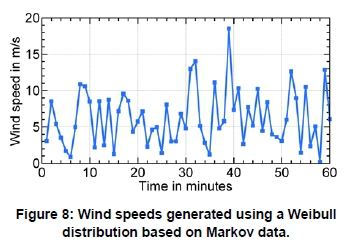
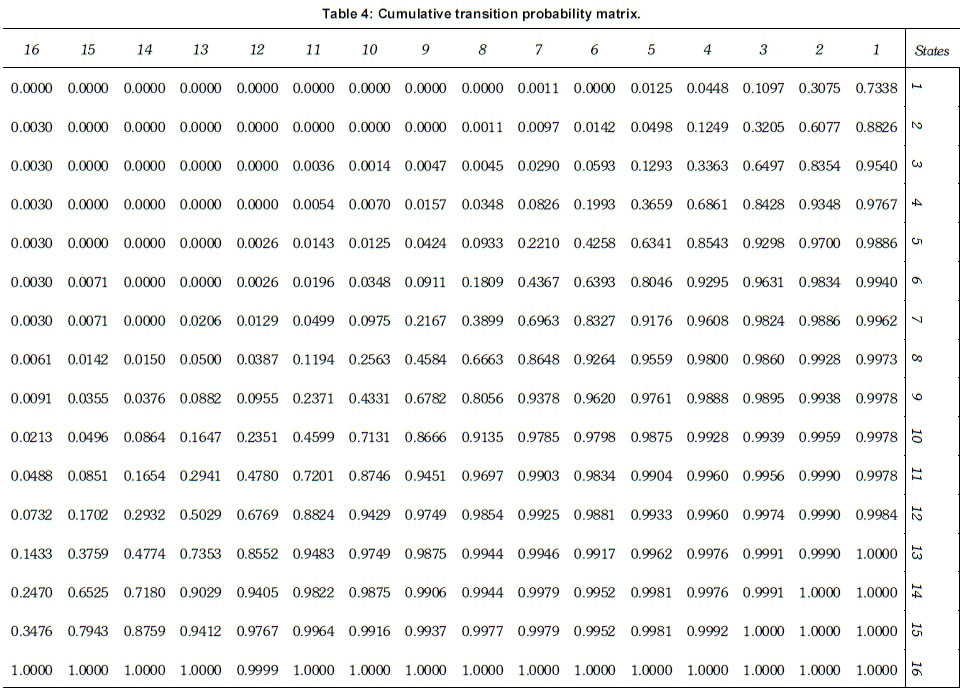
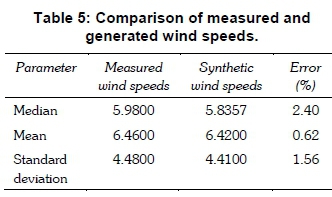
Both the planning and operating of a wind farm demand an appropriate wind speed model of its location. The model also helps predict the dynamic behaviour of wind turbines and wind power potential in the location. This study characterises the wind speed series and power in Durban (29.9560°S, 30.9730Έ), South Africa, using Markov chain and Weibull distribution. Comparison of statistical quantities of measured and Markov model-generated wind speed series revealed that the model accurately represented the measured wind speed series. The Markov model and Weibull distribution were also compared through their corresponding probability density functions. The root mean square error of the Markov model against the measured wind speed series was nearly one-tenth that of the Weibull distribution, indicating the effectiveness of the former. Finally, the analysis of wind power density showed that Durban and its environs need large wind turbines with hub heights greater than 85 m for efficient utilisation of the available wind energy. Highlights: • Wind speed series in Durban can be characterised using the Markov chain model, and the corresponding power can be fairly predicted using the model. • Compared to the conventional Weibull distribution, the Markov chain model accurately represents the wind speed series in Durban. • Durban and its environs require wind turbines with heights higher than 85 m for efficient operation.
dynamic simulation; Markov chain; Weibull distribution; wind turbine
 Thumbnail
 Thumbnail
 Thumbnail
 Thumbnail
 Thumbnail
 Thumbnail
 Thumbnail
 Thumbnail
 Thumbnail
 Thumbnail
 Thumbnail
 Thumbnail
 Thumbnail