A cost-benefit analysis of concentrator photovoltaic technology use in South Africa: A case study
Abstract
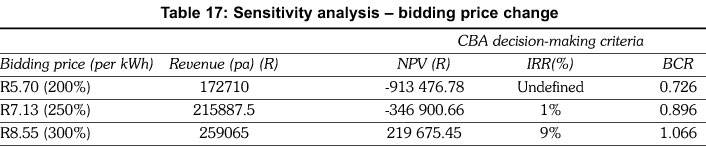
The South African Government currently faces the dual problems of climate change mitigation and the rollout of electricity provision to rural, previously disadvantaged communities. This paper investigates the economic efficiency of the implementation of concentrator photovoltaic (CPV) technology in the Tyefu area in the Eastern Cape, South Africa, as a means of addressing these problems. Two cost-benefit analyses (CBA) are carried out in the study, namely a private CBA and a social CBA. The private CBA investigates the desirability of the CPV project from a private energy investor's perspective, whilst the social CBA investigates the desirability of the CPV project from society's perspective. The social CBA found that the project was socially viable and was, thus, an efficient allocation of government resources. The private CBA, on the other hand, found that investing in a CPV project was not financially viable for a private investor. With respect to the incentive scheme currently offered to private energy investors, it is recommended that the maximum bidding price of R2.85/kWh be increased. A sensitivity analysis of the bidding price showed that an increase of 300% is required to attract private investors into electricity generation projects.
Cost-benefit analysis; concentrator photovoltaic technology; social discount rate
 Thumbnail
 Thumbnail