Socioeconomic determinants of household hybrid electricity adoption on Bugala Island in Uganda
Abstract
The shift towards renewable energy is resulting in increased investment in energy infrastructure, affecting communities of all sizes worldwide. A study on Bugala Island in Lake Victoria, Uganda, explored how socioeconomic factors influence households' decision to adopt hybrid solar electricity. The study utilised a binary logistic regression analysis of cross-sectional research design to understand the significant socioeconomic factors influencing the adoption. The sex of the household head, education level, monthly income, tenure status, and wall and floor materials were the most significant factors for the adoption. However, results suggest that age, household size, marital status, and main occupation were not statistically significant factors in adopting hybrid solar electricity. Insights from these variables can enable policymakers to formulate more efficient and equitable policies geared towards fostering the widespread integration of clean energy solutions. It should be noted that the socioeconomic factors vary in context and location; solar energy systems should be tailored to the needs of each community rather than being implemented using a standardised approach.
island communities; energy policy; household energy transition; rural electrification; energy development
1. Introduction
Households are emerging as key agents in the global quest for energy sustainability. Their embrace of cleaner and more modern energy resources, such as hydropower, solar energy, biomass, briquettes, and liquefied petroleum gas (LPG), represents a crucial shift toward micro-level solutions for pressing global challenges (Gustavsson et al., 2015; Nzabona et al., 2021; UBOS & ICF, 2017). This trend, particularly gaining traction in the Global South, empowers communities to dissociate their energy needs from traditional, often unsustainable, sources. Mbaka (2021) describes this phenomenon as a 'micro-revolution' in energy sustainability, offering the potential for localised energy independence, reduced environmental impact, and improved well-being.
Global energy consumption is projected to increase by 56% by 2040, driven primarily by economic expansion in developing nations (Muhammad et al., 2016). This surge in demand, however, is juxtaposed against the stark reality that over 590 million Africans, particularly those residing in rural areas, lack access to clean energy sources (Zajicek, 2019). Fossil fuels, encompassing oil, firewood, and coal, remain the dominant energy reservoirs, fueling over 90% of the anticipated demand increase.
Recognising this unsustainable trajectory, global initiatives are actively promoting innovative energy technologies to mitigate dependence on fossil fuels (Dorian et al., 2006; Nzabona et al., 2021; Soltani et al., 2019). The Commonwealth Sustainable Energy Transition Agenda, for instance, fosters collaborative efforts among member nations, including Uganda, to achieve a sustainable energy paradigm and realise Sustainable Development Goal 7: universal access to clean and affordable energy (Polack, 2021). For example Uganda's anticipated annual production of 100,000 kg of LPG during peak oil production within the Albertine region will be crucial for meeting the country's energy demands. LPG, as a cleaner-burning substitute for prevalent fuels like firewood and charcoal, promises substantial advantages including enhanced public health, environmental preservation, economic empowerment, and industrial progress (Gustavsson et al., 2015).
Consequently, contemporary energy sources are increasingly emerging as viable alternatives to conventional fuels (Aarakit et al., 2021). While Uganda primarily relies on hydroelectricity (Taye et al., 2020; Fashina et al., 2019), concerted efforts have been made to diversify its energy mix through grid expansion and the introduction of autonomous solar photovoltaic (PV) systems and mini-grid networks (Groenewoudt et al., 2020; UOMA, 2020).
These initiatives represent significant steps towards addressing pressing national energy needs and signify a positive shift towards sustainable energy practices.
Despite Uganda's reliance on hydroelectricity, 68% of rural households remain excluded from grid access due to a confluence of socioeconomic, regulatory, and environmental challenges (Aarakit et al., 2021; Blimpo et al., 2020; Wabukala et al., 2022). This presents a compelling opportunity for the widespread adoption of PV technologies (Katon-gole et al., 2023), particularly in island communities, where grid extension faces significant hurdles (Kayima et al., 2023). While renewable solar energy systems have gained popularity in the energy development discourse (Mazzone, 2019), there is a lack of adequate research on the household factors influencing the adoption of new energy technologies (Simpson et al., 2021). This study investigated the socioeconomic factors influencing hybrid solar electricity adoption on Bugala Island in Lake Victoria.
1.1 Overview of energy status in Uganda
Despite Uganda's population of 45.8 million (World Bank, 2021), residing primarily in rural areas (UBOS, 2021a), electricity access remains a starkly contrasting reality between urban and rural communities. While 70.8% of urban Ugandans have electricity, only 31.8% in rural areas do, highlighting a significant disparity. Guided by the 2007 renewable energy policy and its emphasis on prioritising sustainable solutions within the renewable energy mix while allowing for technological flexibility (Bhamidipati et al., 2019), the Ministry of Energy and Mineral Development oversees the sector. Though the ministry has boasted abundant renewable resources like hydro, biomass, solar, and geo-thermal, 28% of the population still lacks access (Bongomin & Nziu, 2022). Uganda has made impressive strides in generation capacity, increasing from 60 MW in 1954 to 1,267.2 MW in 2020, with biomass dominating consumption at over 89% (Twaha et al., 2016). Hydropower leads as the primary source, contributing 80% of installed capacity, followed by thermal, mini-hydro, and cogeneration (Cartland, 2022). This reliance on renewables, representing nearly 90% of the energy profile, underscores Uganda's commitment to sustainable development. However, addressing the rural-urban access gap and diversifying energy sources remain key challenges for the future.
The Ugandan energy sector comprises four distinct sub-sectors: residential/household, commercial/institutional, agricultural/fisheries, and industrial. The predominant energy source for households remains biomass, with firewood accounting for 73% of usage and charcoal for 21% (UBOS, 2021b). Alternative sources like electricity, biofuels, LPG, and kerosene collectively contribute only 3.9% of the household energy mix, highlighting a significant dependence on traditional fuels. Lighting patterns also reveal disparities, with 56% of households relying on electricity, primarily through solar kits (27%), grid electricity (19%), and solar home systems (11%). This reliance on solar solutions and biomass in rural areas contrasts with the urban landscape, where grid electricity dominates for lighting purposes. Understanding the factors driving these trends is crucial for informing effective policy interventions aimed at increasing access to clean energy in Uganda.
1.2 Development of solar systems in Uganda
To combat widespread energy poverty across various regions, Uganda has strategically embraced solar energy systems (Alinda et al., 2021; Ssenyimba et al., 2020). The nation's favorable solar potential, averaging 5.2 kWh/m2 daily insolation on horizontal surfaces (Adeyemi and Asere, 2014; Katongole et al., 2023), fosters a conducive environment for diverse solar applications. These include PV power generation for electricity, solar thermal electric generation, water heating, and building integration (Zhao et al., 2011). Since the 1980s, solar PV has powered essential services like lighting, healthcare refrigeration, communication, railway signalling, and telecommunication (Bongomin & Nziu, 2022). In rural communities beyond the reach of the national grid, solar energy plays a crucial role in off-grid electrification, powering cooking, water heating, public buildings, and households, enabling access to lighting, mobile phones, and radios (Adeyemi and Asere, 2014; van Hove & Johnson, 2021). To cater to diverse market segments, various PV systems exist, including pico and micro solar home systems, larger solar home systems, standalone institutional systems, solar mini-grids, and PV systems for telecommunication and lighting (Mugagga & Cham-dimba, 2019). Pico and micro solar systems find widespread adoption in areas lacking grid access since they provide basic lighting, are used for mobile charging, use basic appliances, and are affordable (Walwyn & Hanlin, 2022; Salite et al., 2022).
Uganda's grid-connected solar energy capacity experienced a remarkable surge between 2016 and 2019, from 0 MW to 50 MW (Tables 1 and 2). This rapid growth was driven by a confluence of factors, including favorable renewable energy policies, VAT exemptions, and investments from foreign stakeholders. The commissioning of key solar power plants, such as Soroti (10 MW), Tororo (10 MW), Kabulasoke (20 MW), and Mayuge (10 MW), marked this period of expansion. Additionally, numerous community mini-grids, measured in kilowatts (KW), were deployed across the country (Mukisa et al., 2020; Kavuma et al., 2022).
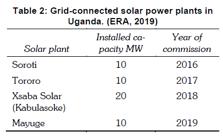
Despite advancements, grid connection solar power contributed only 1% to Uganda's total energy capacity of 1,254 MW by 2021. The smallness of the share is attributed to barriers, including the high up-front costs of solar panel installation, limiting individual and business adoption. The national grid's capacity constraints and transmission inefficiencies further hinder large-scale integration, and intricate regulatory frameworks and lack of financial incentives discourage widespread investment in solar power (Hansen et al, 2015; Kayima, 2023). However, Uganda' s vision aspires to achieve a 12% share of PV generation within the projected 41,738 MW total energy capacity required by 2040 (Cartland et al., 2022). Recognising the limitations of standalone solar systems, Uganda has begun introducing hybrid solar electricity systems. These unique configurations combine PV and diesel power generation components to provide reliable power to communities, particularly evident in the deployment of a 1.6 MW hybrid system on Bugala Island (Kayima et al., 2023). This shift towards hybrid systems aligns with Uganda's ambitious goal of transi-tioning to 100% renewable energy by 2050, necessitating an approximate fourfold increase in solar energy capacity (Gustavsson et al., 2015).
1.3 Hybrid solar plant on Bugala Island
On Bugala Island, Uganda, a 1.6 MW hybrid solar power system tackles the challenge of remote community electrification through meticulous design and comprehensive management. The hybrid system was chosen for the island due to the frequent rain there. A solar-only electricity system was less reliable and night-time solar limitations required costly battery storage, making a hybrid system more practical. Additionally, integrating with existing diesel generators proved more cost-effective and efficient than building an entirely new renewable energy system. Overseen by Kalangala Infrastructure Services, the system integrates 2,832 solar panels, three diesel generators, inverters, a battery bank, and a smart control system, ensuring a dynamic match between hybrid energy output and island demand (Kayima et al., 2023). This intricate setup, encompassing design, generation, transmission, distribution, and sales, reaches 80% of Bugala's communities via a strategically placed network of over 75 transformers. This initiative not only illuminates the island but also serves as a model for sustainable and accessible energy solutions in remote regions.
Although clean and modern energies have been established on various islands, like this one, aiming to reduce dependence on traditional fossil fuels and contribute to a cleaner energy mix, the preference for their use among households in diverse communities is influenced by different dynamics (Mbaka, 2021; Wu et al., 2019). These energies play a central role in socioeconomic transformation, as their development is directly linked to energy consumption intensity and preference (Mbaka et al., 2019). While studies on factors affecting energy use have been conducted (Gustavsson et al., 2015; Mbaka, 2021), they have mainly focused on fossil energy sources globally (Nzabona et al., 2021), and there are only scarce studies on hybrid systems (Khan et al., 2018; Come Zebra et al., 2021). Therefore, the research reported on aimed at understanding the socioeconomic factors influencing hybrid solar electricity adoption on Bugala Island.
2. Material and methods
2.1 Study area
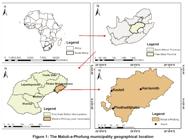
The study was carried out on Bugala Island, situated in Kalangala district (Figure 1). The island represents Uganda's commitment to energy transition in island communities, as evidenced by the hybrid power plant that demonstrates a significant investment in this technology. With a total of 67,200 people in 2020, (0.04% of the total population in Uganda). Bugala is the largest among the 84 islands making up the district (Ssenyimba et al., 2020). Bounded by longitudes 32°01'E and 32°19'52'E and latitudes 00°10'S and 1°20'S (Ssenyimba et al., 2020), Kalan-gala district sprawls across 9,066.8 km2, with a mere 4.8% landmasses, the rest in the embrace of Lake Victoria (Kayima et al., 2023). The study was carried out in Mugoye subcounty and Kalangala Town Council. Mugoye subcounty was chosen since it is where the hybrid solar energy infrastructure under study is located, while Kalangala Town Council was chosen because it has the highest population of electricity consumers, which provided a unique perspective on energy accessibility.
2.2 Study design, sample size, and data collection methods
In March and July 2022, a study was conducted using a quantitative method cross-sectional study (Dunn, 2021). Household data was collected using a semi-structured questionnaire on tablets using open data kit software (Kiran et al, 2022; Lakshminarasimhappa, 2021). The questionnaire covered respondents' socio-economic characteristics, energy sources, how they used them, and the reasons for their choices.
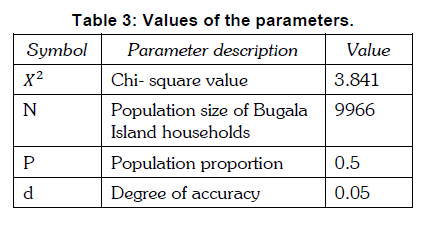
A total of 353 respondents were interviewed, and the sample size was determined using the Krejcie and Morgan sampling formula (1970). This formula was chosen for its simplicity and efficacy. It is well-suited for estimating a representative sample size within a finite population, requiring only population size and desired confidence level as inputs (Penyelidikan, 2006).
Equation 1 expresses the calculation for determining the required sample size (S) for the research study, and Table 3 gives the parameter values.

The researchers closely supervised a team of four trained research assistants who knew the local language (Luganda) and collected the data. The assistants underwent various training stages, including pre-tests, to ensure they comprehended all the questionnaire content and knew how to interact with respondents.
For the study, individuals 18 years and older who served as heads of their households were chosen randomly to participate in the interviews. Visitors to the targeted households and those under 18 years old were not included. To cover the community adequately, local leaders provided estimates of the number of households in each community, which helped determine the proportion of households to be sampled.
2.3 Data management and analysis
The survey data was sent to an online server, and the researchers checked it regularly to ensure accuracy, completeness, and quality. The Statistical Package for Social Sciences software version 25 was used to analyse the quantitative data (Nagaiah & Ayyanar, 2016). Cross-tabulations with frequencies and percentages, which focus on the household socioeconomic characteristics, are displayed in Table 4. The binary logistic regression model was used to test the probability of the dichotomous outcomes (Fritz & Berger, 2015), basing on the household socioeconomic factors to understand the influencing factors for hybrid solar electricity adoption on the Island.
A set of independent explanatory variables were hypothesised to test the factors influencing the adoption. The binary logistic regression model for the factors influencing HSE adoption is specified using Equation 2.

where:
P (user = 1) represents the probability of being a user; ß0 is the intercept term; ß1toßn are coefficients associated with the independent variables (socioeconomic factors); and X1toXnrepresent the independent variables.
This relationship is linear for the log odds and nonlinear for the odds and probability of the outcomes. P<0.05 was used to declare all analyses significant. Wald statistics and odd ratios have been used to examine the significance of the variables in binary logistic regression. P-value was used to identify the significant level of the variables.
2.4 Ethical consideration
Ethical approval for the study was obtained from the Graduate School, Makerere University. Participation in this study was voluntary, and informed consent was obtained from all participants before data collection. This ensured their right to autonomy and decision-making regarding involvement in the research. Additionally, the research assistants underwent comprehensive training modules encompassing the study protocol, the questionnaire content, and ethical research practices. This measure minimised potential errors and ensured adherence to ethical guidelines. Recognising the importance of participant confidentiality, this paper strictly avoids disclosing any personal information or identifiers that could compromise anonymity. This commit-ment to safeguarding privacy underscores the ethical foundation of the research and upholds the dignity and well-being of all participants.
2.5 Limitation of the study
The Covid-19 pandemic hampered data collection due to movement restrictions and health precautions, such as social distancing. Despite the need for direct engagement, we followed Ministry of Health guidelines for sanitisation, social distancing, and mask use. The island's geography created logistical challenges, with data enumerators incurring additional costs due to long distances. Furthermore, poor weather conditions, particularly heavy rain, hampered household accessibility during data collection.
3. Results and discussion
3.1 Socio-demographics
Table 4 presents the socioeconomic characteristics of the 353 respondents (237 hybrid solar electricity users, 116 non-users) who participated in the study. Notably, the majority (60%) were from Mugoye sub-county, highlighting potential geographic variations in hybrid solar adoption patterns. Regarding household composition, male representation among household heads was significant (73%), and the largest age group fell within the 36-60 years range (57%). Educational attainment indicated a primarily lower-middle-income sample, with only 9% having attained tertiary education. Marital status and household size distributions were fairly balanced, with 77% married and 76% residing in households of 2-5 people. Additionally, over half (56%) of the households had 2-5 children living with them.
Agriculture emerged as the dominant source of income for the majority (56%), reflecting the island's economic landscape. Income levels also indicated relative economic homogeneity, with 54% monthly earnings between UGX 150,000 and UGX 450,000 (equivalent to USD 40-122). 68% of households owned land, and 47% lived in two-room dwellings. Housing characteristics revealed a predominance of traditional building materials, with 99% utilising corrugated iron sheets for roofing. Burnt bricks were the most common wall material (64%). All these characteristics suggest a rural, low-income community with moderate access to land and basic amenities.
3.2 Hybrid solar electricity adoption and influencing socioeconomic factors
The results of the binary logistic regression, showing the relationship between socioeconomic factors and the adoption of hybrid solar energy (HSE), are presented in Table 5. The variables in the model were characterised by coefficients (B) of 0.723, standard errors (SE) of 0.114, a Wald statistic of 40.489, a p-value of 0.001, and an odds ratio (Exp) of 2.06.
Table 5 shows that the significant factors influencing the adoption of hybrid solar electricity were the sex of the household head, education level, number of children living in the household, monthly income, tenure status, wall material, and floor material. These variables had a level of significance of 1% and 5%. In examining the relationship between the sex of the household head and the utilisation of HSE, the study revealed a significant impact (Coefficient = 1.74, P-value = <0.001), indicating that men predominantly lead households utilising HSE, resulting in an odd ratio of 5.7 for HSE use among households led by men. This is contrary to the findings of Ang'u et al (2023), whose research challenges the notion that men drive decisions on clean fuel adoption in Vihiga county, Kenya, proposing that women exhibit a greater willingness to embrace clean energy due to their heightened susceptibility to the adverse health effects associated with traditional energy sources. This divergence from the existing literature is reinforced by the inconclusive impact of the sex of the household head on solar PV adoption in Seychelles, as identified by Etongo & Naidu (2022), where universal electricity availability diminishes the influence of sex. Furthermore, Guta, (2020) asserts that households headed by women are more inclined to adopt renewable energy technologies in rural Ethiopia. These disparities underscore the nuanced and context-dependent nature of sex dynamism in shaping energy-adoption patterns, emphasising the need to consider socio-economic factors and regional contexts in comprehending such disparities.
The education level of the household head and the decision to adopt HSE showed a significant impact, indicated by (Coefficient = 0.69, P-value = <0.001). As the education level of the household head increases, the odds ratio for HSE use rises by 2.00, suggesting a positive correlation between education and the likelihood of HSE adoption on the island. This aligns with prior research indicating that lower levels of education may impede the uptake of new technologies, possibly due to challenges in processing information and making decisions about unfamiliar technology. The study aligns with Kelebe et al. (2017) in Tigray, Ethiopia, demonstrating that a higher level of education correlates with increased adoption of small technologies in rural households. Similarly, Sardianou and Genoudi (2013), Wassie and Adaramola (2021), Lin and Kaewkhunok (2021), Ang'u et al. (2023), and Mothala et al. (2022) have supported the idea that educational status plays a significant role in fostering acceptance of renewable energy sources. Nonetheless, Wassie et al. (2021) in southern Ethiopia found that the level of education did not emerge as a significant factor in household energy choices.
The study found a positive correlation between the presence of children in a household and the adoption of HSE (coefficient = -0.591, p-value = <0.006). The association signifies that for each additional child in a household, the likelihood of using HSE increases by a substantial factor of 7.53. This is presumably because larger families inherently require increased lighting and additional appliances, thereby fostering the adoption of HSE. These findings align with the insights of Ang'u et al (2023), who assert that households with a higher number of individuals are more predisposed to embrace clean fuel alternatives. Wassie et al (2021), in their study in southern Ethiopia, note that the presence of children in a household invariably heightens the likelihood of adopting clean energy technology.
The research indicated a significant relationship between monthly income and the adoption of HSE (Coefficient = 0.608, P-value = <0.001). Notably, the study identified that 57% of electricity users earn less than UGX 150,000 (USD 40) per month, underscoring the prevalence of lower-income households in the utilisation of HSE. However, the likelihood of using HSE is markedly influenced by higher household monthly income, with a corresponding factor of 1.838. This association is rooted in the increased financial capability of households with higher incomes, enabling them to afford the necessary metering and subscription to the electricity unit. The study findings align with those of Wassie et al (2021), emphasising the role of fuel af-fordability in shaping households' energy choices. Sardianou and Genoudi (2013) also indicate that households with higher incomes are more inclined to adopt renewable energy sources. This highlights the interconnectedness of financial capacity and energy adoption.
The study also indicated a significant relationship between household land ownership status and the adoption of HSE (Coefficient = -1.217, P-value = <0.001). The ownership of land emerges as a crucial factor, with households that privately own the land on which they reside exhibiting a higher likelihood of accessing electricity. This probably stems from the autonomy afforded to households with private land, enabling them to make decisions regarding electricity access without intermediaries such as another owner. The study aligns with the study done by Alipour et al. (2023), suggesting a parallel trend where privately owned land, not requiring permission, significantly increases the likelihood of accessing electricity, with a higher adoption rate of 20.7% compared to households without private land. The autonomy granted by land ownership underscores the importance of property rights and self-determination in shaping energy adoption patterns, adding a valuable dimension to understanding how socioeconomic factors influence sustainable energy practices.
The wall material of the house correlated significantly with the adoption of HSE (Coefficient = -0.595, P-value = <0.001). A majority of users (66%) had house walls constructed with burnt bricks. It is crucial to emphasise the contextual relevance of this finding with the regulatory framework, as per Uganda's electricity access regulations. The type of house construction material holds significant implications for electricity access, influencing eligibility to connect to the grid system. This regulatory aspect adds a layer to the relationship between household infrastructure, such as wall material, and the adoption of electricity, highlighting the multifac-eted nature of factors shaping energy adoption patterns.
4. Conclusion and recommendations
The study unveiled several factors that positively and significantly influence the adoption of HSE among households. These factors include the sex of the household head, education level, number of children in the household, monthly income, tenure status, and the floor and wall materials of the house. These findings hold paramount importance when contemplating national and regional energy strategy policy analyses, as they highlight the multifaceted nature of factors influencing how people adopt new energy sources. National and regional energy strategies often focus on technical and economic aspects, but this study reveals the importance of considering socioeconomic factors as well. By understanding the role of factors like sex, education level, monthly income. among others, policymakers can develop more effective and equitable energy policies that encourage widespread acceptance of clean energy solutions.
The recognition of socioeconomic factors also highlights the necessity for a tailored approach in the design and implementation of solar energy systems.
It becomes evident that a standardised strategy may not be effective, emphasisng the need for flexibility to accommodate local contexts. Given the susceptibility of island areas to the financial, geographical, and climatic contexts influencing solar adoption, the setup of these systems should consider the identified factors to enhance effectiveness and sustainability.
It is recommended that the government through the Electricity Regulatory Authority, Uganda Electricity Distribution Company Limited, and Uganda Electricity Transmission Company Limited, should play a crucial role in the standard, distribution and expansion of grid systems on these islands. This responsibility should not be left to private companies or individuals who may prioritise their profits over the community's benefits.
Future studies should prioritise investigating the environmental factors that influence the adoption of solar electricity among households. Additionally, it would be beneficial to conduct a spatial analysis of the adoption of hybrid solar systems in Lake Victoria and compare the adoption rates between the island and inland environments to assess the significance of these technologies.
Declaration of interests
The authors declare that they have no known competing financial interests or personal relationships that could have appeared to influence the work reported in this paper.
Acknowledgment
This research was generously funded by the Norwegian Agency for Development Cooperation (NORAD) through the NORHED II Project (2021-2026) titled 'Capacity Building for Socially Just and Sustainable Energy Transitions in East Africa (SET Project)'. The authors also extend sincere gratitude to the respondents, whose contributions were invaluable. Finally, we thank our anonymous reviewers for their insightful feedback, which significantly enhanced the quality of this research.
References
-
Aarakit, S. M., Ntayi, J. M., Wasswa, F., Adaramola, M. S., & Ssennono, V. F. (2021). Adoption of solar photovoltaic systems in households: Evidence from Uganda. Journal of Cleaner Production, 329(May), 129619. https://doi.org/10.1016/j.jclepro.2021.129619
» https://doi.org/10.1016/j.jclepro.2021.129619 - Adeyemi K.O, A. A. . (2014). A review of the energy situation in uganda. International Journal of Scientific and Research Publications, 4(1), 2-5.
- Alinda, K., Geoffrey, M. S., & Adaramola, M. S. (2021). Overview of Opportunities and Challenges of Solar Photovoltaic Promotion in Uganda. Journal of Energy Research and Reviews, 9(4), 34-54., 9, 6.
-
Alipour, M., Ghaboulian Zare, S., Taghikhah, F., & Hafezi, R. (2023). Sociodemographic and individual predictors of residential solar water heater adoption behaviour. Energy Research and Social Science, 101, 103155. https://doi.org/10.1016/j.erss.2023.103155
» https://doi.org/10.1016/j.erss.2023.103155 -
Ang'u, C., Muthama, N. J., Mutuku, M. A., & M'IKiugu, M. H. (2023). Determinants of the sustained use of household clean fuels and technologies: Lessons from Vihiga county, Kenya. Energy Reports, 9, 1990-2001. https://doi.org/10.1016/j.egyr.2023.01.026
» https://doi.org/10.1016/j.egyr.2023.01.026 -
Bhamidipati, P. L., Haselip, J., & Elmer Hansen, U. (2019). How do energy policies accelerate sustainable transitions? Unpacking the policy transfer process in the case of GETFiT Uganda. Energy Policy, 132(May), 1320-1332. https://doi.org/10.1016/j.enpol.2019.05.053
» https://doi.org/10.1016/j.enpol.2019.05.053 - Bjergegaard, R. (2015). Rural Electrification of Uganda: A Technological and Least-cost Feasibility Study. (Doctoral Dissertation, MSc. Thesis. Aalborg University)., 2015.
-
Blimpo, M. P., Postepska, A., & Xu, Y. (2020). Why is household electricity uptake low in Sub-Saharan Africa? World Development, 133, 1-41. https://doi.org/10.1016/j.worlddev.2020.105002
» https://doi.org/10.1016/j.worlddev.2020.105002 - Bongomin, O., & Nziu, P. (2022). A Critical Review on the Development and Utilization of Energy Systems in Uganda. The Scientific World Journal, 2022.
- Cartland, R. (2022). Socio-economic analysis of solar photovoltaic-based mini-grids in rural communities : A Ugandan case study. Journal of Energy in South Africa, 33(3), 36-50.
-
Cartland, R., Sendegeya, A. M., & de Dieu Khan Hakizimana, J. (2022). Socio-economic analysis of solar photovoltaic-based mini-grids in rural communities: A Ugandan case study. Journal of Energy in Southern Africa, 33(3), 36-50. https://doi.org/10.17159/2413-3051/2022/v33i3a10441
» https://doi.org/10.17159/2413-3051/2022/v33i3a10441 -
Come Zebra, E. I., van der Windt, H. J., Nhumaio, G., & Faaij, A. P. C. (2021). A review of hybrid renewable energy systems in mini-grids for off-grid electrification in developing countries. Renewable and Sustainable Energy Reviews, 144(April). https://doi.org/10.1016/j.rser.2021.111036
» https://doi.org/10.1016/j.rser.2021.111036 -
Dorian, J. P., Franssen, H. T., & Simbeck, D. R. (2006). Global challenges in energy. Energy Policy, 34(15), 1984-1991. https://doi.org/10.1016/j.enpol.2005.03.010
» https://doi.org/10.1016/j.enpol.2005.03.010 - Dunn, K. (2021). Research Methods in Human Geography. In Research Methods in Human Geography.
- ERA. (2019). Uganda's Grid-Connected Solar Portfolio Increases.
-
Etongo, D., & Naidu, H. (2022). Determinants of household adoption of solar energy technology in Seychelles in a context of 100% access to electricity. Discover Sustainability, 3(1). https://doi.org/10.1007/s43621-022-00108-4
» https://doi.org/10.1007/s43621-022-00108-4 -
Fashina, A., Mundu, M., Akiyode, O., Abdullah, L., Sanni, D., & Ounyesiga, L. (2019). The Drivers and Barriers of Renewable Energy Applications and Development in Uganda: A Review. Clean Technologies, 1(1), 9-39. https://doi.org/10.3390/cleantechnol1010003
» https://doi.org/10.3390/cleantechnol1010003 -
Fritz, M., & Berger, P. D. (2015). Will anybody buy? Logistic regression. In Improving the User Experience Through Practical Data Analytics, https://doi.org/10.1016/b978-0-12-800635-1.00011-2
» https://doi.org/10.1016/b978-0-12-800635-1.00011-2 -
Groenewoudt, A. C., Romijn, H. A., & Alkemade, F. (2020). From fake solar to full service: An empirical analysis of the solar home systems market in Uganda. Energy for Sustainable Development, 58, 100-111. https://doi.org/10.1016/j.esd.2020.07.004
» https://doi.org/10.1016/j.esd.2020.07.004 -
Gustavsson, M., Broad, O., Hankins, M., & Sosis, K. (2015). Energy Report for Uganda - A 100% Renewable Energy Future by 2050. December, 92. https://doi.org/10.13140/RG.2.2.25454.72007
» https://doi.org/10.13140/RG.2.2.25454.72007 -
Guta, D. D. (2020). Determinants of household use of energy-efficient and renewable energy technologies in rural Ethiopia. Technology in Society, 61, 101249. https://doi.org/10.1016/j.techsoc.2020.101249
» https://doi.org/10.1016/j.techsoc.2020.101249 -
H. Muhammad et al. (2016). Rural-Urban Transformation, Energy Consumption, Economic Growth, and CO2 Emissions Using STRIPAT Model for BRICS Countries. AIChE, 9. https://doi.org/10.1002/ep
» https://doi.org/10.1002/ep - Hansen, U. E., Pedersen, M. B., & Nygaard, I. (2015). Review of solar PV policies, interventions and diffusion in East Africa. Renewable and Sustainable Energy Reviews, 46, 236-248.
- Katongole, D. N., Nyeinga, K., Okello, D., & Mukiibi, D. (2023). Spatial and Temporal Solar Potential Variation Analysis in Uganda Using Measured Data. Tanzania Journal of Science, 49(1), 1-14.
-
Kavuma, C., Sandoval, D., & de Dieu, H. K. J. (2022). Analysis of solar photo-voltaic for grid integration viability in Uganda. Energy Science and Engineering, 10(3), 694-706. https://doi.org/10.1002/ese3.1078
» https://doi.org/10.1002/ese3.1078 -
Kayima, P. (2023). Evaluating the implication of Hybrid Solar Energy electrification on people's livelihood: A case of Bugala Island, Kalangala District, http://196.43.133.114/handle/10570/11398
» http://196.43.133.114/handle/10570/11398 -
Kayima, P., Semakula, H. M., Wasswa, H., Mugagga, F., & Mukwaya, P. I. (2023). Analysis of the socio-economic benefits of on-grid hybrid solar energy system on Bugala island in Uganda. Energy for Sustainable Development, 77(October), 101332. https://doi.org/10.1016/j.esd.2023.101332
» https://doi.org/10.1016/j.esd.2023.101332 -
Kelebe, H. E., Ayimut, K. M., Berhe, G. H., & Hintsa, K. (2017). Determinants for adoption decision of small scale biogas technology by rural households in Tigray, Ethiopia. Energy Economics, 66, 272-278. https://doi.org/10.1016/j.eneco.2017.06.022
» https://doi.org/10.1016/j.eneco.2017.06.022 -
Khan, M. A., Zeb, K., Sathishkumar, P., Himanshu, L., Srinivasa Rao, S., Gopi, C. V. V. M., & Kim, H. J. (2018). A novel off-grid optimal hybrid energy system for rural electrification of Tanzania using a closed loop cooled solar system. Energies, 11(4), 1-22. https://doi.org/10.3390/en11040905
» https://doi.org/10.3390/en11040905 - Kiran Kumar Poloju, Vikas Rao Naidu, Chiranjeevi Rahul Rollakanti, Ram Kishore Manchiryal, A. J. (2022). View of new method of data collection using Kobo ToolBox. Journal of Positive School of Pyschology.
- Lakshminarasimhappa, M. C. (2021). Web-Based and Smart Mobile App for Data Collection: Kobo Toolbox / Kobo Collect. The Journal of Indian Library Association (JILA), 57(2), 1-603.
-
Lin, B., & Kaewkhunok, S. (2021). The role of socio-Culture in the solar power adoption: The inability to reach government policies of marginalized groups. Renewable and Sustainable Energy Reviews, 144(January). https://doi.org/10.1016/j.rser.2021.111035
» https://doi.org/10.1016/j.rser.2021.111035 -
Mazzone, A. (2019). Decentralised energy systems and sustainable livelihoods, what are the links? Evidence from two isolated villages of the Brazilian Amazon. Energy and Buildings, 186, 138-146. https://doi.org/10.1016/j.enbuild.2019.01.027
» https://doi.org/10.1016/j.enbuild.2019.01.027 -
Mbaka, C. K. (2021). Spatial variation of household energy consumption across counties in Kenya. African Geographical Review, 00(00), 1-32. https://doi.org/10.1080/19376812.2020.1845217
» https://doi.org/10.1080/19376812.2020.1845217 -
Mbaka, C. K., Gikonyo, J., & Kisaka, O. M. (2019). Households' energy preference and consumption intensity in Kenya. Energy, Sustainability and Society, 9(1). https://doi.org/10.1186/s13705-019-0201-8
» https://doi.org/10.1186/s13705-019-0201-8 -
Mothala, M., Thamae, R., & Mpholo, M. (2022). Determinants of household energy fuel choice in Lesotho. Journal of Energy in Southern Africa, 33(2), 24-34. https://doi.org/10.17159/2413-3051/2022/v33i2a11390
» https://doi.org/10.17159/2413-3051/2022/v33i2a11390 -
Mugagga, R. G., & Chamdimba, H. B. N. (2019). A Comprehensive Review on Status of Solar PV Growth in Uganda. Journal of Energy Research and Reviews, 3(4), 1-14. https://doi.org/10.9734/jenrr/2019/v3i430113
» https://doi.org/10.9734/jenrr/2019/v3i430113 -
Nagaiah, M., & Ayyanar, K. (2016). Software for Data Analysis in SPSS On over view. In Indian Council of Social Science Research (ICSSR) Sponsored Two-Day National Conference on Research Methodology in Library and Information Science [NCRMLIS 2016]. https://doi.org/10.2139/ssrn.4183343
» https://doi.org/10.2139/ssrn.4183343 -
Nzabona, A., Tuyiragize, R., Asiimwe, J. B., Kakuba, C., & Kisaakye, P. (2021). Urban Household Energy Use: Analyzing Correlates of Charcoal and Firewood Consumption in Kampala City, Uganda. Journal of Environmental and Public Health, 2021(2011). https://doi.org/10.1155/2021/5904201
» https://doi.org/10.1155/2021/5904201 - Penyelidikan, J. (2006). Sample size estimation using Krejcie and Morgan and Cohen statistical power analysis: A comprison. Jurnal Penyelidikan IPBL, 7, 78-86.
-
Polack, A. (2021). Commonwealth Sustainable Energy Transition Series: Enabling Frameworks for Sustainable Energy Transition. Commonw. Sustain. Energy Transit. Ser. 2021 03, 1-22., 14(1), 1-13. https://doi.org/Commonwealth Secretariat, London
» https://doi.org/Commonwealth -
Salite, D., Cotton, M., & Kirshner, J. (2022). Enabling Uptake of Off-Grid Solar: The Case of Mozambique. Climate and Energy, 39(5), 18-25. https://doi.org/10.1002/gas.22321
» https://doi.org/10.1002/gas.22321 -
Sardianou, E., & Genoudi, P. (2013). Which factors affect the willingness of consumers to adopt renewable energies? Renewable Energy, 57, 1-4. https://doi.org/10.1016/j.renene.2013.01.031
» https://doi.org/10.1016/j.renene.2013.01.031 -
Simpson, N. P., Rabenold, C. J., Sowman, M., & Shearing, C. D. (2021). Adoption rationales and effects of off-grid renewable energy access for African youth: A case study from Tanzania. Renewable and Sustainable Energy Reviews, 141 (February), 110793. https://doi.org/10.1016/j.rser.2021.110793
» https://doi.org/10.1016/j.rser.2021.110793 -
Soltani, M., Rahmani, O., Pour, A. B., Ghaderpour, Y., Ngah, I., & Misnan, S. H. (2019). Determinants of variation in household energy choice and consumption: Case from Mahabad City, Iran. Sustainability (Switzerland), 11(17). https://doi.org/10.3390/su11174775
» https://doi.org/10.3390/su11174775 -
Ssenyimba, S., Kiggundu, N., & Banadda, N. (2020). Designing a solar and wind hybrid system for small-scale irrigation: A case study for Kalangala district in Uganda. Energy, Sustainability and Society, 10(1), 1-18. https://doi.org/10.1186/s13705-020-0240-1
» https://doi.org/10.1186/s13705-020-0240-1 -
Taye, B. Z., Nebey, A. H., & Workineh, T. G. (2020). Design of floating solar PV system for typical household on Debre Mariam Island. Cogent Engineering, 7(1). https://doi.org/10.1080/23311916.2020.1829275
» https://doi.org/10.1080/23311916.2020.1829275 -
Twaha, S., Ramli, M. A. M., Murphy, P. M., Mukhtiar, M. U., & Nsamba, H. K. (2016). Renewable based distributed generation in Uganda : Resource potential and status of exploitation. Renewable and Sustainable Energy Reviews, 57, 786-798. https://doi.org/10.1016/j.rser.2015.12.151
» https://doi.org/10.1016/j.rser.2015.12.151 -
UBOS. (2021a). The Uganda national household survey. Uganda Bureau of Statistics, 76. https://www.ubos.org/wp-content/uploads/publications/09_2021Uganda-National-Survey-Report-2019-2020.pdf
» https://www.ubos.org/wp-content/uploads/publications/09_2021Uganda-National-Survey-Report-2019-2020.pdf - UBOS. (2021b). Uganda National Household Survey 2019/2020. In Uganda Bureau of Statistics.
- Uganda Bureau of Statistcs (UBOS), & ICF. (2017). Uganda Demographic and Health Survey 2016: Key Indicators Report. Kampala, Uganda. UBOS, and Rockville, Maryland, USA.
- UOMA. (2018). Mapping the Ugandan Off-grid Energy Market. Uganda Off Grid Energy Market Accelerator, 2018. file:///C:/Users/Dell Latitude/AppData/Local/Mendeley Ltd./Mendeley Desktop/Downloaded/UOMA-2018-Mapping the Ugandan Off-grid Energy Market.pdf
-
UOMA. (2020). Off-grid energy in Uganda. Kampala, Uganda. 2020.https://doi.org/https://uoma.ug/wpcontent/uploads/2020/10/Download-2020-UOMA-Market- map_vFUpdated.pdf
» https://doi.org/https://uoma.ug/wpcontent/uploads/2020/10/Download-2020-UOMA-Market- map_vFUpdated.pdf -
van Hove, E., & Johnson, N. G. (2021). Refugee settlements in transition: Energy access and development challenges in Northern Uganda. Energy Research and Social Science, 78(December 2020), 102103. https://doi.org/10.1016/j.erss.2021.102103
» https://doi.org/10.1016/j.erss.2021.102103 -
Wabukala, B. M., Bergland, O., Rudaheranwa, N., Watundu, S., Adaramola, M. S., Ngoma, M., & Rwaheru, A. A. (2022). Unbundling barriers to electricity security in Uganda: A review. Energy Strategy Reviews, 44(October), 100984. https://doi.org/10.1016/j.esr.2022.100984
» https://doi.org/10.1016/j.esr.2022.100984 -
Walwyn, D. R., & Hanlin, R. (2022). Broadening energy access for poor households in rural malawi: How pico solar, mobile money, and cloud-based services are being combined to address energy exclusion. Frontiers in Energy Research, 10. https://doi.org/10.3389/fenrg.2022.877307
» https://doi.org/10.3389/fenrg.2022.877307 -
Wassie, Y. T., & Adaramola, M. S. (2021). Socio-economic and environmental impacts of rural electrification with Solar Photovoltaic systems: Evidence from southern Ethiopia. Energy for Sustainable Development, 60, 52-66. https://doi.org/10.1016/j.esd.2020.12.002
» https://doi.org/10.1016/j.esd.2020.12.002 -
Wassie, Y. T., Rannestad, M. M., & Adaramola, M. S. (2021). Determinants of household energy choices in rural sub- Saharan Africa: An example from southern Ethiopia. Energy, 221, 119785. https://doi.org/10.1016/j.energy.2021.119785
» https://doi.org/10.1016/j.energy.2021.119785 -
Wu, S., Zheng, X., You, C., & Wei, C. (2019). Household energy consumption in rural China: Historical development, present pattern and policy implication. Journal of Cleaner Production, 211, 981-991. https://doi.org/10.1016/j.jclepro.2018.11.265
» https://doi.org/10.1016/j.jclepro.2018.11.265 -
Zajicek, C. (2019). How solar mini-grids can bring cheap, green electricity to rural Africa. 2019. https://odi.org/en/insights/how-solar-mini-grids-can-bring-cheap-green-electricity-to-rural-africa/
» https://odi.org/en/insights/how-solar-mini-grids-can-bring-cheap-green-electricity-to-rural-africa/ -
Zhao, Z., Zhang, S., & Zuo, J. (2011). A critical analysis of the photovoltaic power industry in China - From diamond model to gear model. Renewable and Sustainable Energy Reviews, 15(9), 4963-4971. https://doi.org/10.1016/j.rser.2011.07.057
» https://doi.org/10.1016/j.rser.2011.07.057