Synthesis of zirconia-based solid acid nanoparticles for fuel cell application
Abstract
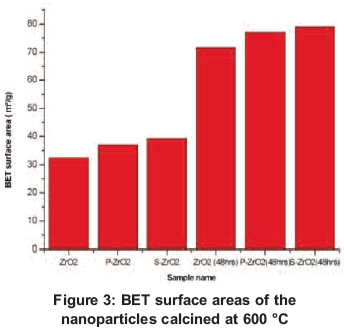
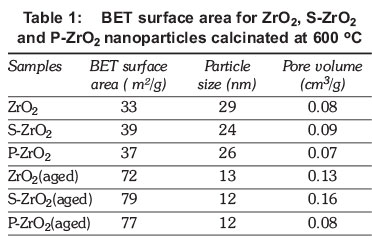
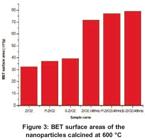
Zirconia nanoparticles were prepared by the precipitation and ageing methods. The precipitation method was performed by adding ammonium solution to the aqueous solution of zirconium chloride at room temperature. The ageing method was performed by leaving the precipitate formed in the mother liquor in the glass beaker for 48 hours at ambient temperatures. The nanoparticles from both methods were further sulphated and phosphated to increase their acid sites. The materials prepared were characterised by X-ray diffraction (XRD), ther-mo-gravimetric analysis (TGA), Brunauer-Emmett-Teller (BET), transmission electron microscopy (TEM) and scanning electron microscopy (SEM) methods. The XRD results showed that the nanoparticles prepared by the precipitation method contained mixed phases of tetragonal and monoclinic phases, whereas the nanoparticles prepared by ageing method had only tetragonal phase. The TEM results showed that phosphated and sulphated zirconia nanoparticles obtained from the ageing method had a smaller particle size (10-12 nm) than the nanoparticles of approximately 25-30 nm prepared by precipitation only. The BET results showed that the ZrO2nanoparticles surface area increased from 32 to 72 m2/g when aged.
nanoparticles; precipitation; zirconium oxide; aging; monoclinic; tetragonal; phosphated zirconia; sulphated zirconia; pore volume; pore diameter
 Thumbnail
 Thumbnail