Investigating diffuse irradiance variation under different cloud conditions in Durban, using k-means clustering
Abstract
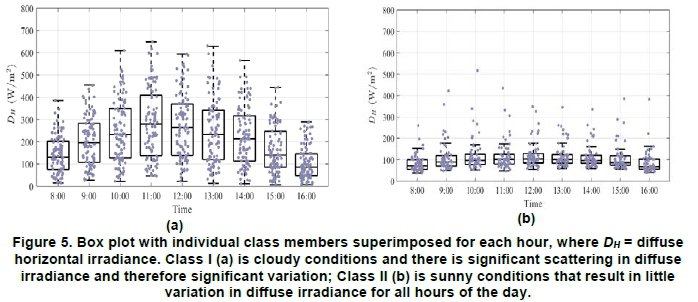
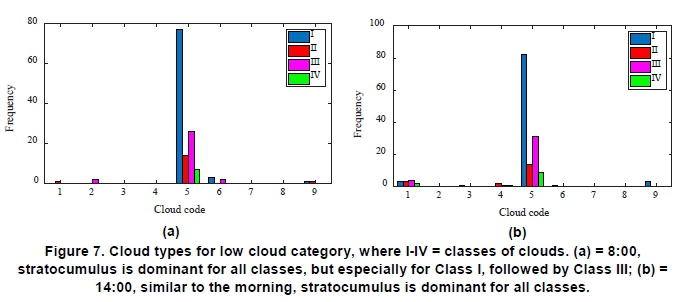
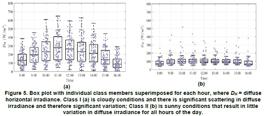
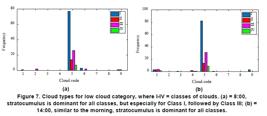
Diffuse irradiance is important for the operation of solar-powered devices such as photovoltaics, so it is important to analyse its behaviour under different sky conditions. The primary cause of short-term irradiance variability is clouds. One approach to analyse the diffuse irradiance variation is to use cluster analysis to group together days experiencing similar cloud patterns. A study was carried out to examine the application of k-means clustering to daily cloud data in Durban, South Africa (29.87 °S; 30.98 °E), which revealed four distinct day-time cloud cover (CC) patterns classified as Class I, II, III and IV, corresponding to cloudy, sunny, or a combination of the two. Diffuse irradiance was then correlated with each of the classes to establish corresponding diurnal irradiance patterns and the associated temporal variation. Class I had highest diffuse irradiance variation, followed by Classes III, IV and II. To further investigate the local cloud dynamics, cloud types were also analysed for Classes I-IV. It was found that stratocumulus (low cloud category); altocumulus translucidus, castellanus and altocumulus (middle cloud category); and cirrus fibrates and spissatus (high cloud category), were the most frequently occurring cloud types within the different classes. This study contributes to the understanding of the diurnal diffuse irradiance patterns under the four most frequently occurring CC conditions in Durban. Overall, knowledge of these CC and associated diffuse irradiance patterns is useful for solar plant operators to manage plant output where, depending on the CC condition, the use of back-up devices may be increased or reduced accordingly. Highlights: • Diffuse irradiance variation is caused by cloud cover. • Clustering applied to cloud cover to find frequently occurring patterns. • There are benefits to analysing diffuse irradiance associated with cloud cover patterns. • Diffuse irradiance variation correlated with cloud type.
cloud cover patterns; stratocumulus; altocumulus; cirrus
 Thumbnail
 Thumbnail
 Thumbnail
 Thumbnail
 Thumbnail
 Thumbnail
 Thumbnail
 Thumbnail
 Thumbnail