Analysis and mitigation of greenhouse gases by replacing traditional energy with a hybrid energy system using battery optimisation
Abstract
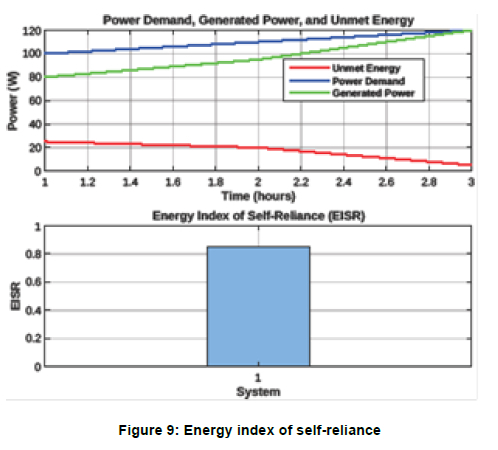
Greenhouse gases (GHGs) are the main cause of global warming. Reducing emissions would contribute to environmental sustainability and could also have economic advantages. GHGs can be reduced by using the hybrid energy system (HES). In developing countries, analysing energy transitions and unmet energy needs should focus on identifying strategies for transitioning to more sustainable energy systems while ensuring access for all. This study looks at the mitigation of GHG emissions by using clean HES energy with battery optimisation. The paper presents an improved Lyapunov optimisation (LO) algorithm to optimally estimate the number of photovoltaic panels and battery banks for enhanced energy management. To increase system efficiency, the losses of power and over-production and under-utilised energy have been considered. The stability analysis is evaluated using the LO algorithm, specifically focusing on the changes predicted by the energy index of the self-reliance report, optimising the system's performance under varying environmental conditions.
hybrid energy system; Lyapunov optimisation; photovoltaics; energy index of self-reliance
 Thumbnail
 Thumbnail
 Thumbnail
 Thumbnail
 Thumbnail
 Thumbnail
 Thumbnail
 Thumbnail
 Thumbnail
 Thumbnail