The effects of electricity load-shedding on the performance of small and medium enterprises in Pretoria, South Africa: A case study of Marabastad Business Community
Abstract
South Africa has been experiencing electricity load shedding for over sixteen years and this has affected the performance of small and medium enterprises (SMEs) across the country, with devastating effects recorded in the post-Covid-19 era. SMEs are key drivers of the economy and their performance has a great influence on it, as they contribute 36% of gross domestic product. This case study of the problem used the qualitative research method, with data collected through interviews. This study established that, in the area studied, there is a decline in the performance of the entrepreneurs and working hours have been drastically reduced due to load-shedding. Proposals are made of measures that the SME implementers and the government of South Africa can take in order to prevent the situation from further deteriorating.
SME implementer; production capacity; power consumption; electricity supply
1. Introduction
South Africa has experienced over 300 years of colonialism, and over 46 years of apartheid during which small and medium and enterprises (SMEs), particularly for the majority of the population, were not promoted (Ndabeni, 2014). In post-apartheid South Africa, SMEs are acknowledged for their significant role in achieveming objectives of a social (poverty alleviation), economic (employment creation, increased incomes, economic growth), and political (black economic empowerment) nature (Philip, 2001; Republic of South Africa, 1998). The promotion of the SME sector is a key element in the government's strategy for job creation and poverty eradication (Biepke, 2005). Rogerson (2011) has emphasised the important role played by SMEs in economic growth, job creation and poverty alleviation, especially in developing countries. In this regard, the South African government has put high priority on supporting SMEs (Garwe and Fatoki, 2012), which have been established as drivers for economic growth in most African countries. However, load-shedding has negatively affected the performance of the SMEs in South Africa.
The electricity utility, Eskom, was established in 1923 as the Electricity Supply Commission, through the Electricity Act No. 42 of 1992 (South Africa, 2006); its mandate is to efficiently, effectively and sustainably supply electricity to the people of the country, with the main intent to ensure that the present and future needs and interests of electricity customers and users are satisfied. Despite this mandate, Eskom has failed to meet the electricity needs of South Africa and has resorted to load-shedding. This came about as a result of Eskom not being able to adequately predict power consumption patterns of electricity users (both domestic and industrial) since the early 1980s (NVMyPower, 2015). Load-shedding is a last-resort measure by a power supply utility, whereby the strain placed on an electricity grid is reduced by means of temporarily halting its supply - purposely limiting electricity supply to users as a result of an over-demand (Eskom 2014; City of Cape Town, 2015). When demand for electricity outstrips supply, power utility companies tend to ration power supply to users in order to avoid overloading the electrical power systems, and this is what is commonly known as load-shedding, which is 'a premeditated power outage in some load zones when it is expected that the power supply cannot meet the demand' (Maqsood et al., 2018).
To put the problem of load-shedding (particularly) in better perspective, previous studies (Pretorius et al., 2015) showed that, over the years, Eskom has faced a mammoth challenge in that residential energy consumption increased by 50% between 2001 and 2007. As a result of the Free Basic Electricity Policy in 2001, electricity (50 kWh per month) is provided to poor households at no cost, with concomitant blocked or stepped tariffs for electricity consumption beyond 50kWh (South Africa, 2003. With the increase in power consumption, an average of 44.1% South Africans was classified as poor between 1996 and 2007 (Odimegwu and Kekovole, 2014) and the number of poor South African households between 2001 and 2007 increased to 51.3 % (South Africa, 2003). It is of no surprise, therefore, that the country has been experiencing an ongoing energy crisis since 2007.
The government has used SMEs as a means of empowering its citizens, hence the development of SMEs is the driving force behind black empowerment. The Broad Based Black Economic Empowerment (B-BBEE) programme is the fundamental policy for the development of SMEs in South Africa. One of its primary objectives is to improve the access of SMEs to resources (DTI, 2007). Juggernath et al. (2013), stated that B-BBEE creates provisions for SMEs to access various resources. However, the erratic supply of electricity and the current trends for long hours of power cuts, give rise to the need to investigate their effects on the performance of SMEs in a simple location.
2. Methodology
This study seeks to establish the effects of electricity load-shedding on the performance of SMEs in Marabastad, a business area in Pretoria, during the post-Covid-19 era. A mixed research method was used which employed both the qualitative and the quantitative methods. Qualitative research methods focus on discovering and understanding the experiences, perspectives, and thoughts of participants -that is, qualitative research explores meaning, purpose, or reality (Hiatt, 1986). The research is concerned with qualitative phenomena that relate to subjective assessments: attitudes, opinions and behavior. Qualitative researchers study things in their natural settings, attempting to make sense of, or interpret, phenomena in terms of the meanings people bring to them (Denzin and Lincoln, 2005). The foremost qualitative methods of data collection and analysis in business studies are interviews, focus groups, observation, case studies, games and role-playing (Rensburg 2010). The quantitative method involved the use of questionnaires to solicit information based on the findings of the qualitative data.
The qualitative research for this study involved in-depth interviews in order to develop a practical understanding of the strategic policies and how they impact on SME performance. In such in-depth interviews, the researcher looks for answers which tap deeply into the respondents' experiences, feelings and opinions (Lee, 2007). Participants for the qualitative study were invited for interviews through phone-calls and emails, and one-on-one interviews were held. The researcher assured, in writing before participation, respondents and informants of their anonymity and the confidentiality of the data they provided.
The structured interviews were used to collect qualitative data from 20 people running businesses in Marabastad. The number was based on the recommendations of Mason (2010) who stated that for bigger populations a minimum sample of 15 participants and a maximum of 50 would be suitable for data analysis and generalizing the results. The non-probability method was used in the study because it provided the researcher with data from the experienced implementers who were knowledgeable about SME operations in the area. The selected group had hands-on experience with the SME sector and its operations. It allowed the researcher to identify and select participants who were able to articulate the SME issues and how load-shedding had affected their operations. The interviews were recorded using an audio media recording machine, the recordings transcribed and an analysis made to develop themes using the NVIVO software package version 10. It is important to note that during the course of the interviews the participants freely expressed themselves and solely their views and opinions were used for the research. The themes that were established in the qualitative data were used to develop questionnaires which were distributed to 150 participants and 74 completed questionnaires were returned.
3. Research profile
The research was conducted in the Marabastad business area in Pretoria, South Africa in 2023, targeting SMEs registered with Tshwane Municipality. The sample, as proposed by Dooley (1990), is a representative group. As described aboved, the recommendations of Mason (2010) were followed, and 20 participants were interviewed, two each from the sectors operating in Marabastad.
The non-probability method was selected because it provided the researcher with data from the implementers, who have been operating for more than five years. The implementers had hands-on experience with the SME sector and its operations. It allowed the researcher to identify and select participants who were able to articulate the SME issues at implementation level. The respondents were knowledgeable of the trends in the power supply systems since they have been operating in the Mabastad business community for more than five years. The interviews brought up three main themes: power supply, production capacity, and alternative sources of power. These were discussed, and assisted in allowing the developing the strategies that the government can employ in order to improve the performance of SMEs under load-shedding.
The interview guide was used as a data collection instrument to guide the researcher in handling discussions and interviews. Leading questions helped the interviewer to remain focused. An interview guide with short questions facilitated a detailed soliciting of data. It provided a quick recall of the interview process that comes out automatically, as it had been practiced (Lee, 2007). The guide was written on a single page, as a big document would waste time for the interview when flicking through the several pages and reading from the list. The researcher rehearsed the whole process several times through pilot trials, in order to check on the applicability of the interview guidelines.
The interview guide questions were as follows:
1. Describe in your own words the changes you have experienced in power supply after the Covid-19 period
2. Has the power supply been consistent?
3. If not, when did you start to have serous interruptions of power supply?
4. How is the load-shedding affecting your production capacity?
5. How do you rate your performance since the introduction of load-shedding?
6. Before load-shedding how many hours were you working per day?
7. With the current situation, how many hours are you working per day?
8. What other alternative sources of power have you used to deal with the effects of load-shedding?
9. Has the government assisted you to deal with the load-shedding effects?
10. In your opinion, what could the government do to improve the power supply?
11. What are the new strategies that can be employed to improve the power supply for you to work your normal hours?
The consent of the participants was sought on the use of the recording instruments and if participants did not agree, detailed notes were written down and a narrative report was produced soon after the interview.
The inclusion of Sustainable Development Goal number seven (SDG 7) to the sustainable development agenda is a clear indicator of global leaders' recognition of energy as one of the cornerstones of sustainable development (Bwalya, 2021). The first target of SDG 7 is ensuring universal access to affordable, reliable, sustainable and modern energy services by 2030 and it has also been established that universal access to energy, particularly electricity, is key to achieving the other 16 SDGs (World Bank, 2017). This noble goal calls for the commitment of each country to supply power in all the spheres of life including industries, retail outlets and households.
Okapar and Kabonga (2009) stated that infrastructure factors such as power supply and access roads were major factors of production. The research by Sharmilee and Muhammad (2016) indicated that the SME owners/managers see power supply and telecommunication infrastructure as main factors affecting business performance. A sufficiently functioning infrastructure in terms of providing services, such as power, is another factor that contributes to SME growth and the role of services such as electricity, transportation, and water sanitation are critical in a country's development and are directly linked to small business success and economic growth (Okpara and Kabongo, 2009). Sharmilee and Muhammad (2016) established that in the KwaZulu-Natal province more than 70% of SMEs find that power supply is affecting their performance. This means that success and economic growth is affected, because the province struggles with the power supply. The situation defines the challenges that the entire sector is facing, since the country has been badly affected by a series of load shedding programmes.
Many countries in Africa have a deficit in the supply of electricity, for example, South Africa (Mashego, 2013:5), Zimbabwe (African Development Bank, 2011; NECF, 2015; ZIMASSET, 2013), and Nigeria (Adebola, Talabi and Lamidi, 2012; Foster and Pushak, 2011), and this tends to limit their destination brand equity. "Modern energy services are central to the economic development of a country and to the welfare of its citizens" (World Bank, 2016:14). Load-shedding in Zambia started in June 2015. It was mainly caused by a drought during the 2014/2015 rainy season (Mulongotie-tal.,2016). Over 80% of Zambia's electric power comes from hydro stations (National Energy Policy, 2019), and the low rainfall led to the low generation of electric power at the two major hydro stations, Kariba North Bank and Kafue Gorge. This in turn, led to most households in the country, especially in low-income residential areas, to experience about eight hours of load-shedding every day. Kitwe residents were among the worst hit: they had three daily schedules, 06:00 to 14:00, 14:00 to 22:00, and 22:00 to 06:00, effected in different residential areas at different times.
In South Africa, two disconnected and parallel economies have historically existed in the rainbow nation. They are characterized by an ever-widening economic gap. On the one hand, there are entrepreneurs engaged in formal businesses who are fully equipped to understand and engage the mechanisms of the market, including competence-building, and technological innovations. On the other hand, there are the survivalist entrepreneurs, mostly from poor and disadvantaged communities who have had no access to markets and are therefore ill-equipped to establish employment-creating opportunities through their SMEs (Ndabeni, 2014). Blacks were meant to provide labour to the white business establishments and, consequently, the policy framework was geared towards the promotion of large enterprises, often leaving SMEs at a disadvantage (Biepke, 2005). It was only after 1994 following South Africa's democratic dispensation, that SME promotion was encouraged, notably through public policy initiatives. In particular, the government acknowledges the potential impact of SMEs on poverty reduction and job creation, as well as their general impact on the national economy (Ndabeni, 2014). This potential of the SMEs to improve the economy of the country led the government to provide resources to support the SME sector.
A strong SME sector contributes greatly to the country's economy, contributing to the gross domestic product (GDP) by reducing the levels of unemployment and poverty, and promoting entrepreneurship activity (Ndabeni, 2014). The role of SMEs in the development of the country is significant (Bayati and Taghavi, 2007). The African economic giants, such as South Africa, Egypt, Nigeria and Kenya, have SME sectors contributing to over 70% in employment, with a 30-40% contribution to GDP (Munyanyiwa 2009). In South Africa, SMEs contribute 56% of private sector employment and 36% of GDP (Ntsika Enterprise Promotion Agency, 2002). Besides assisting in curbing the high level of unemployment, SMEs can be used as a means of transforming the country, by redistributing the productive assets amongst the previously disadvantaged (Ndabeni, 2014). In this regard, any disturbance in the production process of the SMEs will negatively affect their contribution to economic growth.
South Africa is officially estimated to have approximately 33.4% of the economically active population unemployed (Statistics South Africa, 2023). One of the best ways to address unemployment is to leverage the employment creation potential of small businesses and to promote small business development (FinMark Trust, 2006). The National Small Business Act of South Africa of 1996, as amended in 2003, describes an SME as a separate and distinct entity, including cooperative enterprises and nongovernmental organisations managed by one owner or more, including its branches or subsidiaries, if any, in any sector or sub-sector of the economy (Fatoki, 2010).
Apart from the growing number of poor households in South Africa, another factor which directly contributes to the over-demand of electricity is illegal electricity connections, which claim the lives of many as well as causing power outages (Ashley et. al., 2016). This conclusion is supported by a research study done by Pule (2014), which found that most illegal electricity connections were extremely dangerous and often resulted in serious injury (or even death), as well as the overloading of the electricity grid. Eskom and the government have failed to provide permanent solutions to stop the illegal connections, hence all the end-users of electricity are negatively affected by insufficient power reaching all stakeholders.
One of the limitations in maintaining consistent power supply is electricity theft. Eskom and the municipalities lose at least R20 billion annually from electricity theft (Eskom News, 2020). Electricity theft leads to economic losses and threatens the survival of the utility company (Depuruetl, 2017). Former president of South Africa, Jacob Zuma, while in office, said that electricity theft affects each and every South African and it is detrimental to the economy of the nation and in the long term could contribute to job losses in the country (SA News, 2019). South African government must invest in the national grid to help the electricity utility company in addressing the problem of electricity theft. The national grid deployment would also help in generation diversification, conservation of energy, reduction in carbon emission, higher reliability, optimal usage of existing power infrastructure, self-healing, security and demand response (Farhangietl, 2019)
The New Household Electrification Strategy (NHES) was launched in 2014 in order to address the power challenges. The policy adopted the following focus areas to address the challenges (Department of Energy South Africa, 2014):
• Achieve universal energy access by 2025, defined as 97% household electrification.
• Only 90% of new houses will utilise the national grid, while the rest will be electrified with high-quality off-grid SHSs. With 50 to 100 Wp standalone, SHS is recommended for off-grid electrification.
• A well-crafted approach to enhance efficient execution of projects.
• Consolidate and develop proposed delivery targets in line with other national development goals.
Off-grid electrification would be used in areas far away from the grid and considered low-investment regions due to the high cost of extending transmission network, poor accessibility, low population density and dispersed house settings (Eskom, 2019).
One area that has been heavily affected by loadshedding is the hospitality industry. Ashley et al. (2016) stated that load-shedding has had an adverse influence on businesses in the hospitality industry, including the following: (The Capital Hotel School and Training Academy, 2015; Von Ulmenstein, 2014).
• Electric door locks cannot be programmed to allow key cards access to hotels.
• Slow response from emergency services if guests are trapped in elevators.
• The stifling of the supply of cold and frozen food.
• The depletion of backup batteries of fire systems.
• The halting of fire system operations.
The stated effects of load-shedding were further elaborated by Muirhear (2014) as cited by Ashley et al,, (2016) who stated that load-shedding has high effects on production, as the vast majority of these businesses do not have any type of secondary power-generating device and/or back-up facility. It means that under such conditions, the hospitality industry will underperform, as it deals with clients from different cultures, traditions, continents and religious affiliations who require first class services and getting value for their money. The SMEs operating in the hospitality industry have been largely affected by load-shedding, as their operating standards have been lowered by the current power supply trends (Von Ulmenstein, 2014).
Besides the hospitality industry, load-shedding can also affect the income-generating activities of households, though, for instance, reduced revenue and increased operating costs for retailers (Goldberg, 2015). This has significant indirect effects on households dependent on such businesses for their livelihood (Bwalya, 2021). Load-shedding in South Africa therefore produces a ripple negative effect and it is a cause of concern on the performance of the SMEs.
Low-income residential areas have little or no choice of energy alternatives and are thus more adversely affected by load-shedding (Musademba et al., 2012). Most residents of low-income areas run SMEs from their residential or small business premises, a significant proportion of which are dependent on pre-paid electricity supplied through the national grid (Goldberg, 2015). Disruptions in electricity supply are thus likely to affect their income earning abilities to a greater extent than residents of high-income areas that are more likely to be formally employed by companies located in business districts (Bwalya, 2021). Thus, socio-spatial segregation with respect to load-shedding could increase urban inequalities (Aidoo, 2015).
5. Results presentation, analysis, interpretation of data and discussion
The qualitative data was collected from 20 respondents selected from a group of experienced SME implementers in the fields of retailing, stationery sales, butcheries, vegetable sales, photocopying, hair dressing, manufacturing, information technology, photocopying and printing, retail and wholesale activities, and food sales. They own the SMEs and have been in the trade for more than five years. They were knowledgeable of the SME operations in the area and the power supply trends, especially in the post-Covid-19 era which forms the time line for the study. Table 1 shows the views on trends in power supply of the twenty respondents. To uphold anonymity of the interview participants, they were numbered from K0 up to K20.
The respondents indicated that they have been experiencing continuous power shortages and the working hours have been drastically reduced. The female respondent K07 who owns a food outlet elaborated her experiences of power supply shortages:
Since we have come out of lockdown the power supply has not been consistent at all. In some days we get power for less than four hours and on some days for a little bit longer but the power supply cannot be determined. There is no proper schedule of how many hours we are going to get power for the day or week. Anything can happen and this has affected our planning. We cannot project anything in our business because we don't know what will happen tomorrow.
A male respondent, K02, who owns a small butchery expressed his disappointment about the power shortages:
I have reduced my stock because of uncontrolled load shedding. My business is not making any profits and I am struggling to break even because of the power cuts. If the situation remains like what it is right now, I will soon close the shop unless there is an alternative power source. I am worried about the inconsistency in power supply, and we spend most of the time seated because of the power shortages. I have switched off some of the refrigerators because the power we are getting cannot supply all the equipment that I have here.
The respondents indicated that the post-Covid-19 era has seen a drastic reduction in the power supply and there is no proper schedule being followed on load-shedding and this affects planning of any programmes. They further stated that load-shedding is now a random process and the authorities do not follow the schedule that they send to the consumers. This observation has been rated by the respondents as the major contributor to the low production amongst the SME implementers. The interviewees indicated that some essential products for people's survival have disappeared from the shelf because of the uncontrolled load-shedding, which has become the new normal. The reduction of the power supply hours means that business hours have been reduced and this in turn has had a ripple negative effect on the whole business process, leading to less production and less profits.
Gehringer, Rode, and Schomaker (2018) stated that South Africa faced repeated episodes of temporary power shutdowns, or load-shedding. Loadshedding is an intervention of last resort when power demand exceeds supply, and times and areas affected by load-shedding should be communicated by Eskom to the public at short notice, for example via schedules published on Twitter and various dedicated homepages. However, the biggest challenge, as stated by the SME implementers, is that Eskom is not following the given schedule and the consumers cannot plan their work and their function has been greatly affected. The implementers complained about this practice and called for an improvement in the provision of such essential services.
The World Bank (2017) noted that the main challenges in the expansion of the grid-based electrification and access are; the lack of sufficient generation capacity, poor transmission and distribution infrastructure, low tariffs charged by electricity companies on advice of the government, the high costs of supply to rural and remote areas, the inability of low-income households to pay high connection charges, and the weak financial state of the utilities. These are some of the challenges that the government must address as early as possible and come up with new strategies on how to provide alternative sources of power to the SME implementers who are struggling to break even in their businesses. Table 2 shows views of the respondents on the production capacity of SMEs during the post-Covid-19 period.
The respondents indicated that, since the implementation of load-shedding, their production has gone down and they are operating below their usual output levels. The female respondent K14, who owns a vegetable shop, elaborated her experiences of power supply shortages:
The performance of my business in the last six months for example, has gone down because of the power cuts that were introduced. I no longer meet my daily targets and the production levels vary from day to day and the customers no longer have any confidence in my work. The way we are working nowadays is unpredictable and my performance in business is disappointing and at times it appears as if I am just wasting time, but I have no alternative way of getting money. The government has failed us.
Male respondent K12, who owns a photocopying and printing shop, expressed his disappointment about the power shortages:
I have been earning a living through photocopying and printing of documents for over eight years but what is happening now in terms of power supply has destroyed my business. I have been relying on the power from Eskom but now it has turned to be a nightmare because it is no longer reliable. My business is not making any profits at all and I am struggling to break even because of the power cuts. If the situation remains like what it is right now, I will soon close the shop unless there is an alternative power source. I am worried about the inconsistency in power supply, and we spend most of the time seated because of the power shortages. I have switched off some of the refrigerators because the power we are getting cannot power all the equipment that I have here.
Another male respondent, K17, who owns a chicken products and sausages shop, expressed his disappointment about the power shortages:
My refrigerator has been damaged by the power outages and the motor that was affected by continuous power cuts which are uncontrolled is expensive to repair. I am not even sure if I am going to work and raise money for the new motor. The power cut issue has caused more harm than merely shortage of power. To make matters worse most of our appliances are not insured because we are afraid of the extra costs and now its biting us.
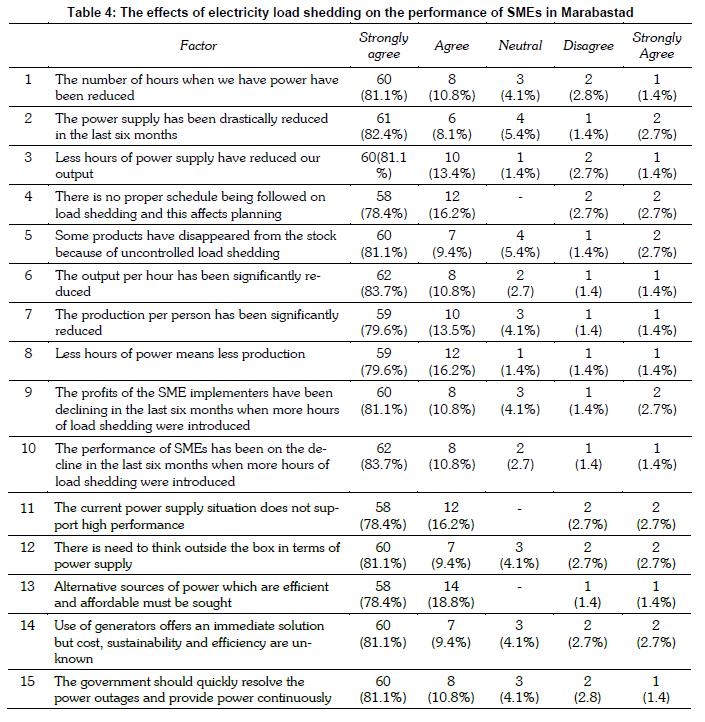
The respondents were asked to indicate their observations on the current trends of the power supply and they all concurred that the power supply is now erratic and it comes without any predictable pattern. The interviewees indicated that the production per person has been significantly reduced and the performance of SMEs has been on the decline, hence profits of the SME implementers have been going down. The conclusion that can be drawn from the data collected is that a significant number of respondents indicated that the output per hour has been significantly reduced because of the continuous power cuts.
The results of the current research concur with the study by Sharmilee and Muhammad (2016), who established that in KwaZulu-Natal more than 70% of SMEs find that power supply is affecting their performance. These sentiments were also echoed by Okpara and Kabongo (2009) who observed that:
A sufficiently functioning infrastructure in terms of providing services, such as power, is another factor that contributes to SME growth and the role of services such as electricity, transportation, and water sanitation are critical in a country's development and are directly linked to small business success and economic growth.
The respondents indicated that the abrupt power cuts have damaged their equipment, an effect noted by World Bank (2017:72), which pointed out that electricity outages may have severe impacts on companies because they can damage assets (such as electronics) and inventory and disrupt work by shutting down equipment and cutting off lighting, heating or internet connections. Energy is an anchor for every country's economic growth (Bilgili and Ozturk, 2015; Tembo et al., 2015). These sentiments indicate that the power supply must always be made available for the SMEs to maintain consistent production levels. In principle, power utility companies expand their electricity generation and supply capacity to meet increasing demand from commercial and domestic users. However, in developing countries, power utility companies, which are mostly parastatals, fail to expand their generation and supply infrastructure fast enough to meet the burgeoning energy demand.
The respondents suggested some alternative measures that the government and local authorities could undertake to mitigate the effects of load-shedding. The female respondent K18, who owns a bakery, said
The government should provide alternative sources of power in order to augment the Eskom power because it is failing to provide enough power. A lot of research and development of new sources of power must be done. The government should invest more money in the field of alternative power supply to meet the great demands of power and new technologies. The government must seriously consider different possibilities of meeting the escalating demand of power in various activities ranging from the households, small industries to large industries that demands high voltage of power.
Male respondent K06, who owns a hardware shop, expressed his disappointment about the power shortages:
I have been operating a hardware for quite some time and my shop depends on the lights and air conditioning since the building has no windows. I cannot open it if there is no power and the continuous load shedding has reduced my working hours. Eskom has let me down and this pattern of power supply will see me closing down the business. I wish I had an alternative source of power, but I cannot afford a generator nor a solar system. I remain hopeful that the government will soon interven and brig other sources of energy. If nothing is done our families will be wiped out by hunger and poverty.
The respondents lamented the effects of the current situation in terms of power supply. The results show that they are keen to see the government providing alternative sources of energy so that the production process is not interrupted. The interviewees advocated for all stakeholders to put their heads together and think outside the box in terms of sourcing the alternative sources of power supply. Some notable features to the responses given by the interviewees were that alternative sources of power which are efficient and affordable must be sought and unveiled to the SME implementers. The respondents further explained that the best approach that the government can use is to consult all the stakeholders involved in the business processes including the implementers, Eskom and other possible service providers who can bring solutions to the power problems.
The responses from the interviews were used to develop questionnaires and 150 questionnaires were distributed to the larger group of implementers and 74 questionnaires were returned. The views of the respondents are summarized in Table 4.
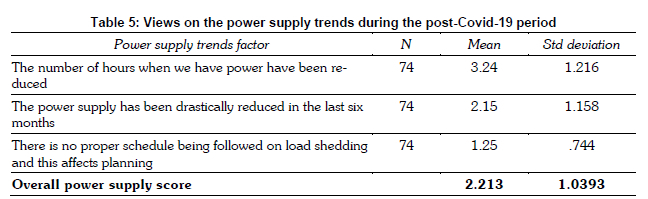
As can be seen in Table 5, the highest mean score is 3.24, which reveals that the respondents indicated that the number of hours when they have power have been drastically reduced, with a variability in the response spread on this notion at standard deviation of 1.216. The lowest mean score is 1.25 which indicates that the respondents strongly agree that there is no proper schedule being followed on load shedding and this affects planning with a slight response variability of 0.744. The overall mean score is 2.213, which means that, generally, the 74 respondents agree that less hours of power supply have reduced their output. Essentially, these statistics concur with the views expressed by the interviewees that the load shedding has reduced the production output of most SME operators.
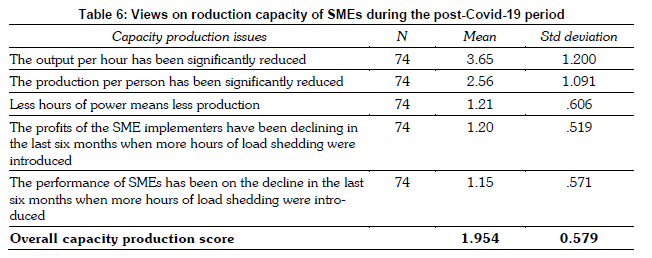
Table 6 shows that the highest mean score is 3.65 with a standard deviation of 1.200. The mean score (3.65) signifies that the respondents agreed that output per hour has been significantly reduced The lowest mean score is 1.15, indicating that the respondents strongly agreed that the performance of SMEs has been on the decline in the last six months when more hours of load shedding were introduced, with a slight response variability at 0.571. The overall mean score on overall capacity production is 1.954, showing that, generally, the respondents felt hat the performance of SMEs has been on the decline in the last six months when more hours of load shedding were introduced. The statistics shed light on the general decline in production by the SMEs as revealed by the 74 SME respondents in this study.
The mean scores outlined above clearly indicate that the respondents either agreed or strongly agreed with the three dimensions expected of government to provide alternative sources of power.
This further emphasises the earlier findings from the interviews, which suggest that the government is viewed as inefficient in providing alternative sources of energy. The results suggest that the government should be proactive and supply alternative sources of power to the SME operators in order to improve on their performance.
The reviewed literature provides examples of governments that have supported the SME sector and high performing SMEs were developed. According to the World Bank (2016), getting electricity is a key competitiveness issue. Universal access to affordable, reliable, and modern energy services, especially electricity, is critical to sustainable development (World Bank, 2016:14). This implies that the government of South Africa needs to revisit the loadshedding schedule and find alternative sources of energy so that the implementers will have enough supply of energy for their day-to-day use. Other authorities have stated that economies rely on electricity supplies that are free from interruptions and shortages so that businesses and factories can work unimpeded (African Development Bank, 2011). All stakeholders in the power supply need to put their heads together and address the current power shortages because if the current trends continue, businesses and factories are going to be negatively affected and low production will be experienced.
The government needs to take cognizance of the fact that, as economies grow, the demand for electrical energy concomitantly increases with rising population, industrialisation, and income (Tabary and Purdie, 2016; Peterson, 2017; Umar and Kunda-Wamuwi, 2019). The challenge of power supply has been felt across the sub-Saharan region. On a global scale, developed countries have generally enjoyed a high degree of electricity supply security due to substantive investment in electricity generation capacity. On the other hand, only about a third of the households in sub-Saharan Africa have access to electricity and up to 80% of the population depends on biomass for cooking (Gujba et al., 2012). The government needs to engage in serious research studies on how it can improve and increase the power supply so that it can meet the high demands of electricity by consumers, especially those in the SME sector whose performance has dropped due to insufficient power supply.
The liiterature indicates that the insufficient power supply that has been experienced in South Africa is due to its inability to satisfy the power demand (because of loss of power generation), and in order to prevent uncontrolled blackouts, the monopoly power supplier Eskom implemented the practice of rotational load-shedding, for several hours a day in most of the country (Gehringer, Rode and Scho-maker, 2018). The monopoly of Eskom must be stopped by the government, and it should invite more service providers to compete with Eskom and improve power supply. The provision of electricity to the South African community must be liberalised, allowing any competent institution to provide power.
Eskom mainly generates electricity through means of coal-powered electricity supply units and nuclear electricity supply units, and it has 10 coal-powered stations. In South Africa, coal accounts for approximately 80% of commercial power production (Eskom, 2016). There is a need for the country to diversify and meet the local needs of power. Coal, oil, biofuel, geothermal and nuclear plants function through the use of a steam-operated turbine operating on what is called the Rankine cycle; these power stations account for more than 79% of electricity generation worldwide (Woodruff et al. 2005). This is the route the government of South Africa should consider following to produce more power for the ever-increasing demand for electricity.
6. Conclusion
The data collected indicated that the interviewees are experiencing high levels of power shortages, and the load shedding process does not follow any definite schedule. The respondents have shown that their daily operations have been negatively affected by the load shedding process. The researcher has drawn three conclusions on the effects of the uncontrolled load shedding processt Firstly, the SME implementers have been forced to lower their production processes and hence their performance is on the decline. The SME sector is no longer as viable as it was during the time of adequate power supply. Secondly, most of the SME implementers cannot afford to supplement the power shortages using their own resources because of the large sum of money required to procure other sources of power like the solar system or high voltage generators. This shortcoming has left the implementer hoping to get assistance from the government which is not taking any action to address the problem. Thirdly, the government on the other hand, is not showing any signs that it is taking corrective measures to improve the power supply. The SME implementers are not aware if the government is taking any action to improve the power supply since it is not communicating with the operators on the ground. This scenario is worrisome to the SME implementers, since their lives depend on their business operations yet the government is in total silence on how it is addressing the crisis at hand.
7. Recommendations
For SMEs to remain viable and contribute towards improved performance, job creation and poverty alleviation, it is recommended that the government of South Africa come up with clear strategies on how it is going to meet the power demands of the nation. This must be done through a rigorous consultative process of all the stakeholders, increasing the output on the grid, trying out new power supplies sources and engage in research and development activities in order to explore the possible new sources of power. The government should provide loans to the SME operators so that they can procure alternative sources of power. The president of the Republic of South Africa showed some commitments to address the power problem by appointing a minister responsible for power supply, but this alone is not enough since the load shedding is a serious national crisis, it requires more attention from the decision makers. The researcher recommends that the government should take a more serious approach and treat load shedding as a national disaster and supply the SME implementers with sufficient power to help them grow their businesses.
References
4. Literature review
- Adebola, O.I., Talabi, F.O. and Lamidi, I.K. (2012). Rebranding Nigeria: the role of advertising and public relations at correcting Nigeria image. Educational Research, 3(5): 424-428.
- African Development Bank (2011). Infrastructure and growth in Zimbabwe: an action plan for sustained strong economic growth. Tunis.
-
Aidoo, K. (2015). Scientific Dumsor report: See which areas enjoy or suffer most. http://www.todaygh.com/scientific-dumsor-report-see-which-areas-enjoy-or-suffer-most/. Accessed 25 January 2018.
» http://www.todaygh.com/scientific-dumsor-report-see-which-areas-enjoy-or-suffer-most/ - Ashley, A., Steenkamp, and Henriette, V. (2016). The influence of load shedding on the productivity of hotel staff in Cape Town, South Africa. In: Expert Journal of Business and Management 4 (2), 69 - 77.
- Bayati, A., and Taghavi, A. (2007). The impacts of acquiring ISO 9000 certification on the performance of SMEs in Tehran. TQM Magazine, 19(2), 140-149.
- Biekpe, N. (2005). Financing small businesses in sub-Saharan Africa: Review of some key credit lending models and impact of venture capital provision. Journal of African Business, 5(1), 29-44.
- Bilgili, F and Ozturk, I. (2015). Biomass energy and economic growth nexus in G7 countries: Evidence from dynamic panel data. Renewable and Sustainable Energy Reviews, 49, 132-8.
-
Bwalya, B. U., Chisola, Mushili, M., Kunda-Wamuwi, B/ M., Kafwamba, F.C., Membele, G.D. and Imasiku, E.N.S. (2021). Load-shedding in Kitwe, Zambia: Effects and implications on household and local economies, Development Southern Africa, DOI: 10.1080/0376835X.2020.Issue No.1870934
» https://doi.org/10.1080/0376835X.2020 -
City of Cape Town (2015). What is load shedding? [Online]. Available from: www.capetown.gov.za/en/electricity/pages/loadshedding-explained.aspx [Accessed on 20/09/2015].
» www.capetown.gov.za/en/electricity/pages/loadshedding-explained.aspx - Department of Trade and Industry (2007). South Africa's Economic Transformation: A strategy for Broad-Based Black
-
Economic Empowerment. Department of Trade and Industry. Pretoria ww.info.gov.za/otherdocs/2003/dtistat.pdf.
» ww.info.gov.za/otherdocs/2003/dtistat.pdf - Dooley, D. (1990). Social Research Methods. London, Prentice Hall.
- Ebohon, O. J, (1996). Energy, economic growth and causality in developing countries: A case study of Tanzania and Nigeria. Energy Policy, 24, 447-53.
-
Eskom, (2014). What is load shedding. [Online]. Available from: http://loadshedding.ESCOM.co.za/loadshedding/description [Accessed on 20/09/2015].
» http://loadshedding.ESCOM.co.za/loadshedding/description -
Eskom News, (2020). Anti-electricity theft campaign steadily making progress, [Online]. Available: http://www.eskom.co.za/news/Pages/Sep2B.aspx. [Accessed: 11- Mar-2020].
» http://www.eskom.co.za/news/Pages/Sep2B.aspx. - Farhangi, H. (2019). The path of the smart grid, IEEE power energy Mag., vol. 8, no. 1, 2019.
- Fatoki, O. O. (2010). Graduate entrepreneurial intention in South Africa: Motivations and obstacles. International journal of business and management, 5(9), 87.
-
Fatoki, O. and Garwe, D. (2012). Obstacles to the growth of new SMEs in South Africa: a principal component analysis approach. [Online] Available: http://www.academicjournals.org/AJBM/PDF/pdf2010/May/Olawale%20and%20Garwe.pdf [Accessed: May 18, 2015].
» http://www.academicjournals.org/AJBM/PDF/pdf2010/May/Olawale%20and%20Garwe.pdf -
FinMark Trust. (2006). FinScope Small Business Survey Report [online]. Available: http://www.finmarktrust.org.za [Accessed: 15 November, 2009].
» http://www.finmarktrust.org.za - Foster, V. and Pushak, N. (2011). Nigeria's infrastructure : a continental perspective. Africa Infrastructure country diagnostic, Country Report, Washington, DC: World Bank
-
Gehringer, C., Rode, H., and Schomaker, M. (2018). The Effect of Electrical Load Shedding on Pediatric Hospital Admissions in South Africa. Epidemiology. 2018 Nov;29(6):841-847. doi: 10.1097/EDE.0000000000000905. PMID: 30063542; PMCID: PMC6167164.
» https://doi.org/10.1097/EDE.0000000000000905 - Goldberg, A. (2015). The economic impact of load shedding: The case of South African retailers Gordon Institute of Business Science, University of Pretoria.
- Hiatt, J. F. (1986). Spirituality, medicine, and healing. Southern Medical Journal, 79, 736-743.
- Denzin, N. K., and Lincoln, Y. S. (2005). Introduction. In N. K. Denzin and Y. S. Lincoln (Eds.), The SAGE handbook of qualitative research (3rd ed., pp. 1-29). Thousand Oaks, CA: Sage.
- Depuru, L., Wang, T., and Devabhaktuni, V. (2017). Electricity theft: Overview, issues, prevention and a smart meter-based approach to control theft, Energy Policy, vol. 39, no. 2, pp. 1007-1015, 2017.
-
Eskom. (2013). Power Stations and Pumped Storage Schemes [Online]. Available from: http://www.eskom.co.za/Whatweredoing/ElectricityGeneration/PowerStations/Pages/Power_Stations_And_Pumped_Storage_Schemes.aspx [Accessed on 15/05/2016]
» http://www.eskom.co.za/Whatweredoing/ElectricityGeneration/PowerStations/Pages/Power_Stations_And_Pumped_Storage_Schemes.aspx - Gujba, H., Thorne, S., Mulugetta, Y., Rai, K., and Sokona, Y. (2012). Financing low carbon energy access in Africa. Energy Policy, 47, 71-78.
- Jiang, R., Lu, Y., Wang, J., Luo, C., and Shen, P. (2018) Energy theft detection issues for advanced metering infra-structure in smart grid, Tsinghua Sci. Technol., vol. 19, no. 2, pp. 105-120, 2018
- Juggernath, S., Rampersad, R., and Reddy, K. (2013). Corporate responsibility for socioeconomic transformation: A focus on broad-based black economic empowerment and its implementation in South Africa. African Journal of Business Management, 5(20), 8224-8234.
- Lee, N. (2008). Doing Business Research. A guide to Theory and Practice. SAGE Publishing, Inc. Los Angeles.
- Maqsood, A., Zhang, Y., and Corzine, K. (2018). Optimal rotational load shedding via bilinear integer programming. In 2018 Asia-Pacific Signal and Information Processing Association Annual Summit and Conference (APSIPA ASC) (pp. 742-747). IEEE.
- Mashego, G. (2013). Investors lose confidence in SA markets. Sunday Times: 5, 1 Jul 2013.
- Mason, M. (2010). Sample size and saturation in PhD studies using qualitative interviews. In Forum qualitative Sozialforschung/Forum: qualitative social research, 11(3).1-19.
- Ministry of Energy. (2019). National Energy Policy. Ministry of Energy, Lusaka.
- Mulongoti, D, Mugala, G, Kumwenda, B and Louie, H, (2016). Determining the effects of load-shedding on residential electricity consumption using meter data - a case study of Kitwe, Zambia. 2016 IEEE Global Humanitarian Technology Conference (GHTC), IEEE, 488-494.
- Munyanyiwa T (2009). SMEs Key to Economic Growth, Recovery.
- Musademba, D, Kanyepe, M, Madiye, L and Hove, T, (2012). Effect of load shedding in Chinhoyi urban residential areas, Zimbabwe. International Journal of Energy Engineering 2, 232-41.
- National Economic Consultative Forum. (2015). Zimbabwe national competitiveness report 2015. Harare.
- Ndabeni, L. L. (2018). National systems of innovation and small enterprise development in South Africa. In The promise of small and medium enterprises (pp. 203-240). Routledge India.
-
Ntsika Enterprise Promotion Agency (2002). State and Small Business Development in South Africa Annual Rev. [Online] Available: http://www.ntsika.org.za [Accessed: 23 November 2009].
» http://www.ntsika.org.za -
NVMyPower. (2015). What is load shedding [Online]. Available from: http://nvmypower.co.za/load-shedding [Accessed 20/09/2015].
» http://nvmypower.co.za/load-shedding - Odimegwu, C. O., and Kekovole, J. (2014). Social Demography of South Africa: Advances and Emerging Issues (Illustrated ed.). Johannesburg: Taylor and Francis 2015.
- Okpara, J. O., and Kabongo, J. D. (2009). An empirical evaluation of barriers hindering the growth of small and medium sized enterprises (SMEs) in a developing economy. African Journal of Business and Economic Research, 4(1), 7-21.
- Peterson, E.W.F. (2017). The role of population in economic growth. SAGE Open 7, 2158244017736094.
- Pretorius, I., Piketh, S., Burger, R., and Noemangus, H. (2015). A perspective on South African coal fired power station emission. Journal of Energy in Southern Africa, 24(3), pp. 27-40.
-
Pule, A. (2014). Vuk'uzenzele. hike [Online]. Available from: Illegal electricity connections endangers lives: http://vukuzenzele.go.za/illegal-electricity-connections-endangers-lives [Accessed on 13/05/2016].
» http://vukuzenzele.go.za/illegal-electricity-connections-endangers-lives - Rensburg, J. (2010). Research in the social sciences. University of South Africa Muckleneuk, Pretoria.
- Rogerson, C.M. (2011). Growing the SMME manufacturing economy of South Africa: Evidence form the Guateng province. Journal of contemporary African studies. 19(2) pp267-289.
- Sharmilee, S and Muhammad, H. (2016). Factors affecting the performance of small and medium enterprises in Kwa-Zulu-Natal, South Africa Problems and Perspectives in Management, Volume 14, Issue 2, 2016.
- Sitharam, S., and Hoque, M. (2016). Factors affecting the performance of small and medium enterprises in KwaZulu-Natal, South Africa. Problems and perspectives in Management, 14(2), 277-288.
- South Africa. (2006). Electricity Regulations Act for Republic of South Africa. No. 4 of 2006. Government Gazette, 493 (28992), pp. 1-9.
-
Statistics South Africa. (2023). Quarterly Labour Force Survey: Second Quarter, April to June 2009. [On-line] Available: http://www.info.gov.za/speeches/2009/09072911151001.htm [Accessed 3 December 2023]
» http://www.info.gov.za/speeches/2009/09072911151001.htm -
Tabary, ME and Purdie, E. (2016). Sustainable development and the demand for energy. World Bank Blogs. https://blogs.worldbank.org/opendata/sustainable-development-and-demand-energy. The World Bank
» https://blogs.worldbank.org/opendata/sustainable-development-and-demand-energy - Tembo, T.S., Mulenga, P.B. and Sitko, N. (2015). Cooking fuel choice in urban Zambia: Implications on forest cover. Working Paper, No 94. Lusaka, Zambia. Indaba Agricultural Policy Research Institute (IAPRI).
-
The Capital Hotel School and Training Academy. (2015). 6 Real Problems Hotels Face During Load-shedding or Extended Blackouts [Online]. Available from: http://www.capitalhotelschool.co.za/blackouts/ [Accessed on 28/02/2015].
» http://www.capitalhotelschool.co.za/blackouts/ - Umar, B.B. and Kunda-Wamuwi, C.F, (2019). Socio-Economic effects of load shedding on poor urban households and small business enterprises in Lusaka, Zambia. Energy and Environment Research 9, 20-9.
-
Von Ulmenstein, C. (2014). Loadshedding impact on Tourism, says SA Tourism! [Online]. Available from: http://www.whalecottage.com/blog/cape-town/loadshedding-impacts-on-tourism-says-sa-tourism/ [Accessed on 13/05/2016]
» http://www.whalecottage.com/blog/cape-town/loadshedding-impacts-on-tourism-says-sa-tourism/ -
World Bank. (2016). World Bank Data. Available online at: http://data.worldbank.org/ (accessed on 10 March 2016).
» http://data.worldbank.org/ - World Bank. (2016). World development indicators: Featuring the sustainable development goals. Washington DC.
- World Bank. (2017). Doing business 2013. New York: The World Bank.
- Zimbabwe Agenda for Sustainable Socio-Economic Transformation. (2013). Zimbabwe agenda for sustainable socio-economic transformation: Towards an empowered society and a growing economy (October 2013 - December 2018). Zimbabwe